
The Ultimate Guide to Getting Your Project Management Certification in South Korea: All You Need to Know in 2026-2027
South Korea is one of the toughest places to be an average project manager because the market rewards speed, precision, stakeholder control, and technical fluency at the same time. A certification can help you enter or level up, yet the real advantage comes from choosing the credential that matches your industry, whether that means IT project management, Agile delivery, construction project management, healthcare project management, or international project management.
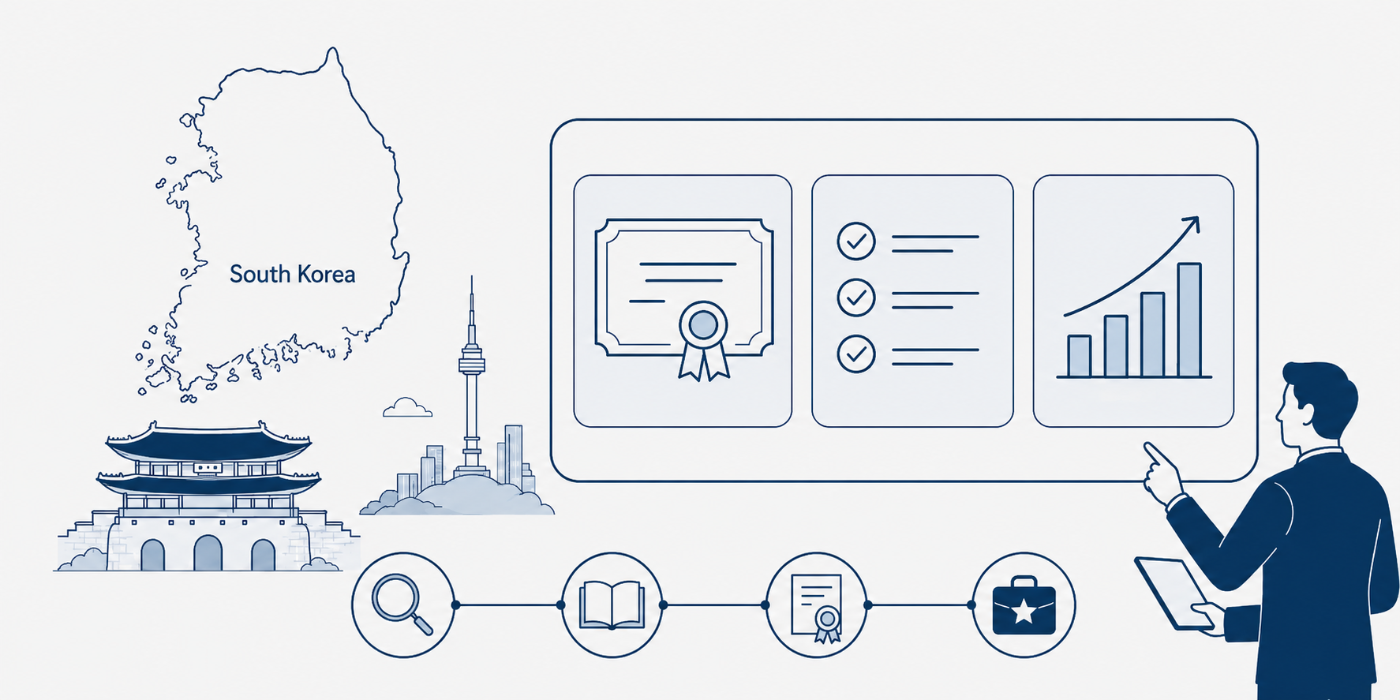
1. Why Project Management Certification Matters in South Korea in 2026-2027
South Korea’s project management market is shaped by technology, manufacturing, infrastructure, digital government, logistics, healthcare innovation, construction, semiconductors, AI, and global exports. That creates opportunity for certified PMs who can control delivery in high-pressure environments where timelines move fast and mistakes become expensive. A strong candidate needs more than a certificate name. Hiring teams want proof that you understand project execution, risk registers, project reporting, stakeholder engagement, and earned value management.
The certification decision should begin with your target role. A project coordinator in Seoul may need CAPM, reporting skills, and clean documentation. A software delivery professional may need Scrum, Agile, Kanban, product backlog fluency, and sprint metrics. A mid-career PM in engineering, telecom, manufacturing, or enterprise IT may gain more from PMP because it signals leadership across complexity. A professional targeting global teams should connect certification with English delivery vocabulary, remote collaboration habits, and measurable outcomes through remote project management roles, PM consulting skills, project portfolio management, and future PM competencies.
South Korea also rewards sector fluency. A PM working around semiconductors, AI infrastructure, smart factories, cloud systems, or cybersecurity needs different proof from a PM managing hospitals, public-sector systems, or construction sites. Build a portfolio that shows your delivery thinking: a project charter, RAID log, stakeholder map, sprint board, vendor scorecard, cost tracker, change register, and executive status report. These assets turn certification into hiring evidence and help you compete for roles tied to AI and project management, machine learning estimation, PM software automation, and digital transformation PMO work.
2. Which Project Management Certification Should You Choose in South Korea?
Choose CAPM if you are entering project management from operations, administration, engineering support, QA, IT support, product coordination, or business analysis. CAPM helps you organize scattered experience into recognized PM language. It works best when paired with proof assets, because junior hiring panels want signs that you can document work cleanly and support delivery without creating noise. Build a small portfolio using project management templates, Gantt chart basics, project closure terms, resource allocation concepts, and project financial management terms.
Choose PMP when you already have real project leadership experience and need a credential that makes your delivery history globally readable. This matters in South Korea because many career paths connect local execution with multinational suppliers, overseas customers, global headquarters, or cross-border product launches. PMP becomes especially strong when your résumé shows budget ownership, vendor control, schedule recovery, risk mitigation, sponsor communication, and business impact. Prepare with PMP exam domains, PMP exam resources, PMP mistake prevention, and PMP renewal planning.
Choose Scrum, Agile, Product Owner, or Kanban certification if your target roles sit near software, AI platforms, fintech, e-commerce, gaming, product operations, digital government, or cloud transformation. Korean tech teams usually care about delivery pace, iteration quality, dependency management, release readiness, and tight feedback loops. A certificate helps, yet your interview strength comes from explaining ceremonies, backlog tradeoffs, sprint health, WIP limits, and stakeholder demos with practical examples. Strengthen this path with Agile glossary terms, Scrum glossary terms, Agile estimation techniques, Agile metrics, and sprint planning concepts.
Choose PRINCE2, PMO, procurement, or governance training if you want structured delivery roles in large enterprises, public-sector programs, construction, infrastructure, digital government, or regulated environments. This route is valuable when projects require formal approvals, audit trails, documentation, stage gates, business cases, and vendor oversight. PRINCE2 can sit beside PMP nicely: PMP proves broad leadership capability, while PRINCE2 strengthens governance method and tailoring. Build this route with project governance best practices, PMO future trends, RFP and RFQ terms, and vendor management terms.
3. How to Build a South Korea PM Certification Roadmap for 2026-2027
Start by choosing the job family first, then choose the credential. A junior PM route can begin with CAPM, reporting, project templates, stakeholder mapping, and risk logs. A software route should stack Scrum, Agile, Kanban, backlog management, release planning, and metrics. An enterprise IT route should add PMP, requirements control, vendor management, cybersecurity awareness, and cloud implementation vocabulary. A construction or infrastructure route should prioritize scheduling, procurement, contractor coordination, EVM, and change control. Match your route with IT PM planning, construction PM planning, government PM planning, and project monitoring control.
Language strategy matters. PMP offers Korean as an exam language, which helps candidates who want to process complex scenarios in their strongest language. Global roles still require English project vocabulary, especially for remote companies, multinational teams, documentation, client communication, and executive reporting. The practical answer is bilingual readiness: study difficult concepts in Korean when useful, then practice explaining the same project decision in English. This strengthens interviews around stakeholder engagement, conflict resolution, team communication platforms, and remote PM collaboration.
Turn every study module into a proof asset. When you study scope, write a scope statement. When you study schedule, build a milestone plan. When you study risk, create a risk register. When you study procurement, create an RFP comparison sheet. When you study Agile, build a sprint dashboard. When you study governance, build a steering committee cadence. This method turns certification into employable proof and prepares you for practical interview questions. Use Agile tools, Kanban software, Scrum platforms, waterfall software, and PM templates to make the assets polished.
The fastest certification payoff comes when your next credential solves a visible hiring weakness.
4. The Best Study Plan for Project Management Certification Candidates in South Korea
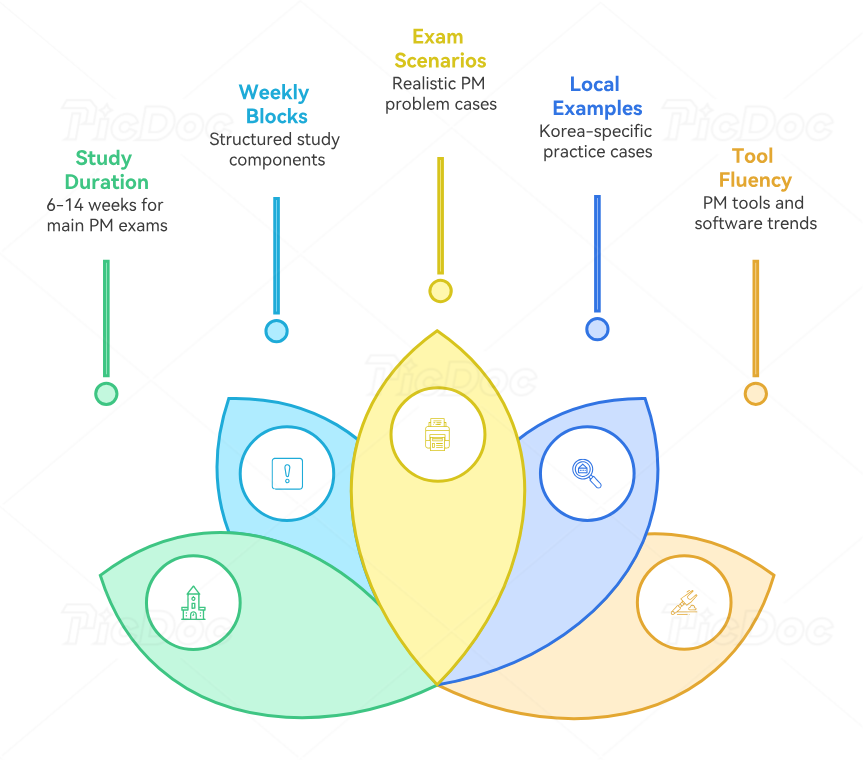
A serious study plan should be built around intensity and consistency. For CAPM, many candidates can work through the exam foundation in 6 to 10 weeks if they study actively. For PMP, 10 to 14 weeks is more realistic for working professionals because the exam requires judgment across people, process, and business value. Scrum and Kanban certifications may move faster, yet they still need practice through real delivery examples. Build weekly blocks for reading, scenario questions, weak-area repair, flashcards, and proof-asset creation using PMP resources, PMP success stories, PMP exam pitfalls, and certification evolution trends.
Study scenarios before memorizing definitions. A good PM exam question may involve an angry sponsor, slipping vendor, unclear requirement, unresponsive stakeholder, overloaded engineer, procurement delay, sprint spillover, or compliance concern. Your job is to identify the most responsible next move. Ask: What agreement controls this? Who owns the decision? Which risk needs escalation? What evidence is missing? Which action protects trust and value? This mindset connects directly to stakeholder engagement, risk mitigation, project reporting, resource allocation, and conflict resolution.
Use South Korea-specific examples while studying. Build practice cases around a semiconductor facility expansion, an AI platform launch, a hospital system upgrade, a public digital-service rollout, a smart factory implementation, a gaming release, a telecom modernization, or a construction delay. Local examples make the concepts stick and give you stronger interview stories. Add tool fluency as you study: Gantt charts, Kanban boards, sprint dashboards, RAID logs, portfolio views, resource plans, and executive reports. Pair this with PM software trends, AI project estimation, best PM templates, and team communication platforms.
5. How to Turn Certification Into Better PM Jobs in South Korea
Certification should immediately change your résumé, LinkedIn profile, portfolio, and interview answers. A weak profile says “PMP certified project manager.” A strong profile says “PMP-certified IT Project Manager focused on cloud migration, vendor governance, risk control, and executive reporting.” The second version gives hiring teams a role, sector, and value proposition. Your summary should mention industries, delivery methods, tools, stakeholder types, team size, project scale, and outcomes. Build positioning through IT PM career guidance, international PM strategy, remote PM roles, and PM consulting skills.
Your résumé bullets should prove delivery pressure and business value. Replace vague lines such as “managed project schedules” with measurable evidence: “Coordinated 8 workstreams across a cloud migration, reduced unresolved dependencies by 35%, and improved steering committee decision speed through weekly risk escalation.” Strong bullets show action, complexity, and outcome. Use numbers where possible: timeline recovered, cost avoided, defects reduced, adoption improved, vendors coordinated, reports automated, or risks closed. Sharpen your language with project execution terms, monitoring and control terms, financial management vocabulary, and quality management terms.
Prepare six interview stories before applying: rescued deadline, controlled scope, handled sponsor conflict, managed vendor failure, improved reporting, and delivered measurable value. Use STAR, then add a PM judgment line: “The key decision was escalating the dependency before the milestone slipped.” That line separates a task-doer from a project leader. For senior growth, connect certification to project management director roles, VP of PM pathways, Chief Project Officer planning, and future PM leadership.
The strongest 2026-2027 candidates in South Korea will connect certification with sector direction. AI, cybersecurity, semiconductor expansion, cloud transformation, public digital services, smart manufacturing, healthcare modernization, and infrastructure all need PMs who can manage pressure without losing control. Use certification as the spine, then build proof around the market you want. A tech PM should show Agile metrics and release discipline. A construction PM should show schedule and procurement control. A government PM should show governance and documentation. A remote PM should show async reporting and decision logs. Support that growth with automation in PM careers, future PM skills, sustainability project management, and freelance PM trends.
6. FAQs About Getting Project Management Certification in South Korea
-
The best certification depends on your target role. CAPM works well for entry-level candidates and career changers. PMP is strongest for experienced professionals who can prove leadership across scope, schedule, risk, stakeholders, vendors, and business outcomes. Scrum, Agile, Product Owner, and Kanban certifications fit software, fintech, gaming, AI, cloud, and product teams. PRINCE2 and governance training fit PMO, public-sector, construction, infrastructure, and structured enterprise environments. Choose with a clear career route using project manager roadmap guidance, Agile PM planning, Scrum Master guidance, and government PM planning.
-
Take CAPM first if you need a formal foundation or do not yet meet PMP experience requirements. Go directly to PMP if you already have enough project leadership experience and can document your role clearly. The real question is whether your experience proves ownership of delivery, decisions, risk, stakeholders, budget, and outcomes. CAPM can help you enter the field with structure. PMP can help you move into stronger roles when your work history already carries leadership weight. Prepare with PMP exam domains, PMP resources, PMP mistakes to avoid, and PM templates.
-
Yes, PMP is available in Korean, which helps candidates who want to process complex exam scenarios in Korean. Still, many South Korea-based professionals should also build English PM vocabulary because international employers, remote teams, multinational vendors, and global clients often expect clear English documentation. A smart preparation plan uses Korean for deep comprehension and English for interview readiness. Practice explaining stakeholder engagement, risk mitigation, project reporting, and remote PM communication in both languages.
-
Scrum certification is useful for project managers targeting software, gaming, fintech, AI platforms, digital services, e-commerce, product operations, or cloud delivery. It becomes much stronger when you can show backlog control, sprint planning, blocker removal, demo discipline, retrospective improvements, and flow metrics. Scrum has limited value when your target work is mainly construction, procurement, public governance, or heavy waterfall execution unless the organization uses hybrid delivery. Strengthen this route with Agile terms, Scrum terms, Agile metrics, and product backlog concepts.
-
Certification can help, especially when combined with English communication, strong documentation, remote operating habits, and measurable delivery outcomes. Global hiring teams want project managers who can manage decisions, risks, dependencies, and stakeholder updates across time zones. Build proof assets that show async reporting, decision logs, remote dashboards, sprint boards, risk escalation, and executive summaries. A credential gives your profile credibility, while your portfolio proves readiness. Build this path with remote PM career guidance, international PM strategy, team communication tools, and freelance PM market trends.
-
After certification, update your résumé, LinkedIn headline, portfolio, and interview stories within one week. Create role-specific versions for IT, Agile, manufacturing, construction, healthcare, government, PMO, or consulting roles. Build three proof assets immediately: one executive status report, one risk register, and one project case study. Then run a 30-day application sprint with measurable résumé bullets and targeted outreach. Long-term growth should connect certification to PM consulting, project portfolio management, PM director roles, and executive PM leadership.
