
How to Transition from IT to Project Management: Your Complete Career Guide
Moving from IT into project management allows you to convert technical knowledge into broader ownership of budgets, schedules, risks, vendors, stakeholders, and business outcomes. The transition is especially practical for professionals who already coordinate releases, resolve dependencies, estimate work, communicate incidents, or guide cross-functional delivery. Project-management specialist employment in the United States is projected to grow 6% from 2024 to 2034, while PMI estimates that global demand could require up to 30 million additional project professionals by 2035.
This guide shows how to translate your IT background, close the right skill gaps, build credible evidence, choose certifications, and secure your first project-management role.
1. Understand How Your IT Experience Transfers Into Project Management
Most IT professionals are closer to project management than their job titles suggest. Developers estimate effort and manage technical dependencies. Business analysts clarify requirements and acceptance criteria. Systems administrators coordinate upgrades and downtime. Cybersecurity professionals assess risk and escalate exposure. Quality-assurance specialists protect standards and release readiness.
The career shift begins when you identify the management value inside those activities. A hiring manager needs to see evidence of project execution, stakeholder engagement, risk-response planning, resource allocation, and project monitoring inside your technical work.
APM describes project managers as responsible for day-to-day management across scope, schedule, finance, risk, quality, and resources. Its competence framework covers 29 outcome-oriented areas across project, program, portfolio, and PMO work.
Move from technical output to delivery ownership
An IT specialist is commonly evaluated on the quality of a technical output: working code, stable infrastructure, accurate analysis, secure systems, resolved incidents, or completed testing.
A project manager is evaluated on whether the complete initiative achieves an approved outcome under defined constraints. That involves coordinating technical teams while controlling project finances, interpreting requirements, managing project schedules, resolving stakeholder conflicts, and producing useful project reports.
Suppose you helped migrate a company from an on-premises application to a cloud platform. Your technical contribution may have included configuring environments, testing integrations, or moving data. Your transferable project contribution may have included:
Identifying migration dependencies
Coordinating application owners
Estimating implementation effort
Sequencing cutover activities
Tracking defects and decisions
Planning rollback conditions
Communicating downtime
Escalating security concerns
Confirming operational acceptance
Documenting lessons after release
Those activities connect directly to risk-register management, schedule compression, vendor coordination, quality-management principles, and disciplined project closure.
Retain enough technical depth to challenge delivery assumptions
Your technical background remains valuable after the transition. It helps you test whether estimates are plausible, recognize hidden dependencies, understand integration risks, question vague requirements, and communicate effectively with specialists.
The strongest IT project managers understand enough architecture, infrastructure, data, security, testing, and development to ask precise questions. They also know when decisions require a subject-matter expert. This balance is particularly important across AI-enabled projects, cybersecurity transformations, software integrations, cloud-based PM systems, and data-intensive estimation and scheduling.
Avoid becoming the unofficial senior engineer for every technical problem. That pattern prevents you from developing delegation, financial control, stakeholder influence, and decision ownership. Your role should make technical work governable rather than personally completing every difficult task.
Recognize the management gaps your IT role may have hidden
Technical professionals often enter project management with strong problem-solving ability but limited exposure to commercial decisions, organizational politics, executive communication, or budget accountability.
Your likely development gaps include:
Translating strategy into project objectives
Building a defensible business case
Estimating total project cost
Managing suppliers and contracts
Negotiating shared resources
Handling executive disagreement
Controlling scope changes
Forecasting beyond the current sprint
Tracking benefit realization
Planning operational adoption
Closing projects formally
These gaps can be addressed through business-analysis training, cost-management knowledge, leadership and communication skills, agile metrics, and stronger project governance.
| IT Experience | Project-Management Capability | Evidence to Capture | Resume Translation | Gap to Close |
|---|---|---|---|---|
| Sprint planning | Scope decomposition, capacity planning, estimation, dependency control | Sprint goal, estimates, capacity assumptions, completion data | Planned and coordinated iterative delivery across a cross-functional technical team | Connect sprint output to budget, milestones, and business outcomes through sprint-planning discipline |
| Backlog refinement | Requirements clarification and priority management | Acceptance criteria, priority decisions, rejected requests | Converted business needs into prioritized, delivery-ready requirements | Strengthen backlog governance |
| Software release | Milestone planning, readiness management, cutover coordination | Release plan, readiness checklist, rollback decision | Coordinated release readiness across development, testing, infrastructure, and support | Formalize execution controls |
| Incident response | Issue triage, escalation, communication, rapid decision-making | Incident timeline, owners, updates, root-cause actions | Directed cross-functional response to a high-priority service disruption | Expand from reactive response to proactive risk planning |
| Change request | Scope and impact analysis | Technical impact, effort, cost, risk, approval outcome | Evaluated change impacts and secured stakeholder approval before implementation | Add financial and benefit analysis using project finance principles |
| System migration | Dependency planning, transition management, operational handover | Migration waves, cutover plan, reconciliation evidence | Coordinated phased migration while protecting service continuity and data integrity | Improve handover and closure |
| Requirements workshop | Facilitation, stakeholder alignment, requirements control | Decision log, requirements baseline, open assumptions | Facilitated stakeholder workshops that converted conflicting needs into approved requirements | Deepen requirements engineering |
| Technical estimation | Schedule and resource forecasting | Estimate basis, assumptions, accuracy, revisions | Developed evidence-based effort forecasts for complex technical work | Add cost, contingency, and agile estimation controls |
| Defect management | Quality control, prioritization, risk-based decision-making | Defect severity, aging, release decision, escape rate | Managed defect priorities and release thresholds across business-critical functionality | Connect defects with quality governance |
| User acceptance testing | Acceptance management and stakeholder readiness | Test scope, approvers, criteria, outstanding exceptions | Coordinated business acceptance and resolved readiness gaps before launch | Strengthen stakeholder accountability |
| Cloud deployment | Environment, vendor, security, cost, and release coordination | Deployment plan, approvals, cost forecast, security review | Led multidisciplinary cloud deployment planning across infrastructure, security, and application teams | Build commercial and supplier-management capability |
| Vendor integration | Third-party delivery and dependency management | Contract milestones, interface ownership, acceptance records | Coordinated vendor deliverables and internal dependencies against contractual milestones | Learn procurement terminology |
| Service desk reporting | Performance analysis and executive reporting | Trends, root causes, service impact, corrective actions | Translated operational data into prioritized improvement recommendations | Move from metrics to decision-ready reporting |
| Root-cause analysis | Problem solving and corrective-action governance | Cause evidence, action owners, deadlines, recurrence data | Led structured root-cause analysis and tracked preventive actions to closure | Connect analysis with monitoring controls |
| Cyber risk assessment | Risk identification, exposure analysis, executive escalation | Threat, vulnerability, impact, treatment, owner | Assessed technology exposure and secured leadership decisions on priority treatments | Integrate cyber risk into the wider project risk register |
| Data conversion | Work-package planning, quality assurance, reconciliation | Mapping rules, exception counts, sign-offs, rollback conditions | Managed conversion dependencies and quality controls across high-volume data migration | Improve standards and assurance knowledge |
| API implementation | Interface ownership and cross-team dependency management | Interface specification, owners, test results, failure handling | Coordinated interface delivery between internal teams and external technology partners | Strengthen integration governance |
| Technical documentation | Knowledge management and operational transition | Runbooks, ownership, version control, acceptance | Established operational documentation and knowledge-transfer standards before handover | Connect documentation with transition acceptance |
| Infrastructure upgrade | Schedule, outage, resource, risk, and communication management | Upgrade schedule, outage notice, resource plan, contingency | Coordinated infrastructure upgrades across technical and business stakeholders | Develop dependency-based schedule planning |
| Capacity monitoring | Demand forecasting and resource planning | Utilization data, demand forecast, scaling decision | Forecast capacity constraints and coordinated preventive scaling decisions | Apply broader resource-allocation methods |
| DevOps pipeline | Process improvement, automation, flow measurement | Lead time, deployment frequency, failure rate, recovery time | Improved delivery flow by coordinating automated controls and cross-team process changes | Understand agile performance metrics |
| Daily stand-up | Progress visibility, blocker identification, team coordination | Blockers removed, actions assigned, dependency outcomes | Facilitated delivery coordination and accelerated resolution of cross-team blockers | Move beyond ceremonies through Scrum fluency |
| Kanban workflow | Flow management, work-in-progress control, bottleneck analysis | Cycle time, blocked work, WIP limits, throughput | Improved work visibility and reduced delivery bottlenecks using flow-based controls | Strengthen Kanban management knowledge |
| Technical support escalation | Stakeholder communication and priority negotiation | Impact, urgency, owner, resolution, customer update | Managed competing priorities and communicated resolution plans to affected stakeholders | Develop conflict-resolution ability |
| Audit remediation | Compliance planning and corrective-action tracking | Findings, owners, evidence, deadlines, validation | Coordinated remediation of control findings across multiple technical owners | Integrate compliance into project governance |
| Technical training | Change enablement, facilitation, adoption planning | Audience analysis, completion, proficiency, support needs | Designed and delivered role-based enablement supporting successful technology adoption | Add structured communication planning |
| Tool selection | Options analysis, requirements evaluation, stakeholder recommendation | Criteria, scoring, total cost, risk, recommendation | Led evidence-based technology evaluation and secured approval for the preferred solution | Expand into comparative tool analysis |
| Technical team leadership | Delegation, motivation, performance management, delivery accountability | Team objectives, coaching, capacity decisions, outcomes | Led specialists through complex delivery constraints while maintaining accountability and quality | Develop broader project leadership capability |
2. Choose the Best Transition Route for Your IT Background
Your first project-management role should remain close enough to your technical expertise that employers can trust your domain judgment. A network engineer may transition into infrastructure projects more easily than marketing transformation. A software developer may be especially credible in application development, cloud migration, platform modernization, or systems integration.
Software developer to technical project manager
Developers understand estimation uncertainty, technical debt, code dependencies, integration risk, testing limitations, and release pressure. Their most natural entry routes include technical project manager, software project coordinator, implementation manager, delivery lead, or Scrum-based team lead.
To become competitive, demonstrate ownership beyond coding. Lead sprint planning, coordinate a release, maintain a product and sprint backlog, improve agile estimation, track delivery metrics, and manage stakeholder expectations.
The biggest career risk is continuing to solve every difficult technical problem personally. Begin measuring success through team throughput, decision quality, risk reduction, release predictability, and business acceptance.
Business analyst to project manager
Business analysts already work across stakeholders, requirements, processes, priorities, and acceptance criteria. Their strongest route involves taking ownership of integrated planning, financial tracking, resources, risks, and delivery governance.
Build on PMI-PBA preparation, strengthen requirements-engineering discipline, learn project financial terminology, and practice schedule management.
Your advantage is the ability to distinguish the requested solution from the underlying business problem. Project managers who preserve that analytical discipline are less likely to deliver technically complete solutions that fail to create operational value.
Quality-assurance specialist to project manager
QA professionals understand acceptance, traceability, defects, environments, release thresholds, and evidence. These capabilities translate well into implementation, software delivery, regulatory technology, and quality-intensive project roles.
Expand your scope by coordinating test phases, environment readiness, defect triage, business acceptance, release decisions, and operational handover. Connect total quality management, ISO standards, requirements traceability, monitoring and control, and project closure.
Avoid defining project success purely through defect counts. A technically sound release may still fail because training, data migration, process readiness, communications, or support arrangements were inadequate.
Infrastructure or systems administration to project manager
Infrastructure professionals regularly coordinate upgrades, outages, migrations, security patches, capacity changes, suppliers, and recovery plans. They are well positioned for infrastructure project manager, cloud migration manager, data-center project manager, or technical delivery manager roles.
Document your use of Gantt scheduling, risk registers, resource allocation, vendor management, and formal project reporting.
Your technical ability to anticipate hidden infrastructure dependencies can become a major differentiator. Strengthen the commercial side by learning contracts, procurement lead times, capital expenditure, operating costs, and supplier acceptance.
Cybersecurity professional to security project manager
Security analysts, engineers, auditors, and governance professionals understand risk, controls, regulatory obligations, remediation, and executive escalation. Natural roles include cybersecurity project manager, compliance program coordinator, identity-and-access project manager, security transformation lead, and risk-remediation manager.
Broaden your experience beyond identifying exposure. Own remediation schedules, funding decisions, technical dependencies, evidence collection, stakeholder communications, and residual-risk acceptance. Integrate cybersecurity concerns, risk-response planning, project governance, stakeholder communication, and ISO knowledge.
Cybersecurity hiring research continues to emphasize problem-solving, collaboration, and communication alongside technical skills, reinforcing the value of professionals who can coordinate security outcomes across the organization.
Service desk or technical support to project coordinator
Support professionals understand user impact, incident priority, service levels, communication pressure, and recurring operational problems. The strongest bridge is often project coordinator, implementation coordinator, PMO analyst, service-improvement coordinator, or junior project manager.
Volunteer to coordinate a knowledge-base redesign, ticketing-platform implementation, device rollout, service transition, or recurring-problem reduction initiative. Use project templates, team communication platforms, conflict-resolution practices, workforce-management tools, and project execution controls.
Support experience becomes convincing when you show ownership of a defined improvement rather than a high volume of individual tickets.
Data, analytics, or AI specialist to project manager
Data professionals understand data quality, source dependencies, analytical uncertainty, stakeholder interpretation, privacy, and model limitations. Suitable roles include data project manager, analytics delivery manager, AI implementation manager, business-intelligence project manager, and data-governance program coordinator.
Build evidence across AI project management, machine-learning estimation, software integrations, cybersecurity controls, and responsible project governance.
PMI identifies data literacy, critical thinking, problem solving, agile delivery, and trustworthy AI practices among the capabilities needed to manage AI-related work responsibly.
DevOps or cloud professional to delivery manager
DevOps professionals operate at the intersection of development, infrastructure, automation, reliability, security, and release management. Their natural career progression may lead toward technical delivery manager, cloud project manager, platform program manager, or transformation lead.
Translate pipeline improvements into measurable reductions in lead time, failed deployments, manual effort, recovery time, or release risk. Combine agile project terminology, Scrum knowledge, Kanban flow management, hybrid project management, and future PM software trends.
3. Build the Project-Management Skills Your Technical Role Did Not Require
Technical competence may help you earn the interview. Management judgment determines whether employers trust you with the entire project.
PMI’s current Talent Triangle organizes development around ways of working, power skills, and business acumen. APM similarly emphasizes planning, monitoring, resource management, decisiveness, conflict resolution, communication, and awareness of how projects affect stakeholders.
Learn integrated planning
A task list shows what people intend to do. An integrated plan reveals how scope, time, cost, resources, risk, quality, procurement, communications, and acceptance interact.
Begin each project by defining:
The business problem
Intended outcomes
Deliverables and exclusions
Acceptance criteria
Major work packages
Dependencies
Resource assumptions
Estimated costs
Decision dates
Risk triggers
Reporting cadence
Handover requirements
Use requirements-engineering practices, Gantt-chart concepts, resource-allocation methods, risk-register guidance, and project-execution terminology.
A common first-time PM failure is developing each plan separately. A schedule may assume resources that the resource plan has not secured. A budget may exclude vendor changes identified in the risk register. A launch plan may ignore training and operational support. Integrated planning exposes those contradictions early.
Develop financial confidence
IT professionals frequently estimate effort without owning total project cost. Project managers must understand labor cost, supplier fees, licenses, infrastructure, training, contingency, operational transition, and post-launch support.
Learn to distinguish:
Budget from forecast
Actual cost from committed cost
Capital cost from operating cost
Contingency from management reserve
Cost variance from cash-flow timing
Under-spending from genuine efficiency
Approved scope from unfunded expectation
Build competence through project financial terminology, cost-professional principles, earned value management, vendor controls, and procurement terminology.
Your finance update should explain what has been spent, what has been committed, what remains uncertain, where the project is likely to finish, and which decision could change that forecast.
Practice stakeholder management beyond status updates
Stakeholder management involves understanding authority, interest, impact, incentives, resistance, information needs, and decision responsibility.
An executive sponsor may care about value, exposure, and decision deadlines. A technical lead may need architectural clarity. End users may care about disruption, training, and usability. Finance may require forecast accuracy. Security may require control evidence. Vendors may focus on contractual obligations and change approval.
Use stakeholder-engagement terminology, leadership communication, conflict-resolution methods, reporting best practices, and governance structures.
Avoid treating communication volume as evidence of engagement. A weekly email has limited value when the recipient does not understand their decision, action, or exposure.
Become methodology-flexible
Many IT professionals have experience with Scrum ceremonies but limited exposure to formal project governance, procurement, budgets, operational transition, or fixed external deadlines. Others have worked in tightly controlled Waterfall environments without learning iterative discovery.
Develop working knowledge of agile project management, Scrum terminology, Kanban principles, Waterfall concepts, and hybrid delivery.
Select methods according to uncertainty, risk, compliance, supplier structure, stakeholder availability, and delivery constraints. A cloud transformation may use iterative application migration inside an overall roadmap with fixed contractual gates, security approvals, and operational deadlines.
Follow a 90-day transition plan
Days 1–30: Translate your experience. Review three significant IT initiatives. Extract objectives, stakeholders, deliverables, estimates, dependencies, risks, decisions, and results. Compare your evidence with project-execution terms, monitoring controls, risk terminology, and closure concepts.
Days 31–60: Build missing artifacts. Create a charter, stakeholder matrix, schedule, budget forecast, risk register, communication plan, change log, and status report for one past or simulated IT project. Use project templates, financial-management guidance, resource-allocation practices, and project-reporting standards.
Days 61–90: Gain visible ownership. Ask to coordinate a release, upgrade, migration, audit-remediation plan, vendor implementation, or service-improvement initiative. Agree on your authority, sponsor, scope, deadline, measures, and escalation route before beginning.
4. Turn Your IT Work Into Resume, Portfolio, and Interview Evidence
The transition often fails during positioning. Candidates describe programming languages, operating systems, ticket volumes, tools, and certifications while giving limited evidence of ownership.
A project-management hiring panel wants to know:
What outcome were you responsible for?
How large or complex was the initiative?
Which stakeholders depended on you?
What constraints threatened delivery?
Which decisions did you influence?
How did you manage scope, schedule, cost, risk, and quality?
What measurable result followed?
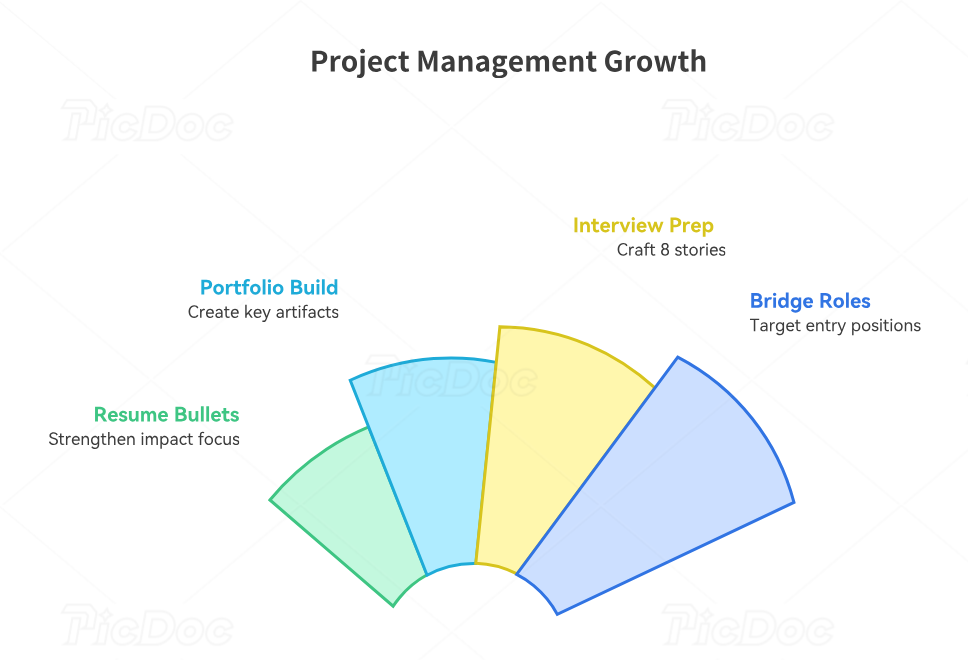
Rewrite technical resume bullets around delivery impact
A technically accurate bullet may still undersell project-management capability:
Configured cloud environments and supported a system migration.
A stronger version shows integrated responsibility:
Coordinated environment readiness, migration sequencing, security approvals, and business validation for a phased cloud transition, resolving cross-team dependencies before each production cutover.
Another weak bullet says:
Participated in Agile ceremonies and updated Jira.
A stronger version says:
Facilitated sprint planning, maintained delivery dependencies, escalated blocked work, and improved forecast visibility across development, QA, infrastructure, and product stakeholders.
Use relevant language from sprint-planning terminology, agile estimation, project reporting, risk management, and resource planning.
Each strong bullet should contain three elements:
Delivery context: The initiative, scale, users, systems, locations, budget band, or timeframe.
Management action: What you planned, coordinated, controlled, negotiated, escalated, or improved.
Result: The outcome, risk reduction, time saved, cost avoided, reliability improvement, adoption level, or milestone achieved.
Build a portfolio that demonstrates complete-project thinking
Your portfolio may contain anonymized work, reconstructed documents, or realistic simulations. Remove customer names, credentials, infrastructure details, security vulnerabilities, employee information, contract terms, and confidential financial data.
Include these artifacts:
Project charter: Objective, business case, deliverables, exclusions, sponsor, constraints, assumptions, and success measures.
Stakeholder matrix: Authority, influence, impact, information needs, concerns, and engagement approach.
Requirements baseline: Business, functional, technical, security, data, operational, and acceptance requirements.
Integrated schedule: Work packages, dependencies, milestones, decision dates, contingency, and critical path.
Budget forecast: Labor, vendors, technology, training, contingency, actuals, commitments, and completion forecast.
Risk register: Causes, events, impacts, probability, severity, triggers, treatments, owners, and residual exposure.
Status report: Progress, forecast, risks, decisions, finances, changes, and actions.
Change request: Scope request, reason, options, cost, timing, benefit, risk, and approval.
Cutover plan: Readiness conditions, communications, validation, rollback, support, and decision authority.
Closure review: Acceptance, handover, remaining risks, benefits ownership, lessons, and outstanding actions.
Base these materials on proven project-management templates, requirements practices, risk-register structures, financial-management controls, and closure terminology.
A polished template carries limited weight without reasoning. Add short notes explaining why you selected a delivery method, changed the schedule, escalated a dependency, rejected a scope request, increased contingency, or delayed release.
Prepare interview stories that prove management judgment
Prepare at least eight stories:
A delayed project or release you helped recover
A difficult stakeholder you aligned
A requirement you clarified before it caused rework
A technical risk you escalated
A resource conflict you resolved
A quality issue that affected release readiness
A process improvement you implemented
A failure or misjudgment that changed your approach
Structure each answer around:
Context: What the project needed to achieve.
Exposure: What could have failed and why.
Responsibility: What you owned.
Analysis: Which evidence, assumptions, and options you examined.
Action: What you changed, coordinated, negotiated, or escalated.
Result: The measurable outcome.
Learning: What you would repeat or improve.
This structure shows leadership communication, conflict-resolution ability, monitoring discipline, project governance awareness, and stakeholder judgment.
Target bridge roles rather than waiting for a perfect title
Useful bridge roles include:
Project coordinator
Junior project manager
Technical project coordinator
PMO analyst
Implementation coordinator
Release manager
Scrum master
Delivery lead
Service-transition manager
Technical business analyst
Customer implementation manager
Infrastructure project manager
Cybersecurity project coordinator
Data project coordinator
Vendor implementation lead
Search for responsibilities alongside titles. A project coordinator who owns risks, plans, vendors, and reporting may offer stronger development than a “project manager” role limited to meeting administration.
Build role readiness through PMO trend analysis, team communication platforms, project-management software, Kanban software, and Scrum platforms.
5. Choose Certifications Strategically and Execute Your Career Move
Certification should support your transition strategy. It cannot replace ownership evidence, stakeholder judgment, or complete-project thinking.
Consider CAPM when you need formal foundations
CAPM can suit professionals with limited formal project-management education who need structured exposure to terminology, processes, business analysis, predictive methods, and agile approaches. PMI currently requires at least 23 hours of project-management education before the CAPM examination.
Prepare through CAPM exam resources, avoid common CAPM exam mistakes, plan for exam day, understand CAPM renewal, and learn how to use CAPM for advancement.
Pair the credential with a portfolio project and visible ownership at work. That combination demonstrates both knowledge and application.
Pursue PMP when your experience supports the application
PMP is designed for professionals who meet PMI’s education, project leadership experience, and training requirements. PMI launched an updated PMP examination on July 9, 2026, with revised content and broader recognition of qualifying educational pathways.
Use PMP preparation resources, study the PMP exam domains, avoid common PMP mistakes, learn from PMP success stories, and understand PMP maintenance.
Document your experience through projects you led, even when your formal title was developer, analyst, engineer, or team lead. Describe the objective, your leadership responsibility, delivery approach, and outcomes accurately.
Use agile certification when it aligns with your target environment
IT professionals working across Scrum, Kanban, Lean, product development, or adaptive delivery may benefit from an agile credential. Compare PMI-ACP, CSM, and SAFe, explore advanced Scrum Master development, review the SAFe Agilist pathway, and study agile certification career outcomes.
PMI-ACP currently covers Scrum, Lean, Kanban, and other agile approaches and requires relevant agile experience plus formal agile training.
A certification focused on one framework should not narrow your identity to running ceremonies. Employers need evidence that you can manage objectives, stakeholders, constraints, risks, finances, and organizational adoption.
Consider PRINCE2 in structured governance environments
PRINCE2 may be useful in organizations that value formal business cases, defined management stages, role clarity, exception controls, and structured governance.
Evaluate PRINCE2 versus PMP, understand PRINCE2 career benefits, avoid PRINCE2 exam pitfalls, compare training providers, and plan for renewal requirements.
The vacancy pattern in your target sector should guide the investment. Review at least 20 relevant jobs before choosing a certification.
Build a 12-month transition roadmap
Months 1–2: Select your target role and IT domain. Analyze job descriptions for recurring skills, tools, certifications, seniority, and delivery methods. Study future PM competencies, project leadership trends, PMO evolution, and governance expectations.
Months 3–4: Complete foundational training and create your portfolio case. Develop competence in risk management, stakeholder engagement, project finances, resource planning, and project reporting.
Months 5–7: Secure ownership of a contained internal project. Request responsibility for the charter, schedule, risks, meetings, reporting, changes, and closure. Record decisions and measurable results rather than waiting for a title change.
Months 8–9: Rewrite your resume and LinkedIn profile. Build eight interview stories. Ask a project manager, PMO leader, or delivery director to challenge your evidence.
Months 10–12: Apply selectively to bridge roles that align with your technical domain. Track rejection patterns. A lack of interviews usually points to positioning, keywords, or unclear ownership. Late-stage rejection may indicate weak interview evidence, commercial judgment, or stakeholder presence.
The 2026 environment increasingly rewards professionals who can manage complex systems rather than isolated task lists. PMI’s 2026 Pulse of the Profession reports that 97% of surveyed professionals managed at least one complex project during the preceding year and that effective complexity management substantially increased the likelihood of success.
Your IT background gives you a strong starting point because you already understand technical uncertainty. Career progression depends on converting that understanding into coordinated decisions, accountable plans, credible forecasts, and measurable business outcomes.
6. FAQs About Transitioning From IT to Project Management
-
You can gain meaningful experience while remaining in your current role. Request ownership of a release, migration, upgrade, vendor deployment, process improvement, audit remediation, or cross-team technical initiative.
Agree on the objective, sponsor, scope, authority, timeline, budget exposure, stakeholders, and success measures. Manage the work through a project charter, integrated schedule, risk register, status reporting, and formal closure process.
This gives you credible project ownership while preserving the security of your existing position.
-
Business analysis, technical team leadership, release management, Scrum facilitation, implementation consulting, service transition, infrastructure coordination, quality assurance, and vendor management commonly provide strong transferable evidence.
The decisive factor is your responsibility rather than the title. Experience with requirements, stakeholders, risks, resources, and delivery controls creates a stronger bridge than technical seniority alone.
-
CAPM may fit candidates who need formal foundations and do not yet satisfy PMP experience requirements. PMP may fit professionals who have already led projects and can document qualifying experience.
Compare your background with official eligibility rules and the requirements appearing in your target vacancies. Use CAPM preparation resources, PMP exam-domain guidance, PMP preparation tools, and certification trend analysis.
A certification creates greater career value when paired with practical portfolio evidence.
-
Coding experience is unnecessary for many IT project-management roles. You need enough technical literacy to understand architecture, integrations, data, environments, testing, security, dependencies, and operational risks.
Business analysts, support professionals, QA specialists, implementation consultants, infrastructure coordinators, and PMO analysts can all build successful IT project careers. Strengthen your knowledge through project APIs and integrations, cybersecurity project concerns, software trend analysis, agile terminology, and Scrum concepts.
-
Include a charter, stakeholder matrix, requirements baseline, integrated schedule, budget forecast, risk register, status report, change request, cutover plan, and closure review.
Choose a scenario such as a cloud migration, software implementation, cybersecurity remediation, CRM rollout, infrastructure upgrade, data-platform deployment, or service-desk transformation. Apply project templates, requirements controls, financial-management principles, risk-response terminology, and reporting practices.
Add commentary explaining your decisions because reasoning demonstrates more value than formatting.
-
Create evidence inside your current environment. Coordinate a contained initiative with clear deliverables, stakeholders, constraints, and measurable outcomes. Volunteer for PMO reporting, release planning, vendor implementation, change control, audit remediation, or cross-team process improvement.
Document the work through monitoring controls, resource-allocation evidence, stakeholder plans, risk registers, and project closure.
