
The Future of Cybersecurity & Project Management: What PMs Must Know by 2027
Cybersecurity is becoming a core delivery constraint across technology, finance, healthcare, infrastructure, government, manufacturing, and AI projects. By 2027, project managers will increasingly be expected to translate security obligations into scope, budgets, schedules, supplier controls, acceptance criteria, and executive decisions. Success will require stronger cybersecurity project awareness, risk-response planning, project governance, and stakeholder engagement.
This guide explains the cybersecurity shifts that will reshape project delivery and the controls every PM should start building now.
1. Why Cybersecurity Is Becoming a Core Project-Management Responsibility
Cybersecurity decisions increasingly begin before technical implementation. A project’s business case may determine which data will be collected, which suppliers will receive access, which systems will integrate, how long information will be retained, and how much recovery capability the budget can support. Once those decisions enter an approved baseline, correcting them can require expensive redesign, contract changes, delayed releases, or regulatory remediation.
Project managers therefore need to connect requirements engineering, project financial controls, vendor-management practices, and project monitoring with cyber-risk decisions from initiation onward.
Cybersecurity governance is moving closer to enterprise governance
NIST Cybersecurity Framework 2.0 added Govern as its sixth core function alongside Identify, Protect, Detect, Respond, and Recover. The Govern function covers cybersecurity strategy, expectations, policy, accountability, and oversight in the context of organizational missions and stakeholder needs. NIST also increased the framework’s emphasis on cybersecurity supply-chain risk.
This shift has direct consequences for project managers. Cybersecurity can no longer remain an isolated technical workstream that reports near the end of implementation. It must influence business-analysis decisions, resource-allocation choices, project reporting, and portfolio governance.
A cyber-ready PM should know who owns security risk, which decisions require specialist approval, when exposure exceeds organizational tolerance, and what evidence must exist before a stage gate passes. Without that clarity, project teams can produce security assessments that nobody is authorized to accept, remediation plans that lack funding, and launch recommendations that conceal unresolved exposure.
Regulation is turning cybersecurity work into scheduled project deliverables
The EU’s NIS2 framework covers 18 critical sectors and requires cybersecurity risk-management measures, incident handling, business continuity, crisis management, supply-chain security, and secure acquisition, development, and maintenance practices. ENISA published detailed technical implementation guidance in 2025 to help covered digital entities produce the required controls and evidence.
The Digital Operational Resilience Act has applied to covered EU financial entities since January 17, 2025. It addresses ICT risk management, operational resilience, incident handling, testing, and third-party technology exposure.
The EU Cyber Resilience Act creates another concrete 2027 milestone. Its reporting obligations began applying on September 11, 2026, while its principal obligations for products with digital elements apply from December 11, 2027. Manufacturers must prepare for lifecycle security, vulnerability management, conformity evidence, and incident reporting.
For PMs, these obligations must become project-execution activities, schedule dependencies, quality criteria, and closure conditions. A compliance deadline without a work package, owner, budget, acceptance standard, and evidence repository remains an unmanaged assumption.
Security-by-design will influence project approval
CISA’s Secure by Design guidance asks technology manufacturers to treat customer security as a core business requirement and to build protections into product design and default configurations. Its Secure by Demand guidance also helps software customers evaluate whether suppliers carry an appropriate share of security responsibility.
This direction changes how projects define success. A digital product can meet its feature deadline and still create unacceptable authentication, logging, update, vulnerability, privacy, or recovery exposure. PMs must therefore incorporate security into product-backlog decisions, sprint planning, agile estimation, and acceptance reporting.
AI is expanding both project capability and cyber exposure
Generative AI can accelerate requirements drafting, risk discovery, documentation, analysis, coding, testing, and reporting. It also creates concerns involving sensitive-data leakage, insecure outputs, model access, unverified content, supplier opacity, intellectual property, prompt manipulation, and automated decision-making.
NIST’s Generative AI Profile extends the AI Risk Management Framework and provides actions for governing, mapping, measuring, and managing risks across the AI lifecycle. NIST also released a preliminary Cybersecurity AI Profile in late 2025, reflecting the growing need to manage cybersecurity risks created by AI systems and AI-enabled threats.
Project managers should connect AI project-management trends, automation impacts, software integration planning, and future PM competencies with approved AI-use policies, data controls, human review, and traceable accountability.
| Cybersecurity Control | PM Responsibility | Required Project Evidence | Failure Signal | Best Review Point |
|---|---|---|---|---|
| Security ownership | Assign accountable business, technical, risk, and approval owners. | Security RACI and delegated authority. | Teams discuss exposure without an authorized risk owner. | Project initiation |
| Data classification | Identify the sensitivity, location, use, transfer, and retention of project data. | Data inventory and classification register. | Security requirements are defined before teams know which data is involved. | Discovery |
| Threat modelling | Schedule structured analysis of assets, threat actors, attack paths, and mitigations. | Threat model with owned treatments. | Threat analysis begins immediately before release. | Architecture and design |
| Security requirements | Translate policy and risk decisions into traceable acceptance conditions. | Requirements traceability matrix. | Requirements use vague terms such as “industry-standard security.” | Requirements baseline |
| Identity and access | Coordinate identity design, role mapping, approval, testing, and deprovisioning. | Access-control matrix and test evidence. | Temporary project access remains active after roles change. | Design and transition |
| Secure architecture | Ensure architecture decisions receive security and operational review. | Approved architecture decision records. | Project dates are committed before architecture risks are assessed. | Solution design |
| Zero-trust alignment | Plan identity, device, application, data, and policy dependencies. | Zero-trust capability roadmap. | A network location automatically grants broad trust. | Architecture approval |
| Secure development | Fund security activities across design, coding, review, testing, and release. | Secure-development plan linked to the delivery method. | Security work appears as an unfunded backlog near launch. | Planning and every release |
| Software inventory | Require visibility of first-party, commercial, and open-source components. | Software bill of materials. | Teams cannot determine whether a vulnerable component is present. | Procurement and release |
| Dependency control | Track libraries, services, APIs, platforms, and infrastructure dependencies. | Integration dependency map. | One supplier update unexpectedly blocks multiple products. | Design and change control |
| Vulnerability management | Define scanning, prioritization, remediation, exception, and verification workflows. | Vulnerability register with service-level targets. | High-risk findings remain open without approved exceptions. | Build, test, and operations |
| Security testing | Schedule code, configuration, penetration, resilience, and control testing. | Test strategy, findings, retests, and acceptance. | Testing time is repeatedly consumed by earlier schedule slippage. | Before release approval |
| Logging and monitoring | Ensure detection requirements, telemetry ownership, and retention are included. | Logging design and monitoring-use cases. | The product launches without visibility into suspicious activity. | Design and operational readiness |
| Incident response | Define triage, escalation, communication, evidence, and decision ownership. | Incident-response and communications plan. | The first severe incident becomes the first test of the response process. | Before launch |
| Regulatory reporting | Translate notification obligations into timelines, owners, and evidence routes. | Reporting obligation register. | Legal teams learn about a reportable event after deadlines start running. | Planning and simulation |
| Business continuity | Define service priorities, fallback arrangements, dependencies, and recovery ownership. | Continuity plan aligned with risk responses. | Recovery targets have no technical design or funded capacity. | Design and operational handover |
| Disaster recovery | Coordinate recovery objectives, backup design, testing, and restoration evidence. | Tested recovery plan and results. | Backups exist, but restoration has never been validated. | Pre-launch gate |
| Supplier due diligence | Evaluate supplier controls, history, dependencies, support, and exit readiness. | Vendor security assessment. | Procurement chooses a supplier before cyber-risk review begins. | Sourcing |
| Contract security | Ensure contracts cover incidents, evidence, updates, subcontractors, audit, and exit. | Security schedule and contractual obligations register. | The supplier’s security responsibilities depend on informal assurances. | Contract approval |
| Cloud concentration | Identify shared-provider exposure and credible fallback strategies. | Concentration-risk assessment. | Several critical services depend on one undocumented failure point. | Portfolio and architecture review |
| AI usage governance | Define permitted tools, data limits, review standards, ownership, and monitoring. | AI-use register linked to AI risk governance. | Staff place sensitive project information into unapproved systems. | Initiation and ongoing control |
| Privacy integration | Coordinate lawful use, minimization, consent, retention, access, and deletion requirements. | Privacy-impact assessment and actions. | Data collection expands without reviewing privacy consequences. | Discovery and change control |
| Security budget | Fund specialists, tools, testing, remediation, monitoring, and resilience. | Cybersecurity cost baseline. | Mandatory controls compete for unused contingency near launch. | Business-case approval |
| Security schedule | Model approval lead times, testing, remediation, retesting, and evidence review. | Security-integrated project schedule. | A fixed launch date leaves no time to close serious findings. | Baseline and every forecast |
| Risk acceptance | Route residual risk to someone with sufficient authority and accountability. | Signed exception with expiry and compensating controls. | Project managers are pressured to accept exposure outside their authority. | Gate and release decision |
| Change security review | Assess cyber impact whenever scope, architecture, suppliers, data, or integrations change. | Security section within the change request. | Approved changes bypass the original threat model. | Change control |
| Operational handover | Transfer monitoring, patching, access, incident, supplier, and recovery responsibilities. | Operational acceptance and support model. | The project closes while security tasks remain ownerless. | Transition and closure |
| Post-launch assurance | Confirm controls remain effective after real users, data, integrations, and workloads appear. | 30-, 60-, and 90-day assurance reviews. | Implementation approval is treated as permanent proof of security. | Benefits and closure review |
2. The 10 Cybersecurity Shifts Every Project Manager Must Prepare for by 2027
1. Security will become a business-case requirement
Security costs frequently appear late because project proposals emphasize features, speed, efficiency, and revenue while underestimating identity controls, testing, monitoring, recovery, specialist reviews, and remediation.
By 2027, stronger business cases will describe the data involved, threat exposure, applicable regulation, required controls, supplier responsibilities, operational-security costs, and consequences of failure. The project manager should make these costs visible through financial-management methods, earned value controls, cost-estimation capability, and risk-register discipline.
The hard question is whether the project remains viable after realistic security, resilience, compliance, and support costs are included. A PM who hides those costs to protect approval creates a future budget crisis.
2. Security requirements will become traceable delivery requirements
Statements such as “the solution must be secure” provide no usable basis for estimation, design, testing, or acceptance. Project teams need specific requirements covering authentication, authorization, encryption, logging, vulnerability management, backup, recovery, data transfer, software updates, retention, incident response, and supplier obligations.
Each requirement should identify its source, owner, verification method, acceptance authority, and consequence of failure. This approach connects requirements engineering, business analysis, quality-management terminology, and ISO-related controls.
Security requirements should also survive methodology changes. Agile projects can place them in epics, stories, acceptance criteria, definitions of done, and release gates. Predictive projects can place them in specification baselines, work packages, verification plans, and stage approvals.
3. Secure-by-design will alter sequencing and estimation
Security-by-design means important security decisions occur during discovery, architecture, requirements, and procurement. CISA’s guidance explicitly places responsibility on technology manufacturers to make products secure through design and default behavior.
This requires project managers to schedule threat modelling, architecture review, data-flow analysis, security requirements, privacy review, and abuse-case analysis before teams commit too deeply to a solution. Use sprint-planning knowledge, backlog controls, agile estimation methods, and hybrid delivery approaches to preserve adaptive development while protecting mandatory control points.
A late security review usually discovers issues when architecture, contracts, and launch commitments have already hardened. Early design work produces more choices and lower correction costs.
4. Software supply-chain visibility will become a standard procurement expectation
Modern systems depend on commercial products, cloud services, open-source components, libraries, APIs, managed services, and subcontractors. CISA describes a software bill of materials as a key building block for software security and supply-chain risk management. Its updated 2026 minimum-elements guidance treats an SBOM as a nested inventory of the components within software applications and systems.
Project managers need to ask who provides the SBOM, how frequently it is updated, who evaluates it, how vulnerabilities are mapped to products, and what happens when an affected component appears. These questions should influence vendor evaluation, RFP and RFQ design, API governance, and project risk responses.
An SBOM file sitting in a procurement folder creates limited protection. Operational value appears when the organization can ingest, validate, search, update, and act on its contents.
5. Third-party risk will extend beyond vendor questionnaires
NIST’s supply-chain risk guidance encourages organizations to identify, assess, and mitigate cyber risks across products and services throughout the supply chain. It integrates supply-chain risk with broader governance, policy, planning, and assessment activities.
Vendor questionnaires provide one input. Projects also need contractual controls, incident-notification commitments, vulnerability obligations, subcontractor visibility, data-return requirements, audit rights, continuity arrangements, recovery evidence, and exit plans.
A PM should maintain a supplier obligation register linking each commitment with an owner, due date, evidence source, review point, and escalation threshold. This strengthens supplier management, project reporting, stakeholder accountability, and project closure.
Cloud concentration also deserves portfolio attention. Several projects may appear independently controlled while relying on the same identity provider, hosting platform, managed-service provider, or security tool. A shared failure can therefore create exposure far beyond one project.
6. Zero trust will become a transformation program rather than a product purchase
NIST describes zero trust as a shift from static network-perimeter defenses toward protection centered on users, assets, resources, and continuous verification. It also provides cloud-native guidance for applying granular access policies across hybrid and multi-cloud environments.
A zero-trust initiative can affect identity, applications, devices, networks, data, monitoring, vendors, operating procedures, and employee behavior. Project managers should break the transformation into capabilities with measurable adoption outcomes rather than treating “implement zero trust” as a single technology milestone.
That work requires portfolio sequencing, resource management, stakeholder communication, and project monitoring. Legacy systems, service accounts, shared credentials, business interruptions, and supplier dependencies can create substantial delivery constraints.
7. AI projects will need combined AI and cybersecurity governance
AI-related projects can introduce model, data, infrastructure, API, identity, privacy, output, and third-party risks. The NIST AI Risk Management Framework emphasizes governance across the AI lifecycle, while its Generative AI Profile highlights risks that require context-specific controls and human accountability.
Project managers should create an AI-use register describing the model or service, business purpose, data inputs, users, decision impact, owner, validation method, human review, monitoring, supplier, and stopping condition.
The project plan should also include red-team exercises where appropriate, output-validation controls, access restrictions, misuse scenarios, logging, data-loss protections, and model-change reviews. Connect these activities with AI project trends, machine-learning project forecasting, cybersecurity modernization, and project governance.
8. Incident readiness will become a launch criterion
The SEC requires covered public companies to disclose material cybersecurity incidents and to provide periodic information about cybersecurity risk management, strategy, and governance. A material-incident Form 8-K is generally due within four business days after materiality is determined.
Project managers may never make the legal materiality determination. They still need to ensure that incident escalation reaches the right people rapidly, evidence is preserved, key facts can be established, suppliers cooperate, and communication responsibilities are understood.
A pre-launch tabletop exercise should test detection, triage, technical containment, executive escalation, legal review, customer communication, regulatory notification, service continuity, recovery, and post-incident actions. Use risk-response planning, conflict-resolution structures, leadership communication, and project-reporting controls to expose unclear authority before a real incident creates pressure.
9. Cyber resilience will carry equal weight with prevention
Organizations cannot assume every control will work continuously. Projects need to preserve essential operations, isolate affected services, restore systems, validate data, communicate with stakeholders, and operate through disruption.
DORA explicitly focuses on the ability of covered financial entities to withstand, respond to, and recover from ICT disruptions. NIS2 implementation guidance also covers incident handling, business continuity, crisis management, supply-chain security, and secure system maintenance.
Project managers must turn recovery objectives into funded architecture, technical procedures, supplier commitments, testing schedules, and operational responsibilities. Pair risk registers, project financial controls, schedule management, and closure planning with credible restoration evidence.
A backup completion report shows that data was copied. A successful recovery test shows that the service can be restored within required conditions.
10. Security metrics will shift toward control effectiveness
Counting vulnerabilities, training completions, or closed tickets can create activity visibility. Decision-makers also need to understand whether exposure is declining and whether controls operate reliably.
Useful project-level indicators can include:
Percentage of security requirements with accepted evidence
Critical findings beyond remediation targets
Privileged accounts without approved owners
Supplier obligations overdue
Recovery tests completed successfully
Security changes awaiting approval
Unsupported components approaching end of life
Incidents detected through planned controls
Mean time from finding to verified remediation
Residual risks awaiting authorized acceptance
These measures strengthen agile metrics, earned value analysis, project monitoring, and executive reporting. Metrics should lead to decisions, ownership, and corrective action.
3. How to Build a Cyber-Ready Project Operating Model
A cyber-ready operating model translates security expectations into routine delivery mechanics. It should tell the team what must happen, when it must happen, who owns the decision, which evidence is required, and what prevents progression.
Add cybersecurity to the project charter
The charter should identify the project’s security objective, data sensitivity, regulatory environment, critical services, risk owner, security lead, approval authority, major supplier exposure, and required assurance.
The charter should also state which decisions sit outside the project manager’s authority. A PM can coordinate risk analysis and present options. Residual exposure may require approval from a business owner, security executive, compliance officer, board committee, or accountable senior officer.
This clarity connects project governance, leadership communication, stakeholder engagement, and project-execution controls.
Create a cyber work breakdown structure
Security work becomes vulnerable when it remains buried inside broad technical tasks. Create explicit work packages for:
Data discovery and classification
Threat modelling
Security requirements
Architecture review
Supplier assessment
Privacy and regulatory review
Secure configuration
Identity and access control
Security testing
Vulnerability remediation
Incident-response preparation
Continuity and recovery testing
Operational monitoring
Handover and post-launch assurance
Estimate each package using agile estimation, resource-allocation methods, schedule-compression knowledge, and financial-management practices.
Include remediation and retesting capacity. A testing task without time to correct findings creates an unrealistic schedule.
Use a risk register that supports action
A useful cyber-risk entry should include:
Cause: The condition creating exposure
Risk event: What may happen
Business impact: Operational, financial, regulatory, customer, safety, or strategic consequence
Existing controls: Current protection
Control weakness: Why exposure remains
Trigger: Evidence that risk is increasing
Treatment: Avoid, reduce, transfer, or accept
Owner: Accountable decision-maker
Action owner: Person implementing the response
Due date: Required completion
Residual exposure: Remaining risk after treatment
Acceptance authority: Person empowered to approve it
Use risk-register guidance, risk-response terminology, stakeholder controls, and project reporting to prevent risks from becoming static descriptions.
Introduce cybersecurity gates
A security gate should answer whether the project has enough evidence to continue responsibly. Possible outcomes include approved, approved with conditions, deferred, returned for remediation, or escalated for risk acceptance.
Initiation gate: Confirm ownership, data sensitivity, regulatory scope, security resources, and initial exposure.
Design gate: Confirm threat modelling, architecture, security requirements, privacy analysis, and supplier assumptions.
Build gate: Confirm secure-development controls, access arrangements, component visibility, logging, and test readiness.
Release gate: Confirm serious findings, accepted exceptions, incident readiness, recovery testing, operational ownership, and monitoring.
Closure gate: Confirm remediation transfer, supplier obligations, access cleanup, documentation, residual risks, benefits ownership, and review dates.
This structure integrates quality-management standards, project monitoring, project closure, and future PMO practices.
Protect security work during schedule pressure
When projects slip, testing and assurance activities often become compression targets because they occur near launch. The project manager should model these activities as decision dependencies rather than optional end-stage tasks.
Report the consequence of each compression option. Removing five testing days may reduce the opportunity to discover defects, remediate findings, perform retests, or complete acceptance evidence. Senior stakeholders can then make an informed risk decision.
Use schedule-compression terminology, Gantt-chart controls, project financial analysis, and governance escalation to expose the trade-off in time for intervention.
4. The Cybersecurity Skills PMs Should Build Before 2027
Project managers need enough cybersecurity fluency to control delivery, challenge weak assumptions, and involve specialists at the correct point. They do not need to become penetration testers, security architects, or incident investigators.
Learn the language of cyber risk
Begin with assets, threats, vulnerabilities, controls, likelihood, impact, residual risk, risk appetite, attack surface, identity, privileged access, encryption, logging, vulnerability, incident, recovery objective, and supply-chain exposure.
Your practical objective is to convert technical concerns into delivery consequences. An unsupported component can create a security risk, procurement dependency, migration requirement, budget increase, service interruption, and deadline threat simultaneously.
Combine risk mitigation, risk-register management, project financial terminology, and project reporting to communicate that combined exposure.
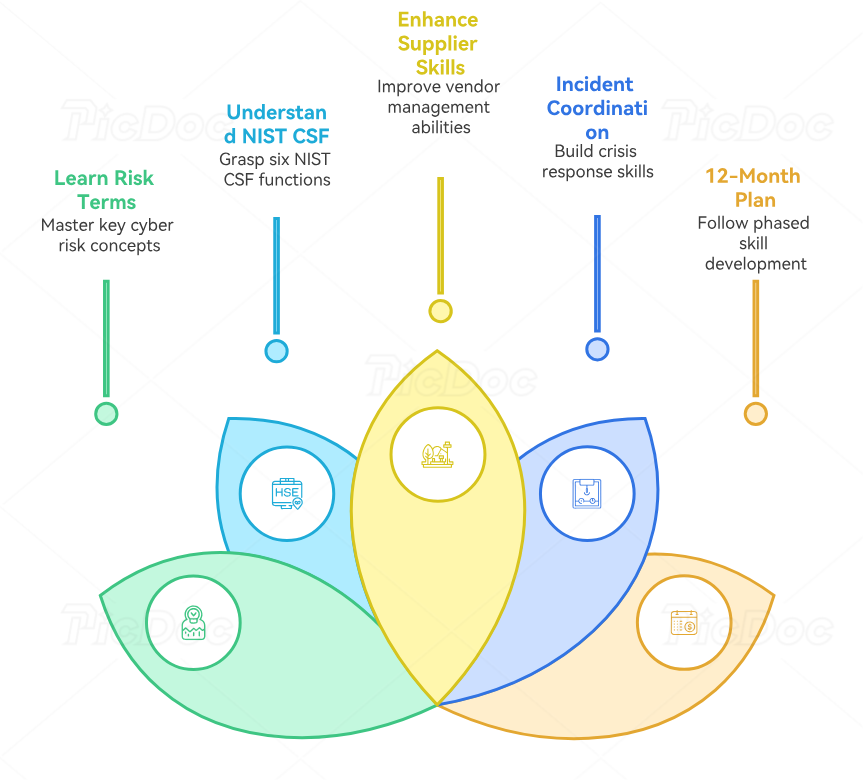
Understand the six NIST CSF functions
The NIST CSF 2.0 functions provide a useful mental model:
Govern: Establish strategy, policy, roles, expectations, and oversight.
Identify: Understand assets, risks, dependencies, and current exposure.
Protect: Implement safeguards that reduce the likelihood or impact of compromise.
Detect: Discover suspicious activity and control failures.
Respond: Contain and manage cybersecurity incidents.
Recover: Restore capabilities and improve resilience.
NIST presents these six functions as a comprehensive view for managing cybersecurity risk across organizations.
A PM can map project deliverables against these functions and identify where the plan is concentrated too heavily. Some projects fund protection controls while neglecting detection, response, or recovery. Others write policies under Govern without delivering the operational capability required to enforce them.
Connect the functions with project-execution terminology, monitoring controls, closure planning, and project governance.
Build stronger supplier and commercial skills
Cybersecurity projects can depend heavily on vendors, managed-service providers, consultants, cloud platforms, testing firms, and software manufacturers. PMs need to understand statements of work, service levels, acceptance, change mechanisms, liability allocation, audit rights, subcontracting, data ownership, incident support, and termination assistance.
Use vendor-management terminology, RFP and RFQ controls, project financial management, and stakeholder engagement to turn security expectations into enforceable delivery obligations.
Ask how the supplier will prove compliance. A promise to follow “best practices” lacks the specificity needed for acceptance or escalation.
Become confident with incident and crisis coordination
During an incident, teams may work with incomplete facts while technical, legal, regulatory, operational, customer, and reputational pressures rise simultaneously.
Project managers can contribute through role clarity, action tracking, decision logs, communication cadence, dependency coordination, evidence requests, vendor escalation, and recovery planning. The PM should preserve a verified timeline and distinguish confirmed facts from hypotheses.
Practice these capabilities through conflict-resolution methods, leadership communication, project reporting, and risk-response planning.
Follow a 12-month cybersecurity development plan
Months 1–3: Study a recognized cybersecurity framework and map one existing project against Govern, Identify, Protect, Detect, Respond, and Recover. Build a data inventory, risk register, security RACI, and regulatory obligation list using project templates, risk-register guidance, requirements practices, and stakeholder controls.
Months 4–6: Participate in threat modelling, architecture review, supplier assessment, vulnerability triage, or security testing. Learn how findings are rated, treated, verified, and accepted. Connect that experience with quality management, project monitoring, vendor management, and change control.
Months 7–9: Lead a cyber-related workstream such as access remediation, cloud-security improvement, secure-software adoption, audit remediation, recovery testing, supplier-risk reduction, or AI governance. Build a schedule, budget, status report, and decision log through Gantt planning, financial controls, resource allocation, and project reporting.
Months 10–12: Run an incident tabletop or recovery exercise. Present the resulting capability gaps to leadership with prioritized actions, owners, investment requirements, and risk consequences. Use executive communication, project governance, portfolio prioritization, and future leadership practices.
5. What Strong Cybersecurity Project Leadership Will Look Like in 2027
Strong cybersecurity project leadership will be visible through decision quality rather than technical vocabulary. Executives will value PMs who can expose cyber consequences early, preserve accountability, protect critical controls during schedule pressure, and translate specialist findings into business choices.
Cyber-ready PMs will challenge unsafe assumptions
Examples include:
A supplier’s certification proves every project-specific control
A cloud service automatically transfers all security responsibility
Encryption resolves weak access governance
A passed penetration test proves long-term security
An approved exception can remain open indefinitely
A backup guarantees recoverability
A high-risk finding can be closed without verification
A launch date carries greater authority than the risk owner
Challenge these assumptions using requirements evidence, risk-response analysis, quality-control principles, and governance escalation.
PMs will translate security findings into executive decisions
A technical report might describe insecure configuration, insufficient logging, excessive privileges, unsupported software, or weak recovery capability. An executive decision brief should explain:
Which objective is exposed
Which systems, users, or customers are affected
The credible operational and financial consequences
The deadline for action
Available treatment options
Cost and schedule impacts
Recommended action
Required decision owner
Consequence of delay
This format combines project reporting, financial-management principles, stakeholder engagement, and leadership communication.
PMOs will aggregate cyber risk across portfolios
Individual projects may report acceptable exposure while creating dangerous collective dependencies. A portfolio can contain several initiatives competing for the same security architects, using the same cloud provider, relying on the same identity platform, or postponing remediation to the same quarter.
Future PMOs will need portfolio views covering shared suppliers, control debt, regulatory deadlines, unsupported technology, specialist capacity, incident readiness, open exceptions, recovery evidence, and concentration risk.
NIST’s CSF 2.0 emphasis on governance and supply-chain risk supports this broader organizational view, while CISA’s updated Cross-Sector Cybersecurity Performance Goals provide prioritized baseline practices aligned with the CSF 2.0 functions.
Develop this capability through PMO evolution, portfolio-management trends, resource-allocation methods, and AI-enabled PM software.
Career value will come from combined delivery and security literacy
Cybersecurity specialists understand threats, controls, architecture, incidents, and vulnerabilities. Project managers understand delivery integration, resources, budgets, schedules, governance, vendors, stakeholders, and organizational change.
Professionals who combine these perspectives can pursue roles such as:
Cybersecurity project manager
Security transformation manager
Digital resilience program manager
Identity and access program manager
Cloud-security project manager
Cyber-risk remediation lead
Security PMO manager
Operational-resilience manager
Secure-software program manager
AI governance project manager
Third-party cyber-risk program manager
Cyber portfolio director
Build the career foundation through future PM skills, AI career transformation, project leadership trends, and evolving certification expectations.
By 2027, the strongest PMs will ensure that security decisions are made while the organization still has affordable choices. Their projects will contain traceable requirements, funded controls, tested recovery, enforceable supplier obligations, prepared incident teams, and clearly accepted residual risk.
6. FAQs About Cybersecurity and Project Management by 2027
-
Every PM handling systems, data, digital suppliers, connected products, operational technology, customer information, AI, cloud services, or regulatory obligations needs practical cybersecurity literacy.
The depth will vary by project. A cybersecurity program manager requires greater technical fluency than an event PM using a standard software platform. Both should understand access, data sensitivity, supplier risk, incidents, recovery, and escalation.
Develop foundational capability through cybersecurity project trends, risk mitigation, vendor management, and project governance.
-
Risk acceptance should sit with an accountable person who possesses appropriate authority, business ownership, and understanding of the consequences. The PM’s role usually includes coordinating analysis, documenting options, confirming treatment costs, escalating exposure, and recording the authorized decision.
Create a responsibility matrix that distinguishes risk owner, control owner, action owner, technical adviser, verifier, and acceptance authority. Support it with stakeholder-engagement practices, risk-register terminology, project reporting, and governance controls.
-
Cybersecurity should enter during concept development and business-case preparation. Early involvement helps the organization understand data, threats, regulatory scope, supplier requirements, architecture constraints, security costs, and resilience needs before approval.
Security activities should continue through requirements, design, procurement, development, testing, launch, transition, and post-launch assurance. Integrate them through requirements engineering, project execution, quality management, and project closure.
-
Useful project evidence can include a data inventory, security RACI, regulatory obligation register, threat model, security requirements matrix, cyber-risk register, supplier assessment, software inventory, security test plan, vulnerability tracker, incident-response plan, recovery test results, exception log, and operational handover pack.
The exact set should match project exposure. Build it through project templates, risk-register guidance, project reporting standards, and ISO-related terminology.
-
The schedule should include threat modelling, security requirements, architecture approval, supplier review, secure configuration, testing, remediation, retesting, risk acceptance, recovery exercises, operational readiness, and post-launch reviews.
Model the dependencies between these activities. A penetration test may require a stable environment. Retesting depends on remediation. Launch approval depends on evidence review and residual-risk decisions.
Protect these dependencies using Gantt-chart planning, schedule-compression controls, resource allocation, and project monitoring.
-
Ask vendors to explain their security responsibilities, control evidence, component visibility, vulnerability process, update policy, incident-notification timeline, subcontractors, data locations, recovery capability, audit support, end-of-life policy, and exit assistance.
Convert accepted commitments into contracts, delivery milestones, acceptance criteria, service levels, and reporting obligations. Apply vendor-management practices, RFP and RFQ terminology, financial controls, and stakeholder accountability.
