
Step-by-Step Guide: Moving from Business Analyst to Project Manager (2026 Edition)
Business analysts already possess many capabilities that determine project success: clarifying needs, identifying process failures, managing stakeholders, evaluating options, and translating ambiguity into usable requirements. The move into project management expands that responsibility from defining the right solution to coordinating its complete delivery. In 2026, a credible transition requires stronger command of project execution, resource allocation, risk response planning, and project monitoring and control. This guide explains how to close those gaps systematically and prove your readiness through measurable delivery experience.
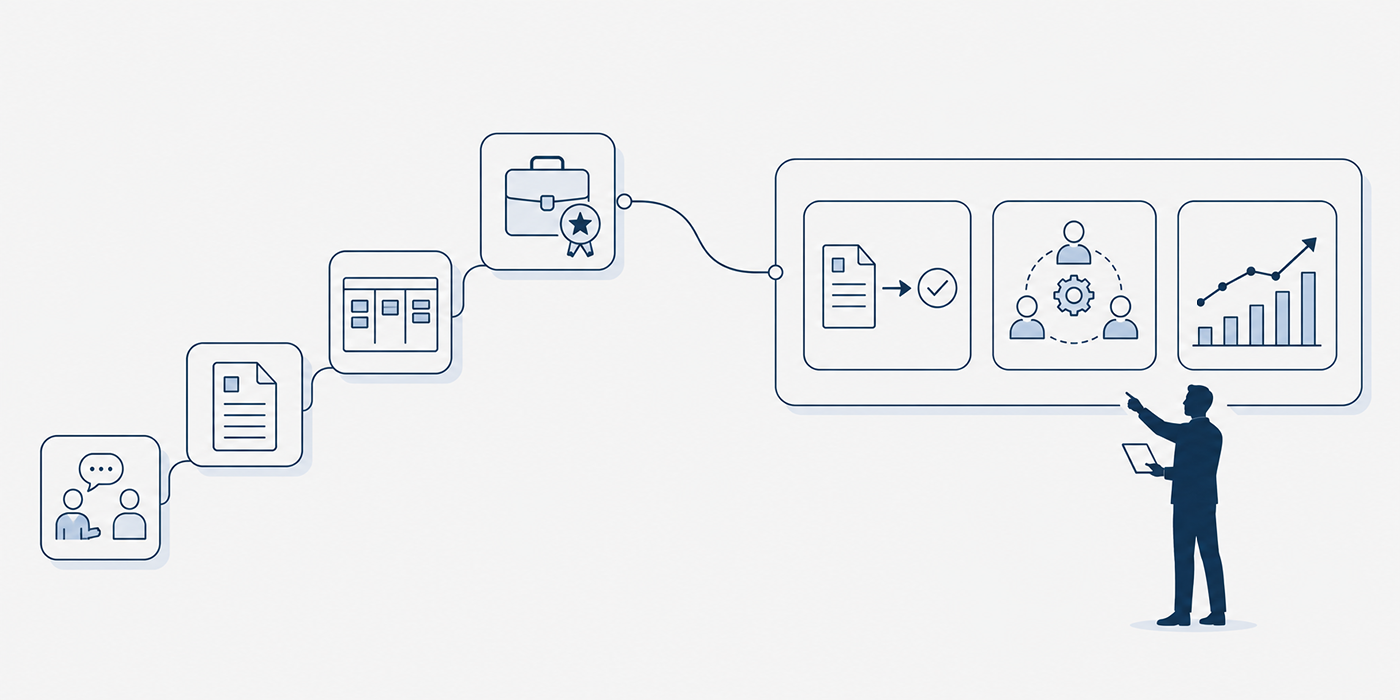
1. Understand How the Business Analyst and Project Manager Roles Differ
Business analysts concentrate on understanding organizational needs, defining problems, documenting requirements, evaluating processes, and helping stakeholders agree on the desired solution. Their work is closely connected to requirements engineering, business analysis certification preparation, stakeholder engagement, and conflict resolution. A strong analyst protects the organization from investing in poorly understood problems, incomplete requirements, and solutions that fail to address the original business need.
Project managers assume wider delivery accountability. They coordinate scope, budget, schedule, people, suppliers, dependencies, quality, risks, governance, and executive reporting. They must understand the solution being delivered while continuously balancing competing constraints. Knowledge of project execution terminology, project financial management, schedule-compression techniques, and project reporting practices becomes essential because project managers are judged on coordinated delivery rather than analysis quality alone.
The most important transition concerns decision ownership. Business analysts typically investigate options, clarify consequences, and support recommendations. Project managers must convert decisions into funded actions, assign ownership, protect deadlines, escalate unresolved issues, and maintain momentum when stakeholders disagree. Your analytical judgment remains valuable, though it must be combined with project governance, risk-register management, resource planning, and leadership communication. Employers need evidence that you can move work forward after the analysis phase ends.
Another difference concerns incomplete information. Analysts often work toward greater clarity before requirements are approved. Project managers frequently need to act while scope, estimates, risks, stakeholder availability, or supplier commitments remain uncertain. This requires structured judgment rather than constant certainty. Familiarity with Agile project management terms, Waterfall delivery concepts, hybrid project management, and Agile estimation techniques helps you select an appropriate planning approach instead of waiting for perfect information.
The BA-to-PM move also changes your relationship with conflict. Analysts commonly mediate disagreement about requirements, priorities, or process design. Project managers face additional conflicts involving deadlines, budgets, resource ownership, supplier obligations, quality expectations, and executive commitments. Your background in stakeholder-engagement terminology, requirements traceability, conflict-resolution methods, and project leadership communication gives you an advantage, provided you learn to resolve conflict through clear decisions, ownership, and escalation.
Many analysts underestimate the financial dimension of project management. Requirements decisions affect effort, procurement, implementation cost, training, support, and expected benefits. A project manager must understand how these decisions change the approved business case. Building fluency in earned value management, project financial terminology, cost-professional principles, and global budget pressures will help you connect scope changes to cost exposure, forecast movement, and delayed benefits.
Your first objective should therefore be broader than changing your job title. You need to demonstrate that you can carry a business need through planning, execution, control, handover, and closure. That means expanding your current strengths in business analysis and requirements management while acquiring visible experience in project execution and project closure. The transition becomes credible when employers can see complete delivery responsibility in your evidence.
| Capability | Existing BA Advantage | PM-Level Capability Required | Practical Evidence to Build | Common Transition Risk |
|---|---|---|---|---|
| Requirements management | Experienced in elicitation, documentation, validation, and traceability. | Control requirements throughout planning, delivery, acceptance, and change. | Requirements baseline connected to schedule, cost, testing, and ownership. | Continuing to analyze after delivery decisions are required. |
| Execution planning | Understands solution scope and business dependencies. | Convert scope into work packages, owners, dates, controls, and deliverables. | Integrated project plan with milestones and accountable owners. | Producing excellent requirements without an executable delivery plan. |
| Schedule development | Can identify process steps and logical dependencies. | Estimate duration, sequence work, manage critical paths, and update forecasts. | Baseline schedule with dependencies, constraints, and variance reporting. | Treating milestone dates as fixed inputs rather than managed commitments. |
| Resource allocation | Knows which subject-matter experts and users are required. | Balance availability, capability, workload, cost, and competing priorities. | Resource plan showing demand, capacity, gaps, and escalation points. | Assuming stakeholder availability without obtaining commitments. |
| Budget management | Can evaluate business needs and expected benefits. | Track approved budget, actual cost, commitments, forecast, and variance. | Monthly budget report with corrective actions and forecast-at-completion. | Viewing financial management as the finance team’s responsibility. |
| Performance measurement | Comfortable interpreting business data and operational measures. | Integrate scope, schedule, cost, quality, risk, and benefit indicators. | Project dashboard with leading and lagging measures. | Reporting activity volume instead of delivery health. |
| Risk management | Identifies requirement, process, stakeholder, and solution risks. | Assign ownership, quantify exposure, fund responses, and monitor triggers. | Prioritized risk register linked to schedule and budget consequences. | Recording risks without securing action or escalation. |
| Contingency planning | Can evaluate alternative processes and solution scenarios. | Prepare fallback options, response budgets, triggers, and recovery actions. | Contingency plan for the project’s highest-consequence risks. | Assuming mitigation eliminates the possibility of disruption. |
| Governance design | Understands stakeholder roles and approval needs. | Define decision rights, reporting forums, thresholds, and escalation routes. | Governance map and steering-committee charter. | Sending every issue to every stakeholder. |
| Stakeholder leadership | Strong in interviews, workshops, facilitation, and expectation discovery. | Secure commitments, manage resistance, and enforce accountable decisions. | Stakeholder plan tied to milestones, approvals, and adoption. | Prioritizing harmony when firm decisions are needed. |
| Conflict resolution | Experienced in reconciling competing business requirements. | Resolve disputes involving scope, budget, ownership, deadlines, and quality. | Decision log showing trade-offs, owners, and agreed consequences. | Reopening settled decisions whenever resistance appears. |
| Executive reporting | Can organize complex findings and communicate business context. | Present exposure, decisions, trends, and recommendations concisely. | One-page executive status report. | Providing detail without clarifying the decision required. |
| Supplier management | May contribute to solution evaluation and vendor requirements. | Manage deliverables, service levels, dependencies, disputes, and corrective action. | Supplier scorecard linked to contract commitments. | Relying on informal vendor assurances. |
| Procurement involvement | Can define functional and operational requirements. | Support sourcing strategy, evaluation, contracting, and delivery governance. | RFP package and weighted supplier-evaluation model. | Leaving acceptance criteria vague during procurement. |
| Quality management | Can define expected outcomes and acceptance conditions. | Plan quality assurance, control, defect handling, and corrective action. | Quality plan with standards, reviews, and defect thresholds. | Assuming testing alone provides quality assurance. |
| Compliance integration | Understands policy, process, and regulatory requirements. | Embed compliance responsibilities, evidence, and approvals into delivery. | Compliance matrix linked to work packages and accountable owners. | Treating compliance review as an end-stage activity. |
| Agile delivery | Can translate user needs into stories, acceptance criteria, and priorities. | Coordinate releases, dependencies, governance, risk, and stakeholder expectations. | Release roadmap with measurable outcomes and decision points. | Equating Agile delivery with an absence of planning. |
| Scrum coordination | May already support backlog refinement and user-story development. | Coordinate cross-team dependencies, external commitments, and executive visibility. | Dependency board and integrated release plan. | Focusing exclusively on ceremonies. |
| Predictive delivery | Skilled in detailed documentation and baseline requirements. | Manage stage gates, sequential dependencies, approvals, and contractual controls. | Stage-gate plan with entry and exit criteria. | Assuming approved requirements will remain unchanged. |
| Hybrid management | Can work across structured analysis and iterative discovery. | Tailor governance and planning methods to different workstreams. | Hybrid delivery model explaining where each control applies. | Creating inconsistent rules that confuse teams. |
| Priority management | Experienced in ranking requirements by value and stakeholder need. | Balance value with urgency, capacity, dependency, cost, and risk. | Prioritization model accepted by project sponsors. | Allowing the most vocal stakeholder to control priority. |
| Team capacity planning | Understands which skills are necessary for analysis and validation. | Forecast demand, availability, capability gaps, and workload conflicts. | Capacity forecast covering the complete delivery lifecycle. | Planning tasks before confirming team capacity. |
| Team communication | Experienced in workshops, documentation, and stakeholder communication. | Create communication routines that support decisions, coordination, and escalation. | Communication plan with audience, purpose, owner, and cadence. | Using more meetings to solve unclear accountability. |
| Project technology | Often familiar with process tools, requirement platforms, and data systems. | Configure integrated planning, reporting, workflow, and collaboration tools. | Tool architecture supporting one version of project truth. | Choosing software before defining the operating process. |
| AI-assisted management | Can evaluate information quality and identify patterns. | Use AI responsibly for forecasting, documentation, analysis, and reporting. | AI workflow with human review and data-control requirements. | Trusting generated outputs without validation. |
| Project closure | Can confirm requirements and business acceptance. | Complete handover, financial closure, lessons, contracts, and benefit ownership. | Closure report with operational owners and unresolved obligations. | Leaving after implementation without securing operational adoption. |
| Portfolio awareness | Understands how business needs connect to strategic priorities. | Recognize resource competition, strategic alignment, dependencies, and portfolio trade-offs. | Portfolio impact assessment for a proposed project. | Optimizing one project at the expense of higher-priority work. |
| Leadership presence | Can facilitate groups and explain complex information clearly. | Set direction, challenge assumptions, enforce ownership, and maintain confidence. | Evidence of leading cross-functional decisions under pressure. | Remaining in a neutral facilitator role when leadership is required. |
2. Audit Your Transferable Skills and Identify the Gaps That Could Block Your Promotion
Begin by separating transferable strengths from PM-specific evidence. Your experience with requirements engineering, business analysis techniques, stakeholder engagement, and conflict resolution gives you a meaningful head start. However, hiring managers will still ask whether you have managed schedules, budgets, delivery teams, suppliers, risks, and executive reporting. Every capability claim should therefore be supported by a specific example, measurable outcome, or artifact.
Create an eight-category readiness audit covering scope, schedule, cost, risk, resources, governance, leadership, and closure. Score each category from one to five, then attach evidence to each score. A five in scope management should demonstrate more than writing requirements. It should show experience controlling changes, protecting baselines, and connecting decisions to delivery impact. Use the standards implied by project execution terminology, schedule management, financial management, and project monitoring when judging your evidence.
Schedule management is often the first major gap. Analysts understand dependencies at the requirement or process level, though they may have limited experience estimating duration, sequencing work, maintaining baselines, or forecasting delays. Develop this capability through Gantt-chart terminology, schedule-compression methods, Agile estimation techniques, and sprint-planning concepts. Volunteer to own an integrated milestone plan and report forecast changes rather than merely updating completed activities.
Financial control is another frequent weakness. A business analyst may contribute to benefits estimates or option appraisals while remaining separate from ongoing budget management. Ask to track actual expenditure, committed cost, forecast-at-completion, contingency use, and the financial effect of changes. Study project financial-management concepts, earned value measures, cost-professional principles, and project estimation trends. Your goal is to explain why the forecast moved and which action can protect the business case.
Resource leadership requires similar development. Analysts coordinate stakeholder input, whereas project managers must secure sustained commitments from team members who often report to different functional leaders. Learn to identify over-allocation, missing capabilities, competing deadlines, and the cost of delayed staffing. Apply resource-allocation methods, workforce-management principles, team communication platforms, and leadership communication practices. Strong PM evidence shows that you negotiated resources, managed workload conflicts, and protected critical-path activities.
Governance experience can accelerate the transition because analysts often already understand approvals and stakeholder structures. Expand this strength by owning meeting design, decision logs, escalation thresholds, status reporting, and steering-committee preparation. Develop your approach through project-governance trends, PMO operating models, executive reporting practices, and portfolio-management principles. A useful governance process should accelerate decisions, expose problems early, and make accountability difficult to avoid.
Your final audit should identify the two gaps most likely to prevent promotion. Do not pursue ten development goals simultaneously. A BA with strong facilitation and requirements experience may need immediate exposure to schedule and budget ownership. Another analyst may already coordinate delivery and need stronger leadership presence or risk management. Select practical assignments using risk-mitigation guidance, project-monitoring controls, project closure concepts, and future PM competencies. Focused evidence closes credibility gaps faster than broad theoretical study.
3. Follow a Structured 12-Month BA-to-PM Transition Plan
During months one and two, make your career intention visible. Tell your manager that you want to progress toward project management and request responsibility for a contained delivery component. Suitable assignments include coordinating a discovery phase, managing a workstream, controlling a requirement release, or leading user-acceptance preparation. Use requirements-management expertise, stakeholder-engagement skills, project execution principles, and project reporting techniques to prove that you can manage an outcome rather than support one activity.
During months two through four, take ownership of a delivery plan. Break the workstream into deliverables, tasks, dependencies, owners, dates, and decision points. Establish a baseline, agree on update responsibilities, and report forecast changes with reasons. Strengthen your approach through Gantt-chart concepts, schedule-compression terminology, Agile estimation methods, and sprint-planning practices. Avoid building a detailed plan that the delivery team neither understands nor owns.
During months three through six, add risk and issue ownership. Facilitate a focused risk workshop, rewrite vague risk statements, identify causes and consequences, assign owners, and establish response deadlines. Connect significant risks to schedule, budget, scope, quality, or benefits. Use risk-register guidance, risk-response terminology, project monitoring controls, and stakeholder-engagement methods. Your value appears when risks trigger preventive action before they become expensive project issues.
During months five through eight, gain financial exposure. Ask to assist with monthly forecasting, supplier costs, change estimates, contingency reviews, or benefits tracking. Build a simple cost report showing approved budget, actuals, commitments, forecast, variance, and explanation. Apply project financial terminology, earned value concepts, cost-management principles, and vendor-management practices. Even partial budget ownership can significantly strengthen your candidacy when the evidence demonstrates sound judgment.
During months six through nine, lead governance activities. Prepare a steering pack, clarify decisions required, record commitments, follow up on actions, and escalate missed obligations. Evaluate whether existing meetings create decisions or merely repeat status information. Use governance best practices, executive-reporting principles, leadership communication terminology, and conflict-resolution frameworks. Effective governance should reduce ambiguity and strengthen the pace of execution.
During months eight through twelve, manage a complete low-to-medium-risk project or substantial project phase. Take responsibility for initiation, planning, execution, monitoring, handover, and closure. This creates stronger evidence than contributing small PM tasks across unrelated initiatives. Apply project execution controls, quality-management terminology, project closure practices, and resource-allocation methods. Document the baseline, major decisions, results, unresolved obligations, and lessons transferred into future work.
By the end of month twelve, you should possess a transition portfolio containing a charter, schedule, budget report, risk register, stakeholder plan, governance pack, status report, change log, and closure report. Templates can be informed by project management resources, project reporting standards, risk-register guidance, and project closure terminology. Remove confidential information while preserving the complexity, decisions, and outcomes that demonstrate your capability.
What Is the Biggest Barrier Between You and Your First Project Manager Role?
4. Build Practical Experience, Credentials, and a Portfolio That Prove PM Readiness
Practical evidence should lead your transition strategy. Volunteer for work where delivery has a clear start, finish, owner, budget, risk profile, and measurable result. Internal system upgrades, compliance remediation, office relocations, process redesigns, customer-onboarding improvements, and reporting transformations can all produce credible experience. Manage them through project execution controls, risk-response planning, resource-allocation practices, and project closure methods. The project’s size matters less than the completeness of your accountability.
Your portfolio should contain short case studies rather than a collection of empty templates. For each project, explain the business problem, delivery objective, scope, constraints, stakeholders, risks, decisions, and measurable outcome. Include sanitized examples of a schedule, risk register, status report, change log, and closure record. Use project management templates, project reporting terminology, risk-register guidance, and monitoring and control practices to make the evidence coherent and professional.
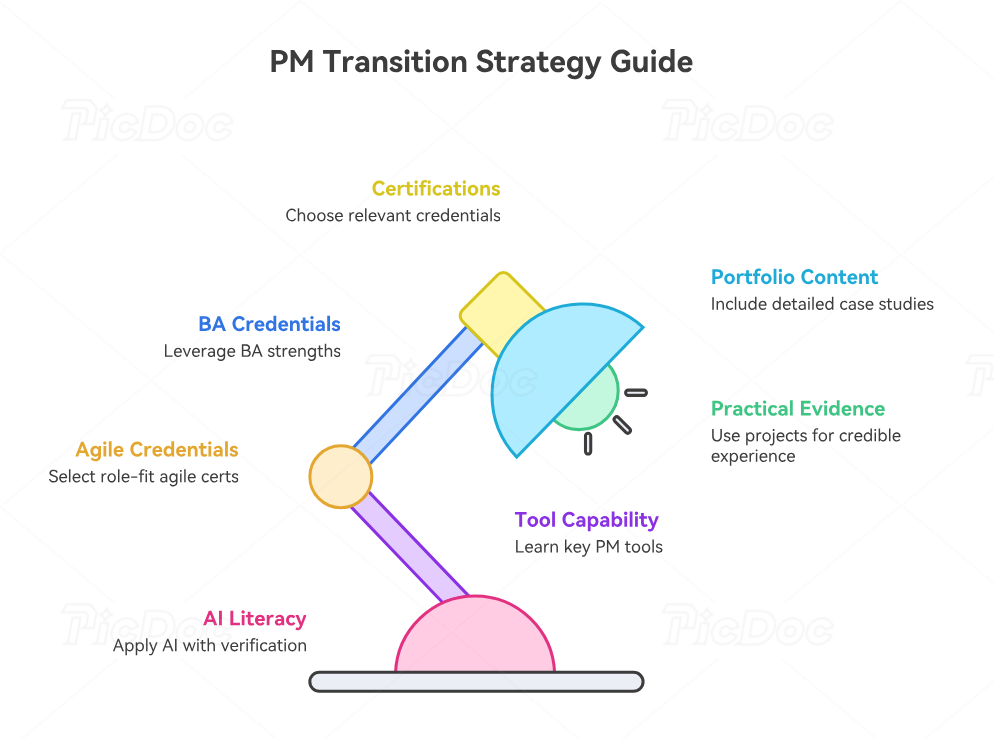
Certifications should reinforce experience rather than replace it. A foundational credential can help analysts organize their knowledge of scope, schedule, cost, risk, quality, resources, and governance. More advanced certifications become relevant once experience requirements are met. Review CAPM preparation resources, CAPM exam mistakes, CAPM career advancement, and PMP exam domains before choosing a path. Select the credential that addresses a genuine market or capability gap.
Your existing BA credentials remain useful. They can distinguish you from PM candidates who struggle with discovery, requirements quality, business cases, or adoption. Strengthen that advantage through PMI-PBA preparation, CPRE certification guidance, requirements traceability, and stakeholder-engagement methods. Position yourself as a project manager who can protect delivery from misunderstood needs, uncontrolled scope, and weak acceptance criteria.
Agile credentials may be valuable when your target roles involve digital products, software, iterative delivery, or cross-functional product teams. Compare PMI-ACP, CSM, and SAFe options, review the SAFe Agilist certification guide, study the Agile project management glossary, and master Scrum terminology. Choose according to your work environment and target employers rather than selecting the most recognizable acronym.
Tool capability should also appear in your development plan. Learn one scheduling platform, one collaborative work-management system, one dashboard or reporting tool, and the project systems used in your industry. Understand configuration, workflow, permissions, integrations, data quality, and reporting limitations. Explore future project management software, project management APIs, team communication platforms, and project management templates. Employers value tool fluency when it improves planning quality and decision visibility.
AI literacy is increasingly relevant to project work, though your value will depend on disciplined application. Use AI to accelerate meeting summaries, risk categorization, first-draft documentation, trend analysis, and reporting preparation while maintaining human verification. Study AI innovation in project management, automation’s impact on PM careers, machine-learning applications, and future PM competencies. Demonstrate judgment around privacy, accuracy, source validation, and decision accountability.
5. Position Yourself for PM Roles and Succeed During Your First 90 Days
Your resume should show progression from analysis support to delivery ownership. Replace duty-based statements with evidence of plans managed, risks controlled, decisions facilitated, resources coordinated, or outcomes delivered. “Documented requirements for a CRM implementation” can become a stronger achievement when it explains how requirements control reduced change, supported delivery planning, and improved acceptance. Use language informed by requirements engineering, project execution, project financial management, and stakeholder engagement.
Create a transition summary near the top of your resume. State your BA experience, industries, delivery methods, project exposure, and growing responsibility. Mention budgets supported, teams coordinated, suppliers managed, or governance forums led where accurate. Reinforce that narrative with Agile delivery knowledge, Waterfall project management, hybrid delivery expertise, and executive reporting capability. Accurate framing can prevent recruiters from overlooking PM-level work hidden beneath a BA title.
Prepare six interview stories covering scope control, schedule pressure, stakeholder conflict, risk response, resource constraints, and delivery recovery. Each story should explain the situation, your diagnosis, your decision, the actions coordinated, and the measurable result. Use the logic behind conflict-resolution terminology, risk-mitigation planning, resource-allocation methods, and monitoring and control. Interviewers need to hear how you behave when delivery conditions deteriorate.
Target roles that allow a credible first step. Project coordinator, associate project manager, junior project manager, implementation manager, workstream lead, delivery analyst, or business project manager may provide stronger progression than waiting indefinitely for a perfect title. Evaluate each role through its exposure to project governance, budget control, resource management, and project closure. Choose responsibility depth over an impressive title with limited authority.
During your first 30 days as a PM, validate the project’s purpose, scope, sponsorship, baseline, stakeholders, risks, dependencies, and decision structure. Review requirements quality, risk-register completeness, governance design, and project reporting controls. Your BA instincts will help you expose assumptions, though you should convert findings into decisions and corrective actions quickly.
During days 31 to 60, stabilize the delivery system. Confirm accountable owners, revise unrealistic dates, address critical resource gaps, improve reporting, and secure responses for major risks. Use schedule-management practices, resource-allocation terminology, risk-response planning, and leadership communication methods. Avoid proving yourself through excessive administration; focus on the controls that improve decisions and delivery reliability.
During days 61 to 90, demonstrate forward control. Improve forecast accuracy, close overdue decisions, resolve recurring blockers, and establish a credible path toward the next major milestone. Begin planning operational handover and benefit ownership before implementation approaches. Apply project monitoring, quality-management practices, project closure terminology, and stakeholder-engagement principles. A successful first quarter should leave sponsors with greater confidence in the project’s current position and future direction.
6. Frequently Asked Questions
-
Business analysis provides an excellent foundation because analysts already understand business needs, requirements, process dependencies, stakeholder interests, and acceptance conditions. Those capabilities support requirements engineering, stakeholder management, conflict resolution, and business-case thinking. The main development requirement is broader delivery ownership. You must add evidence in scheduling, budgeting, resource management, risk control, governance, supplier coordination, and project closure.
-
The strongest transferable skills include stakeholder interviewing, workshop facilitation, requirements analysis, process mapping, prioritization, problem-solving, documentation, and expectation management. These capabilities strengthen project scope control, requirements traceability, stakeholder engagement, and project reporting. To become PM-ready, connect each strength to delivery outcomes such as fewer changes, faster decisions, clearer ownership, improved adoption, or reduced rework.
-
A certification can strengthen foundational knowledge and help recruiters recognize your commitment, though practical delivery evidence carries greater weight. Analysts with limited PM experience may benefit from studying CAPM preparation resources, CAPM exam mistakes, CAPM career advancement, and PMP exam domains. Pair certification study with ownership of an internal project, workstream, or delivery phase.
-
Create the experience inside your current position. Ask to manage a contained initiative, coordinate an implementation phase, own a release plan, lead user-acceptance delivery, or run a process-improvement project. Manage the assignment through project execution practices, risk-register discipline, resource-allocation methods, and project closure controls. Document the full lifecycle so the assignment becomes credible interview evidence.
-
A project coordinator role can be useful when it provides meaningful exposure to plans, budgets, risks, governance, and delivery decisions. Review the responsibilities carefully because some coordinator positions remain heavily administrative. Strong stepping-stone roles should allow you to build experience in schedule management, project reporting, risk mitigation, and resource coordination. Select the role that expands accountability and offers a visible path toward complete project ownership.
-
A direct move is realistic when the analyst already manages workstreams, schedules, risks, stakeholder commitments, implementation activities, or delivery reporting. The job title matters less than the scope of existing responsibility. Strengthen your case through evidence in project execution, financial management, project governance, and project closure. Employers need confidence that you can coordinate the complete delivery system.
