
The Ultimate Guide to Getting Your Project Management Certification in Vietnam: All You Need to Know in 2026-2027
Vietnam’s project market is becoming more demanding because employers now need people who can control scope, manage vendors, report progress clearly, handle hybrid teams, and protect delivery under pressure. A project management certification helps when it turns your experience into recognized language, especially if you are moving from coordination, engineering, IT, construction, operations, finance, or business analysis into formal project roles.
For 2026-2027, the smartest path is choosing the right credential for your career stage, then backing it with practical skills from a strong project management career roadmap, clear project execution terms, sharp stakeholder engagement terms, and job-ready project reporting best practices.

1. Why Project Management Certification Matters in Vietnam in 2026-2027
Project management certification matters in Vietnam because the work itself is becoming more complex. Infrastructure, technology, banking, logistics, manufacturing, healthcare, real estate, education, public-sector modernization, and outsourcing projects all create the same painful problem: many teams have activity, meetings, and deadlines, yet weak project control causes delays, unclear ownership, budget pressure, missed requirements, and endless stakeholder confusion. A strong candidate who understands risk register examples, resource allocation terms, project monitoring and control terms, and project closure concepts becomes easier for employers to trust.
Certification also helps Vietnamese professionals translate local experience into global hiring language. A construction coordinator in Ho Chi Minh City, an IT business analyst in Hanoi, a PMO associate in Da Nang, or a manufacturing operations lead in Binh Duong may already manage timelines, suppliers, reports, risks, and stakeholders. The issue is packaging that experience in a way recruiters understand. Certifications such as CAPM, PMP, PRINCE2, PMI-ACP, Scrum Master credentials, and agile training can support that packaging when paired with real evidence from IT project management careers, construction project management pathways, healthcare project manager roles, and government project management careers.
The mistake many candidates make is choosing a certification because it sounds famous. A junior candidate may rush toward PMP before building enough documented experience. A technical professional may choose Scrum while applying for formal construction or infrastructure roles that need stronger governance language. A coordinator may study tools without learning Gantt chart terms, schedule compression terms, vendor management terms, and RFP, RFQ, and RFI terms. Certification should fit the job market you want, the experience you can prove, and the type of projects you want to manage.
| Career Situation | Best Certification Direction | Why It Fits Vietnam | Risk To Avoid | APMIC Resource |
|---|---|---|---|---|
| New graduate | CAPM or foundational PM training | Builds project language before formal management experience. | Chasing senior credentials before proving delivery exposure. | Project manager roadmap |
| Project coordinator | CAPM, then PMP once experience is documented | Fits scheduling, follow-up, reporting, and stakeholder support roles. | Undervaluing coordination work as certification evidence. | Entry-level to executive guide |
| Experienced project lead | PMP | Useful for senior roles, PMO jobs, cross-border teams, and enterprise projects. | Weak application documentation and vague project descriptions. | PMP exam domains |
| IT project manager | PMP plus agile or Scrum credential | Technology teams often need hybrid planning, delivery, and stakeholder control. | Learning Scrum vocabulary without delivery governance. | IT project manager guide |
| Scrum team member | CSM, PSM, or agile certification | Supports software, product, fintech, and digital transformation teams. | Confusing agile ceremonies with project leadership. | Certified Scrum Master guide |
| Product owner path | Product Owner or agile certification | Fits business value, backlog, stakeholder, and product delivery roles. | Writing features without requirement validation. | Product Owner roadmap |
| Agile coach path | Advanced agile plus coaching experience | Useful where teams adopt agile across departments. | Calling yourself a coach before proving facilitation results. | Agile coach career path |
| Construction professional | PMP, PRINCE2, or construction PM training | Infrastructure and real estate projects need scheduling, contracts, cost, and risk control. | Ignoring procurement, safety, claims, and change control language. | Construction PM guide |
| Healthcare project worker | PMP or healthcare PM pathway | Healthcare systems require compliance, stakeholder, data, and implementation discipline. | Using generic PM language without regulatory sensitivity. | Healthcare PM guide |
| Government or public projects | PMP, PRINCE2, governance-focused training | Public projects need documentation, accountability, procurement, and formal reporting. | Weak audit trail and unclear approval logic. | Government PM roadmap |
| PMO analyst | PMP, CAPM, PPM, or PMO training | Fits reporting, portfolio visibility, standards, and governance work. | Becoming a template admin instead of a decision-support professional. | Future PMO role |
| Portfolio manager path | PPM-focused certification after strong PM experience | Useful for organizations managing many transformation or investment projects. | Skipping benefits, prioritization, and capacity management. | Portfolio manager guide |
| Freelance PM | PMP plus niche proof | Helps clients trust delivery structure across remote or contract work. | Offering generic PM services without a sector focus. | Freelance PM career |
| Remote PM candidate | PMP, agile, tools, and reporting training | Remote employers need proof of asynchronous clarity and stakeholder control. | Depending on certification without communication evidence. | Remote PM roles |
| Consulting path | PMP plus portfolio, governance, or agile credentials | Consultants must diagnose, design, and improve project systems. | Selling advice before building case-study proof. | PM consultant path |
| Consultancy founder | PMP plus business, PMO, and niche specialization | Vietnam-based consultants can serve local and international clients. | Building a firm around credentials instead of outcomes. | PM consultancy firm |
| International career | PMP, PRINCE2, agile, and strong English project documentation | Global teams value recognized frameworks and clear reporting. | Missing cross-cultural communication and remote governance skills. | International PM guide |
| Project director goal | PMP, PPM, leadership, and governance training | Director roles require portfolio thinking, people leadership, and strategic control. | Staying too close to task management. | PM director roadmap |
| VP of PM goal | Executive PM, portfolio, governance, and finance skills | Senior leaders need business-case and organizational alignment skills. | Overfocusing on delivery tools instead of enterprise value. | VP of PM path |
| CPO ambition | Advanced portfolio, governance, strategy, and transformation leadership | Large organizations need project leadership tied to business direction. | Weak executive communication and benefits realization. | Chief Project Officer roadmap |
| AI transformation worker | PMP plus AI, automation, and change management knowledge | Digital initiatives need project managers who understand adoption and risk. | Using AI tools without governance and stakeholder alignment. | AI and project management |
| Software tool-heavy role | Agile, workflow, and PM software training | Teams need clean dashboards, workflows, and reporting discipline. | Learning tools without project judgment. | Future PM software |
| Kanban team member | Kanban or agile workflow training | Useful for operations, product, support, and continuous delivery teams. | Tracking work visually while ignoring bottleneck control. | Kanban PM terms |
| Risk-heavy role | PMP plus risk management practice | Large projects need early threat identification and response discipline. | Recording risks without owners, triggers, or response plans. | Risk mitigation terms |
| Finance-facing PM | PMP plus EVM and financial management practice | Budget pressure requires cost, variance, and forecast language. | Reporting spend without explaining delivery health. | EVM terms |
| Vendor-heavy PM | PMP, procurement, vendor, or contract management training | Vietnam projects often involve suppliers, contractors, partners, and external delivery teams. | Managing vendors informally without acceptance criteria. | Vendor management terms |
| Career switcher | CAPM, agile fundamentals, and project portfolio proof | Helps convert operations, admin, engineering, or analyst work into project language. | Listing certification without showing transferable project evidence. | Freelance PM roadmap |
| Long-term growth | Certification ladder: CAPM → PMP → specialization → leadership | Supports a career from team support to strategic delivery leadership. | Taking random exams without a role-based plan. | Future PM skills |
2. Choose the Right Certification Path for Your Vietnam Career Stage
For Vietnam-based beginners, CAPM is usually the cleanest entry route because it builds vocabulary, project structure, predictive planning, agile awareness, and business analysis basics. It fits students, fresh graduates, coordinators, admin professionals, junior analysts, and career switchers who need recognized proof before they have years of leadership experience. To make CAPM useful, connect it with complete agile project management terms, waterfall project management definitions, essential agile metrics, and product backlog definitions. The value comes from applying the language to actual work, not collecting a badge for your LinkedIn profile.
For experienced professionals, PMP is the strongest global signal because it validates experience leading and managing projects. In Vietnam, PMP can be useful for senior project manager roles, PMO positions, international employers, infrastructure contractors, technology firms, financial services, energy projects, consulting firms, and regional delivery teams. The catch is documentation. Candidates need to describe their real project responsibilities clearly: scope, schedule, team coordination, risk, budget, stakeholders, deliverables, and outcomes. Use PMP exam preparation resources, PMP exam mistakes guidance, PMP exam domain guidance, and PMP certification renewal guidance to plan the credential properly.
Agile and Scrum credentials fit Vietnam’s technology, product, fintech, software outsourcing, startup, and transformation environments. A Scrum Master credential helps if your target roles involve sprint planning, daily coordination, retrospectives, impediment removal, and team facilitation. A Product Owner path helps if your work centers on user needs, backlog priority, acceptance criteria, and business value. Still, agile certifications should be tied to delivery results. Study Scrum glossary terms, sprint planning terminology, agile estimation techniques, and Scrum Master career steps so the certification becomes practical workplace language.
PRINCE2 can be useful for candidates targeting structured governance, public-sector work, international organizations, supplier-heavy projects, or roles where stage control and documentation matter. It teaches controlled project environments and can support professionals who work with formal approvals, business cases, boards, suppliers, and stage boundaries. PMP and PRINCE2 can also complement each other: PMP shows broad project leadership knowledge, while PRINCE2 gives a governance method. Candidates comparing both should also learn project governance trends, project reporting best practices, stakeholder engagement terms, and project closure concepts.
3. Build Your Study and Application Plan Without Wasting Money
The fastest way to waste money is buying a course before deciding which job you want. A Vietnam-based candidate should start with role targeting: junior project coordinator, IT project manager, construction project manager, PMO analyst, Scrum Master, Product Owner, program coordinator, consultant, or remote project manager. Each target role changes the certification decision. A coordinator may need CAPM plus project execution terms. An IT PM may need PMP plus best Scrum project management tools. A construction PM may need stronger schedule compression terms and vendor management terms.
Your study plan should have three layers: eligibility, exam readiness, and job translation. Eligibility means gathering education records, training hours, project descriptions, and application details. Exam readiness means mastering domains, practicing questions, reviewing weak areas, and handling time pressure. Job translation means turning study topics into resume bullets, interview stories, and work samples. This is where many candidates fail. They pass an exam, then still sound vague in interviews. Build proof around project reporting terms, risk response planning, resource allocation concepts, and earned value management terms.
A smart 8- to 12-week plan works for many candidates. Weeks 1-2 should cover the certification guide, eligibility, domain map, and baseline practice test. Weeks 3-6 should focus on core knowledge: scope, schedule, cost, quality, risk, stakeholders, communication, procurement, agile, and business analysis. Weeks 7-9 should emphasize mock exams, missed-question logs, formulas, scenario reading, and weak-area repair. Weeks 10-12 should focus on final review, application cleanup, interview stories, and career positioning. Support each stage with PMP success stories, project management templates, team communication platforms, and project management software trends.
The right certification decision depends on your current role, target industry, proof of experience, budget, English comfort, and timeline.
4. Prepare for Exams, Evidence, Interviews, and Real Vietnamese Workplace Use
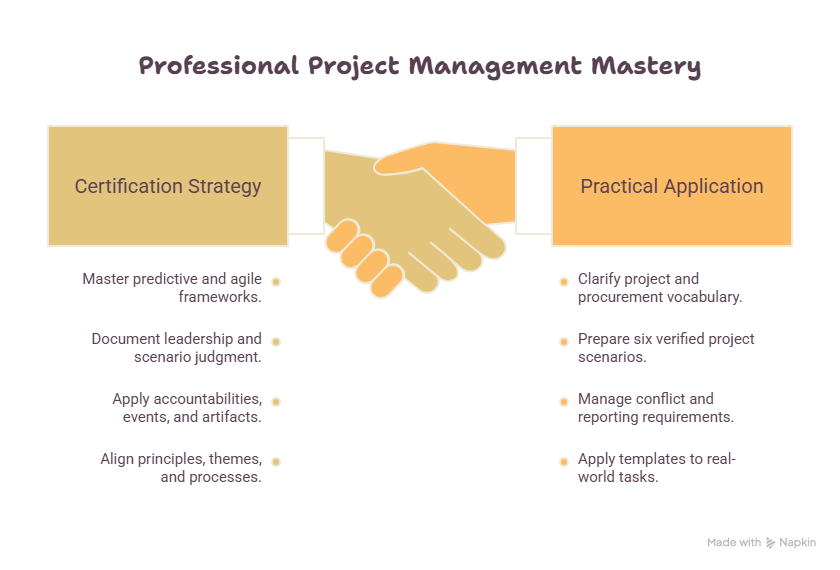
Certification preparation should improve your exam score and your workplace credibility at the same time. For CAPM, that means understanding fundamentals, predictive approaches, agile frameworks, and business analysis. For PMP, it means documenting leadership experience and practicing scenario judgment. For Scrum credentials, it means understanding accountabilities, events, artifacts, commitments, and servant leadership. For PRINCE2, it means understanding principles, themes, processes, business justification, and stage control. Tie every exam topic to project execution terminology, agile project management terms, project financial management terms, and quality management terms.
Vietnam-based candidates should pay extra attention to English project language. Many global certifications use wording that can confuse even capable professionals. Terms like assumption, constraint, issue, risk, stakeholder, deliverable, benefit, acceptance, escalation, backlog, baseline, variance, and procurement need practical clarity. Build a bilingual study sheet if helpful, but practice final answers in English if your exam uses English. Strong vocabulary comes from repeated exposure to risk register terminology, project reporting language, stakeholder engagement terms, and conflict resolution terms.
For interviews, prepare six evidence stories before you apply for better roles. Story one: a delayed project you helped recover. Story two: a difficult stakeholder you managed. Story three: a risk you identified early. Story four: a vendor or supplier issue you helped resolve. Story five: a requirement or scope problem you clarified. Story six: a report or dashboard that improved decision-making. These stories make certification credible. They also align with vendor and supplier management, project monitoring and control, resource allocation concepts, and project management templates.
5. Turn Certification into Jobs, Promotions, and Cross-Border Opportunities
The biggest career mistake is stopping after passing the exam. Certification gives you a signal; your next job still needs evidence. Update your resume with measurable project language: budget range, timeline, team size, stakeholder groups, tools used, risk outcomes, reporting cadence, vendor coordination, process improvements, and business results. A Vietnam-based professional targeting international employers should show comfort with remote communication, English documentation, hybrid delivery, reporting discipline, and tools. Build that around remote project management roles, international project manager guidance, team communication platforms, and project management APIs and integrations.
For promotion, connect certification to your employer’s pain. Managers care about fewer delays, cleaner reporting, better stakeholder updates, controlled scope, predictable vendors, lower risk, stronger communication, and faster decisions. After certification, offer to improve one painful process: weekly status reporting, risk tracking, meeting actions, vendor follow-up, project intake, change control, backlog hygiene, or lessons learned. That practical move can matter more than announcing you passed. Use project reporting best practices, risk response planning terms, project closure concepts, and stakeholder communication terms to create immediate value.
For long-term growth, think in credential layers. Begin with CAPM or core training if you are early. Move to PMP when you can prove enough leadership experience. Add Scrum, agile, PRINCE2, portfolio, governance, AI, sustainability, or industry specialization when your target roles require it. Vietnam’s project market rewards professionals who can bridge local execution and global standards. That means understanding hybrid project management, future project manager skills, AI in project management, and sustainability and ESG project management.
6. FAQs: Project Management Certification in Vietnam
-
CAPM is a strong beginner option because it builds foundational project management language before a candidate has years of leadership experience. It fits students, fresh graduates, coordinators, analysts, admin professionals, and career switchers. Beginners should pair it with project manager roadmap guidance, project execution terms, agile project management terms, and stakeholder engagement terms.
-
PMP can be highly valuable for experienced professionals in Vietnam who already lead projects or manage major workstreams. It is especially useful for PMO roles, infrastructure projects, IT delivery, consulting, international employers, and senior project manager positions. The strongest candidates combine PMP preparation with PMP exam domain guidance, PMP exam mistake guidance, PMP preparation resources, and PMP renewal planning.
-
IT professionals should choose based on job target. PMP fits project managers who handle scope, vendors, budgets, stakeholders, timelines, and governance. Scrum credentials fit agile teams working with sprints, backlogs, product increments, and team facilitation. Many IT professionals benefit from both over time. Start with IT project manager career guidance, Scrum Master guidance, Scrum glossary terms, and agile estimation techniques.
-
PRINCE2 can be useful for professionals working in structured governance environments, supplier-heavy projects, public-sector-style delivery, international organizations, or formal stage-based projects. It can complement PMP when a candidate wants both global project leadership language and structured methodology. Candidates interested in governance should also study project governance trends, project reporting terms, vendor management terms, and project closure concepts.
-
Document experience through project objectives, your role, timeline, deliverables, team size, stakeholders, methods used, risks handled, changes managed, and outcomes achieved. Use clear verbs: led, coordinated, managed, monitored, escalated, reported, planned, controlled, facilitated, delivered, and improved. Strong documentation connects with project execution terms, resource allocation terms, risk register examples, and project monitoring and control terms.
-
Certification can help when it is paired with proof of remote delivery skills. Remote employers want clear writing, async updates, meeting discipline, tool fluency, risk visibility, stakeholder control, and accountability across time zones. Build your profile with remote project management career guidance, international project manager guidance, team communication tools, and project management software trends.
