
The Ultimate Guide to Getting Your Project Management Certification in Netherlands: All You Need to Know in 2026-2027
Getting your project management certification in the Netherlands in 2026-2027 should be planned around employer signals, proof of delivery, and the type of projects you want to lead. A strong route connects project management certification, Agile delivery, portfolio thinking, and international project management into one career story.
Dutch employers reward practical control: stakeholder discipline, clear reporting, vendor coordination, hybrid delivery, and business accountability. The right certification helps when your CV already shows evidence. This guide gives you a Netherlands-specific route across PMP-style leadership, PRINCE2 governance, Scrum delivery, IT project management, and long-term PM career growth.
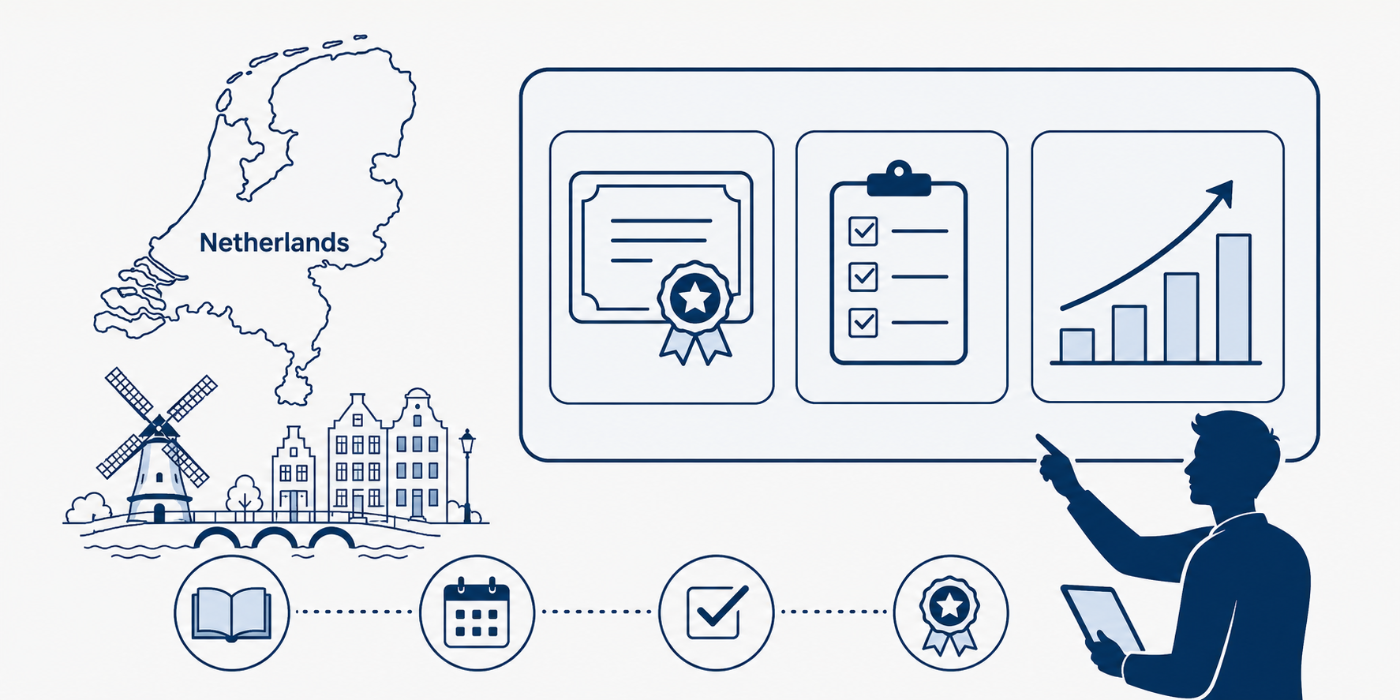
1. Why the Netherlands Needs a Certification Strategy, Not a Random Certificate
The Netherlands has a dense project market: technology, logistics, energy transition, banking, infrastructure, healthcare, SaaS, consulting, public-sector transformation, and multinational operations all depend on structured delivery. That creates opportunity, yet it also raises the hiring bar. A candidate who says “I manage projects” sounds vague. A candidate who connects project execution, stakeholder engagement, risk registers, earned value management, and project reporting into measurable delivery evidence becomes easier to shortlist.
The biggest mistake candidates make is treating certification as a badge purchase. Dutch hiring panels usually care about whether you can survive ambiguity, vendor pressure, scope tension, budget reviews, bilingual stakeholder environments, and matrix decision-making. A certification becomes powerful when it explains your operating model. For example, a junior coordinator can use CAPM-style fundamentals, then build toward Agile project management, Scrum Master capability, product ownership, and remote project roles.
A mid-career professional should pick the certificate that fixes the weakest part of their story. People with strong delivery history and weak formal vocabulary need exam structure around monitoring and control, resource allocation, financial management, vendor management, and leadership communication. People with good theory and weak evidence need a portfolio of project artifacts: charter, RAID log, governance pack, sprint metrics, stakeholder map, decision log, benefits tracker, and closeout report.
| Candidate Situation | Best Certification Direction | What You Must Prove | Dutch-Market Hiring Signal | APMIC Resource |
|---|---|---|---|---|
| New PM candidate | Foundation-level project management | Planning, scope, schedule, risk, stakeholder basics | You can support delivery without creating admin chaos | PM career roadmap |
| Junior coordinator | CAPM-style fundamentals or PRINCE2 Foundation | Terminology, project lifecycle, reporting discipline | You understand delivery language used by PMOs | execution terms |
| IT analyst | Agile plus IT PM pathway | Requirements, backlog, sprint coordination, release risk | You can bridge business and technical delivery | IT PM guide |
| Scrum team member | Scrum Master or Agile PM | Facilitation, impediment removal, team cadence | You can protect flow without hiding delivery problems | Scrum Master guide |
| Product-facing PM | Product Owner plus Agile delivery | Backlog ownership, acceptance criteria, value sequencing | You can turn business goals into delivery priorities | Product Owner guide |
| Public-sector applicant | PRINCE2 or governance-heavy PM route | Controls, approvals, procurement awareness, audit trail | You can work inside formal decision structures | government PM roadmap |
| Consulting candidate | PMP, PRINCE2 Practitioner, Agile stack | Client control, discovery, scope framing, benefits logic | You can manage ambiguity in client environments | PM consultant path |
| Infrastructure PM | Predictive/hybrid PM certification | Schedule dependencies, permits, vendors, cost control | You can manage delivery across external constraints | construction PM guide |
| Healthcare PM | Governance plus stakeholder management | Compliance sensitivity, clinical workflows, change adoption | You can protect service continuity during change | healthcare PM guide |
| Remote PM | Agile, communication, reporting-heavy path | Async planning, decision logs, distributed risk management | You can create visibility across locations | remote PM roles |
| Freelancer | Consulting plus portfolio proof | Scope control, pricing, client reporting, closeout proof | You can sell outcomes instead of hours | freelance PM career |
| PMO analyst | Reporting, governance, portfolio management | Dashboards, standards, escalation rules, benefits tracking | You can turn project noise into executive clarity | future PMO role |
| Experienced PM | PMP or IPMA mid/senior level | Leadership across complexity, risk, people, business value | You can lead beyond task coordination | PM director roadmap |
| Portfolio candidate | Portfolio management path | Prioritization, capacity, benefits, strategic alignment | You can decide which projects deserve resources | portfolio manager guide |
| International applicant | PMP/IPMA/PRINCE2 with English portfolio | Transferable delivery language and global stakeholder control | You can operate across cultures and governance models | international PM guide |
| Agile Coach path | Scrum, Agile coaching, change leadership | Team maturity, facilitation, metrics, adoption blockers | You can improve systems instead of running ceremonies | Agile Coach path |
| Hybrid delivery PM | PMP plus Agile/PRINCE2 blend | Stage gates, iterative delivery, dependency planning | You can manage predictability and adaptability together | hybrid PM future |
| Risk-heavy role | Risk and governance-centered certification | Risk register quality, mitigation ownership, escalation timing | You spot problems before sponsors lose confidence | risk mitigation terms |
| Vendor-heavy role | Procurement and supplier management focus | RFP/RFQ/RFI, SOW quality, vendor accountability | You protect delivery from contract gaps | RFP/RFQ/RFI guide |
| Data/AI project PM | Agile plus AI-aware PM skills | Data quality, model risk, stakeholder adoption, value cases | You understand modern digital delivery pressure | AI and PM trends |
| Sustainability PM | Governance plus ESG project skills | Impact metrics, compliance, benefits, reporting integrity | You can manage projects under environmental expectations | ESG in PM |
| Tool-focused PM | Software plus delivery methodology | Workflow setup, dashboards, integrations, team adoption | You use tools to improve decisions, not decorate work | Agile PM tools |
| Kanban team lead | Kanban plus flow metrics | WIP limits, cycle time, service classes, bottleneck control | You can improve throughput without overloading teams | Kanban terms |
| Waterfall environment | PRINCE2/predictive fundamentals | Stage plans, baseline control, change requests, acceptance | You can manage formal delivery without drift | Waterfall glossary |
| Promotion seeker | PMP/IPMA plus leadership evidence | Budget ownership, team leadership, sponsor management | You look ready for larger accountability | PM to VP path |
| Executive PM leader | Portfolio, PMO, CPO direction | Governance architecture, strategic prioritization, benefits | You can shape enterprise delivery systems | Chief Project Officer roadmap |
| Career changer | Foundation cert plus domain bridge | Transferable leadership, process control, communication | You can convert past experience into PM value | entry-level to executive guide |
| Consultancy founder | Certification plus service positioning | Offer design, delivery framework, client proof assets | You can package PM expertise into a business | PM consultancy firm |
2. Choose the Right Certification Path for the Netherlands: PMP, PRINCE2, IPMA, Scrum, or Hybrid
PMP is usually strongest when you already have meaningful project leadership experience and need a globally recognized signal. It works well for international companies, consulting roles, technology programs, transformation offices, and senior delivery positions. The value comes from translating your experience into structured leadership language: scope, schedule, risk, quality, procurement, people, business value, and governance. Pair PMP preparation with EVM terms, resource allocation, project financial management, stakeholder engagement, and PM leadership communication so your exam prep improves your interview performance too.
PRINCE2 fits candidates who want a governance-heavy route. In the Netherlands, this can help for government-adjacent work, infrastructure delivery, regulated environments, business change, and organizations that prefer clear roles, controls, decision gates, and formal documentation. PRINCE2 is valuable when your pain point is weak governance vocabulary. Build your study around Waterfall project management, Gantt chart planning, project monitoring and control, project closure, and project reporting, because Dutch employers often punish vague handovers and unclear approval history.
IPMA can be especially useful in Europe because it assesses competence maturity across levels. A starting professional can use an entry route to prove knowledge, while experienced professionals can use higher levels to validate leadership complexity. The practical advantage is narrative clarity: you can show where you sit on a competence ladder. Candidates targeting the Netherlands should connect IPMA-style development with PM director progression, portfolio management, PMO evolution, future PM skills, and certification evolution.
Scrum and Agile certifications make sense when your target roles involve product teams, SaaS, IT delivery, digital transformation, analytics, cloud migration, or software-enabled operations. The trap is collecting Scrum certificates while your CV still reads like a meeting calendar. Hiring managers want proof that you improved flow, reduced blockers, clarified priorities, improved sprint predictability, or helped product teams make better trade-offs. Study Scrum terms, sprint planning, Agile estimation, product and sprint backlog, and Agile metrics before you claim Agile capability.
The strongest Netherlands strategy for many candidates is hybrid. Dutch organizations frequently run projects where business cases, budgets, procurement, and compliance need structure, while teams still deliver software, process change, or operational improvements iteratively. A hybrid candidate can speak to sponsors in governance language and delivery teams in flow language. This is where hybrid project management, Agile glossary knowledge, Waterfall terms, risk response planning, and vendor management become a practical career asset.
3. Build Your 2026-2027 Certification Plan Around Job Evidence, Not Study Hours Alone
Start with your target role, then reverse-engineer the certification. A Netherlands-based junior candidate aiming for project coordinator roles needs a different proof set than a senior transformation manager targeting multinational programs. Your plan should define target job titles, sector, methodology, domain language, portfolio artifacts, and interview stories before choosing the exam date. Use project management career steps, entry-level to executive planning, international PM guidance, remote PM career mapping, and freelance PM positioning to avoid choosing a certificate that solves the wrong problem.
Next, create a competency gap map. Rate yourself across requirements control, planning, schedule management, risk, budget, procurement, stakeholder management, governance, Agile delivery, reporting, benefits, leadership, and closure. Then attach proof to every strength. “Managed stakeholders” becomes weak unless you can show a stakeholder register, escalation path, steering update, approval record, conflict resolution example, or adoption metric. Build this with stakeholder engagement terms, conflict resolution terms, project reporting best practices, monitoring and control terms, and closure concepts.
Then prepare your application story. Certification bodies and employers both reward clarity. Write a one-page project history with project goal, business problem, stakeholders, budget or scale, team structure, your role, constraints, risks, delivery approach, result, and lesson learned. This becomes the foundation for your certification application, LinkedIn profile, CV bullets, and interview answers. Candidates who want Dutch-market credibility should connect this story with government PM skills, construction PM delivery, healthcare PM transformation, IT PM delivery, and consulting skills.
Finally, convert study into artifacts. After each major study topic, produce something practical: a sample project charter, change request, communication plan, risk register, sprint health dashboard, dependency map, procurement checklist, lessons learned report, or steering committee slide. This prevents the “certified but empty” problem that damages many applicants. The best exam preparation improves your real-world delivery muscle. Combine risk registers, RFP/RFQ/RFI knowledge, supplier management, schedule compression, and quality management terms into a practical portfolio.
4. Turn Certification Into a Netherlands-Ready CV, LinkedIn Profile, and Interview Story
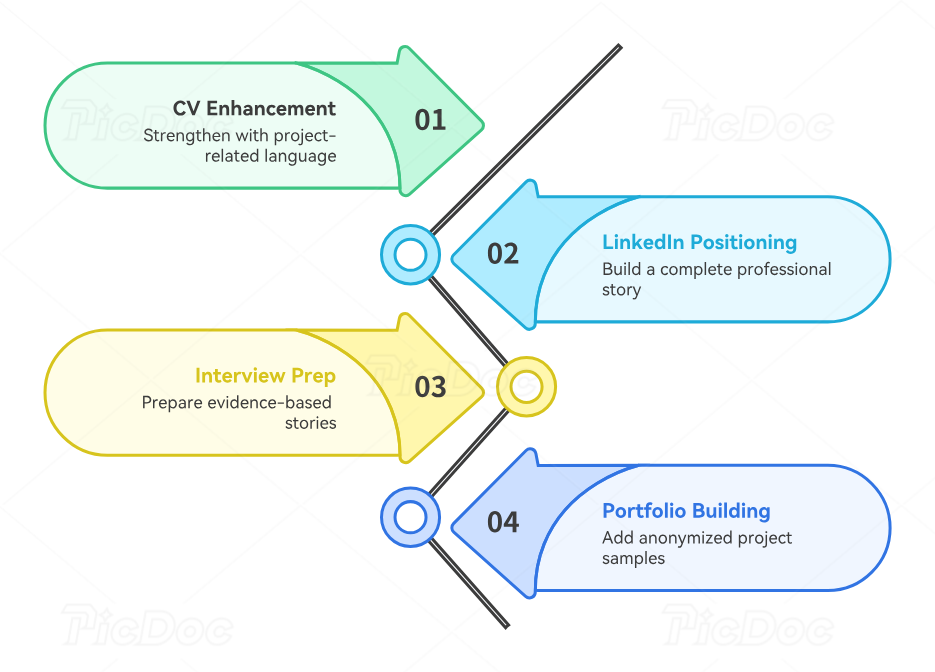
Your CV should make the certification feel earned. Add a certification line, then prove the same capability in your experience bullets. Weak bullet: “Responsible for project coordination.” Strong bullet: “Coordinated 9-workstream digital migration across finance, operations, and vendor teams, maintaining RAID visibility and weekly steering updates.” The second bullet gives employers evidence. Strengthen your CV with project reporting, risk mitigation, resource allocation, stakeholder engagement, and financial management language.
Your LinkedIn profile should position you by project type, methodology, and value. A Netherlands-focused headline could mention “Hybrid Project Manager | Digital Transformation | Governance, Agile Delivery, Stakeholder Alignment.” Your About section should explain the industries you understand, the project problems you solve, and the delivery behaviors you bring. Avoid a profile that only lists certifications. Build a complete story using IT project management, Agile project management, Scrum Master progression, product ownership, and project consultant skills.
For interviews, prepare five stories: a difficult stakeholder situation, a scope-change problem, a risk that became urgent, a delivery recovery, and a measurable outcome. Each answer should show context, action, decision logic, trade-off, and result. Dutch hiring conversations can be direct, so vague confidence collapses quickly. Bring evidence. Mention the artifact you used, the decision you forced, the escalation you handled, and the result you protected. Build these answers with conflict resolution, change control, vendor terms, RFP language, and closure terms.
A strong portfolio can separate you from other certified candidates. Include anonymized samples: project charter, status report, RAID log, governance calendar, sprint dashboard, benefits tracker, stakeholder heatmap, procurement timeline, and lessons learned summary. Hiring managers want to see how you think under constraints. This is especially helpful for career changers, junior PMs, remote applicants, and international candidates. Use PM templates and resources, team communication platforms, project management APIs, Agile tools, and construction PM software to make the proof practical.
5. The Best 2026-2027 Roadmap for Certification, Job Search, and Career Growth
Use a 12-week sprint if you already have project exposure. Weeks 1-2 should focus on certification choice, eligibility, role targeting, and baseline vocabulary. Weeks 3-6 should cover core study domains and artifact creation. Weeks 7-9 should focus on mock exams, weak-area repair, CV rewriting, and LinkedIn positioning. Weeks 10-12 should focus on applications, interview stories, recruiter outreach, and portfolio refinement. This cadence works especially well when paired with Agile estimation, sprint planning terms, Agile metrics, project execution, and monitoring controls.
If you are starting from scratch, use a 6-month roadmap. Month 1: learn fundamentals and map target roles. Month 2: build basic project artifacts. Month 3: complete training and take a foundation-level exam. Month 4: volunteer for project responsibilities at work or through a side project. Month 5: rewrite your CV with outcomes. Month 6: apply to coordinator, junior PM, PMO analyst, Scrum support, or project assistant roles. Support this path with entry-level PM guidance, CAPM-style career planning, Scrum glossary terms, Kanban vocabulary, and backlog knowledge.
For experienced PMs, the roadmap should be more aggressive. Choose PMP, IPMA, PRINCE2 Practitioner, or a hybrid stack based on the roles you want next. Then build a leadership case around complexity: multi-team delivery, budget exposure, external suppliers, senior stakeholders, regulatory constraints, and business benefits. Your certification should support a move into senior PM, program manager, PMO lead, portfolio manager, consultant, or director roles. Use project management director guidance, VP of PM progression, CPO roadmap, portfolio management, and PM consultancy firm guidance.
For the Netherlands specifically, build sector alignment. A technology PM should emphasize Agile delivery, data, cloud, integrations, cybersecurity awareness, and product stakeholders. An infrastructure PM should emphasize schedule, procurement, vendor dependencies, safety, and cost control. A healthcare PM should emphasize adoption, compliance sensitivity, service continuity, and cross-functional stakeholder management. A public-sector PM should emphasize governance, procurement, decision trails, and accountability. Match your certification with AI project management, machine learning project scheduling, cybersecurity PM software overhaul, sustainability project management, and digital transformation PMOs.
The final career advantage comes from renewal and continuous learning. Certification can open the door, yet market trust is maintained through new project wins, updated tools, better stakeholder habits, and visible delivery outcomes. Keep a quarterly proof file with metrics, decisions, risks handled, financial impact, process improvements, and lessons learned. That file becomes your promotion pack, recruiter pack, interview prep, and future certification evidence. Keep sharpening with future PM skills, future PM software, automation and PM careers, future freelance PM trends, and future governance trends.
6. FAQs About Getting Project Management Certification in the Netherlands in 2026-2027
-
The best certification depends on your target role. PMP works well for broader leadership and international recognition, PRINCE2 helps in governance-heavy and structured environments, IPMA fits European competence-based progression, and Scrum or Agile certifications help for digital and product delivery. A candidate targeting Dutch technology roles may combine Agile project management, Scrum Master skills, IT PM capability, Agile metrics, and product ownership.
-
Beginners usually get more value from foundation-level learning first, then move toward stronger credentials after building project evidence. PMP is designed for experienced project leaders, so a beginner should first master core delivery vocabulary, build artifacts, and gain responsibility. Start with PM career basics, project execution terms, risk register basics, stakeholder terms, and reporting best practices.
-
PRINCE2 can be useful when the role involves governance, formal approval, public-sector processes, vendors, infrastructure, business change, or controlled delivery environments. Its value increases when your CV shows decision gates, change control, role clarity, and reporting discipline. Prepare with Waterfall glossary terms, Gantt chart concepts, monitoring and control, closure terms, and government PM skills.
-
Agile certification helps when roles involve software, product, SaaS, IT transformation, data, or cross-functional digital delivery. It becomes much stronger when paired with project control skills. Many Dutch employers need people who can handle Agile teams while still managing budget, stakeholders, vendors, dependencies, and executive reporting. Combine Scrum terms, sprint planning, Agile estimation, project financial management, and vendor management.
-
A realistic timeline depends on your starting point. A beginner may need three to six months to learn fundamentals, create proof assets, and pass a foundation-level exam. An experienced PM may complete a serious certification sprint in eight to twelve weeks if their project history is already documented. Your study plan should include project templates, execution terms, risk response planning, schedule compression, and quality management.
-
Tie the certification to larger accountability. Employers pay more for people who can lead bigger scope, reduce risk, manage budgets, influence senior stakeholders, and protect business outcomes. After certification, update your CV with measurable project results, build a portfolio, and prepare promotion evidence around complexity. Use PM director progression, PM to VP pathway, portfolio manager guidance, PMO trends, and CPO roadmap to frame your next move.
