
The Ultimate Guide to Getting Your Project Management Certification in Kenya: All You Need to Know in 2026-2027
Getting your project management certification in Kenya in 2026-2027 should be planned around one practical question: which credential will help you prove delivery ability in a market shaped by infrastructure, fintech, telecom, healthcare, NGOs, energy, public-sector reform, education, logistics, and digital transformation? The strongest route connects project management fundamentals, Agile delivery, PMO discipline, and international project management into one career story.
Kenyan employers and international organizations operating in Kenya want project professionals who can control deadlines, budgets, risks, vendors, stakeholders, reporting, and benefits without losing the business purpose. Certification becomes powerful when it supports real evidence across project execution, stakeholder engagement, risk registers, earned value management, and project reporting.
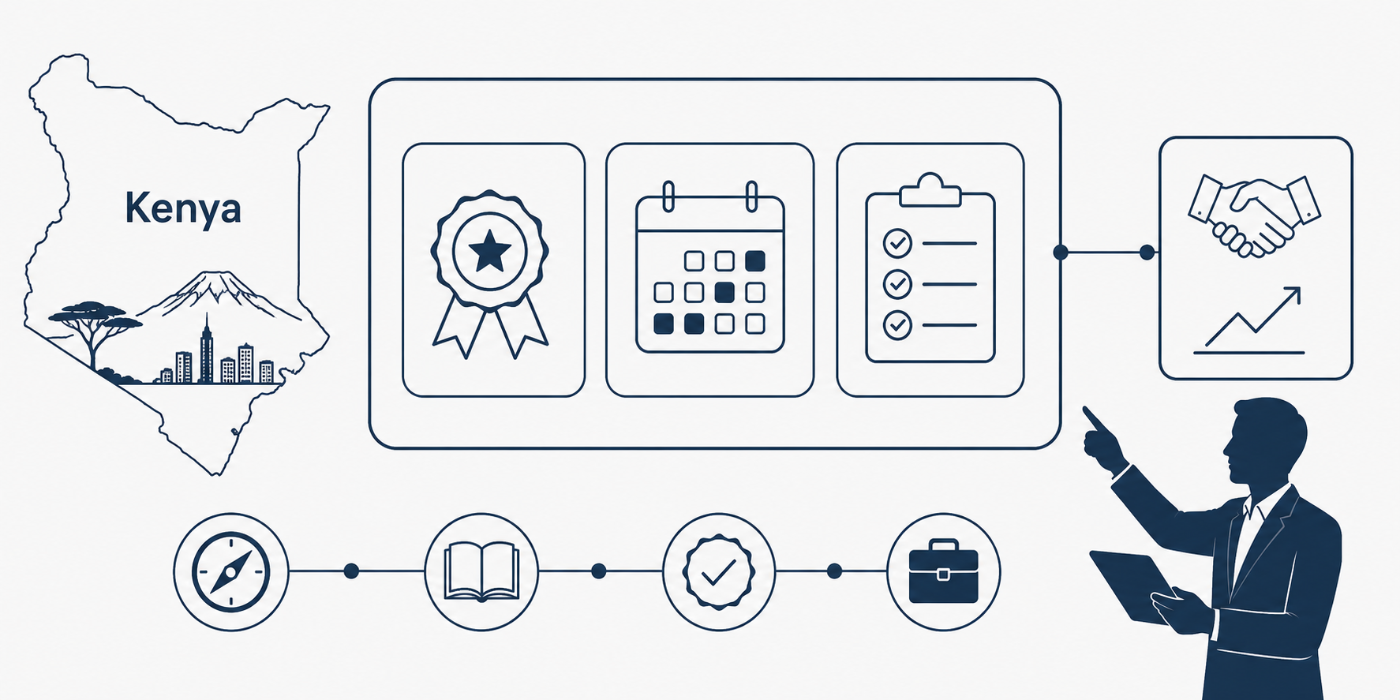
1. Why Project Management Certification Matters in Kenya in 2026-2027
Kenya’s project economy rewards people who can turn plans into controlled delivery. Nairobi’s technology and finance ecosystem, national and county-level public projects, donor-funded programs, construction activity, health initiatives, education programs, energy projects, logistics networks, and telecom delivery all create demand for people who can manage pressure with structure. A candidate who can explain scope control, resource allocation, vendor management, risk mitigation, and project financial management stands out faster than a candidate who only says they “coordinated activities.”
The pain point for many Kenya-based professionals is proof. They have handled launches, field teams, procurement follow-ups, donor reports, site coordination, operations improvements, product rollouts, or IT change, yet their CV still reads like general administration. Certification helps convert that experience into project language. A program assistant can move toward project coordination. A business analyst can move toward IT project management. A team lead can move toward Scrum Master roles. An engineer can move toward construction project management. A delivery specialist can move toward project management consulting.
The strongest candidates build a link between certification, sector needs, and proof assets. For a donor-funded program, that proof may include workplans, logframes, risk logs, stakeholder maps, procurement trackers, field reports, and closeout lessons. For fintech or telecom, it may include Agile boards, release plans, dependency maps, sprint metrics, change logs, and adoption reports. For construction, it may include Gantt schedules, vendor trackers, cost updates, quality checks, and site-risk escalation. This is where monitoring and control, project closure, Gantt chart planning, Agile metrics, and stakeholder engagement become hiring signals.
| Candidate Situation | Best Certification Direction | What You Must Prove | Kenya-Market Hiring Signal | APMIC Resource |
|---|---|---|---|---|
| New PM candidate | Foundation-level PM training | Scope, schedule, stakeholders, risk, basic reporting | You can support delivery with structure and follow-through | PM career roadmap |
| Career changer | CAPM-style fundamentals or PRINCE2 Foundation | Transferable coordination, documentation, communication | You can turn prior work into project evidence | entry-level to executive guide |
| Project assistant | Foundation certification plus portfolio | Meeting actions, trackers, reports, RAID updates | You understand PMO rhythm and delivery hygiene | execution terms |
| NGO program officer | Governance plus monitoring and control | Workplans, donor reporting, stakeholder mapping, risks | You can manage accountability across funders and field teams | monitoring and control |
| IT analyst | Agile plus IT project management | Requirements, backlog, UAT, release coordination | You can bridge business needs and technical delivery | IT PM guide |
| Scrum team member | Scrum Master certification | Facilitation, blockers, sprint rhythm, team improvement | You can improve delivery flow and team visibility | Scrum Master guide |
| Product-facing PM | Product Owner plus Agile delivery | Backlog decisions, acceptance criteria, value sequencing | You can connect customer value with delivery priorities | Product Owner guide |
| Construction PM | Predictive, PRINCE2, or PMP route | Gantt planning, suppliers, permits, site risks, cost control | You can control delivery across site pressure and dependencies | construction PM guide |
| Infrastructure PM | PMP, PRINCE2 Practitioner, or IPMA | Governance, procurement, dependencies, executive reporting | You can handle complexity across public and private stakeholders | Gantt chart terms |
| Public-sector applicant | PRINCE2 or governance-heavy path | Approvals, audit trail, procurement, formal reporting | You can work inside structured decision systems | government PM roadmap |
| Healthcare PM | Governance plus change delivery | Compliance sensitivity, adoption, service continuity | You can deliver change without disrupting critical workflows | healthcare PM guide |
| Fintech PM | Agile, PMP, or hybrid certification | Data, compliance, release risk, stakeholder alignment | You can manage regulated digital delivery pressure | AI and PM trends |
| Telecom PM | Hybrid PM plus vendor management | Dependencies, rollout planning, vendors, service impact | You can coordinate complex delivery across technical teams | vendor management |
| Consulting candidate | PMP, PRINCE2 Practitioner, Agile stack | Discovery, client governance, scope framing, benefits logic | You can lead clients through ambiguity and trade-offs | PM consultant path |
| PMO analyst | Reporting, governance, portfolio fundamentals | Dashboards, standards, escalation rules, benefits tracking | You can turn fragmented project data into leadership clarity | future PMO role |
| Remote PM | Agile plus communication-heavy PM path | Async updates, decision logs, distributed stakeholder control | You can create visibility across locations and time zones | remote PM roles |
| Freelance PM | Consulting plus delivery proof | Scope control, client updates, pricing, closeout evidence | You can sell outcomes through clear delivery assets | freelance PM career |
| Experienced PM | PMP, IPMA Level C/B, or PRINCE2 Practitioner | Leadership, budget, risk, stakeholder pressure, business value | You can lead beyond coordination and task control | PM director roadmap |
| Portfolio candidate | Portfolio management pathway | Prioritization, capacity, benefits, strategy alignment | You can decide where organizational resources should go | portfolio manager guide |
| International applicant | PMP, IPMA, PRINCE2 with English portfolio | Cross-border delivery, stakeholder control, transferable method | You can operate across cultures, vendors, and governance models | international PM guide |
| Agile Coach path | Scrum, Agile coaching, change leadership | Team maturity, metrics, facilitation, adoption blockers | You can improve delivery systems beyond ceremonies | Agile Coach path |
| Hybrid PM | PMP plus Agile or PRINCE2 plus Scrum | Stage gates, iterative delivery, dependencies, governance | You can manage predictability and adaptability together | hybrid PM future |
| Risk-heavy role | Risk and governance-centered certification | Risk quality, mitigation ownership, escalation timing | You prevent surprises from reaching sponsors too late | risk mitigation terms |
| Procurement-heavy role | Supplier management plus governance focus | SOW clarity, RFP/RFQ/RFI, contract accountability | You protect delivery from supplier and contract gaps | RFP/RFQ/RFI guide |
| Sustainability PM | Governance plus ESG project skills | Impact metrics, reporting integrity, benefits realization | You can manage projects under environmental scrutiny | ESG in PM |
| Kanban lead | Kanban plus Agile flow metrics | WIP limits, cycle time, service classes, bottleneck control | You can improve throughput without overloading teams | Kanban terms |
| Promotion seeker | PMP/IPMA plus leadership evidence | Budget ownership, sponsor management, team leadership | You look ready for larger accountability | PM to VP path |
| Consultancy founder | Certification plus service positioning | Offer design, delivery framework, proof assets | You can package PM expertise into a credible business | PM consultancy firm |
2. Choose the Right Certification Route for Kenya: PMP, PRINCE2, IPMA, Scrum, or Hybrid
PMP is a strong route for candidates who already have project leadership experience and want global recognition. It fits professionals targeting multinational companies, donor-funded programs, telecom, fintech, banking, construction, energy, consulting, technology delivery, and senior PM roles. Its value comes from helping you explain leadership across scope, schedule, cost, quality, procurement, stakeholders, people, and business outcomes. Build PMP preparation around earned value management, project financial management, resource allocation, stakeholder engagement, and risk response planning.
PRINCE2 fits candidates who want governance strength. This is useful in roles involving public-sector delivery, NGOs, infrastructure, procurement, donor reporting, enterprise change, and organizations that expect formal approvals, business cases, role clarity, and decision trails. PRINCE2 helps when your project pain points include unclear ownership, late approvals, weak change control, missing documentation, and chaotic handovers. Prepare through Waterfall project management, Gantt chart planning, project monitoring and control, project closure, and project reporting.
IPMA can help professionals who want competence-based progression, especially when they need a development path that recognizes different levels of project maturity. It is useful for candidates who want to show growth from project team participation toward complex project leadership. The strongest benefit is career narrative: you can explain your current level, next level, and the evidence required to progress. Pair IPMA-style development with PM director progression, portfolio management, PMO evolution, future PM skills, and certification trends.
Scrum and Agile certifications make sense for software, fintech, data, cloud, telecom, product, digital transformation, SaaS, and internal process improvement roles. The weak version of Agile certification is learning ceremony names and hoping employers are impressed. The strong version is proving you improved flow, clarified priorities, handled blockers, reduced rework, improved sprint predictability, or helped stakeholders make better product decisions. Build your Agile route through Scrum glossary terms, sprint planning, Agile estimation, product and sprint backlog, and Agile metrics.
Hybrid certification planning often gives Kenya-based professionals the best career return because many real projects combine formal funding, procurement, reporting, and approvals with iterative delivery. A donor-funded health-tech rollout may need Agile product work and strict reporting. A construction project may need predictive scheduling and rapid risk decisions. A fintech initiative may need product discovery and compliance control. A county-level digital project may need stakeholder engagement and technical release planning. This is where hybrid project management, Agile glossary knowledge, Waterfall terminology, vendor management, and project governance trends become a practical advantage.
3. Build a 2026-2027 Certification Plan That Produces Job Evidence
Start with the role you want, then choose the certification. A junior candidate in Nairobi targeting project coordinator roles needs a different path from an experienced PM aiming for infrastructure, NGO program management, fintech delivery, telecom rollout, energy projects, or consulting. Define your target job title, target sector, likely methodology, tool expectations, reporting environment, and required proof assets. Use PM career roadmap planning, international PM guidance, remote PM career guidance, freelance PM positioning, and consulting career steps.
Next, create a capability gap map. Score yourself across scope, schedule, budget, procurement, risks, stakeholders, governance, Agile delivery, reporting, team leadership, benefits realization, vendor control, and closure. Then attach proof to each area. “Managed project stakeholders” becomes stronger when you can show a stakeholder map, steering update, escalation decision, communication plan, conflict-resolution example, or adoption metric. Build this proof with stakeholder engagement terms, conflict resolution terms, project reporting terms, monitoring and control terms, and project closure concepts.
Turn study into artifacts. After each major topic, create one practical asset: a project charter, work breakdown structure, risk register, change request, stakeholder map, communications plan, sprint dashboard, issue log, procurement checklist, cost tracker, vendor tracker, field report, or lessons learned summary. This solves the “certified but unconvincing” problem that blocks many candidates. Employers need to see how you think under pressure. Support the portfolio with project templates, risk registers, RFP/RFQ/RFI language, supplier management, and schedule compression.
Use a 12-week sprint if you already have project exposure. Weeks 1-2 should cover certification choice, eligibility, target roles, and vocabulary repair. Weeks 3-6 should cover exam domains and artifact creation. Weeks 7-9 should focus on mock exams, weak-area repair, CV rewriting, and LinkedIn positioning. Weeks 10-12 should focus on applications, interview stories, recruiter outreach, and portfolio refinement. This cadence pairs well with Agile estimation, sprint planning terms, Agile metrics, execution vocabulary, and quality management.
4. Turn Your Certification Into a Kenya-Ready CV, LinkedIn Profile, and Interview Story
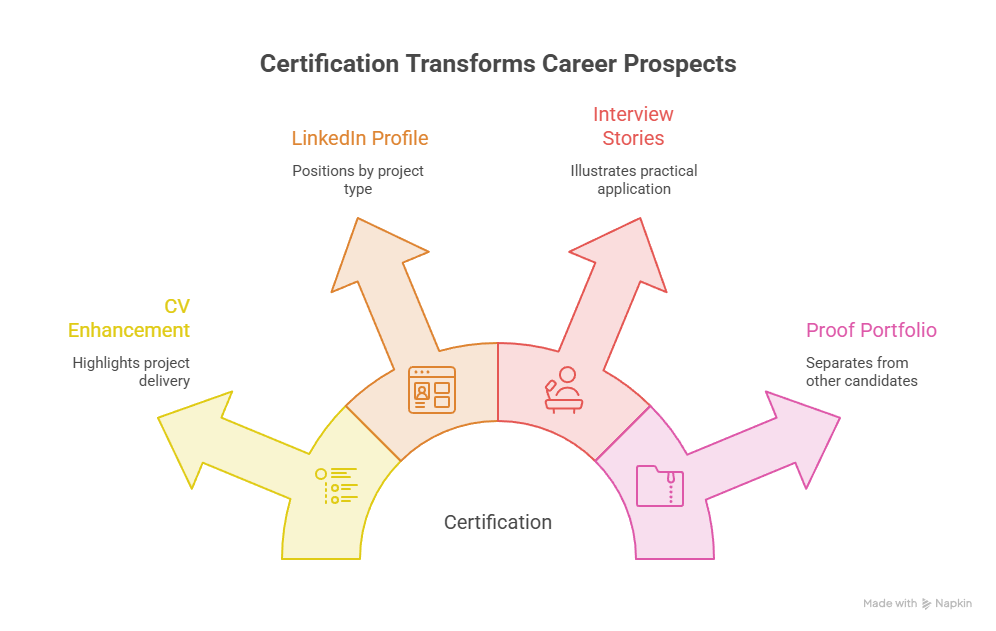
Your CV should make the certification feel earned. The certification line creates a first signal, while your project bullets create trust. Replace weak phrases with delivery evidence. “Supported project implementation” can become “coordinated weekly RAID updates, vendor follow-ups, and stakeholder reporting for a multi-county rollout.” That gives hiring managers scale, control, and context. Strengthen your CV with project reporting, risk mitigation, resource allocation, project financial management, and stakeholder engagement.
Your LinkedIn profile should position you by project type, sector, and delivery value. A strong headline could say “Hybrid Project Manager | NGO Programs, Digital Delivery, Stakeholder Reporting, Risk Control.” Another route could be “Agile Project Manager | Fintech, Product Delivery, Sprint Visibility, Business Change.” The goal is to help recruiters understand your lane within seconds. Build the story through IT project management, Agile project management, Scrum Master progression, Product Owner skills, and PM consulting capability.
For interviews, prepare five stories before applying aggressively. One should cover stakeholder conflict. One should cover scope change. One should cover a risk that needed escalation. One should cover delivery recovery. One should cover measurable impact. Each answer should include context, your role, the artifact used, the decision made, the trade-off, the outcome, and the lesson. This turns certification language into delivery behavior. Build these answers with conflict resolution, change control concepts, vendor management, RFP/RFQ/RFI terms, and project closure.
A proof portfolio can separate you from other certified candidates. Include anonymized examples: project charter, workplan, RAID log, stakeholder map, donor report, sprint dashboard, steering update, change request, procurement tracker, vendor follow-up log, benefits tracker, and lessons learned summary. This is especially useful for career changers, junior candidates, NGO professionals, remote applicants, and freelancers. Use PM templates and resources, team communication tools, project management APIs, Agile PM tools, and construction PM software to make your proof practical.
5. Best Kenya-Focused Roadmap for Certification, Job Search, and Career Growth
For beginners, use a 6-month roadmap. Month 1 should focus on project fundamentals, job-title research, and sector vocabulary. Month 2 should focus on training and basic artifacts. Month 3 should focus on foundation certification and mock project work. Month 4 should focus on workplace project exposure, volunteering, shadowing, or supporting a real rollout. Month 5 should focus on CV, LinkedIn, and interview stories. Month 6 should focus on applications for project coordinator, junior PM, PMO analyst, program assistant, Agile support, or project assistant roles. Support this route with entry-level PM guidance, Scrum terms, Kanban vocabulary, backlog knowledge, and project execution terms.
For experienced PMs, the roadmap should push toward stronger credentials and larger accountability. Choose PMP, IPMA, PRINCE2 Practitioner, or a hybrid stack based on the role you want next. Then build proof around complexity: budget ownership, multi-team delivery, supplier pressure, senior stakeholders, regulatory constraints, donor expectations, recovery decisions, and business outcomes. This path supports moves into senior PM, program manager, PMO lead, portfolio manager, consultant, or director roles. Use PM director guidance, VP of PM progression, Chief Project Officer roadmap, portfolio management, and PM consultancy guidance.
Sector alignment matters. An NGO or development-sector PM should emphasize workplans, donor accountability, monitoring, field coordination, stakeholder reporting, and benefits. An IT or fintech PM should emphasize Agile delivery, integrations, cloud migration, cybersecurity awareness, data quality, and release coordination. A construction PM should emphasize baseline schedules, procurement, site coordination, quality, and cost control. A healthcare PM should emphasize adoption, compliance sensitivity, and continuity. A public-sector PM should emphasize governance, accountability, procurement, and decision trails. Match your profile with AI project management, machine learning project estimation, cybersecurity PM concerns, sustainability project management, and digital transformation PMOs.
Long-term career growth depends on maintaining a proof file. Every quarter, capture projects touched, decisions influenced, risks handled, savings created, delays prevented, cycle-time improvements, stakeholder outcomes, donor reporting wins, vendor corrections, and lessons learned. This file becomes your promotion pack, recruiter pack, interview prep, and future certification evidence. Certification gets stronger when your work keeps proving it. Keep sharpening with future PM skills, future PM software, automation and PM careers, future freelance PM trends, and future governance trends.
6. FAQs About Getting Project Management Certification in Kenya in 2026-2027
-
The best certification depends on your target role. PMP works well for experienced project leaders and international employers. PRINCE2 helps in governance-heavy, public-sector, NGO, infrastructure, and controlled delivery environments. IPMA supports competence-based progression. Scrum and Agile certifications help for fintech, software, telecom, data, cloud, and digital transformation roles. A strong Kenya-focused route connects project management fundamentals, Agile capability, IT PM skills, PMO discipline, and international PM positioning.
-
Beginners usually gain more from foundation-level training, practical artifacts, and entry-level project exposure before moving toward PMP. PMP becomes more useful when you already have experience leading and managing projects. A beginner should first master project vocabulary, documentation, stakeholder communication, risk awareness, reporting, and delivery basics. Start with PM career basics, execution terms, risk register basics, stakeholder terms, and reporting best practices.
-
PRINCE2 can be useful for roles involving governance, formal approval, donor reporting, procurement, infrastructure, business cases, public-sector delivery, suppliers, or controlled change environments. It helps candidates show they understand clear roles, decision points, escalation routes, documentation, and stage-based control. Prepare with Waterfall glossary terms, Gantt chart concepts, monitoring and control, closure terms, and government PM skills.
-
Agile certification helps for fintech, software, telecom, product, SaaS, data, cloud, and digital transformation roles. Many Kenya-based project roles also need reporting, governance, stakeholder control, budget awareness, vendor discipline, and risk management. Agile becomes stronger when paired with delivery control. Build a blended profile through Scrum terms, sprint planning, Agile estimation, project financial management, and vendor management.
-
A beginner may need three to six months to learn fundamentals, complete training, create proof assets, and prepare for entry-level applications. An experienced PM can often use an eight-to-twelve-week sprint for a serious credential if project history, eligibility, and study discipline are already in place. The timeline should include artifact creation, because interviews require examples. Build with project templates, execution terms, risk response planning, schedule compression, and quality management.
-
Tie certification to larger responsibility. Employers promote people who can manage bigger scope, higher risk, stronger stakeholder pressure, larger budgets, tougher vendors, and clearer business outcomes. After certification, update your CV with measurable project results, build a portfolio, and prepare promotion evidence around complexity and value. Use PM director progression, PM to VP pathway, portfolio manager guidance, PMO trends, and Chief Project Officer roadmap to frame the next move.
