
Future of Remote Project Management: Original Insights & Market Trends (2026-27)
Remote project management is no longer a temporary operating mode or a side lane for distributed teams. It is becoming a structural capability that changes how organizations hire, plan, govern, report, and scale delivery. The professionals who win in this environment are not the ones who merely “work from home.” They are the ones who can build execution discipline without physical proximity, create trust without hallway access, and move work forward when visibility, alignment, and accountability are harder to manufacture.
That shift is creating a sharper market. Employers now reward remote PMs who can combine delivery rigor, async communication design, tool fluency, cross-time-zone leadership, and measurable stakeholder control. Anyone trying to build a durable career in this space needs more than general PM instincts. They need the capability stack that sits at the intersection of remote and virtual project management roles, the future project manager skills needed by 2030, hybrid project management methods, and the expanding future of project management software.
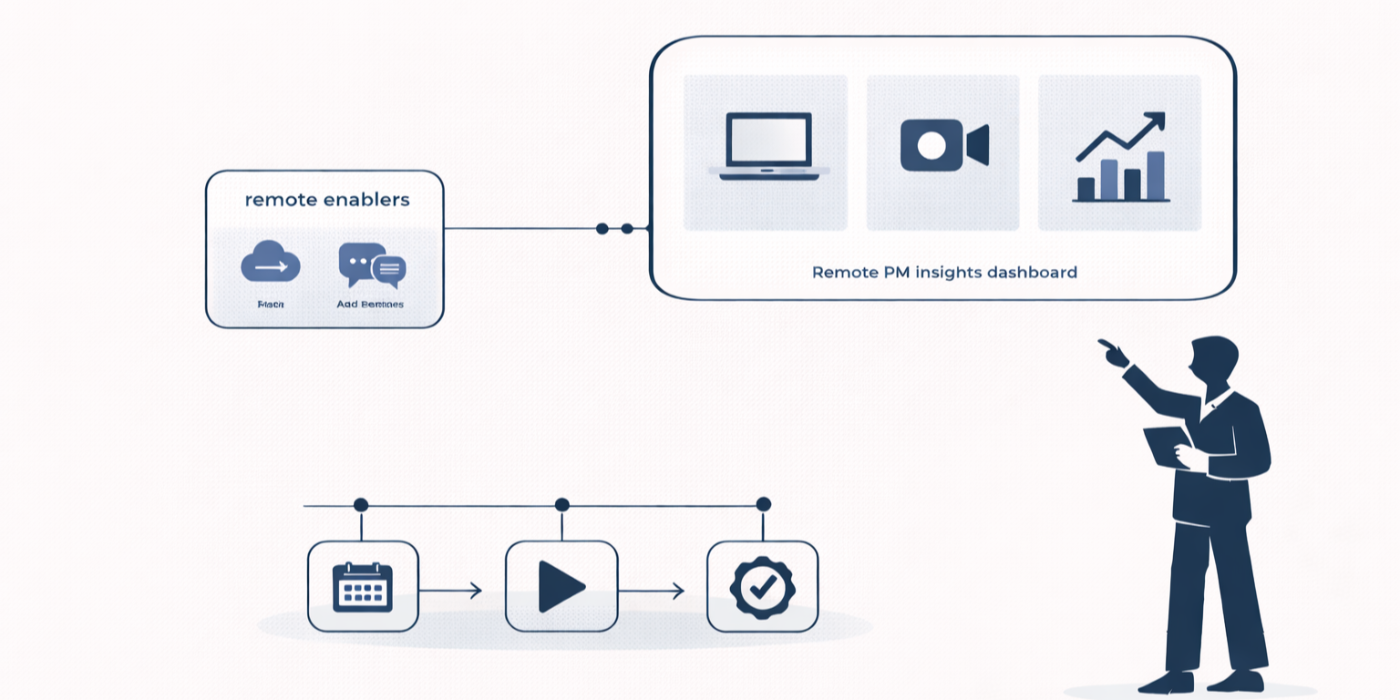
1. Why remote project management is becoming a premium career track, not a fallback option
The biggest misunderstanding in the market is that remote project management is simply traditional project management performed through Zoom, Slack, and shared dashboards. That framing is weak, and it causes a lot of mid-level PMs to underperform in remote settings. In-person environments naturally mask many execution flaws. People can rescue unclear priorities through hallway conversations, fix broken ownership through spontaneous check-ins, and recover from poor documentation because context is floating around the room. Remote environments punish that looseness immediately.
That is why remote PMs are increasingly being judged on operating system quality rather than personal busyness. Companies want leaders who can create decision velocity without constant meetings, maintain momentum without chasing adults for updates, and protect delivery even when teams are split across functions, geographies, and contractor models. This is closely tied to the broader evolution outlined in project management 2030 dominant methodologies, the rise of AI and project management innovations, the expanding need for project governance best practices, and the growing importance of PMO evolution in organizational success.
The demand is strongest where work is complex, approvals are multi-layered, and outcomes must be visible to leadership without daily intervention. That includes software, infrastructure, healthcare transformation, digital operations, consulting, product delivery, construction coordination layers, and cross-border programs. Employers are not simply buying availability. They are buying predictability. This is why remote PMs who understand project portfolio management trends, project reporting and analytics software, dashboard and data visualization tools, and knowledge management software are separating themselves from general coordinators.
Another major shift is that remote delivery expands labor competition while also expanding opportunity. A PM in one city is no longer only competing for nearby roles. They can target organizations in other states, other countries, or specialist domains that value niche coordination skill over office presence. That aligns naturally with long-term career moves into international project management, freelance project management, project management consultancy, and senior pathways such as project management director or vice president of PM.
2. The market trends that will define remote PM hiring and performance through 2026-27
The remote PM market is moving away from generic coordination and toward specialized orchestration. Employers increasingly want PMs who can run remote delivery in environments where complexity is high and the cost of misalignment is expensive. That is why role design is shifting from “project manager” to more context-heavy variants: transformation PM, implementation PM, technical PM, PMO program lead, client delivery PM, agile delivery manager, platform PM, and portfolio-facing PM. This mirrors the segmentation seen across IT project management career paths, healthcare project management, construction project management, and government project management.
A second trend is that async maturity is becoming a hiring filter. Teams that operate across multiple time zones cannot afford project managers who need live meetings to resolve every ambiguity. Remote PMs now have to design information flow itself: what goes into written status, what gets escalated, what belongs in a dashboard, what requires synchronous alignment, and what can move through pre-agreed workflows. That capability intersects directly with calendar and scheduling tools for project managers, document management software for project teams, automation tools for project efficiency, and mobile collaboration apps for project teams.
A third trend is the rise of evidence-based PM hiring. Remote employers are less impressed by generic claims such as “excellent communicator” or “strong leader.” They want proof. That proof may come from documented delivery metrics, reduced variance, improved handoff quality, successful remote launches, stronger executive reporting, better risk control, or the PM’s ability to build remote operating rhythms. Professionals trying to compete here should think like strategists, not applicants. Their profile should connect to global salary benchmarks, certification-driven salary comparisons, PMP career leverage, and future-facing role design shaped by automation and AI in project management careers.
The fourth trend is that hybrid work is not killing remote PM demand. It is actually making remote delivery discipline more valuable. Many organizations now have partial office attendance, fragmented team presence, multiple contractor layers, and geographically distributed decision-makers. That means even “hybrid” teams often function like remote teams from an execution standpoint. The PM who can manage fragmented attention, incomplete overlap, and inconsistent stakeholder availability will outperform the PM who relies on co-location as a crutch. This is one reason hybrid delivery models, future PM leadership styles, project software evolution, and digital transformation across PMOs matter so much in this market.
3. The real skills gap: where remote PM candidates are losing trust, interviews, and promotions
The harsh truth is that many project managers sound remote-ready and tool-aware but are still weak in the capabilities that matter most under distributed conditions. The first major gap is structured written communication. A surprising number of PMs write updates that are vague, bloated, and operationally useless. They summarize activity instead of clarifying state. They bury the decision point. They mention a blocker without assigning ownership. In a remote environment, that style destroys trust because leaders and teams cannot tell what is happening without scheduling another meeting.
The second gap is remote governance. This includes decision control, version control, change discipline, and escalation design. In co-located environments, teams sometimes absorb this mess through frequent interactions. Remote work exposes it. When the PM cannot clearly show what changed, who approved it, what the budget impact is, or how a delayed dependency affects delivery, they stop looking like a leader and start looking like a meeting host. Professionals who want to fix this weakness should study future project governance trends, best procurement management tools, contract lifecycle management software, and project budget tracking tools.
The third gap is tool architecture thinking. Employers do not merely want someone who has used Asana, Jira, Monday, ClickUp, Notion, Smartsheet, or Teams. They want someone who understands how tools create operational behavior. Can the PM design a workflow that reduces update chasing? Can they make risk visible earlier? Can they reduce reporting lag? Can they automate recurring admin? Can they build a single source of truth that survives handoffs? Those who master this layer become much more valuable, especially when they combine Gantt software fluency, project reporting platforms, top productivity software for busy PMs, and mobile PM tools.
The fourth gap is strategic self-positioning. Many remote PMs are capable but hard to place because their profile does not signal a clear value lane. They do not show whether they are strongest in transformations, implementations, PMO governance, agile delivery, client work, technical programs, or portfolio oversight. In a broad market, ambiguity gets ignored. Stronger candidates intentionally connect their work to a recognizable path such as project portfolio manager, agile project manager, scrum master, agile coach, or project management consultant.
The fastest career growth comes from fixing one remote execution weakness, then turning it into visible proof employers can trust.
4. The highest-value remote PM roles and niches likely to grow fastest in 2026-27
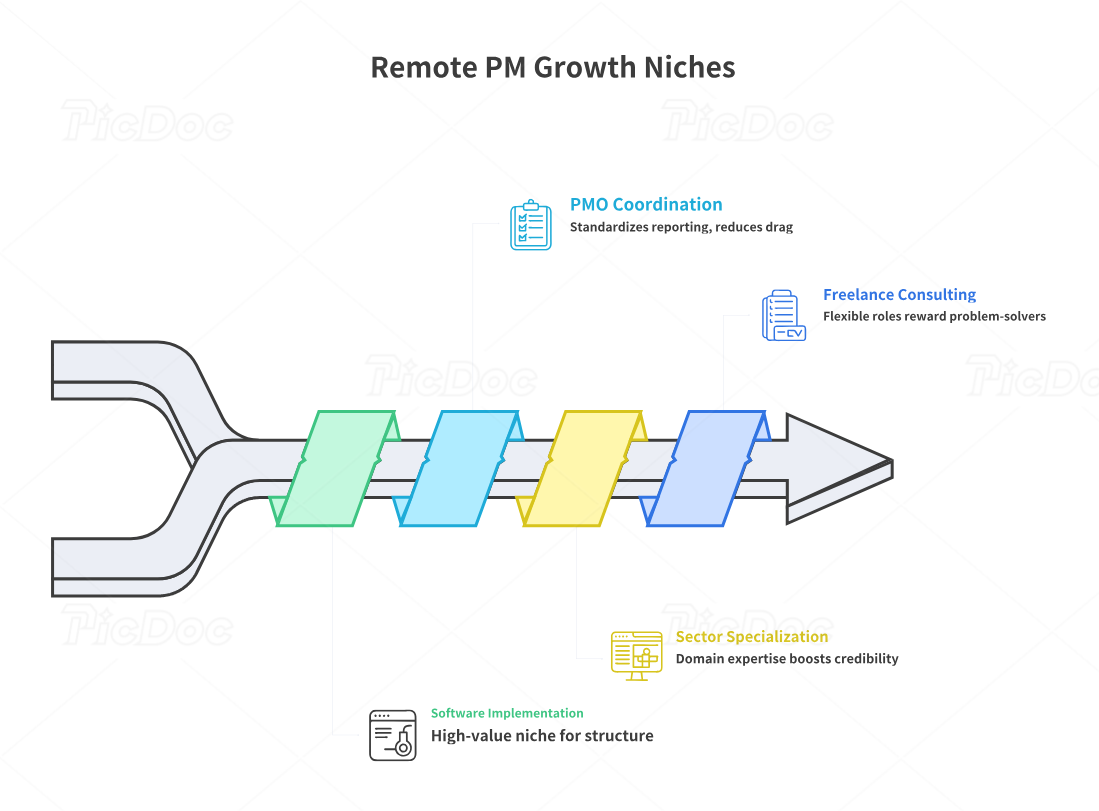
The strongest opportunities will not be evenly distributed. Remote PM growth will concentrate in niches where coordination complexity is high, communication overhead is painful, and business leaders need clear delivery control. One of the best examples is software and platform implementation work. These roles often involve engineering, product, QA, vendors, clients, and change management across multiple time zones. A PM who can bring structure to that environment becomes economically valuable very quickly. That market overlaps naturally with software industry PM tools, AI-enabled PM software, machine learning in estimation and scheduling, and broader AI adoption trends in project management.
A second growth niche is remote PMO and portfolio coordination. As organizations manage more simultaneous work with leaner leadership layers, they need project managers who can standardize reporting, prioritize work, highlight portfolio risk, and support governance without creating administrative drag. This creates strong openings for professionals who understand the future role of the PMO, project portfolio management, dashboard and analytics tools, and project knowledge management software.
A third niche is sector-based remote PM work. Healthcare, financial services, public sector transformation, construction coordination, sustainability programs, and renewable energy initiatives each carry distinct constraints. The more a remote PM understands domain-specific risk, stakeholder behavior, and regulatory pressure, the more credible they become. That is why specialization into lanes like healthcare project management, government project management, construction project delivery, financial services and project management, or renewable energy project management can create much stronger market positioning than remaining a generic all-purpose PM.
A fourth niche is freelance and consulting-led delivery. As organizations seek flexible expertise without long-term headcount commitments, more remote PM opportunities will appear through consulting, fractional leadership, transformation support, vendor-side implementations, and short-term operating redesign work. This lane rewards PMs who can sell confidence, diagnose execution problems quickly, and leave behind stronger delivery systems. It connects directly to freelance PM career growth, future freelance project management trends, starting a PM consultancy firm, and career transitions toward chief project officer pathways.
5. How professionals should position themselves now to capture remote PM demand before the market gets tighter
The first thing serious candidates need to do is stop describing themselves with empty abstractions. Replace “strong communicator,” “results-driven,” and “detail-oriented” with evidence tied to distributed execution. Show how you reduced decision lag, improved status clarity, accelerated cross-functional handoffs, strengthened governance, or improved milestone predictability in a remote or hybrid environment. Employers are looking for operating leverage, not adjectives. That means your profile should borrow thinking from how to become a project manager, entry-level to executive PM career paths, project management consultant skills, and future PM competencies by 2030.
The second move is to build a remote proof portfolio. This does not need to be a flashy website. It can be a disciplined set of resume bullets, case narratives, sample status formats, delivery dashboards, anonymized process improvements, or before-and-after stories showing how you improved coordination quality. The goal is to make invisible PM work visible. If your contributions live only in your memory, the market will underprice you. This is especially important for professionals pursuing remote and virtual PM roles, consultancy work, international PM roles, or portfolio leadership tracks.
Third, strengthen your certification and method story only if it supports your target lane. Remote hiring managers do care about certifications, but not in a vacuum. They want to know how your training improves execution quality. For example, a PMP may signal governance depth, a scrum credential may signal agile environment fluency, and a PMI-ACP may help with adaptive delivery credibility. But the credential matters most when it clearly supports your use case. Professionals comparing options should think in terms of PMP versus PRINCE2, CAPM versus PMP, PMI-ACP preparation, and scrum versus agile certification choices.
Fourth, become materially better at one remote execution pain point that employers consistently struggle with. That could be executive reporting, risk surfacing, cross-time-zone cadence design, vendor coordination, knowledge management, budget visibility, or async stakeholder alignment. The market rewards usable excellence. A PM who is known for solving one expensive problem often gets hired faster than a PM who claims broad competence without sharp differentiation. This is why investing in project reporting tools, document management systems, project training platforms, and project productivity software can create a much stronger career payoff than passively collecting software familiarity.
6. FAQs: high-value questions about the future of remote project management
-
Remote project management is still growing, but the growth is becoming more selective. The easy phase—where many companies simply tolerated remote coordination—has matured into a more performance-driven phase. Roles remain strong where distributed execution is unavoidable, where talent is geographically dispersed, or where organizations need lean but disciplined project control. The opportunity is real, but the winners will be PMs who can prove they improve visibility, governance, and delivery quality in remote settings. Building that edge is easier when your profile aligns with future PM skills, remote PM career strategy, PM software evolution, and AI-led PM career changes.
-
The biggest mistake is sounding generic. Many candidates describe responsibilities instead of outcomes and tools instead of control. Hiring teams do not care that you attended standups, updated dashboards, or used Jira unless you can show what changed because of your work. Strong candidates show how they reduced confusion, accelerated decisions, controlled risk, improved stakeholder trust, or created better forecasting in distributed environments. That story becomes stronger when it connects naturally to project manager career roadmaps, remote PM role strategy, project consultant skill building, and project reporting capability.
-
Software, digital transformation, healthcare operations, public sector modernization, financial services transformation, PMO-led portfolio environments, consulting, and implementation-heavy client delivery functions should remain among the strongest categories. These sectors create enough coordination complexity and enough visibility pressure that capable remote PMs become valuable quickly. Candidates can strengthen positioning by targeting lanes such as IT project management, healthcare PM, government PM, and project portfolio leadership.
-
AI will reduce low-value administrative work, but it is more likely to increase the value of strong remote PMs than eliminate them. The reason is simple: remote delivery problems are rarely caused only by lack of data entry or missing dashboards. They are caused by ambiguity, weak decisions, bad prioritization, poor stakeholder alignment, hidden risk, and broken accountability. AI can help surface signals and automate repetitive tasks, but someone still needs to convert signals into decisions and operating discipline. PMs who combine human judgment with AI-driven project management tools, machine learning for estimation, automation platforms, and future software ecosystems will likely command better opportunities.
-
Start by converting existing work into remote-relevant proof. If you have run hybrid teams, coordinated vendors across locations, owned digital reporting, led async updates, managed distributed stakeholders, or created better documentation and handoff systems, you already have material. Package it deliberately. Add a certification path that supports your lane, strengthen your written status style, improve your dashboard habits, and build a case-based resume rather than a task list. For career transitions, it helps to study entry-level to executive PM progression, freelance PM growth paths, international PM opportunities, and certification salary pathways.
-
The highest-value capability will be the ability to create clarity at scale. That means making priorities visible, decisions traceable, risk actionable, ownership undeniable, and status readable without meetings. Remote PMs who master that become the people organizations trust when delivery complexity rises. It is the skill that sits underneath governance, leadership, communication, portfolio control, and software use. Professionals who develop this capability alongside future PM leadership, project governance best practices, PMO evolution, and remote PM operating models will be positioned far better than candidates who only collect tool exposure.
