
State of Agile Project Management: Original 2026-27 Industry Trends & Insights
Agile project management is no longer in the phase where organizations ask whether it matters. That debate is over. The real 2026–27 question is much sharper: what kind of agile actually works under modern business pressure, and what kind collapses into ceremony, dashboard theater, and exhausted teams? The answer increasingly depends on whether agile is being used as a disciplined operating system for change or merely as a vocabulary layer pasted over unclear priorities.
This industry report breaks down where agile project management stands now, why hybrid delivery models are rising, how AI is changing execution without replacing judgment, what leaders still misunderstand about agility, and where project managers can build the strongest career advantage. Throughout, this piece ties today’s agile reality to certifications, leadership growth, PMO evolution, tooling, and the broader APMIC internal ecosystem.
1) Why Agile Has Moved From Methodology Debate to Operating Reality
A few years ago, many organizations still treated agile as a philosophical choice. Teams argued over Scrum versus Kanban, product leaders promoted iterative delivery, and executives often framed agile as a culture initiative rather than an execution system. In 2026–27, that framing is too shallow. Agile now sits much closer to the center of how organizations manage uncertainty, cross-functional delivery, digital change, and business responsiveness. PMI’s 2024 Pulse of the Profession highlighted that agile, hybrid, and predictive approaches can all produce similar performance results, and that success depends more on choosing the right approach for the work than on ideological loyalty to a single method. It also emphasized the importance of flexible work models, the right tools, stronger skills, and a culture of resilience and continuous learning.
That finding matters because it exposes a hard truth many project managers already feel every week: modern delivery is not being split into neat boxes anymore. Organizations want adaptability, but they also want governance. They want responsiveness, but they also want reporting confidence. They want empowered teams, but they also want visible business alignment. That is exactly why professionals reading how to become a project manager, the entry-level to executive PM career path, the career roadmap to becoming a certified agile project manager, and the future project manager skills needed by 2030 need to stop thinking of agile as a niche specialty. It has become part of the baseline language of modern project leadership.
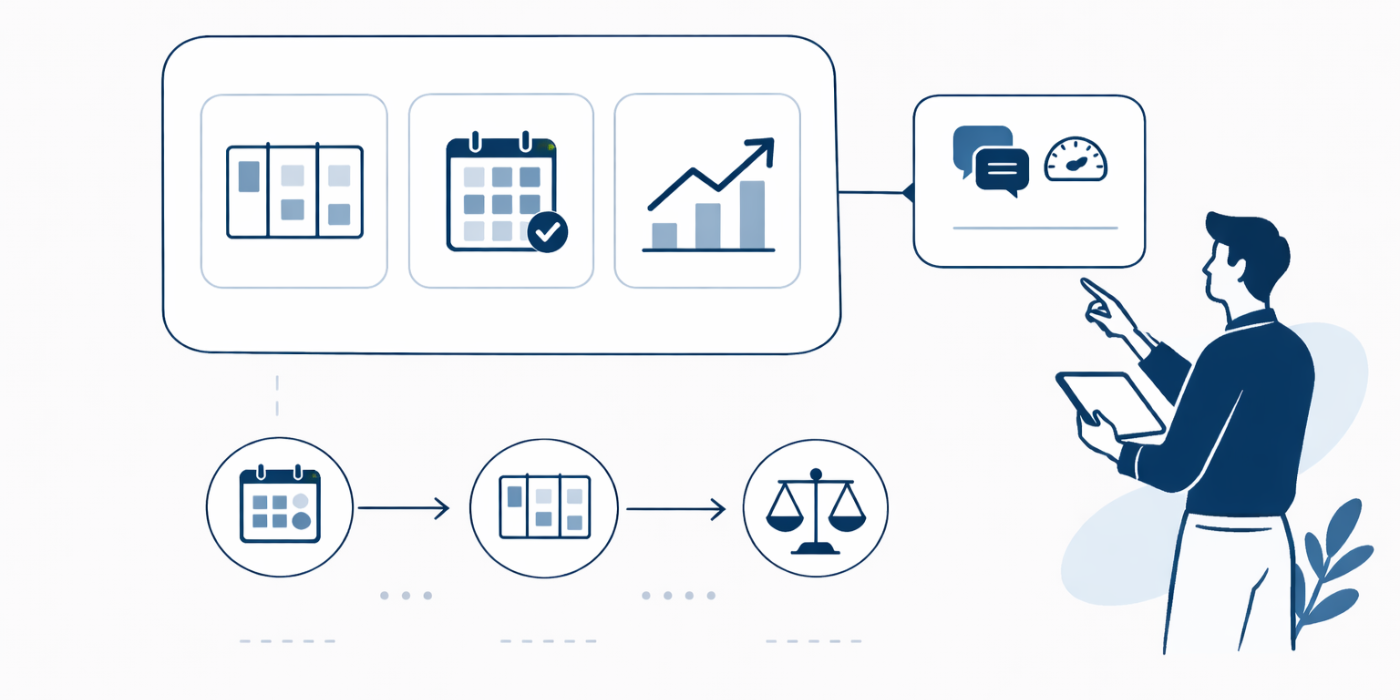
The biggest change is that agile is being judged less by ceremonies and more by operational outcomes. Teams are not being praised because they run standups, retrospectives, or sprint planning well. They are being judged on whether they reduce decision lag, clarify priorities, shorten feedback loops, preserve execution quality, and keep work aligned with changing business conditions. Atlassian’s current teamwork research and operating-practice guidance reinforce this shift. Their material emphasizes aligning work to goals, planning and tracking work together, unlocking shared knowledge, and treating AI as part of the team environment rather than as a novelty. It also notes that teams with clear goals are more productive, and that clear processes materially increase the odds of productive work.
This is why the state of agile is no longer about whether teams “went agile.” It is about whether they built a work system that survives real pressure. That has implications for project management consultants, certified scrum master pathways, agile coach career growth, product owner career paths, and even broader strategic roles such as project management director or chief project officer. Agile has moved from an adoption story to a maturity story.
2) The Biggest Industry Trends Defining Agile Project Management in 2026–27
The first major trend is the normalization of hybrid delivery. Not hybrid in the shallow sense of remote work alone, but hybrid in methodology. Organizations are increasingly combining agile execution with predictive controls, formal governance, compliance checkpoints, and portfolio-level sequencing. PMI explicitly notes that agile, hybrid, and predictive methods can each deliver results when matched to the situation, which reinforces what experienced PMs already know: mature organizations are becoming less ideological and more selective. This is why the rise of hybrid project management, the future of project governance, future of PMO evolution, and project management 2030 methodology predictions are no longer side conversations. They are central to how agile survives enterprise reality.
The second trend is that AI is entering agile work, but mostly as a support layer rather than a replacement for leadership. PMI’s recent AI thought-leadership material frames generative AI as something project professionals are using to improve efficiency, drive smarter decisions, and support transformation. Atlassian’s operating-practice content similarly pushes teams to make AI part of the team environment, not merely a decorative tool. In practical terms, that means agile teams are increasingly using AI for summaries, pattern spotting, knowledge retrieval, draft artifact support, and administrative acceleration. But the pain point remains the same: AI can shorten low-value work, yet it still cannot own tradeoffs, resolve stakeholder conflict, or decide which initiative should lose funding so another can win.
The third trend is the move from velocity obsession to outcome pressure. Mature agile teams are learning that throughput alone does not protect credibility. Shipping more stories does not automatically mean delivering more value. Leaders now want proof that the work being completed is tied to goals, customer movement, operational efficiency, risk reduction, or strategic progress. Atlassian’s current teamwork guidance is useful here because it repeatedly emphasizes visible goals, priority alignment, and explicit connection between projects and objectives. That matters for anyone reading future of project portfolio management, AI and project management innovations by 2030, how machine learning will transform estimation and scheduling, or how automation and AI will transform PM careers. Agile is being pushed closer to business accountability.
The fourth trend is a widening agile talent expectation. PMI’s job-trends material highlights that AI, agility, resilience, strategic thinking, and problem-solving are all becoming more important in the current work landscape, and that digital transformation is reshaping how projects are managed. Scrum Alliance’s 2025 annual report echoes that broader direction by emphasizing agility beyond roles and frameworks, and by describing expanded preparation in leadership and AI-ready skills for modern agile professionals. This means professionals can no longer rely on framework fluency alone. The market increasingly rewards people who combine agile thinking with strategic communication, business judgment, technology literacy, and cross-functional influence.
3) Where Agile Still Struggles Despite Widespread Adoption
The first ongoing struggle is scaling. Many teams can run iterations reasonably well at the squad level, but the moment work crosses teams, functions, vendors, controls, or leadership layers, the system starts cracking. Dependencies become invisible, priorities start conflicting, and each local team optimizes its own workflow without protecting enterprise flow. That is why agile teams keep running into the same pain: they are agile locally but fragmented structurally. This is where project portfolio manager career paths, scrum-master-to-agile-consultant growth, project management consultant paths, and future of project management leadership become so relevant. Scaling problems are usually leadership and design problems before they are tooling problems.
The second struggle is leadership behavior. Many organizations say they support agile, but their executives still operate in ways that quietly sabotage it. They flood teams with urgent work, override prioritization discipline, ask for total flexibility and total predictability at the same time, and then blame the team when planning loses credibility. Agile rarely collapses because the sprint board exists. It collapses because leaders keep bypassing the very tradeoff rules that make agility valuable. That tension is visible across government project management, healthcare project management, IT project management, and international project management roles, because each environment has a different control burden but the same human tendency toward priority distortion.
The third struggle is shallow adoption. Plenty of organizations still perform agile rather than operate agile. They run the rituals, rename the roles, and build dashboards, but the underlying work system remains weak. The backlog is not truly prioritized. The product logic is muddy. Teams are still multitasking across too many initiatives. Blocked work is discussed but not removed. Decision ownership remains vague. This is why professionals comparing certified scrum master preparation, scrum versus agile certification, PMI-ACP exam preparation, and top PMI-ACP exam questions need to understand something important: credentials help, but they do not automatically produce operating maturity. Agile gets stronger only when decisions get cleaner.
The fourth struggle is transformation fatigue. Teams are tired of endless promises that the next tool, the next framework refinement, or the next consultant-led rollout will finally “complete the transformation.” That fatigue is real because many organizations changed language faster than they changed incentives. People are now less impressed by agile slogans and more interested in whether the system actually makes work saner, faster, and clearer. That is one reason the current state of agile feels more mature than before. It is not more glamorous. It is more practical.
Most agile frustration is not caused by lack of effort. It is caused by unclear tradeoffs, overloaded priorities, and weak visibility across the system.
4) What High-Maturity Agile Looks Like Now
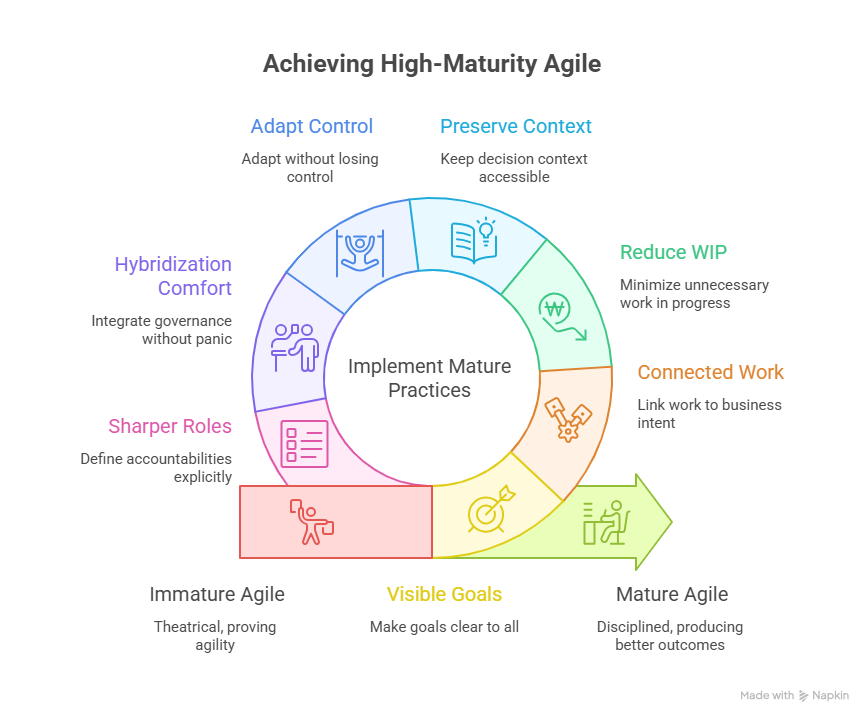
High-maturity agile in 2026–27 looks less theatrical and more disciplined. It is quieter. It is less obsessed with proving that it is agile and more focused on whether the work system is producing better decisions, cleaner prioritization, and healthier flow. Teams with real maturity make goals visible, keep work connected to business intent, reduce unnecessary work in progress, preserve decision context, and adapt without losing control. That direction aligns closely with Atlassian’s current teamwork guidance, which emphasizes visible goals, shared planning, knowledge capture, and AI-enabled teamwork as operating habits rather than one-off tips.
Another sign of maturity is comfort with hybridization. Strong agile teams do not panic when governance enters the room. They know how to preserve iterative learning inside broader structures like stage reviews, budget controls, procurement gates, or executive portfolio checks. They do not see governance as a betrayal of agility. They see bad governance as the problem. This is why future of project governance, future role of the PMO, best project reporting and analytics software, and top dashboard and data visualization tools matter so much. Mature agile environments do not reject oversight. They redesign it to support learning instead of crushing it.
High-maturity agile teams also develop sharper role clarity. They know who owns product direction, who owns execution flow, who carries sponsor communication, who removes blockers, and who decides when priorities change. Role blurring still exists, but healthy teams make the accountabilities explicit enough that confusion cannot live in the shadows. This is especially important for professionals moving between project manager roles, agile coach paths, product owner roles, and project management director tracks. The more senior the environment, the less tolerance there is for ownership ambiguity.
Finally, mature agile teams are building better delivery memory. They do not let critical context disappear into chat threads, informal calls, or individual memory. They connect stories to rationale, decisions to outcomes, and changes to business logic. That is one reason agile increasingly overlaps with document management software for project teams, project knowledge management software, calendar and scheduling tools, and best mobile collaboration apps for project teams. Agile without memory becomes fast confusion.
5) What This Means for Project Managers, Agile Leaders, and Career Growth
For project managers, the state of agile means the role is expanding rather than shrinking. PMI’s job-trends guidance points to agility, resilience, strategic thinking, and AI-era adaptability as valuable competencies, which means PMs who can operate comfortably across agile and hybrid environments are better positioned in the market. This is especially important for people considering remote and virtual PM careers, freelance project management, project management consultancy firm paths, and vice president of PM career progression. Agile literacy is increasingly part of leadership readiness.
For scrum masters and agile coaches, the implication is even sharper. Framework mechanics are not enough anymore. The market is moving toward professionals who can improve system health, not merely protect ritual quality. Scrum Alliance’s 2025 report explicitly frames agility as something broader than narrow roles and emphasizes leadership and AI-ready skills. That means the career ceiling rises for those who can interpret portfolio tension, coach leadership behavior, improve goal visibility, and redesign feedback systems. In plain terms, the future belongs less to ceremony guardians and more to operating-system improvers.
For product-facing leaders, the state of agile means backlog quality is now a strategic asset. Poor prioritization is not a team inconvenience; it is a business leak. When too many initiatives compete for the same attention, the cost is not only slower delivery. The cost is weaker strategic focus, noisier roadmaps, and a rising inability to tell executives what should stop so the right work can accelerate. That is why future of project portfolio management, future of project management software, best automation tools for PM efficiency, and top productivity software for busy PMs should be read together rather than separately. The point is not just better tools. The point is cleaner strategic sequencing.
And for anyone thinking about long-term positioning, the state of agile says this clearly: being “agile-certified” is less impressive than being able to show how you improved flow, clarified prioritization, reduced decision latency, or connected delivery to measurable value. In 2026–27, the professionals who rise fastest are the ones who can translate agile into executive confidence.
6) FAQs
-
Yes, but not mainly as a pure methodology badge. Agile remains important because organizations need adaptable delivery systems, faster learning loops, and better response to uncertainty. What is changing is that agile is increasingly being blended with governance, portfolio controls, and business-value expectations rather than applied as a standalone ideology.
-
The biggest change is the shift from framework loyalty to system effectiveness. Teams are judged less by whether they “do Scrum correctly” and more by whether they improve prioritization, decision speed, transparency, and business outcomes.
-
In many environments, yes, hybrid is becoming more common. That does not mean agile is failing. It means organizations are trying to combine the adaptability of agile with the visibility, governance, and predictability needed at portfolio and executive levels.
-
AI is mostly strengthening support work rather than replacing leadership. It helps with summarization, information retrieval, pattern recognition, draft creation, and administrative acceleration. The human work of judgment, prioritization, conflict resolution, and tradeoff ownership remains central.
-
They often fail because organizations change language faster than behavior. Ceremonies get installed, roles get renamed, tools get purchased, but prioritization discipline, leadership behavior, dependency management, and decision clarity remain weak.
-
Beyond framework knowledge, the strongest skills are strategic thinking, stakeholder influence, business literacy, backlog discipline, decision framing, flow improvement, AI fluency, and the ability to explain agile in business language rather than jargon.
