
Choosing between the Google Project Management Certificate and CAPM can determine how quickly you enter project management, how much you spend, and whether employers take your qualifications seriously. Both credentials target aspiring project professionals, but their costs, assessments, and hiring value differ considerably.
Google emphasizes practical training and portfolio-ready assignments, while PMI's CAPM validates project management knowledge through a standardized examination. This guide compares their true costs, employer recognition, job opportunities, learning outcomes, and long-term career value, helping you select the credential that delivers the strongest return for your experience, budget, and career goals.
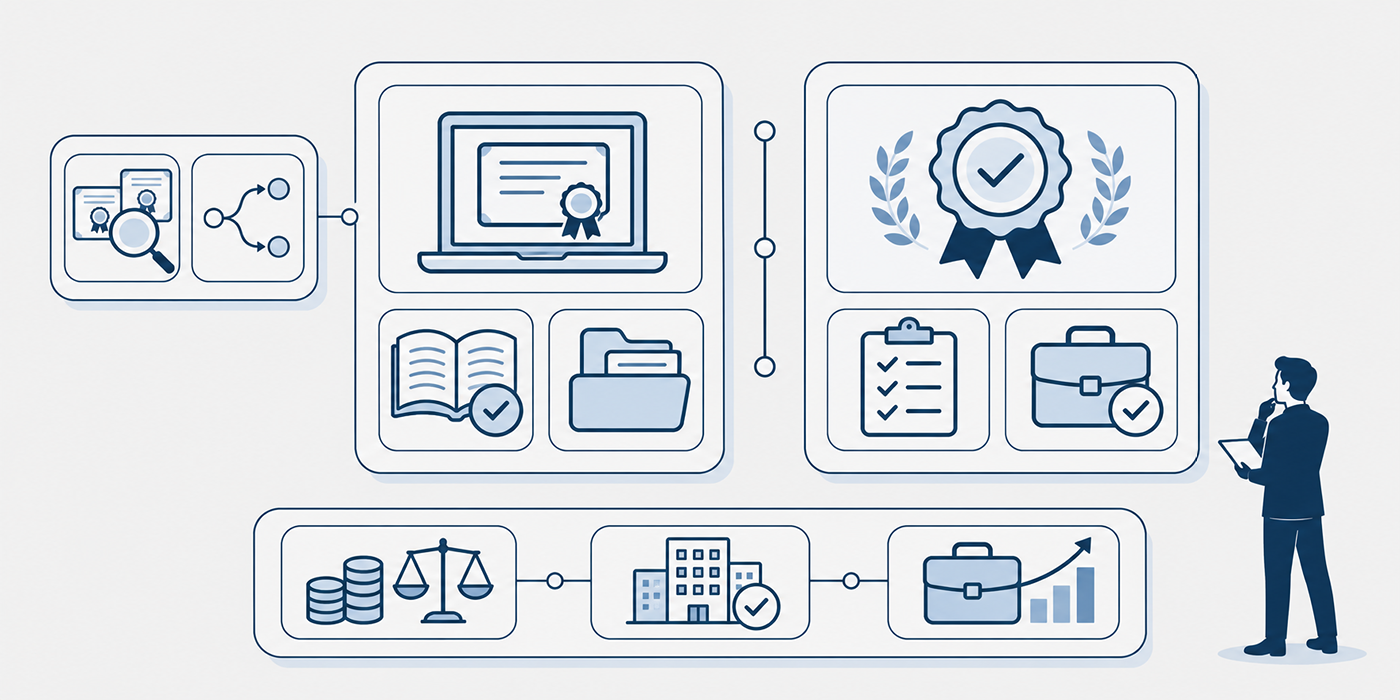
1. Google Project Management Certificate vs CAPM: What Are You Actually Getting?
The Google Project Management Professional Certificate is a beginner-friendly training program developed by Google and delivered through Coursera. CAPM, short for Certified Associate in Project Management, is a professional certification awarded by the Project Management Institute (PMI).
The distinction matters because employers evaluate completed training, independently assessed knowledge, and demonstrated workplace capability differently.
Someone entering project management from retail, education, administration, or customer service may benefit immediately from Google's practical exercises. A candidate already familiar with project scheduling, documentation, and stakeholder communication may find CAPM more useful for demonstrating structured professional knowledge.
This is particularly relevant to professionals exploring teacher-to-project-management transitions, business analyst career changes, operations management transitions, and IT-to-project-management opportunities.
What the Google Project Management Certificate teaches
The current Coursera program is listed as a seven-course series covering foundations, initiation, planning, execution, Agile practices, applied project work, and AI-supported job-search skills.
Its greatest advantage is the opportunity to produce practical evidence of your abilities.
For example, learners can develop project charters, stakeholder analyses, schedules, risk management plans, budgets, and communication documents. These assignments become especially useful when converted into a professional portfolio.
A hiring manager may respond more positively to a candidate who can explain a realistic project charter, defend scheduling assumptions, and describe a stakeholder escalation than to someone who merely displays a completion badge.
For additional practical preparation, candidates can explore project management templates and resources, develop a RACI responsibility matrix, practice earned value management calculations, and strengthen their Agile project management knowledge.
What CAPM certification validates
CAPM tests foundational knowledge across predictive project management, Agile approaches, business analysis, and core project management principles.
The current exam contains 150 questions over 180 minutes, including 15 unscored pretest questions.
Its four examination domains carry these weights:
Project Management Fundamentals and Core Concepts: 36%
Predictive, Plan-Based Methodologies: 17%
Agile Frameworks and Methodologies: 20%
Business Analysis Frameworks: 27%
Candidates must meet PMI's eligibility requirements, including a secondary degree or recognized equivalent, being at least 18 years old under PMI's current eligibility listing, and completing at least 23 hours of project management education before the exam. Prior project management employment is unnecessary.
CAPM becomes particularly relevant to candidates interested in project governance careers, PMO analyst and coordinator positions, international project management opportunities, and eventual project management executive progression.
The most important practical difference
Google helps you learn the work. CAPM provides an independent examination-based credential.
A Google graduate who submits a polished project portfolio may outperform a CAPM holder in a practical interview. A CAPM holder who already has demonstrable delivery experience may have an advantage when a recruiter screens applications for professional credentials.
The strongest candidate combines knowledge, evidence, and experience.
That becomes clear when examining project management resumes without formal PM titles, career-transition strategies, project management salary discussions, and entry-level project management career pathways.
The following comparison identifies where the two credentials differ and which choice is most appropriate for specific career situations.
| Comparison Factor | Google Project Management Certificate | CAPM Certification |
|---|---|---|
| 1. Issuing organization | Google, delivered through Coursera. | Project Management Institute (PMI). |
| 2. Credential type | Professional training completion certificate. | Examination-based professional certification. |
| 3. Primary purpose | Develop practical foundational project management skills. | Validate foundational professional knowledge. |
| 4. Intended audience | Beginners and career changers needing structured training. | Entry-level professionals and candidates seeking formal validation. |
| 5. Prior experience | No professional experience required. | No project management work experience required. |
| 6. Educational prerequisites | No formal degree prerequisite advertised. | Secondary degree or global equivalent. |
| 7. Minimum age | Subject to Coursera's applicable account and participation rules. | At least 18 under PMI's current eligibility requirements. |
| 8. Education hours | Over 100 applicable project management education hours advertised. | At least 23 project management education hours before examination. |
| 9. Listed program structure | Seven-course series, including applied work and job-search preparation. | Four examination domains defined by PMI. |
| 10. Typical completion window | Approximately 3–6 months for many learners. | Variable training and preparation period, followed by the exam. |
| 11. Study format | Self-paced videos, assignments, assessments, and applied exercises. | Self-study or instructor-led preparation; standardized examination. |
| 12. U.S./Canada advertised price | $49 per month after the seven-day trial. | $300 nonmember exam fee or $225 member exam fee. |
| 13. Total cost structure | Monthly subscription multiplied by paid study months. | Training, examination fee, preparation materials, and possible membership. |
| 14. Financial aid | Coursera assistance and regional opportunities may be available. | Financial support depends on applicable PMI or partner programs. |
| 15. Final assessment | Course assessments and applied assignments. | 150-question examination over 180 minutes. |
| 16. External exam requirement | No separate PMI certification examination. | Passing the PMI CAPM examination is mandatory. |
| 17. Predictive methods | Practical planning, budgets, schedules, and execution exercises. | 17% of current CAPM exam content. |
| 18. Agile and Scrum | Dedicated Agile course with Scrum-focused activities. | 20% of current CAPM exam content. |
| 19. Business analysis | Stakeholder, requirements, and project initiation exercises. | 27% of current CAPM exam content. |
| 20. Risk management | Create and apply risk planning documents. | Understand risk management within the examined knowledge base. |
| 21. Portfolio outputs | Structured assignments suitable for adaptation into a portfolio. | No portfolio deliverable required for certification. |
| 22. Exam-pressure exposure | Progress through course-based assessments. | Timed, proctored certification examination. |
| 23. Employer recognition | Recognized as Google-branded training; employer response varies. | PMI certification recognized across project management contexts. |
| 24. ATS relevance | Useful when postings mention Google credentials or practical training. | Particularly useful when postings specify CAPM or PMI credentials. |
| 25. Entry-level job fit | Project assistant, coordinator, and operations support pathways. | Project coordinator, PMO analyst, and junior PM pathways. |
| 26. Career-changing value | Strong for learning terminology and producing evidence. | Strong for formalizing knowledge already demonstrated elsewhere. |
| 27. Employer network | Google offers career resources and region-dependent employer initiatives. | PMI professional community and networking opportunities. |
| 28. Ongoing maintenance | No recurring PMI-style PDU requirement to retain completion. | 15 PDUs in each three-year certification cycle. |
| 29. PMP preparation pathway | Provides project management education relevant to PMI applications. | An active CAPM satisfies PMP's 35-hour training requirement. |
| 30. Best for complete beginners | Strong first step when practical PM knowledge is limited. | Viable with structured exam preparation. |
| 31. Best for experienced coordinators | Useful for filling practical skill gaps. | Often stronger for independent knowledge validation. |
| 32. Best combined strategy | Build practical skills and preserve learning evidence. | Use those foundations to prepare for formal certification. |
2. Google Certificate vs CAPM Cost: Which Offers Better Value for Money?
The advertised price captures only part of the financial decision.
Google charges according to how long you remain subscribed. CAPM has a published examination fee, but candidates also need qualifying education and sufficient preparation to pass the test.
The cheapest option depends on your existing knowledge, available study time, location, and whether you already satisfy PMI's education requirement.
Google Project Management Certificate: What will you actually pay?
Coursera currently advertises $49 per month in the United States and Canada, following a seven-day free trial.
At that rate, the subscription cost is:
2 paid months: $98
3 paid months: $147
4 paid months: $196
6 paid months: $294
These examples exclude applicable taxes and assume the $49 monthly rate remains unchanged.
A learner completing the program in three months pays substantially less than someone taking six months. Regional prices can also differ, and eligible learners may have access to financial assistance or sponsored training.
The most effective cost-saving approach is to establish a consistent weekly study schedule, complete related assignments together, and avoid paying for months when you are unable to study.
For example, build a project charter, develop a RACI matrix, and practice budget forecasting while those topics are fresh.
CAPM certification: The real cost breakdown
PMI's published CAPM examination fees are:
PMI member: $225. Nonmember: $300.
The examination fee covers the exam. Candidates must also complete the required project management education, which may involve additional spending.
Consider three illustrative budgets:
Scenario A: Candidate with qualifying education already completed
The candidate pays the $300 nonmember examination fee and uses available study materials. Their direct certification cost may remain close to the exam fee, depending on any additional preparation purchases.
Scenario B: Candidate purchasing a separate preparation course
A hypothetical $100 training course plus a $300 examination fee produces a $400 initial budget. This is an example calculation rather than a quoted market price.
Scenario C: Candidate combining Google training with CAPM
Four months of Google training at $49 per month costs $196. Adding the $300 nonmember CAPM examination fee produces a combined cost of $496, excluding taxes and optional preparation resources.
Google states that its certificate provides more than 100 hours of project management education relevant to PMI certification requirements. Candidates should retain their completion documentation and ensure the education satisfies PMI's application rules.
Before paying for additional training, assess whether your existing course record already covers the education requirement. Relevant guidance on CAPM preparation resources, CAPM exam mistakes, PMP training resources, and professional certification comparisons can help prevent unnecessary purchases.
Is PMI membership worth purchasing solely for CAPM?
The listed member and nonmember CAPM exam prices differ by $75.
Therefore, purchasing membership purely for the exam discount makes financial sense only if the applicable membership cost and any other required fees are offset by discounts or benefits you actually intend to use.
Membership can provide additional professional resources and networking opportunities, but their value depends on your career plans.
A candidate pursuing PMO leadership, international project management, senior consulting roles, or eventual project executive positions may value the professional community beyond a single examination discount.
The hidden cost that matters most: Delayed employment
Imagine two candidates.
Candidate A spends $150 completing Google training while developing usable work samples and starts applying for project coordinator positions during the course.
Candidate B spends several months preparing for CAPM but postpones applications until passing.
If Candidate A secures relevant experience earlier, that work experience may become more valuable than the difference in certification costs.
However, a candidate repeatedly rejected because job advertisements explicitly prefer CAPM may benefit from completing the examination sooner.
Track remote PM hiring requirements, evaluate entry-level PM position expectations, study project management salary patterns, and compare career-transition outcomes.
A credential's return on investment should account for hiring relevance, useful skills, career momentum, and the money spent obtaining it.
3. Recognition and Hiring Value: Which Credential Do Employers Respect More?
Employer recognition involves several separate decisions.
A recruiter may use certification keywords to shortlist applications. A hiring manager may evaluate whether the candidate understands project delivery. A technical interviewer may test real scheduling, escalation, and stakeholder scenarios.
Success at one stage does not guarantee success at the next.
CAPM has an advantage when recruiters explicitly require PMI credentials
CAPM's most defensible hiring advantage is its standardized examination and direct association with PMI.
When an advertisement states "CAPM preferred," a completed CAPM credential provides specific evidence matching the requirement.
For entry-level PMO and formal project controls positions, this can strengthen an application.
Candidates exploring PMO analyst roles, project governance responsibilities, international PM career progression, and program management careers should examine actual vacancy requirements before committing to an examination.
CAPM may be a particularly useful differentiator when several applicants have similar educational backgrounds and limited practical experience.
Google can have an advantage during skills-based interviews
A completion credential from Google signals structured exposure to project management concepts and applied training.
Its additional advantage depends on whether the learner can demonstrate useful outputs.
For example, imagine a hiring manager asks:
"An important stakeholder requests a new feature five days before launch. What do you do?"
A strong candidate explains how to document the request, assess its cost and schedule implications, evaluate risk, identify approval authority, and communicate the resulting decision.
That explanation can be strengthened through a completed RACI responsibility matrix, a project planning template, an earned value management example, and an Agile delivery example.
Recruiters evaluating entry-level operational roles may value these concrete demonstrations even when the job description contains no certification requirement.
Does Google's employer consortium guarantee an interview?
Google promotes career resources and employer connections in eligible regions. Availability and participating organizations vary geographically.
These initiatives can improve access to opportunities, but a learner should verify whether the relevant resources apply to their country and target market.
A completion certificate does not establish entitlement to an interview, an offer, a particular salary, or a position at Google.
Instead, job seekers should build a targeted application strategy around realistic remote project manager roles, project coordinator career development, career changes from teaching, and business analyst-to-PM progression.
How to determine which credential employers want in your market
Conduct a vacancy audit before enrolling.
Collect 30 recent job advertisements covering your preferred geography and target roles. Separate the positions into project assistant, coordinator, PMO analyst, junior project manager, and specialist project roles.
For every vacancy, record whether it explicitly requires CAPM, prefers PMI certifications, mentions the Google certificate, requests project artifacts, or prioritizes prior delivery experience.
Then classify the results:
CAPM frequently appears in preferred qualifications: Prioritize exam eligibility and preparation.
Practical documentation and collaboration skills dominate: Prioritize Google-style applied learning and portfolio development.
Relevant experience is consistently mandatory: Seek adjacent roles, volunteering, internal projects, or documented responsibility before spending heavily on credentials.
Both knowledge and experience appear repeatedly: Build practical evidence while preparing for certification.
Use project management resume translation strategies, industry-specific PM career research, remote hiring guidance, and certification-focused resume positioning when interpreting the results.
This method replaces assumptions about brand prestige with observable hiring requirements in the market you intend to enter.
Select your biggest challenge to receive a practical next step for your project management career. Recommendations appear instantly.
4. Jobs You Can Get With Google Project Management Certificate vs CAPM
The biggest misunderstanding about entry-level project management credentials concerns the roles graduates can realistically secure.
Both programs can help candidates compete for project-related positions, but job requirements vary substantially by industry, seniority, employer, and geography.
A project manager coordinating a multimillion-dollar infrastructure program requires capabilities beyond those demonstrated through beginner-level training. Entry-level project coordinators, project assistants, and PMO support staff often work under established delivery structures where foundational knowledge can be applied and developed.
The most practical career strategy starts with roles matching your demonstrated responsibilities.
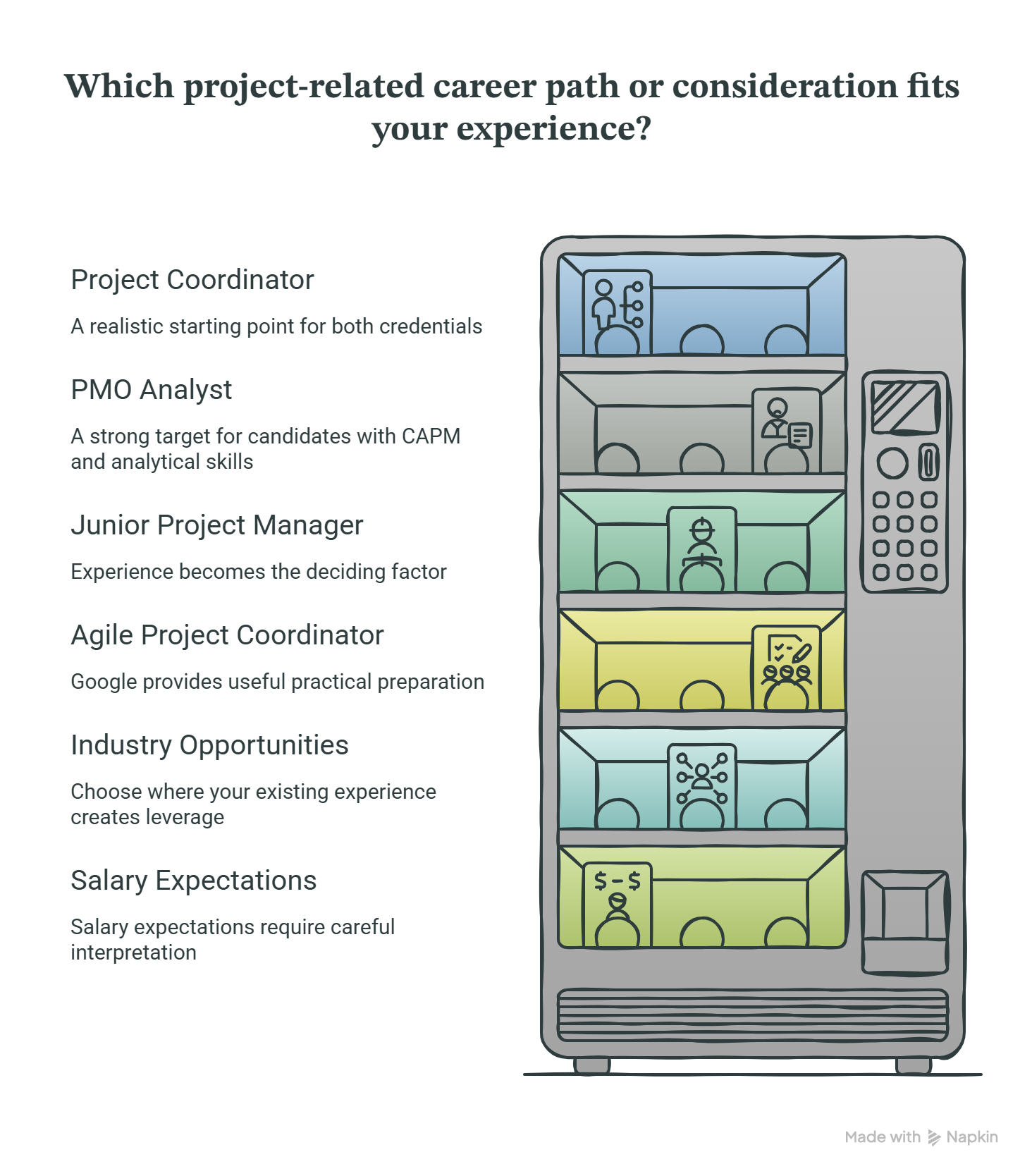
Project Coordinator: A realistic starting point for both credentials
Project coordinators support schedules, meetings, action tracking, documentation, stakeholder communication, and project reporting.
A Google graduate can demonstrate these responsibilities through practical assignments. CAPM holders can explain the formal concepts behind the same activities.
The strongest application includes evidence such as a maintained project schedule, issue log, stakeholder communication plan, and meeting action tracker.
For candidates changing professions, project management resumes without formal PM titles offer a useful framework for translating existing responsibilities. Compare those responsibilities with project coordinator and junior PM career pathways, operations-to-project-management transitions, and business analyst career progression.
Best evidence to present: A project schedule showing dependencies, milestone changes, accountable owners, and an example of how a delayed task was escalated.
PMO Analyst: A strong target for candidates with CAPM and analytical skills
A PMO analyst typically supports standardized reporting, project controls, governance processes, resource tracking, and portfolio visibility.
CAPM can be relevant because its examination covers formal project management concepts, predictive approaches, Agile methods, and business analysis.
However, employers may also expect spreadsheet proficiency, reporting tools, financial interpretation, and the ability to identify inconsistencies across projects.
Candidates should practice building a concise project status report that connects schedule, financial performance, risks, and management decisions.
Use an earned value management calculator to demonstrate CPI and SPI interpretation, a RACI matrix generator to demonstrate accountability, and project governance principles to explain escalation decisions.
Explore PMO analyst versus project coordinator careers to assess which route better matches your analytical and communication strengths.
Best evidence to present: A one-page portfolio status report identifying a deteriorating milestone, the likely cause, financial exposure, and the recommended decision.
Junior Project Manager: Experience becomes the deciding factor
Junior project manager roles may involve managing smaller work packages, coordinating vendors, maintaining delivery schedules, and supervising routine execution.
Some employers accept candidates who have led internal initiatives without previously holding a project manager title.
For example, an operations employee who coordinated a new inventory system rollout may have relevant experience involving vendors, deadlines, user training, stakeholder communication, and acceptance criteria.
That work can provide stronger interview evidence than a certificate alone.
Candidates can strengthen their positioning through operations manager-to-project manager guidance, software engineer-to-PM career insights, IT project management transitions, and marketing project management career development.
Best evidence to present: A documented initiative with a measurable objective, actual stakeholders, a time constraint, and a verifiable result.
Agile Project Coordinator: Google provides useful practical preparation
Google's curriculum includes Agile project management, Scrum principles, and applied activities. These topics can help candidates understand user stories, backlogs, sprint planning, reviews, and retrospective processes.
Employers may still test whether applicants understand the difference between coordinating an Agile team and exercising the accountability of a Scrum Master or Product Owner.
A candidate who can explain dependency management, impediment escalation, and backlog refinement has a stronger foundation for related support roles.
Develop additional context through the Agile team member-to-project manager guide, SAFe Agilist career pathway, Scrum@Scale career roadmap, and freelance Agile project management guidance.
Best evidence to present: A sample backlog with prioritization reasoning, sprint goals, dependency tracking, and an example of resolving a delivery impediment.
Industry-specific opportunities: Choose where your existing experience creates leverage
A professional with healthcare administration experience may find healthcare project coordination more accessible than construction project management.
A teacher may be competitive for education program coordination, curriculum implementation, or training operations roles. A business analyst may transition toward software delivery or process improvement projects.
The advantage comes from combining project management knowledge with existing domain expertise.
Explore education project management software, nonprofit project management careers, environmental project management roles, and international development project careers for examples of specialized opportunities.
Industry alignment can reduce the difficulty of explaining why your previous experience is relevant.
What about salaries?
Salary expectations require careful interpretation.
A job advertisement for a project manager may quote compensation based on years of experience, technical responsibilities, industry conditions, and location. That salary cannot automatically be attributed to completion of an entry-level certificate.
Similarly, a high advertised salary for a broad occupational category may include experienced professionals beyond the target audience of a beginner training program.
Evaluate actual compensation using project management salary reports, industry-specific career comparisons, IT versus construction project management experiences, and remote PM hiring realities.
For a useful comparison, restrict your salary sample to positions sharing the same location, seniority, employment arrangement, and industry.
Then calculate whether the anticipated improvement justifies your training expenditure and time commitment.
5. Which Should You Choose? A Practical 90-Day Career Strategy
Choosing between Google and CAPM becomes easier once the decision is connected to your existing skills and the actual requirements of target vacancies.
Three strategies cover most realistic situations.
Strategy A: Complete Google first if you're entering project management from scratch
This pathway suits candidates who need structured exposure to project work and currently lack a professional portfolio.
Days 1–30: Build the foundation. Study project initiation, scope definition, stakeholder mapping, scheduling, and project documentation. Create an initial charter for a realistic initiative and explain its purpose, assumptions, constraints, and expected benefits.
Use project management templates, responsibility mapping tools, and business analyst career guidance to strengthen your examples.
Days 31–60: Create measurable project evidence. Continue the curriculum while developing a schedule, communications plan, risk register, and budget. Build each artifact around the same case project so employers can follow a coherent delivery story.
Practice cost and schedule performance analysis using the earned value management calculator. Build Agile familiarity through the Agile career progression guide.
Days 61–90: Prepare for interviews and begin targeted applications. Aim to finish the coursework according to your actual schedule, polish three or four portfolio artifacts, and apply for suitable entry-level positions.
Use resume reframing techniques, investigate entry-level PM opportunities, and assess remote project management openings.
The goal is to leave the first 90 days with demonstrable skills and a repeatable application strategy, even if completing the entire certificate requires additional time.
Strategy B: Choose CAPM first if you already understand project delivery
This route is especially relevant to professionals who have coordinated projects informally, participated in implementation teams, or supported project controls.
Begin by reviewing your target job advertisements. If CAPM appears regularly, confirm your eligibility and document the qualifying education hours.
Days 1–30: Study project management fundamentals and predictive methodologies. Identify gaps in your understanding of project life cycles, scope baselines, schedules, risk responses, and stakeholder responsibilities.
Days 31–60: Focus on Agile methods and business analysis frameworks. Use timed practice questions to distinguish conceptual understanding from memorized terminology.
Days 61–90: Complete realistic timed mock examinations, review recurring errors by domain, and take the official exam when sufficiently prepared and eligible.
Strengthen preparation through CAPM study resources, CAPM examination pitfalls, PMP preparation techniques, and exam domain analysis.
The final two weeks should emphasize decision-making accuracy, comprehension of question scenarios, and time management.
Strategy C: Combine Google and CAPM when you need both practical learning and formal recognition
For some candidates, the highest-value strategy is sequential.
Complete Google's project management training first, preserving the documented education hours and useful project artifacts.
Next, identify the CAPM examination topics requiring additional preparation.
Google's training covers relevant concepts, but CAPM preparation should explicitly follow PMI's examination content outline. Timed questions, exam reasoning, and domain-specific knowledge require separate attention.
An illustrative progression is:
Complete practical Google coursework and save your completion documentation.
Build three interview-ready project artifacts.
Verify PMI eligibility and applicable education requirements.
Complete CAPM-focused preparation based on the current examination domains.
Schedule CAPM when readiness is demonstrated.
Apply for roles continuously rather than postponing applications until every credential is complete.
This pathway creates a foundation for later program management opportunities, PMO leadership progression, senior project management consulting, and executive project management careers.
Build a portfolio that proves more than certificate completion
A serious beginner portfolio should demonstrate how decisions were made under realistic constraints.
Select one case project and develop the following:
Project charter: Business problem, measurable goals, exclusions, assumptions, stakeholders, and approval responsibilities.
Responsibility matrix: Roles responsible, accountable, consulted, and informed for significant deliverables.
Project schedule: Milestones, dependencies, resource assumptions, and a plausible critical-path explanation.
Risk register: At least ten credible threats or opportunities with triggers, owners, preventive actions, and contingencies.
Budget and variance report: Baseline estimates, actual or simulated expenditure, assumptions, and an explanation of corrective decisions.
Stakeholder communication plan: Decision cadence, escalation thresholds, information needs, and communication responsibilities.
Use the project management template collection, RACI generator, earned value management calculator, and project governance guidance to improve the technical quality of each artifact.
Clearly label simulated examples as practice projects. For real workplace examples, remove confidential information and explain your exact responsibilities.
A final decision rule for your budget
If you have limited money, weak project management foundations, and little practical evidence, prioritize learning and building usable artifacts.
If you already possess foundational knowledge and employers in your target market repeatedly request CAPM, prioritize meeting PMI's requirements and preparing for the examination.
If you can afford both and need practical competence alongside formal validation, the combined pathway may offer stronger long-term value.
Candidates should also consider project management career resilience, AI-related project management skill changes, professional burnout risks, and industry-specific career opportunities before choosing their first position.
The credential should support a clear employment objective, a practical capability-building plan, and a realistic progression toward more advanced responsibilities.
6. FAQs About Google Project Management Certificate vs CAPM
-
Yes. Google advertises more than 100 hours of project management education applicable to requirements for PMI credentials, including CAPM.
PMI currently requires at least 23 hours of project management education before the CAPM examination. Candidates should retain completion documentation, accurately record their education details, and satisfy PMI's applicable application rules.
Completing Google coursework provides the training component of the pathway. Obtaining CAPM additionally requires meeting eligibility criteria and passing PMI's examination.
Explore CAPM exam preparation resources, CAPM eligibility-related study guidance, PMP preparation resources, and project management certification comparisons for further preparation considerations.
-
CAPM offers a standardized PMI examination credential, which can be especially useful when recruiters explicitly value professional project management certifications.
Google's program offers structured practical training, applied assignments, and a recognizable technology-industry brand.
Employer preference depends on the role and evaluation criteria. A portfolio demonstrating real project judgment may have greater influence during an interview than the title of a certificate.
Evaluate PMO analyst hiring expectations, project management resume requirements, industry-specific PM careers, and career progression expectations against the qualifications in actual job postings.
-
The Google certificate can support applications for entry-level positions, particularly project assistant, project coordinator, and related support roles.
Hiring outcomes depend on demonstrated skills, market competition, employer expectations, and relevant experience from previous work.
Candidates should showcase project documents and identify transferable experience such as coordinating events, managing deadlines, communicating with stakeholders, or implementing new processes.
The most relevant starting points include project coordinator career pathways, teacher career transitions, operations management transitions, and resume development without a PM title.
-
PMI's current CAPM eligibility criteria require a qualifying secondary education credential, an applicable minimum age, and at least 23 hours of project management education.
Professional project management experience is not a prerequisite.
This makes CAPM accessible to students, career changers, and professionals who support projects without formally managing them.
However, employers may independently require work experience for specific positions. Applicants should distinguish CAPM eligibility from job eligibility.
Relevant career guidance includes IT-to-project-management transitions, business analyst career pathways, entry-level PMO careers, and CAPM preparation mistakes.
-
CAPM holders must earn 15 Professional Development Units within each three-year certification cycle and meet PMI's renewal requirements.
The Google Project Management Certificate documents successful course completion and does not have an equivalent PMI-style PDU renewal cycle.
Employers may still expect updated knowledge, especially concerning Agile practices, automation, cybersecurity, and project management technology.
Continued development can include Agile project management skills, AI-supported project management workflows, project management cybersecurity trends, and PMP certification maintenance concepts.
-
Google's curriculum provides substantial foundational learning and qualifying project management education.
For exam readiness, candidates should also study the current CAPM examination content outline, practice scenario-based questions, and identify knowledge gaps across predictive methods, Agile approaches, business analysis, and foundational concepts.
Google coursework may reduce the amount of additional learning required, particularly for beginners, but candidates should assess their readiness through realistic practice examinations.
Use CAPM examination study resources, CAPM mistake-prevention guidance, PMP exam domain discussions, and PMP practice techniques to structure independent examination preparation.
