
Remote Project Manager Jobs in 2026: Reddit Hiring Reality, Experience Barriers & How to Compete for Legitimate Roles
Remote project management remains attractive in 2026 because the work can theoretically be coordinated from anywhere. The hiring market has become far less forgiving, however. Applicants are competing against experienced PMs across wider geographies while employers increasingly demand domain expertise, measurable delivery evidence, and proven remote execution. Understanding the 2026 project-management job market, what employers actually screen for, certification versus real experience, and the project coordinator-to-PM pathway is essential before making “fully remote” the center of a job search.
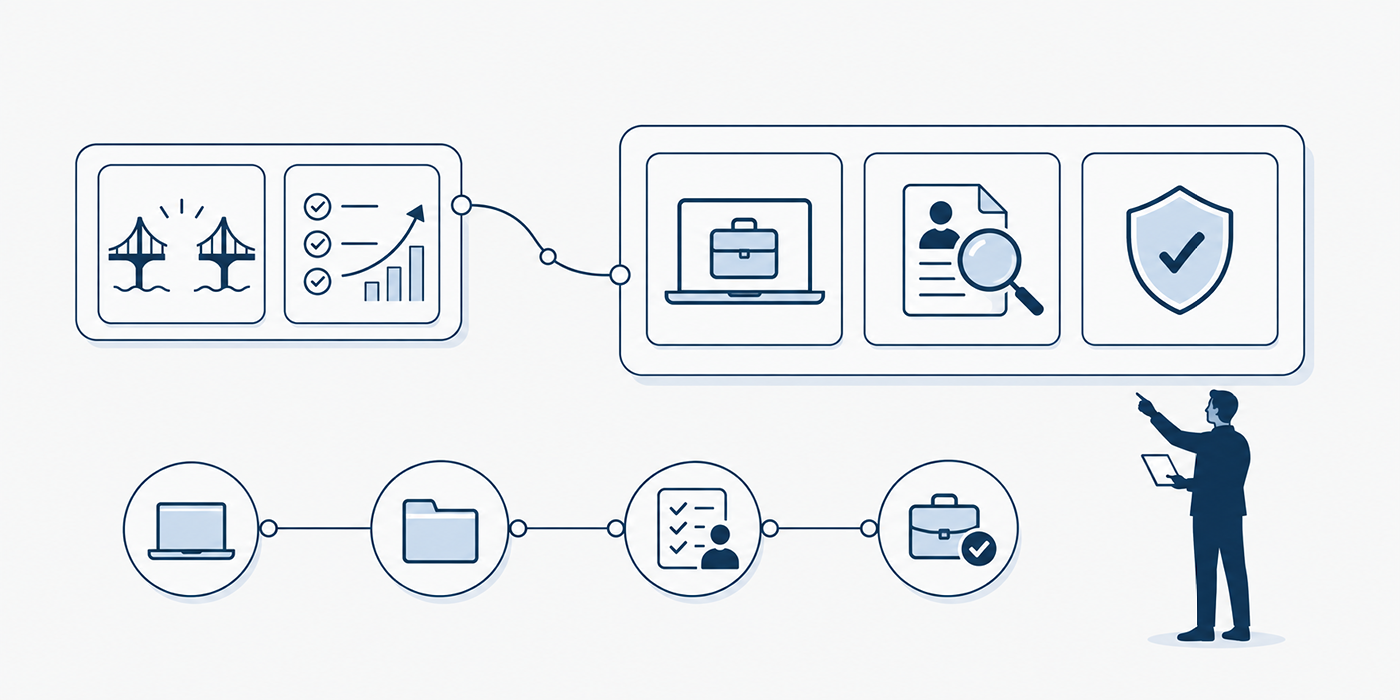
1. Reddit’s 2026 Remote PM Hiring Reality: More Competition, Higher Experience Bars
The first reality is that project management itself still has labor-market demand while remote access to those jobs is considerably tighter. The U.S. Bureau of Labor Statistics reports a 2025 median annual wage of $102,320 for project management specialists, projects 7% employment growth from 2025 to 2035, and estimates roughly 76,500 openings per year over that period. Those figures describe the occupation broadly. They do not guarantee that a meaningful share of openings will be fully remote. Anyone weighing whether project management remains worthwhile, the value of PMP in the current market, future PM certification demand, and PM software-market changes should separate occupational demand from work-location flexibility.
LinkedIn's broader labor-market data help explain the pressure. In 2026, the company reported that U.S. applicants per open role had doubled since spring 2022, while 65% of surveyed job seekers said finding work had become harder. LinkedIn also reported that recruiters themselves were struggling to identify qualified candidates inside the increased applicant volume. Its research on remote work found a persistent gap between how strongly candidates prefer remote roles and how many employers offer them. In the U.S., more than one in five LinkedIn job seekers were still exclusively applying remotely in the underlying research, while the share of jobs members applied to that offered remote flexibility had fallen from 27% at the early-2022 peak to 16% by late 2024. That environment makes strong project-management evidence, modern remote-collaboration knowledge, project-tool fluency, and PMO-level reporting discipline more valuable.
Reddit PM communities make the experience barrier especially visible. A May 2026 discussion from a PMP-holder with eight-plus years of experience described severe difficulty getting interviews and claimed some corporate PM vacancies were attracting hundreds of applicants. A February 2026 senior PM with six-plus years of experience reported more than 200 tailored applications over approximately 18 months, producing only four interviews. A July 2026 PMP-certified PM with seven-plus years across IT, healthcare, pharma, multimillion-dollar projects, and portfolios reported two months of applying with no success yet. These are anecdotes rather than labor-market measurements, but their consistency illustrates how little protection a respectable resume can provide in a crowded funnel. Candidates should therefore understand PM hiring filters, build portfolio evidence, strengthen business-analysis capability, and develop project-governance credibility.
Remote hiring adds another complication: your competition is frequently larger than the labor market within commuting distance of an office. A role open across 20 U.S. states, the entire UK, multiple EU countries, or “anywhere” can produce a far wider qualified pool. Third-party remote-work analysis entering 2026 found significantly heavier application pressure for fully remote positions than hybrid roles. The precise ratios vary by platform and occupation, so candidates should treat headline applicant counts directionally rather than as universal benchmarks. The practical lesson is stronger: a generic “PMP + Agile + stakeholder management” profile competes poorly when applicants also possess technical PM experience, program-management depth, governance leadership, or specialized cybersecurity-project expertise.
The international candidate faces a further filter. “Remote” frequently means remote within an approved jurisdiction, because payroll, labor law, taxes, benefits, data access, client contracts, security requirements, and working-hour coverage can restrict where an employee may live. A June 2026 Reddit thread showed a candidate with three years of coordination, stakeholder, documentation, and procurement experience specifically questioning whether international employers would consider applicants from Africa. Other commenters from India reported similar difficulties. Applicants considering global roles should therefore distinguish remote collaboration capability, IT project-management pathways, agile career progression, and globally portable project-management certification from the employer's legal ability to hire them.
2. Why Qualified Candidates Still Get Rejected From Remote Project Manager Jobs
The first barrier is domain mismatch disguised as a PM-skills match. A candidate may genuinely know planning, risk management, stakeholder communication, governance, Agile, and reporting yet still lose to someone who has delivered the exact class of project. A healthcare SaaS company may prefer a PM who understands implementations, PHI constraints, clinical workflows, client onboarding, and integrations. A cloud employer may prioritize migration dependencies and infrastructure knowledge. A construction organization may need scheduling, procurement, contracts, and field coordination. Reddit hiring discussions repeatedly emphasize that hiring managers increasingly prefer safe bets with relevant project history. This makes IT-to-PM specialization, cybersecurity project-management expertise, environmental PM specialization, and marketing project-management experience strategically valuable.
The second barrier is generic accomplishment language. “Managed cross-functional projects,” “worked with stakeholders,” and “delivered on time” describe the occupation rather than prove individual capability. Remote employers need evidence that a PM can operate without constant proximity or supervision. Stronger bullets expose scope, complexity, business consequence, decision-making, and outcome: the number of workstreams coordinated, budget controlled, client accounts handled, dependencies resolved, risks mitigated, cycle time reduced, adoption improved, revenue protected, or launch moved forward. That evidence standard aligns with portfolio proof that generates interviews, project coordinator promotion readiness, project-governance leadership, and senior PM consulting expectations.
The third barrier is remote-work evidence itself. Employers need confidence that you can prevent information loss across Slack, Teams, Jira, email, documentation systems, and time zones. A remote PM should be able to explain how decisions are documented, how blocked work becomes visible, how asynchronous updates are structured, how ownership is recorded, how urgent issues escalate, and which discussions require synchronous meetings. Experience with remote collaboration systems, modern PM tools, PM software adoption, and effective PMO reporting models should appear in outcomes rather than a disconnected software list.
The fourth barrier is role inflation. Some candidates target Senior Project Manager, Program Manager, or Portfolio Manager because they have many total years of professional experience, even when their direct project ownership is much newer. Remote hiring gives employers enough choice to compare candidates whose title, domain, project scale, and responsibility all align. If your evidence is closer to coordination than ownership, the project coordinator-to-PM transition, the no-experience project-management roadmap, the career-change-to-PM pathway, and the eventual program-manager route give a more defensible progression.
Certification creates the fifth barrier when candidates expect it to carry more weight than employers assign it. PMP can be valuable, especially when job descriptions explicitly use it as a filter, but the credential works best as a multiplier on credible experience. CAPM can establish foundational knowledge, while introductory certificates may support learning, yet neither changes the content of the projects you have actually delivered. Candidates should compare PMP ROI in 2026, CAPM without experience, Google PM Certificate versus CAPM, and PMP versus CAPM versus PRINCE2 versus AgilePM against the vacancies they actually want.
3. Which Remote PM Roles Are Most Realistic to Target in 2026?
The most useful strategy is to search by delivery problem plus domain, rather than typing only “remote project manager.” A technology candidate can target Technical Project Manager, Implementation Project Manager, Cloud Migration PM, Cybersecurity PM, Release Manager, Delivery Manager, Technical Program Manager, or Transformation PM depending on evidence. That approach preserves the value of IT-to-PM experience, creates a route toward program management, supports future project-management consulting, and builds specialized knowledge around cybersecurity delivery.
Client implementation roles deserve particular attention because much of the coordination can be remote while the business value is concrete. These PMs manage onboarding, requirements, configuration, integrations, training, milestones, acceptance, adoption, escalation, and handoff. A strong candidate can prove that a customer went from signed contract to successful launch. That evidence benefits candidates developing business-analysis skills, building stakeholder-heavy PM experience, strengthening remote collaboration capability, and progressing toward senior project roles.
PMO and governance roles can also translate well to distributed organizations because much of the work revolves around standards, reporting, portfolio visibility, resource data, controls, risk escalation, and decision support. Candidates with evidence in these areas can target PMO Analyst, PMO Coordinator, Governance PM, Portfolio Analyst, or Project Controls roles. Developing knowledge of PMO effectiveness, project governance leadership, earned value management, and the path toward project-management executive leadership can turn a remote administrative-looking role into a strong long-term career platform.
Industry selection matters. Reddit discussions in 2025–2026 repeatedly contrasted scarce software/web PM openings with stronger hiring pockets such as construction, healthcare, infrastructure, data centers, and renewable projects, though conditions vary heavily by geography. Construction itself tends to require more physical presence, but adjacent scheduling, controls, estimating, documentation, design coordination, and specialized consulting can provide greater flexibility. Candidates should explore construction-management credentials, cost-professional certification, environmental project management, and project-governance careers rather than assuming every industry offers equal remote access.
Remote-first companies are particularly attractive because their operating systems have usually been designed around distributed work. Look for evidence of documented workflows, asynchronous communication, distributed leadership, clear time-zone expectations, remote onboarding, established collaboration platforms, and measurable ownership. Candidates who understand collaboration-software adoption, project-management tool selection, agile project-management progression, and Scrum@Scale environments can discuss distributed delivery more credibly than applicants who simply say they “prefer working from home.”
4. How to Compete for Remote PM Jobs Without Becoming Another Generic Applicant
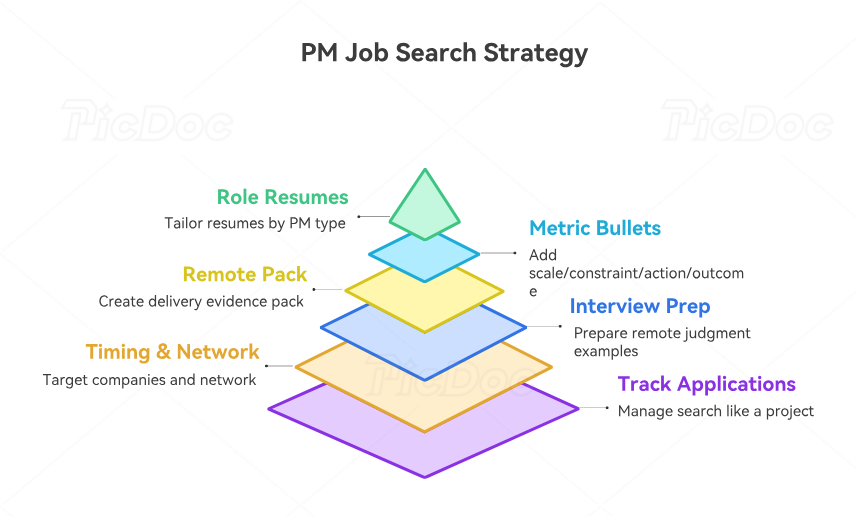
Start by replacing the one-resume-for-everything strategy with role families. A technical PM resume should foreground SDLC delivery, architecture dependencies, releases, integrations, security, and technical risk. An implementation PM version should lead with onboarding, client communication, adoption, configuration, milestones, and escalations. A PMO version should emphasize governance, portfolio reporting, controls, resource visibility, and executive decision support. This mirrors the specialization employers increasingly reward and helps candidates convert experience from IT into project management, move from business analyst to PM, advance from project coordinator to PM, or build toward program-management ownership.
Every important bullet should communicate scale + constraint + action + outcome. “Managed multiple client projects” carries almost no differentiation. “Led eight concurrent enterprise implementations across four time zones, introduced weekly dependency reviews, reduced overdue client actions by 34%, and maintained 96% milestone adherence” gives the hiring team several concrete signals. Exact metrics must be truthful, but useful measurement can include budget, project value, number of users, countries, workstreams, cycle time, backlog, schedule variance, client retention, adoption, forecast accuracy, incidents, or delivery throughput. This is the kind of evidence behind strong PM portfolios, senior PM readiness, project governance progression, and executive PM development.
Then create a remote-delivery evidence pack. A hiring manager should be able to see how you operate without hallway conversations. Include a sanitized weekly status report, RAID log, decision register, stakeholder communication matrix, project roadmap, dependency map, asynchronous update format, escalation path, and meeting-decision record. The portfolio can be brief. Its purpose is to show operational maturity. Strong examples naturally demonstrate remote-team collaboration, PM tool fluency, PMO reporting discipline, and business-analysis thinking.
Remote interviews should expose judgment under weak visibility. Prepare examples where a stakeholder went silent, a distributed team interpreted requirements differently, a dependency surfaced late, one time zone blocked another, an executive needed a decision before the team could meet, or status looked green while underlying work was slipping. Explain the signal you noticed, what information you gathered, what changed in the operating process, and how the result improved. This creates a stronger interview narrative than repeatedly saying you have “excellent communication.” Candidates can sharpen those answers through project governance principles, earned value concepts, agile project-management experience, and modern PMO practices.
Application timing also matters when hundreds of people can see the same vacancy. Build a target-company list and monitor official career pages rather than relying entirely on massive job-board feeds. Follow project leaders, PMO directors, implementation leaders, operations executives, and recruiters in your chosen domain. Comment intelligently before you need anything. Former colleagues, clients, vendors, consultants, and professional communities can all become legitimate referral paths. One Reddit thread about remote PM work described a senior niche vacancy that was filled through referrals without a public listing, illustrating why the visible job market is only part of the market. Networking becomes more productive when supported by credible project experience, clear career positioning, relevant certification choices, and industry specialization.
Finally, run the job search like a project. Track vacancy source, date posted, date applied, eligibility, domain match, experience match, referral status, resume version, compensation, screening result, hiring-manager result, interview stage, and rejection reason. After 40–50 serious applications, calculate conversion by segment. A 1% screen rate across generic remote PM roles but a 15% screen rate in healthcare implementation tells you exactly where the market values your history. This approach is more useful than repeatedly rewriting your resume without diagnosis and aligns with the disciplined thinking behind project-management tool selection, project governance, program-management progression, and senior consulting careers.
5. How to Find Legitimate Remote PM Roles and Avoid Wasting Time on Scams or Misleading Listings
The remote market requires a verification workflow, because fake jobs and misleading “remote” labels consume time even when they never steal money. In August 2026, Reddit users continued reporting postings advertised as fully remote that later introduced recurring office requirements. Read every location clause before tailoring an application. “Remote,” “remote-first,” “work from home,” “distributed,” and “remote eligible” can imply very different arrangements. Combine careful screening with knowledge of remote collaboration models, modern PM software, project tool ecosystems, and PMO operating practices.
For every serious role, verify the company domain, official careers page, recruiter identity, job requisition, legal company presence, and whether people with comparable titles actually work there. Search the company name together with “scam,” “fraud,” “complaint,” and the recruiter name when anything feels inconsistent. The FTC specifically recommends independently searching employers and recruiters, warns job seekers never to pay for the promise of employment, and cautions against employers that send checks and ask recipients to return money or purchase equipment. That verification habit matters just as much as improving PM hiring readiness, building project portfolio evidence, understanding certification value, and strengthening remote-team capability.
Be especially suspicious of unsolicited messages promising vague “remote positions” with unusually high pay, minimal qualification requirements, immediate hiring, text-only interviews, requests to continue on Telegram or WhatsApp, payment for training, cryptocurrency transfers, gift cards, or checks for home-office equipment. In April 2026, the FTC specifically warned about fake recruiter texts using familiar company names and vague work-from-home offers, sometimes asking recipients simply to reply “YES” or “INTERESTED” before moving them deeper into the scam. Legitimate candidates should invest their time instead in positions where their IT project background, project coordinator evidence, governance capability, or program-management experience clearly maps to documented business needs.
Stale listings deserve a different response from outright scams. A real employer may keep an evergreen talent pipeline, repost a difficult vacancy, use multiple location pages for one requisition, pause hiring, or fill the position internally. The applicant cannot reliably infer intent from the listing alone. Your protection is opportunity-cost discipline: prioritize newly posted roles, official company sites, known recruiters, direct referrals, clear requisition numbers, defined responsibilities, stated location requirements, and positions where you meet most of the hard criteria. That discipline gives more return than blindly pursuing every vacancy while simultaneously debating whether PMP is worth it, whether CAPM improves entry chances, or whether a Google PM credential improves employability.
The highest-value mindset is to treat remote flexibility as a constraint inside the career strategy, rather than the entire strategy. Determine the projects you are qualified to lead, the industries where your history creates a hiring advantage, the jurisdictions where employers can legally engage you, the time zones you can sustainably cover, and the compensation level you need. Then search inside that intersection. A candidate who combines real project experience, specialized technical knowledge, strong distributed-team execution, and a clear route toward program leadership has a far stronger proposition than someone whose main qualification is wanting to work from home.
6. FAQs About Remote Project Manager Jobs in 2026
-
Yes. Fully remote PM positions still exist across software, healthcare, SaaS implementation, financial services, consulting, cybersecurity, operations, nonprofit work, and other sectors. Their availability varies heavily by company, geography, industry, seniority, and project type. The wider PM occupation remains substantial, with BLS projecting 7% U.S. employment growth for project management specialists between 2025 and 2035.
Candidates should evaluate the opportunity through current PM job-market conditions, remote collaboration requirements, project-management hiring standards, and portfolio evidence employers can verify. The remote segment is significantly more competitive than the existence of PM demand alone might imply.
-
Qualification is only the starting threshold. Employers may have candidates with closer domain experience, stronger project scale, existing referrals, better jurisdictional fit, more relevant systems knowledge, or clearer evidence of distributed-team delivery. Reddit threads in 2026 include experienced PMs reporting very low interview conversion even after hundreds of applications.
Diagnose the funnel rather than assuming every rejection has the same cause. Compare your profile with what PM employers screen for, strengthen project evidence, assess whether the project coordinator-to-PM route better fits your current responsibility level, and add domain depth through an appropriate IT-to-PM pathway or another specialization.
-
It is possible, but “remote + career change + no formal project experience” creates three simultaneous hiring risks. A more realistic path may begin with Project Coordinator, Implementation Coordinator, PMO Coordinator, Project Assistant, Operations Coordinator, or a domain-adjacent role where existing professional experience remains valuable.
Use the no-experience PM roadmap, evaluate CAPM without experience, understand the coordinator-to-PM progression, and build project portfolio evidence. One year of genuine delivery exposure can be substantially more valuable than repeatedly applying to fully remote PM jobs whose baseline requirements already exceed your evidence.
-
PMP can strengthen a profile when the employer values or requires it, but it does not neutralize domain mismatch, insufficient project scale, weak outcomes, location restrictions, or poor positioning. Its value is strongest when it validates experience that is already compelling.
Candidates should evaluate PMP ROI in 2026, compare PMP, CAPM, PRINCE2 and AgilePM, understand future certification demand, and keep building evidence beyond certification. A PMP attached to exact domain experience, measurable outcomes, and remote delivery proof is much more powerful than the credential by itself.
-
Show how work moved without physical proximity. Useful evidence includes asynchronous reporting, distributed stakeholder coordination, time-zone management, documented decision-making, dependency tracking, remote workshops, risk escalation, collaboration-tool workflows, virtual client implementation, and measurable delivery outcomes.
Your bullets should connect those capabilities with remote collaboration systems, project-management software, organizational PM-tool selection, and modern PMO reporting. “Worked remotely for three years” is a location statement. “Led a four-time-zone implementation using written decision logs, weekly risk reviews, and asynchronous handoffs while maintaining launch milestones” is delivery evidence.
-
Verify the role through the employer's official website, inspect the recruiter's company email domain and professional history, confirm location and employment terms, and independently research the company before providing sensitive information. Never pay to apply, buy mandatory equipment from a recruiter-selected seller using transferred funds, return part of an employer check, or send cryptocurrency or gift cards. Those patterns align with FTC warnings about employment scams.
Spend your effort on verified opportunities where your real PM experience, domain knowledge, remote collaboration capability, and project-governance discipline directly match the employer's stated problem.
