
Which Project Management Tasks Will AI Automate First? Reddit Experiences + a Future-Proof Skill Map for PMs
AI is already changing project management at the task level. Meeting transcription, status drafting, document creation, data synthesis, risk prompts, and action tracking are becoming faster to automate, while ambiguity, political judgment, negotiation, accountability, and strategic trade-offs remain much harder. PMI now explicitly positions AI as part of everyday project delivery, making AI-aware project leadership, modern PM tool fluency, project governance capability, and real project evidence increasingly important career defenses.
1. What AI Is Already Automating in Project Management in 2026
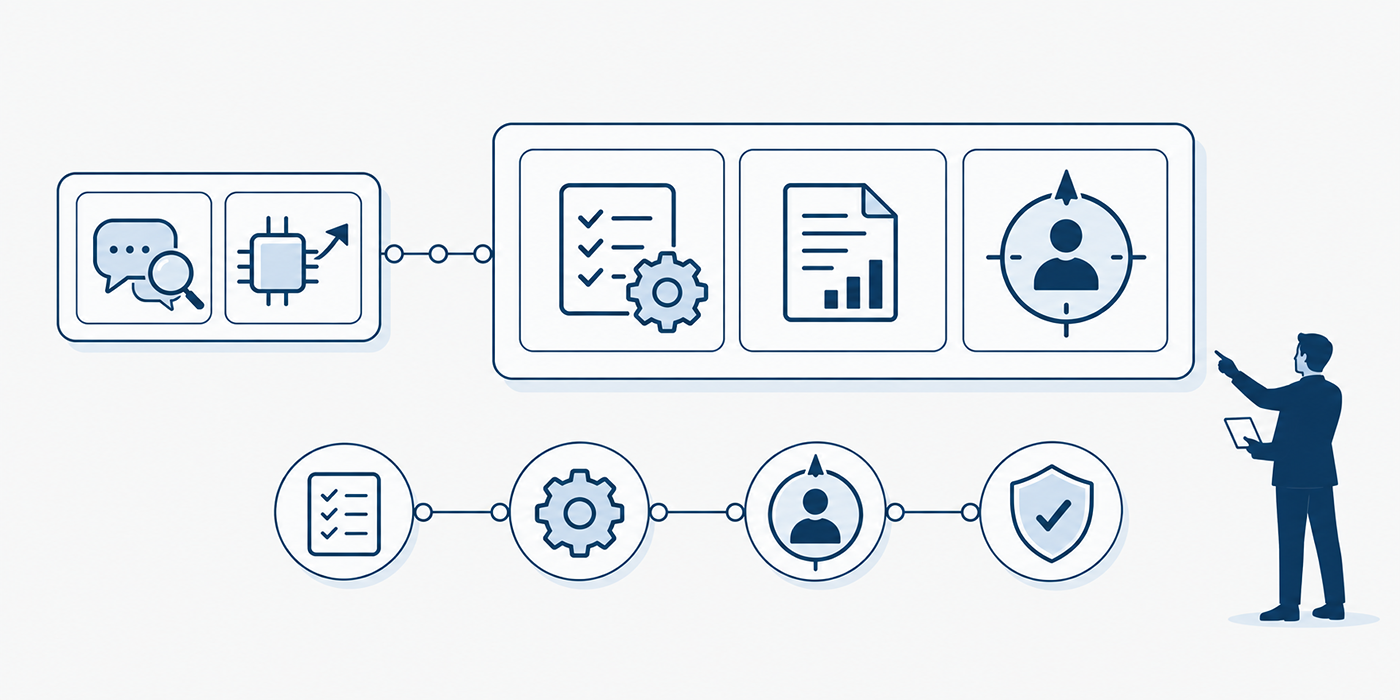
The first wave of PM automation is concentrating on work that has four characteristics: high repetition, structured inputs, predictable outputs, and low consequences when a human reviews the result. PMI's current guidance explicitly lists drafting project plans, status reports and stakeholder communications, summarizing meetings and documentation, analyzing project data, identifying trends, and surfacing potential risks as practical AI applications. PMI still recommends human review, validation, governance, and contextual judgment around those outputs. This makes understanding project-management software adoption, how companies choose PM tools, remote collaboration systems, and effective PMO operations increasingly valuable.
Reddit's 2026 conversations show this transition happening in ordinary workflows rather than theoretical demonstrations. In an August discussion, PMs described using AI-assisted meeting transcription to create first-pass notes, then manually editing them for accuracy. Others described generating initial versions of charters, risk and issue logs, RACI matrices, stakeholder lists, steering-committee decks, and weekly status reports. Another discussion mentioned email drafting, follow-ups, meeting facilitation, action items, and scanning several projects for concerns or missed items. The pattern matters for anyone assessing whether PM remains a worthwhile career, why PM candidates struggle to get hired, future PM certification value, and program-management progression.
A community-led PMI study with 2,314 responses across 129 countries likewise identified data collection and reporting, performance monitoring, and project time management and scheduling among the areas most affected by AI. Those are revealing categories because each contains substantial information-processing work. Gathering five status updates and turning them into one executive summary is largely synthesis. Comparing milestone dates against a baseline is largely analysis. Looking across issue logs for recurring patterns is largely classification. These areas overlap heavily with earned value management, business-analysis practices, PMO reporting, and increasingly sophisticated project-management platforms.
This creates an important distinction: AI can automate production of a PM artifact much faster than it can assume responsibility for the decision represented by that artifact. It may generate a risk register from meeting transcripts. Someone still needs to decide whether a risk deserves executive escalation, whether the probability assessment is credible, whether mitigation is politically feasible, and who will accept residual exposure. It can propose a schedule. Someone still needs to understand why the engineering manager's “two weeks” depends on another team that has never agreed to participate. That gap between producing information and being accountable for action is where project governance leadership, senior PM consulting, program management, and eventually PM executive leadership become much harder to automate.
PMI's 2026 AI standard reinforces this direction. The standard includes human-in-the-loop practices, governance, ethical and legal guardrails, risk controls, and lifecycle considerations rather than assuming autonomous AI should simply take over project work. The safest career strategy is therefore to identify which part of your current workload is artifact production and which part is judgment, influence, accountability, or systems thinking. The former will compress quickly. The latter becomes the foundation of a stronger project-management career, governance career, program-management trajectory, or PM-to-COO pathway.
2. The PM Tasks Most Likely to Disappear, Shrink or Become “Review Work”
The clearest danger zone is manual information movement. A PM who spends Monday chasing updates, Tuesday copying them into PowerPoint, Wednesday turning meeting notes into action lists, Thursday rebuilding schedules, and Friday rewriting the same information for leadership has a highly compressible workload. Modern platforms can increasingly collect updates, summarize conversations, detect overdue work, propose status narratives, and surface anomalies. PMI explicitly frames AI as a way to reduce routine work so project professionals can spend more time on stakeholder engagement, strategic thinking, and value delivery. PMs should therefore deepen their understanding of modern collaboration software, PM software adoption, how companies select PM platforms, and effective PMO design.
Meeting administration is likely to compress especially quickly. AI can already transcribe discussion, identify decisions, propose action items, extract owners, and produce follow-up emails. Reddit PMs are already using these workflows in Teams and Copilot. The valuable skill therefore shifts from “takes immaculate minutes” toward “runs meetings that resolve ambiguity and produce decisions.” A PM able to challenge the right assumption, stop circular discussion, expose an unresolved dependency, and force clarity on ownership offers more value than one who simply documents what happened. That shift supports progression from project coordinator to project manager, then toward program management, project governance leadership, and eventually PM executive roles.
Status reporting is equally exposed. An integrated project environment can ingest progress data, identify missed milestones, compare burn rates, summarize RAID changes, and create the first executive narrative. What remains valuable is deciding whether reported data is trustworthy and what deserves executive attention. A sophisticated PM notices that a workstream has remained “90% complete” for four weeks, that the integration dependency was never formally accepted, or that a supposedly minor change threatens the business case. That requires the deeper thinking behind earned value management, business analysis, project governance, and senior PM consulting.
Basic planning will also become more automated. Give AI a scope statement, resource constraints, milestone requirements, historical delivery data, and dependencies, and it can rapidly propose a work breakdown structure, preliminary schedule, RAID register, stakeholder matrix, communications plan, and governance cadence. Reddit practitioners already report using AI to jump-start exactly these documents. A PM who merely knows how to populate templates therefore becomes easier to substitute. A PM who can determine whether the proposed structure reflects how the organization actually works becomes more valuable. This is why certification versus real experience, PMP value in 2026, future PM certification demand, and real hiring evidence deserve to be viewed through an AI lens.
The most vulnerable PM profile is therefore the human middleware PM: someone whose primary value is receiving information from one group, reformatting it, and sending it to another. The strongest future profile is closer to an organizational decision orchestrator who understands business outcomes, dependencies, incentives, risk, governance, technology, and people. That distinction explains why skills developed through IT-to-project-management transitions, business analyst-to-PM careers, agile leadership, and project-management consulting can become disproportionately valuable.
3. What AI Still Struggles With: The Work That Separates PMs From Project Administrators
A revealing June 2026 Reddit discussion asked what project managers will do if AI can schedule meetings, track tasks, create reports, and send reminders. Several responses pushed back on the premise. Experienced participants described PM responsibility as protecting scope, maintaining alignment with business needs, navigating nuance, and making decisions rather than merely performing administrative tasks. Another April discussion emphasized prioritization judgment, especially deciding what should not be worked on. These are exactly the capabilities associated with project governance, program-management leadership, senior PM consulting, and executive project leadership.
Consider stakeholder conflict. AI can summarize both arguments and suggest compromise options. It cannot reliably know that the head of operations publicly supports a launch while privately resisting it because the new platform removes headcount from her department. It may see organizational charts and communication histories, yet organizational power often operates through information never written down. The PM who reads incentives, recognizes defensive behavior, chooses the correct private conversation, and secures agreement is doing work far beyond task tracking. That skill is essential in PMO environments, business-analysis work, traditional-to-agile transitions, and senior project governance.
The same applies to ambiguity. A sponsor may say, “We need this faster.” Engineering says the date is impossible. Sales has already promised the feature. Finance refuses additional headcount. Compliance introduces a requirement nobody budgeted for. AI can model alternatives brilliantly if given complete inputs. Real organizations rarely supply complete inputs. Strong PMs uncover hidden assumptions, determine which constraint is actually movable, build decision options, and force accountable trade-offs. PMI's 2026 Pulse research places growing emphasis on navigating complex systems rather than simply navigating tasks, reporting that teams that effectively manage complexity are far more likely to succeed. That direction strengthens the value of program management, project governance, executive PM capability, and PM-to-COO development.
Accountability is another important moat. An AI model can recommend cancelling a workstream. The sponsor still needs a human who will defend that recommendation in a steering committee, explain the financial consequences, handle the vendor reaction, manage team morale, and own what happens afterward. AI can identify that a project is likely to miss its launch. A PM still needs to decide when to stop optimistic reporting, escalate, reset stakeholder expectations, and negotiate the recovery plan. The difference between analysis and accountability becomes increasingly important for project-management hiring, real-experience portfolios, project coordinator progression, and program leadership.
PMI's 2026 AI standard explicitly emphasizes human-in-the-loop review, governance, responsible use, legal considerations, intellectual-property issues, audits, and contractual concerns. This means future-proof PMs should become competent in deciding where AI may act, where AI may advise, and where humans must retain authority. Those governance skills are increasingly useful in cybersecurity and project management, the future of cybersecurity-facing PM work, project governance careers, and PM executive progression.
4. The Future-Proof Skill Map: What PMs Should Build Before Administrative Work Shrinks
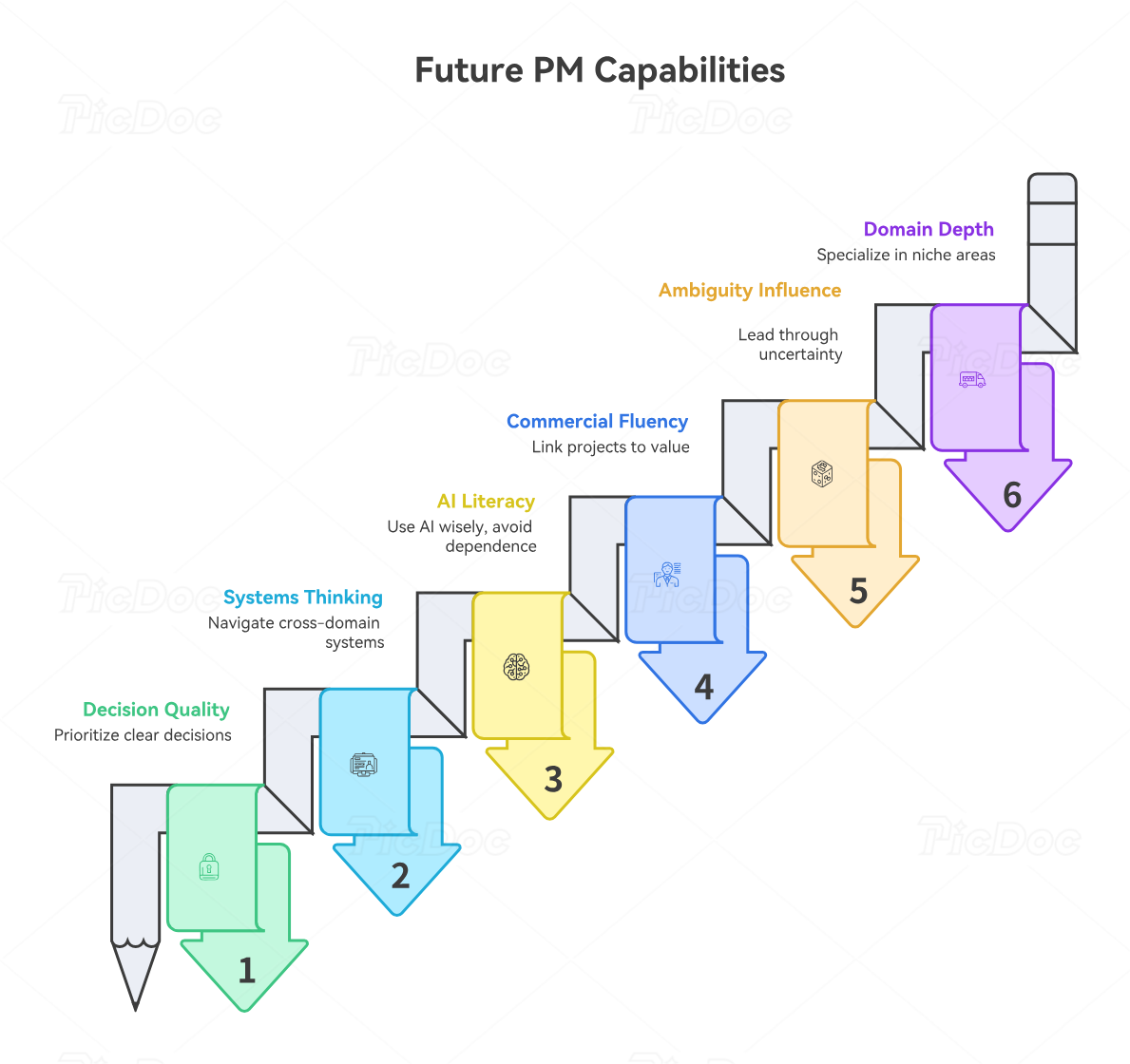
The first future-proof capability is decision quality. Stop measuring personal value by how many artifacts you produce. Measure it by how many important decisions become clearer because you are present. Learn to present options with cost, timing, risk, dependencies, reversibility, and business impact. Create decision logs that document assumptions and consequences. Study the disciplines behind business analysis, earned value management, project governance, and program management. AI can generate alternatives quickly. Organizations still need professionals trusted to choose among them.
The second capability is systems thinking. Projects increasingly fail through interactions across technology, process, vendors, customers, regulations, resources, incentives, and organizational politics rather than through one isolated missed task. PMI's 2026 Pulse research explicitly frames complex-project performance around moving from navigating tasks toward navigating systems. PMs should therefore learn dependency mapping, second-order effects, constraint analysis, portfolio interactions, change impact, and organizational design. These skills support progression through PMO leadership, program management, project governance, and executive project roles.
The third capability is AI literacy without AI dependence. Learn how models fail, hallucinate, lose context, amplify bad source data, expose confidential information, and produce persuasive but weak analysis. Build repeatable workflows in which AI drafts, analyzes or flags while a human verifies. PMI's guidance specifically recommends data-quality practices, governance, reusable prompting approaches, and human validation. That becomes particularly valuable when working with project-management software, remote collaboration ecosystems, cybersecurity-facing project work, and future technology programs.
The fourth capability is commercial fluency. Understand how your project creates, protects, or destroys economic value. Learn basic financial statements, ROI, total cost of ownership, opportunity cost, vendor economics, procurement, forecast variance, revenue impact, and benefits realization. A PM who can explain why a three-month delay changes the business case offers substantially more value than one who merely reports the delayed date. Commercial thinking strengthens pathways into senior PM consulting, program management, project-management executive roles, and eventually PM-to-COO leadership.
The fifth capability is influence under ambiguity. Become excellent at difficult conversations, expectation resets, scope negotiation, stakeholder mapping, executive escalation, conflict mediation, and saying “no” with evidence. One 2026 Reddit discussion centered specifically on prioritization and deciding what should be deprioritized as an area where human judgment remains critical. These capabilities separate a durable PM from a project administrator and improve prospects in project governance, agile project leadership, senior PM consulting, and executive project leadership.
Finally, develop domain depth. AI will make generic PM knowledge cheaper because templates, explanations, frameworks, and first-pass plans become instantly available. Knowledge of regulated healthcare, cybersecurity, cloud infrastructure, construction, finance, ERP implementation, environmental programs, marketing operations, or another real operating environment creates context AI cannot simply infer from a generic prompt. This is why specialized paths such as cybersecurity project management, environmental project management, marketing project management, and IT-to-PM progression can become stronger defenses than accumulating generic PM terminology.
5. How to Redesign Your PM Role Around AI Before Your Employer Does It for You
Begin by performing a two-week work audit. Record each task and classify it as administration, synthesis, analysis, judgment, relationship management, decision-making, governance, commercial work, or leadership. Then estimate how much of each task could be delegated to AI with human review. A PM who discovers that 60% of the week consists of meeting notes, reminders, status consolidation, document formatting, deck preparation, and routine email drafting has identified a productivity opportunity and a career warning at the same time. The answer is to use that capacity to develop PMO capability, project governance expertise, business-analysis depth, and program-management skill.
Next, build an AI delegation ladder. Level one is drafting: email, summaries, agendas, reports, charters, decks. Level two is analysis: trend detection, issue clustering, risk discovery, schedule variance, budget variance, requirements synthesis. Level three is recommendation: scenarios, priorities, recovery options, vendor comparisons. Level four is action: triggering workflows, creating tasks, sending reminders, updating systems, and eventually using agents to carry out approved project actions. Human controls should tighten as consequences increase. PMI's AI standard specifically emphasizes structured governance and human oversight, while its project-work guidance encourages AI use for routine tasks and analytical support. That governance mindset complements cybersecurity-aware PM work, project tool selection, remote collaboration systems, and project governance leadership.
Then quantify what AI gives back. If meeting administration drops from five hours to two, do not refill the three hours with prettier reports. Use that time for sponsor alignment, dependency reviews, customer conversations, financial analysis, scenario planning, risk workshops, or direct work with struggling workstreams. This is where PMs can create measurable evidence that strengthens project-management portfolios, improves project coordinator-to-PM readiness, supports program-management progression, and eventually creates credibility for senior PM consulting.
You should also redesign your resume evidence. “Produced weekly project reports” becomes weaker as reporting becomes automated. “Identified a cross-workstream dependency that threatened launch, quantified the impact, secured executive prioritization, and recovered four weeks of schedule exposure” becomes stronger. “Maintained RAID log” is increasingly administrative. “Reframed three recurring delivery issues into a vendor-governance problem and negotiated corrective milestones” shows judgment. Employers already distinguish between certification and meaningful experience, which is why real portfolio evidence, PM hiring requirements, PMP ROI, and future certification value matter differently in an AI-heavy environment.
PMI's July 2026 PMP refresh explicitly emphasized durable capabilities such as judgment and converting strategy into outcomes as technology changes faster. That is a useful career signal. Use AI aggressively for work machines can perform well. Become unusually strong at the parts requiring accountable human judgment. The PM who combines AI fluency with program leadership, project governance, commercial decision-making, and domain-specific PM expertise becomes more leveraged as routine work disappears.
6. FAQs About AI Automation and the Future of Project Management
-
Meeting transcription, meeting summaries, action-item extraction, routine emails, first-draft status reports, document formatting, information consolidation, basic project templates, preliminary risk identification, and recurring project-data analysis are among the strongest early candidates. PMI already lists plans, reports, communications, summaries, documentation, trend analysis, and risk identification among practical AI-supported PM workflows.
PMs should use the freed capacity to move toward project governance, business analysis, program management, and executive project leadership. The danger is continuing to define professional value around producing artifacts that AI can increasingly draft in seconds.
-
AI is more likely to compress parts of the PM role and change staffing economics before it eliminates the need for project leadership. Organizations may need fewer hours for reporting, coordination, documentation, scheduling, and information processing. Those productivity gains can still reduce the number of people required for certain PMO or coordination workloads.
PMI's current position emphasizes combining AI's speed with human judgment, leadership, accountability, and governance. Career resilience therefore depends on moving beyond the administrative layer toward project governance capability, program-management ownership, senior PM consulting, and strategic operations leadership.
-
Much of traditional coordination work has higher exposure because it often involves meeting administration, task tracking, reminder workflows, schedule updates, status consolidation, documentation, and information routing. These functions map closely to the capabilities current AI and automation platforms already perform well.
That makes progression from project coordinator to project manager more important. Coordinators should intentionally build portfolio evidence, business-analysis skills, project-governance exposure, and eventually program-level capability. The goal is to progress from maintaining the delivery system toward making consequential decisions inside it.
-
The strongest areas are complex judgment, negotiation, conflict management, organizational influence, stakeholder trust, strategic prioritization, commercial decision-making, executive escalation, change leadership, systems thinking, governance, and accountability under uncertainty.
PMI's 2026 direction similarly emphasizes judgment, strategy execution, complexity management, human oversight, governance, and responsible AI adoption. Those skills underpin project governance careers, program-management leadership, project-management consulting, and PM executive progression.
-
Build both, with different objectives. AI literacy improves leverage. Core PM judgment prevents that leverage from becoming dangerous. Learn prompting, AI-enabled project tools, workflow automation, data governance, model limitations, validation, confidentiality rules, and human-in-the-loop controls while strengthening risk judgment, stakeholder management, financial literacy, negotiation, and decision-making.
PMI now provides an AI standard, practical AI guidance, learning resources, and the PMI-CPMAI pathway, signaling that AI capability is becoming part of professional project work. Combine that knowledge with modern PM software awareness, remote collaboration fluency, cybersecurity awareness, and project governance.
-
PMP can remain useful because certification value is broader than the ability to create schedules or reports. PMI's July 2026 PMP refresh explicitly emphasized capabilities intended to remain durable as AI changes technical work, including judgment and translating strategy into results.
Candidates should still evaluate whether PMP is worth it in 2026, compare PMP, CAPM, PRINCE2 and AgilePM, understand the future of PM certifications, and continue building real project evidence. AI increases the importance of proving that you can apply knowledge under real constraints.
