
How to Build a Career as a Marketing Project Manager (Complete Roadmap)
Marketing project managers turn campaign ambition into controlled execution. They coordinate strategists, writers, designers, media buyers, developers, agencies, legal reviewers, and executives while protecting deadlines, budgets, brand standards, and commercial goals. Building this career requires more than learning project execution terminology or using popular project management software. You need marketing fluency, delivery discipline, stakeholder authority, analytical judgment, and proof that you can move complex campaigns from brief to measurable outcome without allowing approvals, scope changes, or resource conflicts to destroy momentum.
1. What a Marketing Project Manager Actually Does
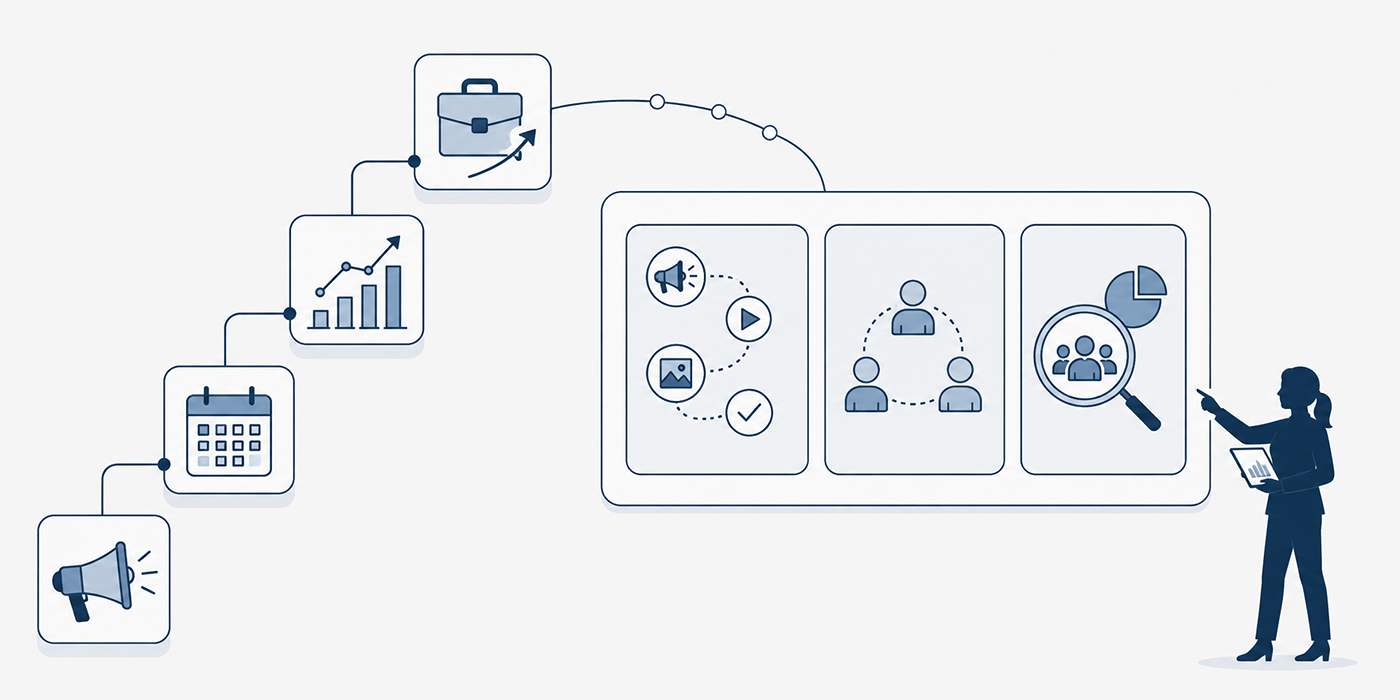
A marketing project manager owns the operating system behind marketing execution. The strategist may determine audience positioning, the creative director may shape the concept, and channel specialists may manage distribution. The project manager converts those decisions into an executable scope, realistic schedule, accountable workflow, approved budget, visible dependency map, and controlled review process.
PMI describes project management as a systematic method for turning marketing and sales ideas into timely, cost-effective implementation. That combination is important because creative thinking generates commercial value only after people, approvals, assets, platforms, and deadlines have been coordinated successfully.
Typical responsibilities include:
Converting campaign briefs into deliverables and milestones
Clarifying ownership across creative, content, media, product, sales, and legal teams
Building launch schedules and dependency maps
Estimating workload and managing resource allocation
Controlling budgets through disciplined project financial management
Running creative reviews and approval cycles
Maintaining risk registers
Managing agencies, freelancers, production partners, and other suppliers
Reporting delivery status and campaign readiness
Closing projects with performance analysis and documented lessons
The role sits between marketing operations and project leadership. A marketing operations manager may own systems, data structures, automation, governance, and process architecture across the department. A marketing project manager usually owns the delivery of defined campaigns, launches, events, content programs, website initiatives, or integrated marketing projects.
Titles vary substantially. Similar vacancies may appear as:
Marketing Project Coordinator
Campaign Project Manager
Creative Project Manager
Marketing Traffic Manager
Integrated Marketing Project Manager
Digital Project Manager
Content Operations Manager
Marketing Operations Project Manager
Agency Project Manager
Brand Project Manager
Production Project Manager
Go-to-Market Project Manager
Read the responsibilities before judging a role by its title. A “coordinator” at a large global company may manage more complexity than a “project manager” at a small agency. Look for ownership of scope, timelines, budgets, dependencies, approvals, resources, and stakeholder decisions.
Why This Career Has Durable Demand
Marketing creates recurring project demand through product launches, website migrations, seasonal campaigns, rebrands, events, content programs, CRM implementations, customer research, paid-media initiatives, and sales-enablement releases. At the same time, organizations face a broader shortage of project talent. PMI estimates that demand for project professionals could increase by 64% between 2025 and 2035, with a potential global talent gap of up to 30 million professionals.
The U.S. Bureau of Labor Statistics projects 6% employment growth from 2024 to 2034 for both project management specialists and advertising, promotions, and marketing managers. These categories are broader than marketing project management, though their parallel growth signals support for professionals who can combine the two disciplines.
Your long-term security comes from owning difficult coordination work. Software can generate task lists, summarize meetings, and automate routine updates. Senior stakeholders still need someone to challenge an impossible launch date, expose a missing dependency, resolve contradictory feedback, control scope, and decide when delivery risk requires escalation. Understanding AI-powered project management will strengthen the role when paired with sound judgment and accountable project governance.
The Career Progression
A common progression looks like this:
Marketing assistant or project coordinator → marketing project manager → senior marketing project manager → program manager or marketing operations lead → director of marketing operations, PMO leader, or integrated marketing director
Several lateral paths are equally valuable. You may move toward Agile project leadership, creative operations, product marketing, digital production, agency operations, event management, content operations, or portfolio management. The right direction depends on whether your strongest contribution is campaign execution, systems improvement, commercial strategy, creative production, or organizational leadership.
2. Build the Combined Marketing and Project Management Skill Stack
The fastest route into this profession is to build a T-shaped capability profile. You need broad fluency across marketing channels and deep competence in execution management. Specializing in one marketing discipline gives you credibility, while project leadership skills allow you to coordinate work beyond that specialty.
Learn Enough Marketing to Challenge a Weak Plan
You do not need to become the best copywriter, designer, analyst, or media buyer on the team. You need enough domain knowledge to recognize missing work, unrealistic assumptions, and misleading progress.
Understand:
Audience segmentation and positioning
Customer journeys and funnel stages
Content strategy and editorial production
Paid, owned, earned, and partner channels
SEO and website delivery
Email, CRM, and lifecycle marketing
Creative production and brand governance
Campaign measurement and attribution
Events, partnerships, and public relations
Product launches and sales enablement
A project manager who lacks marketing fluency becomes a deadline administrator. They may report that a landing page is “80% complete” while missing that tracking parameters, legal copy, mobile testing, CRM routing, localization, and media-platform approvals remain unresolved.
Market research analysts are expected to measure the effectiveness of marketing strategies, and BLS highlights research and analytical capability as central to that work. A marketing project manager benefits from the same analytical literacy even when another specialist owns the formal analysis.
Master Campaign Scoping
A marketing brief often appears deceptively simple: launch a product, produce a webinar, publish a report, or run a holiday campaign. Each request can conceal dozens of deliverables and decision points.
Convert the brief into:
Business objective
Target audience
Required customer action
Campaign channels
Deliverables by channel
Acceptance criteria
Budget
Assumptions
Exclusions
Dependencies
Approval owners
Measurement requirements
Launch conditions
Use disciplined requirements engineering to prevent vague requests from becoming uncontrolled work. Add a formal change process grounded in project governance, because late stakeholder suggestions regularly become invisible scope increases.
Learn Scheduling Through Dependencies
Marketing schedules should be dependency-driven. A final date becomes credible only after you identify the work that must occur before it.
A paid social campaign may require approved positioning, copy, design, legal review, landing pages, tracking, platform setup, quality assurance, budget authorization, and final launch approval. Missing any one of those dependencies can make every visible asset look ready while the campaign remains unlaunchable.
Build schedules using Gantt chart concepts, milestone logic, lead times, approval windows, and explicit handoffs. Apply schedule compression techniques carefully. Compressing design time may save two days while creating six days of rework if the brief remains unstable.
Control Creative Reviews
Creative feedback creates some of the hardest delivery problems in marketing. Reviewers may contradict one another, add personal preferences, arrive late, or reopen approved decisions.
Create a review model that defines:
Who provides input
Who owns the final decision
Which criteria reviewers should assess
How feedback must be submitted
When comments close
How contradictions are resolved
What happens after approval
Which changes require revised cost or timing
Strong stakeholder engagement prevents every senior employee from becoming an unofficial approver. Effective conflict-resolution practices help you separate brand risk, commercial concerns, compliance issues, and subjective preference.
Develop Commercial Judgment
Marketing project managers influence spending even when they do not own the entire marketing budget. You may manage production costs, media dependencies, freelancer fees, event expenses, software licenses, agency retainers, printing, localization, or video production.
Learn:
Budget baselines
Estimates and actuals
Purchase orders
Vendor quotes
Burn rates
Contingency
Change costs
Agency scope
Utilization
Profit margin
Return on investment
Cost per deliverable
Use project financial management to identify the financial effect of delay and rework. An agency project manager must understand margin erosion. An internal project manager must understand opportunity cost and resource trade-offs.
Learn Risk Before the Launch Fails
Marketing risks often remain invisible because the project looks creative rather than operational. Common risks include:
Late legal approval
Unavailable subject-matter experts
Incomplete customer data
Platform rejection
Tracking failure
Vendor delay
Product-readiness changes
Brand inconsistency
Localization errors
Usage-rights violations
Audience fatigue
Overspent media budgets
Website-performance problems
Executive priority changes
Maintain an active risk register and define practical risk responses. “Waiting for legal” is a status description. “Legal review may exceed five working days; the owner will submit draft claims two weeks earlier and activate a claims-free fallback asset if approval misses the deadline” is risk management.
3. Enter the Field Through Experience, Certifications, and Portfolio Proof
Marketing project management rarely has one compulsory academic route. Professionals enter through marketing, communications, business, design, operations, project coordination, analytics, events, technology, or agency work. A degree can support your application, while evidence of controlled execution carries greater practical weight.
Choose One of Four Entry Strategies
Strategy A: Move From Marketing Into Project Management
This route suits marketers who already understand campaigns but want broader ownership. Start managing schedules, approvals, resource plans, and risks inside your current role.
Volunteer to lead:
A campaign launch
A website refresh
An editorial program
An event
A lead-generation initiative
A customer research project
A CRM or automation implementation
Document how you used project templates, stakeholder controls, project reporting, and resource planning.
Strategy B: Move From Project Management Into Marketing
This route suits project coordinators and project managers who already understand delivery controls. Build marketing fluency by supporting one specific area, such as content, creative production, websites, product launches, or events.
Study campaign planning, customer journeys, marketing metrics, creative workflows, and channel dependencies. Your existing command of project execution, monitoring and control, financial governance, and risk management creates a strong foundation.
Strategy C: Start in an Agency
Agencies can provide rapid exposure to briefs, clients, changing priorities, creative production, budgets, and simultaneous campaigns. The workload may be intense, though the learning density can be high.
Develop rigorous scope boundaries, client communications, utilization tracking, and vendor coordination. A weak agency PM says yes before checking cost and capacity. A strong one protects the relationship by explaining the effect of every requested change.
Strategy D: Build Freelance Experience
Freelance work can generate portfolio proof before you secure a full-time title. Offer campaign planning, content workflow setup, launch coordination, or marketing operations support to smaller businesses.
Create fixed packages with defined deliverables, timelines, revision limits, communication rules, and fees. Review the future of freelance project management and use reliable project management templates to professionalize delivery.
Select Certifications by Career Stage
For beginners, CAPM can provide a structured foundation. PMI currently requires a secondary qualification or equivalent and 23 hours of project management education for CAPM eligibility.
PMP becomes more relevant after you have qualifying project leadership experience. PMI positions it as a methodology-independent credential covering predictive, hybrid, and Agile delivery. The PMP exam was updated in July 2026, so candidates should use the current examination content outline and current eligibility guidance.
Useful supporting learning may include:
Google Analytics training through Skillshop
HubSpot Marketing Software certification
Digital advertising training
Agile or Scrum fundamentals
Business-analysis training
Platform-specific workflow credentials
Google currently provides Analytics learning through Skillshop, while HubSpot Academy offers marketing, advertising, software, and reporting certifications.
Certifications work best as gap-fillers. A marketing specialist may need CAPM or broader project management certification knowledge. A project manager may gain more immediate value from analytics, CRM, paid-media, or marketing-automation education.
Build a Portfolio That Shows Your Decisions
Create six portfolio assets:
1. Campaign charter: Include objective, audience, scope, exclusions, success measures, budget, milestones, and governance.
2. Integrated campaign schedule: Show channel dependencies, approval points, production lead times, and launch-readiness gates.
3. Creative request workflow: Demonstrate intake, prioritization, resource assignment, review rounds, and final approval.
4. Risk and issue register: Include probability, impact, response, owner, trigger, and escalation point.
5. Campaign dashboard: Combine delivery indicators with marketing outcomes.
6. Post-campaign review: Explain results, missed assumptions, rework causes, and improvements for the next campaign.
Asana defines campaign management as coordinating campaign elements from planning through launch and emphasizes the volume of stakeholders and deliverables involved. That makes an integrated portfolio more credible than a collection of isolated task boards.
4. Master the Tools and Workflows Used in Marketing Delivery
Tool familiarity helps you enter the field. Workflow architecture helps you advance.
Build a Minimum Viable Marketing Technology Stack
A functional stack normally includes:
A work-management platform
A communication platform
Cloud documents and asset storage
A content calendar
A digital-asset management system
Analytics and dashboard tools
CRM and marketing automation
Creative-review software
Time or capacity tracking
Integration and automation tools
Compare available Agile project management tools, team communication platforms, workforce management software, and project management integrations according to workflow needs.
Avoid building your professional identity around one platform. Employers may use Asana, Monday.com, Wrike, ClickUp, Jira, Workfront, Smartsheet, Trello, Basecamp, or a custom system. Learn transferable concepts:
Intake forms
Templates
Custom fields
Dependencies
Automations
Approval stages
Capacity views
Dashboards
Permissions
Portfolio rollups
Integration triggers
Content-calendar systems increasingly combine planning, organization, approval, publishing, and asset visibility rather than serving as simple date grids.
Design a Campaign Workflow From Intake to Retrospective
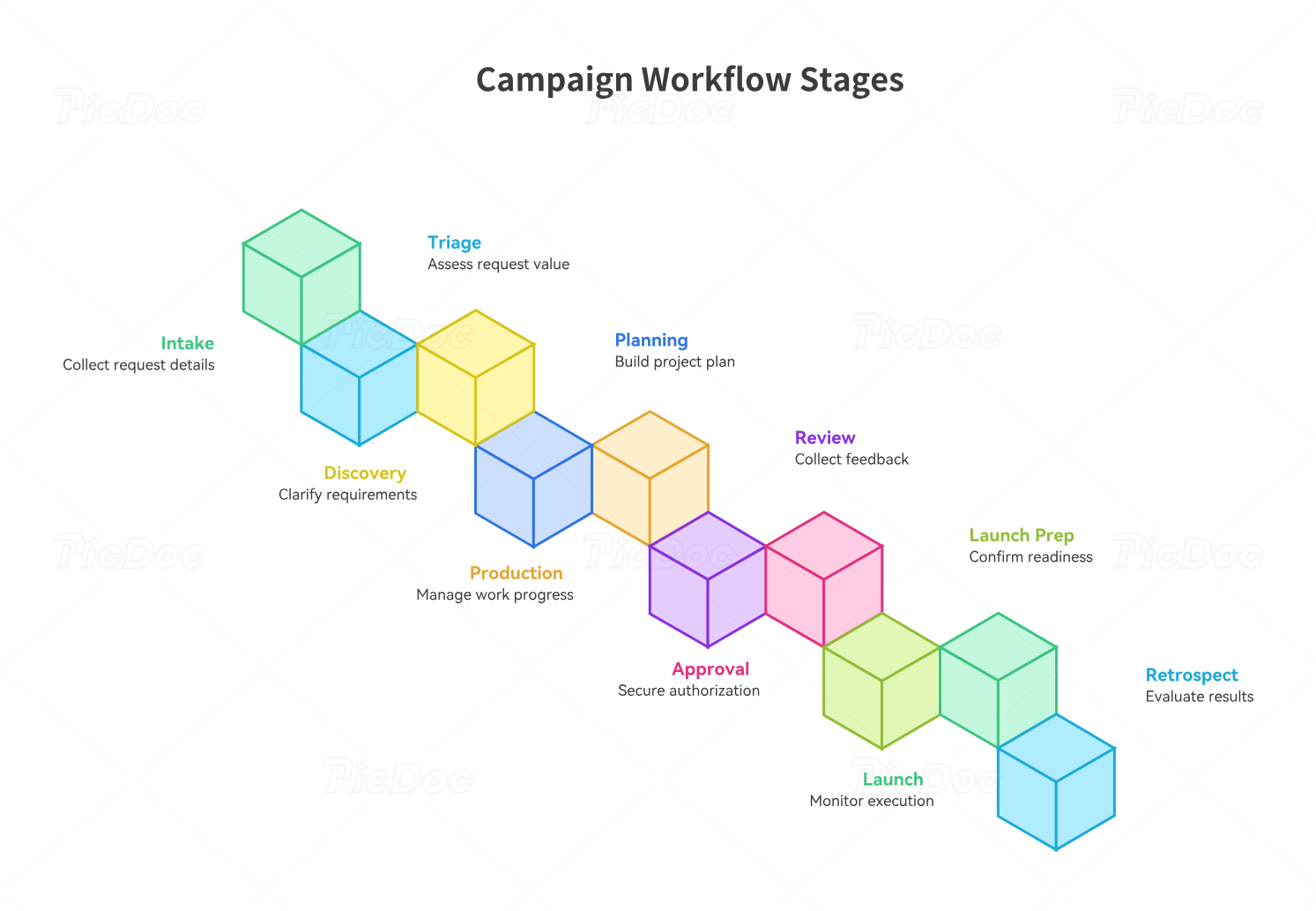
A reliable workflow contains ten stages.
1. Intake
Require the requester to provide objective, audience, desired action, deadline, channels, budget, approver, and supporting evidence. Incomplete requests remain uncommitted until critical information arrives.
2. Triage
Assess strategic value, urgency, estimated effort, capacity, risk, and dependencies. Use portfolio prioritization when demand exceeds capacity.
3. Discovery
Clarify requirements, customer context, technical constraints, measurement, and approval needs. Invite the smallest group capable of resolving ambiguity.
4. Planning
Build deliverables, owners, durations, dependencies, review rounds, risk responses, budget, and launch criteria. Apply Agile estimation techniques when detailed certainty remains low.
5. Production
Move work through visible statuses. Limit work in progress to protect throughput. Use Kanban principles when the team handles continuous creative demand.
6. Review
Collect consolidated feedback against agreed criteria. Separate required corrections from optional improvements.
7. Approval
Record the accountable approver, approval date, approved version, and remaining conditions. A positive comment in chat should never become the only launch authorization.
8. Launch Readiness
Confirm assets, links, tracking, budgets, targeting, legal approval, accessibility, localization, system performance, and rollback plans.
9. Launch and Monitoring
Track both execution and performance. Delivery metrics may include milestone adherence, approval time, rework, and budget variance. Marketing indicators may include reach, engagement, conversions, revenue contribution, or qualified pipeline.
10. Retrospective
Evaluate planning accuracy, delays, feedback quality, process failures, and commercial results. Convert the lessons into updated project templates, stronger monitoring controls, and better project closure practices.
Use AI Without Losing Accountability
AI can help draft project plans, classify incoming requests, summarize feedback, produce status updates, identify missing fields, generate meeting actions, and search campaign documentation.
High-value applications include:
Turning a structured brief into a preliminary work breakdown
Identifying missing dependencies
Comparing feedback from multiple reviewers
Drafting risk statements
Summarizing campaign status
Tagging creative requests
Preparing retrospective themes
Creating channel-specific task templates
Human owners should validate scope, facts, dates, approvals, risks, and strategic decisions. Poor inputs can produce polished plans that remain operationally wrong. Study the future of AI in project management, automation’s effect on PM careers, and emerging project software capabilities to build responsible workflows.
Asana’s documented marketing examples show AI being used to automate work, surface information, and convert major content into channel-specific assets. These cases demonstrate operational potential while leaving workflow design and approval responsibility with the organization.
5. Follow a 12-Month Career Roadmap From Beginner to Job-Ready Candidate
Months 1–2: Select Your Entry Lane
Choose one practical niche:
Content and SEO projects
Creative production
Integrated campaigns
Paid-media campaigns
Events
Product launches
Marketing automation
Websites and digital experiences
Agency delivery
Study five job descriptions in that niche. Extract repeated responsibilities, tools, deliverables, and measurement requirements. Compare them with your current evidence.
Build foundations in project execution, stakeholder engagement, risk mitigation, resource allocation, and project reporting.
Months 3–4: Learn One Platform and One Marketing System
Select one work-management platform and learn how to configure:
Forms
Templates
Dependencies
Approvals
Dashboards
Automations
Portfolio views
Then choose one marketing platform relevant to your niche, such as a CRM, analytics tool, email system, content-management platform, advertising platform, or creative-review system.
Complete a simulated integrated campaign. Avoid creating an attractive task board with weak logic. Include approvals, dependencies, resource assumptions, and launch gates.
Months 5–6: Lead a Real Project
Secure a real assignment through your current employer, a volunteer organization, a small client, or a personal business initiative.
Record:
Baseline problem
Business objective
Stakeholders
Scope
Schedule
Budget
Risks
Changes
Final outcome
Lessons
Measure delivery results such as turnaround time, approval duration, rework, budget variance, late tasks, or launch reliability. Connect them with marketing outcomes where data is available.
Months 7–8: Complete Your Portfolio and Certification Gap
Create polished versions of your six portfolio assets. Redact confidential information and explain assumptions.
Select one certification according to your gap:
CAPM for foundational project knowledge
PMP for experienced project leaders who meet current requirements
Analytics training for measurement gaps
Marketing software training for platform fluency
Agile training for iterative campaign environments
Business-analysis training for complex MarTech work
Review PMP preparation resources, PMP exam domains, CAPM preparation tools, and Agile certification options.
Months 9–10: Rewrite Your Resume Around Outcomes
Replace task-focused bullets with evidence.
Weak:
Managed marketing projects and communicated with stakeholders.
Stronger:
Coordinated a 12-week product campaign across content, creative, paid media, web, sales, and legal; resolved 23 cross-functional dependencies and launched every customer-facing asset on the approved date.
Weak:
Used Asana to manage creative requests.
Stronger:
Rebuilt creative intake and approval workflows, reducing incomplete requests by 38% and average review time from six working days to three.
Use this formula:
Action + project scale + business problem + management method + measurable result
Prepare six interview stories covering:
An impossible deadline
Conflicting stakeholder feedback
Scope expansion
A missed dependency
Resource overload
An underperforming campaign
A supplier failure
A process improvement
Explain the decision you made. Interviewers learn little from a story where “the team worked together” and every difficult choice disappears.
Months 11–12: Target Roles Systematically
Search several titles rather than only “marketing project manager.” Use the title variations listed earlier and filter by your niche.
Build a targeted application package containing:
Resume
Portfolio
Short campaign case study
Relevant certification
Tool summary
Industry experience
Measurable results
Track applications like a project. Record company, role, requirements, application date, referral, interview stage, feedback, and next action.
A practical 12-month target scorecard is:
Career MeasureTargetMarketing niche selected1Work-management platform mastered1Marketing platform learned1Real campaigns led2Portfolio assets completed6Measurable results documented4Relevant certification completed1Interview stories prepared6–8Industry contacts developed20Targeted applications submitted30–50Role-specific interviews completed5+
The career starts moving when you create inspectable evidence. Endless learning without project ownership keeps candidates trapped between marketing support and project coordination.
6. Frequently Asked Questions About Marketing Project Management Careers
-
Employers commonly value a combination of marketing knowledge, project delivery experience, communication ability, analytical literacy, and software fluency. Degrees in marketing, business, communications, management, or a related discipline can help, while professionals also enter through experience in agencies, creative production, events, content, operations, and general project management.
Build formal knowledge through project execution concepts, stakeholder engagement, financial management, and marketing-platform training. Pair education with campaign evidence.
-
Yes. Relevant experience can come from project coordination, design, content, social media, sales operations, events, business analysis, web production, customer success, or agency account management.
Demonstrate that you understand audiences, channels, campaign objectives, creative production, measurement, and launch dependencies. A portfolio showing requirements management, resource planning, risk control, and project reporting can offset an unrelated degree.
-
CAPM is a logical project-management foundation for candidates with limited formal experience. PMI currently requires a secondary qualification or equivalent and 23 hours of project management education.
Marketing-focused credentials in analytics, CRM, content, advertising, or automation can strengthen your profile when project knowledge is already adequate. Compare CAPM preparation resources, Agile certifications, and broader certification trends against your target vacancies.
-
PMP can be valuable for experienced professionals managing complex campaigns, global launches, agency portfolios, MarTech implementations, or enterprise marketing programs. PMI describes PMP as applicable across predictive, hybrid, and Agile approaches rather than tied to one industry.
Its value increases when paired with practical marketing knowledge. Review current PMP exam domains, avoid common PMP preparation mistakes, and verify 2026 requirements directly because the updated PMP exam launched in July 2026.
-
Learn one major work-management platform deeply, then understand transferable workflow concepts. Familiarity with communication, content calendars, cloud storage, analytics, CRM, marketing automation, digital asset management, and creative-review platforms will broaden your usefulness.
Explore Agile project management tools, team communication platforms, project management APIs, and workforce-management software. Employers value your ability to design a dependable workflow more than memorized button locations.
-
Include a campaign charter, integrated schedule, creative workflow, resource plan, risk register, status dashboard, and post-campaign review. Each asset should reveal how you handled decisions, dependencies, revisions, approvals, budgets, and outcomes.
Use realistic project templates, monitoring terminology, stakeholder controls, and project closure practices. Add one case study explaining a difficult decision and its measurable impact.
