
Ultimate Career Guide to Becoming an Environmental Project Manager
Environmental project managers turn scientific findings, regulatory obligations, community concerns, and commercial constraints into executable plans. The role can involve contaminated-land cleanup, renewable energy, water systems, sustainable construction, environmental compliance, or climate resilience. Success requires more than environmental knowledge. You must control budgets, permits, contractors, risks, evidence, and stakeholder decisions through disciplined project execution, environmental governance, risk management, and sustainability planning. This guide shows how to build the technical credibility, project experience, certifications, portfolio, and career strategy employers expect.
1. What Does an Environmental Project Manager Actually Do?
An environmental project manager leads projects that investigate, prevent, reduce, monitor, or remediate environmental harm. The work may focus on soil contamination, groundwater, air emissions, waste, ecology, infrastructure, carbon reduction, environmental management systems, renewable energy, or regulatory approval. Responsibilities often combine project monitoring and control, stakeholder engagement, supplier management, and project reporting with scientific or engineering judgment.
A contaminated-site project may require historical research, sampling plans, field mobilization, laboratory coordination, risk assessment, regulator engagement, remediation design, contractor supervision, waste documentation, validation testing, and closure reporting. A renewable-energy project may require site screening, biodiversity studies, permitting, land access, community consultation, grid dependencies, construction controls, and environmental monitoring. These projects succeed when environmental requirements are connected to resource allocation, schedule planning, project financial controls, and risk-register ownership.
The title covers several distinct career tracks. Consultancy-based environmental project managers deliver assessments, permitting, remediation, monitoring, and client advice. Corporate environmental project managers lead compliance improvements, waste reduction, energy efficiency, environmental management systems, and operational-risk projects. Construction and infrastructure specialists coordinate environmental controls across design, procurement, site work, commissioning, and handover. Sustainability-focused managers translate climate, ESG, resilience, and resource goals into measurable project outcomes through sustainable project governance, construction innovation, renewable-energy project management, and future PMO practices.
The role also carries real commercial responsibility. Environmental sampling delays can hold up land purchases. Permit conditions can change engineering scope. Unexpected contamination can consume contingency. Poor biodiversity planning can stop site access during sensitive seasons. Weak stakeholder consultation can create objections, redesign, or reputational damage. Environmental project managers must translate these exposures into cost forecasts, mitigation plans, schedule dependencies, and executive decisions.
The Environmental Project Lifecycle
During initiation, the environmental project manager defines the problem, affected assets, legal context, stakeholders, assumptions, decision rights, and success criteria. During planning, they develop scope, budgets, procurement packages, field plans, permit schedules, quality controls, communication routes, and environmental risk responses. Execution may include fieldwork, construction supervision, technical review, regulator coordination, data validation, and contractor management supported by project execution terminology, quality-management principles, vendor controls, and project communication practices.
Monitoring requires more than confirming that tasks were completed. The manager must inspect sampling quality, permit compliance, contractor performance, waste records, safety observations, forecast accuracy, stakeholder commitments, and residual environmental exposure. Closure may require regulator acceptance, validation reports, monitoring plans, land-use restrictions, operational handover, records retention, lessons learned, and formal project closure. These responsibilities connect directly to ISO-related management systems, project reporting controls, and risk-register governance.
Career Demand and Salary Context
The U.S. Bureau of Labor Statistics does not publish a separate national category for “environmental project manager,” because the title overlaps environmental science, environmental engineering, construction, consultancy, and natural-sciences management. Useful benchmarks show the breadth of the career: environmental scientists and specialists had a May 2024 median wage of $80,060, environmental engineers had a median of $104,170, and natural sciences managers had a median of $161,180. Actual environmental project-manager compensation varies by technical discipline, sector, geography, responsibility, and project value.
The wider project profession also faces sustained talent demand. PMI estimates that global demand for project talent could grow 64% between 2025 and 2035, potentially requiring up to 30 million additional project professionals. Environmental candidates who combine technical competence with future project-manager skills, sustainability capability, project leadership, and portfolio awareness can compete for roles extending well beyond traditional environmental compliance.
The matrix reveals an important career principle: environmental project management is a destination reached through several technical routes. The strongest route is the one that gives you credible experience with real environmental decisions, evidence, stakeholders, and consequences. A certificate without field or delivery exposure rarely substitutes for a portfolio showing project planning, technical coordination, risk control, and operational handover.
| Specialization | Typical Project Deliverables | Best Entry Role | Capability You Must Prove | Useful Credential or Training |
|---|---|---|---|---|
| Site investigation | Sampling plans, field records, laboratory data, conceptual site models | Environmental technician or graduate consultant | Field planning, data quality, chain of custody, contractor coordination | HAZWOPER where applicable; environmental science degree |
| Environmental due diligence | Desktop reviews, site assessments, liability findings, acquisition recommendations | Environmental consultant or property analyst | Fast evidence review, material-risk translation, client reporting | CHMM or relevant assessment training |
| Brownfield redevelopment | Assessment, cleanup planning, funding coordination, reuse strategy | Remediation consultant or municipal project coordinator | Regulator coordination, funding compliance, community engagement | PMP, CHMM, remediation training |
| Contaminated-land remediation | Remedial designs, contractor scopes, waste records, validation reports | Field scientist, hydrogeologist, or remediation engineer | Technical options analysis, cost control, construction oversight | PMP, CHMM, professional geology or engineering route |
| Groundwater management | Monitoring networks, hydrogeological models, treatment plans | Hydrogeologist or environmental scientist | Long-term monitoring, uncertainty management, data interpretation | Geology credentials and project-management training |
| Environmental impact assessment | Baseline studies, impact analysis, mitigation, environmental statements | Environmental planner or assessment consultant | Multidisciplinary coordination, evidence integration, consultation | IEMA pathway or regional assessment training |
| Environmental permitting | Permit applications, conditions registers, regulator responses | Compliance officer or environmental consultant | Obligation mapping, deadline control, technical coordination | ISO 14001 knowledge and sector-specific training |
| Air-quality projects | Emission inventories, dispersion studies, monitoring plans, permit evidence | Air-quality scientist or compliance analyst | Technical data review, model coordination, regulatory reporting | Air permitting and monitoring training |
| Water and wastewater | Treatment upgrades, discharge controls, monitoring, commissioning | Environmental or civil engineer | Design coordination, permitting, commissioning, operational handover | Engineering license route, PMP, ISO 14001 |
| Stormwater management | Drainage controls, pollution-prevention plans, inspections | Civil technician, environmental coordinator, or inspector | Site controls, compliance records, corrective-action management | Regional stormwater or erosion-control certification |
| Renewable-energy development | Site studies, permitting, land coordination, construction controls | Environmental planner or renewable-energy coordinator | Permitting schedules, ecological constraints, stakeholder alignment | PMP, CSPP, IEMA, GIS training |
| Transmission and utilities | Route assessments, permits, landowner engagement, mitigation plans | Environmental planner or utility coordinator | Linear-project dependencies, land access, community communication | PMP, GIS, environmental assessment training |
| Sustainable construction | Environmental plans, site inspections, LEED evidence, waste controls | Construction environmental coordinator | Site implementation, contractor influence, documentation quality | LEED Green Associate or LEED AP, CCM, PMP |
| Sustainable infrastructure | Resilience assessments, sustainability scoring, design improvements | Infrastructure or sustainability analyst | Whole-life thinking, option appraisal, interdisciplinary facilitation | ENV SP, CSPP, PMP |
| Environmental management systems | Aspect registers, procedures, objectives, audits, corrective actions | Environmental coordinator or EMS analyst | Process design, audit evidence, performance improvement | ISO 14001 internal or lead auditor |
| Industrial compliance | Compliance registers, monitoring, corrective programs, regulator submissions | EHS coordinator or environmental specialist | Operational influence, legal tracking, root-cause correction | ISO 14001, CHMM, industry training |
| Waste and circular economy | Waste audits, reduction programs, vendor transitions, reporting | Waste coordinator or sustainability analyst | Material-flow analysis, procurement change, benefits tracking | CSPP, IEMA, waste-management training |
| Hazardous materials | Inventories, storage upgrades, transport controls, emergency plans | Hazardous-materials or EHS specialist | Regulatory control, lifecycle accountability, incident readiness | AHMM or CHMM; HAZWOPER where applicable |
| Biodiversity and ecology | Habitat surveys, mitigation, restoration, seasonal work plans | Ecologist or environmental field officer | Seasonal scheduling, evidence quality, contractor implementation | Ecology credentials and project-management training |
| Ecological restoration | Restoration designs, planting, invasive-species control, monitoring | Restoration technician or conservation scientist | Long-term outcomes, contractor quality, adaptive management | Restoration ecology and project-management training |
| Flood and coastal resilience | Risk assessments, adaptation options, infrastructure and habitat measures | Climate analyst, coastal scientist, or civil engineer | Scenario planning, public engagement, long-horizon benefits | ENV SP, CSPP, engineering or climate training |
| Climate adaptation | Climate-risk assessments, resilience roadmaps, investment programs | Climate-risk or sustainability analyst | Scenario translation, prioritization, benefits and resilience metrics | CSPP, IEMA, climate-risk training |
| Decarbonization programs | Emission baselines, reduction portfolios, technology implementation | Carbon analyst, energy manager, or sustainability coordinator | Investment sequencing, measurement, supplier and operational change | CSPP, IEMA, energy or carbon-accounting training |
| ESG implementation | Data controls, improvement programs, disclosure-ready evidence | ESG or sustainability analyst | Data ownership, controls, cross-functional delivery, auditability | CSPP, IEMA, reporting-framework training |
| Mining rehabilitation | Closure plans, landform design, water management, monitoring | Mine environmental officer or geoscientist | Long-term liabilities, contractor control, regulator evidence | PMP, environmental management and geoscience credentials |
| Decommissioning | Asset surveys, waste plans, demolition controls, site restoration | Environmental engineer, construction coordinator, or EHS specialist | Interface control, hazardous-material planning, cost forecasting | PMP, CCM, CHMM, demolition-related training |
| GIS and remote sensing | Constraint mapping, spatial analysis, monitoring dashboards | GIS technician or geospatial analyst | Decision-focused mapping, data governance, field integration | GISP after required professional experience |
| Community and environmental justice | Engagement plans, impact communication, commitments, grievance resolution | Community liaison or environmental planner | Trust building, accessible communication, traceable commitments | Stakeholder-engagement and impact-assessment training |
2. Choose the Right Education and Entry Route
Most environmental scientists and specialists enter the profession with a bachelor’s degree in environmental science, natural resources, biology, physical science, or a related field. Environmental engineers commonly require an engineering degree, while management roles generally develop after technical experience. Employers may also value geology, geography, chemistry, ecology, civil engineering, chemical engineering, sustainability, planning, or environmental management depending on the project type.
The degree should support the technical environment in which you want to manage projects. Environmental science offers broad coverage of pollution, ecology, sampling, assessment, and regulation. Civil engineering can create a stronger route into water, infrastructure, remediation, and construction. Geology supports contaminated land, groundwater, mining, and geotechnical interfaces. Geography and GIS can lead toward spatial planning, environmental assessment, climate risk, and land management. Each route becomes more employable when paired with project-management fundamentals, risk terminology, stakeholder communication, and financial awareness.
Entry Route 1: Environmental Science or Engineering Graduate
Graduate roles provide direct exposure to fieldwork, technical reporting, regulation, client delivery, and multidisciplinary teams. Suitable titles include graduate environmental consultant, environmental scientist, field technician, remediation engineer, environmental planner, sustainability analyst, water-quality specialist, and EHS coordinator.
Your early objective should be ownership of a complete technical package. That could include planning a sampling event, coordinating laboratories, managing data, drafting a report section, tracking actions, and presenting findings. Build the work around project reporting standards, quality controls, resource coordination, and vendor management. This creates better management evidence than years of narrow technical support.
Entry Route 2: Project Coordinator Moving Into Environment
A project coordinator may already understand schedules, meetings, budgets, actions, reports, and governance. The missing element is usually environmental credibility. Close this gap by learning the applicable environmental aspects, legislation, permit conditions, sampling methods, evidence standards, and technical terminology for the target sector.
Seek work supporting environmental consultants, renewable-energy developers, utilities, infrastructure contractors, sustainability teams, or environmental departments. Connect your project coordination experience with environmental standards knowledge, sustainability governance, and renewable-energy trends. Your advantage is delivery structure; your development priority is technical judgment.
Entry Route 3: EHS or Compliance Professional
Environmental, health, and safety professionals often possess strong operational knowledge, inspection experience, regulatory awareness, and corrective-action discipline. They can progress by moving from recurring compliance tasks into defined improvement projects such as waste-system redesign, permit remediation, storage upgrades, monitoring automation, ISO 14001 implementation, or pollution-prevention programs.
Document these initiatives through risk-response plans, project schedules, quality-management methods, and project closure evidence. Employers need proof that you can transform compliance findings into funded, coordinated, and sustainable operational change.
Entry Route 4: Construction or Infrastructure Professional
Construction managers, site engineers, project controls specialists, and coordinators can move into environmental project management through site compliance, sustainable design, waste, water, ecology, permitting, remediation, or resilience. Their strengths include contractor control, sequencing, site logistics, commercial awareness, and delivery pressure.
The development gap usually involves environmental regulation, impact assessment, evidence, mitigation hierarchies, monitoring, and regulator expectations. Combine your knowledge of construction project management, construction software, schedule compression, and supplier management with environmental training and supervised project exposure.
Entry Route 5: Career Changer From Business, Data, or Operations
Operations analysts, business analysts, procurement professionals, financial analysts, and data specialists can enter through sustainability reporting, carbon programs, environmental data systems, supplier decarbonization, waste reduction, or ESG implementation. These projects need strong requirements, controls, data ownership, process design, and change management.
Useful foundations include business-analysis certification preparation, requirements engineering, API and integration planning, and project software trends. Add environmental literacy through a recognized course, mentor, professional association, and a contained real-world project.
Build a Technical Foundation Before Chasing a Management Title
Employers need confidence that you can recognize when technical evidence is weak, incomplete, contradictory, or commercially significant. You should understand how environmental data is generated, checked, interpreted, and translated into action. Develop familiarity with sampling design, laboratory limitations, uncertainty, regulatory thresholds, environmental aspects, permit conditions, mitigation, monitoring, and corrective action.
You also need enough project competence to control scope and requirements, project finances, resource allocation, and stakeholder expectations. Technical knowledge allows you to ask the right questions. Project-management capability ensures the answers change the plan.
3. Build the Skills Employers Expect From Environmental Project Managers
Technical Translation
Environmental project managers rarely produce every specialist calculation themselves. They coordinate hydrogeologists, ecologists, engineers, laboratories, surveyors, planners, contractors, lawyers, data teams, and regulators. Their core skill is translating technical findings into scope, cost, schedule, risk, and decisions.
A groundwater result exceeding a screening criterion may affect excavation controls, disposal routes, worker protection, remediation design, land value, permits, and schedule contingency. The manager should connect these consequences through a detailed risk register, financial forecast, stakeholder plan, and project report.
Regulatory and Permitting Control
Environmental projects often depend on multiple approvals, consultations, reports, surveys, and conditions. Build an obligation matrix containing the requirement, source, owner, evidence, submission date, review period, dependency, approval authority, and current status.
This prevents painful discoveries such as a missing seasonal ecology survey, incomplete discharge data, unapproved waste route, or consultation period that extends beyond the planned construction start. Integrate the matrix with Gantt-chart planning, project governance, monitoring controls, and project execution practices.
Budgeting and Commercial Awareness
Environmental uncertainty creates financial exposure. Soil volumes can increase, laboratory turnaround can delay decisions, disposal classifications can change, access restrictions can affect productivity, and remediation systems can operate longer than expected. Build budgets around quantities, assumptions, unit rates, uncertainty, contingency, and decision points.
Track committed cost, actual cost, forecast cost, contingency drawdown, change requests, supplier claims, and cost of delay. Use earned value terminology, project financial management, cost-control certification guidance, and global project-budget pressures to strengthen commercial judgment.
Fieldwork and Contractor Management
Field projects require mobilization plans, access, permits, utility clearance, equipment, laboratories, subcontractors, safety controls, waste routes, weather contingencies, and daily reporting. Weak coordination creates idle crews, invalid samples, missed locations, incomplete documentation, and avoidable remobilization.
Before work begins, confirm the method, acceptance criteria, roles, hold points, communication routes, evidence requirements, and change authority. Connect field control with quality-management terminology, vendor oversight, resource planning, and schedule monitoring.
Stakeholder and Community Engagement
Environmental projects affect landowners, residents, regulators, investors, operators, local authorities, community groups, contractors, and future site users. Each stakeholder may define success differently. A regulator may prioritize evidence and compliance. A resident may care about noise, dust, traffic, health, and trust. A sponsor may focus on approval certainty, cost, and delivery timing.
Create a stakeholder map covering influence, impact, concerns, commitments, communication channels, decision authority, and engagement frequency. Use stakeholder-engagement concepts, leadership communication, conflict-resolution techniques, and project governance to ensure commitments remain visible and owned.
Data, GIS, and Digital Project Controls
Environmental projects generate spatial data, laboratory results, inspection records, photographs, monitoring trends, permits, models, drawings, and contractor reports. Project managers need a controlled source of truth with defined ownership, version control, validation, permissions, and reporting logic.
GIS is especially valuable for mapping contamination, habitats, receptors, sampling points, assets, permits, land constraints, and climate exposure. The full GISP credential currently requires professional experience, portfolio review, and a technical examination, making it a later-career option for managers whose work remains strongly geospatial.
Digital competence should extend to project software selection, API integration, AI-enabled project delivery, and cybersecurity-aware software governance. Environmental data can influence legal, financial, health, and land-use decisions, so uncontrolled spreadsheets and undocumented revisions create material risk.
Sustainability and Benefits Realization
Environmental project managers should understand the difference between completing environmental activities and producing environmental outcomes. Installing a treatment system is an output. Demonstrating sustained contaminant reduction is an outcome. Publishing a carbon plan is an output. Delivering verified emissions reduction is an outcome.
Define environmental benefits with baselines, targets, calculation methods, owners, review dates, and evidence sources. Connect them to sustainability and ESG delivery, future sustainability trends, PMO effectiveness, and portfolio management.
4. Choose Certifications That Match Your Environmental Career Path
PMP or CAPM for Project Leadership
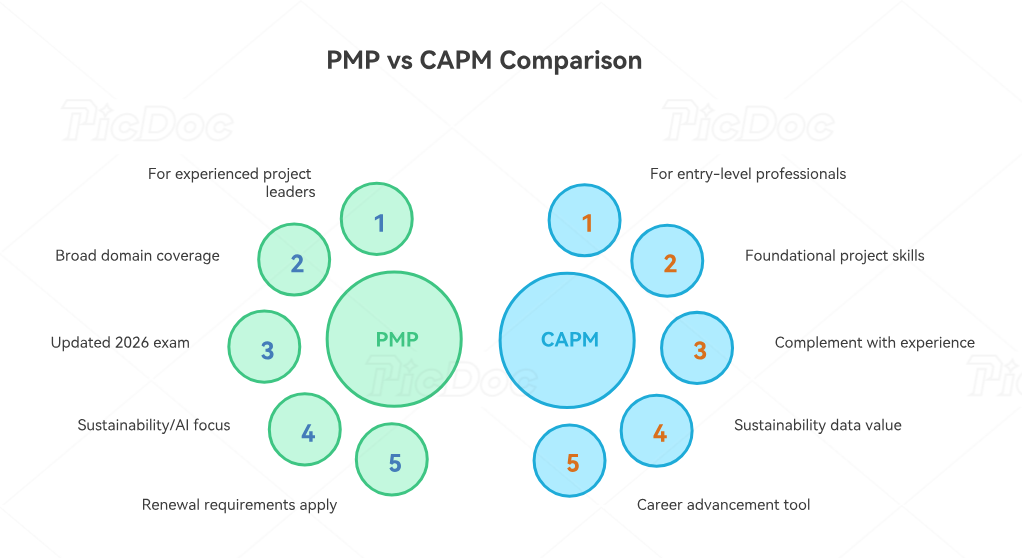
PMP is valuable for professionals who already lead projects and want broad recognition across scope, schedule, stakeholders, risk, governance, value, and hybrid delivery. The updated PMP examination launched in July 2026 and now includes stronger coverage of sustainability, AI, stakeholder engagement, and business environment scenarios.
Environmental professionals preparing for PMP should study the 2026 PMP exam domains, use credible PMP preparation resources, avoid common PMP exam mistakes, and understand PMP renewal requirements.
CAPM can provide a useful foundation for graduates, coordinators, analysts, and career changers who lack the experience required for PMP. Combine CAPM preparation, CAPM career advancement, CAPM exam guidance, and environmental project exposure. CAPM creates stronger value when the résumé also includes sampling coordination, compliance work, sustainability data, contractor support, or stakeholder engagement.
Certified Sustainable Project Professional
PMI and Green Project Management launched the Certified Sustainable Project Professional credential in 2026. CSPP focuses on embedding sustainability into project governance, impact analysis, procurement, resilience, performance measurement, and reporting. PMI offers pathways for existing certified project professionals and entrants without a previous project credential.
CSPP can suit sustainability-program managers, ESG implementation professionals, climate-resilience managers, renewable-energy coordinators, infrastructure professionals, and project leaders responsible for measurable environmental outcomes. It can complement sustainability project trends, renewable-energy opportunities, project governance, and future certification pathways.
IEMA Membership and Professional Progression
IEMA offers graded professional routes for environmental and sustainability practitioners. Its Foundation Certificate can support entrants, while the Certificate in Environmental Management aligns with Practitioner membership. Experienced professionals may progress toward Registered Environmental Practitioner or Chartered Environmentalist status through eligible membership pathways.
This pathway is especially relevant for environmental assessment, sustainability, corporate environmental management, consulting, and strategic leadership. Pair professional recognition with leadership communication, environmental governance, ISO terminology, and a portfolio demonstrating measurable project outcomes.
ISO 14001:2026 Training
ISO 14001 is central to environmental management systems, aspects and impacts, compliance obligations, objectives, operational controls, audits, and continual improvement. A revised ISO 14001 edition was published in April 2026, making updated foundation, internal-auditor, and lead-auditor training especially relevant for current practitioners.
Foundation training suits professionals who need working knowledge of the standard. Internal-auditor training supports employees conducting parts of an organization’s audit program. Lead-auditor training is designed for professionals conducting full management-system audits. Select the level according to your responsibilities and combine it with ISO project terminology, quality management, project monitoring, and closure controls.
LEED Green Associate and LEED AP
LEED credentials are useful for professionals working on sustainable buildings, construction, facilities, design, and operations. The LEED Green Associate is a foundational credential. LEED AP with specialty demonstrates deeper knowledge of green building and a specific LEED rating system, with specialties covering areas such as building design and construction or operations and maintenance.
Use LEED when your target roles involve green-building certification, design coordination, construction documentation, energy, water, materials, waste, commissioning, or building performance. Combine it with construction project trends, construction management certification, construction software, and vendor-management skills.
Envision Sustainability Professional
The ENV SP credential demonstrates knowledge of the Envision Sustainable Infrastructure Framework. It can support professionals working on transport, water, energy, public realm, utilities, resilience, and civil infrastructure.
ENV SP becomes especially relevant when combined with infrastructure project management, portfolio prioritization, sustainability governance, and stakeholder engagement.
CHMM, AHMM, and HAZWOPER
The Certified Hazardous Materials Manager credential supports experienced professionals responsible for hazardous materials, waste, compliance, safety, remediation, transportation, and related environmental functions. IHMM also offers the Associate Hazardous Materials Manager as an entry-level credential.
HAZWOPER training applies to covered hazardous-waste operations and emergency-response work in the United States. OSHA requires training suited to the worker’s assigned duties before covered hazardous-waste operations begin, with requirements varying according to the job function and exposure.
These credentials are most relevant when paired with risk-management competence, contractor control, project quality, and project reporting.
5. Follow a 12-Month Roadmap Into Environmental Project Management
Months 1–2: Select a Target Specialization
Collect at least 30 job descriptions from your target location and sector. Record each role’s project type, technical requirements, preferred degree, years of experience, software, certification, fieldwork expectations, regulatory knowledge, and commercial responsibilities.
Score the 28 specializations in the matrix against your background. Consider entry accessibility, salary potential, field intensity, travel, technical complexity, regulatory burden, and personal interest. Use renewable-energy forecasts, construction trends, ESG project developments, and future PM competencies to understand where your skills could remain valuable.
Choose one primary route and one adjacent route. For example, contaminated-land remediation can pair with brownfield redevelopment. Sustainable construction can pair with LEED and infrastructure resilience. Environmental management systems can pair with industrial compliance and ESG implementation.
Months 2–4: Close the Highest-Value Knowledge Gaps
Create a structured learning plan covering environmental science, project management, regulation, field safety, data, and communication. Limit general courses that produce no work sample. Each learning activity should lead to an artifact or applied task.
A remediation candidate might create a conceptual site model, sampling plan, risk register, and cost estimate. A sustainability candidate could build an emissions-reduction project charter, stakeholder map, benefits register, and reporting dashboard. An infrastructure candidate could produce an environmental-constraints map, permit schedule, mitigation tracker, and procurement checklist using project templates, risk-register guidance, Gantt-chart terminology, and stakeholder-planning concepts.
Months 3–6: Gain Applied Experience
Seek internships, graduate roles, field assignments, university consulting projects, nonprofit initiatives, community environmental programs, internal sustainability work, or volunteer projects. Ask to own a specific output with a deadline and stakeholder.
Suitable responsibilities include coordinating fieldwork, managing laboratory schedules, maintaining permit conditions, preparing status reports, tracking corrective actions, organizing stakeholder workshops, controlling environmental documentation, or leading a small waste-reduction initiative.
Use monitoring and control, resource planning, quality assurance, and project closure to manage the work professionally. Record the initial problem, your responsibility, decisions, obstacles, controls, and outcome.
Months 4–8: Build an Environmental Project Portfolio
Your portfolio should contain six to eight anonymized artifacts:
Environmental project charter
Stakeholder and regulator map
Permit or compliance obligation matrix
Risk, assumption, issue, and dependency register
Budget and cost forecast
Environmental sampling or monitoring plan
Executive status report
Closure or benefits-realization report
Each artifact should explain its purpose, users, decision impact, and result. Use project reporting methods, financial-management terminology, stakeholder engagement, and risk-response planning to ensure the portfolio reflects real management judgment.
Months 6–9: Earn One Role-Aligned Credential
Select one credential based on target-vacancy demand. CAPM may support an entry-level project route. ISO 14001 training may support compliance and environmental-management roles. LEED can support green-building work. CSPP can strengthen sustainable project delivery. CHMM suits hazardous-material and remediation careers after relevant experience. PMP becomes more valuable after you meet its eligibility requirements and can connect the framework to real delivery.
Avoid collecting overlapping certificates without applied evidence. A focused combination of project certification, environmental specialization, technical experience, and leadership proof creates a stronger hiring signal.
Months 8–12: Reposition Your Résumé and Apply Strategically
Replace duty-based statements with evidence-based achievements. “Supported environmental projects” offers little detail. A stronger statement could explain that you coordinated a twelve-location sampling program, resolved access and laboratory dependencies, maintained chain-of-custody documentation, and delivered validated results before a property-acquisition deadline.
Build six interview stories covering:
A technical uncertainty you converted into a decision
A permit or compliance deadline you protected
A contractor or supplier problem you resolved
A budget or schedule forecast you corrected
A stakeholder disagreement you managed
An environmental outcome you verified
Use leadership communication, conflict-resolution terminology, project reporting practices, and monitoring controls to structure each story.
Apply selectively to environmental project coordinator, assistant project manager, project environmental advisor, environmental consultant, sustainability project coordinator, remediation project manager, environmental planner, EHS project lead, and renewable-energy environmental roles. Read the responsibility section carefully because title conventions vary widely.
Build Toward Senior Environmental Leadership
A typical progression may move from technician or analyst to environmental specialist, project coordinator, project manager, senior project manager, program manager, environmental director, sustainability director, or portfolio leader. Senior positions require stronger business-case development, contract management, regulatory strategy, benefits realization, executive influence, and team leadership.
Prepare through program and portfolio trends, PMO effectiveness, project leadership forecasts, and future governance practices. Senior environmental leaders allocate capital across competing risks and opportunities, so portfolio judgment eventually becomes as important as project execution.
6. FAQs About Becoming an Environmental Project Manager
-
Environmental science provides a broad route into assessment, compliance, remediation, monitoring, and consulting. Environmental, civil, or chemical engineering can be stronger for infrastructure, water, treatment, construction, and technically complex projects. Geology supports contaminated land, groundwater, mining, and remediation. Geography, ecology, planning, and sustainability can also lead to relevant careers.
The strongest degree depends on the project pathway you intend to enter. Combine academic training with project execution skills, risk-management knowledge, stakeholder engagement, and financial-management capability.
-
Career changers can enter through project coordination, construction, operations, procurement, business analysis, data, EHS, or sustainability. Success requires building credible environmental knowledge and supervised applied experience in the target sector.
A construction professional might enter through environmental site management. A data specialist might enter through ESG systems or carbon reporting. A project coordinator might support remediation or renewable-energy permitting. Strengthen the transition through requirements engineering, ISO knowledge, sustainability trends, and project-management certification.
-
Entry-level coordinator roles may accept graduate, internship, field, laboratory, compliance, or administrative project experience. Independent project-manager roles commonly require evidence of managing scope, budgets, schedules, suppliers, stakeholders, risks, and technical outputs.
Focus on responsibility depth. One year owning field coordination, reporting, risks, and supplier actions can produce stronger evidence than several years of narrowly defined technical tasks. Build capability through resource allocation, project monitoring, vendor management, and project closure.
-
PMP can be highly valuable when the role includes substantial project leadership, client management, budgets, schedules, risk, suppliers, governance, and cross-functional delivery. It is especially useful for consultants, infrastructure managers, remediation managers, renewable-energy professionals, and senior corporate environmental leaders.
Combine PMP with environmental expertise. Use the PMP exam-domain guide, PMP preparation resources, PMP success stories, and PMP renewal guidance to assess the commitment.
-
The choice depends on the target specialization. CAPM can support project coordination. IEMA Foundation can support entry into environmental and sustainability work. LEED Green Associate can help candidates targeting green buildings. ISO 14001 foundation training can support environmental-management-system and compliance roles. CSPP provides a sustainability-focused project pathway that PMI currently offers without prior professional project experience.
Review CAPM preparation resources, future certification trends, ISO terminology, and sustainability project trends before investing.
-
Core tools may include spreadsheets, project scheduling software, document-management systems, GIS, environmental databases, dashboard platforms, collaboration tools, and sector-specific monitoring or compliance systems. Construction and infrastructure roles may also require familiarity with common construction-management platforms.
Focus on capabilities instead of collecting software names. Learn to create schedules, track permits, manage risks, control documents, map environmental constraints, validate data, report performance, and preserve audit trails. Relevant resources include project software market analysis, project API integrations, construction software tools, and project reporting practices.
