
How to Build a Career as a Project Governance Leader: 2026 Guide
Project governance leaders shape how organizations authorize investments, assign accountability, control risk, escalate threats, and verify whether projects still deserve funding. Reaching this level requires command of project governance practices, portfolio management trends, stakeholder engagement, and project financial management.
This guide explains how to move from delivery roles into governance leadership, build executive credibility, create portfolio evidence, and become the person senior decision-makers trust when major investments face uncertainty.
1. Understand What a Project Governance Leader Is Accountable For
Project governance establishes the authority, controls, decision routes, and accountability conditions surrounding projects, programs, and portfolios. APM describes governance as the mechanism that defines delegated authority, establishes escalation routes, clarifies responsibilities, and gives boards confidence that project investments are being managed effectively. ISO 21505 provides governance guidance for projects, programs, and portfolios, while PMI distinguishes governance responsibilities across each of those levels.
A project manager controls day-to-day delivery across scope, schedule, finance, risk, quality, and resources. A governance leader designs and protects the environment within which those delivery decisions occur.
That distinction changes the questions you must answer.
A project manager asks whether the milestone will be completed on time. A governance leader asks whether the milestone still supports the approved business case, whether the evidence is reliable, whether decision-makers understand the exposure, and whether continued investment remains justified. This requires fluency in project monitoring and control, earned value management, risk-response planning, requirements control, and project reporting.
Governance leadership therefore covers six interconnected accountabilities.
Strategic alignment
Every proposed project should have a defensible connection to organizational strategy. Governance leaders test whether objectives, expected benefits, resource demands, dependencies, and risks support the organization’s priorities. They also identify projects that remain active because of internal politics, sunk-cost thinking, or weak termination mechanisms.
Strategic alignment requires an understanding of portfolio selection practices, the evolving role of the PMO, project leadership approaches, resource-allocation terminology, and business-analysis methods.
Decision architecture
Governance leaders define who may approve, reject, defer, fund, change, pause, or terminate work. They design decision forums, thresholds, stage gates, delegated limits, escalation rules, voting arrangements, and exception procedures.
Weak decision architecture creates meetings where people exchange updates while avoiding commitments. Effective architecture produces named decision owners, clear evidence requirements, time-bound resolutions, and documented consequences. These capabilities draw on leadership and communication terminology, stakeholder engagement principles, conflict-resolution methods, requirements engineering, and project execution controls.
Investment control
Governance leaders examine whether proposed and active projects justify their cost, capacity consumption, operational disruption, and risk exposure. They test estimates, funding assumptions, contingencies, benefits, dependencies, and delivery confidence.
This work requires stronger commercial reasoning than checking whether a budget spreadsheet balances. You must understand project financial management, cost-professional practices, earned value terminology, vendor-management controls, and RFP, RFQ, and RFI processes.
Assurance and challenge
Project teams naturally focus on delivery. Governance leaders provide structured challenge by testing the reliability of status claims, assumptions, forecasts, controls, and recovery plans. Assurance should identify the conditions that could make an approved decision unsafe.
For example, a project may report green status while depending on an unapproved contract, an unavailable specialist, an unresolved integration, or a benefit owner who has never accepted accountability. Governance leaders expose these contradictions through risk-register discipline, quality-management principles, ISO terminology, monitoring and control, and reporting standards.
Sponsor effectiveness
Sponsors remain accountable for championing projects, connecting financial and non-financial considerations, and overseeing benefit realization. Governance leaders help sponsors discharge that accountability through clear decisions, evidence, agendas, escalation routes, and action tracking.
This means protecting sponsors from reports that contain large volumes of data and little decision value. A strong governance leader translates project execution information, financial variances, stakeholder exposure, schedule threats, and risk responses into decisions an executive can understand and own.
Organizational learning
Governance leaders prevent the same failure patterns from repeating across different projects. They compare approval assumptions with actual results, track recurring exceptions, analyze gate failures, standardize lessons, and improve the organization’s delivery system.
Effective learning depends on disciplined project closure, consistent reporting practices, reusable project templates, integrated PM software systems, and a mature understanding of the future PMO.
| Governance Capability | What Strong Performance Looks Like | Evidence Hiring Panels Can Verify | Failure Pattern You Prevent | Who You Influence |
|---|---|---|---|---|
| Strategic alignment | Links every investment to an approved objective, measurable outcome, and accountable executive. | Strategy-to-portfolio traceability map. | Projects continue without a current strategic reason. | Board, executive committee |
| Business-case challenge | Tests cost, benefit, timing, assumptions, options, dependencies, and delivery confidence. | Annotated business-case review. | Optimistic proposals receive approval without credible evidence. | Sponsor, finance, investment committee |
| Decision rights | Defines who recommends, approves, challenges, escalates, pauses, and terminates work. | Delegated-authority matrix. | Decisions remain trapped between overlapping committees. | Executives, sponsors, PMO |
| Stage-gate design | Uses proportional gates with explicit entry evidence, approval criteria, and outcomes. | Gate framework linked to governance practices. | Projects pass reviews through presentation quality rather than readiness. | Assurance teams, sponsors |
| Portfolio prioritization | Ranks investments using value, urgency, risk, capacity, dependency, and strategic contribution. | Scoring model informed by portfolio management. | Political influence determines funding priority. | Portfolio board, finance |
| Benefits governance | Assigns benefit owners, baselines, measures, realization dates, and post-project reviews. | Benefits-realization register. | Delivery is celebrated before value is demonstrated. | Business owners, sponsors |
| Requirements governance | Protects approved outcomes through traceability, acceptance criteria, and formal change decisions. | Requirements control framework. | Scope expands through informal executive requests. | Business owners, delivery teams |
| Change control | Requires impact analysis across cost, schedule, risk, benefit, capacity, and compliance. | Change-authority workflow and decision log. | Changes are approved without funding or consequence analysis. | Change board, sponsor |
| Risk governance | Defines escalation thresholds, risk appetite, ownership, aggregation, and executive responses. | Enterprise risk register. | Severe exposure remains buried in project-level reporting. | Risk committee, executives |
| Issue escalation | Moves unresolved threats to the level with authority, resources, and accountability to act. | Threshold-based escalation protocol. | Teams repeatedly discuss blockers they cannot resolve. | Sponsors, functional leaders |
| Financial governance | Connects approved funding, commitments, forecasts, contingencies, changes, and delivery progress. | Financial control dashboard. | Budget reports omit future commitments and probable overruns. | CFO, finance partners |
| Cost assurance | Challenges estimates, inflation assumptions, reserves, supplier pricing, and forecast accuracy. | Independent estimate review using cost-control principles. | Unrealistic budgets become politically difficult to correct. | Finance, procurement, sponsor |
| Schedule assurance | Tests dependencies, critical path, resource assumptions, approvals, contingency, and recovery logic. | Schedule health review using Gantt controls. | Reported dates ignore unresolved dependencies. | Program directors, PMs |
| Resource governance | Identifies demand conflicts, scarce skills, over-allocation, sequencing choices, and capacity limits. | Portfolio capacity model. | Every project assumes access to the same critical people. | COO, HR, functional heads |
| Dependency governance | Maps cross-project, supplier, technology, policy, operational, and decision dependencies. | Portfolio dependency network. | One project reports green while blocking several others. | Portfolio owners, architects |
| Sponsor enablement | Provides sponsors with concise evidence, decisions, risks, obligations, and unresolved actions. | Sponsor decision pack. | Sponsors receive status information without actionable choices. | Executive sponsors |
| Steering effectiveness | Designs agendas around approvals, exceptions, trade-offs, and accountability. | Decision-focused steering pack using reporting standards. | Governance forums become lengthy project update meetings. | Steering committee |
| Assurance planning | Targets reviews according to risk, complexity, investment value, novelty, and delivery stage. | Risk-based assurance map. | Every project receives the same low-value review process. | Internal audit, assurance teams |
| Data integrity | Defines reporting sources, calculation rules, ownership, validation, timeliness, and exceptions. | Governance data dictionary. | Executives receive conflicting figures for the same project. | PMO analysts, finance, data teams |
| Status calibration | Applies consistent thresholds to schedule, cost, risk, scope, benefits, and confidence ratings. | RAG criteria linked to monitoring controls. | Status ratings depend on individual project-manager optimism. | PMO, portfolio board |
| Commercial governance | Aligns procurement strategy, contract obligations, acceptance, performance, change, and payment. | Supplier governance scorecard. | Supplier invoices progress faster than deliverable acceptance. | Procurement, legal, vendors |
| Compliance integration | Embeds legal, regulatory, security, quality, privacy, and policy requirements into gates. | Compliance traceability matrix using ISO terminology. | Compliance reviews occur after design decisions are fixed. | Legal, audit, security |
| Cyber governance | Requires threat assessment, access controls, incident ownership, privacy review, and recovery planning. | Technology assurance checklist informed by cybersecurity risks. | Delivery speed overrides security obligations. | CIO, CISO, legal |
| AI governance | Defines approved use cases, accountable owners, human review, data limits, bias controls, and monitoring. | Responsible-AI control model using AI project guidance. | Teams introduce automated decisions without ownership or validation. | Executives, legal, technology leaders |
| Method tailoring | Scales controls according to risk, complexity, delivery method, investment, and regulatory exposure. | Hybrid governance model. | Small initiatives carry enterprise bureaucracy while major programs escape scrutiny. | PMO, delivery leaders |
| Closure governance | Confirms acceptance, residual risks, handover, benefits ownership, records, contracts, and lessons. | Project-closure standard. | Projects disappear from reporting with unresolved obligations. | Operations, sponsor, finance |
| Governance maturity | Measures decision quality, cycle time, exception frequency, control effectiveness, and value delivered. | Maturity assessment linked to the future PMO. | More templates are treated as evidence of stronger governance. | COO, PMO director |
| Executive influence | Presents uncomfortable evidence clearly, preserves trust, and secures time-bound decisions. | Executive briefing and documented decision outcome. | Serious concerns are softened until intervention becomes expensive. | Board, C-suite, sponsors |
2. Choose the Career Route That Best Matches Your Existing Experience
Government and professional career frameworks commonly organize project careers around defined roles, technical competencies, behavioral capabilities, and progressive development. The UK Government Project Delivery Profession, for example, describes career pathways alongside role-aligned competencies and development guidance.
Your route into governance leadership should build on capabilities you already possess. The fastest path usually involves closing one or two high-impact credibility gaps rather than restarting your project career.
Route A: Project manager to governance manager
Experienced project managers understand delivery pressure, stakeholder conflict, changing requirements, resource shortages, and recovery planning. Their challenge is moving from controlling one project to evaluating the health of many projects objectively.
Begin by volunteering for gate reviews, cross-project risk forums, change-control boards, lessons-learned reviews, and PMO improvement initiatives. Use your experience with project execution, risk mitigation, project reporting, resource allocation, and stakeholder engagement to identify patterns that affect the wider portfolio.
Your main development priority is independence of judgment. Governance leaders sometimes challenge assumptions made by respected project managers, powerful sponsors, or senior executives. Evidence, thresholds, and documented decision criteria help you challenge the work without turning every review into a personal confrontation.
Route B: PMO analyst to governance leader
PMO analysts often have direct access to status reports, portfolio dashboards, resource data, steering packs, audit findings, and recurring delivery problems. This creates an excellent foundation for governance leadership.
The career risk comes from remaining associated with report production. Move closer to interpretation and intervention. Identify why decisions remain open, why status ratings change late, which dependencies recur, which controls create little value, and where executive attention produces the strongest improvement.
Build expertise in portfolio-management trends, monitoring and control terminology, PMO evolution, project software integration, and automated reporting. Your promotion case should demonstrate improved decision quality, earlier intervention, stronger data integrity, or reduced approval delays.
Route C: Risk, audit, or compliance professional to project governance
Risk managers, internal auditors, compliance officers, quality specialists, and regulatory professionals already understand controls, evidence, independence, exceptions, and accountability. Their primary gap is often practical delivery context.
Spend time with project teams before redesigning governance controls. Learn how agile delivery, Scrum terminology, Waterfall planning, hybrid project management, and schedule compression operate under real deadlines.
This route becomes powerful when control expertise is combined with proportionality. Senior leaders value governance professionals who protect the organization while preserving delivery speed, accountability, and practical ownership.
Route D: Finance or commercial professional to investment governance
Finance business partners, cost controllers, procurement managers, commercial specialists, and contract managers possess highly valuable governance capabilities. They understand commitments, forecasts, reserves, supplier exposure, approvals, and the financial consequences of weak decisions.
Develop broader capability across business analysis, stakeholder management, project risk, project execution, and benefit-oriented portfolio management. This allows you to challenge an investment through strategic, operational, customer, technical, and regulatory lenses alongside financial analysis.
Route E: Business analyst to governance leader
Business analysts understand requirements, traceability, stakeholder needs, operating models, business cases, options, and acceptance criteria. These capabilities translate directly into governance roles where decision quality depends on evidence and clarity.
Your strongest bridge is governance over business cases, requirements, scope, and benefits. Strengthen your understanding of PMI-PBA preparation, requirements-engineering certification, change-control processes, financial-management concepts, and project closure.
Route F: Program or portfolio manager to enterprise governance
Program and portfolio managers already work across dependencies, benefits, resources, investment choices, and strategic priorities. Their development challenge is moving from managing the system to establishing the rules by which the system is directed and assured.
Target roles such as portfolio governance manager, enterprise PMO lead, director of project assurance, governance director, transformation governance lead, or head of portfolio controls. PMI positions its PfMP credential for senior practitioners who align portfolios of projects, programs, and operations with strategic objectives and who balance demands and resource allocation across the portfolio.
Pair advanced experience with portfolio-management knowledge, future leadership approaches, project-governance practices, PMO strategy, and executive communication.
3. Build the Governance Skill Stack Senior Leaders Can Trust
Governance leadership depends on technical knowledge, organizational judgment, and interpersonal credibility. APM reports that more than 95 percent of respondents in its Dynamic Conditions of Project Success research considered interpersonal skills among the most important project-success factors.
Your skill stack therefore needs to prove that you can design controls, analyze evidence, influence authority, and deliver difficult messages without damaging the relationships required for action.
Learn to design proportional governance
Governance should respond to project exposure. A low-cost internal improvement needs fewer approval layers than a regulated transformation involving critical operations, sensitive data, complex suppliers, and public scrutiny.
Create a project-classification model using investment value, complexity, novelty, strategic importance, regulatory exposure, data sensitivity, supplier dependence, operational impact, and delivery confidence. Connect each classification to an appropriate level of documentation, assurance, reporting, approval, and executive oversight.
Use hybrid delivery principles, agile project terminology, Waterfall controls, quality-management language, and ISO standards terminology to design control systems that fit different delivery environments.
Become exceptional at business-case challenge
A business case should explain why an investment deserves resources compared with alternative uses of those resources. Governance leaders test whether the proposal clearly defines the problem, options, expected benefits, full costs, major dependencies, implementation capacity, risks, assumptions, and exit conditions.
Create a challenge checklist that separates evidence from optimism. Ask whether the baseline is credible, whether benefits have named owners, whether operating costs continue after implementation, whether required specialists are available, and whether the chosen option remains superior under adverse assumptions.
These reviews depend on business-analysis capability, cost-professional knowledge, financial-management terminology, risk-register expertise, and resource-allocation analysis.
Master decision-quality reporting
Executive reports should identify the decision required, the deadline, the evidence, available options, consequences, recommendation, and accountable owner. Background detail belongs in supporting material.
A practical decision brief can contain:
Decision requested: State the approval, rejection, escalation, funding, sequencing, or scope choice.
Decision deadline: Explain when delay starts creating cost, schedule, compliance, or operational consequences.
Current exposure: Quantify the financial, schedule, benefit, resource, contractual, and reputational position.
Options: Present realistic choices with consequences and dependencies.
Recommendation: Identify the preferred option and the evidence supporting it.
Ownership: Record who decides, who executes, and who verifies completion.
This structure strengthens project reporting, leadership communication, stakeholder engagement, conflict resolution, and project monitoring.
Develop confidence-based forecasting
Status reporting describes the current position. Governance forecasting estimates the probability that approved outcomes will still be achieved under current conditions.
Require teams to report confidence alongside dates and costs. Ask which assumptions must remain true, what evidence supports completion estimates, how much contingency remains, and which decisions could materially improve the forecast.
Combine earned value management, schedule-compression terminology, resource-allocation methods, risk-response planning, and machine-learning forecasting concepts to distinguish achievable recovery from unsupported reassurance.
Learn to challenge senior stakeholders constructively
Governance leaders sometimes need to explain that a favored initiative lacks a credible business case, an important program requires re-baselining, a supplier commitment is unsafe, or a project should be stopped.
Prepare these conversations around evidence and consequences. State the approved position, current variance, causal factors, decisions already attempted, available options, and deadline for intervention. Avoid personal judgment. Keep the focus on organizational exposure and decision responsibility.
Strong stakeholder-engagement techniques, conflict-resolution terminology, leadership communication, project-reporting practices, and future leadership models help you preserve trust while increasing accountability.
Build digital and AI governance competence
Modern governance increasingly depends on integrated portfolio data, automated workflows, predictive analysis, and AI-supported reporting. Governance leaders must understand where automation can improve consistency and where it introduces privacy, bias, accountability, security, or data-quality exposure.
Develop an approved-use framework that defines permitted data, human-review requirements, model ownership, validation, audit trails, exception handling, and stopping conditions. Connect this framework to AI project-management trends, automation’s career impact, future project software, cybersecurity concerns, and project-management integrations.
4. Create Portfolio, Resume, and Interview Evidence That Proves Governance Leadership
Governance expertise becomes career currency when hiring panels can see how your judgment changed an important decision. A list of steering meetings, reports, templates, and compliance activities demonstrates participation. Strong evidence shows that you found a material weakness, brought the right people together, framed the available choices, secured a decision, and improved organizational exposure.
Build a governance leadership portfolio
Create a portfolio using anonymized work, simulated cases, or publicly available project scenarios. Remove confidential financial, employee, supplier, customer, security, and board information.
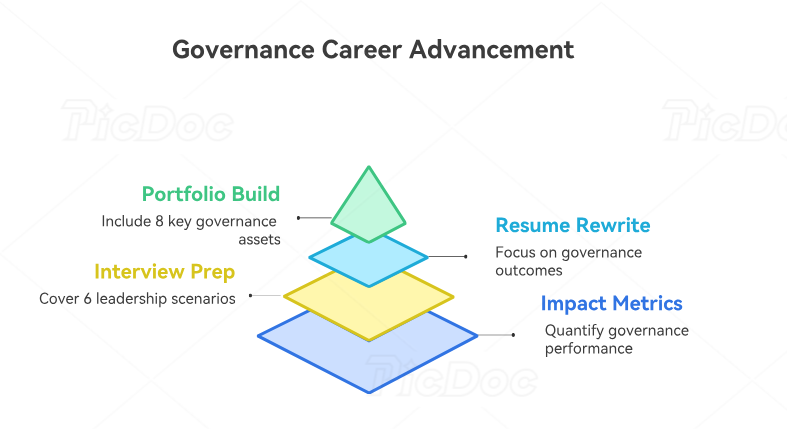
Your portfolio should contain at least eight assets:
Governance charter: Define objectives, principles, decision rights, committees, delegated authority, escalation thresholds, and review cycles.
Portfolio prioritization model: Score initiatives using strategic value, benefits, urgency, risk, capacity, complexity, dependency, and regulatory exposure.
Stage-gate framework: State required evidence, reviewers, approval criteria, possible decisions, and post-gate obligations.
Executive decision brief: Present one major exposure, realistic options, recommendation, decision deadline, and consequences of delay.
Risk-based assurance plan: Match review intensity with project value, complexity, novelty, confidence, and organizational impact.
Benefits-realization register: Identify baselines, targets, owners, measurement methods, realization dates, dependencies, and review points.
Governance dashboard: Show strategic alignment, status confidence, financial exposure, aggregate risk, benefits, resources, dependencies, and overdue decisions.
Governance maturity assessment: Evaluate decision speed, ownership clarity, data integrity, control effectiveness, exception frequency, and lessons adoption.
Build these assets using project templates, risk-register guidance, project-reporting practices, financial-management concepts, and governance trends.
Rewrite your resume around governance outcomes
A weak governance bullet describes administration:
Prepared monthly steering committee reports and maintained the governance calendar.
A stronger version reveals decision impact:
Redesigned portfolio reporting around decision deadlines, forecast confidence, aggregate risk, and benefit ownership, reducing overdue executive decisions and exposing three unfunded dependencies before approval.
Another weak bullet says:
Supported stage-gate reviews for major projects.
A stronger version says:
Introduced evidence-based gate criteria across a multimillion-dollar change portfolio, identified incomplete resource and supplier assumptions, and secured conditional approvals tied to named owners and closure dates.
Each bullet should include the governance problem, scale, evidence reviewed, intervention, stakeholders influenced, decision achieved, and measurable result. Use accurate terminology from project monitoring, stakeholder engagement, project finance, risk response, and project governance.
Prepare six governance interview stories
Your interview examples should cover different leadership capabilities:
An investment you challenged: Explain the assumption weakness, evidence gathered, options presented, and decision changed.
A project you helped recover: Describe the unreliable forecast, governance intervention, re-baseline conditions, and restored accountability.
A project you recommended stopping: Show how you handled sunk costs, executive attachment, benefit deterioration, and termination consequences.
A sponsor you enabled: Explain how you improved their decision information, clarified obligations, and accelerated resolution.
A governance process you simplified: Show which controls created delay, how you preserved assurance, and what cycle-time improvement followed.
A portfolio conflict you resolved: Explain how you managed shared resources, strategic priorities, dependencies, and executive trade-offs.
Structure every answer around context, exposure, evidence, intervention, decision, result, and learning. This approach demonstrates conflict-resolution ability, leadership communication, resource-allocation judgment, portfolio awareness, and project-closure discipline.
Quantify governance performance
Governance impact can be measured through:
Average decision cycle time
Percentage of gates completed with required evidence
Number of overdue executive actions
Forecast accuracy
Frequency of late status deterioration
Benefits with named owners and baselines
Projects with unresolved resource conflicts
Value of avoided or reduced exposure
Percentage of strategic investments reviewed
Time spent preparing governance reports
Repeat audit or assurance findings
Projects stopped, combined, re-scoped, or deferred
Percentage of changes with complete impact analysis
Closure actions completed on time
These measures move your application beyond process ownership. They demonstrate how monitoring controls, earned value, resource management, project reporting, and portfolio governance improved organizational performance.
5. Follow a Practical Path From Project Professional to Governance Executive
Governance careers usually develop through expanding decision scope, independence, and organizational exposure.
Stage 1: Build control credibility
Typical roles include project coordinator, project manager, PMO analyst, risk analyst, cost controller, business analyst, or assurance analyst.
At this stage, become reliable in requirements control, risk registers, project reporting, resource planning, and project closure. Aim to understand why every control exists, who relies on it, and what decision it supports.
Stage 2: Gain cross-project exposure
Typical roles include senior project manager, program controls lead, PMO manager, governance analyst, project assurance manager, or portfolio analyst.
Seek responsibility for cross-project reporting, gate reviews, dependency management, assurance planning, portfolio risk, and executive actions. Your work should begin influencing which projects receive resources and how senior leaders interpret delivery confidence.
Strengthen portfolio-management knowledge, future PMO capability, cost management, stakeholder leadership, and hybrid governance.
Stage 3: Own a governance function
Typical roles include governance manager, portfolio governance lead, PMO director, head of project assurance, investment governance lead, or transformation controls director.
You now design frameworks, advise executives, develop sponsors, manage assurance, set portfolio thresholds, and intervene in material delivery problems. Your credibility depends on whether governance improves decisions and organizational outcomes.
This stage requires advanced project leadership, governance strategy, portfolio controls, financial stewardship, and executive conflict resolution.
Stage 4: Progress into enterprise leadership
Potential roles include enterprise PMO director, chief transformation officer, director of strategy execution, portfolio director, chief operating officer, or board-level transformation adviser.
Enterprise leaders determine how strategy becomes an investable portfolio, how resources are allocated, how underperforming initiatives are challenged, and how benefits remain accountable after delivery. Enterprise project governance has been described by PMI as a top-down structure involving board participation and the major components of organizational project management.
Your success now depends on integrating project governance, portfolio strategy, future PMO design, AI-enabled project management, and leadership capability.
Use certifications to close defined credibility gaps
PMP can validate broad project-management experience. Study through PMP exam resources, exam-domain guidance, common PMP mistakes, and PMP renewal requirements.
PRINCE2 can support candidates working in structured governance environments. Compare it through PRINCE2 versus PMP, PRINCE2 career benefits, exam-pitfall guidance, and renewal requirements.
PMI-PBA or CPRE can strengthen business-case, traceability, scope, and requirements governance through PMI-PBA preparation and CPRE career guidance. Cost-focused professionals can add credibility through CCP certification preparation.
The best credential addresses a capability repeatedly requested in your target roles. Portfolio evidence should then prove that you can apply the credential’s underlying methods.
Use a 12-month transition plan
Months 1–3: Assess 20 target governance vacancies. Record repeated requirements, sector expectations, certifications, reporting lines, and missing capabilities. Build your first governance charter, decision brief, and stage-gate model using project templates, governance guidance, risk controls, and reporting practices.
Months 4–6: Lead or support one cross-project review. Focus on dependencies, aggregate risk, resources, forecast confidence, or benefits. Document the intervention and decision achieved through monitoring controls, resource analysis, project finance, and stakeholder engagement.
Months 7–9: Improve one governance process. Shorten decision cycles, improve gate evidence, standardize status criteria, reduce reporting effort, or strengthen change control. Measure the result and connect it to PMO evolution, software automation, AI adoption, and digital transformation.
Months 10–12: Rewrite your resume around governance outcomes, complete six interview stories, and target roles one level above your current decision scope. Show how your leadership capability, portfolio judgment, financial control, and governance interventions changed decisions senior leaders cared about.
6. FAQs About Building a Career as a Project Governance Leader
-
Useful qualifications depend on the governance environment. PMP supports broad project-management credibility, PRINCE2 supports structured project controls, PMI-PBA and CPRE strengthen requirements and business-case governance, and cost credentials support investment assurance.
Choose qualifications after analyzing your target vacancies. Use PMP exam resources, the PRINCE2 versus PMP comparison, PMI-PBA preparation, CPRE guidance, and CCP certification guidance to evaluate fit.
-
Experienced project managers can move into governance when they demonstrate cross-project perspective, independent challenge, business-case reasoning, portfolio awareness, and executive influence.
Begin with gate reviews, portfolio-risk analysis, PMO improvement, sponsor support, and assurance assignments. These activities build evidence across project governance, portfolio management, risk control, project reporting, and stakeholder leadership.
-
A PMO leader may oversee standards, tools, reporting, capability development, resource data, and portfolio support. A governance leader focuses specifically on authority, accountability, investment decisions, assurance, escalation, benefits, and organizational oversight. One role can contain both sets of responsibilities.
Review the actual decision scope behind the title. Strong roles connect PMO strategy, governance controls, portfolio prioritization, financial management, and executive reporting.
-
Start by solving a visible control problem. Standardize change requests, define status thresholds, improve steering agendas, build a portfolio-risk view, map dependencies, or create a decision log.
Secure a sponsor for the improvement and measure the result. This gives you credible evidence across project monitoring, change control, risk mitigation, stakeholder communication, and governance maturity.
-
Include a governance charter, delegated-authority matrix, stage-gate model, prioritization framework, executive decision brief, assurance plan, benefits register, portfolio dashboard, and maturity assessment.
Each document should reveal your reasoning. Use project templates, risk-register structures, financial-management controls, reporting standards, and resource-allocation principles to make the portfolio operationally credible.
-
Governance leadership is valuable in industries with large investments, regulatory exposure, complex suppliers, public accountability, safety requirements, or major transformation portfolios. Common environments include government, finance, healthcare, energy, construction, technology, infrastructure, education, and professional services.
Build sector fluency through construction PM trends, financial-services project trends, renewable-energy opportunities, cybersecurity concerns, and sustainability governance.
