
How to Become a Scrum@Scale Practitioner: Detailed Career Roadmap
A Scrum@Scale career begins when you can improve coordination across several Scrum teams without burying them under meetings, reporting layers, and centralized control. The Registered Scrum@Scale Practitioner credential supports professionals moving from team-level Scrum into enterprise Agile delivery, cross-team project leadership, and organizational transformation. This roadmap explains the credentialing process, essential capabilities, portfolio evidence, suitable career routes, interview strategy, and a practical 12-month progression plan.
1. Understanding the Scrum@Scale Practitioner Career Path
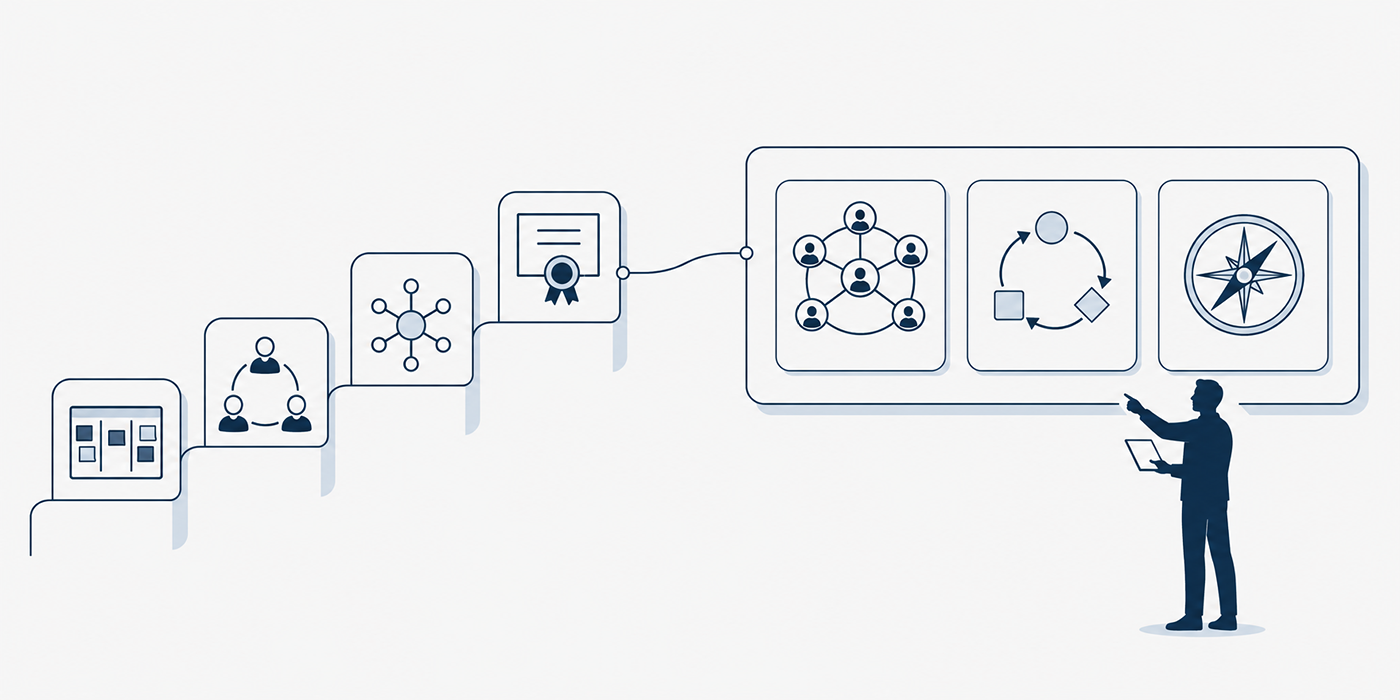
Scrum@Scale extends Scrum across networks of teams that must pursue shared goals, coordinate dependencies, align priorities, and deliver integrated value. Its official guide describes a lightweight, component-based framework built around a “scale-free” architecture and minimum viable bureaucracy. The framework separates the coordination of how work gets completed from the coordination of what work creates the greatest value.
This distinction matters for anyone moving beyond a single Scrum Team. One team can often resolve its own Sprint Planning, backlog refinement, delivery risks, and team communication. A network of ten teams introduces shared systems, competing priorities, upstream constraints, specialist bottlenecks, release dependencies, and executives whose decisions affect every team simultaneously.
The official credential is called Registered Scrum@Scale Practitioner, commonly abbreviated as RS@SP. Candidates become eligible for the credentialing exam after completing at least 14 hours of live instruction covering the official learning objectives with a Registered Scrum@Scale Trainer. The curriculum addresses Product Owner responsibilities, individual Scrum Teams, enterprise leadership, transformation backlogs, enterprise metrics, cross-team collaboration, and release planning.
The credential can strengthen several career directions:
Scrum Master progressing into Scrum of Scrums Master
Product Owner progressing into Chief Product Owner
Project manager moving into enterprise Agile delivery
Program manager coordinating multiple product teams
PMO professional supporting Agile governance
Agile Coach working across departments
Transformation consultant redesigning organizational systems
Delivery leader improving flow across products or value streams
The strongest career progression combines Scrum framework fluency, Agile measurement capability, stakeholder engagement, and system-level impediment removal. The certificate validates learning. Employers still need evidence that you can diagnose coordination failures, protect team autonomy, improve strategic prioritization, and measure whether organizational changes produced better outcomes.
The Two Cycles You Must Understand
The Scrum Master Cycle coordinates how teams deliver. It covers the Team Process, Scrum of Scrums, Scrum of Scrums Master, Executive Action Team, continuous improvement, cross-team coordination, and delivery. The official learning objectives expect practitioners to understand how impediments move to the appropriate organizational level and how scaled events support delivery across teams.
This cycle connects directly with conflict resolution, resource allocation, project monitoring, and continuous delivery automation. Professionals entering through Scrum Master, project delivery, operations, quality, or engineering leadership roles often build their strongest evidence in this cycle.
The Product Owner Cycle coordinates what the organization should deliver. It covers strategic vision, backlog prioritization, backlog decomposition, release planning, Product Owner Teams, Chief Product Owners, and Executive MetaScrum forums. The official curriculum emphasizes translating strategic vision into a single actionable backlog and connecting business value with prioritization decisions.
This cycle aligns naturally with requirements engineering, business analysis, Agile estimation, project financial management, and portfolio prioritization. Product Owners, business analysts, product managers, sponsors, and portfolio professionals often enter Scrum@Scale through this route.
The practitioner’s greatest value appears where the two cycles connect. Teams may deliver efficiently while strategic priorities remain unstable. Leadership may produce a clear strategy while organizational impediments prevent execution. A capable practitioner creates a functioning connection between strategic governance, team-level execution, release feedback, and enterprise metrics.
2. Choosing the Right Entry Route Based on Your Experience
A successful transition begins with a realistic assessment of what you already know and what a scaled environment will expose. Candidates frequently underestimate the distance between facilitating one team and improving an organizational network. Multi-team work introduces governance constraints, fragmented ownership, conflicting incentives, and decisions that remain blocked far above the team level.
Route A: Scrum Master to Scrum of Scrums Master
A Scrum Master already understands team events, empirical improvement, impediment removal, and servant leadership. The next capability is system-level facilitation. You must learn how to identify which teams genuinely need coordination, establish scaled events, surface shared constraints, and prevent the Scrum of Scrums from becoming a status meeting.
Strengthen your command of Scrum terminology, advanced Scrum Master practices, Agile performance metrics, conflict-resolution techniques, and leadership communication.
Build evidence by coordinating two or three teams around one shared outcome. Track unresolved dependencies, impediment age, blocked time, rework, and completion predictability. Your portfolio should show how the coordination mechanism improved delivery while preserving the teams’ ability to self-manage.
Route B: Product Owner to Chief Product Owner
A Product Owner entering Scrum@Scale must expand from one team backlog to a coordinated product system. The Chief Product Owner helps align Product Owners, stakeholders, strategic vision, backlog priorities, and release expectations. The role requires economic judgment and disciplined stakeholder management.
Develop expertise in product backlog management, requirements decomposition, Agile estimation, stakeholder engagement, and project financial terminology.
Create one integrated backlog for a realistic product involving several teams. Show strategic objectives, customer outcomes, prioritized initiatives, decomposed Product Backlog Items, dependency assumptions, release forecasts, and feedback measures. Hiring managers can then evaluate how you translate strategy into ordered work.
Route C: Project Manager to Enterprise Agile Delivery
Project managers often possess valuable strengths in schedules, budgets, risks, governance, suppliers, and executive communication. Their main adjustment involves moving from centralized task control toward transparent goals, stable teams, empirical forecasting, and faster feedback.
Connect your experience in project execution, risk registers, resource allocation, project reporting, and hybrid project management with Scrum@Scale components.
A strong transition project might replace weekly manual status collection with a scaled delivery review based on completed work, impediment age, release forecast, and customer feedback. Another option is converting a temporary matrix of individually allocated specialists into stable cross-functional teams and measuring the reduction in context switching.
Route D: PMO Leader to Executive Action Team Contributor
The Executive Action Team owns the organizational transformation strategy and creates the environment required for Scrum to operate effectively at scale. The official learning objectives distinguish the EAT from a conventional PMO and emphasize its role in making organizational impediments visible and actionable.
PMO professionals can contribute through PMO effectiveness measurement, portfolio governance, project reporting redesign, resource planning, and future PMO transformation.
Your portfolio should contain a transformation backlog. Each item should identify an organizational impediment, affected teams, measurable impact, accountable executive, proposed experiment, completion criteria, and review date. This demonstrates that you can convert complaints about “culture” into governable improvement work.
Route E: Agile Coach to Organizational Transformation Practitioner
An Agile Coach may already possess facilitation, team-development, and behavioral-change experience. Scrum@Scale requires the coach to examine structures, policies, decision rights, incentives, and management systems that shape team behavior.
Develop stronger capability in project governance, portfolio management, enterprise communication, vendor coordination, and organizational leadership.
Your evidence should document a systemic intervention. Examples include reducing approval latency, eliminating duplicate governance forums, stabilizing teams, redesigning stakeholder prioritization, or creating a functioning impediment escalation mechanism.
3. Earning the Credential and Preparing for Practical Application
The official learning objectives extend far beyond memorizing framework labels. Candidates are expected to understand Scrum@Scale components, high-performing team patterns, team scaling, the Scrum Master Cycle, the Product Owner Cycle, release feedback, enterprise metrics, organizational culture, and transformation planning. The learning objectives were updated in March 2025 and emphasize application within a reference organization.
Step 1: Establish Strong Scrum Foundations
Read the Scrum Guide and the official Scrum@Scale Guide before training. Scrum@Scale assumes that team-level Scrum functions effectively. The official guide warns that weaknesses in Scrum implementation become magnified as more teams are added and recommends establishing a healthy reference model before wider scaling.
Review Scrum accountabilities, Sprint Planning terminology, backlog distinctions, Agile estimation methods, and Agile metrics.
You should be able to explain the Product Goal, Sprint Goal, Definition of Done, Product Backlog, Sprint Backlog, Increment, Product Owner, Scrum Master, Developers, and the purpose of every Scrum event. Conceptual gaps at this level will make the scaled components feel like disconnected diagrams.
Step 2: Select an Authorized Course Carefully
Verify that the instructor holds the appropriate Registered Scrum@Scale Trainer status and that the course provides at least 14 hours of live instruction covering the official learning objectives. Completion through an authorized trainer establishes eligibility for the credentialing exam.
Compare courses using practical criteria:
Trainer experience implementing Scrum across multiple teams
Case studies relevant to your industry
Exercises involving real organizational constraints
Opportunities to build a component assessment
Access to post-course clarification
Exam instructions and credential-support procedures
Time-zone compatibility and live participation requirements
Course pricing and schedules can vary by trainer and delivery format. Verify current terms directly through the authorized course listing before enrolling.
Step 3: Study the Framework as an Operating System
Avoid treating Scrum@Scale as a chart to memorize. Study each component through five questions:
What problem does this component solve?
What information enters it?
What decisions or outputs should leave it?
Who holds accountability?
Which metric would reveal weak performance?
For example, the Executive MetaScrum should create strategic alignment, stakeholder input, and a single prioritized backlog. A weak version produces competing priority lists, delayed decisions, and Product Owners receiving contradictory instructions.
The Scrum of Scrums should coordinate delivery across teams pursuing a shared goal. A weak version becomes repetitive reporting. Use project monitoring concepts, stakeholder terminology, risk-response planning, and Agile measurement to analyze each component.
Step 4: Master the High-Performing Team Patterns
The official learning objectives cover patterns including stable teams, swarming, interrupt buffers, Yesterday’s Weather, team happiness, good housekeeping, and the Scrum Emergency Procedure. Candidates must understand how these patterns affect flow, quality, planning, productivity, and organizational scaling.
Convert every pattern into an applied example:
Stable teams: calculate the cost of moving specialists repeatedly between projects.
Swarming: demonstrate how a team can concentrate on completing work before starting additional items.
Interrupt buffer: separate predictable urgent work from uncontrolled disruption.
Yesterday’s Weather: use recent delivery evidence to guide Sprint planning.
Good housekeeping: show how quality issues are addressed within the Sprint.
Scrum Emergency Procedure: prepare a controlled response when a Sprint Goal is at risk.
These examples can be connected with resource allocation, quality management, schedule compression, risk mitigation, and project execution.
Step 5: Build a Reference-Organization Workbook
Choose an organization you know well. It may be your employer, a previous workplace, or a realistic fictional enterprise. Assess its team process, cross-team coordination, impediment removal, delivery, strategic vision, backlog prioritization, release planning, feedback, and metrics.
For every component, record:
Current operating method
Observable failure signals
Business consequences
Root causes
Proposed improvement
Accountable owner
Baseline measure
Target measure
Review cadence
This workbook transforms the course into career evidence. It also prepares you to discuss project governance, PMO performance, portfolio alignment, and enterprise reporting during interviews.
4. Building Career Evidence That Employers Can Evaluate
The most damaging weakness in a Scrum@Scale application is abstract experience. Phrases such as “supported Agile transformation,” “facilitated collaboration,” and “worked with multiple teams” reveal little about your decisions or results.
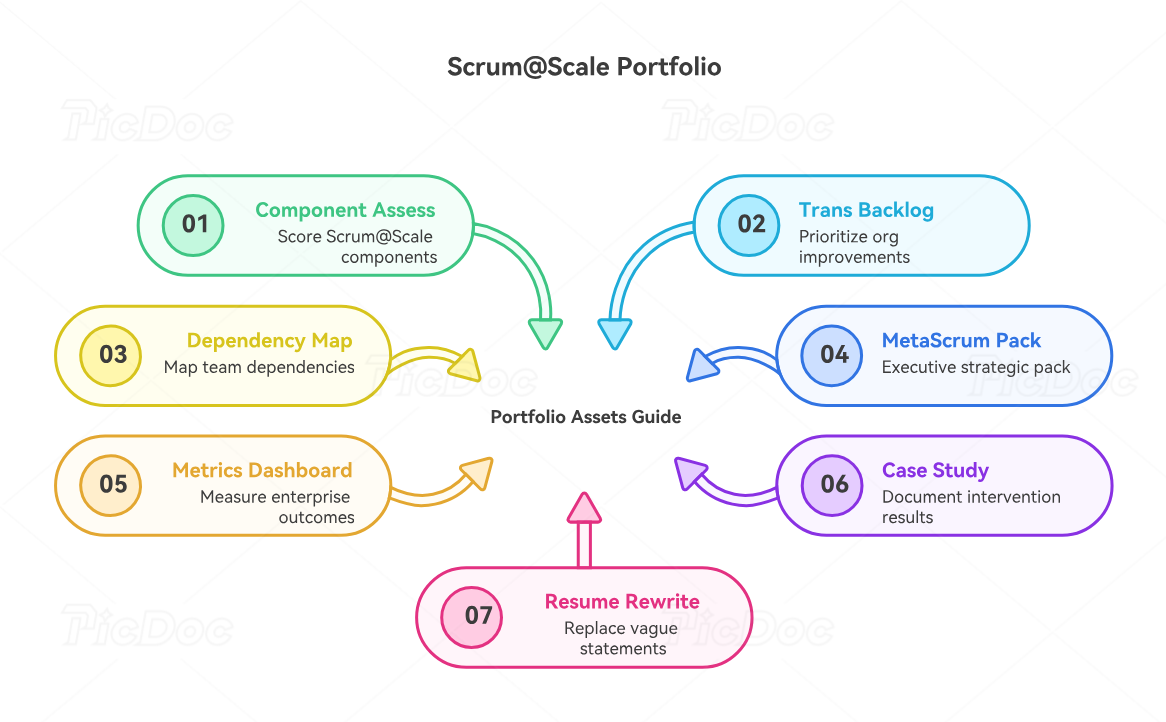
Build a portfolio containing six inspectable assets.
4.1 Component Assessment
Score the organization’s Scrum@Scale components using defined criteria. Identify the weakest component, supporting evidence, downstream impact, and recommended intervention.
A useful assessment should connect project governance, Agile metrics, stakeholder engagement, resource allocation, and project reporting. Include baseline data wherever possible.
4.2 Transformation Backlog
Create prioritized organizational improvements. Examples include stabilizing teams, reducing approval latency, removing duplicate reporting, clarifying Product Owner authority, automating delivery, or creating an Executive Action Team.
Every backlog item should contain:
Problem statement
Affected value stream
Evidence of impact
Proposed experiment
Executive owner
Completion criteria
Success metric
Review date
This artifact demonstrates practical command of backlog management, organizational leadership, PMO redesign, and continuous improvement.
4.3 Cross-Team Dependency Map
Show teams, shared services, technical dependencies, decision dependencies, external suppliers, dates, and escalation owners. Add a measure for dependency age and late discovery.
Use Gantt terminology, risk-register practices, vendor management, resource planning, and project monitoring to make the map operational.
4.4 Executive MetaScrum Pack
Prepare a concise pack containing strategic objectives, stakeholder decisions, prioritized outcomes, product measures, major trade-offs, and one integrated backlog view.
The pack should help executives decide what receives priority. It should avoid becoming another broad status report. Connect the content with business analysis, requirements engineering, project financial management, portfolio management, and stakeholder terminology.
4.5 Enterprise Metrics Dashboard
Measure outcomes across several lenses. Suitable metrics include:
Customer value delivered
Release frequency
Lead time
Cycle time
Process efficiency
Defect escape rate
Impediment age
Dependency resolution time
Sprint Goal success
Employee happiness
Backlog stability
Forecast accuracy
Decision latency
Avoid using velocity as an executive productivity ranking. Metrics need context and should support inspection, adaptation, and system improvement. Combine Agile metrics, earned value concepts, quality terminology, project reporting, and financial controls according to the organization’s context.
4.6 Measured Improvement Case Study
Document one intervention using this structure:
Organizational context
Delivery problem
Baseline evidence
Root-cause analysis
Scrum@Scale component used
Stakeholders involved
Resistance encountered
Experiment implemented
Result measured
Learning and next adaptation
A compelling case might show that clarifying Executive MetaScrum authority reduced priority reversals, or that a Scrum of Scrums reduced late dependency discovery. Another could show that stable teams lowered context switching and improved completion predictability.
Rewriting Your Resume
Replace responsibility statements with evidence.
Weak:
Facilitated Scrum of Scrums meetings and supported Agile teams.
Stronger:
Redesigned cross-team coordination for seven Scrum Teams, introduced dependency aging and escalation ownership, and reduced unresolved delivery blockers from 16 days to six.
Weak:
Helped leadership prioritize the portfolio.
Stronger:
Consolidated four competing initiative lists into one value-ordered backlog, shortening executive prioritization lead time by 40%.
Use the formula:
Action + scale + organizational problem + Scrum@Scale component + measurable result
Link your experience with leadership communication, conflict resolution, project governance, risk management, and project execution.
5. A 12-Month Scrum@Scale Career Roadmap
Months 1–2: Strengthen the Foundation
Read the Scrum Guide and Scrum@Scale Guide. Map every role, event, artifact, component, input, output, and accountability. Complete a self-assessment of your knowledge.
Study Scrum fundamentals, Agile terminology, Sprint Planning, backlog management, and Agile estimation.
Choose one primary route: Scrum of Scrums Master, Chief Product Owner, Agile Coach, delivery leader, transformation specialist, or Executive Action Team contributor.
Months 3–4: Complete Authorized Training
Attend the required live course with a Registered Scrum@Scale Trainer, complete all learning activities, and take the credentialing exam through the process provided after training. Successful candidates can access their credential and may be recognized through the International Registry of Agile Professionals.
During training, build your reference-organization workbook rather than relying only on slides. Record examples from your own industry, especially around stakeholder conflict, project risks, resource constraints, release planning, and project reporting.
Months 5–6: Create Portfolio Evidence
Produce at least four assets:
Component assessment
Transformation backlog
Dependency map
Enterprise metrics dashboard
Select one weak organizational component and design a small improvement experiment. Possible targets include Product Owner alignment, impediment escalation, stable teams, release feedback, cross-team coordination, or executive prioritization.
Months 7–8: Gain Live Multi-Team Experience
Volunteer to coordinate a release, lead a cross-team retrospective, support an Agile transformation, improve portfolio prioritization, or create a multi-team dependency workflow.
Professionals without a Scrum@Scale employer can still demonstrate relevant capability. Apply scaled patterns within a hybrid project environment, traditional PMO, construction program, financial-services transformation, or digital transformation initiative.
Months 9–10: Prepare for the Job Market
Rewrite your resume and LinkedIn profile around scale, system problems, intervention, and results. Add your portfolio assets and specify the number of teams, stakeholders, products, and departments involved.
Prepare interview stories covering:
Competing executive priorities
A cross-team dependency failure
An impediment beyond team authority
An unstable team structure
Product Owner conflict
A delayed integrated release
Resistance from middle management
A metric that drove harmful behavior
A transformation experiment that failed
A successful system-level improvement
Use precise language from stakeholder engagement, Agile metrics, risk mitigation, leadership communication, and project governance.
Months 11–12: Deepen Your Specialization
Choose one advanced direction.
For the Scrum of Scrums Master path, develop systemic facilitation, dependency management, impediment escalation, and multi-team flow.
For the Chief Product Owner path, deepen strategic vision, backlog economics, product feedback, decomposition, and stakeholder alignment.
For the Agile Coach path, strengthen organizational design, leadership coaching, team patterns, and behavioral change.
For the transformation path, master component assessments, transformation backlogs, Executive Action Teams, and measurable organizational improvement.
Experienced practitioners may eventually explore the Registered Scrum@Scale Trainer pathway. Official trainer requirements emphasize proven experience improving multiple teams or organizations, teaching ability, evidence through case studies and references, contribution to the Scrum community, and a formal evaluation process.
Track your progress through a simple scorecard:
Career Measure12-Month TargetScrum and Scrum@Scale guides studied2Authorized course completed1Credentialing exam completed1Portfolio assets created4–6Multi-team improvement initiatives2Measurable outcomes documented3Enterprise interview stories prepared8–10Scrum@Scale practitioners contacted15–20Targeted applications submitted30+Advanced specialization selected1
6. Frequently Asked Questions About Becoming a Scrum@Scale Practitioner
-
The official designation is Registered Scrum@Scale Practitioner, abbreviated as RS@SP. The course teaches how Product Owners, Scrum Teams, and enterprise leaders operate in scaled contexts. It covers cross-team collaboration, release planning, transformation backlogs, enterprise metrics, strategic prioritization, and organizational impediment removal.
Candidates should complement the credential with Scrum terminology, Agile metrics, backlog management, and stakeholder engagement.
-
The official course information focuses on completion of at least 14 hours of live instruction with a Registered Scrum@Scale Trainer before exam eligibility. Strong familiarity with Scrum remains essential because Scrum@Scale builds on functioning team-level Scrum.
Candidates should understand Scrum events, Sprint Planning, Product Backlogs, and Agile estimation before attending.
-
The credential is particularly relevant to Scrum Masters, Product Owners, project managers, program managers, delivery managers, PMO leaders, Agile Coaches, product managers, change leaders, and transformation consultants.
Professionals with strong project execution backgrounds may enter through delivery coordination. Those with requirements expertise may enter through product ownership. Professionals experienced in PMO effectiveness may contribute through transformation governance.
-
The credential supplies framework knowledge and exposure to the role’s accountabilities. Employers will also evaluate multi-team facilitation, dependency management, impediment escalation, release coordination, leadership communication, and measurable improvement evidence.
Build a portfolio containing a dependency map, risk workflow, Agile metrics dashboard, and cross-team communication model.
-
Scrum@Scale uses a lightweight, component-based structure that extends Scrum through networks of teams, the Scrum Master Cycle, the Product Owner Cycle, minimum viable bureaucracy, and context-specific implementation. SAFe provides a broader collection of defined configurations, roles, competencies, and planning structures.
Professionals comparing the options should review their target employers, existing framework, role expectations, and transformation context. The SAFe Agilist guide, Agile certification comparison, future certification trends, and hybrid project management forecast can support the decision.
-
Start with one coordination problem involving multiple teams. Suitable examples include shared dependencies, conflicting priorities, delayed decisions, unstable staffing, repetitive status reporting, or integrated release failures.
Establish a baseline, apply a relevant component or pattern, and measure the result. Connect the intervention with resource allocation, project reporting, stakeholder engagement, and risk mitigation.
