
You earned your CAPM certification, updated your LinkedIn headline, and started applying. Then every supposedly entry-level project management job asked for experience you haven't had the opportunity to gain. The solution starts with targeting roles where employers actually hire beginners, understanding their screening criteria, and demonstrating practical project skills.
This guide identifies 25 CAPM-friendly jobs, explains what employers expect, separates realistic entry points from harder-to-land positions, and provides a practical strategy for turning certification knowledge into interview-worthy evidence, even without a previous project management job title.
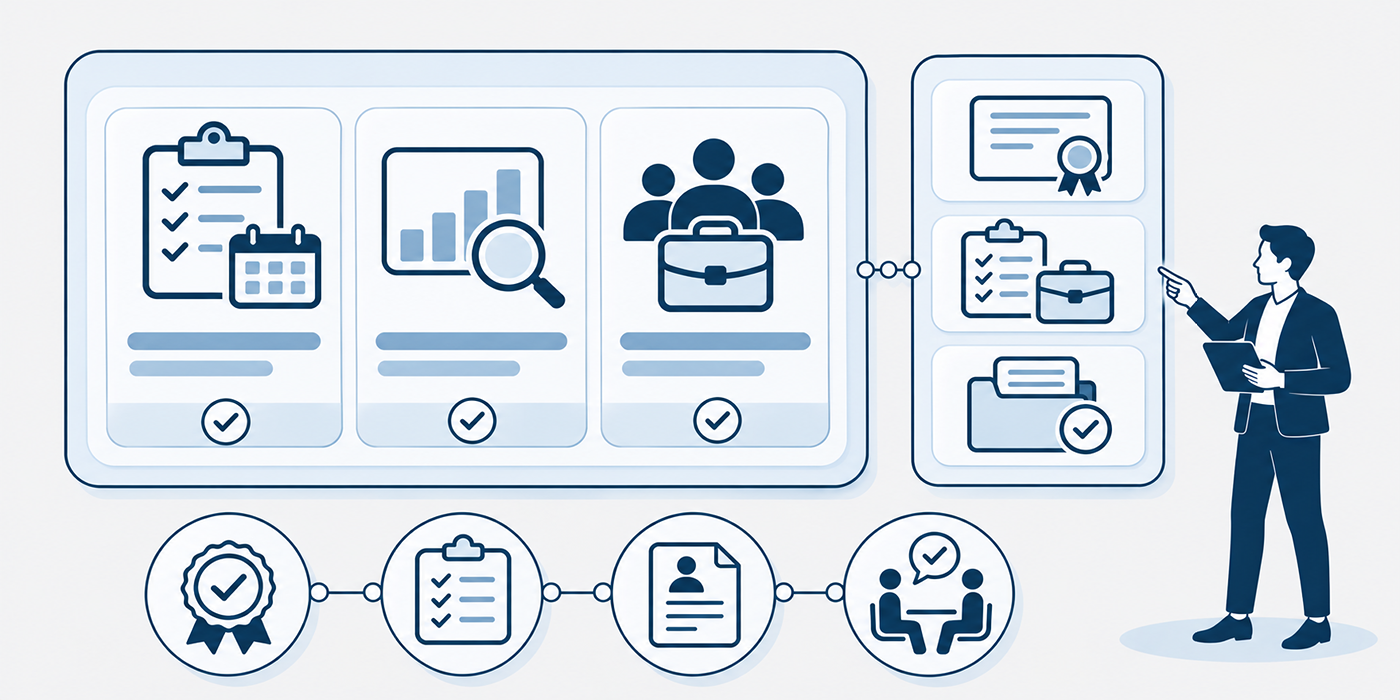
1. Can You Get a Job With CAPM Certification and No Project Management Experience?
Yes. CAPM holders can pursue entry-level project coordination, administration, support, implementation, and PMO positions without prior formal project management employment. Their eligibility depends on the specific job posting, educational background, transferable skills, and ability to demonstrate useful work.
The Project Management Institute's CAPM certification requires a secondary degree or global equivalent and 23 hours of project management education. Previous project management experience is not required to earn the certification. This makes it an accessible starting point for people exploring project management careers without a formal PM title, comparing PMO analyst and project coordinator roles, or planning a career transition into project management.
What employers actually expect from entry-level CAPM candidates
A hiring manager selecting a project coordinator needs someone who can maintain an accurate schedule, follow up on incomplete tasks, record decisions, organize documentation, and escalate risks before they disrupt delivery.
The employer may consider CAPM evidence of foundational knowledge, but practical execution is still the central hiring concern. A candidate who can demonstrate project schedule management, RACI responsibility assignment, and project reporting skills provides stronger hiring evidence than someone who lists the credential without examples.
Recent entry-level coordinator listings have accepted fresh graduates or candidates with approximately zero to six months of experience. Other junior coordinator listings ask for six to twelve months, and some junior project manager positions require two or more years. The words "junior" and "entry-level" therefore need to be interpreted alongside the actual requirements.
The distinction is particularly important for people comparing project coordinator versus junior PM opportunities, reading remote project manager hiring experiences, or evaluating career-switcher resumes.
Five signals that make a CAPM application credible
Employers commonly assess communication, organization, spreadsheet proficiency, familiarity with scheduling tools, and the ability to produce accurate written updates.
A candidate can demonstrate these through a sample project charter, a linked dependency schedule, a risk and issue register, meeting minutes with assigned owners, and a concise status report. These artifacts should describe real activities or clearly labeled simulations rather than invented paid employment.
Understanding project management templates, digital collaboration software, Agile project coordination, and entry-level project career requirements can help determine which examples are most relevant.
A particularly useful exercise is to take one realistic 30-day initiative, such as launching a small training workshop, and prepare a complete project file. The candidate should be able to explain what was planned, which dependencies controlled delivery, what might go wrong, who was accountable, and how progress would be reported.
That single coherent example is often more useful in an interview than ten unrelated certificates, especially for applicants coming from teaching backgrounds, operations roles, or business analysis positions.
| CAPM-Friendly Role | What Employers Look For | Common Skills / Tools | Best Evidence to Show | Entry Fit |
|---|---|---|---|---|
| 01. Project Assistant | Reliable administration, task follow-up, accurate notes. | Excel, Outlook, Word. | Meeting action log and deadline tracker. | Strong |
| 02. Coordinator Trainee | Organization, communication, willingness to learn. | Task boards, Office tools. | Sample weekly project update. | Strong |
| 03. Junior Coordinator | Milestone tracking, documentation, follow-ups. | Excel, Planner, Asana. | Task schedule with ownership and progress. | Strong |
| 04. Project Administrator | Document accuracy, approvals, records control. | SharePoint, Office, Excel. | Approval and document revision register. | Strong |
| 05. Project Support Officer | Stakeholder support, reporting, project governance. | Excel, reporting templates. | Steering update and risk escalation log. | Strong |
| 06. PMO Assistant | Consistent reporting, data collection, governance support. | Excel, PowerPoint. | Multi-project status reporting pack. | Strong |
| 07. PM Intern | Foundational knowledge, curiosity, task ownership. | WBS, basic scheduling. | Project charter and milestone tracker. | Conditional |
| 08. Reporting Assistant | Data accuracy, concise reports, spreadsheet confidence. | Excel, basic Power BI. | Progress and overdue-actions dashboard. | Strong |
| 09. Document Control Assistant | Revision discipline, filing systems, approval tracking. | SharePoint, DMS, Excel. | Document transmittal and version register. | Strong |
| 10. Scheduler Assistant | Dates, dependencies, milestone updates. | MS Project, Excel, P6 basics. | Dependency schedule and critical path example. | Conditional |
| 11. Junior PMO Analyst | Analysis, reporting controls, consistent data quality. | Pivot tables, dashboards. | Five-project health and variance report. | Conditional |
| 12. Project Controls Assistant | Schedule and cost tracking, change records. | Excel, baseline tracking. | Planned versus actual cost and progress report. | Conditional |
| 13. Implementation Coordinator | Rollout planning, stakeholder readiness, acceptance. | Project boards, CRM, Excel. | Phased implementation and go-live checklist. | Conditional |
| 14. Onboarding Coordinator | Client communication, deadlines, process handoffs. | CRM, Sheets, email. | 30-day customer onboarding plan. | Strong |
| 15. IT Project Coordinator | Technical understanding, issue escalation, release support. | Jira, ticketing, Excel. | Release-readiness and issue tracking logs. | Conditional |
| 16. Software Delivery Coordinator | Development handoffs, test status, release tracking. | Jira, Git basics, Agile. | Sprint-to-release workflow and defect log. | Conditional |
| 17. Agile Delivery Coordinator | Backlog organization, blockers, sprint communication. | Jira, Kanban, Scrum. | Sample backlog and sprint review report. | Conditional |
| 18. Operations Project Coordinator | Process improvement and cross-functional coordination. | Workflow maps, Excel. | Process improvement implementation plan. | Strong |
| 19. Marketing Project Coordinator | Creative deadlines, approvals, campaign coordination. | Asana, content calendar. | Campaign schedule with review and approval gates. | Strong |
| 20. Event Project Coordinator | Vendor communication, logistics, contingency planning. | Run-of-show, checklists. | Event plan and contingency register. | Strong |
| 21. Training Rollout Coordinator | Learner communication, session schedules, attendance. | LMS, Excel, calendars. | Training launch and attendance plan. | Strong |
| 22. Nonprofit Project Assistant | Program documentation, stakeholder support, reporting. | Excel, donor reporting. | Community initiative work plan. | Strong |
| 23. Construction Project Administrator | Submittals, contractor records, change documentation. | RFI logs, document control. | Submittal and contractor tracking register. | Conditional |
| 24. Research Project Assistant | Milestone tracking, documentation, research coordination. | Excel, databases, records. | Research milestone and document control plan. | Conditional |
| 25. Assistant Project Manager | Planning support, stakeholder coordination, risk monitoring. | Schedules, RAID log, reporting. | Integrated project plan and risk response report. | Stretch |
| 26. Education Screen | High school, diploma, or degree depending on employer. | Qualification verification. | Relevant credential and transcript. | Varies |
| 27. Experience Screen | Zero experience, internship, or related work may qualify. | Resume and examples. | Transferable work or simulated project. | Varies |
| 28. CAPM Preference | Certification may be preferred rather than mandatory. | PM terminology, methods. | Verified CAPM and practical artifacts. | Helpful |
| 29. Industry Gate | Technical degree, local regulation, or background checks. | Industry-specific tools. | Required qualification or domain knowledge. | Varies |
| 30. Practical Skills Test | Ability to organize, report, and escalate accurately. | Excel, project tools. | Live task exercise or portfolio walkthrough. | Critical |
2. The 25 Best CAPM Jobs With No Experience: Roles, Responsibilities, and Entry Barriers
The following positions represent realistic job-title families to search. Some are genuinely accessible to first-time applicants, while others are conditional on a degree, industry familiarity, software skills, or transferable experience.
Job titles are not standardized across employers. The same "project coordinator" title may describe an administrative position at one organization and a role managing several complex client projects at another. Compare the responsibilities and screening requirements before applying.
Project administration and coordination: Five accessible entry points
1. Project Assistant. Supports meeting arrangements, deliverable tracking, records, and follow-up communications. Employers often prioritize clear written communication, document accuracy, and Excel or Google Sheets. Show a meeting action log with deadlines and named owners. This is a strong first target for candidates using basic project templates and developing administrative-to-PM career skills.
2. Project Coordinator Trainee. Learns scheduling, task follow-ups, stakeholder communications, and reporting under supervision. Graduate and trainee schemes may accept applicants with no previous PM employment, though some require a relevant degree. Demonstrate a weekly project update and a simple responsibility assignment matrix. Compare trainee progression with project coordinator career pathways.
3. Junior Project Coordinator. Maintains project boards, updates timelines, records blockers, and follows up with delivery teams. Common screening requirements include Office proficiency, organizational skills, and sometimes six to twelve months of adjacent experience. Build a demonstrable schedule in Trello, Asana, or Microsoft Planner. Candidates developing Agile coordination skills can use backlog and delivery-tracking examples.
4. Project Administrator. Controls project documentation, approvals, purchase records, meeting minutes, and filing conventions. Employers may accept general administrative experience in place of project-specific experience. Show a version-controlled project register, an approval tracker, and a documented project governance process. This route particularly suits candidates moving from operations administration.
5. Project Support Officer. Assists with milestone monitoring, reporting packs, stakeholder queries, and project controls. Frequently found in public-sector, corporate, and service delivery environments, this role may include specific education or compliance requirements. Produce a sample steering update and risk escalation tracker. Examine project governance career opportunities for longer-term progression.
PMO, reporting, and project controls: Five evidence-driven roles
6. PMO Assistant. Supports reporting schedules, templates, governance meetings, and portfolio records. Employers often screen for spreadsheet accuracy, documentation, and follow-through. Demonstrate a standardized status pack combining five workstreams. Compare the responsibilities against PMO analyst and coordinator career paths and project governance practices.
7. Project Management Intern. Works alongside a project manager to update tasks, prepare notes, collect information, and support planning. Employers may restrict internships to enrolled students or recent graduates. Present a sample WBS and milestone report. Candidates should distinguish internship eligibility from experience requirements and use CAPM preparation resources to reinforce project terminology.
8. Project Reporting Assistant. Maintains dashboards and progress trackers, gathers workstream updates, and prepares summary reports. Employers may prioritize Excel formulas, PowerPoint, Power BI fundamentals, or data quality. Show a dashboard that separates overdue tasks from critical risks and budget variance. The position is suitable for candidates interested in AI-assisted PM reporting workflows and project performance analytics.
9. Document Control Assistant. Manages document numbering, revisions, approvals, distribution, and retrieval. Construction, engineering, and regulated industries may require familiarity with specific document management systems. Show a transmittal log and revision history. This provides an entry route toward construction project management and project governance roles.
10. Project Scheduler Assistant. Updates activity durations, milestones, predecessor relationships, and schedule exceptions under supervision. Some employers expect Microsoft Project or Primavera P6, even in junior positions. Build a sample dependency network and identify its critical path. Candidates who understand predictive project scheduling can demonstrate value beyond simply formatting Gantt charts.
PMO analysis and implementation: Five conditional opportunities
11. Junior PMO Analyst / PMO Analyst Trainee. Validates project data, monitors reporting quality, identifies variances, and supports portfolio governance. Entry-level opportunities exist, although many analyst vacancies expect prior reporting experience or advanced spreadsheets. Demonstrate Excel lookups, pivot tables, and a portfolio health report. Review PMO analyst career requirements and earned value analysis.
12. Project Controls Assistant. Tracks schedules, budgets, planned versus actual progress, and change records. Engineering employers may expect numerical confidence and industry-specific terminology. Show a small cost baseline with actual expenditure and forecast completion. Earned value management calculations and project controls software knowledge offer useful preparation.
13. Implementation Coordinator. Organizes system rollout activities, customer readiness, training dates, configuration milestones, and acceptance. Common requirements include customer communication, task tracking, and basic software literacy. Demonstrate a phased implementation checklist with dependencies and acceptance gates. This route works particularly well for candidates following an IT-to-project-management transition or business analysis career pathway.
14. Client Onboarding Coordinator. Coordinates onboarding milestones across sales, service, operations, and customers. Employers typically prioritize CRM proficiency, communication, deadline management, and customer-service experience. Show a 30-day onboarding schedule with escalation points. Candidates with operations experience can convert client-handling responsibilities into project coordination evidence.
15. IT Project Coordinator. Supports software, infrastructure, cybersecurity, or digital delivery projects. Employers may prefer IT qualifications, ticketing-system familiarity, Jira, or basic technical fluency. Demonstrate a release checklist and issue register. Candidates without technical backgrounds should initially target implementation-administration vacancies, then strengthen their IT project management knowledge and cybersecurity project fundamentals.
Software, operations, and marketing delivery: Five specialized starting points
16. Software Delivery Coordinator. Follows development handoffs, release readiness, testing status, and sprint commitments. Employers commonly screen for Jira familiarity and the ability to communicate with technical teams. Demonstrate a backlog-to-release workflow, defect tracker, and deployment checklist. For a career switch, understanding software engineer-to-PM trade-offs and Agile project coordination is valuable.
17. Agile Delivery Coordinator. Helps teams organize sprint plans, boards, blockers, demos, and action items. Some postings expect previous Agile-team exposure, making this a conditional entry route. Build a backlog with stories, acceptance criteria, and a sprint review summary. Study Agile team member-to-PM progression and traditional-to-Agile transition practices.
18. Operations Project Coordinator. Supports process improvement, branch launches, operational change, and cross-functional initiatives. Employers often value workflow understanding and coordination experience more than a formal PM title. Demonstrate a process improvement plan with baseline and outcome measures. Applicants moving from operations management should emphasize temporary projects rather than daily routine work.
19. Marketing Project Coordinator. Tracks creative briefs, campaign deliverables, review cycles, supplier approvals, and launch dates. Employers may want content workflow knowledge, spreadsheet skills, and familiarity with marketing platforms. Show a campaign calendar including assets, review gates, and dependencies. Review marketing project management career pathways and collaborative project management tools.
20. Event Project Coordinator. Coordinates venues, vendors, guest communications, run-of-show schedules, and contingency arrangements. Employers value calm execution, supplier follow-up, and event familiarity; evenings and weekends may be required. Show an event dependency schedule and contingency log. Explore event project management tools and project risk governance.
Training, nonprofits, research, and junior management: Five further options
21. Training Rollout Coordinator. Supports organizational learning launches, instructor schedules, learner communications, attendance tracking, and feedback reporting. Employers may prioritize LMS familiarity and facilitation skills. Build a multi-site training rollout plan. This is a particularly useful bridge for applicants considering a teacher-to-project-management career change or education project management.
22. Nonprofit Project Assistant. Supports program schedules, donor reporting, field coordination, beneficiary records, and administrative controls. Employers may require grant documentation knowledge or safeguarding training. Demonstrate a community initiative schedule with reporting milestones. Learn from nonprofit project management pathways and international development PM practices.
23. Construction Project Administrator. Manages submittals, change documents, purchase records, meeting notes, and contractor communications. Employers may prefer construction terminology, site documentation, or local safety awareness. Demonstrate a submittal and RFI log. Candidates comparing IT versus construction PM careers should account for on-site and industry-specific requirements.
24. Research Project Coordinator Assistant. Helps coordinate research schedules, documentation, recruitment milestones, and reporting activities. University, healthcare, and research organizations may require a relevant degree, ethics training, or privacy knowledge. Show a milestone and document-control plan. Candidates exploring industry choices for project managers should distinguish general administrative openings from regulated specialist positions.
25. Assistant Project Manager. Supports selected planning, stakeholder coordination, risk control, and delivery responsibilities under a more experienced manager. Some assistant PM positions are genuinely junior; others require years of experience or professional credentials. Treat this as a stretch target unless the posting welcomes graduates or comparable transferable experience. Use junior PM career comparisons and PMP experience planning to evaluate progression.
The most promising first applications are usually project assistant, trainee coordinator, project administrator, PMO assistant, and support positions. Candidates with a relevant industry background can also pursue implementation, reporting, operations, or specialist coordinator openings.
3. Employer Requirements for CAPM Jobs: Degrees, Experience, Software, and Skills
CAPM adds credibility to an application, but employer requirements still determine whether a candidate progresses through screening. The practical approach is to separate mandatory requirements from preferred qualifications and evidence you can demonstrate independently.
How to interpret the experience requirement
A vacancy asking for zero to one year of experience is usually worth examining carefully. A candidate with relevant education, internships, volunteer coordination, or comparable work may have a reasonable basis to apply, depending on the wording.
An explicit requirement for three years of prior project management employment deserves different treatment. A CAPM credential does not automatically replace mandatory years, security clearance, professional registration, or technical certification.
The best entry route often depends on selecting jobs with responsibilities close to your existing experience. Someone with customer-service experience may be a stronger candidate for onboarding coordination than for technical project controls. This approach aligns with project career-change resume guidance, operations-to-PM transition patterns, and industry-specific project management comparisons.
Education requirements vary by employer and industry
Some project support vacancies accept secondary education with strong administrative skills. Other organizations require a bachelor's degree, particularly in analytics, engineering, IT, healthcare, or regulated environments.
The U.S. Bureau of Labor Statistics identifies a bachelor's degree as the typical entry-level education for the broader project management specialist occupation. That occupational category includes positions beyond the administrative entry roles targeted in this article.
Therefore, distinguish a project support vacancy from a project management specialist or professional project manager vacancy. The former may offer access without prior PM employment; the latter can have more demanding qualifications.
Use project coordinator career comparisons, technical PM transition guidance, and project management industry comparisons to decide where your educational background offers the strongest fit.
The software skills worth learning first
Start with Excel or Google Sheets. Be able to sort and validate project data, use conditional formatting, calculate overdue activities, maintain action logs, and summarize status information.
Next, become competent in one task management platform such as Trello, Asana, Monday.com, or Microsoft Planner. Learn how to create task ownership, dependencies, deadlines, status categories, and stakeholder views.
For PMO analyst roles, add pivot tables and basic dashboard design. For software delivery, learn Jira boards and issue types. For scheduling assistants, study Microsoft Project or another tool specifically required by target employers.
The objective is to demonstrate a working example rather than collect a superficial list of software names. Project management tools and integrations, project reporting automation, and practical PM templates provide useful starting points.
Communication is a testable hiring skill
Employers frequently use interviews to assess whether candidates can summarize a problem, prioritize follow-ups, and communicate difficult information without exaggeration.
Practice turning a complicated project update into four sentences: what happened, what is at risk, what decision is required, and who owns the next action.
A sample update might state: "Vendor approval is four days late. Integration cannot start until the revised specification is accepted. The sponsor must approve the proposed workaround by Thursday. The implementation lead will provide a revised milestone forecast afterward."
This demonstrates the practical communication behind project governance, responsibility mapping, and project reporting workflows.
When a CAPM credential deserves priority on the resume
Place CAPM near the top when the vacancy mentions PMI, project coordination, project management methods, or certification as a preferred qualification. Use the exact credential name and avoid representing CAPM as PMP.
When the employer primarily needs a software or industry specialist, lead with the relevant experience and tools, while retaining CAPM prominently as supporting evidence.
The strongest positioning combines credential, transferable skill, and proof. Candidates comparing CAPM preparation resources, PMP certification paths, and entry-role career capital should focus on actual job requirements.
Choose the challenge holding back your project management career and click Submit for personalized hiring guidance.
Submit
Choose your biggest CAPM job-search challenge above to reveal a targeted recommendation.
Focus on project assistant, junior coordinator, PMO support, and project administrator positions that accept beginners. Compare your resume against mandatory requirements before applying. Create separate resume versions for different role families and track which applications generate recruiter responses.
Search for trainee project coordinator, project assistant, PMO assistant, and junior administration positions. Look for fresh-graduate eligibility, zero-to-one-year experience ranges, and acceptance of transferable skills. Prioritize vacancies where your existing qualifications satisfy the employer's mandatory requirements.
Identify examples of scheduling, coordination, stakeholder communication, documentation, and issue resolution from previous work, education, or volunteering. Describe your actual responsibilities and outcomes. Position CAPM alongside evidence of practical delivery skills, while labeling employment and simulation experience accurately.
Master Excel or Google Sheets first, then choose one platform requested by your target employers. Build a project board with task owners, deadlines, status categories, and dependencies. For PMO roles, add pivot tables and a reporting dashboard. For software delivery, learn Jira fundamentals.
Select one realistic project and prepare a charter, work breakdown and schedule, RACI matrix, risk and issue tracker, and weekly status report. Ensure all five documents use consistent milestones and assumptions. Label simulated projects clearly and prepare to explain each management decision in an interview.
Search for remote project assistant, onboarding coordinator, implementation support, and operations coordination roles. Check country restrictions, timezone expectations, and employment authorization requirements. Include hybrid and on-site positions when possible to gain practical experience and build a stronger foundation for future remote work.
4. How to Build a CAPM Resume and Portfolio When You Have No Formal PM Experience
The central challenge is presenting evidence of project delivery capability without inventing employment history. A useful portfolio solves this by showing what you can produce, explaining how you reason through project problems, and labeling experience accurately.
Build a five-artifact mini-portfolio
Choose one realistic initiative with a clear objective, timeline, stakeholders, and constraints. A simulated website launch, training program rollout, office relocation, or nonprofit fundraising campaign can all work.
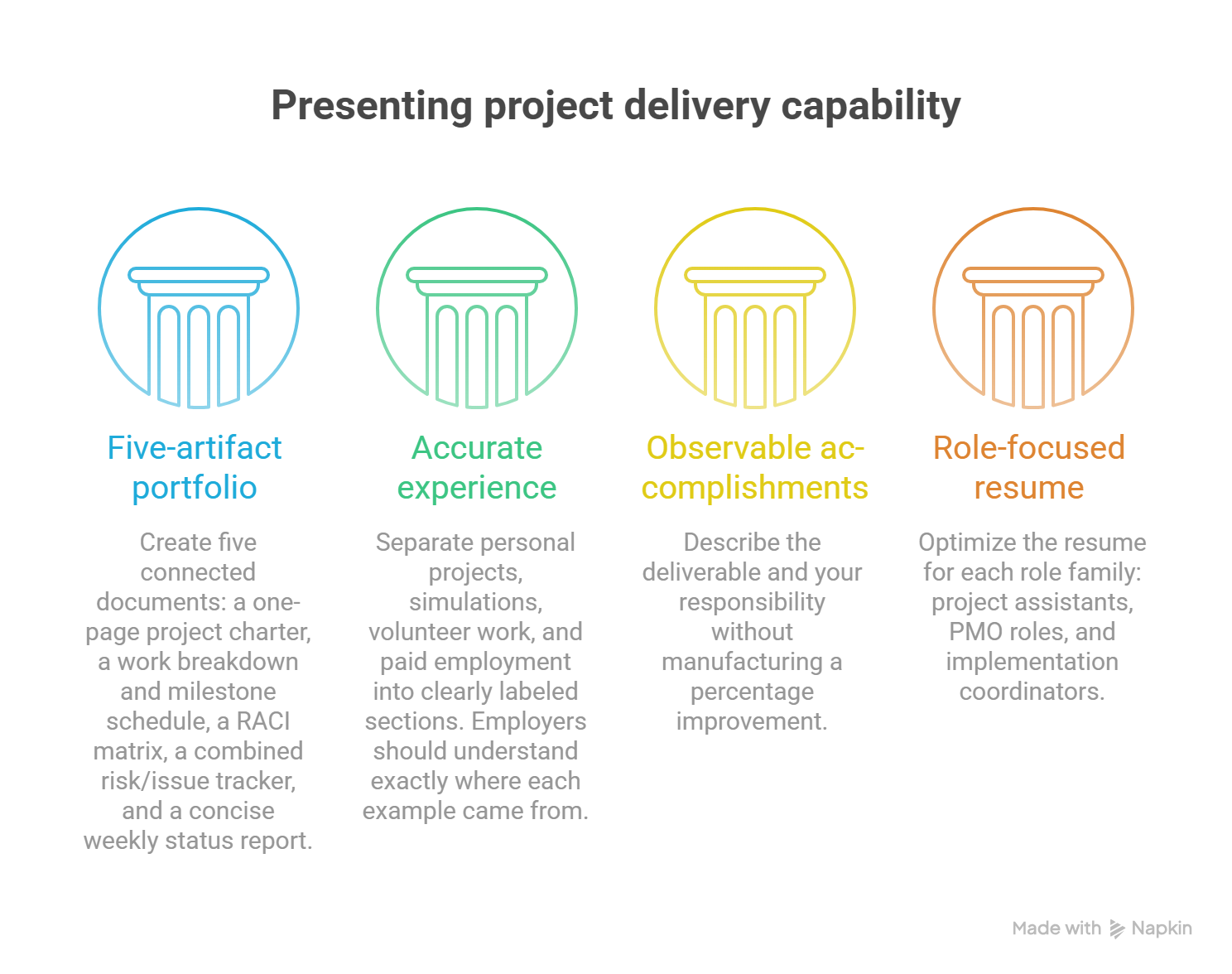
Create five connected documents: a one-page project charter, a work breakdown and milestone schedule, a RACI matrix, a combined risk/issue tracker, and a concise weekly status report.
The documents should agree with one another. If the charter establishes a six-week deadline, the schedule and status report should use the same baseline. If the risk log says supplier approval is overdue, the status report should identify its impact.
A coherent portfolio demonstrates understanding of project management templates, RACI matrix design, project governance, and reporting practices.
Translate experience without exaggerating it
A retail employee who coordinated shift coverage during a store opening can describe planning, communication, and operational handoffs where these duties were genuinely performed.
A teacher who organized a school event can describe stakeholder scheduling, supplier coordination, and delivery planning. A customer-service representative who helped implement a new support tool may have examples of training coordination, issue escalation, and adoption tracking.
Separate personal projects, simulations, volunteer work, and paid employment into clearly labeled sections. Employers should understand exactly where each example came from.
This approach is relevant to teacher-to-PM career changes, operations-to-project-management transitions, and project management resumes without a PM title.
Write accomplishment bullets around observable work
A weak resume bullet says: "Excellent project management and teamwork skills."
A stronger, evidence-based bullet says: "Coordinated a six-person volunteer event team, maintained the delivery checklist, tracked twelve supplier commitments, and completed the event against its approved schedule."
Use actual numbers only when they are accurate. If an outcome cannot be measured, describe the deliverable and your responsibility without manufacturing a percentage improvement.
For a portfolio simulation, write "Built a simulated six-week implementation schedule with 24 linked activities and a defined acceptance milestone." The labeling makes the example credible.
An interviewer can ask about project schedule assumptions, responsibility assignments, or risk control procedures, and you should be able to explain the decisions.
Optimize the resume for each role family
For project assistants, prioritize meeting coordination, records, communication, and follow-through. For PMO roles, highlight spreadsheet accuracy, reporting, and governance documentation. For implementation coordinators, emphasize client communication, rollout preparation, issue tracking, and technical familiarity.
Use the exact wording of relevant skills when it truthfully describes your capability. Avoid flooding the resume with Agile, Waterfall, PMO, Jira, Primavera, and every other keyword unless you can demonstrate each.
This makes applications more focused when targeting Agile coordination jobs, IT project support roles, and marketing project coordination.
5. A Practical 30-Day Plan to Land Your First CAPM-Friendly Project Role
A successful search requires more than submitting the same resume to every vacancy. The applicant must select reachable roles, produce evidence, match each employer's language, and measure whether the process leads to interviews.
Days 1–5: Define your entry-role shortlist
Choose three primary job families based on your strongest existing abilities.
For someone with administrative experience, that might mean project assistant, project administrator, and junior coordinator. Someone comfortable with spreadsheets might prioritize PMO assistant, reporting assistant, and project controls support.
Review approximately twenty relevant job descriptions. Record recurring mandatory requirements, preferred tools, degree expectations, work location, and experience wording. Prioritize openings where you satisfy the mandatory conditions and can demonstrate most of the practical skills.
This approach is more targeted than applying indiscriminately across PMO and junior PM positions, remote project management jobs, and different project management industries.
Days 6–12: Produce the portfolio and close skill gaps
Complete the five-artifact project example. Learn the spreadsheet functions, meeting documentation conventions, and project platform most commonly requested in your shortlist.
Build one practical example in the chosen software and prepare a two-minute explanation of the project. Ask another person to review the materials for consistency and clarity.
Use project management resource templates, project scheduling concepts, and CAPM knowledge preparation to close specific gaps.
Days 13–21: Apply selectively and measure results
Create separate resume versions for your selected job families. Tailor the summary and first few bullets to the employer's actual responsibilities.
As a practical starting experiment, submit roughly fifteen to twenty-five carefully matched applications during this period, adjusting for how many genuinely suitable vacancies exist.
Record application date, title, company, mandatory requirements, resume version, and outcome. The goal is to learn which role families produce responses, rather than treat a particular number of applications as a guarantee.
Compare outcomes with entry-level PM hiring experiences and remote job competition patterns.
Days 22–30: Diagnose interviews and improve positioning
If employers are not responding, examine role seniority, mandatory qualifications, resume relevance, and the strength of your evidence.
If interviews are happening but offers are absent, practice discussing stakeholders, dependencies, delays, changing priorities, and unfamiliar tools. Prepare examples using the situation, your responsibility, your action, and the outcome.
Also evaluate whether a less glamorous first role provides a stronger career foundation. Six months maintaining accurate project records and schedules can create more useful career evidence than waiting indefinitely for a junior project manager title.
For longer-term progression, compare project coordinator versus junior PM career growth, career pathways into program management, and PMP certification preparation requirements.
A useful first job should provide exposure to live schedules, accountable handoffs, stakeholder communication, issue escalation, and measurable project outcomes. Those experiences form the foundation for later leadership roles and qualifying professional experience where PMI's separate PMP requirements are satisfied.
6. FAQs: CAPM Jobs With No Experience and Entry-Level Employer Requirements
-
Yes. Some project assistant, trainee coordinator, administrative support, and internship positions accept applicants without previous formal project management employment.
CAPM demonstrates familiarity with project management concepts, while hiring decisions also consider education, communication, practical tools, and transferable experience. Start with project coordinator entry routes, prepare examples using project management templates, and follow CAPM certification preparation guidance.
-
Project assistant, project administrator, project coordinator trainee, and some project support roles generally provide the most accessible starting points.
Accessibility depends on local vacancies, education requirements, and transferable abilities. A candidate with strong customer-service skills may find onboarding coordination easier, while someone experienced with spreadsheets may compete better for reporting support.
Compare PMO assistant and coordinator responsibilities and career-change experiences before selecting targets.
-
CAPM is often a preferred or beneficial qualification rather than a universal requirement. Many employers prioritize software skills, communication, relevant education, and demonstrated coordination ability.
Some positions specify a particular credential, but applicants should follow the exact requirement stated in each vacancy.
Candidates can strengthen their profile through CAPM exam preparation resources, Agile delivery knowledge, and practical project reporting skills.
-
Remote project support and coordination positions exist, but competition can be high, and employers may restrict applicants by country, employment authorization, timezone, or customer coverage requirements.
Remote vacancies can also ask for independent work experience or stronger communication and tool proficiency.
Consider hybrid and on-site openings alongside remote opportunities. Examine remote project manager hiring realities, digital nomad project management career paths, and project collaboration tools before narrowing the search.
-
Entry-level compensation varies substantially by country, city, sector, degree requirements, and the nature of the position. A project assistant and an engineering project controls analyst may have very different salaries despite both being relevant to CAPM holders.
The broader project management specialist occupation also includes experienced professionals, making its median salary unsuitable as a first-job salary promise.
Compare local openings using project management salary reports and industry-specific career comparisons.
-
Some employers accept CAPM holders for genuinely junior project manager or assistant PM positions. Others require prior delivery experience, industry qualifications, or responsibility for budgets and stakeholders.
Examine the scope of the vacancy. Jobs requiring independent management of complex projects are usually more demanding than positions supporting a senior manager.
Consider PMO analyst versus junior PM career paths, project management career transitions, and future PMP eligibility planning.
