
Managing successful projects in your home market can build an impressive career, but global leadership introduces challenges that local delivery experience may never expose. International employers expect project managers to coordinate distributed teams, navigate different business cultures, understand cross-border risks, and demonstrate measurable business impact. With global demand for project talent growing, experienced professionals have opportunities to expand their careers beyond domestic markets. This guide explains the skills, certifications, international experience, and career decisions that can help local project managers progress toward regional, multinational, and global leadership responsibilities.

1. What Separates a Local Project Manager From a Global PM Leader?
Global project management leadership involves delivering outcomes across geographical, cultural, regulatory, and organizational boundaries.
A local project manager may oversee substantial budgets, manage complex stakeholders, and lead technically demanding initiatives. These capabilities provide a foundation for international responsibilities.
However, multinational projects introduce additional challenges involving distributed decision-making, regulatory differences, communication expectations, currencies, and competing regional priorities.
Professionals examining advanced project management career pathways should evaluate how their existing skills translate into these environments.
Understand the different forms of international project management
There are several ways to build a global career.
Cross-border project management: Managing projects involving teams, suppliers, clients, or stakeholders in multiple countries.
Regional program management: Coordinating related initiatives across several markets, often with shared business objectives and country-specific requirements.
Global PMO leadership: Establishing governance, reporting, delivery standards, and organizational capabilities across international business units.
Global portfolio leadership: Supporting investment decisions and prioritizing initiatives according to multinational organizational strategy.
These paths require different levels of experience.
Someone pursuing program management needs experience coordinating related projects and their collective benefits.
A professional targeting project governance leadership must demonstrate an ability to improve delivery capabilities across organizational boundaries.
Why international employers evaluate experience differently
Consider two project managers with similar years of experience.
The first manages a large domestic technology implementation involving one office, established suppliers, and familiar reporting relationships.
The second delivers a smaller initiative involving development teams in South Asia, clients in Europe, and operational stakeholders in North America.
The second manager may have more direct exposure to cross-border communication, time-zone constraints, distributed accountability, and international stakeholder expectations.
However, the first manager may possess stronger financial or technical delivery experience.
Recruiters evaluate these competencies according to the role.
For professionals exploring IT project management careers, construction project leadership, or industry-specific PM opportunities, relevant international exposure can take several forms.
Experience managing overseas vendors, foreign clients, cross-border procurement, or multinational reporting may already provide useful evidence.
Global demand creates opportunities, with important limitations
The Project Management Institute's Global Project Management Talent Gap report, published in May 2025, estimated approximately 39.6 million project professionals worldwide.
Its projections indicate that global demand could reach between 58.6 million and 65.4 million professionals by 2035, with a potential shortfall of up to 29.8 million.
The report identifies particularly significant projected demand growth in South Asia, China, and Sub-Saharan Africa.
These projections describe broad workforce requirements. Actual hiring opportunities depend on industry, economic conditions, employer needs, and local labor markets.
Candidates researching project management career stability should assess relevant vacancies rather than relying solely on global forecasts.
Compare requirements across remote project management positions and international leadership roles.
Identify where your existing expertise matches actual employer demand.
The three capabilities behind international leadership
PMI's Talent Triangle identifies three areas relevant to professional development: Ways of Working, Power Skills, and Business Acumen.
For international leadership, these translate into practical responsibilities.
Ways of Working includes applying predictive, agile, and hybrid delivery approaches across different organizational environments.
Power Skills includes negotiation, collaborative leadership, communication, and managing stakeholders with different expectations.
Business Acumen involves understanding commercial outcomes, organizational priorities, industry requirements, and the financial implications of decisions.
Professionals building agile project management capabilities and business analysis expertise can use these areas to identify relevant skill gaps.
| Capability | Local PM Experience | Global Leadership Application | Evidence Employers Can Assess |
|---|---|---|---|
| 1. Strategic alignment | Connect projects to departmental objectives | Balance outcomes across regions | Regional objectives and benefits map |
| 2. Distributed leadership | Coordinate a co-located team | Lead geographically dispersed contributors | Distributed team delivery results |
| 3. Cross-cultural communication | Manage familiar communication expectations | Adapt communication across business cultures | Stakeholder communication plan |
| 4. Time-zone coordination | Manage one primary working schedule | Coordinate international handoffs | Multi-time-zone delivery calendar |
| 5. Executive reporting | Report individual project performance | Present regional decisions and trade-offs | Executive decision brief |
| 6. International procurement | Manage domestic supplier relationships | Coordinate overseas suppliers and contracts | Cross-border procurement plan |
| 7. Currency exposure | Monitor primarily domestic budgets | Assess multiple currencies and rate risks | Currency sensitivity analysis |
| 8. Regulatory awareness | Follow familiar domestic obligations | Identify multi-jurisdiction requirements | Jurisdiction and compliance register |
| 9. Data governance | Follow existing local information controls | Coordinate cross-border data requirements | Data governance responsibility map |
| 10. Stakeholder analysis | Engage local departments and sponsors | Balance stakeholders across markets | Multinational stakeholder register |
| 11. Cross-project dependencies | Manage dependencies within a project | Coordinate international workstreams | Integrated dependency register |
| 12. Risk management | Address domestic delivery risks | Assess geopolitical and regional dependencies | International risk assessment |
| 13. Conflict resolution | Resolve familiar team disagreements | Navigate diverse interests and expectations | Documented resolution outcomes |
| 14. Change control | Manage changes under local governance | Coordinate approvals across business units | Multi-region change-control record |
| 15. Hybrid delivery | Apply established organizational methods | Integrate different regional delivery approaches | Hybrid delivery governance framework |
| 16. Financial forecasting | Forecast individual project performance | Consolidate geographically dispersed costs | Regional financial forecast |
| 17. Resource management | Allocate resources within one operation | Resolve international capacity conflicts | Multi-location capacity plan |
| 18. Vendor performance | Monitor domestic supplier delivery | Evaluate geographically distributed vendors | Cross-border supplier scorecard |
| 19. Benefits realization | Deliver approved project outputs | Measure outcomes across regional operations | Benefits realization register |
| 20. Digital collaboration | Use local project reporting tools | Establish shared asynchronous workflows | Distributed collaboration protocol |
| 21. Negotiation | Negotiate local delivery priorities | Resolve competing international objectives | Documented commercial trade-offs |
| 22. Governance design | Follow established approval procedures | Adapt governance across regional operations | Multi-region governance charter |
| 23. Quality assurance | Monitor local acceptance requirements | Align quality standards across locations | Shared quality and acceptance plan |
| 24. Global reporting | Maintain a project dashboard | Consolidate information across countries | Regional performance dashboard |
| 25. Organizational change | Support change within one business unit | Coordinate adoption in multiple regions | Regional change-readiness assessment |
| 26. Commercial judgment | Manage approved project constraints | Evaluate multinational business consequences | Decision paper with financial alternatives |
| 27. Professional networking | Maintain domestic industry relationships | Develop relevant international connections | Cross-market professional engagement |
| 28. Leadership evidence | Document individual project achievements | Demonstrate international accountability | Verified cross-border project case studies |
2. The International Skills That Turn Domestic Experience Into Global Career Capital
Global project leadership requires a combination of technical delivery knowledge, organizational judgment, and the ability to coordinate people operating under different constraints.
The most valuable development opportunities often involve responsibilities that demonstrate how you handle those differences.
Master asynchronous communication and distributed accountability
Managing internationally distributed teams requires clear communication that works even when colleagues are unavailable simultaneously.
Every significant decision should have an identified owner, an agreed deadline, and an accessible record.
Use written decision logs to distinguish between proposals, approvals, and unresolved questions.
When assigning tasks across time zones, specify the delivery date and the relevant time zone. Confirm whether deadlines involve local business days or a shared international reporting schedule.
Avoid turning every coordination problem into another meeting.
For example, establish a structured weekly update containing completed outcomes, upcoming dependencies, decisions required, and blocked work.
Professionals exploring remote project management careers should develop these habits before leading large distributed teams.
Knowledge of remote team collaboration software and project management tool selection can support more efficient coordination.
Develop cultural intelligence through practical stakeholder management
Communication styles, organizational hierarchies, approaches to disagreement, and expectations concerning authority can vary between cultures and companies.
Assuming that every stakeholder communicates or makes decisions in the same way can create unnecessary conflict.
During project initiation, clarify reporting expectations, escalation responsibilities, approval procedures, and communication preferences.
Ask stakeholders how they prefer decisions to be documented and who must be consulted before commitments are made.
Use stakeholder interviews to identify organizational differences rather than relying on national stereotypes.
For professionals pursuing senior project management consulting, these practices support effective client relationships.
Experience in business analyst-to-project manager transitions can also provide a useful foundation for structured stakeholder discovery.
Understand cross-border governance, contracts, and delivery risks
International projects may involve multiple contractual arrangements, legal jurisdictions, procurement procedures, privacy obligations, and regulatory requirements.
A project involving customer data across countries, for example, may require legal and security review of where information is stored and accessed.
Your responsibility is to recognize these dependencies and coordinate with qualified specialists.
Build a jurisdiction-and-obligation register identifying applicable requirements, the responsible experts, approval checkpoints, and unresolved risks.
For procurement, clarify the currency, payment milestones, contractual jurisdiction, acceptance criteria, and delivery responsibilities.
Knowledge of project management and cybersecurity becomes particularly relevant to multinational technology projects.
Additional familiarity with requirements engineering, project governance, and cost management can improve your ability to identify cross-border delivery concerns.
Build financial and business judgment
International project managers need to understand the financial implications of decisions across different locations.
A project may involve supplier payments in one currency, operational expenditure in another, and revenue targets in a third.
Foreign exchange movements, import costs, regulatory delays, and regional resource prices can affect project forecasts.
Develop experience preparing financial scenarios that demonstrate how changes in assumptions influence costs and business outcomes.
Use earned value management where appropriate to analyze project performance, while recognizing that financial forecasting also requires understanding commercial contracts and business conditions.
Professionals targeting program management leadership should additionally develop benefits realization and cross-project investment analysis.
These capabilities become particularly valuable when executives must decide between competing regional priorities.
3. Which Certifications Actually Help You Become a Global Project Management Leader?
Internationally recognized certifications can make professional capabilities easier for employers to identify.
However, hiring decisions also depend on demonstrated experience, industry expertise, communication ability, and the responsibilities of the particular position.
The appropriate certification depends on your current career stage.
Early career: Establish foundational credibility
For professionals with limited formal project management experience, CAPM may provide a useful foundation.
It demonstrates familiarity with established project management concepts.
However, candidates should continue building practical experience through coordination, planning, stakeholder communication, and measurable delivery contributions.
APMIC's discussion of CAPM career outcomes and the Google Project Management Certificate versus CAPM can help compare foundational qualification routes.
Professionals attempting to enter project management without direct experience should concentrate on acquiring meaningful project responsibilities alongside formal learning.
Experienced project managers: Evaluate PMP strategically
PMP is widely recognized across industries and international markets.
It validates knowledge and experience associated with managing projects, people, processes, and business priorities.
Candidates must meet PMI's applicable education, experience, and training requirements.
Professionals researching whether PMP is worth the investment should examine the qualification requirements of their intended employers.
Those comparing credentials can also review PMP, CAPM, PRINCE2, and AgilePM.
The usefulness of a particular qualification varies by region, sector, and employer.
For internationally oriented positions, demonstrate how your knowledge supports complex stakeholder, governance, and delivery decisions.
Program and portfolio leaders: Develop advanced accountability
Professionals who already coordinate multiple related projects may consider PgMP, subject to eligibility.
PgMP emphasizes managing programs that deliver collective organizational benefits.
PfMP is intended for experienced portfolio management professionals involved in aligning investments with organizational strategy.
These qualifications represent different professional responsibilities.
Candidates pursuing program management careers should develop program governance, dependency management, and benefits realization experience.
Those targeting executive project management positions may require broader investment prioritization and organizational leadership capabilities.
Review the latest PMI eligibility requirements before selecting either path.
Specialized credentials: Follow your intended industry
International technology programs may require agile or hybrid delivery knowledge.
Professionals pursuing these roles can investigate PMI-ACP, CSM, and SAFe certifications, depending on employer expectations.
Those targeting scaled agile delivery may consider SAFe Agilist certification or relevant advanced Scrum learning.
Industry-specific responsibilities may justify additional training in construction management, business analysis, or cost management.
Select credentials according to actual responsibilities advertised by employers in your target market.
A practical project portfolio showing successful international coordination can strengthen your candidacy alongside certifications.
Choose the challenge holding back your international career progression and click Submit for targeted guidance.
Submit
Identify international clients, overseas vendors, or multinational stakeholders within your existing organization. Volunteer to coordinate a clearly defined cross-border responsibility. Document the countries involved, your decision-making authority, and measurable delivery outcomes.
Review 15-20 international job descriptions. Identify which requirements are consistently missing from your profile. Prioritize demonstrable international delivery responsibilities, relevant industry knowledge, and targeted professional evidence before investing in additional general training.
Introduce structured asynchronous project reporting and decision logs. Clarify time zones, accountability, handoff requirements, and escalation procedures. Practice stakeholder communication across different working cultures and evaluate measurable improvements.
Compare the requirements of your target positions with your qualifications. Investigate PMP for experienced project delivery roles, PgMP for established program responsibilities, and relevant specialized credentials for industry-specific needs. Verify eligibility with the awarding organization before enrolling.
Choose two or three countries or regional employment markets. Research multinational employers with operations in your location. Verify remote work eligibility, employment arrangements, and relocation requirements. Prioritize opportunities where your experience matches the essential job requirements.
Prepare three concise case studies showing your strongest achievements. Document the business problem, stakeholders involved, your actual responsibilities, and measurable outcomes. Highlight distributed coordination, executive influence, risk decisions, and relevant financial accountability.
Your selection reveals career guidance within the article. Responses are not stored or transmitted.
4. How to Secure International Experience While Working in Your Home Country
One of the greatest obstacles in international career development is the experience gap.
Employers often request previous international project experience, while local professionals may have limited opportunities to acquire it.
The solution is to deliberately pursue responsibilities that involve cross-border stakeholders, geographically distributed delivery, or multinational business requirements.
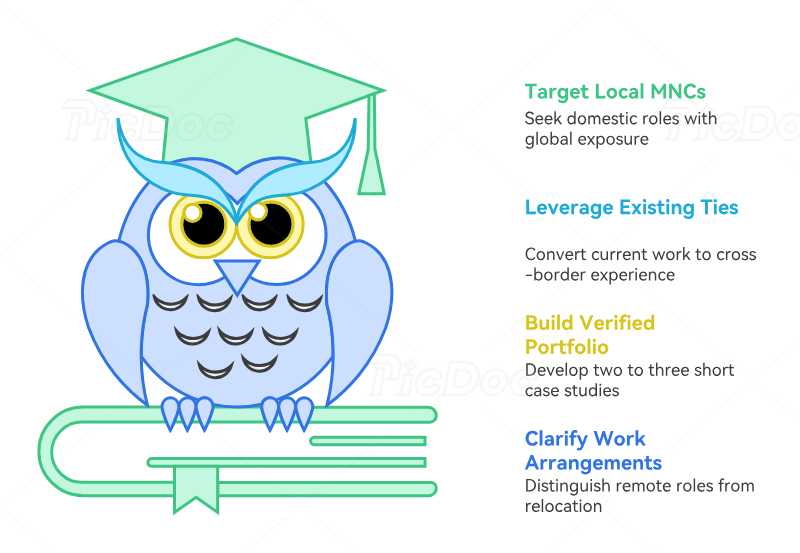
Target multinational companies with local operations
Organizations operating across several countries may offer opportunities to participate in regional projects while remaining based in your home market.
Investigate companies whose local offices support international clients, global technology platforms, shared services, procurement, infrastructure, or business transformation.
When reviewing vacancies, look for responsibilities involving regional stakeholders, distributed teams, global governance, or cross-border suppliers.
A domestic position involving international delivery may provide more relevant exposure than a prestigious local role focused entirely on one market.
Professionals researching remote project manager jobs and IT project management opportunities should evaluate the geographical scope of the work.
Convert existing supplier and client relationships into cross-border experience
Review your current responsibilities for opportunities involving overseas stakeholders.
You may already participate in international procurement, communicate with foreign vendors, or deliver services to overseas customers.
Seek responsibility for coordinating these interactions.
For example, volunteer to manage a supplier transition involving two countries.
Prepare a coordinated delivery plan, define acceptance criteria, establish escalation procedures, and track relevant commercial risks.
This experience can demonstrate international coordination even when you remain physically based in your home country.
Developing procurement and project governance competencies and requirements management skills will support such assignments.
Build an international experience portfolio employers can verify
Develop two or three concise case studies showing the international responsibilities you have actually performed.
Each case study should explain the countries or regions involved, your decision-making authority, the business problem, and the outcomes.
Include measurable evidence wherever possible.
For example, describe how you coordinated deliverables across time zones, reduced dependency delays, or improved multinational stakeholder reporting.
Separate team-wide outcomes from your individual contributions.
Where confidentiality applies, anonymize clients and commercially sensitive information.
Professionals following a project coordinator-to-project manager progression can begin building such evidence before receiving a senior title.
Candidates concerned about certification versus real experience should prioritize demonstrating these practical achievements.
Understand the difference between remote employment and relocation
An overseas employer may hire remote workers, employees based in a local subsidiary, contractors, or people authorized to relocate.
These arrangements have different requirements.
Evaluate employment authorization, local labor rules, taxation, compensation currency, employment benefits, and the hiring entity before accepting an offer.
For physical relocation, investigate employer sponsorship and jurisdiction-specific work authorization requirements through official sources.
For remote positions, confirm whether the employer can legally engage workers in your country and whether the stated location restrictions apply.
Professionals considering remote project management opportunities should clarify these arrangements early in the hiring process.
Comparing opportunities using relevant project management salary data can provide context, but assess taxes, benefits, exchange-rate exposure, and cost of living separately.
5. A 12-Month Career Roadmap: From Local PM Experience to International Leadership Readiness
A realistic development plan should translate career ambitions into specific responsibilities and evidence.
The following roadmap offers a structured approach for professionals who already possess some project delivery experience. The timeline will vary depending on existing skills and access to suitable opportunities.
Months 1–3: Choose a target market and conduct a skills audit
Select one primary target industry and two or three relevant geographical markets.
Review approximately 20 job descriptions across those markets.
Record the required qualifications, delivery methodologies, leadership responsibilities, industry knowledge, and international experience expectations.
Distinguish consistently requested requirements from preferences appearing in only a few vacancies.
Compare these requirements with your current professional experience.
Use APMIC's industry comparisons for project managers and IT versus construction project management guide to clarify possible directions.
Finish this phase with a prioritized skills-gap assessment and an initial development plan.
Months 4–6: Build practical international delivery exposure
Pursue assignments involving international stakeholders, overseas suppliers, or geographically distributed teams.
Volunteer to coordinate cross-border reporting, manage regional dependencies, or support shared delivery standards.
Develop the documentation required for reliable asynchronous coordination.
Track outcomes such as fewer unresolved handoffs, improved decision turnaround, or stronger delivery predictability.
Professionals managing remote team collaboration can use these responsibilities to build practical evidence.
Additional familiarity with hybrid project management may help when working with organizations using different delivery methods.
Months 7–9: Validate your capabilities and improve your professional positioning
Review the certification requirements most relevant to your target roles.
If PMP aligns with your experience and employer requirements, investigate the examination and eligibility process.
Candidates already holding PMP may benefit more from targeted leadership experience or specialized training.
Build a portfolio containing specific examples of international communication, project governance, risk management, and business outcomes.
Update your resume to emphasize scope, accountability, and measurable results.
Instead of describing yourself only as responsible for project schedules, explain the geographical scope of your coordination and the decisions you influenced.
Avoid inventing achievements or claiming international responsibilities beyond your actual involvement.
Professionals who are struggling to secure project management interviews should ensure their professional evidence aligns with the positions they are targeting.
Months 10–12: Apply selectively and develop a global professional network
Prioritize positions where your existing experience matches most essential requirements.
Potential roles include regional project manager, international delivery manager, global PMO analyst, multinational implementation manager, and program coordinator.
The appropriate title depends on your demonstrated responsibility level.
Prepare interview examples involving cross-cultural communication, distributed delivery, financial trade-offs, and complex stakeholder decisions.
Use professional associations, PMI chapters, industry events, and relevant online communities to develop relationships with practitioners working in your target markets.
These interactions can help you understand employer expectations and regional delivery practices.
Continue reviewing developments in project management career demand and AI-driven changes in project management.
If interviews reveal recurring experience gaps, use that feedback to guide the next development cycle.
6. FAQs: Building a Global Project Management Career
-
Yes. Multinational companies and international service providers may employ project managers who coordinate cross-border work remotely or from regional offices.
Relevant opportunities depend on the employer's hiring arrangements and the responsibilities involved.
Develop experience managing distributed teams, overseas clients, and cross-border delivery requirements.
APMIC's guide to remote project management opportunities provides related career context.
-
PMP is recognized internationally and may be required or preferred for particular positions.
Employers also evaluate experience, industry knowledge, leadership skills, and evidence of successful delivery.
Review actual vacancies in your target market before choosing a qualification.
You can compare options through APMIC's project management certification comparison.
-
Requirements vary by position and employer.
Some internationally oriented coordination roles are suitable for professionals earlier in their careers, while regional program and global portfolio leadership positions generally require extensive relevant experience.
Focus on demonstrating responsibilities directly related to the position.
Candidates developing project management experience should prioritize meaningful delivery contributions and progressively broader accountability.
-
International project management roles appear across technology, construction, engineering, healthcare, manufacturing, energy, financial services, and consulting.
Demand varies by geographical market and economic conditions.
Evaluate sectors in which your technical experience is transferable.
APMIC's industry comparison guide provides further discussion of career considerations.
-
Focus on distributed team coordination, clear written communication, stakeholder management, business acumen, cross-border risk awareness, and experience with relevant delivery methodologies.
Build evidence through actual assignments.
Professionals can also strengthen their understanding of project governance and remote collaboration practices.
-
Compensation depends on experience, industry, employer size, location, contractual arrangements, and the responsibilities of the role.
International titles do not automatically imply a higher salary or improved overall financial position.
Compare compensation after considering taxes, benefits, housing, exchange rates, and relocation expenses where applicable.
Review relevant project management salary information when evaluating offers.
