
A project can have a perfect schedule, sufficient funding, and qualified people yet still collapse because nobody knows who owns the final decision. Tasks bounce between departments, approvals stall, and project managers become responsible for problems they have no authority to resolve. A RACI matrix generator helps prevent these failures by identifying who performs work, who owns outcomes, and who must participate in important decisions.
This guide shows you how to build a free RACI matrix, assign roles correctly, identify accountability gaps, and create a responsibility assignment system that improves project execution.
1. What Is a RACI Matrix Generator, and How Does It Work?
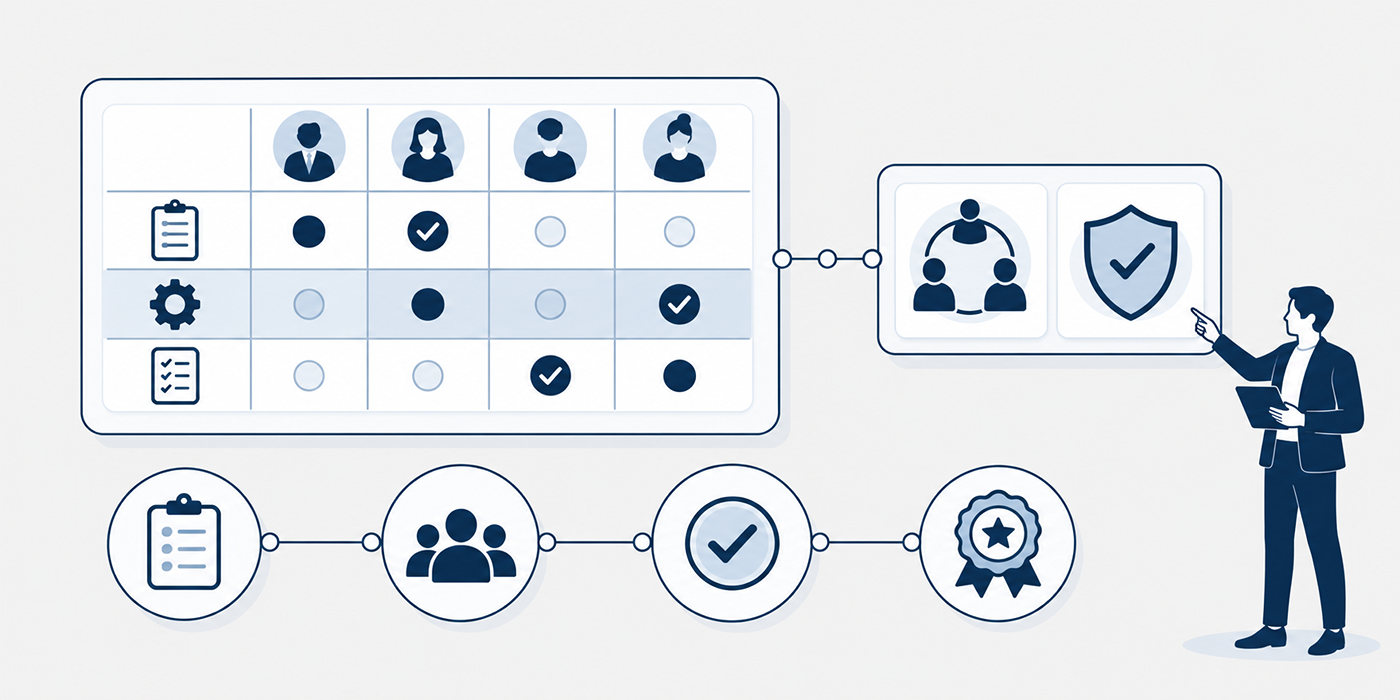
A RACI matrix generator is a project management tool that organizes responsibilities across activities, deliverables, decisions, and stakeholders. It produces a responsibility assignment matrix that clarifies four types of involvement:
R — Responsible: The individual or team performing the work required to complete an activity.
A — Accountable: The person who owns the outcome and holds the appropriate authority to approve or accept it.
C — Consulted: Stakeholders whose knowledge, expertise, or input is required before an activity or decision is completed.
I — Informed: Stakeholders who need relevant updates about progress, decisions, or completed work.
A project manager coordinating an enterprise software implementation might be responsible for maintaining the schedule, while an executive sponsor is accountable for authorizing additional funding. The cybersecurity team may be consulted about security risks, and affected department managers may receive implementation updates.
These distinctions become particularly important when professionals transition from IT into project management, advance from business analysis into PM roles, or develop formal project governance capabilities.
Why unclear accountability damages project performance
Consider a company implementing a new customer relationship management system.
The technology department believes sales leadership owns data migration approval. Sales leadership assumes IT will approve the final migration. Meanwhile, the project manager expects both departments to resolve the issue independently.
The migration is technically complete, but production deployment cannot proceed because formal acceptance remains unresolved.
A RACI matrix identifies this problem during planning by assigning technical validation, business data acceptance, and deployment authorization to distinct accountable roles.
Such ownership clarity becomes increasingly important in complex program management, cross-functional PMO operations, and global project leadership, where authority frequently extends across different reporting structures.
| Project Activity | Responsible (R) | Accountable (A) | Consulted / Informed | Completion Evidence |
|---|---|---|---|---|
| 01. Business case development | Business analyst | Business sponsor | C: Finance, PM | Approved business case |
| 02. Project charter approval | Project manager | Executive sponsor | C: PMO, business owner | Signed charter |
| 03. Stakeholder identification | Project coordinator | Project manager | C: Functional leads | Stakeholder register |
| 04. Requirements gathering | Business analyst | Business owner | C: Users, technical SMEs | Validated requirements |
| 05. Scope baseline approval | Project manager | Executive sponsor | C: Business, delivery leads | Approved scope baseline |
| 06. Work breakdown structure | Project planner | Project manager | C: Workstream leads | Validated WBS |
| 07. Schedule baseline | Project scheduler | Project manager | C: Resource owners | Baselined schedule |
| 08. Budget authorization | Finance analyst | Delegated budget authority | C: PM, sponsor | Funding approval |
| 09. Resource assignment | Functional managers | Resource director | C: Project manager | Confirmed resource plan |
| 10. Risk identification | Project team | Project manager | C: Risk specialists | Risk register |
| 11. Risk response execution | Risk action owner | Authorized risk owner | C: PM, specialists | Mitigation evidence |
| 12. Procurement specification | Procurement specialist | Procurement manager | C: Legal, technical lead | Approved specification |
| 13. Supplier evaluation | Evaluation panel | Procurement authority | C: Finance, SMEs | Evaluation report |
| 14. Contract authorization | Contracts officer | Authorized signatory | C: Legal, finance | Executed agreement |
| 15. Technical architecture | Solution architect | Technology owner | C: Security, operations | Approved design |
| 16. Development execution | Delivery team | Delivery lead | I: Project manager | Completed deliverable |
| 17. Quality assurance | QA engineers | Quality manager | C: Delivery leads | Test results |
| 18. Security assessment | Security specialists | Security authority | C: IT, legal | Security review record |
| 19. Compliance verification | Compliance officer | Compliance authority | C: Legal, process owner | Compliance decision |
| 20. User acceptance testing | Business testers | Business owner | C: QA, developers | Signed UAT acceptance |
| 21. Change impact analysis | Project manager | Project manager | C: Finance, technical leads | Impact assessment |
| 22. Change request approval | Change coordinator | Change control authority | C: Sponsor, workstream leads | Approved change record |
| 23. Executive reporting | Project manager | Project manager | C: Leads; I: Sponsor | Published status report |
| 24. Operational readiness | Operations team | Operations owner | C: IT, support, training | Readiness approval |
| 25. Production deployment | Deployment team | Technology owner | C: Security; I: Sponsor | Deployment verification |
| 26. Training and handover | Training team | Operations owner | C: Business users | Handover acceptance |
| 27. Final deliverable acceptance | Project manager | Business sponsor | C: Business owner, QA | Formal acceptance record |
| 28. Project closure | Project manager | Project sponsor | C: PMO, finance, operations | Approved closure report |
2. How to Build a RACI Matrix Online for Free: Eight Practical Steps
Creating a useful RACI chart requires more than placing letters into cells. The underlying activities must be measurable, the roles must represent actual authority, and the matrix must identify responsibility conflicts before they affect delivery.
Step 1: Define the exact project boundary
Start with a clearly defined process, deliverable group, or project phase.
A matrix labeled "Digital Transformation" may become too broad to maintain. A matrix covering "Customer Data Migration and Acceptance" gives the team a more manageable set of responsibilities.
Define the expected outcomes, major decisions, critical stakeholders, and escalation boundaries before building the chart.
This approach supports professionals transitioning into project management without formal experience and those developing practical evidence of project delivery competence.
Step 2: Create activity rows around measurable outcomes
Each row should describe work that can be completed, reviewed, or approved.
Instead of writing "Finance," write "Authorize project funding." Replace "IT" with "Complete integration testing." Change "Marketing" to "Approve campaign launch assets."
Activity labels should make it possible to identify when the task has finished and what evidence confirms completion.
This distinction matters when connecting a RACI chart to project management software, earned value management practices, or a structured PMO reporting system.
Step 3: Identify roles before assigning individuals
Create columns for roles such as executive sponsor, project manager, business analyst, engineering lead, procurement manager, QA lead, compliance officer, and operations owner.
Using roles allows the matrix to survive personnel changes. Maintain a separate register connecting each role to the current employee, deputy, and escalation contact.
For remote project management environments and international project teams, include organizational affiliation and decision jurisdiction where relevant.
Step 4: Assign the accountable owner first
For each activity, identify the person who has authority to accept its result.
The critical question is: Who can make the binding decision when contributors disagree about whether this activity is complete?
Assign that role A.
If two managers appear equally accountable, determine whether the row combines separate decisions. For example, security acceptance and business acceptance may require different authorities and therefore separate activities.
This method helps clarify governance in cybersecurity projects, construction delivery, and enterprise program management.
Step 5: Assign the people who perform the work
Next, identify the individual or team responsible for producing the deliverable.
Multiple R assignments are reasonable when work genuinely requires several contributors. However, establish who coordinates their contributions, dependencies, and handoffs.
For instance, a reporting dashboard may require data engineering, business analysis, and quality assurance. Give each contributor a clearly defined output and identify the person coordinating integration.
Professionals moving from software engineering into project management or operations leadership into PM positions can use this approach to demonstrate coordination beyond individual task execution.
Step 6: Identify essential consultation requirements
Assign C where expertise is necessary for sound decision-making.
A cybersecurity specialist might evaluate data protection controls. Legal may review contract obligations. Finance may assess budget consequences.
Avoid assigning every stakeholder as Consulted. Excessive consultation expands decision cycles and creates unnecessary coordination work.
This discipline becomes especially valuable in Agile project environments and organizations experiencing stakeholder-related burnout.
Step 7: Assign informed stakeholders and notification triggers
Use I for stakeholders who need timely visibility without participating in every decision.
Identify what triggers communication: milestone completion, material budget variance, approved change requests, deployment readiness, or critical risk escalation.
Where appropriate, define the notification channel and frequency in a stakeholder communication plan.
For distributed project teams, clearly defined notification triggers reduce reliance on informal messages and repeated status meetings.
Step 8: Validate, export, and approve the matrix
Before publishing, check every activity for missing R assignments, absent accountability, duplicate accountable owners, and consultation requirements.
Confirm that accountable stakeholders recognize their assigned authority. Check that responsible contributors have sufficient resources and realistic deadlines.
For export, CSV and XLSX files support ongoing editing, while PDF can provide a convenient approved reference copy.
When choosing among project management collaboration platforms, prioritize version control, controlled sharing, and traceability of significant responsibility changes.
A completed matrix should identify its owner, approval date, version number, and next review trigger.
3. How to Identify RACI Matrix Errors, Accountability Gaps, and Approval Bottlenecks
The greatest benefit of a RACI matrix generator is its ability to expose problems that remain hidden inside ordinary project schedules.
A project can appear fully staffed while important decisions lack authorized owners. Similarly, every activity may have an accountable person, but the same manager might be overloaded with approvals that should belong elsewhere.
Detect multiple accountable owners
When an activity has two A assignments, examine the decision being represented.
Imagine an organization assigning both its IT director and cybersecurity director accountability for approving a production release.
The IT director may own technical readiness. The security director may own security authorization. These responsibilities can coexist, but they represent different approval decisions.
Separate them into two activities with distinct acceptance criteria and decision records.
This type of governance separation is particularly important for cybersecurity project managers and professionals building senior project governance expertise.
Identify activities with no responsible performer
A row containing A but no R indicates that an outcome has an owner without an assigned executor.
This can occur when project leadership approves a deliverable without securing the resources needed to produce it.
Resolve the issue by confirming the delivery resource, workload allocation, and completion date.
In PMO analyst and project coordinator roles, catching these gaps early demonstrates planning competence.
Examine approval concentration
Review how many A assignments belong to each stakeholder.
A senior director accountable for every routine project document may become an approval bottleneck.
Identify decisions that can be delegated under existing organizational policies and those that genuinely require executive authorization.
Delegation must preserve formal financial, contractual, and regulatory limits.
This review supports PMO effectiveness improvements and more sustainable project management workloads.
Investigate excessive consultation
A project activity requiring input from ten departments may suffer repeated review cycles.
Determine which stakeholders provide mandatory expertise, which hold actual approval rights, and which only need updates.
For example, reviewing a minor internal dashboard change may require consultation with data owners but rarely needs the entire executive leadership team.
Reducing unnecessary involvement can improve decision speed while maintaining appropriate controls.
Check authority, capacity, and handoffs
Three additional tests strengthen the matrix.
Authority test: Can the accountable role genuinely authorize the activity's outcome?
Capacity test: Can the responsible person complete the assigned work within the available timeframe?
Handoff test: Has the receiving team agreed to the completion criteria and accepted the transferred deliverable?
The handoff test is especially important when work crosses technical, operational, and commercial boundaries.
Managers using AI-assisted project reporting can automate exception detection, but decisions about delegated authority still require human review.
Fixing your largest accountability gap first can make the entire responsibility matrix more effective.
4. RACI Matrix Examples for Agile, IT, Construction, Marketing, and Remote Teams
Different industries require different responsibility structures. A useful RACI generator should accommodate these differences instead of forcing every project into identical approval workflows.
Agile and Scrum projects
Scrum teams operate through defined accountabilities and self-management.
The Product Owner is accountable for maximizing product value and effective Product Backlog management. Developers are accountable for creating the Sprint Backlog and adapting their plan. The Scrum Master is accountable for establishing Scrum and supporting team effectiveness.
The Scrum Team also holds collective accountability for producing a valuable, useful Increment.
These distinctions, established in the official Scrum Guide, matter when translating Scrum work into a conventional RACI matrix.
A team can use RACI to clarify relationships with external departments, compliance authorities, and release governance. It should preserve collective responsibilities established by Scrum rather than artificially assigning all internal delivery accountability to a project manager.
Professionals following Agile project management career pathways, undertaking a traditional-to-Agile transition, or exploring Scrum scaling practices should apply these distinctions carefully.
IT and software implementation
Technology projects frequently have separate decision authorities for architecture, engineering, data protection, quality assurance, and business acceptance.
Consider a cloud migration project.
The engineering team may perform deployment preparation. The technology owner may approve technical readiness. Security specialists assess relevant controls, while operations determines whether support capabilities are sufficient.
If business acceptance is required, the appropriate business owner must authorize it separately.
This framework becomes useful for professionals transitioning from software engineering to project management, studying IT versus construction PM responsibilities, or developing cybersecurity project management skills.
Construction project management
Construction responsibilities often involve contractual and statutory obligations.
Contractors perform defined works, architects and engineers may hold design-related responsibilities, construction managers coordinate delivery, and owners or delegated authorities approve relevant commercial decisions.
For example, a contractor may be responsible for correcting defective workmanship while an authorized inspector or designated professional assesses compliance with applicable requirements.
A RACI chart should align with the actual contract, safety obligations, and legal decision rights.
This is particularly relevant for candidates pursuing construction management certification and project managers moving into infrastructure delivery environments.
Marketing campaign management
Marketing projects combine creative production, brand approval, legal review, campaign operations, and commercial performance.
A creative agency might be responsible for developing campaign assets while the marketing director is accountable for accepting them.
Legal specialists may need to review regulated promotional claims, while campaign operations handles publication after authorization.
Assigning these responsibilities separately prevents routine creative decisions from becoming unnecessarily complex approval exercises.
Professionals building a marketing project management career can use RACI examples to demonstrate campaign governance, supplier coordination, and controlled launch execution.
Remote and internationally distributed teams
Distributed teams experience additional responsibility risks because working hours, reporting lines, and communication expectations may vary.
An effective responsibility matrix should identify the authorized decision owner, operational contributor, relevant timezone, deputy contact, and escalation pathway.
A stakeholder marked Informed should know whether updates arrive through a shared dashboard, scheduled summary, or direct notification following critical decisions.
These practices support remote project manager workflows, international development project management, and global PM leadership.

5. How to Maintain, Automate, and Measure the Effectiveness of Your RACI Matrix
A responsibility matrix becomes more valuable when it is connected to project execution, governance records, and measurable operational outcomes.
Without maintenance, even a carefully approved chart gradually becomes unreliable as staffing, scope, and organizational authority change.
Link responsibilities to project deliverables
Assign each critical activity a unique identifier that connects it to the schedule, work breakdown structure, or decision register.
For example, a RACI activity labeled "Approve system integration testing" should correspond to a specific testing milestone, acceptance criteria, and approval record.
When a stakeholder asks whether testing is complete, the team can locate both the responsible contributor and the authorized decision owner.
This provides stronger traceability for professionals using earned value management, improving PMO governance, and progressing toward senior project consulting roles.
Establish responsibility review triggers
Review the RACI matrix whenever an event materially changes ownership.
Important triggers include replacement of a key stakeholder, organizational restructuring, addition of a major vendor, significant scope modification, transition into deployment, and transfer of responsibility to operations.
For stable projects, milestone-based reviews may provide sufficient control. Complex programs can require monthly or phase-specific reviews.
Record the previous assignment, replacement authority, effective date, and stakeholder acknowledgment.
Professionals aspiring to PMO leadership or project management executive positions should treat responsibility changes as governance decisions requiring traceability.
Automate repetitive validation
Spreadsheet formulas and dedicated workflow platforms can automatically identify activities with missing accountability, duplicate A assignments, empty R assignments, and unusually concentrated responsibilities.
Conditional formatting can highlight exceptions, while notification rules can alert stakeholders when assignments change.
AI-assisted systems can also review project documentation, suggest initial role assignments, and summarize responsibility changes.
These capabilities are useful within AI-supported project management workflows and broader discussions about which project management activities AI may automate.
Formal approval rights and accountability assignments still require validation from authorized stakeholders.
Track measurable governance improvements
Measure the effectiveness of the matrix through operational indicators instead of treating completion of the document as success.
Ownership exception rate: Divide activities with missing or disputed accountable ownership by the total activities reviewed. Track changes across successive reviews.
Approval turnaround time: Measure the working time between submission of a complete approval request and its authorized decision. Segment routine decisions separately from complex exceptions.
Handoff rejection rate: Track deliverables returned because acceptance conditions, required evidence, or receiving responsibilities were unclear.
Responsibility change latency: Measure how long it takes to update the approved matrix after a staffing or governance change.
Escalation resolution time: Monitor how quickly the organization resolves disputes involving decision authority or ownership.
These indicators can help teams identify governance bottlenecks that contribute to project management stress and support more meaningful PMO performance reporting.
Use your RACI matrix as professional evidence
A well-documented responsibility matrix can demonstrate project management competence during recruitment and promotion.
A useful portfolio example explains the initial accountability problem, stakeholders involved, corrective actions taken, and measurable improvement achieved.
For instance, a candidate might document how they coordinated responsibilities across six departments, identified conflicting approvals, and introduced a standardized escalation process.
Where possible, support the example with anonymized artifacts and verified performance measures.
This approach is particularly useful for professionals preparing a project management resume without a formal PM title, evaluating certification versus practical experience, or investigating why certified PMs struggle to secure interviews.
Hiring managers gain stronger evidence when a candidate can explain how they resolved responsibility conflicts and improved coordination across organizational boundaries.
6. Frequently Asked Questions About RACI Matrix Generators
-
Yes. Google Sheets, Excel for the web where available, and other spreadsheet tools can support basic RACI matrices. Create activity rows, role columns, and RACI assignments, then apply validation rules to identify missing or conflicting ownership.
For teams comparing project management software options, useful selection criteria include export formats, collaboration permissions, and revision history.
-
Responsible refers to the person or team completing the work. Accountable refers to the person who owns the outcome and has the required authority to accept it.
A business analyst might prepare requirements while the business owner approves them.
This difference is important when moving from business analysis into project management, where creating a deliverable and authorizing its acceptance are often separate responsibilities.
-
Yes. The same individual may perform work and own its outcome when organizational governance permits it.
For example, a project manager may prepare and own an internal stakeholder register.
However, important financial, safety, contractual, and regulatory decisions may require independent authorization.
Professionals developing project governance leadership skills should identify these exceptions before assigning combined responsibilities.
-
A conventional RACI matrix assigns one accountable authority per clearly defined activity.
When two departments appear equally accountable, review whether the activity combines multiple approval decisions.
Separating those decisions can clarify authority and create better escalation paths.
This is particularly useful for enterprise program managers working across several functional departments.
-
The activity lacks a clearly designated outcome owner, creating a risk of unresolved approvals and responsibility disputes.
Identify the required decision, determine who has formal authority, and obtain confirmation from that person or an appropriate governance body.
An unresolved accountability gap should remain visible as an exception until corrected.
These controls are central to effective PMO governance.
-
Yes. RACI can help reduce delays caused by unclear ownership, excessive consultation, and disputed approval rights.
For example, identifying the person authorized to approve production deployment before testing begins can prevent a last-minute decision bottleneck.
Teams seeking better project coordination practices can measure approval turnaround and unresolved ownership exceptions to assess results.
