
Career Transition From Traditional PM to Agile Project Management Expert
Moving from traditional project management into agile delivery requires a deliberate change in how you plan, lead, measure, and communicate. Your experience with project governance, risk management, stakeholder engagement, and project financial control remains valuable. The transition involves applying those strengths through shorter planning horizons, empowered teams, rapid feedback, and outcome-based decisions. This guide provides a practical route from traditional PM responsibilities to credible agile expertise without discarding the commercial judgment, leadership maturity, and delivery discipline you already possess.
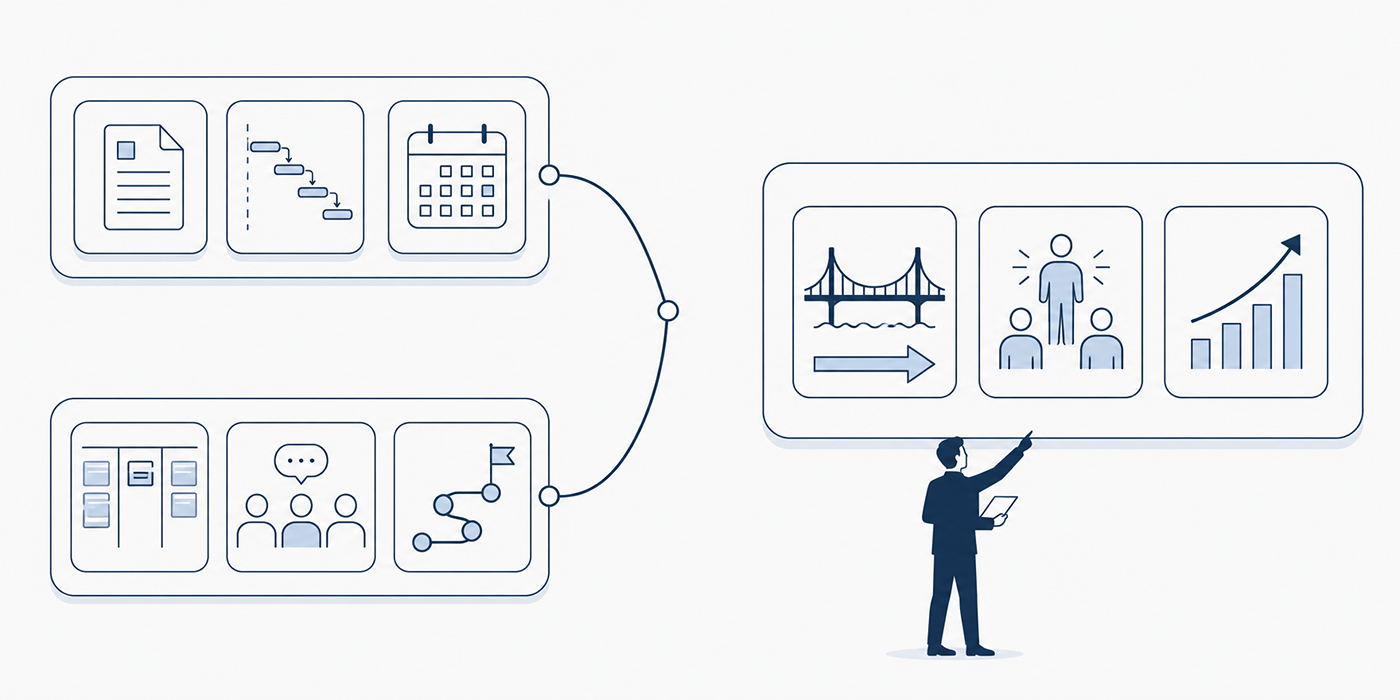
1. Understand What Actually Changes When a Traditional PM Moves Into Agile
A traditional project manager often enters agile training expecting new terminology, additional ceremonies, and a different planning tool. The deeper transition affects the manager’s operating assumptions.
Traditional environments commonly organize work around an approved scope, a sequential plan, assigned resources, scheduled milestones, controlled changes, and formal reporting. Agile environments organize delivery around customer problems, prioritized value, cross-functional teams, short feedback cycles, transparent work, and repeated adaptation.
The transition therefore connects waterfall project management knowledge with agile project management terminology, Scrum accountabilities, and Kanban flow principles. Learning these differences protects experienced managers from recreating a command-and-control structure inside an agile vocabulary.
Your Existing PM Experience Has Significant Transfer Value
Traditional project managers already understand many problems agile teams must solve:
Conflicting stakeholder expectations
Limited budgets and capacity
Dependencies across departments
Delivery risks and commercial constraints
Vendor and contract obligations
Executive reporting requirements
Governance and regulatory controls
Escalations that exceed team authority
Organizational resistance to change
Experience with project monitoring and control, resource allocation, vendor management, and conflict resolution can make a transitioning PM more effective than a framework-certified beginner. The advantage appears once that experience supports team autonomy and faster learning.
The market increasingly rewards methodological range. PMI research has found comparable project performance across predictive, agile, and hybrid approaches when organizations select methods according to the work. This supports a fit-for-purpose career strategy: agile expertise should expand your delivery range while preserving your ability to operate in regulated, contractual, capital-intensive, or schedule-driven environments.
The First Shift: From Plan Ownership to Outcome Stewardship
A traditional PM may feel personally responsible for producing the plan, distributing tasks, collecting updates, resolving deviations, and reporting compliance. Agile teams distribute much of that responsibility.
The Product Owner manages value and ordering decisions. Developers determine how work will be accomplished. The Scrum Master improves team effectiveness and helps remove systemic obstacles. The official Scrum Guide describes Scrum through defined accountabilities, events, artifacts, and commitments, with the entire Scrum Team focused on a Product Goal.
An agile project professional still provides leadership. The leadership appears through:
Creating decision clarity
Facilitating difficult conversations
Exposing delivery risk
Connecting work to business outcomes
Improving flow
Protecting feedback loops
Removing organizational impediments
Helping stakeholders make timely trade-offs
Building conditions for team ownership
This requires strong PM leadership and communication, stakeholder-management practices, project reporting discipline, and project governance judgment.
The Second Shift: From Scope Completion to Value Delivery
Traditional project reporting often asks whether approved scope is on time and within budget. Agile delivery adds questions with greater strategic importance:
Are we solving the right customer problem?
Which feature creates the greatest value now?
What evidence changed our assumptions?
Which work can be removed?
How quickly can we validate the next decision?
Is the product producing the intended outcome?
A transitioning PM must learn product backlog management, agile estimation techniques, sprint-planning concepts, and agile performance metrics. Completing every originally requested feature can still produce a weak product when user behavior, technology, regulation, or market conditions change.
The Third Shift: From Detailed Prediction to Controlled Adaptation
Agile planning contains substantial discipline. The planning happens at several horizons:
Product vision
Product goal
Roadmap
Release forecast
Backlog
Sprint goal
Daily coordination
Review
Retrospective
The manager’s challenge involves matching detail to certainty. Near-term work can receive greater precision. Long-range work remains flexible until evidence supports firmer commitments.
PMI’s 2026 research on complex projects reports that 97% of professionals managed at least one complex project during the preceding year. Around one-third of complex projects failed, and professionals who managed complexity effectively were reported to increase the likelihood of success fivefold. PMI associates stronger performance with outcomes, alignment, and learning rather than heavier reliance on detailed control.
That makes hybrid project management, schedule-management knowledge, risk-response planning, and project execution expertise valuable transition assets. The expert learns when to establish certainty, when to preserve optionality, and when to shorten the feedback cycle.
| Capability | Traditional PM Application | Agile Expert Application | Evidence to Build | Common Transition Trap |
|---|---|---|---|---|
| Project planning | Produce an integrated plan before major execution begins. | Plan continuously across vision, roadmap, release, sprint, and daily horizons. | A rolling roadmap with assumptions, outcomes, and review dates. | Creating a fixed sprint-by-sprint plan for the entire project. |
| Requirements | Baseline detailed requirements and control revisions. | Discover, refine, prioritize, test, and split requirements as learning develops. | Backlog items linked to user evidence and acceptance criteria. | Converting a complete specification into hundreds of unchanged stories. |
| Scope control | Protect the approved scope baseline. | Protect product goals while allowing scope to evolve through prioritization. | A backlog showing additions, removals, splitting, and reordering decisions. | Treating every requested feature as an equal commitment. |
| Estimation | Estimate duration and cost against defined work packages. | Use relative sizing, throughput, historical evidence, and forecast ranges. | Forecast accuracy tracked across several delivery cycles. | Using story points as hours or productivity targets. |
| Scheduling | Manage dependencies, milestones, critical paths, and baselines. | Combine release forecasting, dependency management, flow data, and fixed-date constraints. | A forecast showing assumptions and probability-based completion ranges. | Removing all schedule analysis because the team uses sprints. |
| Resource management | Allocate individuals across projects for maximum utilization. | Build stable, cross-functional teams with sufficient focus and capability. | Reduced multitasking and improved work-item completion time. | Assigning each person across several teams at full capacity. |
| Risk planning | Document risks, owners, responses, probability, and impact. | Combine risk registers with experiments, spikes, early delivery, and frequent review. | Examples where early learning reduced exposure. | Reviewing risks only during monthly governance meetings. |
| Risk ownership | Assign named owners and escalate major exposure. | Make risks visible to the team while preserving clear accountability. | Risk actions integrated into the backlog and review process. | Expecting the Scrum Master to own every delivery risk. |
| Progress control | Measure percentage complete against planned work. | Measure completed value, working increments, flow, quality, and outcomes. | Cycle time, throughput, escaped defects, and outcome measures. | Reporting story completion without explaining customer impact. |
| Performance metrics | Track schedule, cost, scope, quality, and resource variance. | Use balanced metrics covering flow, value, quality, predictability, and team health. | A dashboard connected to management decisions. | Comparing team velocity as an employee performance measure. |
| Cost control | Compare planned value, earned value, actual cost, and forecast. | Connect funding to product outcomes, capacity, incremental value, and changing priorities. | Cost-per-outcome or investment-versus-value analysis. | Funding every original feature despite weak evidence of value. |
| Budget management | Control approved budgets and formal changes. | Use guardrails, product funding, forecasts, and evidence-based investment decisions. | Quarterly funding decisions linked to outcomes. | Treating agile delivery as exempt from financial accountability. |
| Stakeholder management | Map influence, communicate status, and manage expectations. | Engage stakeholders continuously in discovery, reviews, prioritization, and trade-offs. | Documented decisions arising from stakeholder feedback. | Inviting stakeholders to reviews without giving them decision context. |
| Leadership | Coordinate people and direct delivery activity. | Set context, facilitate decisions, develop capability, and remove systemic obstacles. | Team ownership increasing while escalation dependency declines. | Rebranding task assignment as agile leadership. |
| Conflict resolution | Resolve disputes and protect project continuity. | Facilitate constructive disagreement and help teams resolve issues directly. | Examples of facilitated decisions with retained team ownership. | Solving every disagreement before the team attempts resolution. |
| Status reporting | Collect updates and create periodic management reports. | Use transparent systems, outcome reviews, and exception-based reporting. | Reduced report-preparation time with stronger decision quality. | Recreating manual status packs from agile-tool data. |
| Governance | Use gates, approvals, baselines, and escalation routes. | Design lightweight guardrails, review cadences, decision rights, and evidence thresholds. | Faster decisions with maintained compliance. | Removing governance controls without understanding their purpose. |
| Quality management | Plan assurance, inspection, testing, and defect correction. | Build quality into every increment through automation, acceptance criteria, and shared standards. | A clear Definition of Done and falling defect escape rate. | Deferring integration and testing until a release deadline. |
| Vendor management | Control deliverables, milestones, payments, and contractual compliance. | Create collaborative delivery models with outcome-based checkpoints and rapid acceptance. | Shorter vendor feedback cycles and clearer acceptance evidence. | Using a fixed-deliverable contract while demanding unrestricted scope change. |
| Procurement | Define requirements and select suppliers through structured competition. | Purchase capacity, outcomes, discovery, or incremental delivery under suitable terms. | Procurement criteria that evaluate collaboration and adaptability. | Selecting vendors solely through the lowest fixed estimate. |
| Lessons learned | Capture lessons during project closure. | Run retrospectives frequently and verify whether improvement actions worked. | A visible improvement backlog with completed experiments. | Holding retrospectives that produce no owned action. |
| Team planning | The PM develops and maintains the integrated plan. | The team creates a realistic plan around a meaningful Sprint Goal. | Sprint plans owned and adapted by the delivery team. | Entering sprint planning with tasks already assigned. |
| Deadline recovery | Crash, fast-track, resequence, or add resources. | Reduce scope, split value, limit work in progress, remove delays, and improve flow. | Recovery options compared by value, cost, risk, and quality. | Increasing sprint workload whenever delivery falls behind. |
| Workflow management | Track activities against a structured schedule. | Visualize flow, control work in progress, expose queues, and reduce aging work. | A workflow with explicit policies and measurable flow improvement. | Using a board as a decorative task list. |
| Communication | Distribute information through meetings, reports, and escalation channels. | Create rapid, transparent, context-rich communication around goals and work. | Shorter decision delays and fewer handoff misunderstandings. | Replacing every conversation with tool notifications. |
| PMO alignment | Comply with standards, templates, controls, and reporting calendars. | Help the PMO govern outcomes while permitting fit-for-purpose delivery methods. | Agile metrics translated into portfolio-level decisions. | Creating a parallel agile reporting structure disconnected from governance. |
| Portfolio management | Select and govern projects against strategic priorities. | Reallocate investment as evidence changes across products and initiatives. | Portfolio reviews that stop, pivot, continue, or expand work. | Maintaining every approved initiative until its original completion date. |
| Tool usage | Maintain plans, assignments, costs, documents, and reports. | Support transparency, collaboration, prioritization, and flow with minimal administration. | A tool configuration built around actual team decisions. | Allowing the software’s default workflow to define the operating model. |
| Automation and AI | Automate reporting, administration, and forecast preparation. | Use AI to support analysis while preserving human judgment and transparent decisions. | Measured time savings, error rates, and review controls. | Accepting generated plans or summaries without validation. |
| Career positioning | Present experience through budgets, schedules, teams, and completed projects. | Present value delivery, facilitation, learning, flow improvement, and organizational influence. | Outcome-focused résumé stories with measurable evidence. | Changing job titles while describing the same command-driven behavior. |
2. Run a Skills-Gap Audit Before Choosing a Course or Certification
The most expensive transition mistake is collecting certifications before identifying the role you intend to perform. “Agile expert” can describe several career directions:
Agile project manager
Scrum Master
Product Owner
Delivery manager
Agile business analyst
Iteration manager
Release Train Engineer
Agile coach
Transformation lead
Lean portfolio practitioner
Each role requires a different blend of Scrum knowledge, product-backlog expertise, agile leadership, and portfolio governance. A project manager who enjoys facilitation and team development may target Scrum Master or delivery-lead roles. A PM who enjoys commercial strategy, customer discovery, and prioritization may move toward product ownership. A senior enterprise PM may be better positioned for transformation, hybrid delivery, or scaled-agile leadership.
Score Yourself Across Seven Transition Dimensions
Use a one-to-five scale:
1 — Awareness: You recognize the concept.
2 — Understanding: You can explain it.
3 — Application: You have used it with support.
4 — Independent practice: You can apply and adapt it.
5 — Organizational influence: You can coach others and improve systems.
Assess yourself across these dimensions:
Agile mindset and principles
Can you explain why short feedback loops, transparency, adaptation, customer collaboration, and self-management improve decisions? Can you distinguish genuine agility from faster task administration?
Study the complete agile glossary, future agile methodologies, hybrid delivery evolution, and future Scrum developments.
Facilitation and team development
Can you facilitate planning, reviews, retrospectives, conflict, decision-making, and improvement without taking ownership away from participants? Can you coach a team through uncertainty without supplying every answer?
This dimension draws on leadership terminology, conflict-resolution techniques, stakeholder engagement, and team communication platforms.
Product and customer thinking
Can you connect backlog items to user problems, business outcomes, product goals, hypotheses, and evidence? Can you remove low-value work after stakeholders have become attached to it?
PMI’s 2025 Pulse research describes business acumen as a critical differentiator and reports that 18% of surveyed project professionals demonstrated high business-acumen proficiency, while 66% were in the moderate category. That gap reinforces the need to develop commercial and strategic judgment alongside delivery mechanics.
Build this capability through requirements engineering, PMI-PBA preparation, backlog management, and agile estimation.
Flow and delivery management
Can you identify queues, blocked work, excessive work in progress, dependencies, handoff delays, aging items, and bottlenecks? Can you improve delivery without pushing the team to start more work?
Learn Kanban terminology, agile metrics, monitoring and control concepts, and schedule-compression principles. Traditional schedule expertise becomes highly valuable when translated into dependency reduction, delivery forecasting, and flow improvement.
Technical and digital fluency
An agile leader does not need to become a software engineer. The role requires enough technical fluency to understand architecture dependencies, testing constraints, deployment risk, automation, data quality, cybersecurity, and integration.
The World Economic Forum’s Future of Jobs research identifies AI, big data, networks, cybersecurity, and technological literacy among skills growing rapidly in importance. It also identifies resilience, flexibility, agility, leadership, and social influence as rising human-centered capabilities.
Develop this through project management integrations, AI in project management, project software trends, and cybersecurity-driven software changes.
Enterprise and governance capability
Can you connect team-level agility to funding, procurement, compliance, architecture, HR policies, portfolio decisions, and executive governance?
Many transitioning PMs become comfortable with stand-ups and sprint planning while remaining unable to influence the systems that constrain teams. Senior agile roles require PMO strategy, project governance, portfolio management, and organizational leadership.
Evidence and career credibility
Can you prove that your actions improved delivery? Certifications demonstrate structured learning. Employers still need examples involving real teams, stakeholder tension, changing priorities, delivery data, and measurable improvement.
Your transition portfolio should contain:
One backlog or roadmap example
One facilitated workshop
One retrospective improvement
One flow-metric analysis
One stakeholder trade-off
One adaptive planning example
One hybrid-governance example
One measurable outcome
Connect those examples to project reporting standards, agile performance measures, risk-response evidence, and project closure learning.
3. Build the Right Agile Certification and Experience Stack
A certification can create structure, vocabulary, external validation, and access to professional communities. Career credibility grows when that certification is supported by applied evidence.
Choose Certification According to the Role
PMI-ACP for broad agile and hybrid practitioners
PMI-ACP is particularly relevant for experienced project professionals who want coverage across Scrum, Lean, Kanban, product, leadership, delivery, and enterprise agility.
PMI’s March 2026 examination outline organizes the certification around Mindset, Leadership, Product, and Delivery. Current eligibility routes include 21 hours of formal agile training and qualifying experience. The standard route requires two years of agile experience during the preceding five years, with alternative routes available for active PMP holders, qualifying GAC graduates, and holders of eligible third-party agile certifications. The current exam contains 120 items and provides three hours.
Use the comparison of PMI-ACP, CSM, and SAFe, agile-certification success stories, future certification analysis, and PMP-versus-agile career planning to assess its strategic value.
CSM for guided Scrum training and facilitation foundations
Certified ScrumMaster suits professionals who prefer instructor-led learning and want an accessible entry into Scrum accountabilities, events, artifacts, coaching, and facilitation. Scrum Alliance currently requires completion of an approved course before candidates access the 50-question CSM test. Candidates need 37 correct answers, and the course includes two test attempts.
CSM can then lead into Advanced Certified ScrumMaster preparation, deeper Scrum terminology, stronger sprint-planning practice, and practical Scrum software evaluation.
PSM I for assessment-led Scrum validation
Professional Scrum Master I validates fundamental knowledge of the Scrum framework and Scrum Master accountability. Scrum.org positions higher PSM levels around increasingly advanced application, coaching, facilitation, mentoring, and organizational situations.
PSM I can work well for self-directed learners who are comfortable preparing independently through the official Scrum Guide, practice assessments, case discussion, and applied learning. Pair it with Scrum glossary mastery, agile metrics, conflict facilitation, and team leadership.
SAFe Agilist for enterprise-scale transformation environments
SAFe Agilist can be relevant where organizations operate Agile Release Trains, Lean Portfolio Management, large solution structures, or enterprise transformation programs. Scaled Agile’s 2026 material positions the current SAFe Agilist route around Lean-Agile leadership, team and technical agility, portfolio alignment, and AI-supported strategies. The current exam study guide lists a 90-minute, 45-question assessment with an 80% passing score.
Review the SAFe Agilist exam guide, career path to SAFe Agilist, scaled certification comparison, and enterprise PMO evolution before investing.
Avoid Building a Badge Collection
A transition candidate may earn CSM, PSM I, PMI-ACP, SAFe Agilist, Kanban credentials, and product certifications while remaining unable to facilitate a tense retrospective or challenge an overloaded backlog.
Use a capability sequence:
Learn the framework.
Observe skilled practitioners.
Apply the practice in a limited setting.
Measure the result.
Request feedback.
Adapt your approach.
Explain the decision to others.
Coach another person.
Certification should accelerate this sequence. Every course needs an application objective. After learning agile estimation, facilitate an estimation workshop. After learning backlog refinement, help a team split oversized work. After learning Kanban flow, measure blocked time and aging work. After learning risk management, convert a major uncertainty into a time-boxed experiment.
Your transition becomes faster when you treat the primary blocker as a measurable development objective rather than collecting unrelated courses.
4. Create Agile Experience Before You Receive an Agile Job Title
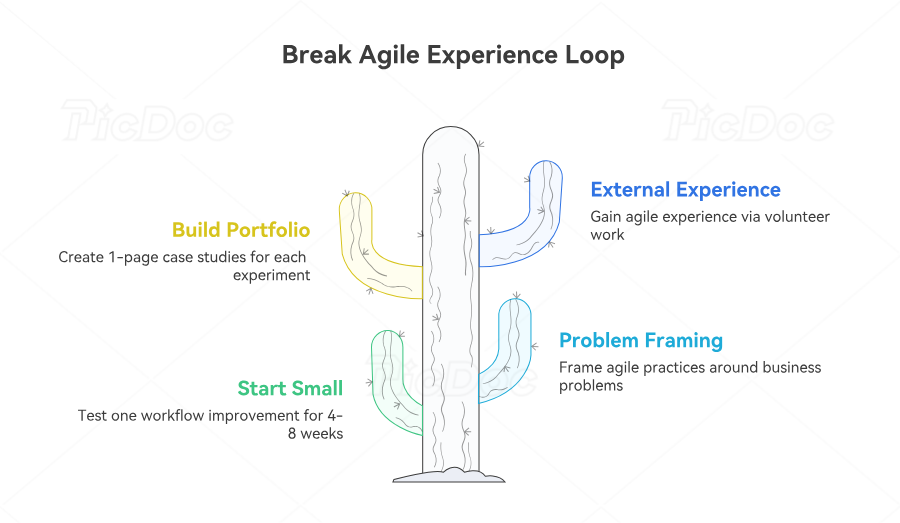
Employers frequently ask for agile experience while candidates wait for an agile role before attempting agile work. Break that loop inside your current position.
Most traditional projects contain areas where adaptive practices can be introduced responsibly. You can preserve necessary project governance, financial control, schedule obligations, and contract requirements while improving how teams discover, prioritize, deliver, and learn.
Start With One Workflow That Causes Visible Pain
Suitable transition pilots include:
Requirements arrive late and create rework.
Stakeholders wait weeks to review deliverables.
Team members start excessive amounts of work.
Priorities change through private conversations.
Status reporting consumes several hours each week.
Quality testing occurs close to release.
Decisions remain blocked across departments.
Risks are documented but receive weak follow-through.
Handoffs create repeated misunderstandings.
Lessons are captured after the opportunity to improve has passed.
Map the current workflow. Measure its baseline. Choose one improvement hypothesis. Test the change for four to eight weeks.
For example:
Problem: Stakeholder feedback arrives after a full solution has been developed.
Experiment: Demonstrate a small usable increment every two weeks.
Measures: Feedback time, rework hours, unresolved assumptions, and stakeholder attendance.
Decision: Continue, adapt, or stop the approach based on evidence.
This creates applied evidence across stakeholder engagement, project monitoring, agile metrics, and risk reduction.
Introduce Agile Practices Through Business Problems
Teams resist methodology campaigns when employees hear unfamiliar language and anticipate more meetings. Frame the change around a business problem.
Instead of announcing “We are implementing Kanban,” explain that too much unfinished work is delaying completion and hiding blocked items.
Instead of announcing “We are starting Scrum ceremonies,” explain that the team needs a clear near-term goal, faster stakeholder feedback, and a recurring opportunity to improve its operating process.
Instead of announcing “We are becoming agile,” explain that the project needs earlier evidence, shorter decision cycles, and stronger prioritization.
This approach uses Kanban concepts, sprint-planning practices, agile terminology, and leadership communication without allowing vocabulary to overshadow the problem.
Build a Transition Portfolio
Document each experiment in a one-page case study:
Context: Industry, team, product, delivery environment, and constraint.
Problem: Observable operational pain and baseline data.
Intervention: Practice introduced and reason for choosing it.
Resistance: Stakeholder concern or team difficulty.
Action: Facilitation, coaching, process, or governance steps.
Result: Measurable change.
Learning: What failed, changed, or requires another experiment.
Strong evidence may include:
Cycle time fell from 18 days to 11 days.
Stakeholder feedback arrived two weeks earlier.
Weekly reporting preparation dropped by three hours.
The team reduced active work from 23 items to 12.
Defects found after release declined across three iterations.
One low-value feature was removed before development.
Decision turnaround improved from ten days to four.
Sprint Goal achievement became more consistent.
The evidence should remain honest. Agile interviews frequently probe what went wrong, how you responded, and how the team’s behavior changed. Sanitized success stories weaken credibility.
Use project-reporting principles, agile metrics, resource-allocation data, and quality-management concepts to quantify improvement.
Find Experience Outside Your Employer
Volunteer and community projects can create credible practice when they contain real users, deadlines, stakeholders, trade-offs, and team dynamics. Options include:
Supporting a nonprofit’s digital project
Facilitating a professional association initiative
Joining an open-source or community product team
Helping a small business organize product delivery
Running an internal employee-experience experiment
Facilitating a study group using an agile backlog
Organizing an event through iterative planning
The work should contain enough complexity to demonstrate backlog prioritization, stakeholder communication, risk management, and project closure learning. A simulated board created solely for a portfolio proves tool familiarity. A real initiative proves judgment.
5. Reposition Your Career and Execute a 180-Day Transition Plan
Your résumé, LinkedIn profile, networking conversations, and interviews need to show continuity between your traditional experience and your agile direction. Presenting yourself as a complete beginner wastes valuable career capital. Presenting yourself as an agile expert after one course creates a credibility gap.
Rewrite Experience Around Transferable Agile Outcomes
A traditional résumé bullet may say:
Managed a 12-person team and delivered a $2 million implementation according to the approved project plan.
An agile-oriented version could say:
Led a 12-person cross-functional implementation team, introduced fortnightly stakeholder demonstrations, shortened feedback time, and reprioritized lower-value scope while maintaining the approved investment ceiling.
Another traditional bullet may say:
Prepared weekly project reports and escalated schedule deviations.
A stronger transition bullet could say:
Replaced manually consolidated status reporting with a transparent delivery dashboard, reducing weekly administration by four hours and enabling earlier escalation of blocked dependencies.
The revised bullets retain project financial accountability, schedule management, project reporting, and stakeholder leadership. They also demonstrate feedback, prioritization, transparency, and adaptation.
Prepare Eight Interview Stories
Build stories around:
A stakeholder who demanded excessive scope
A team that repeatedly missed commitments
A retrospective that exposed a difficult problem
A priority change during active delivery
A dependency outside the team’s control
A metric that encouraged harmful behavior
A conflict between governance and delivery speed
A personal leadership mistake
Use this structure:
Situation → Evidence → Options → Facilitation → Decision → Result → Learning
Interviewers want to see how you think when agile values, commercial commitments, team dynamics, and organizational constraints collide. Strong answers connect conflict resolution, risk management, governance judgment, and agile leadership.
Days 1–30: Establish the Foundation
Select a target role.
Complete the seven-dimension gap assessment.
Read the official Scrum Guide.
Learn core Scrum, Kanban, Lean, and hybrid concepts.
Observe at least two experienced agile practitioners.
Choose one certification path.
Identify one current workflow for an agile experiment.
Use agile terminology, Scrum definitions, Kanban concepts, and hybrid-project practices as the learning base.
Days 31–60: Apply One Practice Deeply
Map the pilot workflow.
Establish baseline measures.
Introduce one or two practices.
Facilitate recurring reviews.
Record resistance and decisions.
Gather participant feedback.
Adapt the intervention.
Avoid introducing stand-ups, sprints, retrospectives, story points, backlog refinement, and new tools simultaneously. A smaller experiment produces clearer evidence.
Track the change through agile metrics, monitoring controls, risk registers, and project reports.
Days 61–90: Build Credential and Portfolio Evidence
Complete the selected certification.
Write the first transition case study.
Facilitate a retrospective or improvement workshop.
Practise backlog splitting and prioritization.
Learn one agile tool beyond basic board usage.
Request feedback from a practitioner or mentor.
Update your résumé and profile.
Compare PMI-ACP, CSM, and SAFe, study the SAFe Agilist pathway, consider advanced Scrum Master development, and review agile career success stories.
Days 91–120: Expand Organizational Influence
Improve one dependency outside the team.
Facilitate a stakeholder prioritization session.
Connect agile measures to executive reporting.
Propose a lightweight governance adjustment.
Coach one colleague in an agile practice.
Build a second case study.
This phase differentiates a framework user from an emerging agile leader. The work begins connecting PMO operations, portfolio priorities, project governance, and future leadership models.
Days 121–150: Enter the Market Strategically
Apply for roles aligned with your evidence level.
Contact agile practitioners in target organizations.
Request informational conversations.
Attend community events or meetups.
Practise scenario interviews.
Tailor every application to the organization’s delivery model.
Ask recruiters how agile roles are defined internally.
A company may use “Scrum Master” for a delivery coordinator, “Agile Project Manager” for a hybrid PM, or “Delivery Lead” for a role combining facilitation, risk, governance, and stakeholder management. Read the responsibilities more carefully than the title.
Use future career skills, agile certification comparisons, automation-driven career forecasts, and future project-management methodologies to assess role longevity.
Days 151–180: Convert Learning Into Professional Identity
Complete at least two evidence-based case studies.
Demonstrate competence across facilitation, flow, value, and governance.
Refine your interview stories using feedback.
Continue applying agile practices in your current role.
Choose the next advanced capability.
Create a 12-month development plan.
Your next capability may involve product ownership, advanced Scrum mastery, Kanban systems design, Lean portfolio management, organizational coaching, DevOps, business analysis, or scaled delivery.
Professional expertise develops through repeated practice across agile estimation, stakeholder leadership, delivery metrics, and adaptive governance. The transition becomes credible when people can observe how your decisions improve delivery.
6. Frequently Asked Questions About Transitioning From Traditional PM to Agile
-
Experienced PMs can carry forward substantial capability in stakeholder management, budgeting, risk, governance, contracts, reporting, leadership, and organizational navigation. The transition focuses on applying those strengths through iterative delivery, team empowerment, adaptive planning, value prioritization, and rapid feedback.
A strong candidate connects waterfall knowledge, agile terminology, hybrid delivery, and project governance. Entry-level agile roles may underuse years of commercial and leadership experience. Agile delivery manager, hybrid PM, senior Scrum Master, program delivery lead, or transformation roles may provide a more suitable bridge when supported by evidence.
-
PMI-ACP usually provides the broadest alignment for PMs who already work across project delivery and want exposure to multiple agile approaches. CSM provides instructor-led Scrum foundations and an accessible Scrum Master route. PSM I suits self-directed candidates seeking assessment-based Scrum validation. SAFe Agilist aligns with enterprises using scaled-agile structures.
Compare the leading agile certifications, SAFe Agilist requirements, advanced CSM development, and future certification trends. Choose according to the role, employer environment, learning preference, and experience requirements.
-
Agile methods operate across marketing, HR, operations, healthcare, finance, education, product development, and transformation work. Software experience can increase access to Scrum Master and digital-delivery roles because many agile vacancies sit inside technology organizations.
Candidates from other sectors should build enough technical literacy to understand iterative delivery, testing, architecture dependencies, integrations, data, cybersecurity, and deployment. Study project-management APIs, AI-enabled PM practices, software platform trends, and cybersecurity risks.
-
Choose a contained problem where shorter feedback, visual workflow, backlog prioritization, work-in-progress limits, iterative review, or frequent retrospectives can improve performance without violating contractual or regulatory commitments.
A waterfall program can still use Kanban workflow practices, agile estimation, risk experiments, and continuous lessons learned. Document the baseline, intervention, result, and learning. This converts internal process improvement into credible agile experience.
-
Agile frameworks distribute responsibilities that may previously have sat with one project manager. Organizations still need people who manage cross-team dependencies, investment, governance, stakeholder alignment, regulatory obligations, delivery risk, and organizational change.
Job titles vary across Agile Project Manager, Delivery Lead, Scrum Master, Product Operations Manager, Release Train Engineer, Program Manager, and Transformation Lead. The safest career strategy combines future PM competencies, hybrid delivery knowledge, PMO evolution, and leadership capability.
-
A focused professional can establish foundational knowledge, earn an entry credential, complete one workplace experiment, and reposition their résumé within three to six months. Deeper expertise requires repeated work across multiple teams, stakeholder environments, and delivery problems.
Measure progress through applied capabilities: sprint facilitation, backlog management, flow metrics, and conflict resolution. A certificate date provides a learning milestone. Professional credibility comes from decisions and outcomes.
