
Project Management Salary in 2026: Reddit Pay Reports by Industry, Experience, Certification & Location
Project management salaries in 2026 stretch from roughly $60,000 junior roles to $200,000+ senior technical, construction, aerospace, and program leadership positions. The useful question is where your profile sits inside that range. Current compensation depends heavily on industry, location, project complexity, domain expertise, seniority, and whether credentials such as the PMP strengthen experience employers already value. Understanding the 2026 project management job market, the PMP salary payoff, certification-versus-experience tradeoffs, and realistic PM career progression gives salary numbers context.
1. What Project Managers Are Actually Earning in 2026
The strongest U.S. baseline comes from the Bureau of Labor Statistics. Its latest data puts the May 2025 median wage for project management specialists at $102,320, with the bottom 10% below $61,580 and the top 10% above $167,970. Finance and insurance reached a $120,700 median, professional/scientific/technical services $108,260, manufacturing $102,640, administrative and support services $98,890, and construction $98,730. Those occupational figures make a useful anchor when assessing whether project management remains financially worthwhile, whether a career change into PM requires a salary reset, or whether an entry route without PM experience makes economic sense.
PMI's 14th Earning Power Salary Survey adds another important benchmark. Across 21 countries, PMP-certified respondents reported a 17% higher median salary than professionals without the credential. In the United States, PMP holders reported a $135,000 median, compared with $109,157 for non-PMP respondents, a gap approaching 24%. That makes the PMP ROI question economically significant, while the wider comparison of PMP, CAPM, PRINCE2 and AgilePM, future certification demand, and real-world PM experience remains critical when interpreting the premium.
Reddit's 2026 salary thread provides something official reports cannot: highly specific combinations of industry, location, experience, title, certification, bonus, and benefits. Examples include a junior tech PM in South New Jersey reporting $60,000, a Seattle project coordinator at $83,000, an LCOL industrial/commercial-systems PM at $125,000, a healthcare senior PM at roughly $151,000, a NorCal banking IT PM at $164,000, and senior technical or construction professionals breaking $200,000. These reports complement research on PM hiring reality, portfolio evidence, project-management career entry, and career-stage certification choices.
The table below combines current official benchmarks with illustrative 2026 Reddit self-reports. Reddit figures represent individual compensation situations, so use them to identify patterns and negotiation possibilities. BLS and PMI provide the broader market anchors against which those individual reports become useful.
2. Project Management Salary by Industry: Where the Biggest Premiums Actually Come From
Industry can move compensation more than a generic PM title suggests. BLS data places finance and insurance ahead of several major sectors at a $120,700 median, while PMI's latest survey identifies pharmaceuticals and aerospace at a $150,000 U.S. median among survey respondents. Those figures help explain why someone evaluating whether PMP is financially worthwhile should examine the credential alongside industry-specific experience, business-analysis capability, and eventual program-management progression.
Technology and technical infrastructure continue to show a large ceiling, especially when the PM understands the systems being delivered. Reddit's 2026 thread includes a Texas senior engagement manager in tech reporting $159,000 plus a 15% bonus, a cloud-tech senior PM reporting $150,000, and a technical program-management director at $203,000 base with bonus and substantial RSUs. Anyone pursuing an IT-to-project-management transition should therefore treat technical competence as economic leverage. Understanding cybersecurity-project-management convergence, future cybersecurity requirements for PMs, and enterprise tool adoption can deepen that leverage.
Construction, engineering, energy, chemicals, and infrastructure produce some of the widest spreads because project scale, technical authority, commercial exposure, and geography vary dramatically. A Chicago construction PM with four years reported $110,000 plus 10%, while a VHCOL senior construction PM reported $250,000 plus a vehicle allowance and bonus. Another Houston engineering manager in chemicals reported $225,000 base with unusually large bonus and long-term-incentive potential. Professionals targeting these environments benefit from construction-management certification knowledge, cost-professional expertise, earned-value management, and strong project governance capability.
Healthcare, pharmaceuticals, and medical devices also demonstrate the value of domain depth. The 2026 Reddit thread includes a Southern California healthcare IS PM at $135,000, an MCOL senior healthcare PM at roughly $151,000 plus bonus and equity, a medical program manager at $175,000 plus 15%, and a Boston-area director of program management at a med-device startup reporting $200,000 plus 20% and equity. Those numbers reinforce why a candidate who already has specialized experience should preserve it while building formal project evidence, choosing an appropriate PM credential, learning PMO governance, and preparing for program leadership.
Government, education, and nonprofits often present a different compensation equation. Reddit respondents reported a VHCOL federal IT senior PM at $150,000, a government manager of project management at $130,000, a HCOL higher-education PM at $105,000, and a remote nonprofit program manager at $80,000 base plus bonuses. Cash compensation tells only part of the story when pensions, retirement contributions, tuition benefits, predictable schedules, and additional leave are substantial. Professionals comparing these paths should understand PM career-market reality, nonprofit PM careers, project-governance roles, and longer-term PM executive progression.
3. Experience and Certification: Why Two Project Managers Can Earn $80K and $180K
Years of experience matter most when those years increase the economic scope of responsibility. Employers pay more for people trusted with bigger budgets, higher-risk implementations, executive stakeholders, regulated environments, multi-vendor programs, larger teams, and decisions with meaningful financial consequences. That is why candidates following a project coordinator-to-PM path should accumulate stronger scope rather than merely accumulate time. The same principle guides people attempting a PM career change at 30, entering project management without experience, or building toward senior PM consulting.
The current PMI salary data gives experience a striking monetary dimension. U.S. respondents who had held the PMP for less than five years reported a median salary of $123,000, while those holding it for more than ten years reported $173,000. Certification tenure overlaps heavily with professional seniority, project complexity, network strength, and career progression, so a candidate should evaluate the figure through the lens of PMP career ROI, certification versus experience, future certification value, and the path toward project-management executive roles.
PMP also functions differently across industries. In banking, government contracting, consulting, enterprise IT, and mature PMOs, it can become a recruiter filter or preferred qualification. In construction, engineering, product environments, and specialized technical sectors, a PE, CCM, technical degree, security expertise, or deep domain record can carry equal or greater weight. That makes PMP versus other PM certifications, the CAPM value proposition, Google PM versus CAPM, and construction-management credentials career-stage decisions rather than universal salary formulas.
The 2026 Reddit data demonstrates this clearly. A medical program manager with no listed certification reported $175,000. A technical program-management director with no certification reported $203,000 plus bonus and stock. A defense engineering project manager principal without a certification reported $230,000. These cases show the pricing power of domain scarcity, seniority, and responsibility. Credentials can strengthen a profile, while actual delivery evidence, employer screening criteria, business-analysis capability, and program-management readiness determine how much responsibility an employer will entrust to you.
4. Location Changes Salary, but Cost of Living and Total Compensation Change the Answer Again
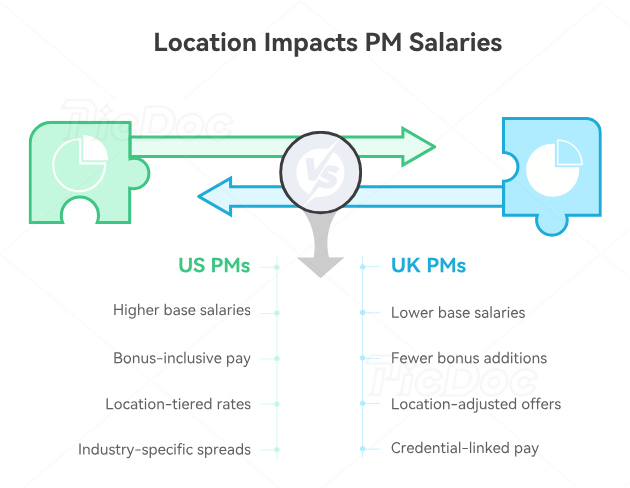
Location remains one of the strongest compensation variables. The 2026 Reddit salary thread includes large gaps between U.S. HCOL markets, LCOL locations, the UK, continental Europe, Singapore, and Australia. The thread itself is heavily U.S.-weighted, which matters when interpreting apparent salary norms. A London construction PM with four years reported £39,000 in a current role and a provisional £58,000 offer, while a U.S. construction PM with four years in Chicago reported $110,000 plus 10%. Anyone comparing locations should use country-specific PM certification guidance, UK-relevant credential strategy, career-market evidence, and experience positioning.
Geography also interacts with industry. A project manager in an LCOL industrial-systems environment reported $125,000 plus 10%, while another LCOL manufacturing PM with a PMP reported $90,000. A VHCOL federal IT senior PM reported $150,000, while a VHCOL senior construction PM reported $250,000 plus allowance and bonus. Those spreads show why comparing “PM salary in my city” provides weak guidance until you layer in technical PM specialization, construction expertise, cybersecurity-related PM skills, and the level of governance responsibility.
International comparisons also require local currency, taxation, healthcare, pension, vacation, employment protection, and purchasing power. The 2026 Reddit thread includes a Singapore senior PM reporting roughly US$100,000 equivalent plus a substantial bonus and family healthcare, an Australian program/senior PM at AU$195,000, and a UK senior PM around £70,000. Someone considering geographic mobility should therefore evaluate international certification portability, country-specific paths such as Germany, France, and Switzerland, alongside salary.
Remote work creates another compensation complication. Some companies pay based on employee location, some use national bands, some preserve headquarters-level compensation, and others adjust offers when employees relocate. A remote job can also trade commuting cost for longer global-team hours. Candidates targeting remote positions should understand collaboration software in remote project teams, how companies choose PM software, 2026 PM software adoption, and the changing project-management job market because remote competition often expands the candidate pool.
Total compensation can turn two apparently similar salaries into very different offers. Compare base salary + target bonus + realistic equity value + employer retirement contributions + healthcare contribution + paid leave + allowances + certification reimbursement + overtime rules + travel burden. A $130,000 government PM role with pension and strong retirement benefits can compete economically with a higher private-sector base. A $145,000 tech position carrying meaningful RSUs may outrun both. This broader lens becomes increasingly important as professionals progress toward program manager positions, senior PM consulting, PM executive leadership, or the longer PM-to-COO pathway.
5. How to Know Whether You Are Underpaid and Build a Stronger Salary Case
Start with a salary evidence stack rather than a single online average. Collect 20 to 30 current vacancies matching your location, industry, seniority, technical specialization, and project scale. Separate required credentials, budget responsibility, team size, remote requirements, travel, and compensation bands. Compare those jobs against the latest BLS and PMI benchmarks and then use 2026 Reddit reports as additional context. This approach resembles the disciplined evidence building required when certified PMs struggle to get interviews, when candidates need stronger portfolio proof, or when assessing PMP financial ROI.
Next, quantify the scope premium you bring. Record the largest budget managed, annual financial impact, savings delivered, revenue enabled, team size, vendors controlled, contract value, sites affected, geographic reach, users impacted, regulatory exposure, executive stakeholder level, and cost of failure. Moving from “managed multiple projects” to “managed a $7.5 million portfolio across four workstreams, six vendors and three countries” gives salary negotiations economic substance. These same proof points strengthen project coordinator promotion cases, program-management readiness, governance leadership, and eventual project-management executive positioning.
Then identify the highest-value gap you can close. A PMP may create leverage when better-paying target jobs repeatedly request it. Technical training may produce more leverage if employers need cloud, ERP, cybersecurity, engineering, healthcare, construction, or financial-services knowledge. Moving into larger-budget projects can create more long-term value than collecting multiple overlapping badges. Compare PMP versus CAPM and PRINCE2, CAPM with limited experience, SAFe career progression, and the agile PM transition path against the actual jobs you want.
For negotiations, set three numbers before the conversation: floor, target, and stretch. The floor is the package below which changing jobs produces insufficient value. The target reflects market evidence for your profile. The stretch incorporates scarce domain knowledge, unusual project scale, competing offers, or highly relevant experience. Negotiate total compensation components individually when the base band is fixed. Bonus guarantees, sign-on payments, equity, retirement contributions, additional PTO, remote days, title, certification reimbursement, travel policy, and review timing all have value. Understanding career-stage PM demand, employer hiring filters, PMO structures, and senior consulting trajectories strengthens that negotiation context.
Finally, track salary growth as a career-design problem. A project manager repeatedly delivering similar $500,000 implementations may eventually hit a compensation ceiling. Moving toward multimillion-dollar programs, regulated environments, portfolio responsibility, strategic transformation, scarce technical sectors, or revenue-linked delivery creates new economic scope. That progression can lead from project manager to program manager, then toward project governance leadership, project-management executive work, and eventually COO-level operating responsibility. Salary usually follows the growing financial consequences of the decisions you are trusted to make.
6. FAQs
-
For the United States, $102,320 is a useful broad median benchmark because that is the latest BLS median for project management specialists. Industry, experience, geography, and scope can move the appropriate figure dramatically. Finance has a BLS median of $120,700, while senior specialized roles frequently exceed $150,000. Compare your profile against the 2026 PM job market, your level of project evidence, your certification stage, and your progression toward senior PM work.
-
PMI's latest survey found PMP holders earning a 17% higher median across 21 countries. In the U.S., PMP respondents reported $135,000, versus $109,157 among respondents without PMP, representing an observed difference of almost 24%. Experience, industry, seniority, and project scale also influence that gap. Candidates should calculate PMP ROI for their own career, compare PMP with alternative credentials, assess real experience versus certification, and examine why certified applicants can still struggle.
-
Current official and self-reported evidence points toward strong ceilings in pharmaceuticals, aerospace, finance, technical infrastructure, technology, medical devices, chemicals, defense, construction, and specialized engineering. PMI reported $150,000 median salaries among U.S. respondents in pharmaceuticals and aerospace, while Reddit examples show specialized technical and construction professionals well above $200,000. Building technical PM capability, construction-management expertise, cost-management knowledge, or cybersecurity-project-management skills can increase access to these sectors.
-
Yes. The 2026 Reddit salary thread includes multiple respondents above $150,000 without PMP certification, including senior technology, medical, defense, and technical-program professionals. Their profiles generally contain substantial experience, domain expertise, management scope, or highly valuable technical backgrounds. Candidates targeting similar compensation should focus on strong project evidence, realistic senior PM career progression, program-management capability, and governance leadership.
-
HCOL and VHCOL markets frequently offer larger nominal salaries, while industry and specialization can outweigh geography. The 2026 Reddit thread includes an LCOL industrial-systems PM earning $125,000 and VHCOL professionals spanning from approximately $150,000 to $250,000 depending on sector and seniority. Compare location alongside remote-team working models, industry demand, specialized PM skills, and portfolio-level career progression.
-
A company change can create a larger repricing opportunity when your responsibilities have outgrown your internal salary band. First determine whether external vacancies value your exact combination of industry expertise, project scale, certifications, tools, and stakeholder level. Strengthen your case through portfolio evidence that gets interviews, understand what employers actually screen for, evaluate the PMP salary case, and compare your current responsibilities with the next rung on the PM promotion pathway.
