
Career Roadmap for Senior Project Management Consultant Roles
Senior project management consultants are hired when an organization needs more than schedule control. Clients expect them to diagnose delivery failures, challenge weak governance, improve portfolio decisions, strengthen executive reporting, and leave behind systems that internal teams can sustain. Building this career therefore requires command of project execution, portfolio management, stakeholder engagement, and project financial management. This roadmap explains how to acquire consulting-grade skills, create credible proof, select profitable specializations, and progress toward senior advisory roles.
1. Understand What Senior Project Management Consultants Are Paid to Solve
A senior project management consultant is usually engaged because the client’s existing delivery system is underperforming. Projects may be missing deadlines, governance forums may be producing discussion instead of decisions, resource demand may exceed capacity, or executives may lack a trustworthy view of portfolio exposure. The consultant must identify the operating causes behind those symptoms using monitoring and control methods, risk-register discipline, business-analysis techniques, and executive reporting practices.
This creates a different standard from internal project management. An internal PM can succeed by delivering assigned outcomes inside established policies. A consultant must evaluate whether those policies, decision rights, controls, tools, and reporting structures are contributing to failure. That demands fluency in project governance, PMO operating models, requirements engineering, and conflict resolution. Your recommendations must address the system generating the problem rather than treating each delayed milestone as an isolated event.
Clients also expect speed. A consultant may have several weeks to understand a portfolio that internal leaders have managed for years. Effective consultants shorten the learning curve through structured discovery: executive interviews, artifact reviews, process mapping, data validation, governance observation, and targeted frontline conversations. Knowledge of stakeholder terminology, project reporting controls, risk-response planning, and requirements traceability helps you distinguish evidence from opinion before recommending structural changes.
The commercial expectation is equally demanding. Senior consultants must explain how delivery problems affect revenue, cash, cost, compliance, customer commitments, and strategic capacity. A late project only becomes an executive-level concern when its business consequences are clear. Build the ability to connect earned value management, project financial terminology, cost-control expertise, and resource allocation to margin erosion, delayed benefits, working-capital pressure, and lost operational capacity.
Senior consultants also manage political risk. A technically correct recommendation may still fail when it threatens a leader’s authority, exposes weak sponsorship, or reallocates resources between competing departments. You need to understand incentives, influence, executive sensitivities, and the history behind current decisions. The strongest consultants use leadership communication, stakeholder mapping, conflict-resolution frameworks, and governance best practices to make difficult truths actionable without creating avoidable resistance.
Your value continues after the diagnosis. Clients pay senior consultants to design practical controls, facilitate executive decisions, transfer capability, and establish measurable improvements. A final slide deck carries limited value when the client cannot operate the proposed system. Consulting maturity appears in your ability to create usable project templates, select appropriate project management software, strengthen team communication, and define governance routines that survive after the engagement ends.
| Consulting Capability | What Strong Performance Looks Like | Proof to Build | Common Client Pain Point | Primary Stakeholders |
|---|---|---|---|---|
| Diagnostic analysis | Separates symptoms from root causes through evidence, interviews, workflow analysis, and data validation. | Diagnostic report linking problems to business impact and corrective priorities. | Leaders disagree about why delivery is failing. | Executives, PMO, functional heads. |
| Governance design | Defines decision rights, approval thresholds, escalation routes, and meeting purposes. | Governance map, committee charter, decision calendar. | Issues circulate for weeks without resolution. | Executive sponsors, PMO, board committees. |
| Portfolio prioritization | Ranks initiatives through strategic value, risk, capacity, cost, and dependency criteria. | Portfolio scorecard with pause, continue, and stop recommendations. | Every initiative is labeled urgent. | CEO, CFO, strategy leaders. |
| Financial fluency | Connects project decisions to cash, margin, forecast accuracy, benefits, and investment return. | Business case, financial sensitivity model, benefits forecast. | Delivery reporting lacks commercial context. | CFO, finance partners, sponsors. |
| Performance measurement | Builds metrics that expose forecast reliability, cost pressure, schedule health, and benefit progress. | Executive dashboard with leading and lagging indicators. | Status reports remain green until failure becomes unavoidable. | PMO, finance, program directors. |
| Risk diagnosis | Identifies systemic, portfolio, operational, supplier, and compliance exposure. | Risk heat map with ownership and quantified consequences. | Risk registers contain vague statements and weak actions. | Audit, legal, sponsors, PMO. |
| Risk response | Designs preventive controls, contingencies, triggers, and recovery actions. | Mitigation plan with dates, owners, costs, and escalation triggers. | Risks are recorded without funded responses. | Executives, operations, compliance. |
| Requirements control | Creates traceability, baseline discipline, acceptance criteria, and change authority. | Requirements framework and traceability matrix. | Scope expands through informal requests. | Product owners, legal, business sponsors. |
| Procurement advisory | Improves sourcing strategy, evaluation logic, scope clarity, and vendor accountability. | RFP pack, evaluation model, commercial-risk checklist. | Poorly defined contracts create costly disputes. | Procurement, legal, finance. |
| Vendor governance | Defines service levels, review cadence, corrective actions, incentives, and exit conditions. | Supplier scorecard and quarterly review process. | Vendors miss commitments without consequences. | Procurement, technology, operations. |
| Resource planning | Matches demand with capacity, capability, sequencing, and priority. | Capacity model, role heat map, resource-allocation rules. | Critical specialists are assigned across too many initiatives. | HR, PMO, department heads. |
| Workforce modeling | Evaluates employees, contractors, outsourcing, skills gaps, and demand variability. | Workforce scenario model and capability plan. | Hiring decisions occur after delivery pressure peaks. | HR, finance, operations. |
| Delivery recovery | Stabilizes distressed programs through scope, schedule, leadership, risk, and decision interventions. | Recovery plan with critical-path and governance resets. | Major program is approaching contractual or public failure. | Sponsors, customers, program teams. |
| Control design | Creates proportionate controls that improve visibility without burying teams in administration. | Control framework with thresholds and exception routes. | Reporting consumes time while providing weak insight. | PMO, audit, project leaders. |
| Executive reporting | Converts complex delivery data into exposure, choices, and recommended decisions. | One-page executive report and decision memo. | Leadership receives detail without clear action. | CEO, board, executive sponsors. |
| Stakeholder strategy | Maps influence, incentives, resistance, communication needs, and commitment levels. | Stakeholder strategy tied to decisions and adoption. | Technically sound changes face political resistance. | Executives, users, customers, regulators. |
| Conflict facilitation | Surfaces competing priorities and creates decision-ready trade-offs. | Facilitated resolution with ownership and documented commitments. | Departments protect local targets at enterprise expense. | Functional leaders, HR, sponsors. |
| Methodology tailoring | Selects delivery controls according to uncertainty, compliance, complexity, and customer needs. | Hybrid delivery framework with clear application criteria. | One methodology is imposed across incompatible work. | PMO, technology, product, compliance. |
| Agile transformation | Improves feedback, prioritization, ownership, flow, and customer learning. | Agile operating model with measurable adoption indicators. | Teams perform ceremonies without improving delivery. | Product, technology, customers. |
| Predictive delivery | Strengthens sequencing, approvals, documentation, baselines, and contractual control. | Stage-gate framework and baseline-control process. | Regulated or capital work lacks disciplined approvals. | Engineering, construction, legal, finance. |
| Quality improvement | Reduces defects through prevention, root-cause correction, standardization, and learning. | Quality-control plan with defect and rework metrics. | Teams repeatedly fix the same failures. | Operations, quality, customers. |
| Compliance integration | Translates standards into ownership, controls, evidence, and audit readiness. | Compliance matrix and evidence-management process. | Project controls are disconnected from regulatory duties. | Compliance, audit, legal, security. |
| Technology advisory | Assesses platforms through business need, integration, governance, adoption, and lifecycle cost. | Tool-selection framework and implementation roadmap. | Software is purchased before operating requirements are clear. | CIO, CTO, PMO, finance. |
| Integration planning | Maps data flows, interfaces, ownership, dependencies, and support requirements. | Integration architecture and dependency register. | Disconnected platforms create manual reconciliation. | Technology, data, operations. |
| AI opportunity assessment | Prioritizes AI use cases through value, data readiness, control, reliability, and adoption. | AI use-case portfolio with risk and value scoring. | Executives pursue AI without a credible operating case. | Technology, legal, data, operations. |
| ESG integration | Embeds sustainability requirements into governance, sourcing, metrics, and reporting. | ESG project-control framework and supplier criteria. | Public commitments lack operational ownership. | Board, procurement, legal, investors. |
| Capability transfer | Develops internal leaders, coaches teams, documents practices, and reduces client dependence. | Training materials, coaching plan, ownership handover. | Improvements disappear after consultants leave. | PMO, HR, project leaders. |
| Executive advisory | Frames ambiguous problems, tests assumptions, presents options, and challenges decisions constructively. | Board-ready recommendation with scenario analysis. | Senior leaders lack an independent delivery perspective. | CEO, COO, CFO, board. |
2. Build the Technical, Commercial, and Advisory Skills Required at Senior Level
The first skill cluster is diagnostic thinking. Clients rarely describe their core problem accurately in the first meeting. A request for a new PMO may actually reflect weak executive sponsorship, confused decision rights, uncontrolled demand, or unreliable reporting. Use business-analysis methods, requirements-engineering practices, risk-register analysis, and monitoring frameworks to construct an evidence chain from observed symptoms to operating causes.
A strong diagnosis should quantify the consequence of each weakness. Poor change control may create rework, contractual exposure, schedule extensions, and benefit delays. Weak resource planning may reduce utilization, increase contractor spending, and slow strategic work. Convert observations into financial and operational implications through project financial management, earned value analysis, resource-allocation principles, and cost-professional techniques. This makes your recommendation relevant to executives who control funding.
The second skill cluster is operating-model design. Senior consultants should be able to define how projects enter the portfolio, how priorities are approved, how resources are assigned, how risks escalate, and how benefits transfer into operations. Study future PMO models, portfolio-management trends, project-governance practices, and project closure concepts. Your designs should specify ownership, inputs, outputs, thresholds, service levels, decision rights, and performance measures.
Methodology fluency is equally important. Clients may need Agile product delivery, predictive capital-project controls, or a hybrid structure that combines iterative development with regulated approvals. Develop command of the Agile project management glossary, Scrum terminology, Waterfall project management, and hybrid project delivery. Seniority appears in your ability to tailor controls to the work instead of enforcing a preferred framework everywhere.
The third cluster is executive communication. Senior consultants frequently present unwelcome findings: the portfolio is unaffordable, sponsorship is weak, the deadline lacks evidence, or a strategic program should be stopped. Your recommendation must be concise, defensible, and politically aware. Strengthen this capability through leadership communication terms, stakeholder-engagement frameworks, conflict-resolution tools, and executive reporting practices. Lead with the decision required, explain the evidence, outline the consequences, and present realistic options.
The fourth cluster is commercial consulting judgment. You should understand statements of work, assumptions, exclusions, change requests, utilization, margin, delivery risk, and account expansion. Scope ambiguity can destroy both client trust and consulting profitability. Build procurement fluency through RFP, RFQ, and RFI concepts, vendor-management terminology, project financial controls, and risk-response planning. Document deliverables, acceptance criteria, client dependencies, decision deadlines, and out-of-scope conditions before work begins.
Technology literacy has become another core requirement. Clients expect senior consultants to understand how AI, automation, cloud systems, integrations, and data quality affect project delivery. Build informed judgment through AI innovation in project management, automation’s career impact, project software evolution, and project management integrations. Focus on business value, process ownership, control design, adoption, support cost, and data governance.
3. Create a Consulting Portfolio That Proves You Can Improve Client Outcomes
Your portfolio should contain evidence of diagnosis, intervention, and sustained result. A conventional PM resume often emphasizes project size, delivery dates, and methodologies used. Senior consulting evidence must also show what you discovered, which executive decisions you influenced, how the operating model changed, and what measurable improvement followed. Frame case studies using project execution principles, governance controls, financial-management measures, and benefits-realization logic.
Build at least five detailed case studies. Include one distressed-project recovery, one governance or PMO redesign, one portfolio-prioritization engagement, one technology or process transformation, and one stakeholder-intensive assignment. Each case should state the starting condition, business exposure, diagnostic method, recommendation, implementation approach, resistance encountered, and verified result. Draw supporting language from risk mitigation, portfolio management, stakeholder engagement, and conflict resolution.
Quantification should extend beyond schedule performance. Useful outcomes include forecast accuracy improved, governance cycle time reduced, low-value initiatives stopped, resource conflicts resolved, contractor spending controlled, benefits recovered, defects reduced, or executive decisions accelerated. Strengthen your measurement approach through Agile metrics, earned value terminology, quality-management concepts, and project reporting standards. Record baseline, target, actual result, measurement period, and data source.
Create reusable intellectual property from your experience. This may include a PMO maturity assessment, portfolio-scoring model, project-health diagnostic, governance-design checklist, recovery-plan template, or executive-reporting framework. Use project management templates, risk-register guidance, requirements-engineering practices, and monitoring terminology to make each asset methodical. Reusable tools improve delivery consistency and help prospective clients understand how you work.
Protect confidentiality when preparing public materials. Remove client names, commercially sensitive values, personal identifiers, and proprietary process details. Preserve the complexity and outcome by using ranges, percentages, generalized sectors, or anonymized descriptions. Your portfolio can still demonstrate experience in construction project management, financial-services transformation, renewable-energy projects, or sustainability programs without exposing protected information.
What Is Blocking Your Move Into Senior PM Consulting?
4. Follow a Deliberate 24-to-36-Month Roadmap Into Senior Consulting
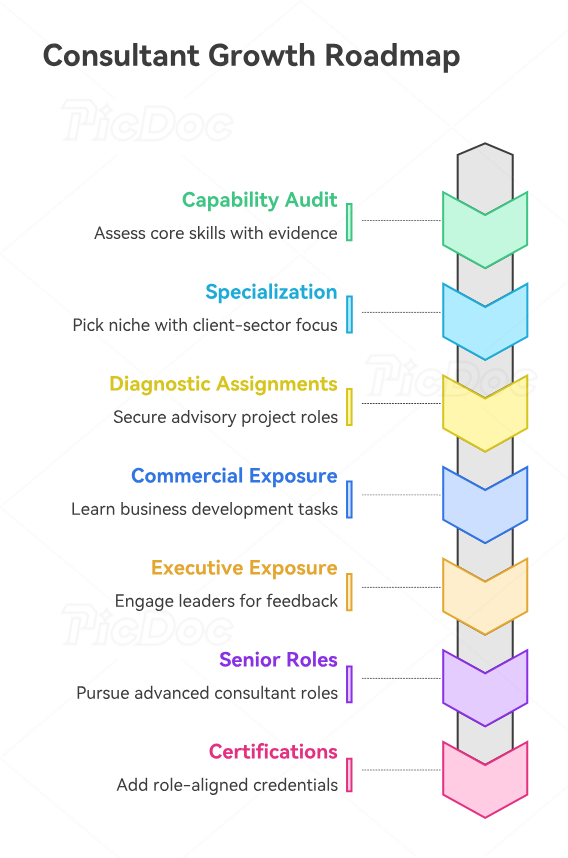
During months one through six, perform a capability audit against the work senior consultants actually deliver. Score yourself across diagnosis, governance, portfolio management, financial analysis, executive communication, commercial management, facilitation, technology, and industry expertise. Require evidence for every rating. Use future project-manager competencies, leadership terminology, project governance trends, and portfolio-management practices to define the standard required.
Choose a specialization during the same period. A credible specialization combines a client problem, a delivery capability, and a sector context. Examples include distressed-program recovery in construction, PMO transformation in healthcare, Agile portfolio governance in financial services, or technology-integration leadership in education. Explore construction PM software, educational project platforms, financial-services project trends, and digital PMO transformation to identify areas where your experience can command stronger credibility.
During months six through twelve, secure assignments that require diagnosis and advisory work. Volunteer to assess project health, redesign governance, facilitate portfolio prioritization, improve executive reporting, or lead a recovery review. Apply risk-register techniques, monitoring and control methods, stakeholder-engagement frameworks, and conflict-resolution practices. Request permission to document anonymized results for your portfolio.
During months twelve through eighteen, build commercial exposure. Participate in proposal writing, discovery calls, effort estimation, client presentations, scope negotiation, and change-request discussions. Learn how consulting firms calculate utilization, delivery margin, sales pipeline, and account value. Strengthen your foundation through RFP and RFQ terminology, vendor-management concepts, cost-professional preparation, and project financial management. Senior consulting roles combine delivery excellence with commercial responsibility.
During months eighteen through twenty-four, increase executive exposure. Present portfolio recommendations, facilitate sponsor decisions, lead steering-committee resets, and communicate recovery options. Ask senior leaders for feedback on your clarity, judgment, challenge style, and business framing. Refine your approach using executive reporting practices, leadership communication, future PM leadership approaches, and stakeholder-management principles. Your goal is to become trusted for judgment rather than known only for coordination.
By months twenty-four through thirty-six, pursue senior consultant, managing consultant, principal consultant, or independent advisory assignments. Evaluate opportunities through client access, project complexity, commercial ownership, intellectual-property development, and sector relevance. A title upgrade has limited value when the work remains administrative. Seek roles that involve enterprise portfolio decisions, PMO transformation, AI-enabled delivery change, and complex governance design.
Certifications should support the roadmap at the point where they close a specific credibility gap. PMP maintenance can preserve senior delivery credibility. PMI-PBA preparation can strengthen diagnostic work. CCP certification preparation can deepen commercial and cost expertise. A comparison of Agile certifications can guide specialization in adaptive delivery. Pair each credential with an assignment that demonstrates applied capability.
5. Position, Price, and Win Work as a Senior PM Consultant
Your professional positioning should communicate the client problem you solve, the setting in which you solve it, and the outcome you create. “Experienced project management consultant” gives buyers little reason to remember you. “I help regulated organizations recover high-risk transformation programs by repairing governance, forecasting, and executive decision-making” is more useful. Build your message around risk-response capability, governance expertise, financial control, and executive reporting.
Your resume should read like a portfolio of business interventions. Lead each role with scale: portfolio value, budget influenced, functions involved, regions covered, users affected, or suppliers managed. Then show diagnosis, executive action, and measurable outcome. Use language grounded in portfolio prioritization, resource allocation, quality improvement, and benefits realization. Remove generic statements about attending meetings, updating plans, and coordinating stakeholders.
Pricing should reflect risk, complexity, scarcity, and value. Day rates remain common, though fixed-fee diagnostics, milestone-based engagements, retainers, and outcome-linked components may fit certain services. Define the deliverables, assumptions, client responsibilities, review limits, acceptance conditions, and change process before selecting a fee. Knowledge of procurement terminology, vendor management, cost control, and risk mitigation protects your commercial position.
Discovery calls should uncover urgency, authority, financial exposure, previous attempts, organizational constraints, and decision timing. Ask what is happening, how long it has persisted, who is affected, what the current failure costs, and what would make leadership act. Apply business-analysis questioning, stakeholder mapping, requirements control, and risk-register thinking. Avoid proposing a solution before you understand the decision environment.
A strong proposal explains the client’s condition in their own business language, defines the engagement outcome, presents the work approach, clarifies deliverables, identifies dependencies, and establishes governance. Include how knowledge will transfer to internal teams. Use project templates, reporting practices, project closure concepts, and leadership communication to make the engagement easy to approve and manage.
Long-term career growth depends on repeatability and referrals. After every engagement, record the client problem, results, reusable methods, lessons, and follow-on needs. Request testimonials that describe business outcomes and advisory value. Build relationships with former clients, consulting partners, technology providers, recruiters, and sector specialists. Thought leadership on future PM methodologies, AI adoption, digital transformation, and future project leadership can reinforce your specialization when it includes practical insight.
6. Frequently Asked Questions
-
Many senior consulting positions expect substantial project leadership experience, though years alone provide weak evidence of readiness. Hiring firms look for increasing complexity, executive exposure, commercial judgment, and successful interventions across multiple environments. A candidate with eight years of repetitive coordination may be less prepared than someone with six years spanning recovery work, governance redesign, and portfolio decisions. Build proof through project execution, portfolio management, financial management, and stakeholder engagement. Your experience should demonstrate that senior leaders trusted you with ambiguous, politically sensitive, and commercially significant problems.
-
The right certification depends on the consulting problem you intend to solve. PMP can support broad delivery credibility, while PMI-PBA strengthens requirements and diagnosis. CCP may help consultants working with cost-intensive programs, and Agile credentials can support transformation or product-delivery work. Review PMP renewal requirements, PMI-PBA preparation, CCP certification guidance, and Agile certification comparisons. Certifications improve your market position when they reinforce an existing specialization and accompany measurable consulting results.
-
A senior project manager usually owns delivery within one organization’s established system. A senior PM consultant evaluates that system, identifies structural weaknesses, recommends changes, and often supports implementation across different clients. Consulting work requires faster diagnosis, greater independence, stronger commercial awareness, and confidence when challenging executive assumptions. Develop these capabilities through business analysis, governance design, executive reporting, and conflict resolution. Consulting success is measured by the client’s improved capability and business result as well as the immediate project outcome.
-
Agile project managers can progress into senior consulting when they expand beyond ceremonies and team-level delivery. Clients need consultants who can connect adaptive working practices to portfolio funding, governance, operating models, customer value, compliance, and executive decision-making. Strengthen your foundation through the Agile project management glossary, Scrum terminology, Agile metrics, and hybrid project management. Build case studies showing shorter feedback cycles, better prioritization, improved flow, stronger adoption, and measurable business value.
-
The strongest specialization sits at the intersection of significant client pain, available budgets, scarce expertise, and your credible experience. Promising areas include enterprise PMO transformation, distressed-program recovery, AI-enabled delivery improvement, portfolio optimization, regulatory project governance, and capital-project controls. Explore future PMO trends, AI in project management, construction project trends, and financial-services transformation. Choose a field where you can build deep evidence and understand the client’s economics, risks, regulations, and operating language.
-
Treat internal assignments as advisory engagements. Diagnose a delivery problem, define the business impact, interview stakeholders, present options, recommend a course of action, and measure the result. Volunteer for project-health assessments, governance redesigns, PMO maturity reviews, portfolio-prioritization exercises, and recovery planning. Apply risk-register methods, project monitoring, stakeholder-engagement practices, and executive reporting. Document each assignment as an anonymized consulting case study showing diagnosis, intervention, decision influence, and sustained outcome.
