
IT Project Management vs Construction Project Management: Reddit Experiences on Pay, Entry Barriers, Stress & Stability
IT and construction project managers can both own budgets, schedules, stakeholders, vendors, risks, and delivery, yet the careers feel radically different in practice. Construction adds physical sequencing, subcontractors, inspections, safety exposure, procurement lead times, and jobsite constraints. IT adds technical ambiguity, shifting requirements, releases, integrations, cybersecurity, and continuous technology change. For professionals assessing whether project management is still worth it, comparing certification with real experience, considering an IT-to-PM career move, or exploring construction management credentials, the better path depends on much more than salary.
1. IT Project Management vs Construction Project Management: The Same PM Core, Very Different Operating Reality
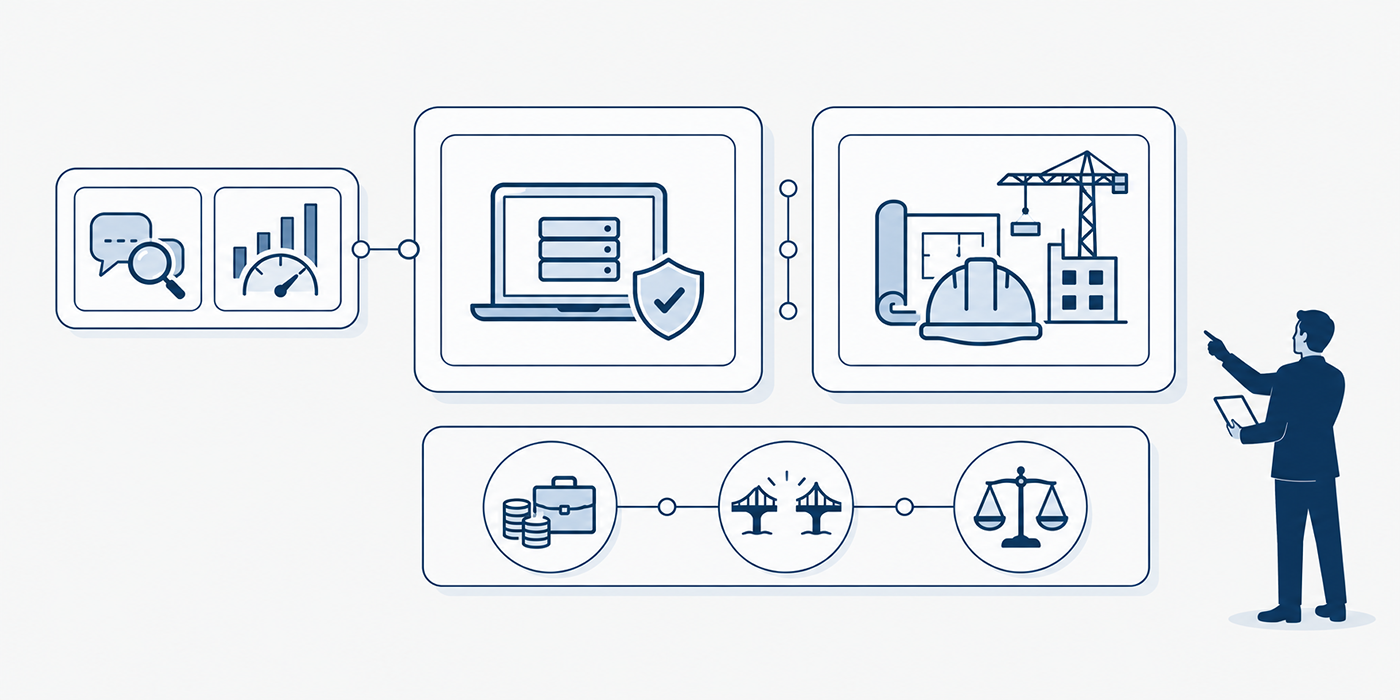
Both careers require planning, stakeholder management, forecasting, risk control, communication, and decision-making. That shared foundation explains why project-management certifications, PMP career value, earned-value knowledge, and strong project-governance skills can travel between industries. The crucial difference is what the PM is coordinating and how expensive errors become once work moves forward.
Construction PMs operate against physical irreversibility. Concrete gets poured, steel gets fabricated, trades mobilize, equipment arrives, inspections happen, and rework can consume real material, labor, access, and schedule. You therefore need enough construction knowledge to anticipate sequencing conflicts before they become field problems. A Reddit discussion about moving from IT into construction captured this well: one construction PM argued that a newcomer does not need mastery of every trade, but must understand construction phases well enough to detect problems before substantial work, material, or time is wasted. That makes construction-management preparation, cost-management expertise, earned-value capability, and genuine PM delivery experience particularly important.
IT PMs operate against technical and requirements uncertainty. A dependency can exist inside an API, infrastructure environment, data migration, vendor product, security control, or undocumented legacy system. The output is less physically visible, yet the coordination challenge can be equally severe. Requirements can change rapidly, software teams may use different development models, and one integration assumption can destabilize several workstreams. This makes IT-to-project-management skills, business-analysis capability, Agile project-management experience, and an understanding of cybersecurity in project management highly valuable.
The salary comparison also needs discipline. The U.S. Bureau of Labor Statistics reports a May 2025 median annual wage of $114,990 for construction managers, with the highest 10% above $189,440. For project management specialists, a broad category encompassing many corporate project roles, the median was $102,320, with the highest 10% above $167,970. BLS projects construction-manager employment to grow about 9% from 2025 to 2035, versus roughly 6.7% for project-management specialists. Those figures provide a useful baseline for people comparing PM career prospects, senior PM careers, program-management progression, and longer-term project-management executive paths.
Those BLS numbers should not be interpreted as “construction always pays more than IT.” IT project management does not map neatly onto one federal occupational category. Compensation differs dramatically across healthcare IT, finance, cloud, ERP, cybersecurity, consulting, government, SaaS, infrastructure, and internal enterprise technology. A senior technology PM can materially out-earn either occupational median, while a junior IT coordinator can sit far below it. The same dispersion exists across residential construction, commercial general contracting, data centers, heavy civil, owners' representation, specialty contracting, and megaprojects. That makes career-stage certification choices, real-world PM evidence, industry specialization, and cost-control competence more useful than comparing two job titles.
| Career Factor | IT Project Management | Construction Project Management | Career Implication | What to Investigate Before Choosing |
|---|---|---|---|---|
| Primary deliverable | Systems, software, infrastructure, integrations, transformation | Physical buildings, infrastructure and installed systems | Determines the domain knowledge you must build | Which outputs genuinely interest you long term? |
| Typical uncertainty | Requirements, architecture, integrations, technical discovery | Site conditions, procurement, field coordination, constructability | Stress comes from different unknowns | Which uncertainty type do you handle better? |
| Change cost | Can range from small backlog change to major rearchitecture | Can trigger demolition, rework, claims and remobilization | Construction often punishes late discovery physically | How strong are the organization's change controls? |
| Work location | Remote, hybrid or office depending on employer | Office plus substantial site presence in many roles | Major lifestyle difference | How frequently must the PM be on site? |
| Remote potential | Often materially higher | Limited for contractor-side field-heavy positions | IT can offer geographic flexibility | Is remote work contractually supported? |
| Schedule logic | Technical dependencies, releases, environments and approvals | Physical sequencing, trades, inspections and material lead times | Both require dependency thinking | Which scheduling tools and methods are used? |
| Budget exposure | Labor, software, vendors, cloud, licenses, consultants | Labor, materials, equipment, subcontracts, change orders | Construction PMs often work closer to detailed cost control | Will you own forecast and cost-to-complete? |
| Vendor management | SaaS, implementation partners, MSPs, consultants | Subcontractors, suppliers, designers and consultants | Commercial leverage differs significantly | Who owns contract enforcement? |
| Technical fluency | SDLC, systems, integrations, infrastructure or relevant domain | Drawings, specifications, trades, sequencing and field conditions | Generic PM knowledge alone has limits | What level of technical knowledge does hiring require? |
| Safety exposure | Usually information, operational and cyber risk | Physical safety can be directly consequential | Construction carries another layer of responsibility | How is safety accountability structured? |
| Quality control | Testing, UAT, code quality, performance, acceptance | Inspections, installation quality, punch lists, commissioning | Quality failures manifest differently | Who owns acceptance criteria? |
| Procurement risk | Licensing, hardware, vendor capacity, procurement approvals | Long-lead equipment, steel, electrical gear, specialty materials | Construction procurement can dominate the critical path | Which items have the longest lead times? |
| Weather exposure | Minimal for most projects | Can directly affect productivity and schedule | Adds uncontrollable planning variance | How are weather allowances handled? |
| Stakeholder type | Executives, users, engineers, security, product, vendors | Owners, architects, engineers, inspectors, trades, authorities | Both require political fluency | Who can stop or materially change the project? |
| Meetings | Often numerous and digitally distributed | Office meetings plus site coordination and field walks | Meeting load can burn out both groups | How much time is protected for actual control work? |
| Firefighting | Production incidents, defects, missed integrations, release failures | Trade conflicts, missing material, field errors, inspection failures | Both careers can become reactive in weak companies | Are root causes actually fixed? |
| Entry barrier | Often demands credible technical or industry context | Often demands construction-specific knowledge and field credibility | Construction is typically harder to bluff into | What does the employer expect on day one? |
| Typical degree signal | IT, business, engineering or varied backgrounds | Construction management, civil engineering or related backgrounds common | Construction education can carry stronger domain signaling | Does experience substitute for education? |
| Useful certifications | PMP, Agile-related credentials, technology-specific learning | PMP, CCM and relevant industry credentials | Credential value depends on existing experience | Which credentials appear repeatedly in target jobs? |
| Core software | Jira, Azure DevOps, ServiceNow, MS Project and similar systems | P6, Procore, Bluebeam and construction-specific systems | Tool fluency can shorten transition time | Which systems dominate your target sector? |
| Contract intensity | Varies heavily by project and employer | Often central to daily project decisions | Construction PMs need stronger contract instincts | Will you manage claims, variations and pay applications? |
| Documentation | Requirements, RAID, plans, decisions, tickets, releases | RFIs, submittals, change orders, drawings, claims, inspections | Both punish poor documentation | What records become contractual evidence? |
| Salary upside | Strong in finance, consulting, cloud, security and large tech environments | Strong in commercial, heavy civil, data centers and major projects | Sector matters more than title alone | Compare total compensation, not base only |
| Bonus structure | Cash bonus, equity or none depending on company | Bonus, ESOP, vehicle, per diem or project incentives can matter | Total package can distort base-salary comparisons | What is guaranteed versus discretionary? |
| Hours risk | Can spike around releases, incidents and transformations | Can be consistently long on contractor-side active projects | Employer model matters enormously | Ask actual weekly hours, not official hours |
| Travel | Low to high depending on consulting and implementation | Can require relocation, project travel or jobsite commuting | Construction opportunity may require geographic mobility | Who pays housing, mileage and per diem? |
| Layoff exposure | Budgets, reorganizations and cancelled transformation work can affect roles | Project pipeline, financing and construction cycles affect demand | Neither career is recession-proof | How diversified is the employer's pipeline? |
| Industry switching | Possible but recruiters often demand domain fluency | Possible but field knowledge creates a meaningful barrier | PM skills transfer more easily than credibility | Which adjacent sector preserves your experience? |
| Career ceiling | Senior PM, program manager, portfolio leader, technology leadership | Senior PM, project executive, operations, owners rep, construction executive | Both have strong leadership ladders | Which executive path attracts you? |
| Best fit | Enjoys technology, abstraction, change and cross-functional knowledge work | Enjoys tangible delivery, field problems, contracts and operational coordination | Lifestyle fit can outweigh a modest pay difference | Which bad day would you rather have? |
2. Pay and Stability: Construction Has Strong Numbers, While IT Has a Wider Compensation Spectrum
Construction's current U.S. labor-market numbers are strong. BLS reports a 2025 median salary of $114,990 for construction managers, with approximately 49,700 openings per year projected on average through 2035. Large construction firms may prefer candidates combining a relevant bachelor's degree with actual construction experience, and the occupation is projected to grow faster than the overall labor market. That creates a compelling case for people evaluating construction-management certification, building cost-management expertise, strengthening earned-value knowledge, or comparing the field with the broader 2026 PM job market.
Reddit's 2026 PM salary thread demonstrates how messy real compensation becomes. One construction PM with four years of post-graduation experience reported a $110,000 base plus a 10% bonus. Another construction PM with ten years across APM and PM work reported $132,000 plus a 5–7% bonus. In the same thread, an IT PM in finance reported $140,000 plus a 15% bonus, while a healthcare IT PM reported $83,000 and an MSP IT PM reported $61,000. Those are self-reported individual examples rather than market benchmarks, but they illustrate why “IT PM salary” is an enormous category. Anyone comparing paths should assess PMP salary leverage, employer screening criteria, certification versus experience, and the wider future of PM certifications.
Construction can also hide substantial compensation outside base salary. Per diem, overtime, truck allowances, housing, ESOP participation, bonuses, travel allowances, and project incentives can materially alter the package. A 2026 Reddit poster working as a construction PM on a data-center project reported a workload of 56 hours per week alongside significant overtime and per-diem income. That package may look exceptional financially while carrying a lifestyle cost that matters to someone prioritizing career sustainability, future program-management progression, executive PM development, or a transition toward senior PM consulting.
IT can offer a different form of economic leverage: access to industries with high margins and broader geographic hiring. Finance, enterprise software, cybersecurity, cloud, healthcare IT, consulting, data, and large-scale transformation can produce substantial PM compensation. Remote or hybrid arrangements can also change the effective value of the package by reducing commuting and relocation pressure. Professionals entering this market still need credible IT project-management experience, knowledge of cybersecurity-project trends, familiarity with modern project-management software, and increasingly strong remote-collaboration skills.
Stability requires another distinction: occupational demand versus employer stability. Construction can have strong long-run labor demand while an individual contractor experiences a weak backlog, cash-flow problems, financing delays, or geographic concentration. One 2026 civil-construction PM described a company deteriorating from a previously strong environment into delayed payroll, supplier holds, restructuring, resource shortages, and strained client relationships. Career stability therefore depends on employer health as well as the strength of project-management demand, good project governance, appropriate PMO effectiveness, and sound cost-management controls.
IT stability has a parallel problem. Transformation budgets can disappear, reorganizations can remove entire PMOs, products can be cancelled, consulting demand can fall, and automation can change administrative work. Professionals protect themselves by moving higher up the value chain toward program management, stronger project governance, deeper cybersecurity knowledge, and demonstrable real-world delivery evidence. Stability comes from being useful in difficult environments, rather than simply carrying a PM title.
3. Entry Barriers and Stress Are Higher in Different Places
Construction has a particularly visible domain-credibility barrier. A PM needs to understand how drawings, specifications, RFIs, submittals, procurement, schedules, inspections, contracts, change orders, payment applications, field coordination, and trade sequencing interact. BLS says construction managers typically need a bachelor's degree, and large firms may prefer candidates who combine construction-related education with industry experience. Someone coming from technology should therefore treat the move as a genuine domain transition rather than assuming PMP certification, a general PM credential comparison, project-management experience, or construction-manager certification alone will erase the knowledge gap.
Reddit consistently reflects that barrier. In one discussion, an IT PM considering construction was warned that the transition was substantial, highly stressful, commonly site-based, and involved juggling many moving pieces. A newer 2026 thread from an IT graduate considering construction similarly focused on whether CAPM, Primavera P6, Procore, and a coordinator role would be enough to establish credibility. That instinct is directionally useful: combine entry-level PM knowledge, real experience, construction-management preparation, and relevant cost-management capability instead of collecting credentials without field context.
IT has its own gatekeeping mechanism. Recruiters may expect familiarity with SDLC concepts, Agile or hybrid delivery, infrastructure, cloud, ERP, data, cybersecurity, implementation, product teams, or whichever technical environment surrounds the role. A construction PM attempting to move into corporate technology can possess exceptional scheduling, budgeting, contracting, risk, and stakeholder skills and still face rejection because employers want evidence of technology delivery. A Reddit construction PM described applying to corporate and IT roles even after obtaining PMP and finding that recruiters continued to emphasize technical experience. This is why IT-to-PM transition guidance, Agile-career development, business-analysis capability, and cybersecurity-project knowledge can matter more than another generic credential.
The stress profiles are also different. Construction stress tends to be immediate and operational. A missing subcontractor, failed inspection, incorrect installation, damaged material, delayed equipment delivery, site-access issue, safety event, weather disruption, or owner-directed change can affect today's work. Corrective action may involve multiple companies, crews, contractual positions, and physical dependencies. A construction PM who cannot resolve the issue can lose days while project overhead continues accumulating. That makes earned-value competence, cost-management knowledge, good project governance, and mature PM leadership operationally valuable.
IT stress is frequently ambiguity-heavy and cognitive. Requirements shift, business teams and engineers interpret scope differently, multiple environments behave differently, dependencies emerge late, cybersecurity creates additional gates, vendors control critical capabilities, and executives may still expect a fixed date. Remote work can eliminate commuting while increasing meeting density, digital interruptions, and cross-time-zone availability. Strong collaboration practices, effective project-management tools, deeper cybersecurity understanding, and Agile-delivery competence become practical workload controls.
Construction work-life balance also changes dramatically by employer model. In a September 2026 Reddit discussion, one construction PM said work-life balance improved significantly after moving from a general contractor to an owner's-representative role, while others described burnout on large, complex projects. That is a crucial career lesson. Comparing project-management career paths, senior consulting routes, program-management progression, and executive PM careers requires evaluating the operating model, not merely the industry label.
4. The Day-to-Day Reality: One PM Coordinates Digital Complexity, the Other Coordinates Physical Consequences
An IT PM's day may include sprint or delivery meetings, dependency reviews, architecture conversations, vendor calls, backlog discussions, release readiness, security reviews, UAT coordination, executive reporting, and escalation management. The exact mix depends on whether the role sits in software development, infrastructure, ERP, cybersecurity, healthcare systems, financial technology, or transformation. Learning how organizations select project-management tools, how teams use collaboration software, how cybersecurity affects PM work, and how professionals progress through Agile project management helps explain why “IT PM” encompasses so many different jobs.
A construction PM may start much earlier. Site coordination, superintendent conversations, subcontractor issues, RFIs, submittals, change orders, procurement, pay applications, owner meetings, inspections, schedule reviews, forecasting, safety concerns, and field walks can all compete for attention. One Reddit construction PM described end-to-end infrastructure delivery involving designer risk discussions, sponsor expectations, stage-gate roadblocks, contractor progress, RFIs, variations, and payment claims. That combination explains the importance of construction-management expertise, earned-value controls, cost-professional knowledge, and strong project-governance capability.
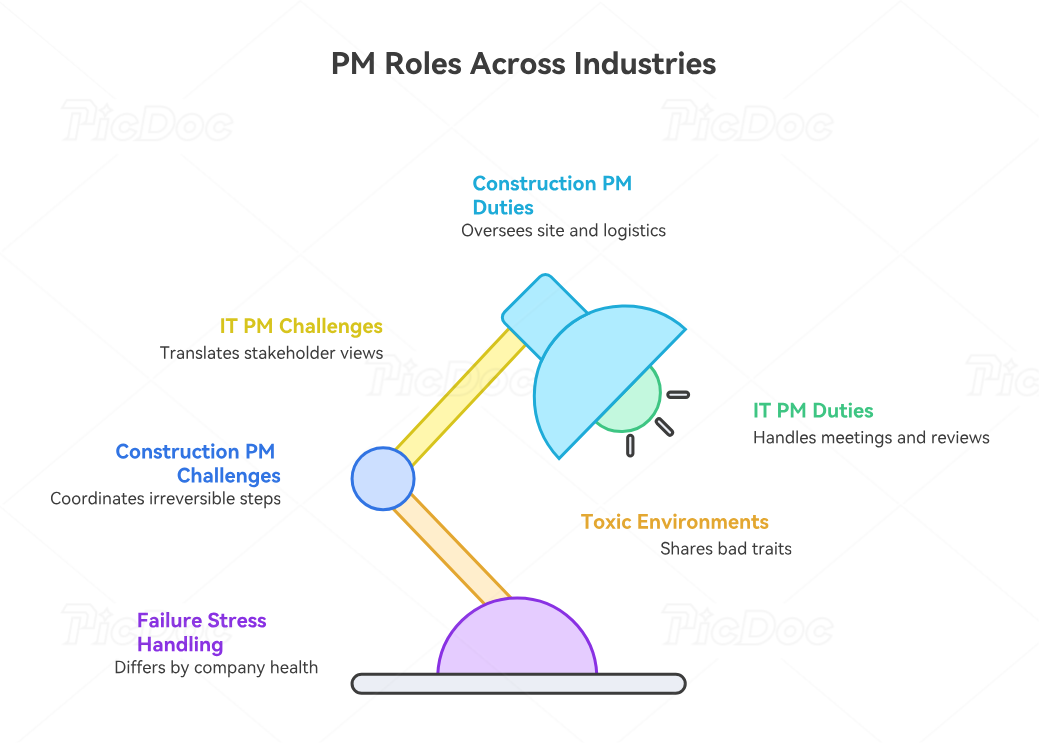
In IT, the PM's hardest moments frequently involve translation. Engineering says the requested date ignores technical dependencies. Leadership hears that delivery is slow. Product wants additional capability. Security adds a control. Operations wants reliability. The PM must convert these viewpoints into choices that preserve business value. Professionals moving through business analysis into PM, IT-to-project-management transitions, Agile-team leadership, and program-management careers benefit from learning to turn technical complexity into decision-ready business language.
In construction, the equivalent challenge is often coordination under irreversible sequencing. The structural trade may need access before mechanical work. Electrical gear may have a long lead time. A late design change can affect procurement and installation. An inspection failure can prevent subsequent work. A subcontractor delay can disrupt several downstream trades. The PM's value comes partly from detecting these collisions early enough to protect cost and schedule. That capability intersects with construction-manager development, earned-value management, cost-professional skills, and broader senior PM consulting.
The worst environments in both sectors share recognizable traits. In IT, watch for permanently changing priorities, unowned technical decisions, excessive meetings, hidden dependencies, weak sponsorship, and executives expecting dates before discovery. In construction, watch for chronically weak subcontractors, unrealistic schedules, poor drawings, cash-flow trouble, uncontrolled changes, bad procurement, and management treating nights or weekends as ordinary recovery capacity. Career durability depends on recognizing these conditions before they become normalized. That matters when deciding whether PM remains worth it, choosing between PMP and alternative credentials, evaluating real PM experience, and planning eventual project-management leadership.
A particularly useful question in either industry is: Where does the stress go when the plan fails? Healthy companies turn failure signals into prioritization, scope changes, additional resources, escalation, or revised dates. Weak companies transfer the gap onto the project manager through longer hours, endless chasing, and reputational pressure. That distinction affects careers across remote project teams, PMO structures, technical project environments, and complex construction programs.
5. Which Career Should You Choose, and How Can You Switch Without Starting Over?
Choose IT when you genuinely enjoy technology, abstract problem-solving, changing requirements, knowledge work, stakeholder translation, and continuous learning. It is particularly attractive when remote or hybrid flexibility carries substantial value. Candidates should investigate the IT-to-project-management roadmap, strengthen business-analysis skills, understand Agile project-management careers, and develop awareness of cybersecurity-project trends rather than assuming generic project knowledge is sufficient.
Choose construction when tangible delivery energizes you, you enjoy operational problems, you can tolerate site constraints, and contracts, costs, schedules, physical sequencing, and field coordination feel intellectually satisfying. The field currently has strong BLS growth projections and a robust wage profile. It rewards people who build construction-management expertise, serious cost-management capability, practical earned-value knowledge, and credible project leadership experience.
If you are moving from IT into construction, preserve your transferable evidence: stakeholder management, vendor coordination, risk management, change control, budgeting, scheduling, governance, executive communication, and delivery recovery. Then close the construction-specific gaps aggressively. Learn drawings and specifications, RFIs, submittals, change orders, procurement, contract structures, cost codes, field sequencing, inspections, safety interfaces, Primavera P6, Procore, and the relationship between superintendent and PM responsibilities. A candidate combining PMP-level PM fundamentals, construction-specific preparation, cost controls, and demonstrable real project experience has a much stronger argument than someone offering PM terminology alone.
Do the reverse when moving from construction into IT. Keep your evidence around complex schedules, budgets, risk, contractors, executives, clients, governance, and recovery, then add technology context. Learn the SDLC, common Agile and hybrid delivery models, requirements traceability, release management, environments, API and integration concepts, cloud basics, cybersecurity gates, data migration, Jira or Azure DevOps, and whichever technology domain you intend to enter. The goal is to combine IT-project fluency, Agile PM capability, relevant business-analysis knowledge, and existing project-management evidence.
A Reddit construction PM trying to pivot into IT reported that PMP alone had not materially changed the response from recruiters, illustrating why domain proof matters. Conversely, an IT PM considering construction received feedback emphasizing the importance of understanding phases and recognizing field mistakes before they create expensive consequences. Both stories reinforce the same principle visible in PM certification versus experience, why certified PMs still miss jobs, CAPM career outcomes, and PMP career outcomes: credentials strengthen evidence; they rarely substitute for it.
The smartest cross-industry transitions often happen through a bridge sector. Data-center construction combines technology infrastructure and physical delivery. ERP implementations for contractors combine IT with construction operations. Construction technology, smart buildings, facilities systems, capital-program software, BIM platforms, industrial automation, warehouse systems, and infrastructure digitization all reward mixed backgrounds. These niches let professionals reuse more of their existing PM experience, develop technology-project expertise, retain construction-management context, and eventually progress toward program-management roles without accepting a complete career reset.
Before switching, score both options across ten factors: expected total compensation, realistic weekly hours, commute or travel, remote flexibility, technical learning burden, job-market depth in your location, employer quality, long-term leadership options, tolerance for field pressure, and genuine interest in the work. Weight each factor according to your life rather than treating all ten equally. Someone prioritizing geographic freedom may accept lower compensation for a remote IT role. Someone who hates abstract digital work may happily accept site presence for the satisfaction of physical delivery. That is a stronger career decision than chasing whichever side currently appears more fashionable in the PM labor market, the certification market, project-management software trends, or executive career ladder.
6. FAQs About IT vs Construction Project Management
-
Construction managers had a U.S. median annual wage of $114,990 in May 2025, while project-management specialists had a median of $102,320. That comparison does not isolate IT PMs, and technology compensation varies enormously by sector. Senior IT PMs in finance, consulting, cloud, cybersecurity, or transformation can exceed construction medians substantially. Compare PMP salary leverage, PM career-market conditions, real experience premiums, and relevant senior PM career routes.
-
Construction often creates more immediate field pressure through subcontractors, inspections, procurement, physical errors, weather, safety, and irreversible sequencing. IT commonly produces cognitive pressure through changing requirements, technical ambiguity, releases, integrations, security, and stakeholder misalignment. Employer quality can outweigh industry. Construction Reddit discussions range from major burnout to dramatically better work-life balance after moving into owners-representative roles. Evaluate project-management career fit, governance maturity, PMO effectiveness, and the organization's collaboration systems.
-
IT can provide more varied entry routes through coordinator, analyst, implementation, operations, support, and business-analysis roles, although technical context still matters. Construction commonly expects more direct familiarity with the physical delivery environment, particularly when the PM is expected to make decisions affecting trades, contracts, schedule, and cost. BLS notes that larger construction firms may prefer relevant education plus construction experience. Candidates should compare no-experience PM entry routes, CAPM value, Google PM versus CAPM, and construction-manager preparation.
-
BLS currently projects stronger percentage employment growth for construction managers than project-management specialists, at roughly 9.1% versus 6.7% over 2025–2035. Individual stability still depends on employer backlog, geography, financing, project type, client concentration, and company finances. IT stability depends heavily on sector, budgets, transformation demand, reorganizations, and technical relevance. Use the 2026 PM market analysis, future certification outlook, program-management career path, and governance-career roadmap when considering long-term resilience.
-
Experienced IT PMs can preserve stakeholder, budget, schedule, risk, governance, vendor, and change-management experience, but construction-specific competence still needs to be demonstrated. Targeting construction technology, data centers, smart buildings, infrastructure systems, or owners with major technology programs can reduce the reset. Build knowledge of drawings, contracts, RFIs, submittals, procurement, cost control, P6, Procore, and field sequencing. Combine PMP experience, construction certification knowledge, cost-management capability, and strong portfolio evidence.
-
It is possible, especially through bridge sectors where construction knowledge has direct value. Data-center programs, facilities technology, ERP implementations for contractors, construction software, industrial systems, and infrastructure technology can preserve seniority better than applying cold to unrelated software roles. A broad jump into IT may still encounter recruiter resistance around technical experience, as Reddit career discussions show. Strengthen IT project-management knowledge, Agile delivery skills, business-analysis capability, and existing PM evidence.
