
Project Management Burnout: Reddit Stories on Stakeholders, Meetings, Firefighting & How to Spot a Bad PM Environment
Project-management burnout often develops while the PM still appears highly functional. The calendar is full, stakeholders keep receiving updates, crises get contained, and leadership sees delivery continuing. Underneath that surface, the PM may be absorbing conflicting priorities, weak ownership, endless escalation, and responsibility without matching authority. Understanding whether that pressure reflects a difficult project or a structurally bad environment matters for anyone assessing the 2026 project-management career market, building real PM experience, developing PMO effectiveness, or pursuing project-management leadership.
1. Why Project Management Burnout Feels Different From Simply Having Too Much Work
The most dangerous PM burnout often comes from high accountability combined with low control. You own the date, yet another manager controls the resource. You own stakeholder communication, yet the technical team controls the estimate. You own the risk register, yet executives decide whether mitigations receive funding. You own delivery visibility, while sponsors can change priorities without changing expectations. That structural tension explains why developing project-governance capability, understanding effective PMO structures, gaining real project-management experience, and learning program-management thinking matter far more than simply becoming better at task tracking.
A November 2025 Reddit discussion described this form of burnout as the exhaustion of continually patching problems while carrying ownership for conditions the PM does not fully control. The poster highlighted changing priorities, late messages, context switching, misleadingly positive status reporting, and the expectation that the PM remain calm while the surrounding system deteriorated. Those pain points should concern anyone evaluating whether project management remains worth pursuing, whether their PM software actually improves delivery, how remote collaboration systems affect workload, and whether their organization understands modern project-management governance.
A March 2026 Reddit discussion described another drain that rarely appears in a workload spreadsheet: keeping several competing versions of reality aligned. A PM may hear one commitment from engineering, another expectation from leadership, a different interpretation from the client, and a fourth assumption embedded in the schedule. The PM becomes the human reconciliation layer between them. That emotional and cognitive load increases sharply in technical project-management careers, complex cybersecurity projects, large Agile delivery environments, and roles progressing toward senior PM consulting.
This is why hours alone are a weak burnout diagnostic. A PM working 45 hours with reliable sponsorship, credible estimates, clear authority, and focused meetings may have a healthier job than someone working 40 hours in uninterrupted uncertainty. One January 2026 Reddit poster described working roughly 45–50 hours while feeling mentally overwhelmed because the workday contained almost no meaningful breaks and responsibilities continually accumulated. Work design matters alongside workload. Strong project collaboration systems, thoughtful project-management tooling, mature PMO operating models, and realistic project governance determine whether complexity is managed or simply transferred onto the PM.
A useful burnout equation is:
Demand + ambiguity + context switching + low control + emotional containment − recovery = PM burnout risk.
Each component can exist temporarily on a difficult project. The alarm should rise when several become permanent operating conditions. Strong PMs can manage uncertainty. They cannot indefinitely compensate for missing governance, permanent understaffing, absent sponsorship, dishonest dates, contradictory priorities, and decision-makers who refuse decisions. Knowing that distinction is especially important for people moving from project coordinator to project manager, transitioning from business analysis into PM, building an Agile project-management career, or deciding whether PMP will improve their career options.
| Signal | Healthy / Temporary Version | Bad-Environment Version | Evidence to Watch | PM Response |
|---|---|---|---|---|
| Urgent work | Occasional genuine exceptions | Everything arrives labeled urgent | Urgent items repeatedly displace committed work | Force ranked priorities and document displacement |
| Scope changes | Impact assessed before approval | Leadership adds work while protecting date and budget | Baseline changes without trade-offs | Show explicit scope/time/resource consequences |
| Sponsor support | Sponsor resolves escalated decisions | Sponsor expects PM to absorb political conflict | Escalations repeatedly stall | Track decision aging and business impact |
| Resource shortages | Shortfall has recovery plan | Permanent understaffing becomes PM responsibility | Same roles overloaded every cycle | Forecast capacity and quantify delivery loss |
| Meetings | Decisions, coordination, escalation | Meetings substitute for ownership | Same topics recur without closure | Require purpose, decision and owner |
| Status reporting | Status informs action | PM maintains multiple decorative reports | Reports consume time without decisions | Consolidate into one source and audience-specific views |
| After-hours contact | Rare critical incident | Routine messages expect immediate response | Evenings become normal operating time | Define emergency criteria and response windows |
| Deadline pressure | Date reflects estimates and constraints | Date is politically declared before planning | Teams repeatedly say date is impossible | Present scenarios instead of false certainty |
| Technical uncertainty | SMEs own technical estimates | PM must defend estimates SMEs will not own | No accountable estimator exists | Record estimate owner and confidence level |
| Escalation | Escalation produces a decision | PM gets blamed for escalating bad news | Risks are discouraged from appearing red | Preserve written evidence and escalate factually |
| Priorities | Leadership explicitly ranks work | Five initiatives are all called number one | Resources are double-booked | Ask which commitment moves when another moves up |
| Accountability | Owners accept deliverables | PM becomes owner of everyone else's actions | Teams wait for repeated chasing | Publish ownership visibly |
| Decision-making | Clear authority by decision type | Committees avoid decisions indefinitely | Decision log grows older every week | Attach cost of delay to every overdue decision |
| Firefighting | Rare incident followed by root-cause work | Same crisis category repeats constantly | No preventive action survives urgency | Track repeat incidents and structural causes |
| Project load | Portfolio matches capacity | New projects are added without removing old ones | Planning time disappears | Show capacity at portfolio level |
| Role clarity | PM coordinates accountable owners | PM becomes scheduler, analyst, admin, QA and product owner | Work expands whenever another role is missing | Create responsibility boundaries |
| Governance | Proportionate controls support decisions | Governance generates forms without authority | Heavy reporting, weak decisions | Link every control to a decision purpose |
| Client pressure | Expectations are negotiated against constraints | Every client demand becomes an internal emergency | No commercial boundary exists | Route requests through scope/change mechanisms |
| Bad news | Problems are surfaced early | Teams hide issues until they become crises | Status turns red suddenly | Reward early visibility and forecast confidence |
| Psychological safety | People challenge unrealistic assumptions | Agreement is safer than accuracy | Meetings contain silence followed by private disagreement | Request explicit dissent before decisions |
| Documentation | Records preserve decisions | PM documents because nobody trusts anybody | Every discussion requires defensive evidence | Separate governance records from defensive bureaucracy |
| Communication | Channels have clear purposes | Email, chat and meetings carry conflicting commitments | PM constantly reconciles versions | Define authoritative channels |
| Performance feedback | Manager gives specific coaching | PM hears complaints only after escalation | Expectations remain vague | Request explicit success measures |
| Vacations | Coverage is planned | PM remains unofficially available | Work stops without one individual | Build deputy coverage and handover rules |
| Mistakes | Root causes produce learning | Blame searches for one person | Postmortems become defensive | Document system causes and corrective actions |
| Success | Delivery outcomes are recognized collectively | Success belongs to teams, failure belongs to PM | Accountability is asymmetrical | Clarify authority and performance measures |
| Process improvement | Retrospectives create changes | Everyone knows the system is broken but nothing changes | Same lessons recur quarterly | Track improvement actions like project deliverables |
| Work recovery | Intense periods are followed by quieter periods | One peak rolls directly into the next | No workload valley exists | Assess portfolio design, not personal productivity |
| Manager behavior | Manager helps remove structural blockers | Manager tells PM to “manage better” regardless of constraints | Every problem is personalized | Bring quantified system evidence |
| Burnout response | Organization changes workload or controls | PM receives wellness advice while workload remains identical | Structural causes stay untouched | Request measurable operating changes |
2. Stakeholder Burnout Usually Comes From Unclear Ownership, Weak Sponsorship and Endless Emotional Translation
Difficult stakeholders are part of project management. A structurally bad environment appears when the PM becomes the permanent emotional shock absorber between groups that refuse to align directly. Engineering complains privately about product. Product complains privately about leadership. Leadership wants certainty nobody can credibly provide. The client demands a date while rejecting the constraints behind it. The PM translates all four perspectives, protects relationships, updates the plan, and still owns the visible outcome. That problem cannot be solved through stronger stakeholder communication alone. It requires functioning project governance, credible PMO escalation mechanisms, and mature program-management leadership.
One useful diagnostic is decision latency. Track how long material decisions sit unresolved after the PM has supplied sufficient information. If a sponsor routinely needs three weeks to approve something but still expects the original milestone, the workload problem sits upstream of PM productivity. The PM should record the decision request date, options, recommendation, required owner, decision deadline, and quantified consequence of delay. This creates more useful evidence than repeated reminders and reflects the discipline expected in project-governance careers, mature PMO reporting, effective business-analysis practice, and senior project-management consulting.
A second diagnostic is accountability asymmetry. Ask who gets challenged when another functional owner misses a commitment. In a healthy structure, the PM exposes the variance and the accountable owner explains the recovery. In a weak structure, leadership asks why the PM failed to “make them deliver.” PMs can influence, coordinate, escalate, negotiate, and clarify. They cannot manufacture authority that the organization refuses to establish. People moving from business analyst to project manager, progressing from project coordinator to PM, entering PM from technical careers, or building Agile leadership skills need to recognize this boundary early.
A 2025 Reddit poster managing a major startup described being short-staffed, training another PM, dealing with departments changing processes mid-project, losing sleep, forgetting routine work, and struggling through stakeholder meetings. That combination matters because stakeholder trouble can become the visible symptom of capacity failure. The answer may involve workload redesign, stronger sponsorship, or portfolio reduction rather than better meeting charisma. Evaluating that difference is essential when considering PMP career development, CAPM-to-PM progression, PM certification versus experience, and the reasons certified PMs still struggle in some workplaces.
Strong PMs also learn to stop privately carrying public disagreements. When two directors want mutually incompatible outcomes, translate the conflict into an explicit trade-off and put it before the right decision-maker. “Team A wants X and Team B wants Y” creates politics. “Option X protects the launch date but delays capability B by six weeks; option Y preserves capability B and moves launch” creates governance. That shift is fundamental to executive project-management capability, program-management progression, project-governance leadership, and eventually moving from PM into COO responsibilities.
3. Endless Meetings and Constant Firefighting Are Usually Symptoms of Missing Control Systems
A crowded calendar can create the illusion of strong coordination while eliminating the time needed for actual project control. The PM moves from stand-up to vendor call, steering preparation, risk review, technical workshop, status meeting, client update, and internal escalation. At 4:30 PM, the real work begins: analyzing schedule impact, updating risks, preparing decisions, reconciling contradictory information, and thinking ahead. This pattern should trigger questions about collaboration-software adoption, project-management tool selection, PMO operating effectiveness, and the organization's broader project-management software strategy.
Meetings should primarily perform one of four functions: decide, solve, coordinate, or escalate. Information that can be consumed asynchronously should usually remain asynchronous. A recurring meeting that repeatedly produces “we'll take that offline,” “let's revisit next week,” or “can everyone send me their updates?” may be compensating for missing ownership. PMs developing Agile project-management skills, transitioning toward Scrum@Scale practice, working within SAFe environments, or improving remote-project collaboration should audit meeting purpose rather than merely shortening agendas.
A practical audit is to calculate each recurring meeting's decision yield. During four weeks, record decisions made, blockers removed, cross-team commitments established, and escalations resolved. A weekly 60-minute meeting involving 12 people consumes 12 person-hours before preparation is counted. If the meeting generates no meaningful coordination outcome, the organization is paying an expensive tax for the feeling of visibility. This kind of operating discipline matters for senior PM consultants, project-management executives, program managers, and leaders responsible for PMO performance.
Firefighting deserves the same analysis. One June 2026 Reddit PM working in a technical manufacturing environment described limited documentation, continually shifting priorities, and near-constant firefighting while trying to determine whether the struggle reflected a normal learning curve or organizational dysfunction. The key test is repeatability. A one-off supplier failure is an incident. Supplier failures every month without stronger qualification or contingency planning are a system. One emergency deployment is unusual. Every release becoming an emergency indicates weak planning, quality, change control, or leadership. Those distinctions matter in technical PM transitions, cybersecurity-focused projects, earned-value environments, and complex construction project management.
Build a firefighting ledger for six weeks. For every major disruption, capture trigger, root cause, impacted milestone, hours lost, temporary fix, structural corrective action, owner, and whether the same category has occurred before. Patterns become difficult for leadership to dismiss when “we're always busy” becomes “11 of our last 17 escalations came from late requirements approval and consumed 96 hours of recovery work.” That transforms stress into management evidence. The same analytical discipline strengthens project-governance careers, PMO improvement, senior PM consulting, and executive project leadership.
4. How to Tell a Brutal Project From a Bad PM Environment
A brutal project has a reason for being brutal. A regulatory deadline, acquisition, emergency remediation, major migration, product launch, or recovery effort may temporarily create extraordinary pressure. The organization acknowledges the pressure, prioritizes work, gives leaders authority, makes decisions quickly, temporarily increases resources where possible, and allows recovery afterward. The intensity has an event, boundary, and exit condition. That distinction matters when assessing project-management career sustainability, real PM experience, program-management careers, and senior project leadership.
A bad environment makes extraordinary effort ordinary. The migration ends and another “critical” project arrives Monday. The company loses two people and quietly redistributes their work. Every quarter becomes the most important quarter. Leadership promises resources that never materialize. Estimates are demanded, ignored, and later used as accountability weapons. Risks are tolerated until they become issues, then treated as PM failures. Retrospectives identify the same causes without funding corrective action. Those conditions expose failures in project governance, PMO effectiveness, portfolio tooling, and organizational collaboration design.
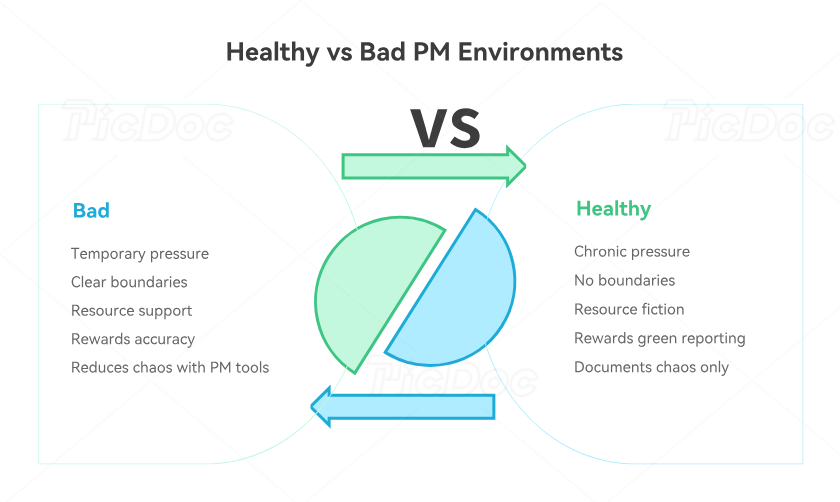
Watch the truth penalty. Healthy environments prefer an uncomfortable accurate status over a comfortable inaccurate one. Dangerous environments reward green reporting until failure becomes impossible to hide. If experienced PMs repeatedly soften risks because executives become hostile when projects turn amber, the dashboard is performance theatre. A PM learning through PMP preparation, CAPM progression, Agile development, or business-analysis experience can wrongly conclude that managing expectations means hiding operational reality. It does not.
Watch the resource fiction too. If a person is allocated 70% to Project A, 60% to Project B and 50% to Project C, the problem cannot be solved by a prettier schedule. Ask functional managers to resolve the capacity contradiction before treating the dates as commitments. This becomes increasingly important in earned-value environments, project software planning, remote project teams, and program-management portfolios.
Another clue is whether good PM behavior makes the situation better. Imagine you introduce clear RAID ownership, decision logs, meeting agendas, dependency tracking, change control, realistic forecasting, and structured escalation. In a healthy organization, those mechanisms gradually reduce chaos. In a bad environment, they simply document chaos more accurately while leaders continue avoiding trade-offs. That distinction tells you whether you need stronger project-management capability, better project-management tooling, stronger governance leadership, or a different employer.
Reddit provides useful evidence that PM jobs vary considerably by environment. In one discussion, a burned-out PM described repeated high-pressure roles, while commenters contrasted that experience with PM positions that kept normal working hours and far lower levels of stress. The practical implication is important for anyone questioning the long-term value of project management, considering career advancement after PMP, pursuing project governance roles, or exploring program-management progression: employer design can matter as much as profession choice.
5. How to Reduce PM Burnout Without Becoming the Person Who Simply Works Harder
Start by replacing invisible effort with visible constraint management. When capacity is insufficient, stop silently covering the gap. Show the work, available capacity, collision, and consequence. “I am overwhelmed” can be dismissed as subjective. “We have 640 estimated hours of committed work against 410 available hours, and these three milestones share the same two specialists” creates a management problem. This evidence-oriented approach strengthens PMO decision-making, project governance, earned-value capability, and senior consulting credibility.
Use conditional commitments when constraints remain unresolved. Instead of saying “we'll make the date,” say, “The date remains achievable if security review completes by Tuesday and the integration engineer remains available at 50% capacity. If either condition moves, the release forecast changes.” Conditional language keeps assumptions attached to commitments. It also develops the judgment required for PMP-level careers, program management, project-governance leadership, and eventually PM executive roles.
Protect control time in the calendar. Project managers need uninterrupted time to examine trends, think through upcoming milestones, reconcile conflicting information, prepare decisions, and identify emerging risk. Two protected 90-minute blocks may produce more project control than six additional status meetings. Audit recurring calls, replace updates with asynchronous reporting, shorten attendee lists, require agendas, and decline meetings where the PM has neither a decision nor contribution. That discipline complements smarter collaboration software use, stronger project-management tool choices, better PM software adoption, and effective Agile delivery practices.
Build an escalation ladder before crises. Define what the team owns, what the PM owns, what functional managers own, what the sponsor owns, and which thresholds trigger escalation. Risks without owners, decisions without deadlines, resource conflicts without authority, and scope changes without approval should automatically move upward. This reduces the exhausting ritual of renegotiating authority during every problem. The same maturity is essential in cybersecurity project management, emerging cybersecurity responsibilities for PMs, PMO governance, and senior project-management consulting.
Then run a 30-day environment test. Choose three structural problems and ask for measurable changes. Examples include reducing your active project load from eight to five, replacing two recurring status meetings with asynchronous updates, establishing sponsor decision SLAs, documenting after-hours emergency criteria, or assigning functional owners to recurring actions. If leadership agrees and follows through, the environment may be repairable. If every request receives verbal sympathy while operating conditions remain identical, that is valuable career information. Candidates can then assess the wider PM job market, strengthen their portfolio evidence, understand what employers actually screen for, and pursue environments with stronger PMO maturity.
When interviewing elsewhere, investigate the environment rather than focusing only on salary and title. Ask how many concurrent projects PMs typically own, who controls resources, how project priorities are ranked, what happens when scope changes, how sponsors handle escalations, how often PMs work after hours, why the previous PM left, which meetings are mandatory, and how leadership handles an unrealistic date. These answers can reveal more about sustainability than a polished job description. This is especially important for candidates using PMP to improve career leverage, moving from project coordinator to PM, changing from IT into project management, or advancing toward program-management roles.
Leaving can become a rational professional decision when the organization consistently requires PMs to absorb problems it refuses to govern. The career itself may still fit you exceptionally well in another environment. Reddit discussions repeatedly show PMs asking whether chronic stress is intrinsic to the profession while others report dramatically healthier experiences across different employers and sectors. The strongest response is to evaluate the system with the same rigor you would apply to a troubled project: identify causes, test corrective actions, measure the response, and make the next decision from evidence.
6. FAQs About Project Management Burnout and Bad PM Environments
-
Compare the work itself with the environment surrounding it. If you still enjoy planning, solving dependencies, coordinating teams, clarifying decisions, managing risk, and turning ambiguity into execution, the profession may still fit. Chronic frustration may instead come from missing authority, dysfunctional sponsorship, unrealistic workload, or weak governance. Compare your experience with the broader project-management career outlook, expectations around real PM experience, PMO effectiveness, and possible program-management pathways.
-
Occasional firefighting is normal where delivery contains genuine uncertainty. Repeated fires with the same root causes indicate a control problem. Track incident categories, causes, impact, temporary fixes, corrective actions, and recurrence. When identical failures continue despite visibility, the environment lacks prevention discipline. This analytical approach aligns with project governance, earned-value management, effective PMO controls, and mature technical project management.
-
The better metric is whether meetings eliminate the time required for project control. If most of the working day is consumed by meetings and analytical work routinely moves into evenings, the meeting architecture deserves redesign. Measure decision yield, remove pure status meetings, reduce attendance, shift information updates asynchronously, and protect thinking time. Strong remote collaboration practices, better PM software choices, appropriate project-management tools, and stronger Agile delivery systems can materially reduce meeting dependence.
-
A particularly serious signal is accountability without authority plus punishment for truthful escalation. That combination forces the PM to own outcomes while discouraging the information required to manage them. Other red flags include permanent understaffing, every priority being urgent, routine after-hours expectations, repeated scope additions without trade-offs, and sponsors who refuse decisions. These conditions undermine project governance, PMO effectiveness, senior PM performance, and sustainable project-management careers.
-
PMP may expand your employment options, strengthen framework knowledge, and improve market credibility, but it cannot repair a dysfunctional operating system by itself. Its career value is strongest when paired with demonstrated delivery judgment and the ability to choose healthier organizations. Review whether PMP is worth it in 2026, compare PMP with CAPM, PRINCE2 and AgilePM, examine certification versus experience, and understand why certified PMs can still struggle to get good roles.
-
Bring scenarios instead of resistance. Present the requested date alongside the assumptions required to achieve it, the probability drivers, the resources needed, what must be removed from scope, and the consequences of missing key conditions. Give leadership choices that can actually be governed. That approach demonstrates the judgment expected in senior project-management roles, project governance, program management, and executive PM careers.
