
Guide to Advancing Your Career to Project Management Executive
Advancing from project manager to project management executive requires a deliberate shift in scope, judgment, and business ownership. Senior leaders are evaluated through portfolio performance, financial outcomes, organizational capability, governance quality, and executive confidence rather than individual project completion. The transition becomes easier when you understand the future project manager skills, strengthen project governance, develop PM leadership and communication, and build visible evidence that you can lead across an enterprise.
1. Understand What Changes When You Move from Project Manager to Executive
A project manager receives a defined objective and organizes people, schedules, risks, resources, and decisions around its completion. A project management executive helps decide which objectives deserve investment, which initiatives should be stopped, how delivery capacity should be distributed, and how the organization should respond when strategy changes.
That distinction affects every part of your career development. Strong knowledge of project execution terms, project monitoring and control, risk registers, and stakeholder engagement can establish your delivery credibility. Executive advancement begins when you use those disciplines to influence enterprise priorities, operating costs, customer outcomes, regulatory exposure, and investment decisions.
Many experienced project managers become trapped at the delivery level because their organizations view them as dependable operators. They rescue troubled projects, manage difficult stakeholders, maintain detailed plans, and absorb operational pressure. This reputation can increase workload without increasing authority. Every successful rescue reinforces the belief that the manager belongs inside project execution rather than above the portfolio.
To escape this pattern, begin evaluating work through five executive questions:
Why should the organization fund this initiative?
Which measurable business outcome will justify the investment?
What should receive fewer resources when this work receives more?
Which risks require executive acceptance rather than project-level mitigation?
What organizational capability will remain after the project closes?
These questions connect delivery decisions with project financial management, resource allocation, earned value management, and the evolving role of the project management office. They also change how senior leaders experience your contribution. You become someone who improves the quality of decisions rather than someone who waits for decisions and manages their consequences.
Recognize the executive roles available to you
The executive pathway rarely moves directly from project manager to chief operating officer. Most professionals progress through broader positions such as senior project manager, program manager, portfolio manager, PMO leader, transformation director, head of delivery, vice president of program management, or enterprise operations executive.
Each route rewards a different combination of strengths. A PMO director needs strong reporting practices, governance design, prioritization, and portfolio visibility. A transformation director needs hybrid project management, change leadership, benefits realization, and cross-functional influence. A chief operating officer needs commercial judgment, operating-model ownership, talent leadership, cost discipline, and the ability to convert strategy into repeatable execution.
Your next role should close a specific capability gap. A promotion that merely increases project size can leave you with the same career profile. A strategically valuable move gives you exposure to budgets, portfolio trade-offs, executive committees, workforce planning, vendor strategy, organizational change, or enterprise governance.
2. Build the Capability Stack Required for Executive Promotion
Executive readiness comes from combining several capabilities that reinforce one another. A project manager with excellent scheduling skills and weak financial judgment remains limited to delivery conversations. A manager with strong commercial awareness and poor people leadership will struggle to operate at scale. Your development plan should therefore build a connected capability stack rather than a collection of unrelated courses.
Develop portfolio-level judgment
Portfolio leadership requires the discipline to compare initiatives that have different objectives, sponsors, risk profiles, and measurement systems. One program may protect revenue, another may reduce regulatory exposure, and another may build long-term capability. A simple ranking based on financial return will distort the portfolio.
Build a scoring model that considers strategic alignment, mandatory obligations, expected benefits, delivery risk, urgency, resource demand, dependency intensity, and reversibility. The model should support informed discussion rather than produce an automatic answer. Studying project portfolio management trends, project governance practices, resource allocation terminology, and project reporting standards will help you construct a defensible approach.
Volunteer to prepare the portfolio review pack, consolidate initiative dependencies, analyze delivery capacity, or recommend which projects should be paused. These assignments expose you to the trade-offs executives actually manage.
Become financially credible
Project executives must understand how delivery decisions affect revenue, margin, operating expense, capital expenditure, cash flow, working capital, and long-term cost. Senior leaders will hesitate to expand your authority when every recommendation is expressed through dates, tasks, and resource hours.
Begin translating project information into financial consequences. A six-week delay may defer revenue, extend contractor costs, trigger penalties, increase financing expense, or postpone operational savings. A scope reduction may preserve launch timing while reducing expected customer value. An early vendor commitment may secure capacity while increasing sunk-cost exposure.
Use project financial management concepts, earned value terminology, cost-professional certification guidance, and project estimation developments to improve the quality of your analysis. Ask finance partners to review one of your business cases or forecasts. Their feedback will reveal where your assumptions, classifications, or benefit calculations lack executive-grade rigor.
Learn to design governance
Many managers treat governance as a calendar of meetings. Executive governance defines who can authorize funding, accept risk, approve scope, resolve conflicts, and stop work. It also determines what evidence decision-makers receive and how quickly unresolved issues escalate.
Design governance according to risk and complexity. A regulated transformation may require formal controls, documented approvals, audit evidence, and strict change authority. A low-risk internal experiment may need rapid reviews and lightweight decision records. Your credibility grows when you understand requirements control, risk-response planning, ISO project standards, and the future of project governance.
Create a one-page governance architecture for your current program. Include decision forums, thresholds, attendees, inputs, outputs, escalation paths, and turnaround expectations. This exercise will show whether the organization has genuine decision control or a collection of status meetings.
Build leaders beneath you
Executives scale through systems and people. A manager who remains personally responsible for every difficult meeting, recovery plan, status report, and stakeholder negotiation creates an operational dependency. Promotion becomes risky because nobody can absorb the work left behind.
Select two or three responsibilities that can be delegated with clear decision boundaries. Coach a project manager to run the steering committee, own the integrated plan, manage a vendor, or lead risk reviews. Use PM leadership concepts, conflict-resolution practices, stakeholder engagement methods, and team communication platforms to establish repeatable leadership routines.
Document the result. Promotion panels respond strongly to evidence that you developed managers, increased decision capacity, reduced escalation dependency, and improved team retention.
3. Create Executive-Level Evidence Before Applying for Executive Roles
Ambition rarely persuades an executive hiring panel. Evidence does. You need proof that your leadership has already crossed the boundaries of an individual project, even when your formal title has not changed.
Build a quantified executive achievement portfolio
Create a private document containing eight to twelve high-value leadership cases. Each case should explain the business problem, your decision authority, the complexity involved, the action you led, the measurable outcome, and the capability demonstrated.
A weak achievement says, “Managed a major transformation project worth $8 million.” A stronger achievement explains that you restructured governance, removed low-value scope, renegotiated supplier milestones, reduced forecast exposure, protected the regulatory deadline, and established a portfolio control process used by three business units.
Prioritize outcomes such as avoided cost, protected revenue, increased capacity, reduced cycle time, improved forecast accuracy, lower risk exposure, higher adoption, fewer defects, faster decisions, stronger retention, and benefits realized after implementation. The EVM glossary, project financial glossary, quality-management terminology, and project closure concepts can help you define outcomes with greater precision.
Replace activity language with enterprise-impact language
Many qualified candidates weaken their resumes through descriptions of coordination activity. Phrases such as “managed schedules,” “facilitated meetings,” and “tracked risks” describe baseline responsibilities. Executive hiring decisions depend on scale, judgment, commercial consequence, organizational influence, and leadership leverage.
Rewrite your experience around decisions and outcomes:
“Redesigned governance across a 14-project portfolio, reducing unresolved executive decisions from 31 to 9 within one quarter.”
“Reallocated specialist capacity toward three regulatory initiatives, protecting mandatory deadlines without increasing headcount.”
“Introduced benefits ownership after implementation, recovering $1.2 million in previously untracked operational savings.”
“Developed four program managers who assumed full governance and sponsor-management responsibilities.”
Use business-analysis preparation, project reporting practices, vendor-management terminology, and future PM leadership trends to sharpen the language used in your executive profile.
Increase your exposure to executive decisions
Visibility should come from useful contribution rather than self-promotion. Ask to attend portfolio reviews, investment committees, transformation forums, operational planning sessions, risk committees, and quarterly business reviews. Prepare concise insights before speaking. Executives remember people who clarify trade-offs, surface hidden exposure, and recommend practical decisions.
A valuable executive contribution usually contains four elements: the issue, its business consequence, the realistic options, and your recommendation. This approach aligns with strong stakeholder communication, disciplined conflict resolution, concise project reporting, and mature risk-register management.
Request ownership of one enterprise problem with unclear boundaries. Examples include excessive project demand, inconsistent governance, unreliable portfolio reporting, vendor underperformance, weak benefits tracking, or duplicated tools. Solving an enterprise problem gives you executive evidence that a larger project cannot provide.
4. Position Yourself for Project Management Executive Opportunities
The executive job market evaluates candidates through a different lens from project-management recruitment. Recruiters may search for delivery scale, PMO ownership, portfolio governance, transformation leadership, budget responsibility, commercial exposure, and team size. Hiring executives then examine judgment, influence, leadership maturity, business understanding, and the candidate’s ability to represent the function across the enterprise.
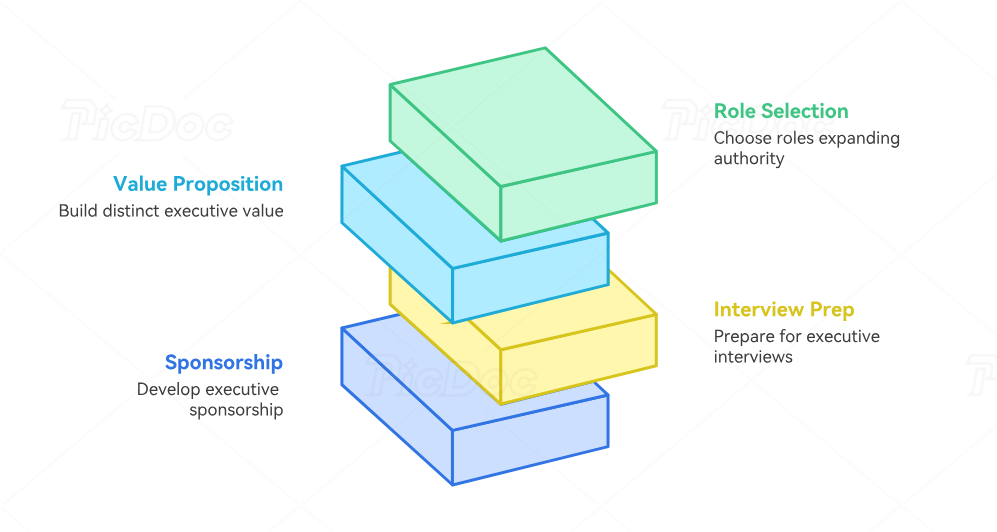
Choose roles that expand authority
A larger project can strengthen your operating experience, although it may leave your executive profile unchanged. Evaluate opportunities according to the authority they provide.
A strategically useful role should give you several of the following:
Ownership of multiple programs or an enterprise portfolio
Budget or investment-management responsibility
Authority over prioritization and resource allocation
Regular access to senior executives
Responsibility for managers rather than individual contributors
Accountability for benefits after delivery
Commercial, vendor, or procurement authority
Responsibility for governance standards or PMO services
Exposure to operational performance and organizational design
Research the future direction of project portfolio management, PMO leadership, automation-driven PM careers, and project management leadership before deciding which role creates the best bridge.
Build an executive value proposition
Your value proposition should explain the business problems you solve, the environments where you perform best, and the outcomes you repeatedly create. “Experienced project leader with excellent communication skills” offers little differentiation.
A stronger positioning statement might read:
Project portfolio and transformation leader who improves investment discipline, stabilizes high-risk delivery, strengthens governance, and builds leadership capacity across complex regulated environments.
Support the statement with evidence from risk-management practices, portfolio trends, governance principles, and project leadership competencies. Every phrase should connect to a measurable case in your career history.
Prepare for executive interviews
Executive interviews focus heavily on ambiguity, competing interests, difficult decisions, and organizational consequences. Prepare examples covering:
An initiative you recommended stopping
A sponsor you challenged constructively
A portfolio trade-off involving scarce resources
A major financial assumption you corrected
A governance failure you redesigned
A leader you developed into a larger role
A crisis where information was incomplete
A strategy you translated into executable programs
A benefit that failed to materialize and how you responded
A decision where every available option carried risk
Use the STAR structure only as an internal preparation tool. Your spoken answer should sound like an executive briefing. Establish the context quickly, explain the stakes, describe your judgment, and quantify the result. Knowledge of conflict-resolution techniques, stakeholder engagement, project financial management, and executive reporting will strengthen your answers.
Develop sponsorship rather than collecting contacts
A network gives you access to information. A sponsor uses personal credibility to advocate for your advancement. Sponsorship usually develops after a senior leader has observed your judgment, reliability, discretion, and enterprise contribution.
Identify leaders who influence appointments in operations, transformation, technology, finance, or the PMO. Help them solve meaningful problems. Ask for feedback on your executive readiness, including the gaps that concern them. A useful question is: “Which evidence would you need to see before recommending me for a portfolio or executive role?”
The answer may point toward financial responsibility, people leadership, commercial exposure, strategic planning, or governance ownership. Build that evidence deliberately through PMO transformation work, AI-enabled project management, hybrid delivery leadership, and future-focused PM competencies.
5. Follow a 12-Month Plan to Become Executive-Ready
A focused twelve-month plan can materially strengthen your promotion case when each quarter produces visible evidence. The goal is to change the scope of your contribution, the language of your achievements, and the seniority of the problems you can solve.
Months 1–3: Diagnose your readiness gap
Assess yourself against the 28 capabilities in the matrix. Ask three senior colleagues to identify the two gaps most likely to block your promotion. Compare their feedback with your own assessment.
During this period:
Review your organization’s strategy, operating plan, financial priorities, and risk profile.
Rewrite your resume using business outcomes and enterprise-scale decisions.
Create your executive achievement portfolio.
Learn the organization’s investment, procurement, governance, and budgeting processes.
Select one capability gap with immediate business relevance.
Use the future project manager competency guide, project financial glossary, requirements-engineering guide, and risk-register framework to structure your baseline.
Your first-quarter output should be a one-page development strategy containing the target role, required evidence, priority gaps, assignments needed, and leaders who can observe your progress.
Months 4–6: Lead an enterprise-level improvement
Choose a problem affecting several teams or initiatives. Suitable areas include inconsistent reporting, delayed decisions, resource conflicts, unreliable forecasts, weak benefits ownership, duplicated tools, vendor underperformance, or unclear governance.
Treat the assignment as an executive case study. Establish a baseline, define the economic or operational consequence, identify decision owners, implement the solution, and measure the result. Apply project reporting principles, resource-allocation methods, vendor-management practices, and governance standards.
Your second-quarter output should demonstrate a measurable improvement beyond your assigned project. Examples include shorter approval times, fewer unresolved dependencies, improved forecast accuracy, lower contractor costs, or clearer portfolio priorities.
Months 7–9: Expand leadership leverage
Delegate operational responsibilities that consume your time without increasing your executive capability. Establish clear decision boundaries, coaching routines, and performance measures for the people taking ownership.
Develop at least two managers or senior team members. Give them visible assignments involving sponsor communication, governance leadership, recovery planning, or cross-functional negotiation. Apply leadership and communication concepts, conflict-resolution terminology, team communication systems, and stakeholder-management methods.
Your third-quarter output should prove that you increased the leadership capacity of the organization. Track delegated decisions, reduced escalations, successor readiness, retention, and performance improvements.
Months 10–12: Convert readiness into opportunity
Present your executive evidence to a sponsor, manager, or mentor. Ask for a direct assessment against the role you want. Close any final gaps and begin pursuing internal or external opportunities with a clear value proposition.
Target positions where your experience addresses a genuine organizational need. A company modernizing its PMO may value your governance and portfolio background. A business experiencing uncontrolled growth may need capacity planning and operating discipline. A regulated organization may prioritize risk, documentation, and compliance. A technology transformation may require knowledge of AI-enabled project management, project management software trends, cybersecurity-driven software changes, and hybrid delivery models.
Your final output should include an executive resume, a quantified achievement portfolio, three strong sponsors or references, ten prepared interview cases, and a targeted opportunity list. At that point, you will be presenting verified executive capability rather than asking an employer to take a chance on your potential.
6. Frequently Asked Questions About Becoming a Project Management Executive
-
There is no universal experience threshold because organizations evaluate scope more heavily than tenure. A professional with ten years of repetitive project delivery may appear less prepared than someone with seven years across programs, portfolios, financial decisions, governance design, and people leadership.
Hiring panels usually examine the size and complexity of your decisions, the scale of budgets or portfolios, the seniority of stakeholders, the number of leaders you managed, and the business outcomes you produced. Building expertise in project portfolio management, financial management, governance, and leadership competencies can accelerate readiness more effectively than accumulating similar projects.
-
The best progression depends on the capabilities you have already demonstrated. Program directors suit professionals experienced in coordinating strategic outcomes across related projects. PMO directors need strength in governance, standards, portfolio reporting, capability development, and executive decision support. Transformation directors require cross-functional leadership, change management, benefits realization, and strategic execution.
Professionals aiming for chief operating officer roles should pursue responsibility for operational performance, budgets, workforce planning, organizational design, commercial decisions, and enterprise execution. Review the future role of the PMO, future leadership approaches, portfolio-management trends, and automation’s impact on PM careers when selecting your route.
-
Certifications can strengthen foundational credibility, improve terminology, and support career transitions. Executive selection places greater weight on business outcomes, strategic judgment, financial fluency, leadership scale, and organizational influence.
A PMP may support broad project and program credibility. PRINCE2 can be valuable in structured governance environments. Agile credentials help in product, technology, and transformation settings. The strongest choice depends on the operating context and the gap in your profile. Compare PRINCE2 and PMP, review advanced Agile certifications, explore SAFe Agilist preparation, and study future certification trends before investing.
-
Start by requesting access to approved business cases, monthly forecasts, vendor spend, resource costs, and benefits reports. Offer to analyze forecast variance, quantify delay consequences, challenge benefit assumptions, or prepare financial scenarios for a steering committee.
Partner closely with a finance business partner and ask them to review your calculations. Learn how the organization distinguishes operating expense, capital expenditure, committed cost, accrued cost, forecast cost, and realized benefit. The project financial management glossary, earned value guide, cost-professional certification guide, and estimation technology forecast provide a useful technical foundation.
-
Change the problems you volunteer to solve and the language you use to discuss them. Raise issues through their business consequences, present options with trade-offs, and make recommendations. Seek assignments involving portfolio priorities, governance design, resource allocation, benefits ownership, commercial decisions, and leadership development.
Reduce the time spent demonstrating personal control over every task. Build capable team members who can manage delivery details while you focus on enterprise decisions. Strengthen your approach using project leadership terminology, resource-allocation concepts, stakeholder engagement, and project governance practices.
-
An MBA can strengthen knowledge of finance, strategy, operations, organizational behavior, and commercial decision-making. Its value depends on the strength of the program, the network it provides, the cost, and the gaps in your current experience.
Before enrolling, identify the evidence missing from your promotion case. An MBA may be useful when you need broad business education or access to a new market. Direct assignments may create faster value when your primary gaps involve portfolio ownership, executive exposure, budget responsibility, or people leadership. Combine any formal education with practical application through portfolio-management work, financial-management responsibilities, PMO transformation, and future leadership development.
