
Career Pathway to Nonprofit Project Management Success: 2026 Guide
Nonprofit project managers work where limited resources, public accountability, stakeholder expectations, and urgent community needs meet. Building a sustainable career requires more than understanding timelines. You need requirements discipline, stakeholder engagement, project financial management, risk-response planning, and evidence that you can convert funding into measurable outcomes.
This 2026 guide maps the entry routes, skills, proof assets, career stages, and leadership decisions that move professionals from mission interest to credible nonprofit project leadership.
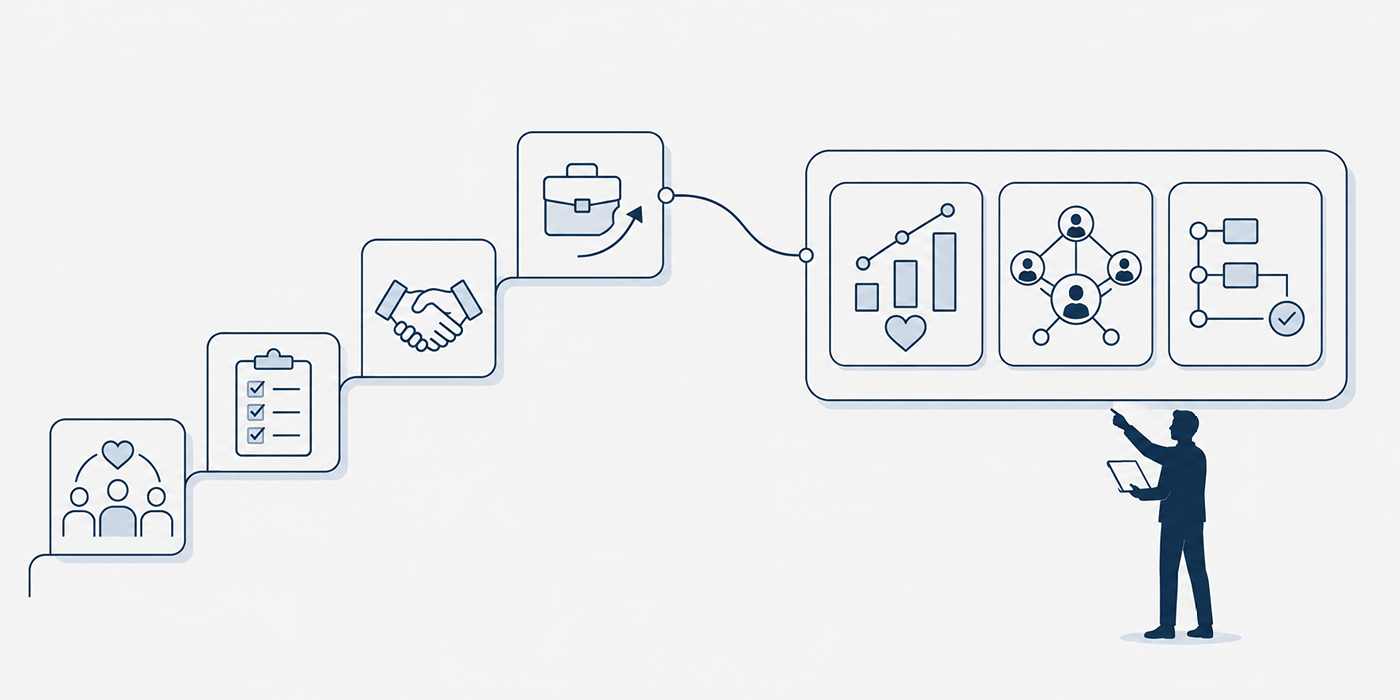
1. Understand What Nonprofit Project Management Success Actually Requires
Nonprofit project management combines delivery discipline with mission stewardship. A commercially successful project may be judged primarily through profit, efficiency, adoption, or market growth. A nonprofit project can face a wider test: Did the organization serve the intended population, respect donor restrictions, protect participants, document spending, meet grant conditions, and generate evidence strong enough to support future funding?
That environment rewards project managers who understand project execution terminology, apply reliable monitoring and control practices, maintain usable project reporting systems, and close initiatives through disciplined project-closure procedures. Mission commitment may help you enter the conversation, but operational credibility determines whether senior leaders trust you with a grant-funded program.
A nonprofit project manager may coordinate education programs, fundraising campaigns, humanitarian responses, digital transformations, research initiatives, volunteer networks, advocacy campaigns, healthcare services, environmental programs, or capacity-building projects. Each setting introduces different risks. A community program may depend on participant retention. A donor-funded initiative may depend on allowable-cost rules. A digital project may involve privacy, accessibility, and cybersecurity controls. A partnership program may fail because responsibilities were never translated into a usable governance structure.
The strongest candidates therefore build three forms of credibility:
Delivery credibility means you can convert an objective into scope, milestones, owners, dependencies, budgets, controls, and acceptance criteria. This requires practical command of Gantt chart terminology, resource-allocation decisions, schedule-compression methods, and escalation rules.
Mission credibility means you understand who the project serves, whose voice is missing, what harm could occur, and how the work connects to an organizational theory of change. This requires stronger leadership and communication judgment, inclusive decision-making, and the ability to manage stakeholder conflict.
Funding credibility means you can protect restricted funds, reconcile program activity with spending, maintain evidence for reports, and alert leaders before a missed deliverable becomes a grant-compliance problem. Candidates who understand earned value management, cost-control principles, and RFP, RFQ, and RFI processes have a significant operational advantage.
| Capability | What Strong Performance Looks Like | Evidence to Place in Your Portfolio | Failure Signal Employers Notice | Primary Partner |
|---|---|---|---|---|
| Mission alignment | Connects deliverables to strategic outcomes and beneficiary needs. | One-page project-to-mission map. | Reports activity without showing why it matters. | Executive director, program lead |
| Requirements control | Creates a clear baseline, acceptance criteria, and traceable changes using sound requirements practices. | Requirements log and approval workflow. | Allows informal requests to expand scope. | Program owner, funder |
| Theory-of-change translation | Converts long-term impact goals into outputs, outcomes, assumptions, and indicators. | Logic model with measurement notes. | Confuses completed activities with achieved outcomes. | Monitoring and evaluation lead |
| Grant compliance | Tracks restrictions, reporting dates, evidence requirements, and approval conditions. | Grant obligation register. | Discovers donor conditions near the reporting deadline. | Grant manager, finance |
| Scope governance | Uses decision rights and formal change review supported by clear project governance. | Change-control form and decision log. | Accepts additions without adjusting budget or timing. | Executive sponsor |
| Budget stewardship | Connects spending, commitments, forecasts, and deliverable progress. | Budget-versus-actual dashboard. | Reports remaining cash without forecasting obligations. | Finance manager |
| Cost control | Uses variance thresholds and corrective action informed by earned value concepts. | Cost variance analysis. | Explains overruns only after funds are depleted. | Finance, sponsor |
| Resource allocation | Balances staff capacity, volunteer availability, specialist input, and delivery priorities. | Capacity plan using resource-allocation principles. | Builds schedules around assumed availability. | Department managers |
| Risk management | Assigns owners, triggers, responses, due dates, and residual exposure. | Structured risk register. | Lists risks without funded responses. | Leadership team |
| Safeguarding | Builds participant protection, reporting routes, vetting, and escalation into delivery. | Safeguarding integration checklist. | Treats protection procedures as separate paperwork. | Safeguarding officer |
| Stakeholder mapping | Separates influence, interest, impact, vulnerability, and decision authority. | Stakeholder engagement matrix. | Uses one communication plan for every audience. | Community and communications teams |
| Community participation | Creates meaningful opportunities for affected groups to shape project decisions. | Participation plan and feedback loop. | Collects feedback after major decisions are fixed. | Community representatives |
| Partner coordination | Clarifies responsibilities, handoffs, escalation routes, and shared measures. | RACI and partnership operating guide. | Relies on goodwill instead of explicit ownership. | Delivery partners |
| Vendor management | Links supplier performance to deliverables, service levels, risks, and payment gates. | Vendor-management scorecard. | Pays invoices without verifying acceptance criteria. | Procurement, finance |
| Procurement fluency | Plans sourcing timelines, bid evaluation, conflicts, approvals, and documentation. | Procurement calendar and RFP evaluation matrix. | Underestimates approval and contracting lead time. | Procurement, legal |
| Schedule management | Models dependencies, decision dates, reporting deadlines, and realistic contingency. | Dependency-based Gantt schedule. | Tracks tasks without critical dependencies. | Workstream leads |
| Adaptive delivery | Uses short learning cycles where requirements or community conditions may change. | Iteration plan based on agile estimation. | Follows an obsolete plan despite new evidence. | Program team, users |
| Hybrid methodology | Protects fixed donor milestones while adapting implementation details. | Hybrid delivery framework. | Applies one methodology regardless of project constraints. | Sponsor, delivery team |
| Impact measurement | Defines indicators, baselines, collection methods, frequency, ownership, and data limitations. | Indicator reference sheet. | Selects metrics after implementation begins. | Evaluation specialist |
| Data quality | Establishes validation, completeness, consent, storage, and correction rules. | Data-quality protocol. | Reports precise numbers from inconsistent source data. | Data and evaluation teams |
| Reporting discipline | Provides decision-ready progress, variance, risk, budget, and outcome information. | Concise project status report. | Produces long updates without decisions or forecasts. | Sponsor, funder, board |
| Communication planning | Matches message, detail, channel, timing, and owner to each audience. | Communication matrix using PM communication principles. | Sends identical updates to staff, communities, and funders. | Communications team |
| Conflict resolution | Separates interests, constraints, evidence, authority, and workable trade-offs. | Documented conflict-resolution case. | Delays difficult conversations until delivery stalls. | Sponsor, HR, partners |
| Volunteer coordination | Defines role boundaries, supervision, onboarding, safety, retention, and recognition. | Volunteer work package and onboarding guide. | Treats volunteer time as unlimited free capacity. | Volunteer manager |
| Technology selection | Evaluates usability, integration, privacy, administration, support, and total cost. | Tool-selection scorecard informed by PM software comparisons. | Selects platforms around features teams cannot sustain. | IT, operations, users |
| AI governance | Defines approved use cases, human review, privacy limits, bias checks, and accountability. | Responsible-AI workflow linked to AI project-management practices. | Uses sensitive data in unapproved systems. | Leadership, IT, legal |
| Knowledge transfer | Captures operating knowledge, decisions, contacts, templates, and lessons before staff transitions. | Handover pack and searchable decision record. | Allows essential knowledge to remain with one person. | Operations, successor |
| Sustainable closure | Confirms ownership, funding, maintenance, evaluation, records, and post-project support. | Complete project-closure plan. | Ends activity when the grant period ends without transition planning. | Program owner, community, funder |
2. Choose the Right Entry Route Based on Your Existing Experience
There is no single nonprofit project management starting point. Your strongest route depends on the evidence you already possess and the capability gap most likely to stop an employer from trusting you with delivery.
Route A: Program or frontline service experience
Program coordinators, caseworkers, educators, outreach officers, and community organizers often understand beneficiary realities better than external project applicants. Their weakness usually appears in formal planning, budgeting, dependency management, and executive reporting.
The fastest transition involves taking responsibility for a contained initiative: a workshop series, participant-enrollment drive, volunteer-training cycle, community event, or service-improvement pilot. Manage it through a charter, requirements baseline, risk register, resource plan, and final closure report. This converts valuable field knowledge into evidence of project control.
Route B: Operations or administrative experience
Operations assistants, office managers, executive assistants, and coordinators already handle vendors, calendars, records, approvals, and cross-functional follow-up. Their resume often hides this value under passive wording such as “assisted,” “supported,” or “helped.”
Reframe the experience around ownership. Show how you reduced turnaround time, improved documentation, coordinated decisions, prevented missed deadlines, or standardized a recurring process. Build fluency in vendor-management terminology, workforce-management systems, team communication platforms, and reusable project templates.
Route C: Fundraising, grants, or development experience
Grant writers and development coordinators understand funder language, submission deadlines, budgets, and reporting commitments. Their growth opportunity is to connect proposal promises with implementation reality.
Seek responsibility after an award is signed. Translate the proposal into deliverables, assumptions, work packages, reporting dates, spending controls, and evidence requirements. This is where business-analysis capability, project financial terminology, cost-management expertise, and project-reporting discipline become career accelerators.
Route D: Corporate or public-sector project experience
Experienced project managers entering the nonprofit sector usually bring structure, forecasting, governance, and technology skills. Their credibility risk comes from appearing detached from community participation, equity, funding restrictions, and mission outcomes.
Avoid presenting cost reduction or speed as the whole success story. Explain how you handled competing stakeholders, constrained resources, ethical risks, accessibility, user participation, and decisions with uneven impacts. Knowledge of sustainability and ESG project management, future leadership approaches, project-governance standards, and hybrid project delivery will translate well when tied to mission outcomes.
Route E: Volunteer, board, or community leadership
Volunteer experience becomes career evidence when it includes responsibility, constraints, decisions, and measurable results. A hiring panel gains little from “volunteered at fundraising events.” It gains far more from “coordinated 32 volunteers across four shifts, introduced a check-in process, resolved coverage gaps, and delivered the event within the approved operating budget.”
Request defined ownership before accepting unpaid work. Ask for a goal, authority boundary, deadline, sponsor, available resources, and success measure. Use the opportunity to produce a stakeholder map, communication plan, monitoring dashboard, and documented lessons learned.
Your entry route should close the smallest number of credibility gaps. A frontline professional may need stronger financial and scheduling proof. A corporate PM may need mission and community evidence. A grant writer may need implementation ownership. Career progress becomes faster once your development plan addresses the hiring objection most likely to remove you from consideration.
3. Build a Nonprofit-Ready Skill Stack That Employers Can Verify
A collection of course certificates rarely creates enough confidence on its own. Hiring managers need evidence that you can apply project methods under nonprofit constraints. Build your skill stack around outputs that could survive an audit, executive review, partner dispute, or funding change.
Master scope, assumptions, and change control
Nonprofit teams frequently begin with ambitious outcomes and incomplete delivery detail. Your task is to turn broad language into boundaries. Define included populations, locations, services, quantities, standards, dates, exclusions, and acceptance authority. Record assumptions about recruitment, partner support, approvals, volunteer capacity, and participant availability.
Use a requirements traceability approach, formal project-execution vocabulary, structured business-analysis techniques, and decision gates informed by project governance. Every requested addition should trigger an impact review covering time, cost, staffing, compliance, and expected outcomes.
Learn grant-to-delivery translation
A proposal is usually written to secure funding. An implementation plan must be detailed enough to control work. Break every grant commitment into an owner, due date, evidence source, budget line, dependency, approval requirement, and reporting destination.
Create an obligation register immediately after award. Link the register to your schedule, budget, risk log, and reporting calendar. This connects financial management controls, earned value indicators, schedule-management terminology, and project-reporting standards into one operating system.
Develop evidence-aware planning
Projects become harder to evaluate when teams design activities first and discuss measurement later. Before delivery begins, clarify the intended outcome, indicator, baseline, target, data source, collection frequency, disaggregation requirements, responsible person, and known limitation.
A useful measurement plan also distinguishes reach from change. Number of people trained measures an output. Improvement in participant knowledge, behavior, income, safety, or access may indicate an outcome. The distinction protects the organization from overstating impact and improves the quality of board, donor, and community reporting.
Use agile metrics carefully, strengthen monitoring and control, standardize definitions through quality-management terminology, and document controls aligned with relevant ISO standards.
Build budget forecasting competence
Nonprofit budget management requires more than confirming what has already been spent. You must understand commitments, restricted categories, staff allocations, procurement timing, currency exposure, matching requirements, indirect-cost treatment, and probable future costs.
Review budget variance alongside delivery variance. Underspending may indicate efficiency, delayed implementation, unfilled positions, weak procurement planning, or activities that never reached participants. Overspending may result from scope expansion, inaccurate estimates, price changes, low productivity, or missed controls. Pair cost-professional techniques with project finance concepts, resource-allocation analysis, and disciplined risk responses.
Strengthen facilitation and difficult-conversation skills
Nonprofit project managers operate across people who may have different authority, incentives, professional languages, and relationships with the mission. A funder may prioritize evidence. A community representative may prioritize access. Finance may prioritize allowability. Program staff may prioritize continuity. Leadership may prioritize organizational survival.
Your value comes from making the trade-off visible and decision-ready. State the issue, affected objective, evidence, constraints, options, consequences, recommendation, decision owner, and deadline. Effective stakeholder engagement, practical conflict-resolution methods, strong leadership communication, and clear reporting language prevent disagreement from becoming delivery paralysis.
Follow a 90-day capability-building plan
During the first 30 days, select one realistic nonprofit project and construct its charter, stakeholder matrix, requirements log, work breakdown, schedule, budget, risk register, and indicator plan. You can base the exercise on a real volunteer initiative, an anonymized past project, or a credible case study.
During days 31–60, add execution controls: a status report, change request, issue log, procurement tracker, partner RACI, budget forecast, and funder-reporting calendar. Use project-management templates, risk-register guidance, agile estimation methods, and vendor-management controls.
During days 61–90, create an executive presentation explaining the project’s mission case, delivery strategy, budget exposure, measurement plan, major risks, and recommended decisions. That presentation becomes interview evidence because it demonstrates judgment across the whole project life cycle.
4. Turn Your Experience Into Portfolio, Resume, and Interview Proof
Your application should allow a hiring manager to answer five questions quickly: What did you own? What constraints did you face? How did you control delivery? What improved because of your decisions? What evidence supports the claim?
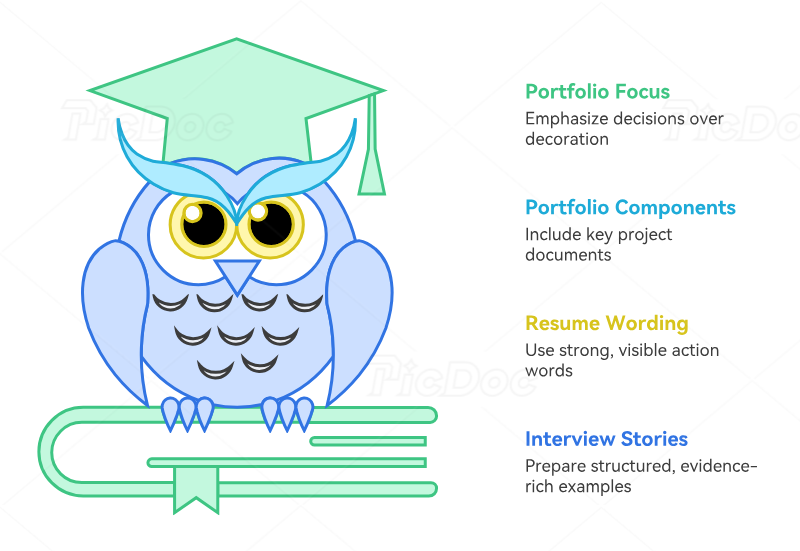
Build a portfolio around decisions rather than decoration
A credible nonprofit project portfolio can contain anonymized or simulated documents. Hiring managers are evaluating your thinking, structure, and judgment. They do not need confidential donor, participant, employee, or financial information.
Your strongest portfolio case should include:
A one-page charter showing the problem, mission connection, scope, constraints, outcomes, sponsor, and success measures.
A stakeholder matrix separating funders, beneficiaries, board members, staff, volunteers, partners, regulators, and vendors.
A requirements and change log based on sound requirements-engineering practices.
A schedule showing dependencies, approvals, reporting deadlines, and contingency using accurate Gantt concepts.
A budget forecast connecting expenditure with progress through project financial management.
A risk register with triggers and funded mitigation responses.
A status report that makes decisions and variances visible through strong project reporting.
A closure review documenting acceptance, handover, unresolved work, outcomes, and lessons.
A polished schedule without a decision trail shows software familiarity. A portfolio that explains why you changed sequencing, rejected a scope request, escalated a safeguarding risk, or revised an indicator demonstrates project-management judgment.
Write resume bullets that reveal control
Weak resume wording hides project value:
Supported the delivery of community programs and worked with different stakeholders.
Stronger wording makes the operating challenge visible:
Coordinated a six-month community training initiative across four delivery partners, established milestone and evidence controls, resolved facilitator-capacity gaps, and completed all funder deliverables within the approved budget period.
A useful resume bullet contains a project objective, scale, constraint, management action, and verifiable outcome. Where confidentiality prevents exact numbers, use defensible ranges, percentages, time reductions, delivery counts, budget bands, or documented process improvements.
Use terminology that matches the vacancy, but avoid stuffing your resume with disconnected phrases from an agile glossary, Scrum glossary, Kanban terminology, or Waterfall glossary. Every important term should connect to an action you can defend in an interview.
Prepare evidence-rich interview stories
Use an expanded interview structure:
Context: Explain the mission objective, population served, funding condition, deadline, and delivery environment.
Exposure: Identify what could have failed, including compliance, budget, partner, capacity, quality, safeguarding, data, or reputation risks.
Decision: Describe the options considered, evidence reviewed, stakeholders consulted, and authority used.
Control: Explain the schedule, budget, reporting, escalation, change, or quality mechanism you introduced.
Result: State the measurable delivery and outcome result.
Learning: Explain what you would preserve, change, or monitor earlier next time.
This structure proves more than task completion. It demonstrates risk-management capability, stakeholder judgment, conflict-resolution skill, and the reflective discipline expected from future project-management leaders.
Prepare at least six stories: recovering a delayed project, managing a difficult stakeholder, controlling a budget issue, handling an unclear requirement, responding to a serious risk, and improving a delivery process. Select examples that reveal different capabilities instead of repeating one successful project six times.
5. Progress From Your First Nonprofit Role to Leadership in 2026
A sustainable career pathway usually moves through expanding decision scope rather than titles alone.
At the project support stage, common roles include project assistant, program assistant, grants assistant, operations coordinator, volunteer coordinator, or monitoring assistant. The goal is to become dependable at documentation, follow-up, data quality, meeting actions, scheduling, procurement support, and reporting inputs. Learn the organization’s operating system before attempting to redesign it.
At the project coordination stage, roles may include project coordinator, program coordinator, implementation officer, grants coordinator, or partnerships officer. You should own a complete workstream, maintain controls, coordinate partners, forecast delays, and prepare decision-ready updates. Strengthen your use of team communication platforms, project templates, workforce-management tools, and appropriate PM software integrations.
At the project management stage, you become accountable for the integrated project. This includes scope, budget, schedule, people, vendors, risks, reporting, quality, and stakeholder confidence. Your promotion case should show that your control system improved delivery rather than merely increasing documentation.
At the program leadership stage, titles may include senior project manager, program manager, portfolio manager, head of programs, or implementation director. You coordinate related projects, manage cross-project dependencies, allocate scarce resources, and protect strategic outcomes. Understanding the evolving role of the PMO, portfolio-management trends, project-governance practices, and leadership models becomes increasingly important.
At the organizational leadership stage, you may progress toward director of programs, chief operating officer, country director, executive director, or transformation leader. Your decisions now shape organizational capacity, funding exposure, governance, talent, technology, partnerships, and long-term mission performance.
Build the capabilities that are becoming more valuable in 2026
Funding conditions remain uneven, making scenario planning and revenue-risk awareness more important. Candid’s 2026 charitable-giving outlook describes changing payout behavior across foundation sizes and notes that some foundations have committed to temporarily increasing grantmaking budgets or payout rates. Project leaders therefore need to understand both expansion readiness and funding-contraction contingencies.
AI literacy is also becoming part of nonprofit project leadership. Candid reported that 80% of 850 nonprofits surveyed in its 2025 AI Equity Project were familiar with AI, while more than half were concerned about potential harm to marginalized communities. Responsible adoption therefore requires privacy controls, bias awareness, community consideration, and human accountability.
PMI describes basic AI fluency as an essential capability for modern project professionals and emphasizes data literacy, communication, and ethical foresight. In nonprofit settings, those skills should support activities such as document classification, meeting summaries, scenario generation, risk identification, grant prospecting, and draft reporting while preserving human review and approved data-handling rules.
Build practical competence through AI and project-management analysis, automation career forecasting, future PM software trends, and machine-learning estimation concepts. The leadership advantage comes from choosing responsible use cases, establishing controls, measuring benefit, and stopping tools that create unacceptable risk.
Use certifications strategically
A certification can strengthen credibility when it closes a specific gap. Entry-level candidates may use CAPM preparation to formalize terminology and process knowledge through CAPM study resources and exam-day preparation. Experienced professionals may pursue PMP using strong exam-preparation resources, detailed PMP domain guidance, and realistic exam-mistake prevention.
Professionals working in adaptive program environments may compare PMI-ACP, CSM, and SAFe, while governance-heavy organizations may value a careful PRINCE2 versus PMP comparison. Business-analysis, cost-control, evaluation, safeguarding, data protection, and sector-specific credentials may produce greater value than collecting multiple general PM badges.
Apply one decision rule: pursue the credential most frequently requested in your target roles, then pair it with a portfolio artifact proving that you can apply the underlying capability.
6. FAQs About the Nonprofit Project Management Career Pathway
-
Previous nonprofit employment helps, but equivalent evidence can come from public service, education, healthcare, community initiatives, corporate social-impact work, associations, foundations, or structured volunteering. Hiring panels need confidence that you can operate with constrained resources, multiple stakeholder groups, mission accountability, and strong documentation.
Translate your background using stakeholder-engagement evidence, risk-management examples, financial-control proof, and complete project-closure records. One well-controlled mission-related project can be more persuasive than years of loosely described nonprofit involvement.
-
Project assistant, program assistant, operations coordinator, grants assistant, volunteer coordinator, partnerships assistant, monitoring assistant, and implementation coordinator roles can all create viable pathways. Prioritize vacancies that offer ownership of schedules, budgets, reporting, vendors, partners, risks, or defined workstreams.
A role with a fashionable title may provide less development than a modest coordination role with real control responsibility. Review whether the job allows you to practice project execution, resource allocation, monitoring and control, and formal stakeholder communication.
-
PMP requirements vary by employer, project scale, funder environment, and seniority. Many coordinator and early-career roles prioritize relevant delivery evidence, while senior or internationally funded positions may value recognized certification more heavily.
Assess the vacancies you realistically plan to pursue. When PMP appears repeatedly, use PMP preparation resources, study the current exam domains, and understand certification maintenance. Earlier-career professionals can use CAPM resources while building the experience required for more advanced credentials.
-
Include one complete case showing mission alignment, scope, stakeholders, schedule, budget, risks, indicators, reporting, decisions, and closure. Add a change request, variance explanation, decision log, and short reflection on what you would improve.
Use anonymized documents and remove personal, financial, donor, employee, participant, and partner information. Reliable project templates, reporting practices, risk-register structures, and project finance terminology can help you construct a professional evidence pack.
-
Build a simulated grant implementation pack using a publicly available funding brief or an anonymized opportunity. Extract objectives, eligibility conditions, deliverables, allowable activities, reporting dates, indicators, documentation requirements, and budget restrictions.
Turn those conditions into a grant obligation register, implementation schedule, risk log, evidence matrix, budget forecast, and reporting calendar. This demonstrates requirements analysis, cost control, project reporting, and governance discipline without claiming experience you do not possess.
-
Learn one mainstream project-management platform deeply enough to configure workflows, permissions, dependencies, dashboards, recurring tasks, and reporting. Add spreadsheet competence, document collaboration, presentation, survey, CRM, and data-visualization skills. Tool selection should reflect the organization’s scale, security needs, team capability, integrations, and operating cost.
Explore agile project-management tools, Kanban software, team communication platforms, and project-management integrations. Employers gain more value from candidates who can design a sustainable workflow than candidates who merely list ten platforms.
