
Teacher to Project Management: Reddit Career-Change Experiences, Transferable Skills & the Roles Most Realistic to Target
Teachers exploring project management usually discover that the transition problem is deeper than rewriting “lesson planning” as “project planning.” Hiring teams want evidence that you can coordinate work across stakeholders, manage dependencies, surface risk, document decisions, and deliver something with a defined endpoint. That distinction explains why understanding project management hiring reality, building portfolio evidence that gets interviews, choosing a realistic no-experience PM entry route, and understanding the project coordinator-to-PM pathway matter more than collecting credentials blindly.

1. What Reddit Career Changers Reveal About the Teacher-to-PM Transition
Recent Reddit discussions expose the central tension clearly. Teachers often possess strong planning, communication, leadership, facilitation, conflict-management, and prioritization skills, yet those strengths frequently fail to translate into corporate hiring evidence. A June 2026 discussion involved an assistant principal with 11 years in education who saw project management as a logical transition and had already begun a Google PM certificate. Another 2026 teacher described coordinating STEM events, schedules, resources, stakeholders, timelines, and deliverables while targeting project coordinator and junior PM work.
The mistake is assuming transferable skills automatically create equivalent professional experience. One former teacher who became a pharmaceutical research project manager specifically warned that teaching alone did not prepare someone to lead specialized clinical projects. Domain exposure had to come first. Another successful career changer broadened the search from PM titles to Project Assistant positions, entered through an ERP migration, and subsequently gained direct exposure to budgets, purchase orders, vendors, contracts, issues, and stakeholders. That pattern closely matches the broader distinction between certification and real PM experience, the realities of becoming a PM without experience, and why some certified PM candidates still struggle to get hired.
Think of teacher-to-PM employability as three layers. Layer one is transferable capability: communication, organization, facilitation, planning, reporting, adaptability, and stakeholder management. Layer two is project evidence: defined objectives, deliverables, deadlines, dependencies, risks, decisions, measurable outcomes, and multiple contributors. Layer three is business context: budgets, procurement, vendors, contracts, software workflows, governance, commercial constraints, or an industry-specific operating environment. Studying how companies choose PM tools, understanding PMO effectiveness, learning the business-analysis side of project work, and seeing how remote project teams collaborate helps close that third layer.
This explains why sending 300 applications with the same generic “teacher seeking project manager position” resume can produce almost nothing. A career changer should first decide which business problem they are credible enough to help solve. An education technology company may value curriculum implementation experience. A nonprofit may value grant-funded programs and community coordination. A training company may value instructional delivery and stakeholder management. A generic construction PM opening may demand procurement, subcontractor, scheduling, and cost experience the same candidate cannot yet demonstrate. Choosing a lane is therefore as important as deciding whether project management remains worth entering, whether CAPM makes sense without experience, or whether a Google PM certificate or CAPM fits the next step.
2. How to Translate Teaching Experience Into Evidence a PM Hiring Manager Can Trust
A strong transition begins by separating responsibilities from projects. Teaching algebra every semester is an operational responsibility. Launching a new intervention program across six classes, coordinating four teachers, setting milestones, tracking adoption, resolving scheduling conflicts, and evaluating results has project characteristics. That distinction matters because employers assessing real PM experience look for temporary work with an objective and outcome. It also protects applicants from the credibility problem discussed in PM hiring stories, particularly when candidates are pursuing a first PM role without formal experience.
For every legitimate project, build a one-page project evidence sheet. Record the objective, scope, start and finish, contributors, stakeholders, major milestones, constraints, risks, your decisions, artifacts you created, and measurable outcome. Then identify whether you can reconstruct sanitized versions of the schedule, action log, stakeholder matrix, status report, issue tracker, implementation checklist, or retrospective. This creates the same evidence discipline that becomes valuable when moving from project coordinator to project manager, pursuing a business analyst-to-PM transition, moving from IT into project management, or eventually developing toward program management.
The strongest teacher skills also need business-language precision. “Communicated with parents” becomes more valuable when the real story is “created a recurring stakeholder communication cadence covering progress, risks, upcoming decisions, and unresolved actions.” “Planned lessons” should never be mechanically relabeled “managed projects.” A stronger example could be “coordinated a six-week curriculum implementation across three classes, sequenced dependencies, monitored completion milestones, and adjusted the rollout after resource constraints emerged.” Learning formal project governance, understanding how organizations evaluate PMO performance, developing stronger business-analysis capability, and understanding earned value concepts can sharpen that translation without exaggerating experience.
Pay particular attention to commercial gaps. Teachers often have strong people-side capability and much weaker evidence around budgets, procurement, vendor management, contracts, forecasting, resource economics, or executive reporting. Those gaps can be closed intentionally. Volunteer for a school initiative involving an external vendor. Help coordinate a funded program. Track a real budget. Manage a technology implementation. Ask to participate in purchasing or rollout discussions. Learn how companies select project-management tools, how the PM software market is evolving, how remote teams coordinate work, and how cybersecurity changes PM responsibilities. One genuinely commercial project can materially improve a teacher's interview credibility.
Certification should then be chosen around the evidence gap. An early-career applicant comparing CAPM with limited experience against a Google PM certificate has a different decision from an experienced candidate determining whether PMP is worth it. Comparing PMP, CAPM, PRINCE2 and AgilePM is useful only after deciding which jobs you intend to pursue. A certificate can improve vocabulary, methodology, and recruiter recognition. Your experience story still has to answer, “What did you actually deliver?”
3. The Project Management Roles Teachers Should Target First
The most realistic first target for many teachers is Project Coordinator. Coordinators often maintain schedules, chase actions, organize meetings, update trackers, prepare status material, communicate with stakeholders, and support the PM. Those responsibilities create the bridge between teacher strengths and commercial delivery. Candidates can study the coordinator-to-project-manager progression, strengthen their understanding of what employers screen for, and use the no-experience PM roadmap to identify which missing pieces can be built before applying.
Project Assistant and PMO Assistant positions can be even more strategic when direct PM applications keep failing. These jobs expose career changers to governance packs, minutes, reporting calendars, issue logs, RAID registers, financial tracking, resource data, and portfolio reporting. A year of serious exposure can answer questions a certificate cannot. Understanding PMO effectiveness, building toward project governance leadership, learning earned value management, and observing how organizations make project-management tool decisions can turn an assistant-level foothold into a powerful apprenticeship.
Teachers should also examine Implementation Coordinator, Customer Onboarding Coordinator, Training Implementation Specialist, Learning and Development Project Coordinator, and EdTech implementation roles. These positions reward the ability to teach users, organize rollout activities, manage adoption, communicate changes, and troubleshoot confusion. The candidate already understands learning behavior, resistance, audience differences, and facilitation. Add the delivery mechanics found in agile project-management careers, the traditional-to-agile transition, SAFe career development, and Scrum@Scale pathways, and that education background becomes much easier to position.
Program Coordinator and nonprofit project roles are another strong adjacency, particularly for teachers who have managed school initiatives, community partnerships, student programs, grants, interventions, or extracurricular programs. Applicants can investigate the nonprofit PM career pathway, understand eventual movement toward program manager positions, study the route toward senior PM consulting, and see how experienced project professionals eventually progress toward PM executive leadership. The immediate target should still match the candidate's current evidence.
Direct Project Manager applications make the most sense when the teacher has genuine project ownership beyond normal classroom operation. Department heads, assistant principals, instructional coaches, technology leads, program leads, or teachers who have delivered funded cross-school initiatives may already possess stronger evidence. Even then, industry distance matters. A teacher with extensive digital-learning implementation may be credible for EdTech PM work while remaining poorly positioned for construction delivery. Anyone considering specialized sectors should study role-specific paths such as environmental project management, marketing project management, cybersecurity and project management, and eventually project-management consulting before assuming PM skills travel equally across industries.
A useful application rule is one level adjacent before two levels aspirational. Apply heavily to roles where approximately 70–80% of the work can already be evidenced, selectively pursue stretch roles where domain overlap compensates for missing formal title history, and stop spending most of the application budget on positions demanding capabilities you have never practiced. That same discipline helps people making a career change into PM at 30, candidates deciding whether PM is still worth pursuing, and applicants deciding which PM certification fits their career stage.
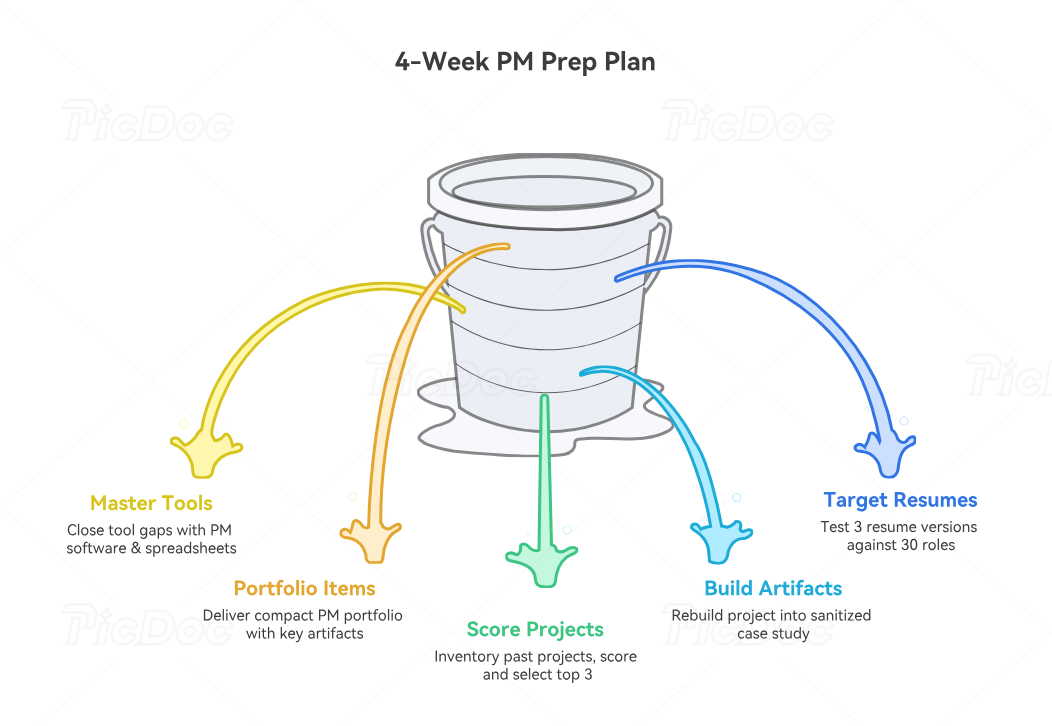
4. Build a 30-Day Teacher-to-PM Proof Portfolio Before Mass Applying
Spend the first week performing a project inventory, not editing fonts on your resume. Review the previous three to five years and identify six to ten initiatives with a defined objective, finite timeline, multiple contributors, constraints, and an outcome. Score each project for scope clarity, stakeholder complexity, timeline ownership, risk handling, documentation, budget exposure, vendor exposure, and measurable results. Keep the strongest three. This evidence-first method is more useful than immediately buying another certification, particularly when evaluating CAPM with no experience, PMP career value, Google PM versus CAPM, or the broader certification-versus-experience problem.
During week two, rebuild one project as a sanitized professional case study. Create a project charter showing the objective, scope, exclusions, stakeholders, milestones, and success criteria. Add a simple RAID log containing risks, assumptions, issues, and dependencies. Create a stakeholder matrix, milestone schedule, weekly status report, decision log, and lessons-learned page. Remove student names, confidential information, and internal school data. The objective is to show that you understand the mechanics behind the work. Exposure to PMO reporting practices, business analysis, project governance, and collaboration software can make those artifacts substantially more realistic.
Week three should close tool and workflow gaps. Pick one mainstream task-management environment and become competent enough to build a project from scratch. Create milestones, dependencies, owners, views, status fields, risk items, and a basic dashboard. Then reproduce the same project in a spreadsheet so you understand the underlying logic rather than becoming dependent on software. Reviewing the project-management software market, understanding how companies choose PM tools, studying remote collaboration adoption, and learning where AR and VR may affect project work builds broader tool literacy without turning software badges into the centerpiece of your candidacy.
Week four is for targeted market testing. Build three resume variants rather than one universal version. Version A can target Project Coordinator and PMO roles. Version B can target EdTech implementation, customer onboarding, or learning projects. Version C can target nonprofit or program coordination. Search 30 relevant vacancies and create a frequency sheet showing which capabilities appear most often. If 21 request status reporting, 18 request stakeholder coordination, 17 request a specific tool, and 15 mention risk or issue tracking, your development priorities become obvious. This is more disciplined than sending undifferentiated applications while wondering whether PM certification will solve the problem, whether certified candidates automatically get hired, or whether project management remains a viable career.
The final deliverable should be a compact portfolio containing three case studies, one charter, one timeline, one RAID log, one stakeholder map, one status report, one decision log, one lessons-learned document, and one project dashboard. You can then discuss the same material during interviews instead of relying on abstract claims such as “teachers are great communicators.” Candidates moving through project coordinator roles, agile PM careers, nonprofit project management, or eventually program management all benefit from the same principle: evidence creates a stronger bridge than potential alone.
5. Fix the Resume, Interview Story and Application Strategy at the Same Time
Your resume headline should position you around the role you are pursuing, while the experience section should preserve truthful job titles. Changing “Teacher” to “Project Manager” creates avoidable credibility risk. Instead, bullets should show project behavior where it genuinely occurred. A useful structure is problem → scope → coordination → action → result. This format aligns naturally with the evidence employers expect when reviewing career changers entering PM, candidates building portfolio proof, professionals moving from coordinator to project manager, and applicants confronting PM hiring filters.
Consider the difference between “Led professional development for teachers” and “Coordinated a six-week professional-development rollout for 42 staff across four departments, sequenced sessions around operational constraints, tracked attendance and outstanding actions, and revised delivery based on feedback.” The second bullet gives an interviewer something to interrogate. They can ask about scope, schedule, resistance, stakeholders, changes, and outcomes. The same evidence style is useful in marketing project-management careers, environmental PM roles, nonprofit PM positions, and project governance careers.
Interview preparation should focus heavily on project judgment, because communication ability alone is rarely the concern with an experienced teacher. Prepare examples covering scope change, missed deadlines, competing stakeholder priorities, resource constraints, an escalating issue, a failed initiative, ambiguous requirements, a difficult decision, and a project whose original plan had to change. For each, explain what information you had, what options existed, what you chose, why you chose it, and what happened. Learning from business-analysis practices, earned value management, agile project-management progression, and PMO operating models gives you stronger frameworks for discussing those decisions.
Application strategy should then become narrower and more analytical. Track applications by role family, industry, experience requirement, domain match, referral status, resume version, screening result, interview result, and rejection stage. After 30–40 carefully selected applications, inspect the funnel. Almost no screens suggests a positioning or targeting problem. Screens without hiring-manager interviews suggest insufficient evidence or domain fit. Repeated final-round losses suggest interview calibration, competition, or role-level mismatch. This diagnostic approach is far more useful than assuming another credential will fix everything. Before buying one, compare PMP ROI, CAPM outcomes, major PM certification options, and the future of project-management certifications.
Finally, be willing to accept a strategic title reset when it buys valuable experience. An experienced teacher may emotionally resist “Coordinator” because it sounds junior after years of classroom leadership. Corporate seniority is measured against a different capability stack. Six to eighteen months gaining real exposure to budgets, vendors, governance, implementation, systems, and executive reporting can create more long-term leverage than another year applying only to PM titles. The goal is a progression path toward project management leadership, senior PM consulting, program management, or even a longer-term PM-to-COO trajectory, rather than winning the most impressive title on day one.
6. FAQs About Moving From Teaching to Project Management
-
Yes. The transition becomes much more credible when the teacher can document genuine project work and targets roles that match existing domain knowledge. Recent Reddit discussions include successful teacher-to-PM transitions alongside candidates who struggled because transferable skills or certifications failed to substitute for industry exposure.
Start by separating classroom operations from finite initiatives, then build evidence around scope, milestones, stakeholders, risks, decisions, and outcomes. The no-experience project-management roadmap, project coordinator progression, certification-versus-experience analysis, and broader assessment of whether project management is worth pursuing in 2026 provide useful frameworks for deciding how aggressive that transition should be.
-
Project Coordinator, Project Assistant, Implementation Coordinator, Program Coordinator, PMO Assistant, EdTech Implementation Specialist, Customer Onboarding Coordinator, and Learning & Development Project Coordinator are often more defensible first targets than generic mid-level Project Manager positions.
The best choice depends on where your domain advantage survives the career change. Education technology rewards school-system understanding. Nonprofits may value community programs and grant exposure. Training implementation rewards facilitation and adoption skills. A candidate can compare the project coordinator-to-PM path, nonprofit project-management pathway, program-management progression, and business analyst-to-PM route before deciding where the strongest adjacency exists.
-
Some do, but years spent teaching do not automatically equal years managing projects. The correct question is whether you led finite initiatives with defined outcomes, timelines, stakeholders, deliverables, constraints, and meaningful responsibility for execution.
A curriculum rollout, LMS migration, school-wide event, intervention launch, accreditation initiative, funded program, technology implementation, or cross-department improvement project may provide legitimate evidence. Routine classroom management generally provides transferable capability instead. Understanding the distinction between certification and project experience, PM hiring requirements, business-analysis work, and project governance helps classify that experience accurately.
-
Choose according to the hiring problem you need to solve. A beginner who needs structured PM vocabulary and workflow exposure may gain value from introductory training. Someone seeking a recognized entry credential may consider CAPM. A candidate who genuinely satisfies PMP experience requirements may evaluate PMP. None should be purchased simply because applications are failing.
Compare Google PM Certificate versus CAPM, whether CAPM is worthwhile without experience, the 2026 value of PMP, and the differences among PMP, CAPM, PRINCE2 and AgilePM against actual vacancies in your target market.
-
Keep the official job title accurate and reconstruct relevant bullets around project evidence. Identify the objective, scale, contributors, deadline, constraints, your actions, artifacts, and result. Replace education-specific language where equivalent business terminology is accurate, while avoiding invented budgets, fake clients, inflated authority, or routine teaching duties presented as full project ownership.
Your resume becomes substantially stronger when supported by portfolio evidence, aligned with what PM employers actually screen for, targeted toward an appropriate project coordinator progression, and supported by relevant knowledge of modern PM software.
-
The most consequential gap is often business-delivery context, especially budgets, vendors, procurement, contracts, formal governance, commercial priorities, executive reporting, project tooling, and industry-specific workflows. Teachers frequently already possess strong communication and facilitation skills. More communication training therefore has diminishing value if the hiring barrier is commercial exposure.
Look for projects that expose you to those missing dimensions while learning how PMOs operate, how organizations choose project tools, how collaboration works across remote teams, and how cybersecurity intersects with project delivery. One project involving budgets, vendors, dependencies, risks, and executive reporting can be more valuable than several generic online courses.
