
Freelance Agile project management offers experienced professionals the opportunity to work with startups, software teams, agencies, and growing businesses without committing to one employer. But finding paying clients requires more than knowing Scrum ceremonies or holding a certification. Businesses want someone who can resolve delivery bottlenecks, organize priorities, and improve how teams work.
This guide explains how to choose profitable services, build a credible portfolio, find your first clients, price engagements, and turn short contracts into recurring freelance income. You'll also find practical templates, a 28-step launch checklist, and a realistic 90-day business roadmap.

1. Step One: Identify Your Freelance Agile Specialty and Build Marketable Skills
Freelance Agile professionals enter a market where clients frequently describe their problems differently from project management textbooks. A startup founder might complain about missed launches, while an agency owner struggles to coordinate five remote contractors. Both may need Agile delivery expertise.
Your first decision is which problems you're qualified to solve.
Understand the services clients actually purchase
A freelance Agile project manager may coordinate delivery, manage dependencies, maintain stakeholder communication, and improve project visibility. A Scrum Master focuses on Scrum effectiveness, facilitation, coaching, and removing impediments. An Agile coach may work across several teams to improve organizational practices.
These responsibilities can overlap in commercial engagements, but contracts should clearly define your actual authority.
The official Scrum Guide emphasizes self-managing teams, with the Product Owner accountable for product value and the Scrum Master accountable for Scrum effectiveness.
This distinction matters when exploring career transitions into Agile project management or advancing from an Agile team member into project leadership.
You should understand Scrum, Kanban, backlog management, iterative planning, workflow visualization, and continuous improvement well enough to select an approach appropriate to the client.
Choose an industry where your experience creates an advantage
Start with the industries you already understand.
A former software engineer can offer technical delivery coordination. Someone with marketing experience may specialize in campaign execution. A healthcare operations professional may support digital implementation projects that demand careful stakeholder coordination.
Relevant experience reduces the amount of industry-specific knowledge you must acquire before delivering useful results.
Compare Agile career development opportunities, marketing project management pathways, and IT-to-project-management transitions to identify your strongest starting position.
A practical positioning statement:
"I help small software teams improve delivery predictability through backlog management, dependency tracking, and structured stakeholder reporting."
This tells prospective clients which problem you address, which customers you serve, and how you contribute.
Select certifications according to your experience
Professional credentials can strengthen credibility, especially when clients explicitly request them.
Consider these pathways:
Certified ScrumMaster (CSM): Foundational Scrum training, including a required instructor-led course.
Professional Scrum Master (PSM): Scrum knowledge assessment through Scrum.org.
PMI Agile Certified Practitioner (PMI-ACP): Broader Agile expertise for professionals meeting PMI's eligibility criteria.
SAFe Agilist: Potentially useful for organizations using the Scaled Agile Framework.
Scrum Alliance states that CSM candidates must complete a 16-hour course before taking its assessment. PMI-ACP has separate experience and training requirements that applicants should verify against PMI's current certification information.
Explore PMI-ACP versus CSM and SAFe, the Advanced Certified ScrumMaster pathway, and SAFe certification preparation.
Prioritize credentials that support the services you intend to sell. A training certificate becomes more persuasive when accompanied by evidence of successful project delivery.
Build a minimum viable technical toolkit
Practice configuring Jira or a similar delivery board, managing work-in-progress limits, building release dashboards, and preparing clear project reports.
Learn to interpret cycle time, throughput, blocked-work age, and delivery forecasts without misrepresenting uncertainty.
Professionals considering Scrum Product Owner certification, requirements engineering, or Agile certification career outcomes should also develop practical demonstrations of their skills.
The objective is straightforward: prospective clients should be able to see what you can deliver before committing to a contract.
| Step | Action | Deliverable | Success Check |
|---|---|---|---|
| 01 | Assess Agile delivery experience | Skills inventory | Identify responsibilities you can demonstrate |
| 02 | Choose a target industry | Niche statement | Specify a buyer and business problem |
| 03 | Identify suitable clients | Ideal client profile | Define size, sector, and maturity |
| 04 | Map delivery pain points | Problem inventory | Prioritize expensive recurring problems |
| 05 | Refresh Scrum fundamentals | Knowledge checklist | Explain accountabilities and events |
| 06 | Practice Kanban techniques | Sample workflow | Demonstrate WIP limits and flow metrics |
| 07 | Evaluate certifications | Credential roadmap | Match training to client requirements |
| 08 | Choose delivery tools | Demo workspace | Configure a functioning client board |
| 09 | Select initial services | Service menu | Define three clear deliverables |
| 10 | Develop sample templates | Template library | Include logs, dashboards, and plans |
| 11 | Document past project work | Case studies | Verify achievements and results |
| 12 | Build a portfolio | Portfolio page | Show capability without confidential data |
| 13 | Optimize LinkedIn | Targeted profile | Explain niche and client outcomes |
| 14 | Create freelance profiles | Marketplace listings | Clearly describe offered services |
| 15 | Research pricing | Rate worksheet | Include fees and nonbillable work |
| 16 | Package a diagnostic | Audit offer | Define duration and written findings |
| 17 | Write a discovery script | Question list | Test urgency, authority, and budget |
| 18 | Build prospect list | Lead tracker | Include relevant decision-makers |
| 19 | Develop outreach examples | Message templates | Personalize around business problems |
| 20 | Set proposal boundaries | Statement of work | Define scope and exclusions |
| 21 | Establish payment terms | Contract checklist | Specify invoicing and milestones |
| 22 | Plan client onboarding | Access checklist | Obtain approvals and system access |
| 23 | Baseline delivery performance | Initial metrics | Record a defensible starting point |
| 24 | Run a pilot engagement | Delivery improvement | Complete agreed scope |
| 25 | Report results | Outcome summary | Separate observed results from estimates |
| 26 | Request client feedback | Testimonial request | Secure permission for publication |
| 27 | Offer ongoing support | Retainer proposal | Specify capacity and responsibilities |
| 28 | Review business performance | Monthly scorecard | Track margins, leads, and retention |
2. Step Two: Build an Agile Portfolio and Package Services Clients Will Pay For
Clients evaluating an independent project management specialist want evidence that you can improve their delivery process without requiring months of supervision.
Build your initial portfolio around outcomes, business context, and tangible examples of your work.
Create three focused service packages
Package A: Agile Delivery Health Check
Offer a structured assessment of how a team plans, tracks, and delivers work.
Review its backlog quality, workflow, stakeholder communication, blockers, and reporting practices.
Deliver a current-state assessment, prioritized improvement opportunities, and an actionable 30-day roadmap.
This service can attract startups that need help diagnosing delivery problems before committing to ongoing consulting.
It is particularly relevant to organizations researching PMO effectiveness and evaluating project management software adoption.
Package B: Agile Delivery Setup
Help a business establish a practical delivery workflow.
Potential deliverables include a configured Jira board, work policies, backlog refinement process, stakeholder dashboard, and documented working agreements.
Create an agreed handover process so the client can maintain the system independently.
The engagement should reflect the team's actual needs. Avoid introducing unnecessary Scrum events into a simple workflow.
Study how companies choose project management tools and collaboration software adoption in remote teams for related implementation considerations.
Package C: Fractional Agile Delivery Management
Offer ongoing coordination for clients that need recurring support but cannot justify a full-time project manager.
Define weekly availability, stakeholder reporting, dependency tracking, delivery coordination, escalation procedures, and meeting responsibilities.
Fractional work can be attractive to agencies managing several active client projects. However, capacity must be allocated realistically.
A freelancer serving three organizations cannot promise instant availability to each during the same working hours.
Professionals interested in senior project management consulting or project governance leadership can eventually expand these services.
Build case studies that demonstrate credible value
Use this format for each previous project:
Client problem: What delivery challenge existed?
Your responsibility: Which activities were you authorized to manage?
Intervention: What changes did you introduce?
Evidence: Which records or metrics establish the outcome?
Result: What improved, what remained unresolved, and what was handed over?
For example, a legitimate case study might demonstrate how a delivery team reduced the average age of blocked work after introducing explicit escalation policies.
Support that claim with before-and-after records. State the observation period, sample size, and other changes that may have influenced the outcome.
Where client information is confidential, publish anonymized descriptions only with the necessary permissions.
Applicants developing portfolio evidence instead of relying exclusively on certification can use the same approach.
What if you haven't completed a paid Agile engagement?
Build a demonstration environment using fictional projects and clearly label them as simulations.
You might create a sample product backlog, Jira board, risk register, reporting dashboard, and release readiness checklist.
These examples show tool proficiency and structured thinking. They should remain separate from your professional case studies.
Beginners can explore project management career entry without experience, CAPM for early-career professionals, and project coordinator advancement.
Your initial service scope should match what you can competently deliver.
3. Step Three: Find Freelance Agile Clients and Convert Leads Into Contracts
Client acquisition becomes easier when you stop competing for every project management vacancy and focus on buyers experiencing problems your services address.
Identify decision-makers with an immediate delivery problem
Potential buyers include startup founders, engineering leaders, product directors, agency owners, and operations managers.
Prioritize organizations showing signals of delivery complexity, such as expanding product teams, repeated launch delays, contractor coordination problems, or recently introduced project management systems.
Look for opportunities through Upwork, LinkedIn, specialized consulting networks, industry communities, and professional referrals.
Relevant Reddit discussions on freelance Agile opportunities and part-time project management consulting show that independent practitioners actively explore these routes.
Their experiences are anecdotal, so validate actual demand in your chosen market.
You can strengthen your positioning by researching remote project management opportunities, the strongest industries for project managers, and Agile career advancement routes.
Write outreach that addresses a specific business concern
An effective message connects an observable situation with a narrowly defined offer.
Example outreach message:
"Hi, I noticed your team is expanding its product delivery operations. I help growing software teams improve release visibility and reduce coordination bottlenecks. If delivery reporting or cross-team handoffs are becoming difficult, I'd be happy to discuss a short workflow assessment and share the kinds of improvements it could identify."
Personalize the opening with relevant public information or a legitimate referral.
Avoid claiming that an organization has delivery problems unless you have evidence.
Qualify prospects before preparing lengthy proposals
Use a discovery call to establish:
Which delivery outcome is currently at risk?
What has the client already tried?
Who owns decisions about scope and priorities?
How many teams and systems are involved?
What budget and start date are realistic?
What would make the engagement successful?
A useful question is: "What happens financially or operationally if this problem remains unresolved for another two months?"
The answer helps establish urgency and the value of solving the problem.
Clients comparing Agile and traditional project management may also need help deciding whether Scrum, Kanban, or a hybrid approach fits their constraints.
Use a concise, outcome-driven proposal
A strong proposal contains the client's problem, engagement objectives, included deliverables, working assumptions, timeline, fees, and next steps.
Example statement of work:
Engagement: Four-week Agile Delivery Health Check
Scope: Examine two delivery teams, review existing workflow information, interview key stakeholders, and facilitate an improvement-planning workshop.
Deliverables: Current-state assessment, identified delivery constraints, baseline performance measures, prioritized improvement backlog, and a 30-day action plan.
Exclusions: Software development, unrestricted system configuration, company-wide transformation, and ongoing team management.
Acceptance: Completion of agreed deliverables and one client review session.
Clearly defining exclusions protects both parties from scope disputes.
Before using a formal proposal, check the client's procurement requirements and applicable contract conditions.
What's Your Biggest Obstacle to Landing Your First Freelance Agile Client?
Submit
4. Step Four: Set Freelance Rates, Negotiate Contracts, and Protect Profitability
Freelance rates should reflect the value and complexity of your work, the commercial market you're serving, and the expenses involved in operating independently.
Understand market rate benchmarks
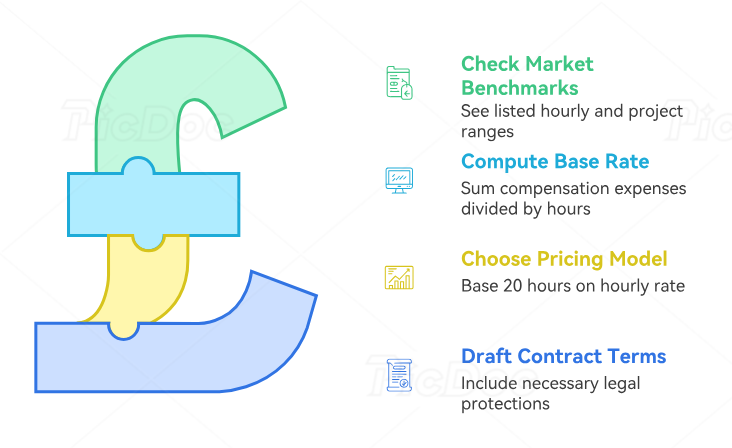
Upwork's May 2026 rate guide lists the following broad marketplace ranges:
Agile Project Managers: $40–$85 per hour.
Agile Consultants: $50–$120 per hour.
These are platform benchmarks, rather than guaranteed earnings or recommended minimums.
The same platform's Agile project manager hiring guide describes focused project engagements ranging from approximately $800 to $2,500, with larger implementation and transformation work potentially costing substantially more.
Your location, experience, client industry, competitive environment, and scope will influence actual pricing.
Professionals researching project management salaries, Agile certification career outcomes, and project management consulting careers should distinguish salaried compensation from freelance revenue.
Calculate your minimum sustainable rate
Use this formula:
Required hourly billing rate = (target annual compensation + annual business expenses) ÷ expected annual billable hours
Suppose you want $60,000 in annual compensation, expect $12,000 in business expenses, and forecast 1,000 billable hours.
Your initial rate would be $72 per billable hour, before adjusting for applicable taxes, platform fees, additional reserves, and local requirements.
Your working hours will exceed your billable hours because marketing, proposals, administration, and professional development also consume time.
If your engagement comes through Upwork, account for its current variable freelancer service fee, which ranges from 0% to 15%.
Select the appropriate pricing model
Hourly pricing fits assignments where the volume of coordination work changes frequently.
Fixed-fee pricing suits a clearly defined assessment, setup, or workshop with measurable deliverables.
Retainers work best when the client requires ongoing capacity, predictable availability, and regular support.
Consider a workflow assessment involving 20 hours of estimated work. If your sustainable hourly rate is $75, the initial labor estimate is $1,500.
Add any applicable costs and risk allowance before finalizing the fixed fee.
Specify how additional requests will be handled.
Establish essential contract protections
Every engagement should document the scope, payment schedule, responsible parties, access arrangements, confidentiality duties, ownership of work products, change approval process, termination provisions, and dispute-resolution approach.
For ongoing coordination, specify the weekly time allocation and response-time expectations.
If a client expects round-the-clock availability, treat that as a distinct service requirement with an appropriate commercial arrangement.
Professionals moving toward program management, project governance leadership, or executive project management positions can apply the same principles to increasingly complex contracts.
For cross-border clients, verify relevant tax, invoicing, confidentiality, insurance, and worker-classification requirements with qualified local advisers.
5. Step Five: Deliver Excellent Client Results and Build a Sustainable 90-Day Freelance Business
Winning a contract proves that a client is willing to hire you. Your delivery process determines whether the engagement creates a credible case study, referral, or recurring relationship.
Start with a structured first-week assessment
Your first week should establish the client's actual delivery conditions.
Review the existing backlog or work inventory, project objectives, stakeholder expectations, team capacity, dependencies, and current reporting.
Identify whether priorities change without approval, blocked work remains unresolved, or planned commitments regularly exceed capacity.
Agree on the metrics relevant to the client's problem.
A software team might monitor work-item cycle time, aging blocked tasks, and release readiness. A marketing agency might track campaign milestones, revision queues, and approval delays.
Avoid imposing identical dashboards across unrelated clients.
Learning about remote collaboration software adoption, project management tool selection, and PMO effectiveness can help you choose appropriate reporting practices.
Introduce improvements without undermining team ownership
A freelancer joining an established delivery team should clarify authority and responsibilities during onboarding.
For Scrum teams, protect the Product Owner's accountability for product value and the Developers' responsibility for planning their work.
Facilitate decisions, improve transparency, and help remove obstacles rather than taking over every team decision.
Track the adoption of new working agreements through observable behavior.
For example, if a team introduces an explicit blocked-work escalation rule, examine whether unresolved dependencies are being surfaced earlier.
Professionals developing Scrum Master expertise, Agile leadership skills, or Scrum@Scale knowledge will benefit from focusing on practical team effectiveness.
Build a client reporting rhythm
Agree on a weekly communication format covering completed outcomes, delivery risks, open decisions, upcoming milestones, and assistance required from the client.
Keep reports concise enough for executives to use.
Distinguish confirmed delivery information from estimates or forecasts.
If automation tools help prepare reports or summarize meetings, verify important details before sharing them.
Review AI applications in project management, tasks likely to be automated, and project management cybersecurity considerations when working with client systems and sensitive information.
Your first 90 days: an execution roadmap
Days 1–30: Establish the foundation
Choose your niche, verify your core skills, create two case studies, build your service packages, and prepare your client discovery process.
Research 30 suitable prospects and identify their actual needs.
Set up a simple CRM to record outreach, responses, follow-ups, and proposals.
Days 31–60: Test your commercial offering
Begin targeted outreach, apply selectively to relevant contracts, and schedule discovery conversations.
Improve your service descriptions using questions prospects repeatedly ask.
Seek a manageable pilot project with clearly defined deliverables.
Track the ratio between qualified leads, proposals, and signed contracts rather than focusing solely on message volume.
Days 61–90: Improve delivery and pursue repeat business
Complete agreed client work, document verified results, request feedback, and evaluate whether ongoing support would create value.
Review your billable hours, administrative workload, client acquisition costs, and realized hourly earnings.
Decide whether to refine your niche, change pricing, or develop a more specialized offer.
This is an illustrative roadmap. Your actual progress will depend on previous experience, business relationships, and market conditions.
Turn a successful engagement into recurring revenue
Arrange a closing review that compares the agreed objectives with actual results.
Present completed deliverables, remaining risks, unresolved decisions, and recommended next steps.
If the client needs continued coordination, propose a retainer with clear deliverables and capacity limits.
A successful engagement may also generate authorized testimonials and referrals.
As you gain experience, explore advanced project management consulting, Agile leadership careers, and long-term project management career development.
The commercial objective is to build a reliable practice where each completed engagement produces useful evidence, stronger relationships, and a clearer understanding of what clients will pay you to accomplish.
6. FAQs: Launching and Growing a Freelance Agile Project Management Career
-
Yes. Previous employment involving genuine project coordination, delivery leadership, Agile facilitation, or implementation can provide relevant evidence.
Start with services that match your existing capabilities and prepare credible case studies.
Professionals transitioning from employment can examine how to enter project management without formal experience and how to translate operational management experience.
-
Choose according to your experience and target clients.
CSM and PSM focus on Scrum, PMI-ACP covers broader Agile practices, and SAFe may be relevant for organizations using scaled approaches.
Compare PMI-ACP, CSM, and SAFe before investing in training.
-
Earnings depend on billable hours, pricing, utilization, operating expenses, and the market served.
Upwork's 2026 guide lists broad Agile project manager rates of $40–$85 per hour, although individual rates vary considerably.
Use these figures alongside research on project management compensation and your own operating-cost calculations.
-
Start with professional contacts, relevant freelance marketplaces, LinkedIn, software agencies, consulting partnerships, and industry-specific communities.
Approach organizations with identifiable delivery problems and explain the practical service you offer.
Freelancers considering remote project management opportunities should examine contract structure, required overlap hours, and client communication expectations.
-
Part-time engagements are possible when clients understand your availability and the arrangement supports the team's needs.
A focused coaching or workflow improvement engagement may require fewer hours than embedded daily support.
Define the boundaries carefully and avoid promising immediate availability beyond contracted capacity.
-
Suitable initial services might include delivery reporting setup, backlog organization, workflow visualization, stakeholder coordination, or a narrowly scoped assessment.
Choose according to your verified skills.
Early-career professionals can explore project coordinator roles and practical experience-building strategies.
