
Business Analyst to Project Manager: Reddit Career Paths, Skill Gaps & How to Move Without Starting Over
Business analysts already own much of the career capital that project managers need: stakeholder trust, requirements discipline, facilitation, documentation, dependency awareness, and cross-functional coordination. The difficult part is proving ownership beyond analysis. Employers want evidence that you can control delivery, make trade-offs, manage risk, recover slipping work, and communicate decisions upward. That makes the BA-to-PM transition highly achievable when you deliberately expand your scope, reposition existing experience, and build the missing delivery evidence before changing titles.

1. Why Business Analysts Can Move Into Project Management Without Sacrificing Career Capital
The strongest BA-to-PM transitions start by identifying what you already do at project-manager level. A business analyst who facilitates requirements workshops, resolves stakeholder conflicts, tracks dependencies, supports UAT, coordinates developers, manages changes, and explains delivery implications is already touching several PM competencies. The next career move becomes easier when those activities are translated into delivery ownership. This is why the broader business analyst to project manager career roadmap, the realities of becoming a project manager without prior PM titles, and the distinction between project management certification and real experience matter so much for analysts considering the move.
Recent Reddit discussions show the same pattern. Analysts describe working with stakeholders, requirements, UAT, Jira, Confluence, development teams, onboarding, and post-launch support before asking how to formalize a transition into project work. Another BA-to-PM discussion included professionals describing the move as a common progression while emphasizing project plans, resource planning, progress tracking, expectation management, and firsthand ownership of a small project.
That distinction matters because a hiring manager rarely evaluates your title in isolation. They look for evidence that you can convert ambiguity into controlled execution. Analysts often have exceptional discovery skills but leave delivery evidence hidden inside BA language. A resume bullet saying “gathered requirements from business stakeholders” sounds narrower than “aligned eight stakeholders on scope, documented approved requirements, controlled downstream changes, and protected the release from late scope expansion.” The underlying work may be similar. The second version communicates PM value. Candidates struggling with this should study why certified project managers still struggle to get hired, how project coordinators prove readiness for PM promotion, and how employers weigh CAPM when candidates have limited formal PM experience.
The transition also becomes easier when you preserve domain depth. A banking BA who understands KYC workflows, a healthcare BA who understands clinical systems, or an ERP analyst who understands finance integrations can move toward project leadership without discarding that expertise. Domain knowledge can reduce the perceived hiring risk because you already understand stakeholders, terminology, constraints, failure modes, and operational consequences. This same principle appears in IT-to-project-management career transitions, Agile team member-to-PM progression, and longer-term paths toward program management and project governance leadership.
| BA Strength | PM Capability to Add | Best Proof-Building Action | Evidence to Keep | How to Frame It in Interviews |
|---|---|---|---|---|
| Requirements elicitation | Scope control | Own baseline approval and change decisions | Scope baseline and change log | Show how you prevented uncontrolled scope growth |
| Stakeholder interviews | Stakeholder governance | Create influence and communication plans | Stakeholder matrix | Explain how you managed conflicting interests |
| Workshop facilitation | Decision facilitation | Drive meetings toward documented decisions | Decision log | Demonstrate reduced decision latency |
| Process mapping | Delivery planning | Convert processes into work packages | Work breakdown structure | Connect analysis to executable work |
| User stories | Backlog governance | Coordinate priorities, dependencies, and readiness | Backlog snapshots | Show control over sequencing and dependencies |
| Acceptance criteria | Quality governance | Define completion and acceptance gates | Acceptance checklist | Explain how you protected quality |
| UAT coordination | Test delivery ownership | Own UAT schedule and blockers | UAT tracker | Quantify readiness and blocker resolution |
| Gap analysis | Risk identification | Convert gaps into risks with owners and responses | Risk register | Describe risk prevention before impact occurred |
| Impact analysis | Change control | Assess cost, schedule, scope, and dependency effects | Change-impact assessment | Explain trade-offs you helped leadership make |
| Traceability | Governance discipline | Link commitments to approvals and outcomes | Traceability matrix | Demonstrate auditability and control |
| Jira administration | Progress control | Build status views around milestones and blockers | Delivery dashboard | Focus on decisions enabled by the data |
| Confluence documentation | Project information management | Design a project source of truth | Governance workspace | Explain how information gaps were reduced |
| Business rules | Constraint management | Track regulatory and operational constraints | Constraint register | Show how constraints shaped planning |
| Requirements prioritization | Trade-off management | Facilitate scope, time, and value decisions | Prioritization record | Give an example involving competing priorities |
| Cross-team coordination | Dependency management | Own cross-team dependency tracking | Dependency map | Explain how you prevented downstream delay |
| SME coordination | Resource planning | Track specialist availability and constraints | Resource forecast | Show how resource conflicts were handled |
| Release support | Milestone ownership | Own one release milestone end-to-end | Milestone plan | Describe the path from planning through acceptance |
| Issue investigation | Issue management | Assign owners, deadlines, escalation thresholds | Issue log | Show speed and quality of resolution |
| Root-cause analysis | Recovery planning | Build corrective-action plans | Recovery plan | Explain how delivery was stabilized |
| Data analysis | Project forecasting | Turn operational data into delivery forecasts | Forecast dashboard | Link insight to management action |
| Vendor requirements | Vendor management | Track commitments, milestones, and acceptance | Vendor tracker | Demonstrate external accountability |
| Solution evaluation | Benefits realization | Track outcomes after implementation | Benefits tracker | Connect project output to business impact |
| Business case support | Financial awareness | Track assumptions, costs, and expected value | Business-case model | Discuss commercial reasoning |
| Meeting minutes | Executive reporting | Convert detail into decision-ready updates | One-page status report | Show concise upward communication |
| Training support | Change adoption | Coordinate readiness and adoption activities | Adoption plan | Quantify readiness and adoption outcomes |
| Functional knowledge | Workstream leadership | Lead one functional workstream | Workstream plan | Establish end-to-end ownership |
| Sprint participation | Agile delivery leadership | Own impediments and release coordination | Impediment log | Show delivery leadership inside Agile teams |
| Status contributions | Project reporting | Own weekly status and variance explanations | Status pack | Demonstrate visibility and escalation judgment |
| Operational handover | Project closure | Own transition, acceptance, and lessons learned | Closure pack | Show disciplined completion |
| BA domain expertise | Integrated delivery ownership | Lead a small initiative using the capabilities above | Complete project evidence pack | Present yourself as a delivery professional with BA depth |
2. The Skill Gaps That Actually Block Business Analysts From Project Manager Roles
The biggest gap is usually accountability breadth. BAs may influence scope, risk, testing, priorities, and stakeholder alignment while another person remains accountable for the overall delivery commitment. A PM must understand what happens when a dependency slips, a resource disappears, a vendor misses a milestone, an executive adds scope, or a launch date becomes unrealistic. Building this judgment matters more than simply adding another methodology badge. Candidates weighing credentials should compare PMP career value in 2026, PMP, CAPM, PRINCE2 and AgilePM, and the broader future of project management certifications against the experience they already possess.
Planning depth is the second major gap. A BA may understand requirements sequencing yet have limited experience building a schedule around milestones, resources, dependencies, lead times, approval gates, and critical constraints. Start practicing decomposition. Take one initiative and identify deliverables, work packages, owners, dependencies, milestone dates, assumptions, and schedule threats. Analysts working in cost-heavy environments can strengthen this through earned value management concepts and cost-management certification knowledge, while technology analysts should understand how organizations evaluate project management tools and how the project management software market is changing.
Risk ownership deserves special attention. Writing “dependency identified” is analysis. Strong PM behavior means defining probability, impact, trigger, owner, mitigation, contingency, escalation threshold, and due date. A useful training exercise is to build a RAID log for a real project and review every item weekly. The goal is to demonstrate that risks become management actions. That capability becomes increasingly important in technically complex environments such as project management and cybersecurity, where the evolving cybersecurity responsibilities of PMs demand stronger governance, and in Agile environments where candidates moving from traditional PM into Agile delivery need disciplined risk visibility without excessive process.
Resource and financial awareness create another dividing line. Many analysts have never formally forecast resource demand, tracked burn, challenged estimates, reviewed supplier costs, or explained budget variance. You do not need to become a finance specialist. You should be able to explain how scope decisions affect effort, how resource scarcity affects dates, how forecast changes should be escalated, and how trade-offs affect business value. This wider commercial awareness helps candidates aiming eventually for senior project management consulting, project management executive roles, or the longer progression from project management into COO responsibilities.
Finally, analysts need executive compression. BA work often rewards detail. PM leadership rewards the ability to compress detail into a decision. An executive update should communicate current status, deviation, business impact, decision required, owner, and deadline within minutes. Learning this skill is especially valuable inside PMOs, where PMO effectiveness depends on decision-quality information, and in distributed teams where remote collaboration practices can create dangerous information gaps.
3. The Lowest-Risk Career Paths From Business Analyst to Project Manager
The internal transition is often the most efficient route because your organization already knows your domain knowledge, reliability, and stakeholder relationships. Ask for ownership of a contained project, release, remediation initiative, migration, vendor implementation, or operational improvement. The assignment needs a defined outcome and enough complexity to produce scope, schedule, risk, dependency, stakeholder, and closure evidence. Reddit contributors have specifically recommended managing a small project and using internal opportunities to accumulate project ownership alongside BA responsibilities.
This path aligns well with the evidence-first approach described in the project coordinator-to-PM roadmap, the real-experience versus certification analysis, and guidance for people trying to enter project management without the formal title.
A second route is the hybrid BA/PM role. These roles are especially valuable in smaller organizations, transformation programs, consulting environments, and technology teams where rigid job boundaries are uncommon. You might still own requirements while adding release planning, RAID management, stakeholder reporting, vendor coordination, implementation readiness, and milestone tracking. That creates measurable PM evidence while preserving BA credibility. Professionals moving through Agile project management career paths, SAFe-oriented environments, and Scrum@Scale career development can often find similar hybrid ownership opportunities.
A third option is moving into project coordinator, associate PM, junior PM, implementation PM, or workstream lead positions. Whether this makes sense depends on your seniority. A ten-year BA should be cautious about accepting a role with significantly less decision authority merely to obtain “PM” in the title. Compare the actual scope of responsibility. A project coordinator role owning governance, planning, RAID, reporting, and vendor follow-up may be strategically useful. A coordinator role focused almost entirely on meeting administration may slow your progression. This is where understanding what employers actually screen for and whether project management remains worth pursuing becomes critical.
The fourth route is domain-preserving external movement. A senior insurance BA may target insurance implementation PM roles. A technical BA may pursue technical PM positions. A construction analyst can target project controls or delivery roles close to construction. A marketing operations analyst can explore the marketing project manager pathway, while mission-driven analysts may investigate nonprofit project management and sustainability specialists may explore environmental project management careers. Domain continuity allows employers to evaluate one major transition variable instead of several simultaneously.
One detailed Reddit BA-to-PM account described progression through QA, business analysis, business systems analysis, senior BSA, and eventually technical project management. A particularly useful lesson from that story was the career value of taking ownership of difficult projects that colleagues avoided and turning messy work into structured, visible execution.
4. How to Build Project Manager Proof Before You Have the Title
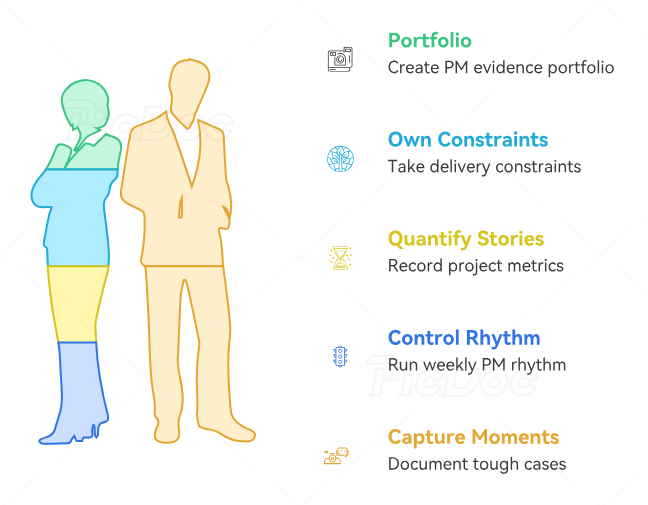
Create a PM evidence portfolio around real work. This can remain private if company information is confidential. For one project, keep sanitized versions of a charter, stakeholder matrix, milestone plan, RAID log, decision log, change register, status report, dependency map, resource forecast, and closure summary. These artifacts transform vague claims such as “strong project skills” into verifiable management behavior. This is the same proof principle behind the portfolio evidence that gets PM interviews, the project coordinator promotion framework, and the broader no-experience project management roadmap.
Next, deliberately own one delivery constraint. Ask your manager to make you responsible for the UAT schedule, a release milestone, one vendor dependency, an implementation workstream, business readiness, or an integration dependency. Ownership means you maintain the plan, chase dependencies, identify variance, escalate at defined thresholds, and communicate the outcome. After that is stable, add another constraint. This progressive expansion builds genuine competence much faster than studying frameworks in isolation. Analysts already comfortable with requirements may find PMI-PBA preparation useful for deepening analysis credibility while adding delivery capabilities separately.
You should also build quantified delivery stories. For every initiative, record baseline conditions, constraint, action, decision, and measurable outcome. Useful metrics include cycle-time reduction, avoided rework, requirements churn, defects prevented, approval time, milestone recovery, adoption rate, backlog reduction, escalation reduction, vendor turnaround, or percentage of deliverables accepted on schedule. This evidence becomes especially important because certification alone rarely answers the hiring manager's core question: What happened when you had to make the project move? Comparing CAPM outcomes for inexperienced candidates, Google PM Certificate versus CAPM, and PMP career leverage is much more useful after you know which credibility gap you are trying to close.
A strong BA can also start running a weekly project-control rhythm. Maintain the milestone plan on Monday, review RAID and dependencies midweek, resolve decision blockers before they age, and finish the week with a concise stakeholder update. This creates PM muscle memory around cadence rather than occasional intervention. It also builds familiarity with the governance logic behind effective project management offices, distributed project collaboration systems, and the selection of project management platforms.
The highest-value evidence usually comes from a difficult moment. Capture examples where requirements changed late, a dependency threatened launch, two executives disagreed, a vendor underperformed, testing exposed a serious issue, or resources became unavailable. Hiring panels learn more from your recovery logic than from a project that encountered no resistance. Explain what information you gathered, what options you created, how you quantified consequences, who made the decision, what you escalated, and what happened afterward. That thinking scales naturally toward program management roles, governance leadership, and eventually project management executive positions.
5. How to Reposition Your Resume, Choose Certifications and Execute a 90-Day Move
Your resume needs to expose delivery ownership immediately. Replace task-heavy language with evidence of scope, decisions, dependencies, risks, milestones, stakeholder alignment, and business outcomes. “Documented business requirements” provides limited evidence. “Led discovery across five business units, secured scope approval, resolved conflicting requirements before build, and reduced downstream rework” gives the hiring manager something concrete to evaluate. A 2026 Reddit career-transition discussion similarly advised analysts to reframe experience around scope, timelines, risk, and delivery outcomes rather than leaving transferable PM work buried under BA terminology.
This positioning becomes even more important in a difficult job market. Review the reasons certified PMs still miss interviews, understand the current debate around whether project management remains a worthwhile career, and compare your profile against people progressing from project coordinator to project manager. The objective is to remove uncertainty for the recruiter.
For certification, select according to the hiring problem you need to solve. A BA with enough qualifying project leadership experience and a target market that values PMP can investigate whether PMP produces sufficient career leverage. Earlier-career analysts can evaluate CAPM with limited experience or compare the Google Project Management Certificate with CAPM. Candidates working internationally should compare PMP, CAPM, PRINCE2 and AgilePM against actual job descriptions in their target geography.
Then execute a 90-day transition sprint.
Days 1–30: audit your experience. Identify ten examples involving scope, planning, risk, dependencies, stakeholders, change, implementation, quality, or recovery. Rewrite your resume around outcomes. Build a sanitized RAID log, status report, project plan, and decision log from a real initiative. Compare your evidence with the BA-to-PM transition roadmap and the experience employers expect from aspiring PMs.
Days 31–60: secure live ownership. Ask for one contained initiative or workstream. Take responsibility for the cadence, milestone plan, risks, issues, dependencies, decision tracking, and stakeholder reporting. Develop proficiency in the actual tools your organization uses, especially as PM software adoption and remote collaboration practices continue changing how project evidence is generated and communicated.
Days 61–90: begin targeted applications and internal conversations. Apply for roles where your domain knowledge offsets the missing PM title. Prepare six interview stories covering scope conflict, schedule pressure, risk, stakeholder disagreement, failed assumptions, and recovery. Ask references to describe you in delivery terms. If your long-term objective extends beyond individual projects, map the next stages toward program management, senior PM consulting, project governance leadership, or project management executive roles.
A successful transition should preserve your BA advantage. Requirements fluency, process thinking, stakeholder discovery, and analytical depth can make you a stronger PM because you understand how vague business intent becomes executable scope. Add project control, delivery judgment, risk ownership, financial awareness, and executive communication to that base, and your profile becomes substantially more difficult to replace.
6. FAQs: Business Analyst to Project Manager
-
Yes. The two roles share stakeholder management, communication, prioritization, documentation, requirements awareness, problem-solving, facilitation, and cross-functional coordination. The transition becomes credible when you add direct evidence of planning, risk ownership, dependencies, resource constraints, project reporting, and delivery accountability. The BA-to-PM roadmap and project coordinator-to-PM progression show how to turn those adjacent capabilities into promotable evidence.
-
Your appropriate entry point depends on the responsibility you already hold. An experienced BA who has coordinated releases, stakeholders, dependencies, UAT, implementation, and change may be competitive for PM or associate PM positions directly. A coordinator role can still be useful when it adds genuine ownership. Evaluate the job through the lens of real experience versus certification and the realities of entering PM without a formal PM title.
-
Prioritize scope control, milestone planning, RAID management, dependency tracking, change control, resource awareness, executive status reporting, decision facilitation, and recovery planning. These capabilities close the most important ownership gaps. Analysts working in Agile environments should also understand Agile PM progression, while technically oriented analysts can strengthen their positioning through IT-to-PM transition skills.
-
PMP can strengthen an already credible experience profile when you meet eligibility requirements and employers in your target market value it. Review PMP outcomes and salary leverage before investing. Earlier-career candidates can examine CAPM outcomes without extensive experience and the wider certification comparison.
-
Volunteer to own a defined release, workstream, migration, UAT cycle, implementation, vendor activity, remediation project, or operational improvement. Run the plan, RAID log, dependencies, decisions, stakeholder updates, and closure. Keep sanitized artifacts that demonstrate ownership. This is more persuasive than merely claiming PM exposure, especially in the hiring environment described in why certified PMs still struggle to get jobs.
-
Translate analytical activities into delivery consequences. Show how requirements work controlled scope, how stakeholder facilitation produced decisions, how UAT protected release readiness, how process analysis reduced implementation risk, and how coordination prevented delays. Quantify outcomes wherever reliable numbers exist. The strongest approach follows the same evidence logic discussed in PM certification versus real delivery experience and project coordinator promotion evidence.
