
Operations Manager to Project Manager: Reddit Transition Stories, Resume Reframing & Certification ROI
Operations managers often enter a project management job search with more relevant experience than their resume reveals. The real challenge is translating recurring operational ownership into the language employers use to evaluate real project management experience, choosing certifications with sensible career-stage ROI, and proving delivery rather than merely listing responsibilities. That distinction matters in a market where even certified project managers struggle to get hired and employers increasingly screen for evidence of ownership, stakeholder management, risk control, and measurable outcomes.

1. Why Operations Managers Are Often Closer to Project Management Than Their Resume Suggests
The operations-to-project-management transition usually starts with a language problem. An operations manager may have coordinated a warehouse migration, implemented new scheduling software, renegotiated supplier workflows, redesigned an onboarding process, opened a new location, reduced service delays, or led a compliance rollout. Those are highly relevant delivery experiences. Yet the resume often describes them as routine operations rather than the kind of portfolio evidence employers evaluate. This creates the same problem faced by candidates trying to become project managers without formal PM experience: valuable work exists, but the evidence has been framed incorrectly.
The most useful distinction is temporary change versus ongoing operation. Running the weekly staffing roster is operational work. Designing and implementing a new scheduling model across five teams is project work. Monitoring vendor performance is operational. Replacing a vendor, defining transition requirements, managing contractual milestones, coordinating handover, and measuring post-change performance resembles formal project delivery. Candidates considering a project coordinator to project manager path should make the same distinction because hiring panels reward evidence of controlled change, rather than job-title prestige.
Operations managers also tend to possess competencies that junior PM candidates spend years trying to build. They manage competing priorities, resource constraints, escalations, cost pressure, stakeholder disagreements, deadlines, dependencies, and incomplete information. These capabilities align closely with the reasons project management remains commercially valuable. The advantage becomes especially strong when an operations candidate can prove governance maturity through decision logs, budget ownership, vendor controls, compliance evidence, dashboards, and measurable improvement.
There is still a genuine gap to close. Operations managers sometimes execute change intuitively without using explicit project structures such as a RAID log, stakeholder map, change-control process, milestone baseline, benefits register, or project closure review. That gap can be fixed faster than starting from zero. Reviewing how effective PMOs formalize delivery governance, how organizations select project management tools, and how companies use collaboration software in remote teams helps an experienced operator convert instinctive coordination into repeatable PM methodology.
The strongest transition candidates therefore perform an evidence audit before buying another course. Go through the previous three to five years of work and isolate every initiative with a defined objective, deadline, group of stakeholders, constrained resources, implementation period, risk, and measurable result. That exercise produces the raw material required for stronger resumes, interviews, certification applications, and eventual progression into program management or project governance leadership.
2. How to Reframe an Operations Resume for Project Management Roles
Resume reframing begins with a shift from responsibility language to delivery language. “Responsible for warehouse operations and 35 employees” tells a recruiter what you supervised. “Led a six-month warehouse redesign across operations, procurement, facilities, and technology, reducing average dispatch time by 18%” demonstrates scope, timeframe, stakeholders, change, and result. That type of evidence is precisely what candidates need when formal certification alone is failing to generate interviews or when they are building the experience proof needed for a first PM role.
A strong bullet can be built from five components: objective, ownership, complexity, method, result. Suppose an operations manager introduced a new customer-support platform. A weak bullet says, “Implemented CRM system for operations team.” A stronger version says, “Led cross-functional implementation of a customer-service platform across 60 users, coordinating requirements, vendor milestones, data migration, training, launch readiness, and stabilization, achieving 94% adoption within the first month.” That reads like project management because it demonstrates lifecycle ownership. Candidates moving from IT into project management or from business analysis into PM benefit from the same construction.
Numbers should establish scale rather than decorate the resume. Useful measures include budget controlled, team size, number of locations, project duration, vendors managed, cycle-time improvement, downtime reduced, revenue protected, savings realized, adoption rate, backlog reduction, customer-impact improvement, and compliance findings closed. This strengthens the candidate's case more effectively than listing every methodology studied in a course. The same logic explains why the debate between certification and real experience usually ends with employers preferring candidates who can demonstrate both.
The resume title also deserves careful handling. An operations manager should not falsify a previous job title. The solution is contextual positioning. A line such as Operations Manager | Business Transformation & Project Delivery preserves the formal role while surfacing relevant capability. The summary can then state the volume and type of initiatives led. This is particularly useful for people making a mid-career project management transition because recruiters need immediate evidence that prior experience transfers.
Portfolio evidence can strengthen the resume further. Remove confidential data and create sanitized examples of a project charter, implementation timeline, stakeholder map, RAID log, change register, executive status report, lessons-learned document, or benefits tracker. A candidate researching PMO effectiveness can use those artifacts to model professional governance. Someone targeting technology-heavy companies should also understand current project management software adoption and how businesses evaluate PM tools.
The interview narrative should mirror the resume. Describe one initiative from initiation through closure rather than jumping among unrelated operational accomplishments. Explain the original business problem, who sponsored the change, how scope was defined, which dependencies threatened delivery, how decisions were made, what changed during implementation, and how success was measured. That structure helps an interviewer visualize you functioning in the target role and is also useful when preparing for senior project management consulting or future project management executive roles.
3. Certification ROI: When CAPM, PMP, Agile Credentials, or No New Certification Makes Sense
Certification ROI should be evaluated against a specific hiring obstacle. Buying a credential because it appears repeatedly in job descriptions can become expensive procrastination if the actual weakness is poor project evidence. The starting question is therefore whether the candidate lacks knowledge credibility, screening eligibility, experience proof, or domain relevance. Someone debating whether the CAPM is worthwhile without experience faces a different decision from an experienced operations leader deciding whether the PMP is worth the investment.
For an operations manager with substantial initiative leadership, PMP can have stronger signaling value when eligibility requirements are met and target roles repeatedly request it. The credential can help formalize existing delivery experience and pass recruiter screens, but its value rises when the resume already demonstrates credible outcomes. Reviewing the wider comparison between PMP, CAPM, PRINCE2, and AgilePM prevents candidates from selecting a certification based solely on popularity. The broader future of project management certifications also matters when planning a multi-year career path.
CAPM can make sense for an operations candidate whose project exposure is real but fragmented and whose target market values PMI terminology. Its strongest use is usually structured knowledge plus screening support. Candidates expecting it to replace demonstrable delivery experience may encounter the same disappointment discussed in analyses of CAPM job outcomes. The comparison between the Google Project Management Certificate and CAPM is especially useful for candidates trying to decide whether they need foundational learning or a stronger recruiting signal.
Agile credentials become more useful when the target environment genuinely works through product, technology, software, iterative delivery, or scaled agile structures. An operations manager moving toward that environment may need to learn terminology and delivery mechanics covered in a traditional PM to agile transition, the path from agile team member to project manager, or the SAFe Agilist career route. A credential has better ROI when it closes a visible market gap rather than merely adding another badge.
Candidates moving into specialized sectors should also evaluate domain-specific credentials. Construction-oriented professionals may benefit from understanding the Certified Construction Manager pathway. Cost-heavy environments can make Certified Cost Professional preparation more relevant. Roles with deep analysis responsibilities may reward knowledge associated with PMI-PBA certification, while organizations with mature cost and schedule controls may value earned value management knowledge.
A useful ROI formula is simple: expected increase in qualified opportunities × probability the credential materially improves selection × career value of those opportunities, compared against direct cost, study hours, exam risk, and the opportunity cost of building stronger evidence instead. If 30 target jobs require PMP and your experience already qualifies, certification may solve a real bottleneck. If those same jobs reject you because your resume cannot show project ownership, spend the next month creating stronger project evidence before buying another course.
4. What Reddit Transition Stories Reveal About Moving From Operations Into PM
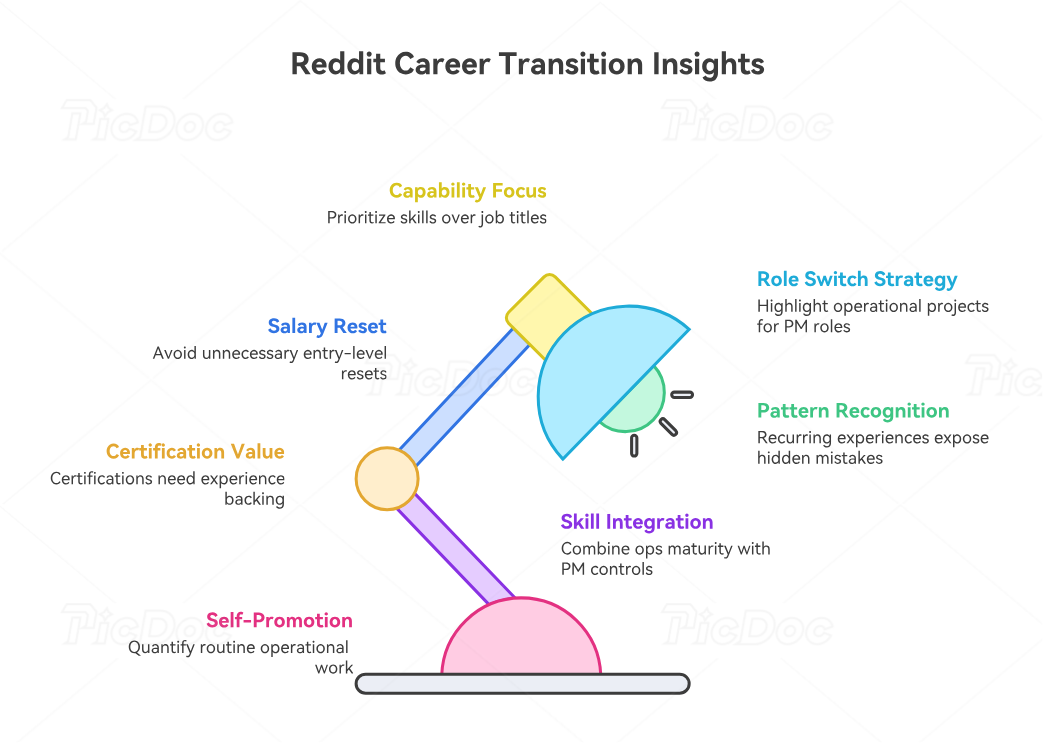
Reddit career discussions are most useful as qualitative pattern recognition. Individual salaries, timelines, and hiring outcomes are anecdotal, but recurring experiences can expose mistakes that formal career guides overlook. One of the clearest patterns in operations-to-PM conversations is that successful switchers stop presenting themselves as beginners. They identify projects hidden inside their operational history and build a bridge into adjacent roles. This resembles the path described in career-change project management stories and the progression from project coordinator to project manager.
Another recurring lesson is that job-title matching is less important than capability matching when the resume has been engineered properly. A company may advertise for an implementation project manager, transformation PM, business project manager, operations project manager, PMO project manager, or continuous-improvement PM. An experienced operator can often compete for several of these titles. The mistake is applying only to generic “Project Manager” roles and ignoring pathways aligned with existing domain knowledge. Candidates with technology exposure can explore IT-to-project-management transitions, while those with sustainability experience may be better positioned for environmental project management.
Salary-reset anxiety appears frequently in career-change discussions because an operations manager may already hold substantial responsibility and compensation. A complete reset to an entry-level coordinator role can be unnecessary when the person has credible project ownership. The stronger strategy is to target lateral roles where operational domain knowledge reduces employer risk. Someone from marketing operations could investigate marketing project management. A mission-driven operations professional may find better continuity in nonprofit project management. Technology and security exposure can create opportunities where project management intersects with cybersecurity.
A second common Reddit theme is frustration after earning a certification and seeing no improvement in response rates. That outcome is understandable when the hiring problem existed in positioning, evidence, or job targeting. The issue appears repeatedly in the broader discussion of why certified PMs still struggle to get jobs. Certification works best as a multiplier of credible experience. It performs poorly as a substitute for it, which is why candidates should compare certification against portfolio evidence before deciding where to invest their next 100 hours.
The most effective transition stories also reveal a willingness to learn formal project controls without discarding years of operational maturity. Experienced operators already know how organizations behave under pressure. They understand that stakeholders miss deadlines, vendors overpromise, budgets tighten, senior leaders change priorities, and dependencies fail. Formal PM knowledge gives structure to those realities. Studying PMO governance, collaboration practices in remote project teams, and the evolving project management technology market can quickly strengthen that structure.
There is also an important psychological lesson. Candidates frequently undersell routine exposure because the work felt normal to them. Running a $2 million operational budget, coordinating four external suppliers, managing a 70-person staffing model, handling executive escalations, or leading a multi-site systems rollout may feel ordinary after years in the job. To a PM hiring manager, those facts can signal delivery maturity. The task is to extract them, quantify them, and connect them to the requirements appearing in target roles.
5. A 90-Day Operations-to-Project-Manager Transition Plan
The first 30 days should focus on evidence extraction and market calibration. Review 30 to 50 target job descriptions and record recurring requirements, project types, methodologies, tools, certifications, industries, budget expectations, and stakeholder levels. Compare those findings with the wider discussion of where PM demand is holding up and with research into how organizations choose PM tools. Then identify six to ten projects hidden within your operational history and document objective, scope, timeline, stakeholders, budget, risks, decisions, deliverables, and results.
During days 31 to 60, rebuild the resume and create proof assets. Every major bullet should reveal ownership plus measurable effect. Prepare three detailed interview stories: one successful implementation, one project that encountered serious risk, and one stakeholder conflict requiring negotiation. Build sanitized project artifacts so your evidence resembles the controls discussed in project governance careers. If your target companies use agile structures, close terminology gaps using the agile PM transition roadmap or Scrum@Scale career guidance.
This is also the right point to make the certification decision. Search your actual target jobs and calculate how often PMP, CAPM, PRINCE2, AgilePM, SAFe, or another credential appears as required, preferred, or irrelevant. Compare the findings against the PMP ROI discussion, CAPM outcomes for inexperienced candidates, and the broader certification comparison. That turns credential selection into an evidence-based career decision.
Days 61 to 90 should focus on targeted applications, networking, and interview conversion. Create separate resume versions for the two or three PM categories closest to your operations background. An operations manager with software implementation exposure should emphasize technology rollout and stakeholder adoption. A supply-chain operator should foreground procurement, vendors, cost, timelines, and risk. Someone managing broad business transformation should emphasize governance, change, benefits, and executive reporting. Those capabilities can later support progression into program management, senior PM consulting, or eventually PM-to-COO progression.
Track the funnel like an operational process. Measure applications submitted, recruiter screens, hiring-manager interviews, final rounds, rejections, and offers. If 40 tailored applications produce zero screens, positioning or targeting is probably broken. If recruiter screens occur but hiring-manager interviews do not, project evidence may be weak. If final interviews occur without offers, investigate interview stories, domain fit, compensation, and executive presence. This diagnostic approach is more productive than assuming the answer is always another credential.
The transition is especially powerful when operations experience becomes a permanent differentiator rather than something the candidate tries to escape. Project managers who understand implementation after handover, staffing realities, service performance, customer impact, supplier behavior, and operational constraints often make stronger delivery decisions. That foundation can also become valuable as technology changes the profession, particularly in areas such as cybersecurity and project management and emerging AR/VR applications in project management.
6. FAQs
-
Yes, especially when the target role values the same industry, systems, vendors, customers, or operational environment you already understand. A large salary reset becomes more likely when candidates position themselves as complete beginners. Translating existing change initiatives into credible project evidence, targeting adjacent PM roles, and understanding the career-change salary-reset problem can preserve more of your market value. Experienced operators should also compare opportunities against the broader PM job market rather than automatically accepting junior coordinator positions.
-
The job title itself does not determine whether work qualifies as project experience. Look for temporary initiatives with defined objectives, stakeholders, deliverables, timelines, constraints, and outcomes. A recurring monthly process is operations. Designing and deploying a new version of that process across several teams is much closer to project delivery. Candidates asking whether they can enter PM without formal experience should perform this audit before assuming they have zero experience. The same evidence strengthens progression from project coordinator into PM.
-
PMP can have strong ROI when you meet the eligibility requirements, target jobs repeatedly request it, and your resume already demonstrates substantial delivery responsibility. Review whether the PMP pays off for your target roles and compare it against CAPM, PRINCE2, and AgilePM. The strongest combination is usually formal credibility plus demonstrable delivery evidence, especially because certification by itself does not guarantee hiring success.
-
CAPM can help when you need foundational PM terminology or encounter employers that value the credential. It should not automatically delay your job search. An experienced operations manager may already have sufficient delivery evidence to apply while studying. Compare CAPM outcomes for candidates without formal PM experience with the Google PM Certificate versus CAPM and prioritize whichever closes a real gap in your target market.
-
The highest-probability roles usually sit near your existing domain: operations project manager, implementation PM, transformation PM, business project manager, process-improvement PM, PMO project manager, systems implementation PM, facilities PM, supply-chain PM, or change project manager. Technology-heavy operators can use an IT-to-PM roadmap, while analytical professionals may find similarities with the business analyst to project manager pathway. Sector alignment often produces better conversion than applying indiscriminately to generic PM vacancies.
-
Include sanitized evidence showing how you plan, control, communicate, and close work: project charters, milestone plans, RAID logs, stakeholder maps, status reports, change registers, budget trackers, implementation checklists, training plans, benefits measures, and lessons learned. These artifacts strengthen the portfolio evidence employers use to judge experience and help candidates demonstrate the governance practices associated with effective PMO environments. Tool familiarity can be strengthened by understanding current project management software adoption.
