
The Ultimate Guide to Getting Your Project Management Certification in Pakistan: All You Need to Know in 2026–2027
Pakistan’s project-management market rewards professionals who can control delivery across tight budgets, distributed teams, regulatory pressure, shifting client requirements, and unpredictable commercial conditions. A recognised certification can improve your credibility, although employers still expect visible command of project scheduling, risk assessment, stakeholder engagement, budget management, and project reporting. This guide explains how professionals in Pakistan can select the right credential, prepare efficiently, avoid unreliable training providers, and turn certification into stronger employment evidence during 2026–2027.
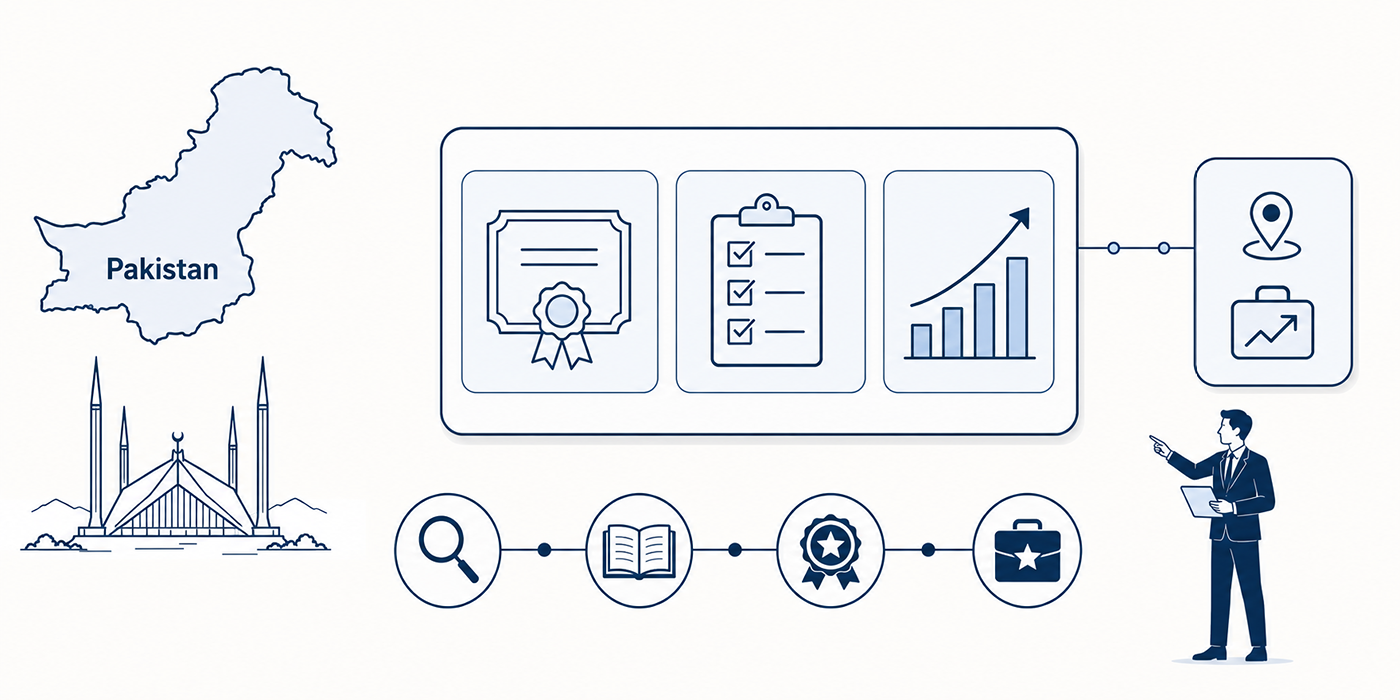
1. Why Project Management Certification Matters in Pakistan in 2026–2027
Project delivery in Pakistan now extends far beyond traditional construction and engineering environments. Banks run core-system upgrades and digital onboarding programmes, software houses manage overseas product releases, telecom companies coordinate infrastructure rollouts, manufacturers implement enterprise systems, hospitals digitise services, public bodies deliver reform initiatives, and development organisations manage donor-funded programmes. These employers need professionals who understand project initiation, critical-path planning, resource allocation, quality controls, and contract management.
Pakistan’s technology sector creates a particularly relevant opportunity. The Pakistan Software Export Board reported that ICT exports increased by 28% to US$1.86 billion during the first half of FY2024–25. Continued export growth increases the need for professionals who can coordinate international clients, remote development teams, release schedules, documentation, dependencies, and service transitions. Candidates targeting this market should understand agile delivery tools, Scrum platforms, Kanban software, issue-tracking systems, and team communication platforms.
Certification helps because project-management experience in Pakistan frequently appears under inconsistent job titles. A professional may have managed implementation work while officially employed as an engineer, assistant manager, business analyst, software lead, procurement officer, site coordinator, operations executive, or client-services manager. A credential gives that fragmented experience a recognised structure and helps recruiters connect your background with scope control, schedule governance, vendor management, risk responses, and stakeholder communication.
The painful reality is that certification initials alone rarely overcome weak evidence. Pakistani employers regularly receive applications from candidates who have completed a short course yet cannot explain how they controlled a baseline, assessed a change request, managed an underperforming supplier, resolved a resource conflict, or recovered a missed milestone. Your credential becomes valuable when your CV and interviews demonstrate practical fluency in schedule compression, conflict resolution, cost management, project procurement, and executive reporting.
Certification can also support Pakistani professionals seeking remote employment, Middle Eastern opportunities, consulting contracts, or multinational assignments. Global clients may know little about a local employer or university, while credentials such as PMP, CAPM, PRINCE2, PMI-ACP, PSM, and CSM give them a familiar reference point. Candidates exploring regional mobility can compare employer expectations through the Qatar certification guide, Kuwait certification guide, Oman certification guide, Bahrain certification guide, and Malaysia certification guide.
| Career Situation | Best-Fit Certification | Why It Fits | Proof to Build | Hiring Risk to Address |
|---|---|---|---|---|
| University student | CAPM | Provides formal project foundations before full-time experience | Charter, schedule, risk register, team-project outcome | Expecting immediate access to senior PM positions |
| Fresh graduate | CAPM or PRINCE2 Foundation | Strengthens applications for junior delivery roles | Internship case study and quantified academic project | Presenting certification without practical artefacts |
| Project coordinator | CAPM, PMP, or PRINCE2 | Formalises existing planning and coordination work | RAID log, status report, dependency tracker | Describing follow-up activity without ownership |
| Assistant project manager | PMP when eligible | Supports progression into independent delivery leadership | Budget, stakeholder, change, and schedule decisions | Failing to distinguish support from leadership |
| Experienced project manager | PMP | Validates cross-functional project leadership | Delivery scale, recovered milestones, business impact | Weak documentation of qualifying experience |
| Software project manager | PMP plus agile credential | Combines governance with iterative delivery capability | Release plan, backlog decisions, defect and velocity trends | Using agile vocabulary without delivery evidence |
| Scrum Master | PSM or CSM | Builds role-specific credibility in Scrum environments | Impediment removal and measurable flow improvement | Reducing the role to meeting facilitation |
| Product owner | Product-owner or agile credential | Supports prioritisation and value-delivery decisions | Roadmap trade-offs and backlog-value evidence | Confusing product ownership with project governance |
| Business analyst | CAPM or PMP | Connects requirements work with end-to-end delivery | Traceability matrix and change-impact assessment | Showing analysis without implementation ownership |
| PMO analyst | CAPM, PMP, or PRINCE2 | Strengthens governance and reporting credibility | Portfolio dashboard and assurance checklist | Appearing administrative rather than analytical |
| Construction engineer | PMP plus sector expertise | Supports movement into broader project leadership | Critical path, contractor control, variation register | Assuming general certification replaces technical competence |
| Site coordinator | CAPM or PMP when eligible | Structures site-planning and coordination experience | Look-ahead plan, inspection tracker, delay analysis | Reporting activity without commercial impact |
| Telecom project lead | PMP | Fits multi-vendor rollout and infrastructure work | Deployment dashboard and regional dependency plan | Underplaying vendor and regulatory interfaces |
| Banking technology PM | PMP or PRINCE2 Practitioner | Supports governance-heavy transformation programmes | Control gates, testing evidence, compliance dependencies | Ignoring audit and operational-risk expectations |
| Fintech delivery lead | PMP plus agile credential | Balances speed, controls, integration, and releases | Release governance and partner-integration plan | Presenting rapid delivery without control evidence |
| ERP implementation lead | PMP | Supports complex business and technology coordination | Data migration, testing, training, and cutover plan | Focusing only on software configuration |
| Procurement professional | PMP or PRINCE2 | Connects sourcing work with project outcomes | RFP calendar, evaluation model, contract milestones | Treating procurement as a standalone purchase |
| Vendor manager | PMP | Frames supplier performance within delivery governance | SLA dashboard and corrective-action plan | Escalating problems without recovery options |
| Operations manager | CAPM or PMP | Supports transition from operations into change delivery | Business case, transition plan, benefits measures | Using routine operational work as project evidence |
| Public-sector professional | PRINCE2 or PMP | Strengthens formal governance and accountability | Approval matrix, audit trail, procurement controls | Weak evidence of benefits and stakeholder ownership |
| Development-sector PM | PMP or PRINCE2 | Supports donor, government, community, and partner coordination | Results framework, risk log, monitoring plan | Reporting outputs without outcome evidence |
| Healthcare project lead | PMP | Fits operationally sensitive, multi-stakeholder delivery | Readiness plan and service-continuity controls | Ignoring clinical and operational dependencies |
| Manufacturing project lead | PMP or Six Sigma pathway | Supports process, quality, cost, and implementation control | Process map, quality trend, benefits calculation | Using technical improvements without project governance |
| Freelance delivery manager | PMP or agile credential | Provides recognisable evidence for overseas clients | Client case studies and delivery dashboard | Relying on marketplace ratings alone |
| Career changer | CAPM or PRINCE2 Foundation | Creates structured entry-level project knowledge | Transferable case study from previous work | Discarding valuable industry experience |
| Middle East job seeker | PMP | Provides portable recognition across regional markets | Gulf-focused CV and commercial project evidence | Assuming certification replaces sector experience |
| Programme manager | PMP followed by PgMP | Supports progression into benefits and dependency leadership | Programme roadmap and benefits-governance model | Claiming programme experience through project volume |
| Senior PM seeking promotion | PMP, PgMP, or specialist certification | Supports movement toward strategic delivery responsibility | Executive decisions, benefits, coaching, governance | Collecting credentials without expanding responsibility |
2. Which Project Management Certification Should You Choose in Pakistan?
Your certification decision should begin with your target vacancies rather than the popularity of a credential on social media. Search for 20 to 30 roles you would realistically pursue during the next year and record the recurring requirements. Pay attention to the requested credential, experience level, industry knowledge, software exposure, education, reporting responsibilities, client geography, and delivery method. This exercise will reveal whether your strongest route is PMP preparation, CAPM preparation, PRINCE2 training, agile-tool proficiency, or stronger domain knowledge.
PMP is usually the strongest choice for professionals who already lead projects, coordinate teams, manage stakeholders, make delivery decisions, and take responsibility for outcomes. Its value is particularly clear in Pakistani banking, technology, telecom, construction, consulting, manufacturing, and development-sector roles where employers need evidence of risk governance, budget discipline, procurement control, schedule recovery, and stakeholder leadership.
The PMP eligibility pathways currently require 60 months of project leadership experience within the previous eight years for candidates with a secondary-school qualification, or 36 months for candidates with a bachelor’s degree or global equivalent. Both pathways generally require 35 hours of project-management education, while PMI also publishes an additional route for graduates of qualifying accredited programmes. Candidates should document their experience carefully through project-initiation language, requirements control, project reporting, quality management, and conflict resolution.
CAPM is better suited to students, fresh graduates, project coordinators, junior analysts, career changers, and professionals whose experience has not yet reached the PMP threshold. PMI currently requires a secondary qualification or global equivalent and at least 23 hours of project-management education before the examination. The CAPM exam contains 150 questions over 180 minutes and covers project fundamentals, predictive approaches, agile methods, and business analysis. Candidates can strengthen this pathway through CAPM exam resources, CAPM mistake analysis, exam-day preparation, career-advancement planning, and renewal guidance.
PRINCE2 Project Management Version 7 can be effective for professionals working in formal governance environments, consulting engagements, public-sector programmes, donor-funded initiatives, PMOs, and organisations with structured approval processes. The method emphasises principles, practices, processes, roles, people, communication, sustainability, digital information, and tailoring. PeopleCert currently states that PRINCE2 Foundation certification must be renewed every three years. Before enrolling, compare PRINCE2 with PMP, review common PRINCE2 pitfalls, evaluate training providers, understand career benefits, and plan for PRINCE2 renewal.
Agile credentials make sense when your target work actually involves iterative development, backlog management, sprint planning, product ownership, continuous delivery, or Scrum facilitation. PSM or CSM can support Scrum Master pathways, while PMI-ACP may suit experienced professionals who work across several agile approaches. Your employability will still depend on evidence that you can remove impediments, improve flow, control dependencies, facilitate difficult decisions, and maintain transparency. Develop that evidence through Scrum-role knowledge, Scrum software, Kanban platforms, team communication tools, and project-management integrations.
Professionals in Pakistan should also recognise the limits of a general credential. A construction employer may expect site execution, quantities, contracts, safety interfaces, contractor management, and construction PM software. A banking employer may prioritise compliance, testing, data migration, controls, and analytics reporting. A software company may expect Jira-style workflows, releases, APIs, and issue tracking. A procurement-heavy role may require RFP and RFQ knowledge alongside contract lifecycle management.
3. Eligibility, Costs, Exam Changes, and Study Planning for Pakistani Candidates
The July 2026 PMP update is the most important timing issue for candidates planning their certification during 2026–2027. PMI states that the updated exam launches on 9 July 2026. The new examination remains 180 questions, allows 240 minutes, introduces additional case, scenario, graphical, and interactive question formats, and allocates 33% of questions to People, 41% to Process, and 26% to Business Environment. Approximately 40% of the exam represents predictive delivery, while the remaining 60% is divided between agile and hybrid approaches. Candidates should update their preparation through the PMP domain guide, exam-mistake guide, PMP resources, success stories, and risk terminology.
Candidates who are already prepared for the earlier PMP examination may choose to test before the transition, while candidates beginning close to July should study against the new examination content outline. Mixing old question banks, outdated video courses, and new study materials can create contradictory decision rules. Before paying any provider, confirm the exam version, course-update date, instructor status, access period, mock-test format, and eligibility of the training hours. Cross-check provider claims using PMP exam resources, PMP mistake analysis, project scheduling terminology, stakeholder terminology, and project quality concepts.
Cost planning requires special care in Pakistan because international certification charges may be affected by exchange-rate movement, banking conversion rates, taxes, foreign-transaction charges, membership decisions, and provider markups. Avoid building your budget around a social-media screenshot or an old training advertisement. Open the certification body’s official checkout page, compare member and non-member totals where relevant, confirm whether tax appears at checkout, and ask your bank about international card charges. Add the cost of training, official materials, mock examinations, internet backup, possible travel, rescheduling exposure, retakes, and renewal. The PMP renewal guide, PRINCE2 renewal guide, CAPM renewal guide, training-provider review, and exam-resource comparison can help reveal ownership costs beyond the first payment.
A Pakistani training provider should be evaluated through evidence rather than claims such as “guaranteed pass,” “internationally accredited,” or “100% success.” Verify the provider in the awarding body’s directory where applicable, confirm the instructor’s credential status, request the course outline, ask which exam version is covered, and inspect the quality of sample questions. A useful course should teach decisions involving scope changes, schedule compression, supplier disputes, budget variances, and stakeholder resistance.
Study duration should reflect your starting point and weekly capacity. An experienced PMP candidate may need 10 to 16 focused weeks, while someone learning formal project terminology from the beginning may need longer. CAPM preparation can take two to four months depending on business-analysis and agile familiarity. PRINCE2 Foundation may fit a shorter intensive plan, while Practitioner requires deeper scenario application. Your schedule should combine concept learning, timed questions, error review, and full simulations using Gantt-chart concepts, project-risk terminology, communication techniques, procurement definitions, and quality-management terms.
4. How to Earn Your Certification Efficiently in Pakistan
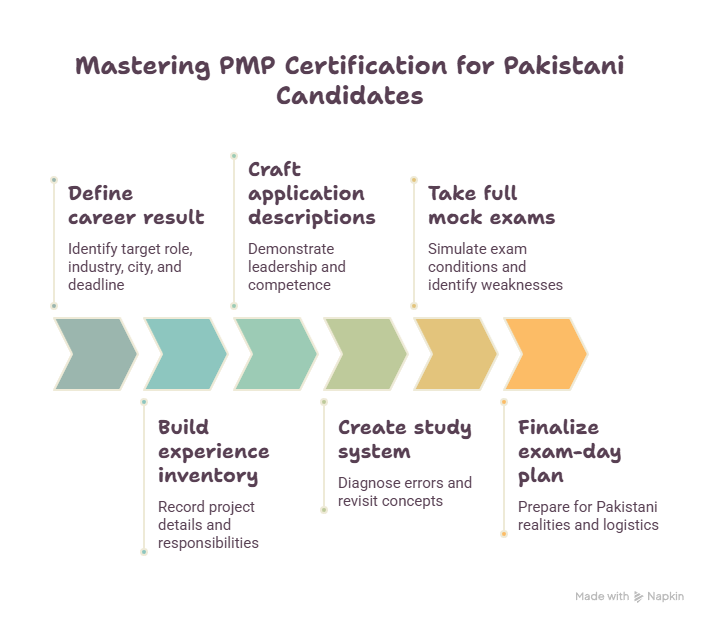
Begin by defining the career result you expect from certification. A useful objective identifies the target role, industry, city or employment market, and deadline. “I want a project coordinator position” provides little direction, while “I want to move from business analyst to technology project manager in a Karachi bank within nine months” gives you a clear basis for selecting PMP, identifying skill gaps, and building evidence. Compare adjacent markets through the China certification guide, Japan certification guide, South Korea certification guide, Vietnam certification guide, and Thailand certification guide.
Next, build a detailed experience inventory before purchasing training. Record the organisation, project objective, dates, delivery method, team structure, stakeholders, your responsibilities, major decisions, constraints, risks, and final outcome. This document helps determine PMP eligibility, improves your application, exposes gaps in your experience, and supplies material for interviews. Use the language of project initiation, critical-path planning, budget control, stakeholder management, and risk assessment while keeping every statement accurate.
Your application descriptions should demonstrate leadership rather than produce a catalogue of meetings. “Attended weekly status meetings and coordinated with departments” provides little evidence of responsibility. A stronger description explains that you maintained the integrated schedule, identified a supplier dependency threatening the launch, assessed recovery options, secured steering approval, and tracked the corrective plan through completion. That language reveals competence in schedule recovery, vendor governance, executive reporting, decision escalation, and issue tracking.
Create a study system built around diagnosis and repetition. Learn a concept, answer questions on it, record each error, and revisit the reasoning several days later. Your error log should identify the topic, why your answer appeared attractive, which fact you missed, the correct principle, and how you will recognise a similar scenario. This approach works well for procurement scenarios, contract questions, resource conflicts, quality failures, and communication breakdowns.
Pakistani candidates who use English professionally may still struggle with long scenario questions because the exam tests subtle distinctions between several reasonable actions. Slow reading alone will not solve this. Train yourself to identify the project stage, delivery approach, threatened outcome, accountable role, missing information, and required next action before comparing answer choices. Review PMP exam domains, common PMP errors, CAPM mistakes, conflict-resolution terms, and stakeholder-engagement concepts while practising.
Full mock exams should begin early enough to influence your study plan. One strong result can create false confidence when the question set happens to match familiar material. Several timed simulations reveal whether you can maintain concentration, control pacing, interpret unfamiliar scenarios, and recover after a difficult section. Use the results to revise scheduling concepts, budget terminology, project risks, team-building concepts, and project reporting.
Your exam-day plan should account for Pakistani realities such as internet stability, power interruptions, travel time, identity requirements, and time-zone mistakes. Online-proctored candidates should test the exact computer, camera, microphone, room, network, and backup power arrangement they intend to use. Test-centre candidates should verify the route and arrival requirements directly. Review the CAPM exam-day guide, PMP preparation resources, PMP success strategies, project-management templates, and top PM terminology during the final revision period.
5. How to Turn Certification Into Better Project Management Opportunities in Pakistan
Certification should trigger an immediate rewrite of your professional positioning. Place the credential prominently on your CV and LinkedIn profile, then rebuild your experience around delivery outcomes. Each bullet should explain the objective, scale, constraint, action, and result. Quantify time saved, cost avoided, revenue enabled, defects reduced, risks closed, delays recovered, vendors managed, users migrated, or locations deployed. Support these claims with knowledge of cost management, schedule control, quality assurance, vendor performance, and stakeholder reporting.
A weak CV says, “Responsible for managing projects and coordinating teams.” A stronger version says, “Recovered a six-week implementation delay by rebuilding the dependency schedule, renegotiating supplier milestones, and establishing twice-weekly risk decisions, enabling launch within the client’s contractual window.” The stronger version proves critical-path understanding, contract awareness, schedule recovery, risk governance, and executive communication.
Create a compact portfolio of anonymised proof assets. A one-page charter, milestone schedule, RAID log, stakeholder matrix, executive status report, and change-impact assessment can show how you think without exposing confidential employer information. Technology candidates may add a release roadmap or sprint dashboard, while construction professionals may include a look-ahead schedule, variation register, or contractor tracker. Build these through project templates, dashboard tools, reporting software, resource-allocation platforms, and workforce-management systems.
Interview preparation should focus on six high-pressure stories: a delayed project, a difficult stakeholder, a supplier failure, a scope change, a serious risk, and a decision that protected business value. Explain the baseline, competing interests, options, decision path, governance route, outcome, and lesson. Hiring managers can detect vague storytelling quickly, especially when candidates claim expertise in conflict resolution, procurement management, team leadership, project communication, and stakeholder management without a concrete example.
Target your applications according to evidence level. A newly certified CAPM candidate may be competitive for project coordinator, PMO analyst, implementation assistant, junior business analyst, delivery coordinator, or project-support positions. An experienced PMP holder can pursue project manager, implementation manager, delivery manager, programme coordinator, PMO manager, or transformation roles aligned with previous industry experience. Improve your fit through small-business PM software, waterfall platforms, agile tools, contract-management software, and project-management integrations.
Salary improvement usually follows expanded responsibility, stronger industry positioning, and evidence of commercial impact. Certification can help you reach those opportunities, while salary negotiations still depend on your sector, city, employer, experience, technical knowledge, client exposure, communication ability, and project scale. Build your case around recovered revenue, avoided cost, controlled risk, faster delivery, improved quality, or successful adoption using budget terminology, project analytics, risk-identification methods, supplier-management concepts, and resource-allocation evidence.
Professionals targeting Gulf markets should translate Pakistani experience into internationally understandable evidence. Replace internal abbreviations, explain project scale, clarify your authority, quantify results, and show familiarity with multicultural teams, contractors, formal reporting, and commercial governance. Compare regional expectations through the Saudi-market alternatives in Qatar, Kuwait PM guide, Oman PM guide, Bahrain PM guide, and Turkey PM guide.
Finally, plan renewal from the month you pass. Record webinars, courses, mentoring, volunteering, professional reading, presentations, and permitted work-based learning in the format required by your certification body. Choose development activities that also strengthen your employment value, such as advanced risk management, project dashboards, contract management, quality improvement, and stakeholder communication.
6. Frequently Asked Questions About Project Management Certification in Pakistan
-
PMP is usually the strongest broad-market credential for experienced professionals, particularly in technology, banking, telecom, construction, consulting, manufacturing, and development work. CAPM is better aligned with students, graduates, coordinators, and career changers. PRINCE2 suits structured governance environments, while PSM, CSM, and PMI-ACP support agile delivery careers. Compare your options through the PMP and PRINCE2 guide, CAPM career guide, Scrum-role guide, agile-tool review, and PM terminology guide.
-
PMI evaluates your education, project-leadership experience, and responsibilities. Professionals working as engineers, business analysts, consultants, team leads, implementation specialists, operations managers, or coordinators may qualify when their work genuinely involved leading and managing projects. Build a chronological evidence file showing your decisions, stakeholders, schedules, risks, and outcomes. Use accurate language from project initiation, project scheduling, risk management, stakeholder engagement, and project reporting.
-
The rupee cost can change because the exam is priced internationally and your final payment may reflect exchange rates, taxes, bank conversion, foreign-transaction charges, membership status, and provider fees. Check the official PMI checkout total when you are ready to apply and obtain your bank’s current international-card charges. Include training, mock exams, possible retakes, and renewal in the budget. Review the PMP resource guide, PMP renewal guide, PMP mistakes guide, exam-domain guide, and success-story guide.
-
Candidates already prepared for the earlier exam can consider testing before the transition. Candidates beginning close to July should use resources built for the updated examination launching on 9 July 2026. The new version expands business-environment coverage and introduces stronger emphasis on value, AI, sustainability, and interactive scenarios. Prepare through the 2026 PMP domain guide, exam-resource guide, risk glossary, stakeholder glossary, and quality-management guide.
-
Recognition comes from the awarding body and the legitimacy of the certification process. Online preparation can be effective when the provider is authorised where required, the course satisfies current education rules, the materials match the active exam version, and the examination is delivered through an approved channel. Verify every claim directly before paying. Compare training providers, PMP resources, CAPM resources, PRINCE2 pitfalls, and exam-day requirements.
-
Certification can strengthen recognition when overseas employers are unfamiliar with your local organisation or job title. Your success will still depend on industry experience, communication, delivery scale, client exposure, documentation quality, and measurable results. Build proof through vendor management, contract terminology, project analytics, team communication tools, and project-management integrations.
