
The Ultimate Guide to Getting Your Project Management Certification in Kuwait: All You Need to Know in 2026-2027
Kuwait’s best project management roles reward candidates who can prove control, governance, documentation, procurement awareness, and stakeholder confidence under pressure. A certificate helps, but the strongest candidates connect it to real delivery evidence, from requirements control and project reporting to procurement terms and risk management. Kuwait’s Vision 2035 also focuses on making the country a regional and international financial and trade hub, which raises the value of project professionals who can manage structured delivery in regulated, multi-stakeholder environments.
1. Why Project Management Certification in Kuwait Is a Career Filter in 2026-2027
For Kuwait, the real career question is rarely “Do I need a certificate?” The sharper question is whether your certificate can make your work history easier to trust. Hiring panels in construction, oil and gas, government services, banking, telecom, logistics, healthcare, and IT transformation want evidence that you can protect scope, control approvals, manage vendors, escalate issues early, and keep executives informed through clean reporting. That is where PMP preparation, PRINCE2 comparison, CAPM career use, stakeholder engagement, and project initiation terms become practical career assets.
A Kuwait-based PM candidate often loses momentum because their resume reads like a task list: “coordinated meetings,” “updated trackers,” “worked with vendors,” “supported delivery.” Those phrases leave hiring managers guessing. Stronger positioning says you controlled baseline changes, maintained a decision log, reduced approval delays, managed RFP inputs, tracked critical path movement, escalated risks before cost impact, and translated stakeholder noise into decisions. Build that language through critical path terms, schedule compression concepts, contract management terminology, communication techniques, and budgeting terms.
Certification works best when it gives structure to your proof. PMP strengthens your story when you already have leadership experience. CAPM helps newer candidates show disciplined fundamentals. PRINCE2 suits environments that value stage gates, governance, roles, business case thinking, and controlled delivery. Agile and Scrum credentials help when Kuwait employers are hiring for product, digital transformation, systems implementation, workflow automation, or hybrid delivery. Your edge comes from connecting the certificate to Gantt chart fluency, risk identification, quality management, vendor management, and dashboard reporting.
2. Choosing the Right Certification Path for Kuwait: PMP, CAPM, PRINCE2, Agile, or Hybrid
Choose your certification based on the role you want to win, the evidence you already have, and the gaps that keep weakening your applications. PMP is the strongest fit when you have real project leadership experience and need a globally recognized signal for senior PM, project lead, PMO, program coordination, construction delivery, IT implementation, or transformation roles. PMI’s current PMP route includes experience and training requirements, and PMI has announced a 2026 exam update with stronger focus on real-world impact, value, AI, sustainability, stakeholder engagement, hybrid delivery, and scenario-based judgment. Build your PMP case with PMP exam domains, PMP mistakes to avoid, PMP resources, real PMP success stories, and PMP renewal planning.
CAPM is the sharper option if you are early in your career, moving from coordinator to junior PM, switching from operations into project delivery, or trying to prove structured PM language before you have enough leadership experience for PMP. PMI lists CAPM eligibility around a secondary degree and at least 23 hours of project management education before the exam, making it a practical foundation route for candidates who need credibility fast. To make CAPM valuable in Kuwait, connect it with CAPM exam resources, CAPM mistakes, CAPM exam day strategy, CAPM renewal requirements, and career advancement tactics.
PRINCE2 is powerful when your target roles mention governance, controlled stages, business case, tolerances, escalation, formal approvals, or structured delivery. PeopleCert describes PRINCE2 7 Practitioner around applying and tailoring the method to projects, leading teams, and supporting project success, which makes it relevant for organizations that value control and repeatable governance. A Kuwait candidate can use PRINCE2 as a governance story by linking it to PRINCE2 vs PMP, PRINCE2 exam pitfalls, PRINCE2 training providers, PRINCE2 salary and benefits, and PRINCE2 renewal.
Agile, Scrum, and Kanban credentials help when the work involves product teams, app builds, ERP rollouts, workflow automation, CRM implementation, customer platforms, cybersecurity projects, or business process improvement. Kuwait employers increasingly need PMs who can handle hybrid delivery: formal approvals for leadership, flexible execution for technical teams, and crisp reporting for stakeholders. Study agile PM tools, Scrum responsibilities, Kanban software, team communication platforms, and PM APIs and integrations if your target job description mentions digital delivery.
3. Build Kuwait-Ready Proof Before You Apply, Study, or Interview
The biggest mistake is treating certification as the full career plan. Start building proof assets before you sit the exam. A proof asset is a work sample, story, template, tracker, or measurable example that makes your competence visible. For Kuwait, useful proof assets include a one-page project charter, stakeholder register, RACI, RAID log, change register, procurement timeline, vendor evaluation sheet, dashboard screenshot, meeting decision log, and lessons-learned summary. These assets turn your resume from generic to credible when paired with project templates, RFP/RFQ/RFI knowledge, vendor management terms, stakeholder terms, and reporting best practices.
Your resume should show delivery pressure. Replace passive descriptions with evidence of control: “maintained a 42-item risk register across civil, MEP, and procurement dependencies,” “reduced approval turnaround by creating weekly decision packs,” “tracked vendor milestones against contract deliverables,” or “recovered three weeks through resequencing and escalation.” Those claims sound stronger when your language connects to schedule terms, schedule compression, quality terminology, cost management terms, and issue tracking software.
Interview preparation should use Kuwait-specific delivery realities: multi-party approvals, vendor dependence, Arabic/English documentation flows, authority-sensitive stakeholder communication, site constraints, payment milestones, procurement timelines, executive reporting, and cross-border suppliers. Prepare six stories: one scope-change story, one delay-recovery story, one stakeholder-conflict story, one vendor-risk story, one budget-pressure story, and one governance-improvement story. Sharpen them with conflict resolution terminology, human resource management terms, team building terminology, procurement management tools, and contract lifecycle management tools.
4. A Practical 8-Week Study and Application Plan for Kuwait Candidates
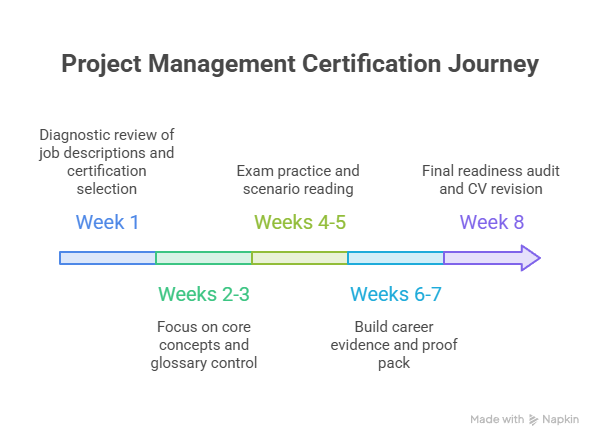
Week 1 should be diagnostic. Review your target job descriptions and mark every repeated skill: governance, procurement, scheduling, vendor management, Agile, reporting, stakeholder management, risk, budgeting, and contract exposure. Then choose the certification that closes the most painful gap. A construction coordinator with heavy site experience may need PMP and critical path vocabulary. A fresh graduate may need CAPM and PM fundamentals. A PMO analyst may need PRINCE2 and reporting discipline. A digital delivery candidate may need Scrum roles and Kanban flow.
Weeks 2 and 3 should focus on core concepts and glossary control. Kuwait interviews can expose weak PM language quickly because experienced panels ask practical questions: “Who approved the change?” “How did you know the vendor caused the delay?” “Which milestone was on the critical path?” “How did you escalate the risk?” Study project initiation terms, risk assessment terms, budgeting terms, communication terms, and quality management definitions until you can explain each term through one project example.
Weeks 4 and 5 should move from reading to exam practice. Use timed quizzes, review every wrong answer, and write a short reason for the correct choice. For PMP, scenario reading matters because the answer often depends on stakeholder priority, governance, value, risk response, or team leadership. For CAPM, build clear foundations across predictive, Agile, business analysis, and core PM concepts. For PRINCE2, focus on principles, practices, processes, tailoring, roles, stages, and escalation. Pair study with PMP exam mistakes, CAPM exam mistakes, PRINCE2 pitfalls, exam-day CAPM strategy, and PMP domain review.
Weeks 6 and 7 should produce your career evidence. Build your proof pack while studying because this locks knowledge into memory and strengthens job applications. Create a project charter, work breakdown summary, Gantt view, risk register, issue log, stakeholder matrix, communication plan, vendor tracker, and dashboard. Use one real project where possible and anonymize details. Support the pack with project templates, Gantt chart terms, vendor terms, dashboard tools, and project reporting software.
Week 8 should be final readiness. Audit your application, confirm education hours, check ID requirements, review exam scheduling, and complete two timed mock sessions. Then revise your CV so every line earns space. A strong Kuwait PM resume should mention sector, project type, budget exposure when appropriate, stakeholders, vendors, schedule control, risk ownership, reporting cadence, and measurable outcomes. Finish with PMP renewal awareness, CAPM renewal clarity, PRINCE2 renewal planning, PM software awareness, and resource allocation tools.
5. How to Position Your Certification for Kuwait Roles, Interviews, and Salary Growth
Positioning depends on the sector. Construction and infrastructure roles reward schedule control, procurement knowledge, site coordination, change control, quality acceptance, claims awareness, and contractor management. IT and digital roles reward requirements control, stakeholder workshops, Agile delivery, backlog discipline, integration awareness, testing coordination, release planning, and adoption tracking. Finance, healthcare, and government-linked environments value governance, auditability, approvals, compliance-friendly documentation, reporting, and risk controls. Translate your certificate into sector language with construction PM software, educational institution PM tools, event PM tools, workforce management software, and HR tools for project teams.
For interviews, prepare answers that sound operational. When asked about delayed projects, explain the original baseline, the critical dependency, the risk trigger, the escalation path, the decision needed, the recovery option, and the trade-off. When asked about difficult stakeholders, explain decision rights, interest level, objection type, communication route, and approval history. When asked about vendors, explain contract deliverables, milestone payments, acceptance criteria, pending issues, and change exposure. These answers become stronger when backed by contract terminology, procurement tools, conflict resolution terms, issue tracking software, and six sigma terms.
For salary conversations, certification helps when combined with proof of business impact. Speak in outcomes: fewer approval delays, cleaner handovers, reduced rework, better vendor control, clearer executive visibility, faster decisions, improved risk response, and stronger documentation. Avoid relying on the certificate name alone. Anchor your value in controlled delivery, sector readiness, and repeatable systems. Compare your profile with regional guides such as project management certification in UAE, project management certification in Saudi-adjacent markets through UAE context, project management certification in Turkey, project management certification in Egypt, and project management certification in South Africa to understand how certification positioning changes across markets.
6. FAQs
-
PMP is usually the strongest choice for experienced project leaders because it signals broad PM capability across people, process, business impact, risk, stakeholders, and hybrid delivery. CAPM fits entry-level candidates, coordinators, and career switchers who need a credible foundation. PRINCE2 is valuable for governance-heavy roles where employers care about business case, controlled stages, approvals, escalation, and clear roles. Agile or Scrum credentials work best for digital transformation, IT implementation, product delivery, and workflow automation. Compare your target job descriptions with PMP domains, CAPM resources, PRINCE2 vs PMP, Agile tools, and Scrum roles.
-
Yes, PMP can make existing experience easier to verify and easier to sell, especially when your work includes schedule control, stakeholder leadership, vendor coordination, risk management, reporting, or change control. The certificate helps most when your resume uses evidence-rich language. Strengthen your profile with PMP preparation resources, PMP mistake avoidance, risk management vocabulary, project reporting terms, and stakeholder engagement terms.
-
CAPM is a smart route when you lack enough project leadership experience for PMP or need a structured foundation before applying for coordinator, junior PM, PMO analyst, project administrator, or assistant project manager roles. Use CAPM to learn the vocabulary hiring managers expect, then create proof assets around schedules, risks, stakeholders, issues, and reporting. Start with CAPM exam tools, CAPM exam-day tips, CAPM career advancement, project initiation terms, and top PM terms.
-
Rewrite every bullet around control, decision-making, and measurable delivery. Mention project type, stakeholders, baseline, timeline, budget exposure where appropriate, risks, vendors, approvals, reporting cadence, and outcome. Replace vague phrases with proof: “created weekly steering reports,” “tracked procurement milestones,” “managed change requests,” “maintained RAID log,” or “coordinated sign-off across business and technical teams.” Use resume-ready project templates, communication terms, contract terms, vendor management terms, and budgeting terms.
-
The strongest skills are scope control, schedule management, stakeholder engagement, procurement awareness, vendor management, risk tracking, budget discipline, change control, quality acceptance, executive reporting, and tool fluency. For hybrid environments, Agile, Scrum, Kanban, and digital collaboration tools add another layer. Study Gantt charts, critical path terms, RFP/RFQ/RFI terms, Kanban tools, and team communication platforms.
-
Most candidates should plan 6 to 10 focused weeks, depending on experience, exam choice, study hours, and comfort with PM vocabulary. Experienced PMs may move faster because they can connect exam concepts to real projects. Beginners should spend more time on terminology, practice questions, and proof assets. Build your plan around PMP study resources, CAPM preparation tools, PRINCE2 training providers, project scheduling terms, and risk identification terms.
