
The Ultimate Guide to Getting Your Project Management Certification in Qatar: All You Need to Know in 2026-2027
Qatar is a sharp market for project managers because employers need people who can control timelines, vendors, approvals, risk, documentation, and stakeholder pressure in complex delivery environments. A certification helps most when it supports evidence: project logs, schedule controls, procurement awareness, governance habits, and interview-ready examples. Use this guide with the PMP exam domains, project reporting terms, stakeholder engagement terms, procurement terms, and risk management glossary to build a certification plan that actually improves your career outcomes.
1. Why Project Management Certification Matters in Qatar in 2026-2027
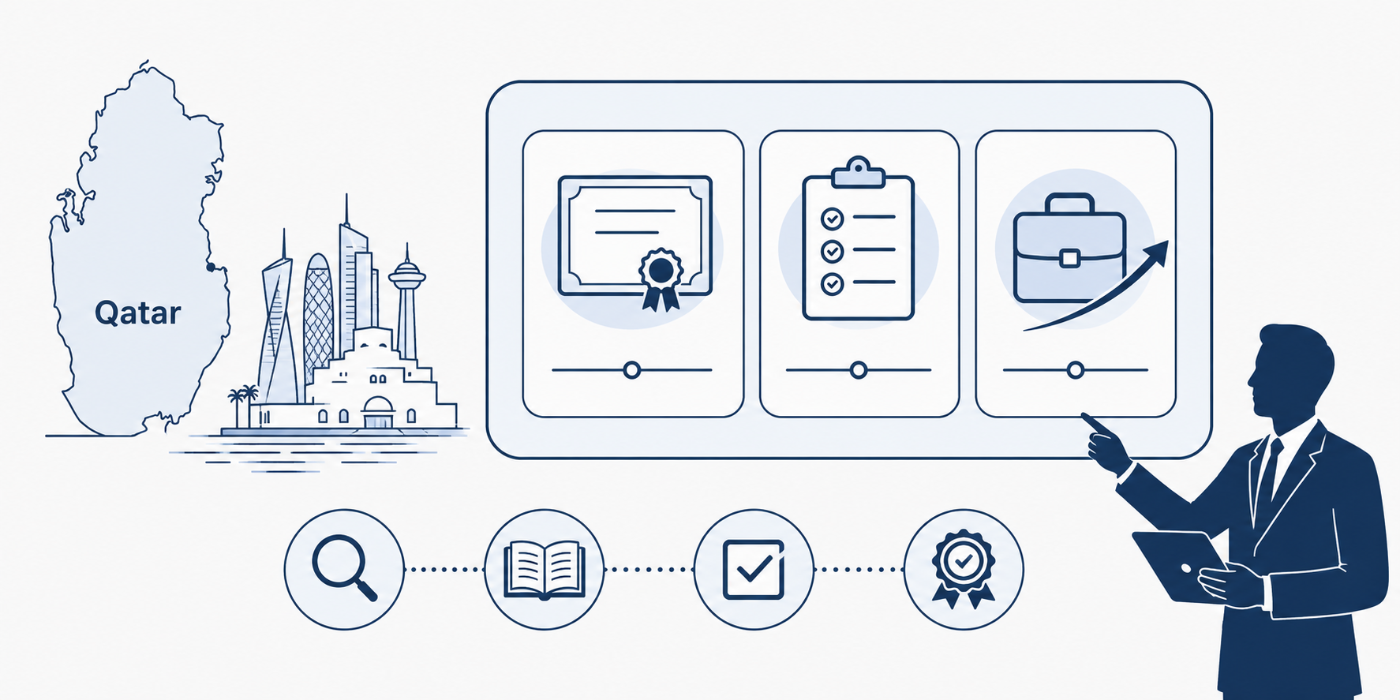
Qatar’s project market rewards disciplined delivery because large employers, government-linked entities, infrastructure contractors, energy organizations, technology teams, healthcare operators, and consulting firms all need managers who can translate ambition into controlled execution. Qatar National Vision 2030 emphasizes diversification and private-sector growth, while the Third National Development Strategy 2024-2030 focuses on growth, specialized economic clusters, innovation, and workforce productivity, which makes certified delivery talent more valuable when it can prove practical execution ability.
For a Qatar-based project manager, certification gives structure to skills employers already test during interviews: scope control, governance rhythm, stakeholder mapping, procurement timing, risk ownership, and reporting discipline. Study requirements control, strengthen your critical path method knowledge, review Gantt chart terminology, sharpen budgeting terms, and connect everything to project quality management terms because hiring managers want examples that sound operational, measurable, and credible.
The biggest mistake candidates make in Qatar is treating certification as a certificate-only exercise. A strong candidate turns exam preparation into proof assets: a governance pack, a project dashboard, a risk register sample, a vendor evaluation checklist, a lessons-learned note, and a stakeholder communication map. That proof pairs well with project templates and resources, project communication techniques, vendor management terms, contract management terminology, and issue tracking software guidance.
| Capability | What “Strong” Looks Like | Qatar Career Impact | Proof Asset to Build | Best APMIC Next Read |
|---|---|---|---|---|
| Scope control | Clear baseline, change log, acceptance rules, and traceable approvals. | Protects timelines in construction, IT, public-sector, and operations projects. | Scope statement + change register. | Project initiation terms |
| Schedule control | Milestones, dependencies, float, critical path, recovery options, and escalation points. | Helps you discuss delays with evidence instead of excuses. | Gantt snapshot + milestone report. | Scheduling terms |
| Critical path | Knows which activities can slip and which ones threaten delivery date. | Strong signal for infrastructure, fit-out, energy, and transformation roles. | Critical path worksheet. | CPM terms |
| Procurement fluency | Understands RFP, RFQ, RFI, bid evaluation, SOW, vendor risks, and contract boundaries. | Valuable in Qatar because vendor-heavy delivery is common. | RFP checklist + vendor comparison sheet. | RFP, RFQ, and RFI guide |
| Contract awareness | Tracks obligations, approvals, deliverables, payment triggers, and dispute evidence. | Prevents weak coordination with procurement, legal, and finance. | Contract obligation tracker. | Contract management terms |
| Stakeholder mapping | Identifies power, influence, approvals, blockers, and communication preferences. | Helps you manage sponsor pressure and cross-functional friction. | Stakeholder map. | Stakeholder engagement terms |
| Governance cadence | Uses steering packs, decision logs, RACI, meeting rules, and escalation thresholds. | Signals maturity to enterprise and government-linked employers. | Governance calendar + RACI. | Stakeholder terms to master |
| Risk ownership | Turns vague threats into probability, impact, owner, mitigation, trigger, and status. | Builds trust when projects carry cost, safety, compliance, or vendor exposure. | Risk register with response plans. | Risk management glossary |
| Issue control | Separates risks from live issues and assigns owners, dates, decisions, and impact. | Makes you look reliable during delivery pressure. | Issue tracker sample. | Issue tracking tools |
| Cost discipline | Knows baseline, actuals, forecast, variance, contingency, and approval limits. | Improves interviews for PMO, construction, operations, and vendor roles. | Budget variance summary. | Cost management terms |
| Reporting clarity | Reports status with decisions needed, risk exposure, milestone movement, and next actions. | Helps senior leaders trust your updates fast. | One-page executive dashboard. | Reporting best practices |
| Agile literacy | Explains backlog, sprint planning, product ownership, increments, and retrospectives. | Useful for digital, fintech, software, and transformation projects. | Sprint board screenshot or mockup. | Agile PM tools |
| Scrum role clarity | Knows Product Owner, Scrum Master, developers, ceremonies, and accountability lines. | Prevents weak claims in tech interviews. | Scrum roles explainer note. | Scrum roles |
| Kanban flow | Can discuss WIP limits, cycle time, bottlenecks, and flow metrics. | Helpful for operations, support, service delivery, and software teams. | Kanban board sample. | Kanban tools |
| Waterfall control | Uses stage gates, baselines, sign-offs, documentation, and formal handovers. | Critical for regulated, construction, engineering, and public programs. | Stage-gate checklist. | Waterfall software |
| Resource planning | Matches capacity, skills, dependencies, leave, vendor resources, and workload peaks. | Supports credible delivery planning in lean teams. | Resource allocation sheet. | Resource allocation software |
| Team leadership | Handles conflict, accountability, motivation, role clarity, and performance signals. | Moves you beyond coordinator-level positioning. | Team charter. | Team building terminology |
| Conflict handling | Uses facts, escalation rules, trade-off options, and documented decisions. | Protects delivery when vendors, users, and sponsors disagree. | Conflict resolution case note. | Conflict resolution terms |
| Quality management | Defines acceptance criteria, defect tracking, QA gates, rework causes, and sign-off rules. | Strong for healthcare, construction, IT, and service delivery. | Quality checklist. | Quality management terms |
| Six Sigma language | Understands defects, variation, root cause, DMAIC, and continuous improvement. | Useful for operations improvement and process excellence roles. | Root-cause analysis sample. | Six Sigma terms |
| Tool stack judgment | Picks tools based on workflow, reporting, integrations, permissions, and adoption. | Prevents shallow “I know software” claims. | Tool comparison matrix. | PM software guide |
| Dashboard design | Shows KPIs, risks, milestones, blockers, spend, and decision requests cleanly. | Helps executives read your work in minutes. | Dashboard wireframe. | Dashboard tools |
| Integration thinking | Connects PM tools with finance, HR, CRM, ticketing, BI, and document systems. | Important for digital transformation programs. | Integration map. | PM APIs and integrations |
| PMP readiness | Links people, process, business environment, hybrid delivery, and scenario judgment. | Best for experienced PMs seeking stronger senior-market credibility. | PMP study tracker. | PMP preparation resources |
| CAPM positioning | Uses foundational certification to enter PM coordination, PMO, and junior delivery roles. | Good for early-career candidates and career switchers. | CAPM application plan. | CAPM exam resources |
| PRINCE2 judgment | Understands controlled stages, business justification, tolerances, and governance roles. | Strong for structured, documentation-heavy environments. | PRINCE2 vs PMP decision sheet. | PRINCE2 vs PMP |
| Exam execution | Studies scenarios, avoids traps, tracks weak domains, and practices time discipline. | Protects your fee, time, and confidence. | Mistake log. | PMP exam mistakes |
| Career conversion | Turns certification into resume bullets, interview stories, LinkedIn proof, and salary leverage. | Separates certified candidates from hireable certified candidates. | Certification-to-career action plan. | Career advancement with certification |
2. How to Choose the Right Project Management Certification for Qatar
Start with your experience level. PMI lists CAPM eligibility as a secondary degree plus 23 hours of project management education, while PMP eligibility depends on education level, project leadership experience, and 35 hours of project management education or CAPM; PMI has also announced a new PMP exam beginning in July 2026, so 2026-2027 candidates should verify timing before locking a study plan. Use CAPM exam resources, CAPM exam mistakes, PMP exam preparation resources, PMP success stories, and PMP renewal guidance to avoid choosing from vibes.
Choose CAPM if you are early-career, shifting from administration, engineering support, operations, customer success, procurement support, or team coordination into project work. CAPM helps you speak structured PM language before you have enough leadership history for PMP. Pair it with top PM terms, human resource management terms, team communication platforms, project templates, and Trello vs Basecamp analysis so your resume shows practical readiness.
Choose PMP if you have led projects, owned deadlines, managed stakeholders, controlled risk, handled vendors, or delivered outcomes with measurable responsibility. PMP carries stronger senior-market weight when your experience section proves ownership instead of participation. Build your application around PMP exam domains, PMP exam day survival tips, PMP common mistakes, schedule compression terms, and risk identification terms.
Choose PRINCE2 when you target structured environments that value governance, stage control, roles, tolerances, business case discipline, and formal documentation. It can be especially useful when your target roles involve PMO, public-sector delivery, consulting, controlled vendor programs, or documentation-heavy environments. Compare PRINCE2 vs PMP, review PRINCE2 training providers, study PRINCE2 exam pitfalls, understand PRINCE2 salary and career benefits, and keep PRINCE2 renewal rules in view.
3. How to Prepare Your Certification Plan Without Wasting Months
Build a 10-week plan if you can study consistently, and stretch it to 14-16 weeks if your job is unpredictable. Week one should audit eligibility, pick the certification, map domains, and create a mistake log. Weeks two through six should cover core knowledge, scenario practice, and weak-area drills. Weeks seven through nine should focus on mock exams, timing, and explanation review. The final week should tighten confidence, logistics, formulas, definitions, and mental stamina. Support the plan with PMP exam resources, PMP exam domains, CAPM exam resources, CAPM renewal requirements, and exam mistake guidance.
Your study notes should read like decision training. When a question mentions a late vendor, decide whether the issue belongs in procurement, risk, schedule, communication, or governance. When a scenario mentions sponsor disagreement, identify the missing decision path. When a team conflict appears, separate performance management from facilitation. That mental sorting becomes interview strength in Qatar because employers test judgment through messy examples. Reinforce that thinking with vendor and supplier terms, procurement tools, communication terms, conflict resolution terms, and stakeholder engagement language.
Create a proof portfolio while studying. A Qatar hiring panel may never ask to see every document, yet the act of building them makes your resume sharper and your interview answers more specific. Prepare a one-page status report, a risk register, a milestone plan, a change request template, a stakeholder map, and a vendor evaluation sheet. These assets help you answer, “How do you control delivery?” with substance. Use project reporting best practices, project budgeting terms, contract lifecycle tools, project dashboard tools, and PM templates.
4. How to Turn Certification Into Interviews in Qatar
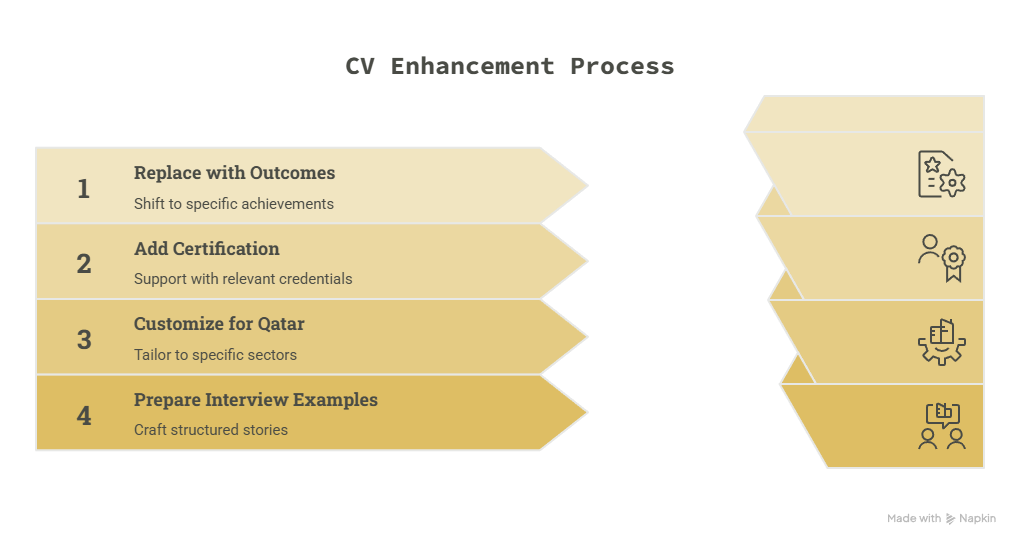
Your CV should turn certification into delivery evidence. Replace weak task language with outcomes: “controlled vendor delays through weekly risk reviews,” “reduced approval bottlenecks through a decision log,” “built dashboard reporting for milestone, risk, and budget visibility,” or “managed scope change through documented impact assessment.” Then add a certification line that supports the story. Strengthen the language with project reporting terms, risk assessment terms, stakeholder terms, budgeting terms, and quality management terms.
For Qatar roles, customize your resume by sector. Construction and fit-out roles need schedule, contractor, safety, approvals, and variation-control language. Energy and utilities roles need risk, compliance, shutdown planning, procurement, and stakeholder discipline. IT and digital transformation roles need Agile, hybrid delivery, backlog, integration, vendor, and adoption language. Healthcare and education roles need compliance, service continuity, reporting, change management, and user adoption. Use construction PM software, PM software for education, Agile PM tools, workforce management software, and HR management tools to speak the language of the environment.
Your interview examples should follow a clean pattern: project context, constraint, decision, stakeholder handling, tool or document used, measurable result, and lesson. Avoid rambling project histories. Qatar hiring teams are often filtering for maturity, especially when the role involves vendors, approvals, multicultural teams, senior sponsors, and compressed deadlines. Prepare six stories: late milestone, difficult stakeholder, vendor issue, scope change, budget pressure, and team conflict. Build them with conflict resolution terms, schedule compression terms, contract management terminology, procurement terms, and Gantt chart terms.
5. Qatar Salary, Sector, and Career-Move Strategy After Certification
Certification can support better pay when it changes how the market sees you. The strongest salary case combines credential, project scale, sector relevance, stakeholder complexity, budget exposure, tool fluency, and proof of controlled outcomes. Build a promotion file before you negotiate: projects delivered, delays prevented, budget variance reduced, approvals accelerated, reports created, vendors controlled, issues resolved, and teams coordinated. Use project budgeting terms, cost management terms, dashboard tools, reporting analytics software, and resource allocation software.
Plan your next move around role level. If you are junior, target project coordinator, PMO analyst, project analyst, operations coordinator, and assistant project manager roles. If you are mid-level, target project manager, delivery manager, implementation manager, construction PM, IT PM, and transformation PM roles. If you are senior, target program manager, PMO lead, portfolio coordinator, governance manager, and consultant roles. Compare regional pathways with project management certification in UAE, project management certification in Saudi-adjacent Egypt, project management certification in Turkey, project management certification in Germany, and project management certification in Netherlands.
Keep building after certification. Employers forget certificates that sit alone, while they remember candidates who can show practical judgment. Add one tool skill, one reporting sample, one sector-specific case study, one governance template, and one measurable project story every month for six months. That steady proof stack makes your LinkedIn, CV, and interviews sharper. Expand with event project management tools, team communication platforms, contract lifecycle management software, procurement management tools, and project management APIs.
6. FAQs About Project Management Certification in Qatar in 2026-2027
-
PMP is usually the strongest choice for experienced project managers because it signals tested leadership across people, process, and business delivery. CAPM is better for entry-level candidates, coordinators, fresh graduates, and professionals shifting into PM roles. PRINCE2 is useful for structured governance environments. Your best choice depends on eligibility, target sector, and role level. Compare PRINCE2 vs PMP, review CAPM resources, study PMP domains, and use PMP preparation resources.
-
PMP can be worth it when you already have project leadership experience and want stronger credibility for PM, senior PM, delivery manager, PMO, consulting, or program-related roles. It works best when your CV proves outcomes, stakeholder ownership, schedule control, risk handling, and vendor coordination. Certification with weak evidence creates limited movement. Support your PMP plan with PMP exam mistakes, PMP success stories, reporting best practices, and risk management terms.
-
CAPM is a smart route for beginners because it gives foundational vocabulary, exam discipline, and confidence before PMP eligibility. It helps candidates move toward coordinator, PMO support, project analyst, and junior delivery roles. Beginners should pair CAPM with tool practice and proof assets rather than waiting for a certificate to do all the work. Use CAPM exam mistakes, CAPM career advancement, project templates, and top PM terms.
-
A focused candidate can often prepare in 10-14 weeks with consistent study, timed practice, and proper review. Candidates with demanding jobs may need 16 weeks. The real key is study quality: scenario questions, explanation review, mistake logging, and weak-domain repair. Build around PMP exam domains, exam day survival tips, CAPM resources, PMP resources, and PMP exam mistakes.
-
Certification can support careers in construction, engineering, oil and gas, energy services, IT, digital transformation, telecom, healthcare, education, events, operations, consulting, and PMO environments. Each sector values a different proof angle. Construction wants schedule and contractor control. IT wants Agile and integration fluency. Healthcare wants compliance and service continuity. PMO wants governance and reporting discipline. Study construction PM software, Agile tools, project reporting terms, and quality management terms.
-
Certification can help you compete, especially when you translate previous experience into Qatar-relevant delivery language. The stronger play is to show transferable evidence: vendor management, reporting, budget control, stakeholder engagement, risk ownership, cross-cultural communication, and governance discipline. Add a sector-focused portfolio to reduce uncertainty for employers. Use stakeholder engagement terms, vendor management terms, contract management terms, and project communication techniques.
