
The Ultimate Guide to Getting Your Project Management Certification in Hong Kong: All You Need to Know in 2026–2027
Hong Kong project managers operate where financial controls, technology delivery, construction governance, procurement discipline, and regional stakeholder management collide. A respected certification can strengthen your profile, yet employers still examine whether you can manage project risks, control budgets, build credible schedules, handle vendors, and communicate decisions through disciplined project reporting. This guide shows you how to select, earn, and convert the right credential into measurable career value during 2026–2027.
1. Why Project Management Certification Carries Weight in Hong Kong
Hong Kong employers frequently recruit project professionals across banking, insurance, fintech, construction, transport, property, telecommunications, consulting, healthcare, education, retail, and public-sector transformation. Each sector uses different delivery language, yet the underlying expectations remain remarkably consistent: define outcomes, control scope, build an executable plan, protect the budget, surface risks early, coordinate specialists, and leave a defensible decision trail.
A certification gives recruiters a standardised signal that you understand these disciplines. The signal becomes substantially stronger when your CV also demonstrates practical command of project initiation, critical-path analysis, resource allocation, stakeholder engagement, and issue tracking. Hiring managers want evidence that you can translate a framework into controlled delivery under commercial pressure.
Current Hong Kong recruitment listings illustrate the breadth of that pressure. Project roles appear across banking technology, cybersecurity infrastructure, software development, AI integration, corporate relocation, exchange operations, and product development. Many combine degree expectations with several years of relevant delivery experience, technical exposure, and cross-functional coordination.
Certification solves a positioning problem
Many capable candidates struggle because their experience appears fragmented. They have coordinated deployments, chased suppliers, prepared progress updates, organised testing, handled client changes, or resolved delivery conflicts without holding the formal title “Project Manager.” A credential helps place these activities inside a recognised professional structure.
That structure is especially useful when moving from:
Project coordinator to project manager
Business analyst to technology project manager
Engineer to construction or infrastructure project manager
Scrum Master to hybrid delivery manager
Operations manager to transformation project manager
Team lead to programme-delivery professional
Overseas project role to a Hong Kong-facing position
The credential still needs proof. A candidate who can explain a requirements baseline, demonstrate change control, defend a procurement strategy, map stakeholder influence, and quantify a recovered delay will usually present a stronger case than someone relying on certificate initials alone.
Hong Kong employers reward commercial control
The local market places significant value on professionals who understand approval structures, auditability, governance committees, contractual dependencies, regional vendors, and senior-management reporting. That makes RFP, RFQ, and RFI fluency, contract terminology, cost management, quality management, and conflict resolution highly valuable across multiple industries.
| Career Situation | Best-Fit Credential | Why It Fits | Evidence to Build Beside It | Main Selection Risk |
|---|---|---|---|---|
| Student or fresh graduate | CAPM | Builds formal PM vocabulary before extensive leadership experience | University project charter, schedule, risk register | Applying only for full project-manager roles |
| Project coordinator | CAPM or PRINCE2 Foundation | Structures existing coordination experience | RAID log, status report, meeting decision log | Describing duties without outcomes |
| Experienced project lead | PMP | Validates leadership across people, process, and business priorities | Benefits achieved, budget controlled, delays recovered | Weak documentation of qualifying experience |
| PMO analyst | CAPM, PMP, or PRINCE2 | Supports governance, reporting, and portfolio visibility | Dashboard, assurance checklist, governance calendar | Appearing administrative rather than analytical |
| Business analyst | CAPM or PMP | Connects requirements work with end-to-end delivery | Traceability matrix and change-impact analysis | Failing to show ownership beyond requirements |
| Scrum Master | CSM, PSM, or PMI-ACP | Signals agile facilitation and adaptive delivery competence | Impediment log, cycle-time trend, retrospective actions | Reducing the role to ceremonies |
| Product owner | CSPO or agile pathway | Strengthens prioritisation and value-delivery language | Roadmap decisions and backlog-value evidence | Confusing product ownership with project control |
| Hybrid delivery manager | PMP plus agile credential | Covers governance alongside iterative execution | Integrated roadmap, release plan, dependency map | Collecting credentials without integration evidence |
| Banking technology PM | PMP or PRINCE2 Practitioner | Supports governance-heavy, cross-functional delivery | Control gates, testing evidence, regulatory dependencies | Underplaying risk and audit requirements |
| Fintech project lead | PMP plus agile credential | Balances speed, controls, vendors, and product iteration | Release governance and third-party integration plan | Presenting speed without operational control |
| Cybersecurity PM | PMP with security-domain knowledge | Supports complex remediation and implementation programmes | Risk treatment plan, dependency map, acceptance criteria | Relying on PM knowledge without security fluency |
| Infrastructure PM | PMP or PRINCE2 Practitioner | Strengthens planning, controls, procurement, and handover | Critical path, contractor tracker, commissioning plan | Ignoring technical and contractual interfaces |
| Construction coordinator | CAPM, PMP, or sector qualification | Formalises scheduling and coordination capability | Look-ahead schedule, variation log, safety interfaces | Assuming a general credential replaces local sector requirements |
| Property-development PM | PMP or PRINCE2 | Supports consultant, authority, contractor, and budget coordination | Approval tracker and commercial change register | Weak evidence of financial control |
| Procurement project lead | PMP or PRINCE2 | Connects sourcing activities with delivery governance | RFP calendar, evaluation model, contract milestones | Treating procurement as a standalone transaction |
| Vendor manager | PMP | Frames performance, dependencies, escalation, and acceptance | SLA dashboard and vendor corrective-action plan | Reporting activity without commercial outcomes |
| Operations manager | CAPM or PMP | Supports transition from continuous operations into change delivery | Business case, transition plan, benefits measures | Using operational KPIs as project evidence without context |
| Change manager | PMP or PRINCE2 | Connects adoption planning with controlled implementation | Readiness assessment and adoption dashboard | Separating people change from delivery milestones |
| Consultant | PMP or PRINCE2 Practitioner | Provides portable delivery language across clients | Engagement plan, decision paper, benefits case | Listing frameworks without client results |
| Government contractor | PRINCE2 or PMP | Supports structured governance and formal accountability | Approval matrix, audit trail, contract deliverables | Underestimating documentation requirements |
| Healthcare project lead | PMP | Supports multi-stakeholder implementation and operational readiness | Clinical dependencies, risk controls, readiness plan | Ignoring service-continuity risks |
| Education-sector PM | CAPM, PMP, or PRINCE2 | Frames technology, campus, and programme delivery | Academic-calendar constraints and adoption measures | Using commercial assumptions without sector adaptation |
| Event project manager | CAPM or PMP | Structures fixed-date planning and supplier coordination | Run sheet, contingency matrix, supplier tracker | Ignoring post-event benefits and lessons |
| Risk specialist | PMI-RMP | Deepens risk identification, analysis, response, and monitoring | Quantified risk model and response ownership | Taking a specialist credential before building core PM competence |
| Programme manager | PMP followed by PgMP | Builds from project execution toward strategic coordination | Benefits map and cross-project dependency governance | Claiming programme leadership through project volume alone |
| Career changer | CAPM or PRINCE2 Foundation | Creates credible entry-level structure | Transferable project case study from previous industry | Hiding prior experience instead of translating it |
| Overseas applicant | PMP or role-specific credential | Provides a portable signal across markets | Hong Kong-focused CV and local-sector terminology | Assuming certification alone secures work authorisation |
| Senior PM seeking promotion | PMP, PgMP, or specialist pathway | Supports progression toward programme or portfolio responsibility | Benefits governance, executive decisions, coaching evidence | Adding another badge without broadening responsibility |
2. Which Project Management Certification Should You Choose in Hong Kong?
The strongest choice depends on three variables: your qualifying experience, the delivery environment you want to enter, and the hiring objection currently blocking you. Use job advertisements from your target sector as a live requirements dataset. Record every repeated credential, methodology, tool, regulatory term, language expectation, and experience threshold across 20–30 suitable vacancies.
PMP: strongest for experienced, cross-industry project leaders
The Project Management Professional credential fits candidates who already lead projects and need a widely portable validation of that experience. It aligns well with Hong Kong roles involving regional stakeholders, substantial budgets, vendors, governance committees, and hybrid delivery.
PMP candidates should be comfortable with project risk terminology, schedule compression, project budgeting, stakeholder strategy, and team communication. These areas regularly appear inside scenario-based exam questions and real delivery conversations.
Choose PMP when your experience already includes responsibility for decisions, trade-offs, stakeholder expectations, delivery planning, risk responses, or team performance. A title such as coordinator, analyst, engineer, consultant, or team lead can still contain qualifying leadership work; the quality and accuracy of your documented responsibilities determine the strength of your application.
CAPM: best entry point for foundational credibility
CAPM suits graduates, career changers, coordinators, junior analysts, and professionals building formal project vocabulary before meeting PMP experience requirements. PMI describes CAPM as an experience-free foundational certification, while PMP requires several years of project leadership experience.
Pair CAPM preparation with practical outputs. Build a charter, milestone schedule, risk register, stakeholder matrix, change log, and status report using the best project-management templates. Strengthen your planning fluency through Gantt-chart terminology, scheduling concepts, quality terminology, and human-resource management terms.
The common pain point appears after certification: candidates continue applying only to jobs requiring five or more years of independent delivery ownership. A more productive first target may be project coordinator, PMO analyst, junior project manager, implementation specialist, delivery analyst, or business-change coordinator.
PRINCE2 7: valuable for structured governance environments
PRINCE2 Foundation and Practitioner provide a controlled method built around principles, practices, processes, roles, management products, and tailoring. This pathway can work well where employers value formal stage controls, business justification, clear accountabilities, exception management, and governance discipline.
Foundation develops method recognition. Practitioner tests whether you can apply and tailor the method within scenarios. PeopleCert currently identifies PRINCE2 Project Management Version 7 as the active pathway and states that Foundation certification is renewed every three years, with CPD or another qualifying route available to maintain currency.
PRINCE2 preparation becomes more useful when paired with project reporting discipline, stakeholder-engagement vocabulary, contract-management knowledge, procurement definitions, and team-building terminology.
Agile credentials: valuable when delivery genuinely uses agile methods
Technology and product environments may value CSM, PSM, PMI-ACP, or product-owner pathways. Choose according to the role you intend to perform:
CSM: guided training and foundational Scrum Master development
PSM: assessment-led validation of Scrum understanding
PMI-ACP: broader agile capability across multiple approaches
Product-owner credential: backlog, prioritisation, stakeholder, and value decisions
PMP plus agile certification: hybrid governance and iterative delivery
Scrum Alliance requires continuing education units for CSM-family renewal every two years. Before paying, decide whether the role requires facilitation, product ownership, delivery management, technical leadership, or enterprise governance. Recruiters can quickly detect candidates who memorise Scrum events while lacking evidence of resolving impediments, improving flow, negotiating scope, or protecting sprint goals.
Expand your practical understanding through the best Scrum platforms, top agile project-management tools, Kanban software directory, Scrum roles and responsibilities, and team communication platforms.
Sector credentials and knowledge remain essential
A general PM certification supports transferable delivery competence. Employers in construction, engineering, cybersecurity, finance, healthcare, and regulated environments may also seek sector knowledge, professional membership, technical qualifications, or direct regulatory experience.
Construction candidates should develop fluency in construction project-management software, contractor dependencies, variations, site sequencing, inspection records, handover, and commercial controls. Technology candidates should understand project-management integrations, issue-tracking systems, dashboards, testing stages, data migration, release governance, and cybersecurity risk. Procurement-heavy roles require confidence with supplier-management concepts, contract lifecycle tools, and procurement-management platforms.
When considering a Hong Kong academic or vocational programme, check whether it appears in the territory’s Qualifications Register. Hong Kong’s Qualifications Framework exists to support recognised academic, vocational, professional, and continuing-education pathways, while the public register provides information about quality-assured local programmes.
3. Eligibility, Exam Changes, Costs, and Timelines for 2026–2027
PMP eligibility and application evidence
Under PMI’s currently published pathways, applicants with a secondary-school qualification need 60 months of project leadership experience within the previous eight years plus 35 hours of project-management education. Applicants with a bachelor’s degree or global equivalent need 36 months plus 35 education hours. Graduates of an accredited GAC programme may qualify with 24 months and the required education.
The application should describe your role in leading and managing work. Build a private evidence file containing:
Project name and organisation
Start and finish dates
Objective and expected outcome
Your leadership responsibilities
Team and stakeholder environment
Delivery approach
Risks, constraints, and decisions handled
Result or business impact
Supervisor or verifier details
Training certificates and qualifying hours
Use language grounded in action. “Managed the integrated plan, chaired weekly risk reviews, assessed supplier slippage, secured steering approval for recovery actions, and protected the regulatory deadline” provides stronger evidence than “worked on an important implementation.”
Study the PMP exam domains, review common PMP exam mistakes, compare preparation resources, and examine successful candidate strategies before purchasing a large training package.
The July 2026 PMP exam change
Timing deserves careful attention. PMI states that the redesigned PMP examination launches on 9 July 2026. Candidates seeking the previous exam version must sit it before 8 July. The updated examination retains 180 questions, extends the testing time to 240 minutes, introduces more interactive scenarios, and increases emphasis on business outcomes, AI, sustainability, stakeholder engagement, adaptive delivery, and real-world decision-making.
The new weighting changes to:
People: 33%
Process: 41%
Business Environment: 26%
That shift makes strategic alignment and business context much harder to treat as a small revision topic. Candidates preparing for the new version should practise decisions involving value, governance, sustainability, emerging technology, uncertainty, and organisational impact alongside predictive, agile, and hybrid delivery.
PMI has also announced planned changes to qualifying live PMP training in late Q4 2026. Once the change takes effect, eligible live instruction will need to come through an authorised or otherwise approved route. Self-paced training rules differ, and PMI says training completed before the effective date will remain eligible under the existing requirements. Verify the rule in force when you enrol.
Build a realistic certification budget
Course advertisements often highlight one headline price while the candidate eventually pays for several components. Your planning budget should account for:
Certification-body membership, when financially beneficial
Exam application or voucher
Instructor-led or self-paced training
Official textbook or digital manual
Question bank and full mock examinations
Travel to a test centre, where applicable
Online-proctoring equipment or room requirements
Currency conversion and card charges
Possible retake protection
Renewal fees and continuing education
Time away from billable or salaried work
Treat prices as dynamic. Certification bodies, training providers, taxes, exchange rates, bundles, memberships, and promotions can change during 2026–2027. Compare the full checkout total and verify whether the package includes the exam, official materials, mock tests, rescheduling terms, and retake coverage.
A low-priced course can become expensive when it provides outdated slides, no instructor access, shallow questions, or a completion certificate that fails the required training rules. A premium package can also waste money when it overwhelms the learner with unused content. Evaluate providers using the PMP resource guide, exam-domain breakdown, exam-day performance guidance, CAPM preparation resources, and PRINCE2 provider comparison.
Choose an achievable timeline
A structured PMP candidate with current delivery experience may plan 10–16 weeks. A CAPM candidate learning project vocabulary from the beginning may need 8–14 weeks. PRINCE2 Foundation can fit a shorter intensive schedule, while Practitioner requires deeper scenario practice. Agile course-based credentials may be completed quickly, although workplace competence develops through repeated application.
Your readiness depends on diagnostic performance. Schedule the exam when you can consistently:
Separate urgent action from appropriate action
Identify the accountable role before choosing a response
Preserve governance while resolving delivery pressure
Handle predictive, agile, and hybrid scenarios
Read stakeholder and team conflicts accurately
Explain why the incorrect options fail
Complete full simulations within time limits
Maintain concentration across the entire exam
4. How to Get Certified Without Wasting Time or Money
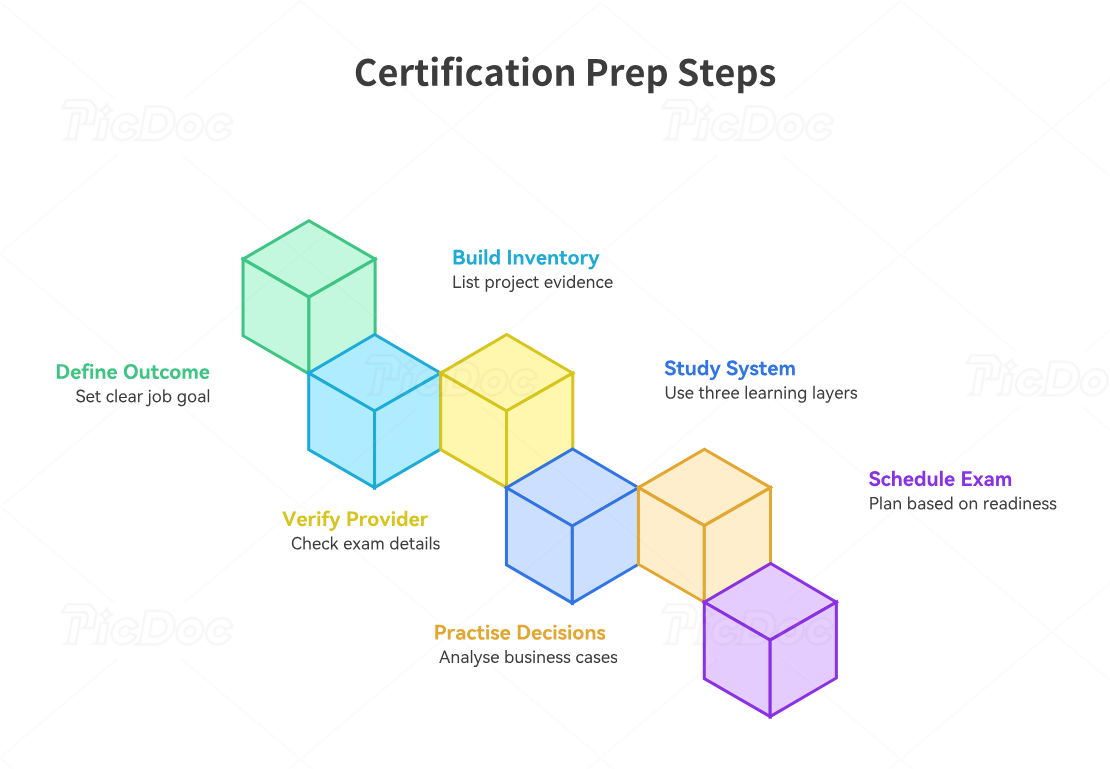
Step 1: Define the exact job outcome
Write one target sentence: “Within six months, I want to qualify for technology project-manager roles in Hong Kong banking,” or “I want to move from construction coordinator to assistant project manager.” A credential selected without a job outcome can become expensive professional decoration.
Study local vacancies and compare your target with nearby markets through the Malaysia certification guide, China certification guide, Japan certification guide, South Korea certification guide, and Vietnam certification guide. Regional comparison reveals which credentials travel well and which expectations remain sector-specific.
Step 2: Build an eligibility and evidence inventory
List every project from the relevant eligibility window. Include formal projects, client implementations, product launches, compliance initiatives, relocations, system migrations, construction packages, operational transitions, and organisational changes.
For each one, capture:
Objective and measurable outcome
Dates and duration
Your authority and responsibilities
Team size and functions
Budget or commercial exposure
Delivery method
Major risk or constraint
Decision you influenced
Result achieved
Person able to verify your involvement
This inventory supports the certification application, CV, interview preparation, and future performance review. It also exposes gaps. Someone claiming strong scheduling experience should be able to explain dependencies, float, baselines, slippage, and recovery using critical-path terminology, Gantt-chart concepts, and schedule-compression techniques.
Step 3: Verify the provider and current exam version
Confirm the provider’s status directly with the certification body. Check:
Which exam version the course covers
Whether required training hours qualify
Instructor credentials
Official materials included
Access period
Mock-exam quality
Retake and cancellation conditions
Support for application questions
Refund policy
Renewal obligations
A beautifully designed sales page cannot compensate for outdated content. This risk becomes particularly important around the July 2026 PMP transition and the later live-training rule change.
Use the PRINCE2 provider review, PRINCE2 and PMP comparison, CAPM mistakes guide, PMP mistake analysis, and exam-preparation resource guide to challenge provider claims.
Step 4: Use a three-layer study system
Layer one: concept accuracy. Learn roles, artefacts, processes, principles, terminology, and decision rules.
Layer two: scenario interpretation. Determine what has happened, what is threatened, who owns the decision, and which action should occur next.
Layer three: exam execution. Practise pacing, concentration, flagging, review discipline, and recovery after difficult questions.
A productive weekly structure may include three short concept sessions, three question-review sessions, one long scenario block, and one rest period. Every wrong answer should enter an error log with the topic, your reasoning, the correct principle, and the trigger you missed.
Support this system with the top 100 PM terms, risk-management glossary, stakeholder terminology, communication techniques, and conflict-resolution glossary.
Step 5: Practise full business decisions
Weak candidates search each question for a memorised keyword. Strong candidates diagnose the delivery system. Ask:
What outcome is threatened?
Which fact changes the decision?
Who owns the next action?
Does governance require escalation or local resolution?
Which action protects value while preserving accountability?
What should be documented afterward?
Apply the same reasoning to procurement scenarios, vendor-performance problems, budget pressure, quality failures, and resource conflicts.
Step 6: Schedule around evidence, rather than anxiety
Book when your performance is repeatable. One strong mock can result from familiar questions or favourable topic distribution. Three or four timed simulations reveal endurance, pacing, and recurring weaknesses more accurately.
In the final week:
Stop collecting new resources
Review the error log
Revisit weak decision patterns
Confirm identification requirements
Test the online environment or route to the centre
Protect sleep and meal timing
Prepare for examination-day breaks
Avoid emotionally reacting to difficult opening questions
The CAPM exam-day guide, PMP preparation resources, and successful exam stories can help you design a controlled final phase.
5. How to Convert the Certification Into a Hong Kong Career Advantage
Rebuild your CV around delivery evidence
Place the certification near your name or professional summary after earning it. Then prove its relevance through quantified project bullets.
A strong bullet follows this structure:
Problem or objective + your decision or action + delivery complexity + measurable result
Example:
“Recovered a delayed core-system migration by rebuilding the dependency schedule, negotiating revised vendor milestones, and introducing weekly executive risk decisions, enabling launch within the regulatory window.”
That sentence demonstrates schedule control, vendor management, risk governance, stakeholder communication, and reporting discipline without filling the CV with framework jargon.
Quantify outcomes through time saved, cost avoided, revenue enabled, defects reduced, audit findings closed, adoption increased, downtime prevented, risks retired, vendors consolidated, or milestones recovered. Protect confidential information by using percentages, ranges, or scale descriptions.
Create five proof assets
A hiring manager cannot inspect your previous project environment. Portable artefacts make your thinking visible. Prepare anonymised examples of:
One-page project charter
Integrated milestone plan
RAID log with clear ownership
Executive status dashboard
Change request with impact assessment
Add a stakeholder map, procurement evaluation, benefits tracker, lessons report, or sprint dashboard when relevant. Build these using project-management templates, dashboard tools, reporting and analytics software, resource-allocation software, and issue-tracking tools.
Prepare six interview stories
Hong Kong project interviews commonly probe delivery pressure rather than textbook definitions. Prepare detailed stories covering:
A project that slipped and how you recovered it
A senior stakeholder conflict
A vendor or contractor failure
A major scope change
A risk you escalated early
A decision that protected business value
For every story, define the baseline, constraint, competing interests, options considered, decision made, governance route, measurable result, and lesson applied later. Avoid claiming “successful stakeholder management” without identifying the disagreement and your intervention.
Review conflict-resolution terminology, team-building concepts, project communication techniques, quality-management definitions, and contract-management terminology while preparing.
Target roles by evidence level
Freshly certified candidates often damage their response rate by applying too broadly. Segment opportunities into:
Ready now: you satisfy most delivery and domain requirements
Credible stretch: you meet the core responsibilities with one manageable gap
Future target: the role requires authority, scale, or sector exposure you still need to build
A CAPM holder may target coordinator and PMO roles while gathering ownership evidence. A newly certified PMP with strong technology experience can target project-manager positions in technology rather than senior construction roles. A PRINCE2 Practitioner with governance experience should highlight controlled environments, tolerances, reporting, and decision structures. An agile-certified candidate should quantify delivery flow, impediment removal, release outcomes, and stakeholder value.
Your tool knowledge should follow the role. Explore agile tools, waterfall software, small-business PM systems, workforce-management platforms, and project-management integrations according to your target environment.
Overseas applicants must separate certification from immigration eligibility
A professional credential can strengthen your evidence of capability. Work authorisation remains a separate process. Hong Kong’s General Employment Policy generally considers factors including education or proven professional ability, a genuine vacancy, a confirmed relevant job offer, skills or experience that cannot readily be filled locally, and remuneration aligned with prevailing professional market levels.
Prepare an immigration-ready evidence folder containing your passport, degree records, professional certificates, employment references, detailed role history, project outcomes, and any requested employer documentation. Check the official rules applicable to your nationality, residence status, and scheme at the time of application because eligibility can change.
Regional mobility research can also help you compare opportunities through the Thailand certification guide, New Zealand certification guide, Ireland certification guide, Germany certification guide, and Netherlands certification guide.
Protect the credential after earning it
Renewal planning should begin immediately. Record continuing education, professional contributions, webinars, courses, mentoring, volunteering, presentations, and relevant work-based learning as permitted by the certification body.
PMP holders can use the PDU and renewal guide. PRINCE2 professionals should review the renewal and recertification guide. CAPM holders can follow the CAPM renewal requirements. Scrum credential holders should track the education units and fees required by their certification level.
The strongest renewal activities also improve your career evidence. A course in risk assessment, a webinar on project analytics, or practical learning in contract lifecycle management can support both maintenance and promotion.
6. Frequently Asked Questions About Project Management Certification in Hong Kong
-
PMP is often the strongest broad-market choice for experienced project leaders because it supports roles across technology, finance, consulting, construction, operations, and transformation. PRINCE2 can be highly relevant in structured governance environments. CAPM fits early-career candidates, while CSM, PSM, and PMI-ACP suit agile delivery contexts.
Choose through job evidence. Analyse vacancies for your exact sector, seniority, and role family. Compare the requested credential with required domain experience, tools, languages, and delivery scale. The PMP versus PRINCE2 comparison, CAPM career guide, Scrum tools guide, and agile tools review can help narrow the decision.
-
Yes. PMI evaluates qualifying education, experience, and responsibility rather than relying solely on job titles. A business analyst, engineer, consultant, implementation lead, operations manager, or coordinator may have led substantial project work.
Document the projects accurately. Emphasise your responsibility for planning, leadership, decisions, stakeholders, risk, delivery, or outcomes. Avoid inflating administrative participation into leadership. Review the current eligibility rules, build a chronological project inventory, and study the PMP domains, project initiation terminology, risk glossary, and stakeholder terms.
-
Candidates already well prepared for the previous version may benefit from sitting before the transition deadline. Candidates beginning preparation near the change should consider the updated examination and use resources explicitly aligned with the new content outline.
The new version launches on 9 July 2026 and places greater weight on business environment, outcomes, AI, sustainability, stakeholder engagement, and adaptive real-world scenarios. Your choice should reflect preparation depth, available study time, mock performance, and access to current materials.
-
A realistic range depends on your starting knowledge, credential, working hours, and study quality. PMP preparation often requires several months of structured practice. CAPM may take a similar period for candidates learning formal terminology from the beginning. PRINCE2 Foundation can be prepared more quickly, while Practitioner requires stronger application and scenario analysis.
Measure progress through timed accuracy and reasoning quality. Use the PMP preparation guide, CAPM resources, PRINCE2 pitfalls guide, and project-management terminology directory to structure the work.
-
Certification can improve access to roles with greater delivery responsibility, yet compensation usually reflects the whole profile: sector, seniority, project scale, technical knowledge, regulatory exposure, language capability, employer type, leadership scope, and proven outcomes.
Use the credential to pursue a defined increase in responsibility. Build evidence of budget control, vendor governance, schedule recovery, risk reduction, and executive reporting. Those achievements create the commercial basis for stronger salary negotiations.
-
Recognition depends on the awarding body and credential, rather than the learner’s physical location during preparation. A genuine examination delivered through an approved online or test-centre route can carry the same certification outcome, subject to the body’s current rules.
Verify the awarding organisation, provider status, exam voucher, proctoring arrangement, identity requirements, materials, and renewal conditions. For locally offered academic or vocational programmes, check the Hong Kong Qualifications Register. For global professional credentials, verify directly through the relevant certification body.
