
The Ultimate Guide to Getting Your Project Management Certification in Indonesia: All You Need to Know in 2026–2027
Indonesia’s project economy needs professionals who can convert ambitious plans into controlled budgets, realistic schedules, accountable vendors, and measurable outcomes. A recognised credential strengthens that capability when it matches your experience, industry, and target employer. Whether you are comparing PMP and PRINCE2, entering through CAPM career advancement, strengthening Agile delivery knowledge, or pursuing an Indonesian competency certificate, this guide explains how to choose, fund, earn, and use your certification effectively during 2026–2027.
1. Which Project Management Certification Should You Choose in Indonesia?
Certification selection should begin with the work you want to perform. Indonesian employers recruit project professionals across technology, construction, energy, mining, telecommunications, manufacturing, logistics, banking, healthcare, consulting, government programmes, and digital transformation. Each environment places different weight on project scheduling knowledge, procurement management, stakeholder engagement, risk assessment, and technical domain expertise.
PMP for experienced project leaders
The Project Management Professional credential is generally the strongest international option for professionals who already lead projects, workstreams, teams, budgets, vendors, or major stakeholder decisions. PMP covers predictive, Agile, and hybrid delivery, making it relevant to Indonesian organisations operating across traditional infrastructure and fast-moving digital programmes.
A PMP candidate should be able to demonstrate ownership of project initiation, scope control, project budgeting, resource allocation, and delivery outcomes. A long task list carries limited value when the application and resume fail to show the decisions you personally led.
CAPM for graduates, coordinators, and career changers
CAPM suits university graduates, project administrators, junior engineers, business analysts, PMO coordinators, operations professionals, and people moving into formal project work. It establishes structured knowledge before you accumulate the experience required for PMP.
Its market value improves when you combine it with practical evidence. Build a portfolio containing a Gantt chart, RAID log, stakeholder register, project charter, change log, and status report. Use focused CAPM exam resources, prepare for recurring CAPM exam mistakes, practise reliable exam-day techniques, and understand CAPM renewal requirements.
PRINCE2 for governance-heavy environments
PRINCE2 Project Management Version 7 can serve professionals working in consulting, PMOs, public programmes, multinational organisations, regulated industries, and environments requiring formal approval stages. It develops competence in business justification, defined responsibilities, management stages, tolerances, escalation, and method tailoring.
Candidates should study the differences through a detailed PRINCE2 versus PMP comparison, assess reputable PRINCE2 training providers, prepare for common PRINCE2 examination pitfalls, and factor PRINCE2 recertification into the total investment. PeopleCert describes Version 7 as a method designed for application and tailoring across different project environments.
Agile and Scrum credentials for digital delivery
Scrum and Agile certifications can strengthen applications for software, product, fintech, e-commerce, telecommunications, data, and digital-transformation roles. Their usefulness depends on your ability to apply backlog prioritisation, release planning, dependency control, sprint forecasting, feedback loops, and impediment removal.
Develop operational fluency through Scrum roles and responsibilities, leading Scrum project-management platforms, practical Kanban software, and team-communication platforms. Hiring managers will expect examples showing how your delivery choices improved lead time, prioritisation, quality, or customer value.
BNSP competency certification for Indonesian recognition
Indonesia also has a national competency-certification system overseen by Badan Nasional Sertifikasi Profesi. The BNSP describes itself as an independent body responsible for occupational competency certification, while Indonesia’s SKKNI framework defines the knowledge, skills, expertise, and work attitudes relevant to specific occupations.
BNSP lists LSP Manajemen Proyek IAMPI as an active third-party certification body with a licence valid through August 2029. The LSP’s published certification offering includes Ahli Muda, Ahli Madya, and Ahli Utama Manajemen Proyek. BNSP also lists occupation-specific schemes such as ICT Project Manager and construction project-management pathways through licensed bodies.
This creates a useful two-track strategy. An internationally mobile professional may prioritise PMP, PRINCE2, or an Agile credential. A professional whose target employer, tender, regulated occupation, or Indonesian role specifically requests BNSP competency recognition should investigate the relevant LSP and scheme. Some candidates benefit from holding both forms of recognition when each serves a distinct hiring requirement.
Indonesia PM Capability Matrix (28 Rows): Skills Employers and Assessors Can Verify
| Capability | What Strong Performance Looks Like | Why It Matters in Indonesia | Proof Asset | APMIC Resource |
|---|---|---|---|---|
| Business case | Connects the investment to measurable outcomes, assumptions, costs, benefits, and decision criteria. | Prevents projects from moving forward with attractive ideas and weak commercial justification. | One-page business case | Initiation terms |
| Project charter | Defines authority, objectives, sponsor, constraints, success measures, and major stakeholders. | Creates accountability across teams, clients, contractors, and regional offices. | Approved charter | Project templates |
| Scope baseline | Documents deliverables, boundaries, exclusions, acceptance criteria, and change authority. | Controls informal requests that consume budget and delay completion. | Scope statement | Core PM terms |
| Requirements | Links each requirement to its owner, source, priority, test, and final acceptance. | Reduces disputes between business teams, technical teams, clients, and suppliers. | Traceability matrix | RFP and requirements |
| Scheduling | Builds dependencies, milestones, durations, resources, calendars, and ownership into one credible plan. | Supports geographically dispersed delivery and complex contractor coordination. | Integrated schedule | Scheduling terminology |
| Critical path | Identifies the activities controlling completion and monitors changes to total float. | Provides an evidence-based answer when leadership asks which delay matters most. | Critical-path report | CPM guide |
| Schedule recovery | Compares crashing, fast-tracking, resequencing, scope adjustment, and resource changes. | Helps teams protect critical deadlines without creating uncontrolled risk. | Recovery options paper | Compression terms |
| Budget control | Tracks approved budget, commitments, actual expenditure, forecast, reserves, and variance. | Strengthens control where materials, contractors, currencies, and logistics affect costs. | Cost forecast | Budgeting guide |
| Cost analysis | Explains the cause, consequence, owner, and corrective response behind every material variance. | Shows financial judgment beyond invoice tracking. | Variance narrative | Cost terminology |
| Risk management | Scores exposure, assigns owners, funds responses, watches triggers, and reports residual risk. | Essential in infrastructure, technology, energy, manufacturing, and regulated projects. | Prioritised risk register | Risk glossary |
| Issue resolution | Records impact, urgency, decisions, owner, target date, and escalation threshold. | Stops recurring problems from disappearing inside meeting minutes. | RAID log | Issue-tracking tools |
| Change control | Assesses proposed changes across cost, time, risk, quality, benefits, and contractual impact. | Protects the baseline when senior requests or field conditions alter delivery. | Change register | Reporting practices |
| Procurement | Plans the sourcing route, specification, approval sequence, evaluation method, and lead time. | External suppliers frequently control critical activities and specialist capability. | Procurement plan | Procurement terms |
| Tender strategy | Selects an RFI, RFQ, or RFP based on uncertainty, market knowledge, and evaluation needs. | Improves supplier comparisons and reduces poorly defined bidding exercises. | Tender strategy | RFI, RFQ and RFP |
| Contract control | Tracks obligations, variations, notices, deliverables, milestones, acceptance, and remedies. | Limits commercial exposure and undocumented supplier disputes. | Obligation register | Contract terms |
| Vendor performance | Measures schedule adherence, quality, responsiveness, risk, documentation, and acceptance. | Creates objective evidence for corrective action and commercial conversations. | Vendor scorecard | Vendor-management guide |
| Stakeholder mapping | Identifies influence, interest, resistance, expectations, decision rights, and engagement needs. | Supports projects involving government bodies, local teams, communities, investors, and contractors. | Stakeholder map | Stakeholder terms |
| Engagement | Plans communications and interventions around the behaviour required from each stakeholder group. | Improves adoption during organisational, digital, and process transformation. | Engagement plan | Engagement terminology |
| Communication | Matches detail, channel, timing, language, and escalation path to the audience. | Reduces ambiguity across multilingual and geographically dispersed teams. | Communication matrix | Communication techniques |
| Executive reporting | Shows forecast, exposure, decisions required, delivery confidence, and consequences of delay. | Enables faster sponsor and steering-committee action. | One-page report | Reporting software |
| Resource planning | Forecasts capacity, skills, availability, bottlenecks, competing priorities, and mobilisation time. | Prevents scarce specialists from becoming hidden schedule constraints. | Capacity plan | Allocation tools |
| Team leadership | Defines roles, working agreements, decision routes, feedback expectations, and accountability. | Supports matrix teams where project managers may lack direct line authority. | Team charter and RACI | Team-building terms |
| Conflict handling | Diagnoses the cause, protects relationships, identifies options, and secures a documented resolution. | Helps resolve friction among functions, suppliers, clients, and delivery partners. | Conflict case study | Conflict glossary |
| Quality control | Defines standards, reviews, testing, acceptance, defects, corrective action, and ownership. | Reduces expensive rework and protects contractual acceptance. | Quality plan | Quality terminology |
| Agile delivery | Links prioritisation, iteration, feedback, dependencies, and releases to measurable value. | Highly relevant to software, product, financial-technology, and digital-transformation work. | Release roadmap | Agile tools |
| Scrum execution | Applies accountabilities, events, artefacts, sprint goals, and impediment management correctly. | Provides structure for cross-functional digital-product teams. | Sprint evidence pack | Scrum responsibilities |
| Kanban flow | Uses work-in-progress limits, lead time, throughput, blockers, and service expectations. | Improves visibility in operational, support, maintenance, and continuous-delivery teams. | Flow dashboard | Kanban software |
| Lessons learned | Captures decisions, causes, reusable practices, ownership, and implementation actions. | Prevents repeated failure across programmes, business units, and regional projects. | Lessons register | PM resources |
2. Eligibility, Costs, Training, and Local Recognition in 2026–2027
PMP eligibility from 9 July 2026
The updated PMP examination launches on 9 July 2026. Its eligibility structure expands the professional-experience lookback period to ten years and provides four education-based routes:
Upper-secondary education plus 60 months of non-overlapping project leadership
Recognised post-secondary or short-cycle tertiary education plus 48 months
A bachelor’s degree or recognised equivalent plus 36 months
A degree from a PMI GAC-accredited programme plus 24 months
Candidates must also complete at least 35 hours of qualifying project-management training. Active CAPM holders receive credit for that training requirement once the education and experience conditions are satisfied.
The word leading matters. Your application should demonstrate ownership of decisions involving project scope, schedule control, project risks, stakeholder management, and delivery outcomes. Job titles such as engineer, consultant, implementation lead, operations manager, product owner, or business analyst may contain qualifying leadership experience.
Concurrent projects require careful treatment. When two projects overlap, the shared calendar months count once toward the experience requirement. Create a timeline showing project start and finish dates, your role, employer, sponsor, delivery approach, and major responsibilities. Review PMP exam domains, use reliable PMP preparation resources, and study proven PMP success patterns before submitting the application.
CAPM eligibility
CAPM requires a secondary qualification or global equivalent and 23 hours of project-management education completed before the examination. Previous project experience is unnecessary.
Early-career candidates should use those 23 hours to build applied competence. Practise creating project schedules, risk registers, stakeholder plans, project reports, and team communication workflows. These outputs give employers evidence extending beyond examination knowledge.
BNSP assessment eligibility
BNSP certification is delivered through licensed Lembaga Sertifikasi Profesi. Each scheme can have its own documentary, education, work-experience, portfolio, and assessment requirements. A candidate interested in Ahli Muda, Ahli Madya, Ahli Utama, ICT Project Manager, or construction-related project management should verify the current scheme directly with the licensed LSP.
Request five items before paying:
The exact scheme name and BNSP licence details
The competency units being assessed
Required education and work evidence
Assessment method and reassessment rules
Certificate validity and renewal process
This protects you from enrolling in generic training marketed with vague certification language. Compare the scheme against the role’s requirements and your practical competence in contract management, vendor management, resource planning, quality management, and project reporting.
Calculate the full cost before enrolling
Course advertisements often display one component of the investment. Build a total-cost sheet covering:
Training fee
Examination fee
Membership fee where applicable
Taxes and foreign-currency charges
Books and practice platforms
Travel or test-centre costs
Reassessment or resit exposure
Renewal fees
Continuing-education expenses
Working hours or annual leave used
A cheaper course can become expensive when it provides weak instruction, outdated materials, limited question practice, or no application support. Evaluate providers by instructor experience, exam-version alignment, completion documentation, mock-exam quality, support period, refund terms, and verifiable authorisation.
For PMP, confirm that training aligns with the July 2026 Examination Content Outline. For PRINCE2, confirm the exact Version 7 examination and included official materials. For BNSP, confirm the licensed LSP, scheme, assessment location, competency units, and certificate route. Use PMP exam-mistake guidance, PRINCE2 provider comparisons, CAPM study resources, and project-management templates when assessing the learning package.
3. A Step-by-Step Certification Roadmap for Indonesian Professionals
Step 1: Analyse 30–50 target vacancies
Create a spreadsheet of positions you would genuinely accept. Record the requested credential, experience threshold, industry, software, delivery method, language requirements, location, travel expectations, technical knowledge, contract exposure, and budget responsibility.
This exercise may reveal that your real gap involves construction PM software, procurement-management tools, dashboard and visualisation tools, workforce-management software, or project integrations. Certification selection becomes far more accurate once the labour-market evidence is visible.
Step 2: Choose one primary credential
Select the credential that removes the largest barrier between your current profile and target role.
Choose PMP when you already possess substantial project leadership and need an internationally recognised senior credential. Choose CAPM when foundational credibility and structured knowledge are the immediate priorities. Choose PRINCE2 where formal governance appears repeatedly in target vacancies. Choose an Agile or Scrum certification when product-delivery capability dominates the role. Choose BNSP when the employer, occupation, tender, or Indonesian competency framework specifically values that recognition.
Avoid collecting several entry-level credentials at once. Concentrate your budget on one credible certification, one domain strength, and one evidence portfolio. A technology candidate could combine PMP with Scrum execution, Kanban flow management, Agile project tools, and cybersecurity or cloud knowledge.
Step 3: Build an audit-ready experience file
Create a separate record for every qualifying project:
Project name and objective
Organisation and business unit
Start and finish dates
Sponsor or verifier
Team structure
Your authority and responsibilities
Delivery approach
Budget or commercial exposure
Major risks and stakeholders
Decisions you led
Measurable outcomes
Use concise project language grounded in project initiation, project scheduling, budget control, risk management, and stakeholder engagement. Keep employment records, education evidence, training certificates, and verifier contact information organised in case the application is audited.
Step 4: Study for the examination you will actually take
The July 2026 PMP exam contains 180 questions and allows 240 minutes. Its weighting is 33% People, 41% Process, and 26% Business Environment. Approximately 40% of items represent predictive approaches, while the other 60% covers adaptive, Agile, and hybrid approaches. New formats include case-based, graphic-based, data, tool, and scenario questions.
This structure rewards applied judgment. Memorising isolated definitions will leave you exposed when a question presents a delayed vendor, resistant stakeholder, compliance concern, incomplete requirement, or threatened benefit. Practise interpreting critical-path data, selecting schedule-compression responses, resolving project conflicts, evaluating procurement options, and reading project dashboards.
Step 5: Use a three-layer study system
Layer one: knowledge. Learn the content outline, terminology, principles, roles, artefacts, governance, and delivery approaches.
Layer two: application. Solve scenario questions and explain why the chosen response should occur before the alternatives.
Layer three: examination control. Complete timed mocks, manage fatigue, flag uncertain questions, and review errors by pattern.
Create an error log with categories such as stakeholder authority, premature escalation, incomplete analysis, weak change control, Agile misunderstanding, risk-versus-issue confusion, and lost business-value focus. Use PMP preparation resources, PMP exam-domain guidance, common PMP mistakes, and real PMP success strategies.
Step 6: Schedule around readiness
A firm examination date creates urgency, while an unrealistic date creates panic and shallow learning. Book after you can complete full-length practice under timed conditions, maintain stable performance across domains, and explain your reasoning.
Protect the final two weeks from production releases, major tenders, site mobilisation, financial closing, audits, and heavy travel. Test your equipment for online proctoring or confirm the route and identification requirements for a test centre. Read the current examination rules directly before test day because operational requirements can change.
What Is Your Biggest Barrier to Building a Project Management Career in Indonesia?
4. How to Build a Resume and Portfolio Indonesian Employers Can Trust
A certificate establishes a knowledge signal. Employers still need evidence that you can control delivery when requirements change, vendors underperform, approvals slow down, budgets tighten, and stakeholders disagree.
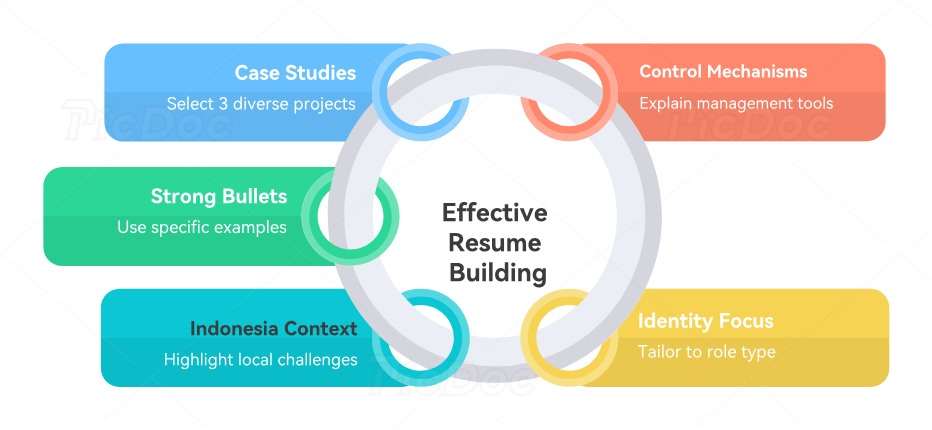
Select three projects with different pressure points. One could demonstrate schedule recovery, another supplier control, and another digital or organisational change. Build each case study using project templates, reporting frameworks, issue-tracking tools, dashboard software, and communication techniques.
Each portfolio case should answer:
What business problem existed?
What outcome had been approved?
Which authority did you hold?
Which constraints threatened delivery?
Which options did you evaluate?
Which action did you personally lead?
Which evidence proves the result?
A weak resume bullet reads, “Responsible for project schedules and vendors.” A stronger version reads, “Rebuilt the integrated schedule after a supplier mobilisation delay, resequenced three dependent work packages, and protected the contractual completion milestone without increasing approved headcount.”
Another weak bullet reads, “Managed stakeholder communication.” A stronger version reads, “Mapped 18 business, technical, regulatory, and supplier stakeholders, introduced decision-specific steering papers, and reduced overdue approvals from nine to two within six weeks.”
Use accurate language from vendor management, contract administration, stakeholder engagement, conflict resolution, and project risk management. Every term should correspond to work you can explain under questioning.
Show Indonesia-specific delivery difficulty
Strong candidates demonstrate how they handled practical operating complexity, including dispersed locations, regional coordination, permitting dependencies, multilingual stakeholders, vendor capacity, logistics, weather exposure, infrastructure constraints, or community interests where relevant to the project.
Explain the control mechanism. For example:
A regional rollout can demonstrate phased deployment, local readiness criteria, handover control, and escalation thresholds.
A construction programme can demonstrate critical-path management, cost forecasting, contract control, and construction software use.
A digital product can demonstrate Scrum accountabilities, Kanban metrics, release planning, and user-feedback decisions.
A transformation programme can demonstrate stakeholder resistance, adoption measures, benefits, training, and executive governance.
Tailor the resume to one professional identity
“Project manager” covers many distinct labour markets. Position yourself clearly as an IT Project Manager, Construction Project Manager, PMO Analyst, Digital Transformation Manager, Implementation Manager, Engineering Project Manager, Scrum Master, or Project Coordinator.
The first third of the resume should communicate your target title, sector, experience level, certification, delivery approaches, project scale, technical environment, and strongest outcomes. Support that positioning with relevant Agile platforms, Waterfall software, project-reporting tools, procurement systems, and contract-lifecycle platforms.
5. Turning Certification Into Better Roles and Long-Term Career Value
Use the learning before the examination. Apply improved risk language to your current register, tighten your meeting decisions, rebuild weak schedules, strengthen vendor scorecards, and improve steering reports. These changes create interview evidence while you study.
Build a role-specific certification stack
A useful stack contains:
One recognised project credential
One delivery specialisation
One industry or technical capability
One credible evidence portfolio
A technology project manager could combine PMP with Scrum, cloud, data, cybersecurity, or enterprise-system knowledge. A construction professional could combine PMP or BNSP recognition with construction PM software, contract terminology, schedule compression, and cost control. An operations professional could pair CAPM or PMP with Six Sigma terminology, workforce planning, analytics, and process improvement.
Regional experience also supports Indonesia-based professionals seeking multinational or Southeast Asian opportunities. Evidence involving teams or clients in Singapore, Malaysia, Vietnam, Thailand, or China can demonstrate cross-border governance and cultural adaptability.
Prepare six decision-rich interview stories
Prepare examples covering:
A delayed project you recovered
A major risk you reduced
A resistant stakeholder you aligned
A supplier failure you controlled
A change request you assessed
A project outcome that created measurable value
Each answer should explain the situation, stakes, analysis, options, decision, execution, and result. Use detailed knowledge of risk identification, stakeholder terminology, vendor-management concepts, conflict-resolution techniques, and executive reporting.
Plan certification renewal immediately
PMP holders must earn 60 PDUs within each three-year cycle, including at least 35 Education PDUs. CAPM holders need 15 PDUs, including at least nine Education PDUs.
PeopleCert states that applicable PRINCE2 certifications require renewal every three years, with renewal routes that can include CPD activity or another qualifying examination within the same product suite.
Create a three-year plan built around real development gaps. Study advanced scheduling, budget management, project quality, team leadership, and project communications. Renewal then becomes a structured career-development cycle instead of an administrative emergency near the expiry date.
6. Frequently Asked Questions About Project Management Certification in Indonesia
-
PMP generally provides the strongest international signal for experienced project leaders. CAPM suits early-career professionals, PRINCE2 supports structured governance roles, Agile credentials serve digital-delivery careers, and BNSP certification can matter where Indonesian occupational recognition is specifically requested.
Analyse vacancies before choosing. Compare PMP and PRINCE2, study CAPM career applications, review Scrum responsibilities, and verify relevant BNSP schemes through licensed certification bodies.
-
Choose according to the recognition your target role requires. PMP supports international portability, multinational employers, senior project leadership, and broad methodology coverage. BNSP validates competence through Indonesia’s national professional-certification system and may carry particular relevance in locally regulated, occupational, contractual, or tender-driven settings.
Some professionals benefit from both credentials. Build that combination only where each removes a separate career barrier. Strengthen it with procurement knowledge, contract-management competence, quality terminology, and project-reporting skills.
-
Yes. PMI evaluates education, training, and experience leading projects. Your title may be engineer, consultant, product lead, operations manager, implementation specialist, business analyst, or team leader.
Show how you led temporary initiatives with defined objectives and outcomes. Document your responsibility for project initiation, schedule decisions, risk responses, stakeholder engagement, and resource or commercial decisions.
-
The revised examination uses 180 questions over 240 minutes. The domains are People at 33%, Process at 41%, and Business Environment at 26%. Approximately 40% of questions cover predictive delivery, while 60% covers Agile, adaptive, and hybrid delivery. It also introduces more case, graphic, data, tool, and practical scenario questions.
Candidates should strengthen PMP domain knowledge, project-reporting interpretation, stakeholder judgment, and risk-assessment decisions.
-
CAPM can help graduates demonstrate formal understanding of project delivery when their work experience remains limited. Its value grows substantially when paired with domain knowledge, software skills, internships, volunteer projects, or university initiatives documented as professional evidence.
Build practical outputs using Gantt-chart principles, project templates, issue-tracking software, team platforms, and project dashboards.
-
Many working professionals can build a serious preparation plan across eight to twelve weeks, while candidates with major knowledge gaps may need longer. Study duration should follow readiness evidence rather than a popular timetable.
Measure performance across domains, delivery approaches, question types, and decision patterns. Use PMP study resources, eliminate common PMP errors, practise schedule-compression scenarios, and review conflict-resolution decisions.
