
Augmented Reality & Virtual Reality in Project Management: Forecast to 2030
Augmented reality and virtual reality are moving project information beyond dashboards, drawings, and video calls. By 2030, project teams may inspect digital twins, rehearse high-risk work, validate designs at full scale, guide remote technicians, and review schedule impacts inside spatial environments. Capturing that value will require disciplined project governance, stronger software integration, dependable risk controls, and capable future project managers. This forecast explains where immersive technology can improve delivery and how organizations should prepare.
1. Understanding the AR and VR Project Management Landscape in 2026
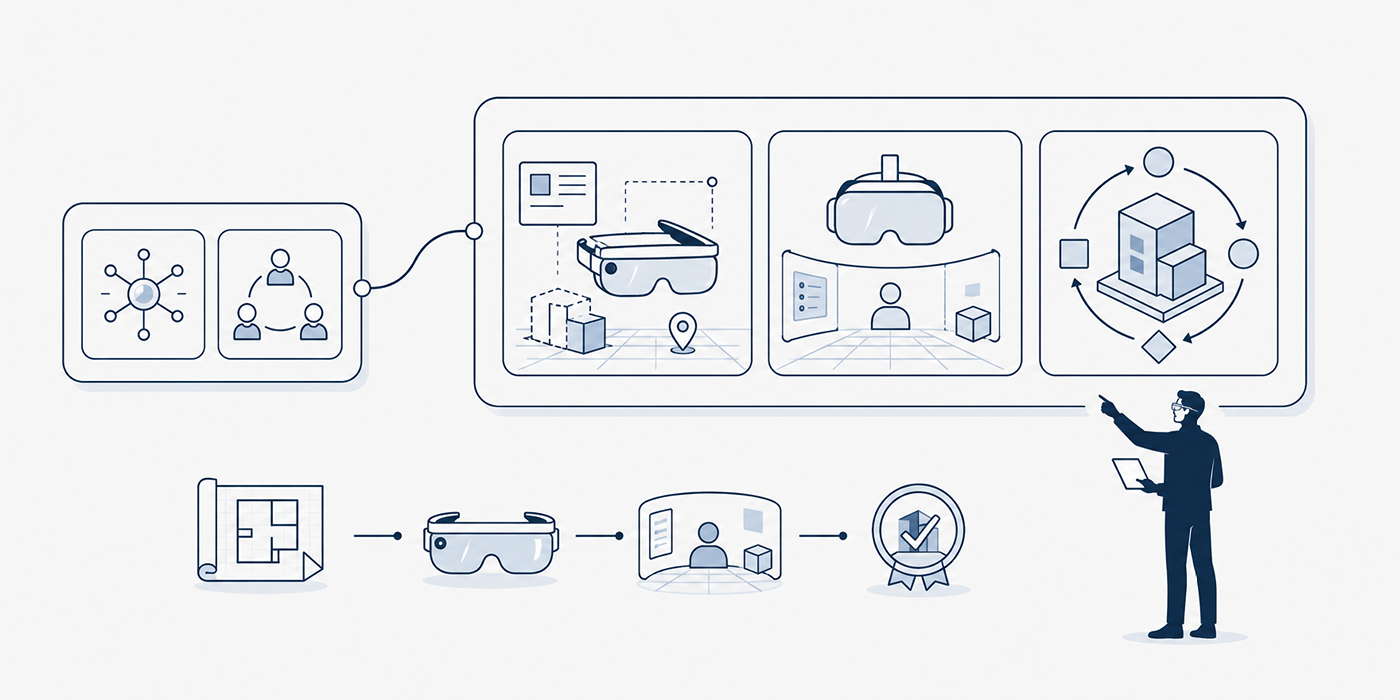
Augmented reality places digital information within a user’s physical environment. A technician might view instructions, asset data, hazards, or spatial annotations while standing beside equipment. Virtual reality places the user inside a computer-generated environment suited to simulations, design reviews, training, and scenario testing. Mixed reality combines physical surroundings with interactive digital objects. Project leaders should understand these distinctions because each model creates different requirements for project execution, technology selection, resource planning, and stakeholder engagement.
Enterprise spatial computing already supports design reviews, product visualization, training, guided work, and distributed collaboration. Apple promotes enterprise applications that allow teams to examine three-dimensional designs, review prototypes, train workers, and collaborate in spatial workspaces. Unity’s industrial work focuses increasingly on immersive training, simulation, digital twins, and operational environments that combine asset information with live data. These developments support a 2030 forecast in which spatial experiences become connected components of digital transformation programs, project software ecosystems, AI-enabled project management, and cloud integrations.
Digital twins will provide much of the information foundation for valuable AR and VR experiences. A functioning digital twin connects a virtual representation to information about the physical asset, process, site, or system. That connection can give project teams a common environment for reviewing design intent, construction progress, operational performance, and future scenarios. Autodesk describes digital twins as dynamic representations that evolve with their physical assets, while Unity’s recent work positions them as operational information surfaces rather than isolated 3D viewers. This direction strengthens the connection between project monitoring, project reporting, machine-learning forecasting, and immersive interfaces.
Reality capture will also accelerate practical adoption. Photogrammetry, laser scanning, drones, mobile cameras, and connected sensors can create or refresh spatial records of a jobsite, facility, or asset. Autodesk’s 2025 and 2026 materials highlight the growing use of reality capture for site documentation, asset modeling, workflow improvement, and issue detection. Project managers can use these inputs to strengthen progress monitoring, improve construction project management, support quality management, and validate project closure evidence.
Current platform changes also reveal an important strategic lesson. Microsoft has announced that Dynamics 365 Guides and Remote Assist will reach the end of support after December 31, 2026, while some remote collaboration capabilities have moved toward Teams mobile and spatial annotations. This shift demonstrates the platform-lifecycle risk attached to immersive projects. Organizations need vendor-management controls, an informed procurement strategy, resilient API and integration planning, and clear technology risk responses before committing operational processes to one headset or application.
The strongest use cases usually begin with an expensive project problem. Repeated design misunderstandings, dangerous training conditions, costly travel, weak site visibility, slow expert support, and avoidable rework can justify immersive investment. A fashionable demonstration without a measurable problem can consume budget while adding another disconnected tool. Project sponsors should therefore connect AR and VR proposals to project financial management, earned value management, benefits tracking, and portfolio prioritization.
Adoption also depends on workflow fit. A headset may produce impressive visual fidelity while remaining unsuitable for long shifts, restricted environments, rapid task switching, or organizations with limited technical support. Mobile AR may offer lower immersion while reaching more users through familiar devices. Desktop-based 3D review may solve some collaboration problems without specialized hardware. Strong business analysis, precise requirements engineering, careful stakeholder discovery, and proportionate project governance should determine the experience selected.
| AR/VR Application | Project Problem Addressed | Primary Value | Required Data or Integration | 2030 Adoption Outlook |
|---|---|---|---|---|
| Immersive design reviews | Stakeholders struggle to interpret drawings, models, or technical descriptions. | Earlier feedback and fewer requirement misunderstandings. | 3D model, requirements baseline, issue-management workflow. | High in construction, engineering, manufacturing, and product development. |
| Full-scale requirement validation | Users approve designs without understanding spatial implications. | More precise acceptance criteria and reduced late-stage change. | Requirements repository, spatial model, approval record. | High for facilities, equipment, transport, healthcare, and complex products. |
| AR construction overlays | Teams cannot easily compare design intent with installed work. | Earlier detection of positioning, sequencing, and installation errors. | BIM model, location tracking, current site scan. | High on digitally mature construction programs. |
| Spatial progress verification | Status percentages rely on delayed or subjective reporting. | Stronger evidence of completed work and emerging variance. | Reality capture, schedule, work breakdown structure. | High where progress can be visually or geometrically verified. |
| Immersive status rooms | Executives receive fragmented reports across multiple systems. | Shared understanding of schedule, risk, cost, and physical progress. | Dashboard feeds, digital twin, portfolio data. | Medium, concentrated in major programs and asset-intensive sectors. |
| Spatial risk visualization | Risk registers fail to show where hazards or dependencies exist. | Clearer risk comprehension and stronger response planning. | Risk register, location data, asset model. | Medium to high for safety-critical and geographically complex work. |
| Emergency simulations | Real-world crisis exercises are expensive, unsafe, or disruptive. | Repeatable rehearsal of response roles and escalation decisions. | Scenario engine, emergency procedures, performance records. | High in infrastructure, healthcare, energy, aviation, and public safety. |
| Leadership simulations | Managers receive limited practice handling conflict and crisis decisions. | Controlled rehearsal of communication, trade-offs, and escalation. | Scenario scripts, competency model, assessment data. | Medium as AI-driven virtual participants improve. |
| Workforce training | Training requires equipment downtime, travel, or scarce instructors. | Repeatable instruction with measurable learner performance. | Training content, user identity, learning-management system. | High for procedural and equipment-intensive work. |
| Remote expert assistance | Specialists must travel to diagnose onsite problems. | Faster resolution and reduced travel dependency. | Video feed, annotations, asset records, secure communication. | High, with delivery shifting across devices and collaboration platforms. |
| Guided compliance work | Workers miss procedural steps or struggle with complex documentation. | Contextual instructions and stronger evidence collection. | SOPs, control library, identity, audit records. | Medium to high in regulated operational environments. |
| AR quality inspections | Inspectors must switch repeatedly between physical assets and documents. | Faster checks, clearer defect capture, and traceable corrective action. | Quality checklist, model, camera feed, issue system. | High in manufacturing, construction, utilities, and maintenance. |
| Immersive handover | Operations teams receive documentation without adequate asset familiarity. | Improved readiness, training, and transfer of project knowledge. | Asset model, manuals, maintenance data, acceptance records. | High for complex facilities and industrial equipment. |
| Virtual prototype reviews | Physical prototypes create cost and lead-time pressure. | Earlier evaluation of form, access, usability, and configuration. | Engineering model, materials data, requirements. | High where physical prototyping is expensive. |
| Rework-cost visualization | Stakeholders approve changes without understanding downstream impact. | Clearer connection between change, physical work, cost, and schedule. | Cost model, schedule, digital twin, change log. | Medium as commercial data becomes more integrated. |
| 4D schedule walkthroughs | Traditional schedules hide spatial and sequencing conflicts. | Improved constructability and phase-planning decisions. | 3D model, schedule activities, dependency data. | High for construction, shutdowns, events, and major installations. |
| Workspace and resource simulation | Teams discover congestion and access conflicts during execution. | Better labor, equipment, layout, and logistics planning. | Site model, resource plan, workflow assumptions. | Medium to high in facilities and capital projects. |
| Collaborative option evaluation | Departments debate proposals using different assumptions. | Shared evidence and faster resolution of design trade-offs. | Scenario models, decision criteria, cost and risk data. | Medium as multi-user spatial collaboration matures. |
| Portfolio scenario rooms | Executives struggle to visualize dependencies among major investments. | Improved prioritization of assets, locations, and transformation programs. | Portfolio data, geographic models, resource forecasts. | Selective adoption among large asset owners and governments. |
| Renewable-site planning | Projects face terrain, access, environmental, and community constraints. | Better site evaluation and stakeholder communication. | Geospatial data, environmental studies, engineering models. | High for wind, solar, storage, and grid infrastructure. |
| Environmental-impact visualization | Stakeholders struggle to understand projected land, energy, or community effects. | More informed consultation and alternative evaluation. | Environmental model, emissions data, geographic information. | Medium to high as ESG evidence requirements expand. |
| Virtual service environments | Teams cannot test customer journeys safely in live operations. | Earlier identification of process, privacy, and experience failures. | Process model, customer scenarios, compliance controls. | Medium in financial services and other regulated service sectors. |
| Immersive education projects | Learning-space decisions lack feedback from teachers and students. | Stronger design validation and training before implementation. | Facility model, curriculum requirements, user-testing data. | Medium, driven by specialized institutional projects. |
| Virtual event rehearsals | Complex events face access, crowd, staging, and timing risks. | Improved run-of-show planning and contingency rehearsal. | Venue model, schedule, capacity and logistics information. | High for major events, exhibitions, and broadcast productions. |
| AI-generated scenario testing | Teams test too few combinations of disruption, demand, and resource conditions. | Broader forecasting and more rigorous contingency planning. | Historical data, simulation engine, AI model, validation rules. | High-value emerging capability through 2030. |
| Virtual AI project assistants | Users struggle to locate contextual project information quickly. | Conversational access to models, risks, tasks, and instructions. | Project systems, language model, permissions, spatial interface. | Medium to high once data governance becomes dependable. |
| Spatial workflow integration | Immersive tools remain disconnected from systems of record. | Actions captured in AR or VR update project workflows automatically. | APIs, identity, workflow engine, synchronized data model. | Essential foundation for scaled adoption by 2030. |
| Distributed project war rooms | Global teams lack a shared environment for complex decisions. | More contextual collaboration across locations and disciplines. | Secure multi-user environment, project data, communication tools. | Medium, with strongest uptake in complex global programs. |
2. Forecasting How AR and VR Will Change Project Delivery by 2030
Design validation will become one of the most dependable immersive use cases. Traditional drawings and screen-based models demand technical interpretation that many sponsors, users, and community stakeholders do not possess. Spatial review can let participants experience scale, access, visibility, layout, and workflow before construction or production begins. Autodesk already presents immersive digital twins as shared environments for understanding proposed infrastructure and improving alignment. By 2030, this capability should become a regular component of requirements validation, stakeholder engagement, quality planning, and change control on spatially complex projects.
Project reviews will become more evidence-rich as reality capture and digital twins mature. A project manager could enter a spatial representation of a facility, select an area, inspect current progress, compare it with the baseline model, review open defects, and identify schedule exposure. That environment could connect Gantt-chart information, earned value indicators, risk-register entries, and executive reporting. Autodesk’s work on reality capture, cloud collaboration, digital workplaces, and issue detection supports this direction, although the maturity of implementation will vary significantly between organizations.
Training will expand because immersive simulations can represent expensive, hazardous, inaccessible, or uncommon situations without exposing projects to the full real-world consequences. Unity’s enterprise materials emphasize scalable XR training and simulations, while Apple highlights guided work and immersive training as enterprise applications. By 2030, project learning plans may combine workforce management, leadership development, risk-response rehearsal, and quality assurance inside trackable simulations.
Remote expert support will remain valuable, though its platforms and devices will continue changing. A field worker can share a live view, receive visual annotations, and access instructions while an expert supports the task remotely. Microsoft’s product transition illustrates why organizations should separate the business capability from one vendor’s application. The lasting requirement involves secure visual collaboration connected to supplier management, issue resolution, team communication, and project reporting systems.
Artificial intelligence will make immersive environments more responsive. Meta’s research has explored converting instructional video into personalized mixed-reality guidance, while its Quest developer tools provide access to passthrough cameras for computer-vision and machine-learning use cases. Unity is also connecting digital twins with AI agents and machine information systems. By 2030, users may receive context-aware guidance, automated hazard identification, intelligent model navigation, and conversational access to project records. These capabilities will connect AI project management, machine-learning scheduling, project automation, and software integrations.
Spatial collaboration should improve distributed decision-making when teams need to examine a shared physical context. Global engineering, product, construction, energy, and infrastructure teams may review the same virtual asset while discussing risks, sequencing, access, or design alternatives. Apple’s enterprise positioning already emphasizes spatial collaboration and prototype review across locations. By 2030, immersive meetings could support selected portfolio decisions, vendor reviews, stakeholder workshops, and project governance forums.
Adoption will remain uneven across sectors. Asset-intensive industries possess stronger use cases because their work already depends on 3D models, physical environments, safety procedures, and expensive field coordination. Construction, manufacturing, healthcare, energy, utilities, transport, aerospace, and defense are therefore likely to progress faster than teams managing primarily text-based or low-spatial work. The opportunity will be especially strong in construction project management, renewable-energy projects, sustainability programs, and digital PMO transformation. This sector pattern is an inference from the current concentration of enterprise use cases described by Apple, Autodesk, and Unity.
3. Building the Business Case, Data Foundation, and Technology Architecture
Begin with a quantified pain point. Suitable measures include travel expenditure, defect cost, design-review duration, training downtime, rework hours, expert-response time, change frequency, safety exposure, or acceptance delays. Establish the baseline before selecting hardware. The investment case should connect the immersive workflow to project financial terms, earned value performance, resource utilization, and project benefits reporting. A credible proposal identifies where value appears, how it will be measured, and which business owner remains accountable.
Use-case selection should test necessity, frequency, risk, scalability, and integration effort. A rare experience requiring extensive custom modeling may fail to recover its cost. A repeated inspection, training, design, or maintenance process may support a stronger return. Apply business-analysis discipline, requirements engineering, portfolio scoring, and project estimation to compare candidate use cases before authorizing a pilot.
The data architecture deserves more attention than the headset. An immersive application may require BIM or CAD models, schedules, asset records, location data, quality checklists, work orders, risk registers, identity services, and communication platforms. Conflicting versions can cause users to act on outdated information. Define the system of record for each data element and design synchronization through project management APIs, cloud project software, project reporting controls, and requirements traceability.
Model quality must also be governed. A visually convincing model can contain inaccurate dimensions, outdated configurations, missing assets, incorrect metadata, or unsupported assumptions. Establish model ownership, update frequency, validation rules, approval status, and archival procedures. Connect these controls to total quality management, ISO-related project standards, project monitoring, and project closure requirements. The user should be able to identify whether an immersive object represents a concept, approved design, installed condition, or live operational state.
Security requirements increase when devices capture physical surroundings, employee activity, confidential prototypes, medical information, or critical infrastructure. Apple has introduced enterprise-focused visionOS controls for protected content and restricted capture, showing that security capabilities are becoming part of spatial platform design. Project teams still need data classification, device management, identity controls, retention rules, third-party assessments, and incident procedures. These requirements belong within project governance, vendor management, risk mitigation, and ISO-aligned controls.
Procurement should assess hardware, software, content development, integration, support, connectivity, device replacement, licensing, and model maintenance. Exit planning is especially important because current products can be deprecated before a long-lived asset or transformation program reaches completion. Request open export options, documented APIs, data ownership, portability provisions, service commitments, and migration support. Use RFP and RFQ controls, supplier-management practices, project financial management, and technology-risk planning. Microsoft’s 2026 product transition provides a current example of why lifecycle planning belongs in the business case.
Pilot design should test business performance under realistic conditions. Select representative users, devices, environments, connectivity levels, workflows, and data. Measure time saved, errors prevented, adoption, comfort, task completion, support demand, and integration reliability. Define stopping criteria before the pilot begins. Combine project execution controls, Agile estimation, project monitoring, and risk-response planning to prevent a demonstration from being mistaken for operational proof.
What Could Derail Your Organization’s AR or VR Project?
4. Preparing Project Managers for Immersive Delivery Environments
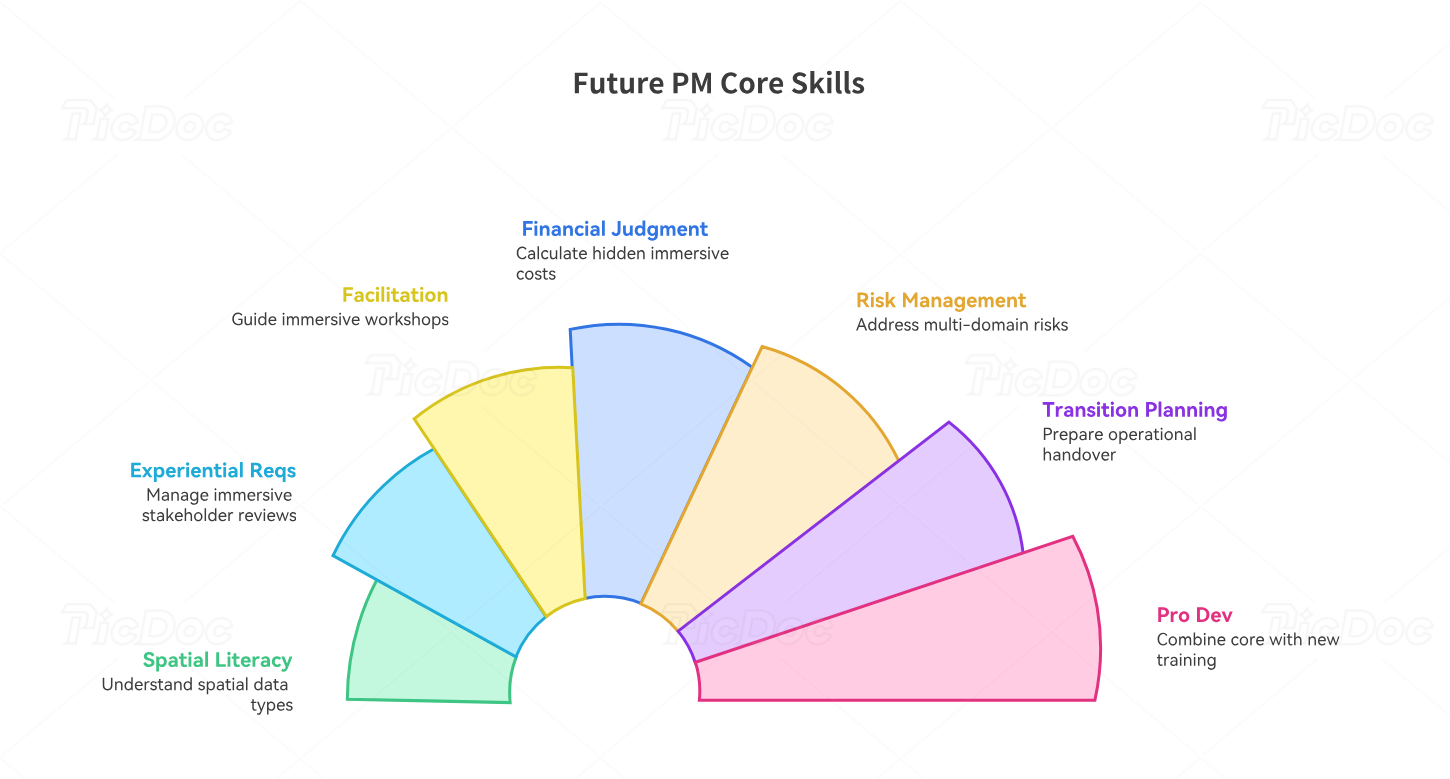
Project managers will need spatial-data literacy. They should understand how CAD, BIM, digital twins, point clouds, reality capture, asset records, and live sensor data differ. The role does not require expert-level modeling skills, though managers must challenge model freshness, accuracy, ownership, and suitability. Build this foundation through future PM competencies, project software trends, API integration principles, and project reporting controls. Unity and Autodesk’s recent digital-twin work demonstrates how spatial platforms are becoming connected operational systems.
Requirements management will become more experiential. Stakeholders may walk through a planned facility, manipulate a product, or rehearse a workflow before formal approval. Project managers must capture observations as controlled requirements, decisions, defects, or change requests. Informal comments made during an immersive review can create scope confusion unless the session has defined objectives and documentation rules. Use CPRE requirements practices, PMI-PBA preparation, project execution controls, and stakeholder engagement methods.
Facilitation skills will change as well. An immersive workshop requires orientation, accessibility planning, role assignment, device management, content control, and structured feedback. Participants can become absorbed in visual details that fall outside the decision under review. The facilitator should define the question, guide attention, record evidence, separate observations from approvals, and close with accountable actions. These capabilities draw from project leadership communication, conflict resolution, stakeholder planning, and project governance.
Financial judgment will remain central. Immersive projects include hidden costs for model preparation, content creation, integration, support, device management, upgrades, security, replacement, and training. A pilot may appear affordable because it excludes the expense of scaling across sites and maintaining content over several years. Project managers should build total-cost scenarios using project financial terms, cost-professional principles, earned value management, and resource-allocation analysis.
Risk management must address physical, digital, human, and organizational exposure. Relevant risks include motion discomfort, restricted visibility, distraction, unsuitable protective equipment, inaccurate overlays, data leakage, weak connectivity, device failure, vendor closure, and exclusion of users with accessibility needs. Record causes, events, consequences, owners, triggers, and funded responses through risk-register discipline, risk mitigation planning, ISO-related controls, and project monitoring.
Project managers will also need stronger product and service-transition thinking. An immersive solution requires ongoing content updates, user administration, incident support, device replacement, cybersecurity patches, data synchronization, and performance monitoring. Define the operational owner before approving implementation. Prepare handover through project closure terminology, vendor-management controls, workforce planning, and quality-management practices.
Certification and professional development should support these emerging responsibilities. A project manager may combine strong core delivery knowledge with business analysis, Agile, cost, change, data, cybersecurity, or sector-specific training. Review PMP exam domains, PMI-PBA preparation, Agile certification options, and CCP certification guidance. Immersive-tool expertise carries greater career value when it sits on top of sound project judgment.
5. Following a Practical AR and VR Adoption Roadmap Through 2030
During 2026 and 2027, organizations should concentrate on discovery, data readiness, and tightly scoped pilots. Select a recurring pain point, document the baseline, identify representative users, and test the workflow under real operating conditions. Prioritize applications such as immersive design review, remote assistance, procedural training, or visual quality inspection where value can be measured clearly. Manage the pilot using Agile project methods, project estimation techniques, monitoring and control, and risk-response planning.
The first phase should also establish technology principles. Define permitted devices, supported operating systems, identity requirements, integration standards, data ownership, model formats, security controls, and exit provisions. Recent enterprise platform changes show that organizations need architectures capable of surviving product transitions. Use project management APIs, vendor-management terms, RFP and RFQ practices, and future project software analysis.
During 2027 and 2028, successful pilots should move into repeatable operational services. Standardize content-development methods, device deployment, user onboarding, support, performance measurement, and model updates. Integrate the solution with project systems so observations become issues, approvals, work orders, or lessons without manual duplication. This phase requires stronger PMO governance, workforce management, software integration, and project reporting.
During 2028 and 2029, organizations can expand from isolated experiences into connected digital-twin workflows. Project teams may combine asset models, schedules, costs, risks, quality records, and operational data within shared spatial interfaces. Unity’s 2026 work describes digital twins evolving toward broader machine information systems that connect visualization, operational data, and AI agents. This direction could strengthen AI-enabled project management, machine-learning forecasting, portfolio management, and project automation.
By 2030, mature adopters may treat spatial interfaces as one access layer within a broader project-information environment. Users could move between desktop dashboards, mobile AR, head-mounted displays, and large immersive rooms according to the task. A site worker may need hands-free guidance, a sponsor may need a spatial design review, and a portfolio director may need a conventional financial dashboard. This forecast is supported by the present diversity of enterprise spatial applications and device-level capabilities across Apple, Meta, Autodesk, Unity, and Microsoft.
Project roles will evolve alongside the technology. Larger organizations may create immersive-delivery leads, digital-twin program managers, spatial-experience product owners, XR training managers, reality-capture coordinators, or immersive governance specialists. Traditional project managers will increasingly coordinate specialists in 3D content, data engineering, cybersecurity, user experience, AI, and asset operations. Career preparation should therefore combine future PM skills, project leadership trends, automation forecasts, and digital PMO development.
The organizations gaining the greatest value by 2030 will build dependable operating systems around immersive technology. Their advantage will come from clean data, clear ownership, strong integration, measurable use cases, accessible workflows, capable users, and disciplined governance. Those foundations already determine success in project execution, portfolio management, risk management, and stakeholder engagement. AR and VR will amplify the quality of the underlying project system.
6. Frequently Asked Questions
-
AR will likely support site inspections, guided work, remote assistance, design comparison, quality checks, asset identification, progress validation, and contextual access to project information. A worker may view instructions, approved dimensions, open defects, hazards, or maintenance records within the physical environment. The strongest applications will connect AR to project monitoring, quality-management processes, risk registers, and supplier workflows. Current enterprise spatial applications, reality-capture workflows, and passthrough-camera development support this forecast.
-
VR can help teams evaluate scale, layout, workflow, access, safety, construction sequencing, and user experience before physical work begins. It can also support scenario testing and rehearsal where real-world simulation would be dangerous or expensive. Project managers should record VR findings through requirements engineering, connect approved changes to project execution, assess cost through project financial management, and control decisions through project governance. Autodesk and Apple currently highlight immersive design, prototype review, and spatial collaboration as enterprise applications.
-
Construction, manufacturing, healthcare, energy, utilities, transport, aerospace, defense, and complex product development possess strong early use cases because their projects involve physical assets, spatial coordination, safety, training, and expensive rework. Adoption should expand particularly within construction project management, renewable-energy programs, sustainability projects, and digital transformation portfolios. This forecast reflects the current enterprise sectors emphasized by Autodesk, Unity, and Apple.
-
Project teams will continue using scheduling, budgeting, risk, document, collaboration, and portfolio systems as authoritative records. Spatial interfaces can provide an additional way to access, understand, and update selected information. Their value depends on reliable connections to project management APIs, cloud software platforms, project reporting systems, and portfolio-management tools. Unity’s current digital-twin direction supports a model where visualization, operational data, and AI services converge inside connected systems.
-
The major risks include weak business justification, inaccurate spatial data, privacy exposure, cybersecurity weaknesses, user discomfort, accessibility barriers, poor connectivity, hardware limitations, platform dependency, and insufficient operational support. Organizations should control these through risk-register management, risk-response planning, vendor governance, and ISO-related project controls. Current product lifecycle changes and new enterprise security APIs show why both vendor continuity and information protection require early attention.
-
Start with the measurable cost of the existing problem. Relevant metrics include travel, rework, defects, training downtime, design-review time, expert-response time, equipment interruption, safety incidents, and delayed approvals. Compare those costs with hardware, software, content development, integration, support, model maintenance, security, training, and replacement. Track results using project financial terminology, earned value management, project reporting, and resource-allocation measures. Include several years of operating cost because the pilot price rarely represents the scaled service.
-
Project managers will need strong core delivery skills plus enough knowledge of spatial models, digital twins, reality capture, data integration, cybersecurity, user experience, accessibility, AI, and device management to challenge specialists effectively. They should develop through future project-management competencies, requirements-analysis training, project software knowledge, and leadership communication. Current digital-twin architectures already span visualization, operational data, AI agents, and system integration.
