
A project management portfolio gives recruiters evidence of how you plan, execute, recover, and deliver projects under real constraints. Job titles and certifications establish context, while a well-documented portfolio reveals your decision-making ability. Whether you're pursuing entry-level PM roles, transitioning from business analysis, or targeting senior project management opportunities, this guide provides ten practical project concepts, recruiter-reviewable artifacts, portfolio examples, and a structured method for demonstrating your value without exposing confidential information.
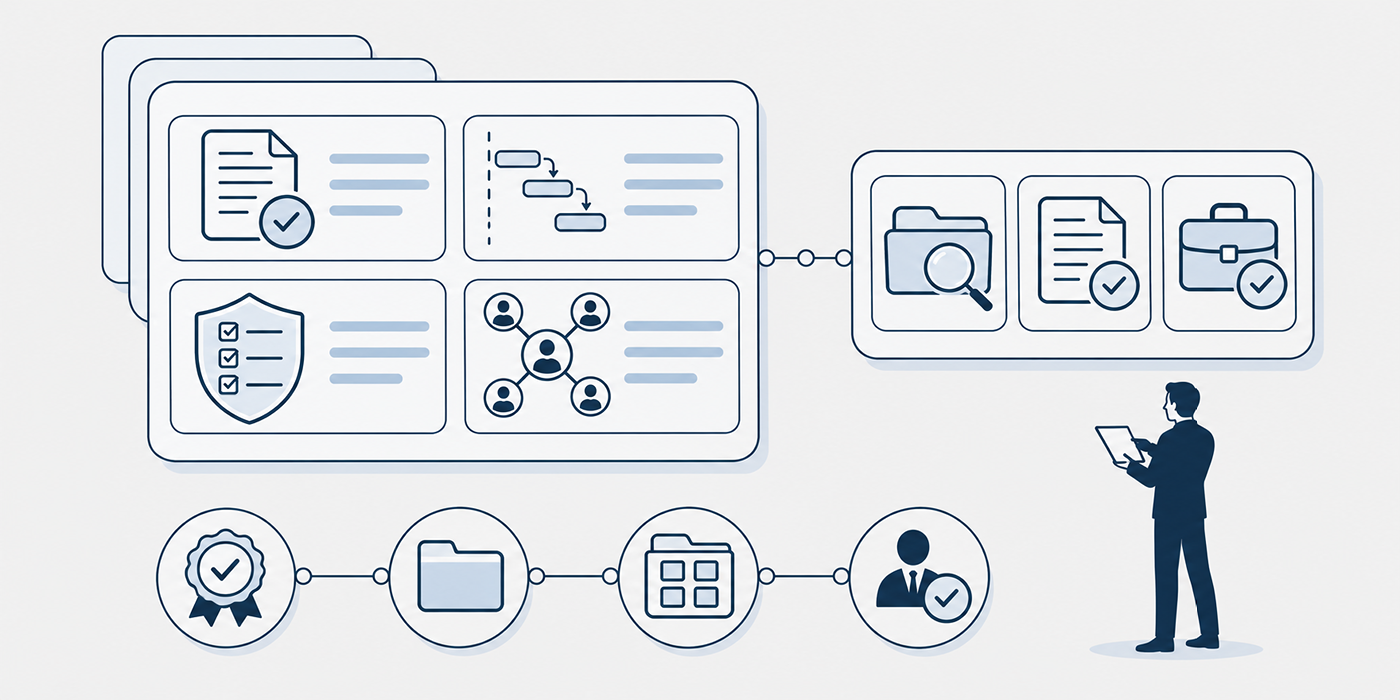
1. What Makes a Project Management Portfolio Worth a Recruiter's Time?
A recruiter reviewing 50 applications rarely has the capacity to inspect dozens of documents. Your portfolio must establish relevance quickly, demonstrate your contribution, and provide enough evidence for a hiring manager to examine your decisions.
A candidate claiming excellent stakeholder management should provide a stakeholder decision record, a RACI responsibility matrix, or a documented escalation example. Someone highlighting budget control should show how an estimate changed, which corrective action was selected, and whether the resulting forecast improved.
This evidence is especially important for professionals preparing a project management résumé without a formal PM title or transitioning from operations management.
The five questions every portfolio project must answer
What was the business problem? Establish the original constraint, business objective, and consequences of inaction.
What did you personally own? Distinguish your responsibilities from the sponsor's, delivery team's, and functional managers' contributions.
Which decisions required judgment? Identify competing priorities, unresolved dependencies, trade-offs, and rejected alternatives.
What evidence supports your contribution? Provide selected artifacts such as a charter, risk register, issue log, or performance forecast.
What happened afterward? Report actual outcomes, agreed limitations, and lessons that influenced subsequent decisions.
For an agile project management career, the evidence might be a release decision, backlog trade-off, and stakeholder acceptance record. For a governance-focused PM role, decision gates, approvals, and exceptions carry greater weight.
Three evidence categories recruiters can evaluate
Decision evidence: Documents explaining why an option was selected, which alternatives were considered, and who authorized the outcome.
Execution evidence: Schedules, risk responses, change records, resource assignments, and delivery forecasts demonstrating how work was controlled.
Outcome evidence: Accepted deliverables, measured operational improvements, financial results, and post-implementation reviews.
Your strongest projects should combine all three. Candidates applying for program management positions should also show how project-level decisions affected wider organizational objectives.
Use project management templates to create consistent documents, then customize them around meaningful decisions. A portfolio containing ten untouched templates gives an interviewer little evidence of how you would manage uncertainty.
| Portfolio Artifact | What Strong Evidence Shows | Recruiter Review Question | Common Weakness | Related APMIC Resource |
|---|---|---|---|---|
| 01. Project brief | Problem, constraints, owner, and outcome | Why did this project exist? | Vague background | Project templates |
| 02. Project charter | Authorization, scope, funding, and objectives | What was formally approved? | Missing sponsor authority | Governance guide |
| 03. Business case | Costs, expected value, and alternatives | Why was investment justified? | Unsupported benefits | Business decisions |
| 04. Scope statement | Included work, exclusions, boundaries | How was scope expansion prevented? | Unclear exclusions | Scope control |
| 05. Work breakdown | Deliverable-level decomposition | How was work made manageable? | Task list without ownership | Planning resources |
| 06. Schedule baseline | Dependencies and milestone logic | Which activities controlled delivery? | Dates without logic | Schedule forecasting |
| 07. RACI matrix | Clear responsible and accountable roles | Who owned difficult decisions? | Overlapping accountability | RACI generator |
| 08. Stakeholder map | Influence, concerns, and engagement tactics | How were competing interests handled? | Generic contact list | Stakeholder consulting |
| 09. Communications plan | Audience, cadence, channel, and decisions | How were stakeholders informed? | Meetings without purpose | Communication workflows |
| 10. Risk register | Triggers, owners, responses, and exposure | Which threat was anticipated? | Risk list without action | Risk analysis |
| 11. Assumption log | Testable assumptions and validation dates | What uncertainty was resolved? | Unverified dependencies | Control registers |
| 12. Issue log | Live problems, owners, and resolution timing | How was a blockage cleared? | No resolution history | Operational controls |
| 13. Change request | Impact analysis and authorization decision | What trade-off was approved? | Missing decision record | Change governance |
| 14. Cost baseline | Authorized spending by category | What was the approved cost limit? | Unreconciled estimates | Cost measurement |
| 15. EVM snapshot | PV, EV, AC, and forecast interpretation | How was cost or schedule drift detected? | Metrics without decisions | EVM calculator |
| 16. Resource plan | Capacity, allocations, and constraints | How were competing demands handled? | Unlimited resource assumptions | Resource management |
| 17. Vendor evaluation | Scored criteria and sourcing rationale | Why was this supplier selected? | Preference without evidence | Vendor evaluation |
| 18. Procurement tracker | Lead times, approval gates, commitments | How were purchasing delays managed? | Unowned approvals | Procurement oversight |
| 19. Sprint backlog | Priorities, acceptance criteria, dependencies | How was delivery work prioritized? | Backlog without rationale | Agile delivery |
| 20. Release plan | Sequencing, release gates, and trade-offs | What justified the release decision? | Dates without acceptance | Release planning |
| 21. Integration plan | Interfaces, data ownership, error handling | How were technical dependencies controlled? | Missing recovery process | Integration controls |
| 22. Security review | Control owners and remediation evidence | Who accepted residual exposure? | Unapproved security exceptions | Security oversight |
| 23. UAT evidence | Scenario results, defects, and sign-off | How was readiness demonstrated? | Approval without test evidence | Technical validation |
| 24. Executive status | Variance, decisions, owners, and escalation | What required executive attention? | Activity-only reporting | Status reporting |
| 25. KPI dashboard | Defined metrics and meaningful trends | How were results monitored? | Unexplained vanity metrics | Predictive dashboards |
| 26. Training plan | Audience, proficiency, adoption measures | How were users prepared? | Attendance treated as adoption | Change communications |
| 27. Cutover checklist | Go/no-go rules and rollback ownership | Who could stop deployment? | Missing failure recovery | IT project delivery |
| 28. Handover record | Support owner, documentation, acceptance | Who owns the deliverable afterward? | No operating owner | Operational handover |
| 29. Benefits review | Baseline, actual results, and realization date | Was the business case delivered? | Outputs mistaken for outcomes | Benefits realization |
| 30. Lessons learned | Root cause, action, and process improvement | What would you do differently? | Generic reflections | PMO improvement |
2. Ten Project Management Portfolio Projects Recruiters Can Actually Review
These ten project concepts cover operational improvement, technical delivery, agile execution, governance, financial control, and organizational change. Each can be developed into a legitimate work sample using real authorized experience, a volunteer initiative, or a clearly labeled simulation.
The figures below are illustrative project scenarios. Use verified results from your own experience when building a professional portfolio.
Project 1: Customer Support Workflow Improvement
Scenario: A company handling 4,000 monthly customer requests experiences inconsistent routing, excessive reassignments, and delayed resolution. Your assignment is to redesign the workflow, implement ownership rules, and establish a consistent reporting process.
Artifacts to produce:
Project charter establishing the service improvement objective.
Current-state and future-state workflow maps.
RACI matrix for support, technical, and escalation teams.
Issue log demonstrating how routing failures were resolved.
Before-and-after KPI analysis with clearly defined metrics.
What recruiters should inspect: A decision record showing how you prioritized the highest-impact bottlenecks and secured agreement between competing operational teams.
For an illustrative model, target a reduction in ticket reassignment from 24% to 12%, then explain how the measurement would be validated.
This project is particularly relevant for operations professionals entering PM roles, business analysts transitioning into delivery, and candidates targeting PMO coordinator positions.
Project 2: CRM Data Migration and System Integration
Scenario: A growing organization needs to migrate 12,000 customer records from a legacy CRM into a consolidated platform while maintaining data integrity and uninterrupted sales operations.
Artifacts to produce:
Migration scope and data ownership matrix.
Source-to-target mapping document.
Security and privacy approval checklist.
Test reconciliation report and cutover decision record.
What recruiters should inspect: Your approach to managing duplicate records, incomplete fields, interface failures, and business acceptance.
A credible sample should document reconciliation rules, exception thresholds, and rollback conditions. For example, define what happens if more than 1% of eligible records fail validation.
This project provides evidence for a transition from IT into project management, while demonstrating awareness of cybersecurity risks in project delivery, API coordination, and technical project governance.
Project 3: Agile Mobile Application Release
Scenario: A product team must release a mobile application update within eight weeks while facing incomplete requirements, limited development capacity, and changing stakeholder priorities.
Artifacts to produce:
Product goal and release scope.
Prioritized backlog with acceptance criteria.
Sprint plan and capacity assumptions.
Release-readiness checklist.
Retrospective showing an implemented process improvement.
What recruiters should inspect: The decisions you made when planned work exceeded available capacity. Include one item deliberately deferred, the justification, and its impact on user value.
For instance, demonstrate why a reporting feature moved to a later release while security and login reliability remained mandatory acceptance conditions.
Candidates pursuing an agile project management career can use this to establish delivery judgment. Those targeting larger initiatives can add dependency controls informed by SAFe career practices, Scrum@Scale coordination, and traditional-to-agile transition methods.
Project 4: Cybersecurity Remediation Program
Scenario: An internal security assessment identifies 40 findings with different severity levels, ownership requirements, and remediation deadlines.
Your role is to coordinate remediation across infrastructure, application development, compliance, and business operations.
Artifacts to produce:
Risk-prioritized remediation roadmap.
Workstream ownership and RACI assignments.
Exception and dependency register.
Executive escalation memo.
Closure evidence tracker.
What recruiters should inspect: How you handled a high-severity issue that could not be resolved within its original deadline.
Show the decision authority, temporary controls, escalation date, and evidence required to close or formally accept the remaining exposure.
This project demonstrates experience relevant to project management and cybersecurity integration, future cybersecurity delivery requirements, and project governance leadership.
Project 5: Nonprofit Fundraising Campaign
Scenario: A nonprofit plans a six-week fundraising campaign with a $15,000 operating budget, multiple community partners, and a defined donor acquisition objective.
Artifacts to produce:
Campaign project charter and budget.
Volunteer and partner responsibility matrix.
Communications calendar.
Donor acquisition KPI tracker.
Post-campaign budget reconciliation and benefits review.
What recruiters should inspect: Your approach to allocating limited resources between events, digital outreach, volunteer support, and donor communications.
For a simulation, model three budget options and explain which one you recommend under conservative donor-conversion assumptions.
This project is relevant for nonprofit project management careers, marketing project management, event delivery roles, and international development initiatives.
A real volunteer campaign can become an especially useful entry-level portfolio project when your responsibilities and documented results are clear.
Project 6: University Enrollment Process Redesign
Scenario: A university experiences application-processing backlogs before the start of a semester. Applicants receive inconsistent updates, while academic and administrative teams rely on separate spreadsheets.
Artifacts to produce:
Process improvement charter.
Stakeholder mapping and approval hierarchy.
Work breakdown structure for the redesigned workflow.
Admissions exception log.
Pilot results and operational handover checklist.
What recruiters should inspect: How you balanced processing speed, record accuracy, accessibility, and administrative workload.
An illustrative success criterion might reduce median processing time from ten working days to six while maintaining a documented quality threshold.
Candidates moving from teaching into project management can demonstrate transferable coordination experience. The project also connects with PM software for educational institutions, project planning resources, and PMO career development.
Project 7: Office Renovation and Contractor Coordination
Scenario: An organization needs to renovate a 5,000-square-foot office within a $250,000 budget while maintaining access to critical business areas.
Artifacts to produce:
Scope and phased occupancy plan.
Contractor procurement evaluation.
Dependency-based milestone schedule.
Change request with cost and schedule analysis.
Final inspection and handover record.
What recruiters should inspect: A documented response to an unexpected site condition, including the available alternatives, contractor implications, approval authority, and revised forecast.
For example, model a two-week materials delay and compare resequencing work against paying for accelerated procurement.
This project is valuable for candidates comparing construction and IT project management careers and developing earned value management capabilities.
It can also demonstrate structured decision-making relevant to PRINCE2 and PMP approaches and senior consulting positions.
Project 8: Energy Efficiency and Sustainability Upgrade
Scenario: A commercial facility plans lighting, HVAC scheduling, and monitoring improvements with the objective of lowering energy consumption and improving operating efficiency.
Artifacts to produce:
Baseline energy consumption assessment.
Investment option comparison.
Supplier and procurement plan.
Project risk register.
Benefits verification plan with measurement dates.
What recruiters should inspect: How you justified the investment, estimated the operational impact, and separated energy savings from broader environmental claims.
Your sample might compare three retrofit options against capital expenditure, installation disruption, maintenance requirements, and expected annual utility savings.
This is particularly relevant to an environmental project management career, international development projects, and program benefits management.
Include sensitivity analysis informed by predictive analytics principles when energy prices or utilization assumptions materially affect the forecast.
Project 9: PMO Reporting and Portfolio Dashboard
Scenario: A company manages 15 concurrent projects but lacks consistent reporting definitions, escalation thresholds, and visibility into resource conflicts.
Artifacts to produce:
PMO reporting requirements.
Standardized status definitions.
Project prioritization criteria.
Portfolio exception report.
Executive decision log documenting interventions.
What recruiters should inspect: How you identified which projects required immediate action and avoided confusing reporting completeness with actual delivery health.
Demonstrate the difference between an activity dashboard and a decision-ready executive report. Include thresholds for forecast overruns, unresolved dependencies, and resource conflicts.
This scenario supports progression from project manager to PMO leader, program manager, and project management executive.
Candidates can also demonstrate familiarity with AI-supported project reporting and predictive project controls.
Project 10: International Product Launch Across Three Markets
Scenario: A company plans to introduce a digital service across three international markets with different localization requirements, vendor dependencies, and regulatory review processes.
Artifacts to produce:
Market-by-market launch readiness assessment.
Cross-country stakeholder matrix.
Localization and compliance dependency register.
Integrated milestone plan.
Launch decision record and lessons learned.
What recruiters should inspect: How you managed conflicting market requirements and decided whether to launch simultaneously or phase the rollout.
Build a decision scenario involving one market that fails an essential readiness test. Document the commercial implications, escalation path, and recommended sequencing.
This project demonstrates the coordination capabilities associated with global project management leadership, international development project management, remote project management careers, and digital nomad project delivery.
3. How to Build Portfolio Artifacts That Prove Your Decisions
A project folder full of screenshots creates a discovery problem for recruiters. A stronger approach organizes each project around a short case study and selected artifacts that support its claims.
Build a one-page case study before attaching documents
Use this repeatable structure:
Project: [Descriptive name]
Context: [Business problem and operating environment]
My role: [Specific responsibility and authority]
Constraints: [Budget, time, resource, technical, or regulatory limitations]
Key decision: [The consequential choice and alternatives considered]
Artifacts: [Three to five linked work samples]
Outcome: [Measured actual result or clearly labeled modeled result]
Lesson: [What changed in your approach]
This structure is especially useful for professionals without a formal PM title, candidates moving from business analysis, and applicants pursuing senior PM consulting positions.
Demonstrate judgment through a difficult decision
An artifact becomes substantially more informative when it documents a meaningful trade-off.
For example, imagine a project approaching a launch deadline with three unresolved defects. One affects a rarely used reporting feature, another blocks a required payment process, and the third introduces a possible data exposure.
Your portfolio could show how you classified the risks, identified release blockers, recommended deferral of the reporting feature, and obtained the correct acceptance decision.
Include the risk assessment, stakeholder responsibilities, change authorization, and release planning rationale.
A hiring manager can then challenge your reasoning and observe how you defend a decision under pressure.
Show the original problem, intervention, and evidence
For a schedule recovery example, provide three snapshots.
Original baseline: Show the agreed milestone and dependency structure.
Emerging problem: Identify the delay, affected activities, and available recovery options.
Revised approach: Demonstrate the approved decision and its consequences for cost, risk, scope, and delivery.
Where an appropriate earned value baseline exists, include CPI and SPI interpretation. For uncertain delivery environments, explain the assumptions behind your forecasting method.
If you created the example independently, label every modeled baseline and outcome as illustrative. Recruiters should be able to distinguish your analytical skills from actual organizational results.
Create two levels of portfolio access
Level one: Recruiter overview. Present a concise project index with role relevance, business problem, responsibilities, and measurable results. Make the strongest three examples accessible immediately.
Level two: Hiring-manager evidence pack. Provide selected files showing planning, governance, escalation, and performance interpretation.
Use clear document names such as CRM-Migration_Risk-Response.pdf, Agile-Release_Decision-Record.pdf, and Service-Desk_Benefits-Review.pdf.
Recruiters evaluating junior PM candidates may prioritize coordination and documentation. Hiring managers selecting program managers, project governance leaders, or PM executives will generally need evidence of broader trade-offs and accountability.
Select your biggest challenge to receive a practical recommendation for improving your portfolio.
4. How to Present Portfolio Evidence Without Exposing Confidential Information
Confidentiality is one of the most important constraints in a professional project management portfolio. Internal budgets, customer records, vendor agreements, employee information, and security findings may be restricted by contract or organizational policy.
A strong portfolio demonstrates your methods while respecting those restrictions.
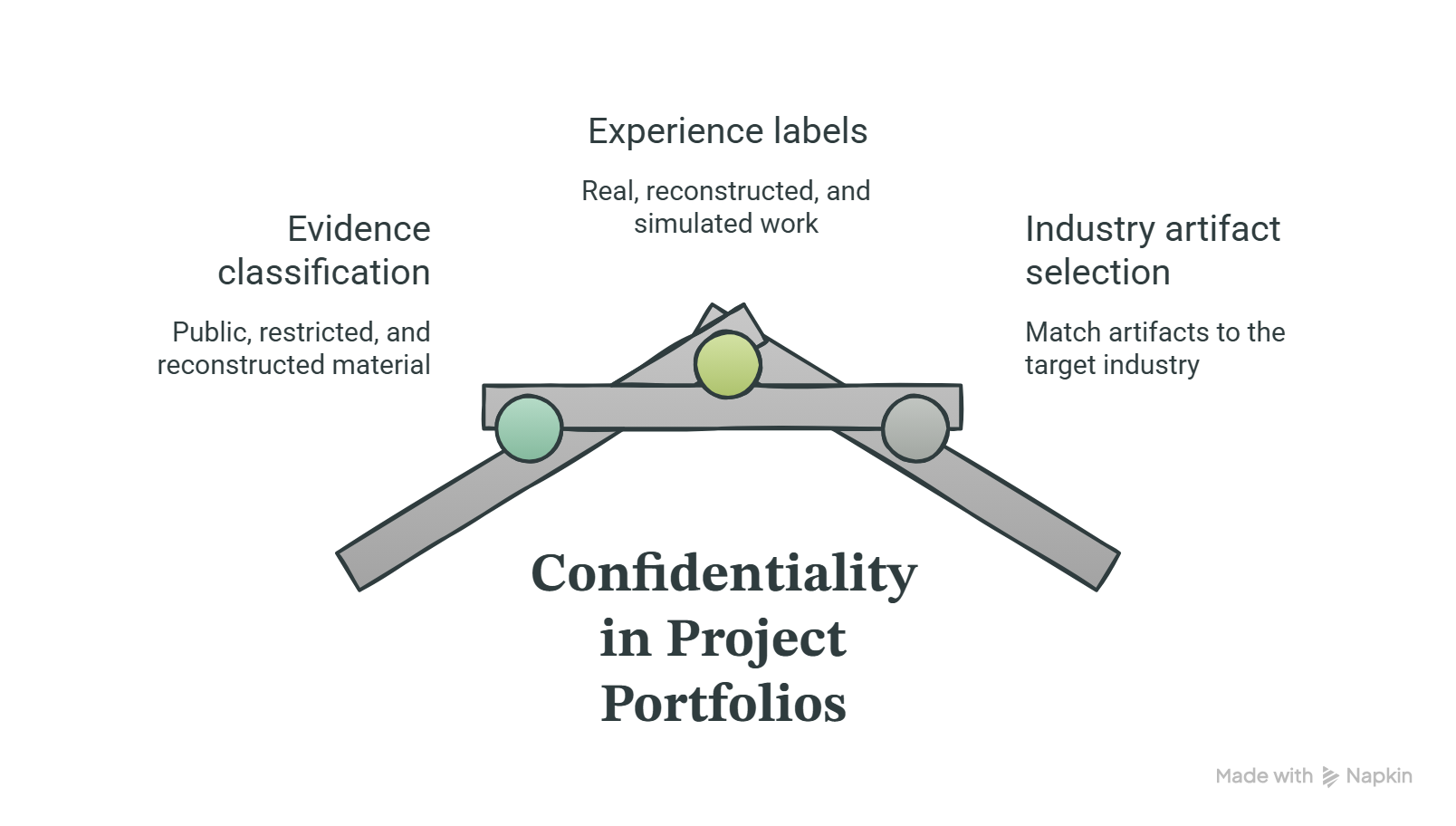
Use an evidence classification process
Before publishing an artifact, determine whether its contents are authorized for external sharing.
Public material can include independently created templates, publicly documented projects, and authorized case studies.
Restricted material requires review against applicable confidentiality agreements, employment policies, and data-protection obligations.
Reconstructed material can demonstrate the structure of a document using fictional names, independently generated figures, and invented scenarios.
For example, you might reconstruct the method used to manage an integration delay using synthetic dates and a hypothetical system. Describe the work as a reconstructed case study and explain which elements reflect your professional approach.
This matters particularly for cybersecurity project portfolios, international development work, and senior project consulting, where the portfolio may reference sensitive organizations, budgets, or stakeholders.
Separate actual experience from simulation
Use explicit labels:
Real project — authorized and anonymized: Based on genuine professional experience with any approved information removed or generalized.
Reconstructed work sample: Independently recreated to demonstrate a method used in professional work.
Simulated project: A hypothetical project developed to demonstrate planning and analytical skills.
These distinctions help recruiters interpret the evidence accurately, especially when assessing a career transition into PM or a candidate's transferable project experience.
If a document cannot be safely redacted, create a new fictional example from scratch. Removing names alone may leave organizations identifiable through budgets, dates, locations, system configurations, or unusual incidents.
Match artifact selection to the target industry
For a technical implementation role, prioritize integration decisions, release controls, technical dependencies, and cybersecurity governance.
For construction, highlight contractor dependencies, schedule recovery, change authorization, and cost-performance management.
For nonprofit project management, emphasize restricted funding, stakeholder accountability, and benefits verification.
For agile delivery positions, select artifacts showing prioritization, release readiness, and response to changing requirements.
The objective is to help reviewers understand your relevance through the specific challenges of their industry.
5. How to Turn a Project Management Portfolio Into More Interviews
Portfolio quality depends on how clearly a reviewer can connect your evidence to the role being filled.
A technically impressive collection may produce limited results when applicants send identical material to employers seeking different capabilities.
Match each featured project to the job description
Read the role's principal responsibilities and identify the strongest supporting example for each.
If the advertisement emphasizes stakeholder coordination, lead with a case study containing escalation decisions and RACI ownership.
If the position prioritizes financial control, present a budget and earned value example.
For remote PM opportunities, emphasize asynchronous decisions, dependency visibility, and distributed stakeholder coordination.
Candidates targeting PMO and program leadership roles should highlight resource prioritization and governance across multiple initiatives.
Use your résumé to create a direct evidence trail
A résumé bullet should make a defensible claim that the portfolio can substantiate.
Sample résumé statement:
"Coordinated cross-functional service workflow redesign, established ownership controls, and introduced performance reporting across five operational teams."
The corresponding portfolio case study should identify what you personally coordinated, which governance controls you introduced, the planning artifacts you produced, and the results supported by available evidence.
This approach strengthens résumés without formal project management titles and supports professionals pursuing business analyst-to-PM transitions.
Prepare a five-minute portfolio walkthrough
A useful interview walkthrough follows a deliberate sequence.
First minute: Describe the business problem, project scope, and your responsibilities.
Second minute: Explain the most difficult constraint and the alternatives available.
Third minute: Open the artifact documenting your key decision.
Fourth minute: Explain what happened and which evidence supports the outcome.
Final minute: Describe what you learned and how you would apply it to the employer's environment.
Prepare follow-up answers about rejected alternatives, stakeholder disagreements, financial assumptions, and unsuccessful decisions.
A portfolio becomes more credible when you can explain why something went wrong and how you addressed it. This is especially useful when discussing project manager layoffs and career resilience, difficult stakeholder environments, and career progression into leadership.
Build a focused portfolio in 14 days
Days 1–3: Select three projects aligned with your target role. Confirm whether each is real, reconstructed, or simulated.
Days 4–6: Draft the project summaries and identify the most meaningful decisions.
Days 7–9: Complete the essential artifacts, including the charter, RACI matrix, and risk or change evidence.
Days 10–11: Review confidentiality, calculation accuracy, consistency, and document usability.
Days 12–13: Create a navigable portfolio page with functioning links and readable files.
Day 14: Conduct a mock interview and revise weak explanations.
A focused three-project launch portfolio can establish your capabilities while you develop the remaining seven examples. Use the larger project library to tailor applications to IT delivery, agile management, operations transformation, or global PM positions.
6. Project Management Portfolio FAQs
-
Some recruiters and hiring managers review portfolios, especially when work samples help distinguish candidates with similar qualifications. Review practices vary by employer, role, and hiring process.
A concise portfolio with relevant outcomes and supporting documents makes your claims easier to evaluate during interviews.
Candidates entering project coordinator roles can demonstrate organizational capability, while applicants targeting senior PM positions can present complex decision records and governance evidence.
-
Three carefully selected projects are a practical starting point. A broader portfolio of six to ten projects provides flexibility across industries and specializations.
Feature the projects that best demonstrate role-relevant skills, then make additional examples available through an organized index.
For candidates transitioning from teaching, business analysis, or operations management, relevance and evidence quality should guide project selection.
-
Yes. Volunteer initiatives, university assignments, community projects, and transparently labeled simulations can demonstrate planning, documentation, analytical reasoning, and coordination.
For example, a simulated implementation can include a project charter, RACI matrix, schedule baseline, and risk-response scenario.
Candidates using a portfolio to support career entry without a formal PM title should clearly explain the nature of each project. The work sample demonstrates capability within its stated context.
-
The strongest selection depends on the position.
For project coordination, useful evidence includes schedules, decision logs, responsibility matrices, and escalation records.
For delivery leadership, highlight change requests, risk responses, and cost-performance analysis.
For PMO leadership, cross-project prioritization and governance evidence can be more relevant.
Each artifact should support a specific claim about your role, judgment, or outcome.
-
A difficult or unsuccessful project can demonstrate valuable judgment when you explain the original assumptions, warning indicators, decisions made, and lessons that influenced later work.
A useful case study identifies what was within your authority, which interventions you attempted, and what remained unresolved.
This approach may strengthen discussions about project management stress and delivery pressures, stakeholder conflict, and risk governance.
-
Portfolios and certifications serve different evaluation purposes. PMP certification establishes that a candidate has met a credential's applicable requirements. A portfolio allows reviewers to examine selected examples of practical work.
Neither guarantees interview selection or job performance.
Professionals preparing for the PMP examination can also improve their understanding of practical project documents. Candidates should ensure their credential applications accurately reflect real experience, particularly when dealing with PMP application documentation and audits.
