
Working from a beachside café sounds appealing until a client schedules an emergency meeting at 2 a.m., your internet disconnects, and a project deadline approaches. Becoming a digital nomad project manager requires more than finding remote work and booking flights. You need dependable clients or employment, location-independent delivery skills, predictable income, and a realistic understanding of visas, taxes, and international work restrictions. This roadmap explains how to build a portable project management career, secure legitimate opportunities, establish sustainable systems, and develop the financial stability needed to work successfully while traveling.

1. What Does a Digital Nomad Project Manager Actually Do, and Which Career Model Works Best?
A digital nomad project manager coordinates projects remotely while periodically living or traveling outside their usual home location.
Their responsibilities can include managing budgets, coordinating distributed teams, tracking milestones, resolving risks, communicating with stakeholders, and ensuring that projects deliver their agreed objectives.
The profession combines established project management capabilities with the practical demands of working across geographical boundaries.
Professionals considering remote project management careers should understand that different employment arrangements provide significantly different degrees of location flexibility.
Remote employment, freelance contracts, and consulting
Remote employment involves working as an employee for an organization that allows duties to be performed away from its physical offices.
This arrangement may provide predictable compensation, established organizational processes, and access to employee benefits.
However, the employer may restrict where employees can work because of payroll, tax, immigration, security, insurance, and operational considerations.
A vacancy advertised as remote may require residence in a specific country or time zone.
Freelance project management involves providing services to clients under commercial agreements.
Freelancers may manage software implementations, marketing campaigns, operational improvements, product launches, or other defined initiatives.
This arrangement offers flexibility in choosing clients and negotiating working conditions, but freelancers must also handle business development, contracting, invoicing, and gaps between assignments.
APMIC's freelance agile project management guide and guide to marketing project management explore relevant professional specializations.
Independent consulting generally involves helping organizations solve specific delivery or management problems.
Consultants may establish a project management office, recover a delayed initiative, improve governance, or design a delivery framework.
Experience in senior project management consulting and project governance leadership can support movement toward these assignments.
Consulting commonly requires stronger commercial judgment and independently demonstrated expertise.
Which industries are most compatible with location-independent delivery?
Digital services often offer practical opportunities because their outputs can be managed and reviewed remotely.
Examples include software implementation, digital marketing, e-commerce operations, website development, cloud migrations, and business process improvement.
However, an industry being digitally enabled does not automatically make every position location-independent.
Some technology projects involve regulated customer information or restricted systems. Others require regular client-site attendance.
Certain construction and infrastructure roles depend heavily on physical inspections and site coordination.
Professionals comparing IT and construction project management should consider these differences.
Those pursuing software engineering-to-project management transitions may find their technical familiarity useful when coordinating distributed development teams.
An effective starting point is to identify projects whose critical responsibilities can be completed securely and reliably without regular physical attendance.
Assess whether your current experience is portable
Review your previous projects and identify responsibilities already performed remotely.
Perhaps you coordinated stakeholders across different offices, managed external suppliers, maintained digital project plans, or conducted virtual status meetings.
These experiences can provide evidence of remote delivery capability.
Candidates considering project management without a formal PM title should document transferable responsibilities and measurable results.
Professionals entering the field can also explore realistic entry routes into project management and project coordinator career progression.
Your first development goal should be proving that you can manage real delivery responsibilities remotely from a stable working location.
That evidence becomes more persuasive when you can demonstrate results under actual business constraints.
| Career Requirement | Practical Action | Evidence of Readiness | Risk if Overlooked |
|---|---|---|---|
| 1. PM fundamentals | Manage scope, schedule, budget and risks | Completed project case study | Delivery failures |
| 2. Remote delivery | Coordinate a project without physical meetings | Remote delivery example | Dependence on office supervision |
| 3. Industry specialization | Select a remote-compatible delivery sector | Relevant projects and outcomes | Weak service positioning |
| 4. Asynchronous communication | Document decisions, tasks and updates | Shared communication process | Missed decisions and delays |
| 5. Time-zone planning | Schedule realistic overlap with stakeholders | Time-zone coverage plan | Disrupted working hours |
| 6. Task management | Use an appropriate delivery tracking system | Working project dashboard | Poor progress visibility |
| 7. Scope control | Define deliverables and change procedures | Scope baseline or statement of work | Unpaid additional work |
| 8. Stakeholder management | Coordinate remote clients and teams | Stakeholder engagement plan | Conflicting expectations |
| 9. Risk management | Identify project and mobility risks | Risk register with assigned responses | Unplanned disruptions |
| 10. Portfolio | Document three relevant project outcomes | Verifiable case studies | Low employer confidence |
| 11. Certification fit | Compare qualifications with target roles | Targeted learning plan | Unnecessary training expenses |
| 12. Remote job eligibility | Check accepted residence and work locations | Verified role eligibility | Wasted applications |
| 13. Client acquisition | Develop a repeatable outreach process | Qualified leads and proposals | Irregular work opportunities |
| 14. Service packaging | Define a specific client problem to solve | Clear service offer | Generic positioning |
| 15. Contract scope | Specify deliverables, responsibilities and terms | Reviewed client agreement | Payment and scope disputes |
| 16. Payment system | Confirm legitimate payment methods | Tested invoicing and receipt process | Delayed or inaccessible income |
| 17. Income stability | Track recurring versus one-time revenue | Reliable income history | Unexpected cash shortages |
| 18. Emergency reserve | Save for essential living and business costs | Accessible contingency funds | Financial vulnerability |
| 19. Destination research | Compare work rules, costs and connectivity | Destination assessment | Unsuitable travel choices |
| 20. Immigration permission | Verify authorization for intended work | Appropriate visa or work permission | Immigration violations |
| 21. Employer permission | Obtain required approval to work abroad | Written authorization | Employment or contract breaches |
| 22. Tax planning | Review residence and cross-border obligations | Qualified tax assessment | Unexpected tax liabilities |
| 23. Health coverage | Verify destination-appropriate protection | Valid health coverage documents | Uninsured medical expenses |
| 24. Internet resilience | Arrange primary and backup connectivity | Tested connection alternatives | Missed client commitments |
| 25. Information security | Protect client devices, accounts and data | Approved secure access setup | Confidentiality breaches |
| 26. Contingency planning | Prepare for illness, outages and cancellations | Business continuity plan | Interrupted project delivery |
| 27. Trial work period | Test productivity from another approved location | Successful mobility trial | Unanticipated work difficulties |
| 28. Career progression | Develop leadership and specialization | 12-month development roadmap | Professional stagnation |
2. Build the Skills, Certifications, and Portfolio That Remote PM Employers Will Pay For
Remote project management requires technical delivery knowledge alongside strong communication, independent decision-making, and reliable digital coordination.
Employers and clients need evidence that you can maintain control of an initiative without depending on constant physical supervision.
Master asynchronous project management
Asynchronous communication allows work to continue when project participants are unavailable simultaneously.
This becomes essential when your clients, developers, suppliers, and stakeholders operate across different time zones.
Establish a shared system for tracking decisions, responsibilities, milestones, and unresolved problems.
A useful weekly project update should identify completed deliverables, upcoming priorities, active risks, blocked dependencies, decisions needed, and the individuals responsible.
Ensure that decisions made during calls are recorded and accessible to stakeholders who could not attend.
Professionals developing agile project management capabilities can adapt these practices to iterative delivery.
Knowledge of remote team collaboration practices and project management software selection can help establish reliable workflows.
Learn tools by their purpose, rather than collecting software badges
You should be comfortable using a project scheduling or task management system, a communication platform, shared documents, and reporting tools.
Jira may be relevant to software delivery, while Asana, Monday.com, ClickUp, or comparable tools may suit different organizational workflows.
The appropriate software depends on stakeholder needs, integration requirements, organizational controls, and the delivery methodology.
Focus on demonstrating what you can accomplish.
For example, create a project dashboard that automatically highlights overdue dependencies, upcoming milestones, blocked work, and decisions requiring stakeholder approval.
Develop a realistic sample project containing an initiation document, scope definition, delivery roadmap, risk register, communication plan, and status report.
Professionals researching project management software adoption can use these exercises to understand the practical implications of tool selection.
Choose certifications according to your career stage
For professionals beginning their project management careers, CAPM can provide foundational knowledge of project management terminology and methods.
Candidates should compare its requirements with their educational background and existing experience.
APMIC's CAPM career outcomes guide and Google Project Management Certificate versus CAPM comparison explore these options.
Experienced project managers may consider PMP, particularly when target employers list the certification as required or preferred.
However, qualifications should complement practical evidence of managing stakeholders, risks, deadlines, and project outcomes.
Candidates evaluating PMP certification value and PMP versus alternative credentials should examine actual client or employer requirements.
Specialized learning may also be useful.
Professionals coordinating agile delivery can investigate PMI-ACP, CSM, and SAFe qualifications.
Those working with product teams may benefit from understanding Scrum product ownership.
Build a portfolio that answers the client's real questions
A convincing portfolio should demonstrate how you solve project delivery problems.
Create three case studies describing the business challenge, stakeholders involved, your responsibilities, the management approach, and the achieved outcomes.
For example, describe how you coordinated a website migration involving developers, designers, and marketing stakeholders.
Explain the scope-control process, timeline, major dependencies, and how delivery progress was communicated.
Include measurable results wherever you can substantiate them.
If confidentiality prevents you from revealing a client's identity, anonymize the details and avoid publishing sensitive information.
Professionals exploring project management resumes without a formal PM title should emphasize demonstrable delivery responsibilities.
Additional knowledge of business analysis and requirements engineering can improve how you present complex project experience.
3. How to Find Legitimate Remote Project Management Jobs and Freelance Clients
Securing a dependable source of income is one of the most important stages of becoming a digital nomad project manager.
A remote job offer, freelance agreement, or consulting engagement should be evaluated for its commercial stability and actual location restrictions.
Search for eligible roles instead of relying on the word "remote"
Remote vacancies may restrict applicants to particular countries, regions, or time zones.
For example, a position might be advertised as fully remote while requiring the employee to reside in the United States or maintain regular working hours aligned with a European office.
Review the full vacancy before applying.
Look for the accepted countries of residence, employment structure, time-zone requirements, travel expectations, and whether international work is explicitly permitted.
Candidates evaluating remote project management hiring barriers should distinguish remote-from-home positions from genuinely location-flexible opportunities.
Useful search terms include remote project manager worldwide, international delivery manager, freelance implementation manager, and distributed project coordinator.
Relevant vacancies may also appear under program coordinator, technical project manager, implementation lead, delivery manager, or PMO analyst.
Professionals exploring PMO analyst and project coordinator roles can use these titles to broaden their search.
Build a repeatable client acquisition system
For freelance work, define a service offering that solves a specific business problem.
A general promise to provide project management services gives prospective clients limited information about your specialization.
A more useful offer could involve coordinating a website redesign, recovering an overdue software implementation, establishing project reporting for a growing agency, or managing a recurring digital marketing delivery process.
Start with a clearly defined service, the customer problem it addresses, and the outcomes you can realistically deliver.
Create a short proposal framework covering scope, milestones, deliverables, assumptions, communication arrangements, payment terms, and change procedures.
Professionals exploring freelance agile project management or marketing project management can develop more targeted service packages.
Experienced professionals may also consider senior project management consulting or project governance improvement services.
Price your services around scope and delivery risk
For project-based work, decide whether hourly, milestone-based, or recurring arrangements best suit the engagement.
Hourly contracts can accommodate uncertain workloads, although clients often expect transparent time tracking and expenditure limits.
Milestone contracts provide clearer commercial expectations when deliverables and acceptance criteria are well defined.
Recurring retainers may suit ongoing coordination or project reporting responsibilities.
Before quoting, estimate delivery hours, meetings, administrative work, software expenses, payment processing fees, taxes, and potential revisions.
Include appropriate provisions for scope changes and late payments.
Your pricing should reflect the business responsibilities you assume and the level of expertise required.
Candidates researching project management salaries should avoid treating employee compensation as directly equivalent to freelance revenue.
Independent contractors generally carry business expenses and income uncertainty that employees may not experience.
Protect yourself from remote employment scams
Verify the company, its business activities, the recruiter's identity, and the proposed employment arrangement.
Be cautious about vague job descriptions, unusually high compensation for minimal responsibilities, and requests for upfront payments.
Legitimate employers should be able to explain the work, hiring process, compensation terms, and relevant company information.
A request to pay money to secure a job, release earnings, or purchase mandatory equipment from an unfamiliar payment recipient is a serious warning sign.
Professionals concerned about project management hiring difficulties should prioritize verified opportunities rather than responding indiscriminately to attractive remote advertisements.
Establish a stable income arrangement and confirm its location permissions before making substantial travel commitments.
Choose the biggest challenge holding back your location-independent career and click Submit for personalized guidance.
Submit
Review 15-20 remote project management job descriptions. Separate worldwide opportunities from country- or region-restricted roles. Verify work-location permissions directly with employers before investing time in applications. Target distributed companies whose hiring arrangements support your country of residence.
Choose one remote-compatible project management specialization. Develop a clear service package with defined deliverables and outcomes. Prepare three relevant project case studies and a concise proposal. Track qualified outreach, client discussions, proposals and conversions to identify the most effective approach.
Calculate essential monthly living costs, business expenses, taxes, insurance and travel requirements. Build an emergency reserve appropriate to your income uncertainty. Establish dependable revenue before making major travel commitments. Test your working arrangements through an affordable initial trial.
Choose one intended destination. Check the official immigration requirements for your nationality and type of work. Confirm whether remote employment or freelance activity is permitted. Review tax residency, employer obligations, health insurance, and social security requirements with qualified specialists.
Introduce written decision logs, clear ownership, shared milestones, and regular asynchronous updates. Define time-zone overlap requirements and escalation procedures. Practice coordinating a remote project from a stable location before attempting extended travel.
Review your current project management experience and target roles. Identify frequently requested qualifications and practical skills. Compare CAPM, PMP and relevant specialized learning against those needs. Prioritize building evidence of remote project delivery alongside appropriate professional development.
Your selection reveals guidance within this article. Responses are not collected, stored or transmitted.
4. Digital Nomad Visas, Taxes, Insurance, and the Risks That Can Disrupt Your Career
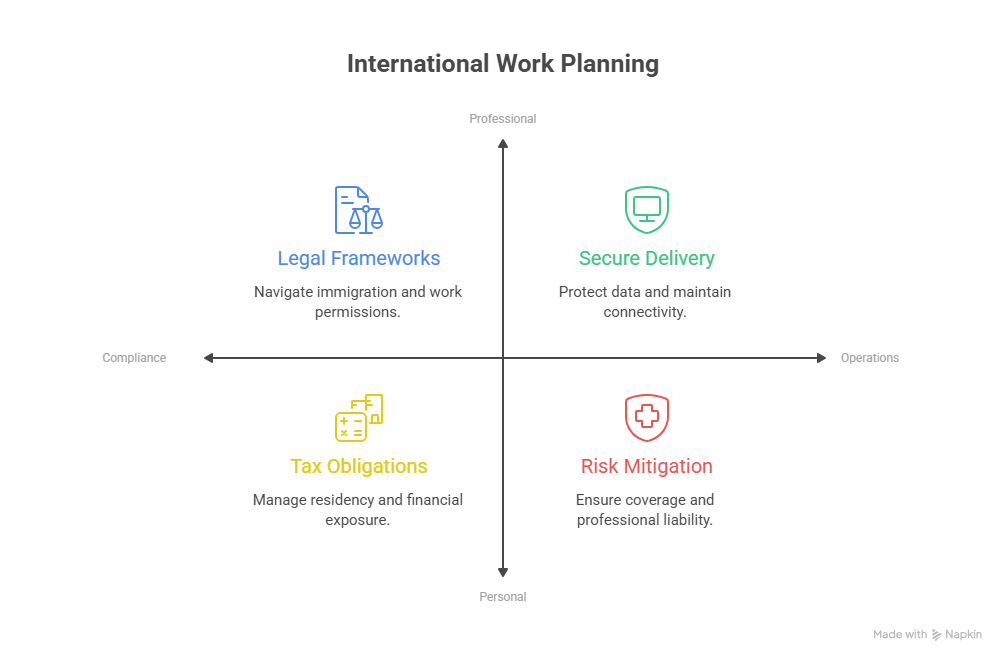
Moving between countries introduces legal and financial considerations that can affect both independent contractors and remote employees.
Before choosing a destination, determine whether your nationality, employment arrangement, income, and intended work activities satisfy the applicable rules.
Understand the difference between tourism and permission to work remotely
Immigration rules differ significantly between countries.
Some jurisdictions offer specific digital nomad arrangements for people working remotely for overseas employers or clients.
Others allow certain remote activities under defined visitor conditions.
For example, Spain's international telework framework supports qualifying applicants working remotely for businesses outside Spain, subject to eligibility and documentation requirements.
Malaysia's DE Rantau Nomad Pass provides a specific route for qualifying remote workers and digital professionals.
New Zealand also permits certain overseas remote work activities for visitors under its applicable visitor visa conditions.
These arrangements have different rules concerning employment, contract duration, income, insurance, and permitted local business activities.
A useful first step is to review the requirements published by the destination's immigration authority or relevant consulate.
Professionals researching international project management careers should understand that foreign clients, foreign employment, and local business activities may be treated differently.
Calculate tax exposure before becoming internationally mobile
Cross-border remote work can affect personal taxation, employer obligations, and the tax status of business activities.
Tax residency depends on applicable domestic laws and any relevant tax treaties.
The number of days spent in a country can be important, but residency tests may also consider factors such as the location of your home, family, economic interests, and habitual residence.
Employers may additionally need to evaluate whether an employee's activities abroad create a taxable business presence or other compliance obligations.
Maintain accurate travel records and obtain qualified advice before establishing long-term working arrangements abroad.
Professionals developing international project management leadership should treat these considerations as part of responsible international business planning.
Choose insurance that supports actual remote working arrangements
Review whether your insurance covers ordinary medical treatment, emergencies, ongoing medical needs, and any applicable destination-specific requirements.
Some immigration programs require particular insurance coverage or participation in a local healthcare or social security system.
Travel insurance and comprehensive health insurance can provide different levels of protection.
Check the territorial limits, exclusions, claim procedures, and coverage periods of any policy.
For freelancers, consider professional liability exposure, contractual indemnities, data protection responsibilities, and equipment-related risks where applicable.
Experience in project management risk assessment can help structure a personal risk register covering these issues.
Maintain a secure and dependable working environment
Client information, financial records, and project documents must remain protected while you travel.
Use approved devices, multifactor authentication, encrypted storage, and secure access methods consistent with client or employer requirements.
Avoid accessing sensitive information through unmanaged shared computers.
Establish a backup internet connection and define what happens when connectivity fails during critical project activities.
If your work involves regulated data, confirm whether the client permits access from your proposed location.
APMIC's discussion of cybersecurity and project management and AI-assisted project workflows provides further context for managing digital delivery risks.
5. A 12-Month Roadmap for Building a Sustainable Digital Nomad PM Career
A phased transition reduces the likelihood of leaving stable employment before securing dependable remote income.
The following roadmap is a planning framework that can be adjusted according to your existing skills, financial position, and opportunities.
Months 1–3: Assess your experience and build remote delivery credibility
Identify your strongest project management competencies and select a remote-compatible specialization.
Review relevant job descriptions to understand employer expectations.
Evaluate your experience in stakeholder coordination, delivery planning, risk management, budgeting, and reporting.
Build a portfolio demonstrating these capabilities.
Candidates pursuing career changes into project management should concentrate on documenting transferable responsibilities.
Professionals transitioning from operations can review operations manager-to-project manager pathways.
During this phase, develop repeatable practices for asynchronous communication, meeting documentation, task tracking, and remote stakeholder reporting.
Months 4–6: Secure remote employment or initial freelance contracts
Begin targeted applications or client outreach using a clearly defined service offering.
Track the positions or clients contacted, eligibility requirements, interview feedback, commercial proposals, and outcomes.
For freelance work, start with engagements whose scope and delivery responsibilities you can manage confidently.
Develop case studies from successfully completed assignments, subject to confidentiality obligations.
Candidates pursuing freelance agile project management may consider initial services involving agile coordination, backlog administration, or implementation planning where they have relevant expertise.
Professionals who encounter repeated application rejections should revisit project management experience gaps and adjust their positioning.
Maintain existing income arrangements until you understand the reliability of your new opportunities.
Months 7–9: Strengthen financial reserves and operational systems
Once you have established remote income, review its consistency.
Track monthly gross revenue, business expenses, taxes, personal expenditure, and savings.
Establish a contingency reserve appropriate to your obligations and the stability of your work.
For independent contractors, consider holding several months of essential living and business expenses, with a larger reserve where income is highly variable.
Set up dependable invoicing, payment tracking, client documentation, secure backups, and an emergency communication plan.
Professionals considering project management career stability should evaluate how their proposed business or employment arrangement would withstand a temporary loss of income.
At this stage, shortlist destinations based on work authorization, living expenses, connectivity, time-zone compatibility, and insurance requirements.
Months 10–12: Test your mobility before committing to extended travel
Begin with a short, legally compliant working arrangement from a different location.
If your employer permits it, a domestic trial can help identify practical difficulties without introducing international immigration or tax complexity.
Evaluate internet reliability, quiet working conditions, meeting schedules, productivity, and personal expenses.
Then research suitable international arrangements using the rules applicable to your nationality and work model.
Before departure, confirm employer or client authorization, immigration permission, insurance, tax considerations, emergency reserves, and equipment security.
Professionals evaluating remote PM opportunities should reassess employment restrictions whenever their residence or working location changes.
Build long-term career progression into the nomad lifestyle
Location independence should support continued professional development.
After establishing stable remote work, consider moving toward larger international initiatives, specialized consulting, or program management.
Professionals with stronger technical backgrounds may pursue agile project management specialization.
Experienced managers may explore program management careers or project management executive pathways.
Continue developing evidence of business outcomes, reliable delivery, and effective stakeholder management.
6. FAQs About Becoming a Digital Nomad Project Manager
-
You can develop remote project management experience through progressively more independent assignments.
Begin by demonstrating your ability to coordinate stakeholders, maintain digital project records, and deliver measurable outcomes without constant supervision.
Consider remote-compatible coordination positions and build experience before pursuing more demanding roles.
APMIC's guide to entering project management without experience provides relevant career development guidance.
-
PMP may be required or preferred by particular employers or clients, especially for more experienced positions.
However, requirements vary by industry, project complexity, and the responsibilities involved.
Practical experience managing remote projects remains important.
Candidates can evaluate PMP certification value and alternative project management qualifications.
-
Freelance earnings depend on specialization, experience, client budgets, project complexity, geographical markets, and the number of paid assignments secured.
Gross contract revenue must cover business expenses, unpaid administrative work, taxes, insurance, and periods without clients.
Use realistic income assumptions when planning travel.
APMIC's project management salary research offers broader compensation context, although employee salaries and freelance revenue require different financial calculations.
-
Useful tools depend on the nature of the work.
Common categories include task management, project scheduling, document collaboration, video communication, reporting, and issue tracking.
Jira, Asana, ClickUp, Monday.com, Microsoft Project, and comparable systems serve different organizational needs.
The most valuable skill is knowing how to establish reliable workflows and reporting practices.
Explore project management software selection and remote collaboration systems for additional context.
-
The answer depends on the immigration rules of the destination and the specific activities involved.
Some countries permit defined remote work for overseas employers or clients under particular visitor conditions. Others provide dedicated remote work visas or require separate authorization.
Check official immigration information for your nationality and proposed activities before working abroad.
Employer permission and tax obligations should also be reviewed independently.
-
Identify a specific service that matches your existing experience.
Prepare a portfolio showing relevant delivery capabilities and develop a clear proposal covering scope, outcomes, milestones, communication, and payment arrangements.
Contact prospective clients with evidence that addresses their actual needs.
APMIC's freelance agile PM guide and marketing PM career roadmap can help you identify potential specializations.
