
Projects rarely fail because a stakeholder's name was missing from a contact list. They fail when someone with approval authority surfaces too late, affected users resist implementation, or decision-makers receive information that never addresses their concerns. A stakeholder map generator helps project managers identify these risks before they become expensive delays. Using a power/interest grid, you can prioritize engagement, clarify decision rights, and build a communication strategy around actual influence. This guide provides a free mapping template, practical scoring rules, 32 stakeholder examples, and actionable methods that complement RACI responsibility mapping and project governance planning.
1. What Is a Stakeholder Power/Interest Grid, and How Does It Improve Project Decisions?
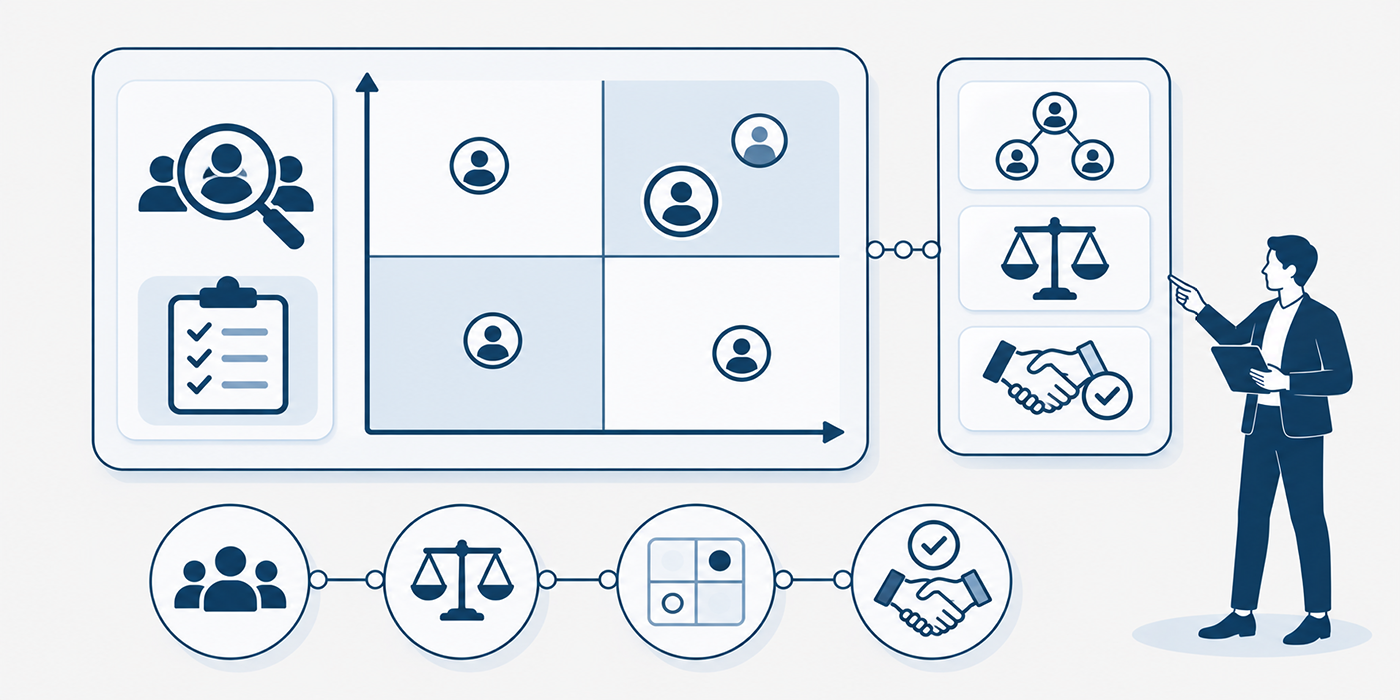
A stakeholder power/interest grid is a two-dimensional framework that classifies stakeholders according to their ability to influence a project and their level of interest in its outcomes. Often associated with Mendelow's matrix, it supports four engagement strategies: Manage Closely, Keep Satisfied, Keep Informed, and Monitor.
The framework becomes especially useful when projects involve competing priorities, unclear authority, or stakeholders with different expectations. A project manager coordinating an enterprise technology transition may need frequent input from technical leads, executive approvals from a sponsor, and early feedback from affected employees. Mapping these relationships supports governance leadership, cross-functional coordination, and organizational change management.
Understand the Difference Between Power and Interest
Power measures a stakeholder's ability to influence project decisions or outcomes. It can come from budget control, approval authority, ownership of scarce resources, contractual rights, regulatory powers, or the ability to mobilize other stakeholders.
A chief financial officer may have high power over a technology initiative despite limited interest in its daily activities. Conversely, a frontline employee may experience significant operational consequences without controlling the project's funding or final approval.
Interest measures how closely a stakeholder follows the project and how strongly its outcome matters to them. Interest can come from operational exposure, financial consequences, professional accountability, personal impact, or organizational priorities.
Importantly, interest and support are separate variables. An executive who actively opposes a project may be highly interested in it. Treating interest as support can produce serious errors in stakeholder engagement planning, risk management, and executive decision-making.
Why a Stakeholder Register Alone Is Insufficient
A stakeholder register identifies who matters. The power/interest grid helps determine how much engagement each stakeholder requires and why.
For example, a register may identify a legal adviser, product owner, finance director, implementation team, and customer representatives. Their names alone reveal little about who can stop delivery, who needs detailed consultation, or whose expectations may change during implementation.
A useful grid therefore connects stakeholder characteristics to specific decisions, communication needs, and review triggers. Combined with project management templates, responsibility assignment tools, and strategic project oversight, this creates a practical engagement system.
| Stakeholder / Role | Evidence of Power | Interest Indicator | Power / Interest | Grid Quadrant | Recommended Action |
|---|---|---|---|---|---|
| 1. Executive project sponsor | Controls funding and escalation | Accountable for business outcomes | 5 / 5 | Manage Closely | Agree decision thresholds and hold weekly exception reviews. |
| 2. Product owner | Controls product priorities | Direct responsibility for delivered value | 5 / 5 | Manage Closely | Review backlog trade-offs and acceptance decisions each iteration. |
| 3. CIO on an ERP rollout | Controls technology investment decisions | Responsible for system integration outcomes | 5 / 4 | Manage Closely | Confirm architecture dependencies and major technical gates. |
| 4. Clinical safety lead | Can withhold safety approval | Direct accountability for patient safety | 4 / 5 | Manage Closely | Validate clinical risk controls before each release gate. |
| 5. Grant program officer | Controls milestone funding approval | Monitors achievement of funded outcomes | 4 / 5 | Manage Closely | Share milestone evidence and resolve eligibility questions early. |
| 6. Public works approval lead | Can authorize or delay construction stages | Accountable for compliant execution | 5 / 4 | Manage Closely | Confirm permit conditions and review dates before mobilization. |
| 7. Operations director | Controls implementation resources | Responsible for post-launch performance | 4 / 5 | Manage Closely | Co-design cutover, support ownership and operational acceptance. |
| 8. Cybersecurity remediation owner | Controls security acceptance for release | Directly responsible for risk closure | 4 / 4 | Manage Closely | Track remediation evidence and unresolved control exceptions. |
| 9. Chief financial officer | Can freeze major expenditure | Primarily reviews budget exceptions | 5 / 2 | Keep Satisfied | Provide concise cost forecasts and escalation triggers. |
| 10. General counsel | Can block noncompliant agreements | Engages at defined legal review gates | 5 / 2 | Keep Satisfied | Confirm legal checkpoints and document material changes. |
| 11. Audit committee chair | Can demand control remediation | Typically reviews periodic exceptions | 4 / 1 | Keep Satisfied | Provide assurance summaries and early notice of material control failures. |
| 12. Procurement director | Controls purchasing approvals | Interested at sourcing and contract gates | 4 / 3 | Keep Satisfied | Agree sourcing deadlines and contract approval evidence. |
| 13. Insurance underwriter | Can impose coverage conditions | Reviews material exposure changes | 4 / 2 | Keep Satisfied | Notify significant scope or risk changes that affect coverage. |
| 14. Corporate brand vice president | Controls brand approval | Reviews major public-facing milestones | 4 / 2 | Keep Satisfied | Schedule brand reviews before external publication. |
| 15. Data protection officer | Can require privacy remediation | Engages for data-risk exceptions | 4 / 3 | Keep Satisfied | Share privacy impact findings and obtain necessary review. |
| 16. Property owner | Can restrict access to a project site | Primarily concerned with access conditions | 5 / 2 | Keep Satisfied | Agree access conditions and give notice of disruptive works. |
| 17. Frontline nurse representative | Limited formal budget authority | Daily workflow affected by implementation | 2 / 5 | Keep Informed | Run workflow demonstrations and collect usability feedback. |
| 18. Student representative group | Limited formal approval authority | Directly affected by campus system changes | 2 / 5 | Keep Informed | Test accessibility and gather feedback before release. |
| 19. Contact center supervisor | Limited strategic authority | Responsible for adoption within their team | 3 / 5 | Keep Informed | Share release details and evaluate training readiness. |
| 20. Volunteer coordinator | Can influence local execution | Works directly with program participants | 3 / 5 | Keep Informed | Invite field feedback and clarify operational changes. |
| 21. Accessibility testing group | Limited budget control | Directly affected by product usability | 2 / 5 | Keep Informed | Provide test access and address documented barriers. |
| 22. Reporting data analysts | Can influence local reporting design | Rely on the new data model daily | 3 / 4 | Keep Informed | Validate field definitions and reconciliation outputs. |
| 23. Supplier integration engineer | Can influence one technical workstream | Works daily on dependent interfaces | 3 / 5 | Keep Informed | Share integration changes and resolve dependency questions. |
| 24. Neighborhood residents group | Limited current formal authority | Directly affected by construction disruption | 3 / 5 | Keep Informed | Consult early, address impacts and rescore if collective influence grows. |
| 25. Adjacent department observer | No current project decision authority | Occasional curiosity about progress | 2 / 2 | Monitor | Include in periodic updates when dependencies change. |
| 26. Noncritical supplier contact | No current delivery-gate authority | Interested mainly in future opportunities | 2 / 1 | Monitor | Reassess when purchasing scope changes. |
| 27. Peripheral service desk team | Limited current delivery influence | Minimal near-term workload impact | 3 / 2 | Monitor | Review status if support responsibilities expand. |
| 28. Optional pilot observer | No approval responsibility | Interested in high-level progress only | 1 / 2 | Monitor | Offer summaries at relevant milestones. |
| 29. Future-phase team member | No authority over the current release | Later project phases may affect their work | 2 / 2 | Monitor | Reassess before their phase begins. |
| 30. Records archive clerk | Limited approval authority | Minimal change to existing duties | 2 / 2 | Monitor | Check whether retention or handover rules change. |
| 31. Unaffected facilities contact | Limited relevant authority | No expected operational disruption | 2 / 1 | Monitor | Revisit only when physical dependencies emerge. |
| 32. Regional business observer | No authority over the current initiative | Occasional interest in future expansion | 1 / 1 | Monitor | Reassess at expansion or scale-up decisions. |
2. How to Build a Stakeholder Map Using a Free Power/Interest Grid Generator
An effective stakeholder map should produce a defensible engagement decision for every person or group included. The following six-step method works in Excel, Google Sheets, or an existing project management software environment.
Step 1: Define the Project Decision Being Mapped
Start by identifying the specific project, delivery phase, or decision requiring stakeholder analysis. Stakeholder influence is contextual. An IT security director may control system release approval but have limited influence over a marketing campaign's creative direction.
Record the project's objective, pending decisions, approval gates, and expected impact. Use a project management template to capture this scope before beginning stakeholder identification. For complex initiatives, connect the map to program governance, executive oversight, and relevant RACI assignments.
Step 2: Identify Stakeholders Beyond the Reporting Structure
Build your initial list using organizational charts, contracts, approval registers, meeting records, user research, procurement documents, and regulatory obligations.
Consider stakeholders who control decisions, perform the work, receive the benefits, absorb the consequences, or can significantly affect delivery. This matters in international development projects, nonprofit programs, technology implementations, and environmental initiatives.
For example, a healthcare system launch may require input from clinicians, patients, privacy specialists, IT operations, administrators, and external service providers. Missing affected users can undermine adoption even when executive approvals are complete.
Step 3: Assign Evidence-Based Power Scores
Use the following 1–5 scoring rubric:
1: Can observe or comment but has minimal influence over decisions.
2: Can provide recommendations or local feedback without approval authority.
3: Can delay or materially influence a particular workstream.
4: Controls a significant approval, resource, or implementation dependency.
5: Can approve, suspend, fund, or stop the initiative through relevant authority.
Support each score with evidence. A job title alone is insufficient when actual decisions are delegated elsewhere.
For example, a technical architect may receive a power score of 4 because their approval is mandatory for system integration. A senior executive may receive a 2 for a project where they have no relevant authority or resource control.
Document these distinctions using responsibility mapping, project governance procedures, and cross-functional delivery planning.
Step 4: Score Stakeholder Interest Independently
Use a second 1–5 scale:
1: Little current awareness or practical exposure.
2: Occasional interest at major milestones.
3: Regular interest in progress or specific outcomes.
4: Frequent involvement in decisions or substantial operational impact.
5: Direct, ongoing involvement or consequences that are central to the stakeholder.
An employee who strongly opposes an implementation may score 5 for interest even if they hold little formal authority.
This distinction becomes especially important in Agile product delivery, organizational transformation, and stakeholder-intensive program management.
Step 5: Automatically Generate the Four Quadrants
For a free spreadsheet-based generator, create these columns in order:
Stakeholder ID → Name/Role → Power Evidence → Power Score → Interest Score → Quadrant → Current Stance → Desired Stance → Decision Gate → Next Action → Engagement Owner → Review Date
Enter numerical power scores in column D and interest scores in column E.
In cell F2, insert this formula:
=IF(OR(D2="",E2=""),"",IF(D2>=4,IF(E2>=4,"Manage Closely","Keep Satisfied"),IF(E2>=4,"Keep Informed","Monitor")))
Copy the formula down the remaining rows.
With 4–5 classified as high and 1–3 classified as low, the formula automatically assigns the appropriate quadrant whenever a stakeholder's scores change.
For example, power 5 and interest 2 produce Keep Satisfied, while power 2 and interest 5 produce Keep Informed. These labels can drive conditional formatting or filtered views within your chosen project management software. The same scoring approach can support freelance project management engagements and global delivery programs.
The 32-row HTML table above serves as the completed example template. Replace the illustrative stakeholder entries with your own data and apply the formula in your spreadsheet.
Step 6: Assign an Engagement Owner and Review Trigger
Every mapped stakeholder should have an engagement owner, a concrete next action, and a reason for reassessment.
For example, the project manager may own sponsor briefings, the product owner may coordinate user demonstrations, and the compliance lead may manage regulatory consultations.
Attach engagement responsibilities to your RACI framework, include decision commitments in project governance documentation, and connect outstanding issues to your project tracking process.
3. How to Use the Four Power/Interest Quadrants to Prevent Stakeholder Resistance
The value of the grid emerges when each quadrant produces an appropriate engagement strategy. Communication frequency, message depth, and decision involvement should reflect what stakeholders need to participate responsibly.
Manage Closely: High Power, High Interest
These stakeholders can materially influence the project's direction and actively care about its outcomes. They often include project sponsors, product owners, major operational leaders, and approval authorities.
Provide direct access to critical decisions, material risks, and unresolved trade-offs. Weekly reviews or decision-based checkpoints may be appropriate for active projects.
A sponsor responsible for financial results should receive validated forecasts, delivery options, and explicit approval requests. Use earned value measures, executive reporting practices, and program oversight techniques to make those discussions decision-oriented.
Failure signal: Major decisions remain unresolved because stakeholders attend meetings without clear proposals or required evidence.
Keep Satisfied: High Power, Low Interest
These stakeholders may engage infrequently but retain substantial authority. Examples include finance directors, legal approvers, board representatives, or external oversight bodies.
Provide concise updates focused on their specific concerns: budget variance, regulatory exposure, contractual commitments, or milestone approval.
For instance, a finance director may need a monthly cost forecast and immediate notification when expenditure exceeds an agreed threshold. They may have little need for detailed daily task reports.
Use project governance controls, forecasting calculations, and portfolio-level reporting approaches to provide relevant information without overwhelming them.
Failure signal: An important approval becomes a surprise because its owner was contacted too late.
Keep Informed: Low Power, High Interest
These stakeholders experience significant project consequences and often possess essential operational knowledge.
Examples include frontline employees, service users, customer advocates, field workers, and implementation support teams.
Invite feedback during requirements development, prototypes, testing, and rollout preparation. Explain how their input affected decisions, particularly when requested changes cannot be accommodated.
In Agile delivery environments, frequent demonstrations are useful. In nonprofit projects or international development programs, structured consultations may help reveal operational or community impacts.
Stakeholders facing serious safety, accessibility, or rights-related consequences deserve appropriate substantive engagement regardless of their formal power score.
Failure signal: Leadership reports successful deployment while affected users continue rejecting or bypassing the solution.
Monitor: Low Power, Low Interest
These stakeholders currently have limited influence over the defined project decision and relatively little direct interest.
Use proportionate communication, such as milestone summaries, opt-in updates, or periodic reassessments. Avoid inviting peripheral stakeholders to every meeting when their involvement adds little value.
However, reassessment remains essential. A stakeholder may gain power when a dependency changes, a new project phase begins, or an overlooked issue becomes critical.
A lightweight monitoring process can be maintained using project management templates, software integration workflows, and project reporting practices.
Failure signal: A previously peripheral stakeholder becomes an unexpected decision-maker, but the map still reflects their original position.
4. Free Stakeholder Mapping Template: Build an Engagement Plan That Teams Actually Use
A stakeholder map becomes operationally useful when the assessment is connected to a clear engagement plan.
The free template structure introduced earlier contains twelve fields. Each supports a specific management decision, and together they create a record that can be maintained throughout the project.
Connect Scores to Stakeholder Attitudes
For each stakeholder, record current stance and desired stance separately from power and interest.
A practical stance scale is: Unaware, Resistant, Neutral, Supportive, and Leading.
Suppose a department director has power 5, interest 5, and a Resistant stance. Their quadrant is Manage Closely, but your engagement objective is to understand their opposition and agree on the evidence or changes needed to improve support.
A different stakeholder may also score 5/5 while already providing active leadership. That person may need decision briefs and strategic input rather than persuasion.
This approach helps business analysts transitioning into project management, program managers, and project governance leaders distinguish engagement intensity from relationship health.
Record the Decision or Risk Each Stakeholder Controls
Avoid generic next actions such as "communicate regularly" or "maintain engagement."
Use verifiable actions instead:
Obtain the security owner's written acceptance before the production release gate.
Secure finance approval of the revised cost forecast before the steering meeting.
Collect feedback from at least two frontline user groups before final workflow design.
Confirm procurement approval before issuing a supplier commitment.
Resolve the operations director's support-ownership concern before handover.
These actions create traceable commitments. Connect them to project responsibility assignments, project management documentation, and executive delivery oversight.
Use Communication Cadence as a Starting Point
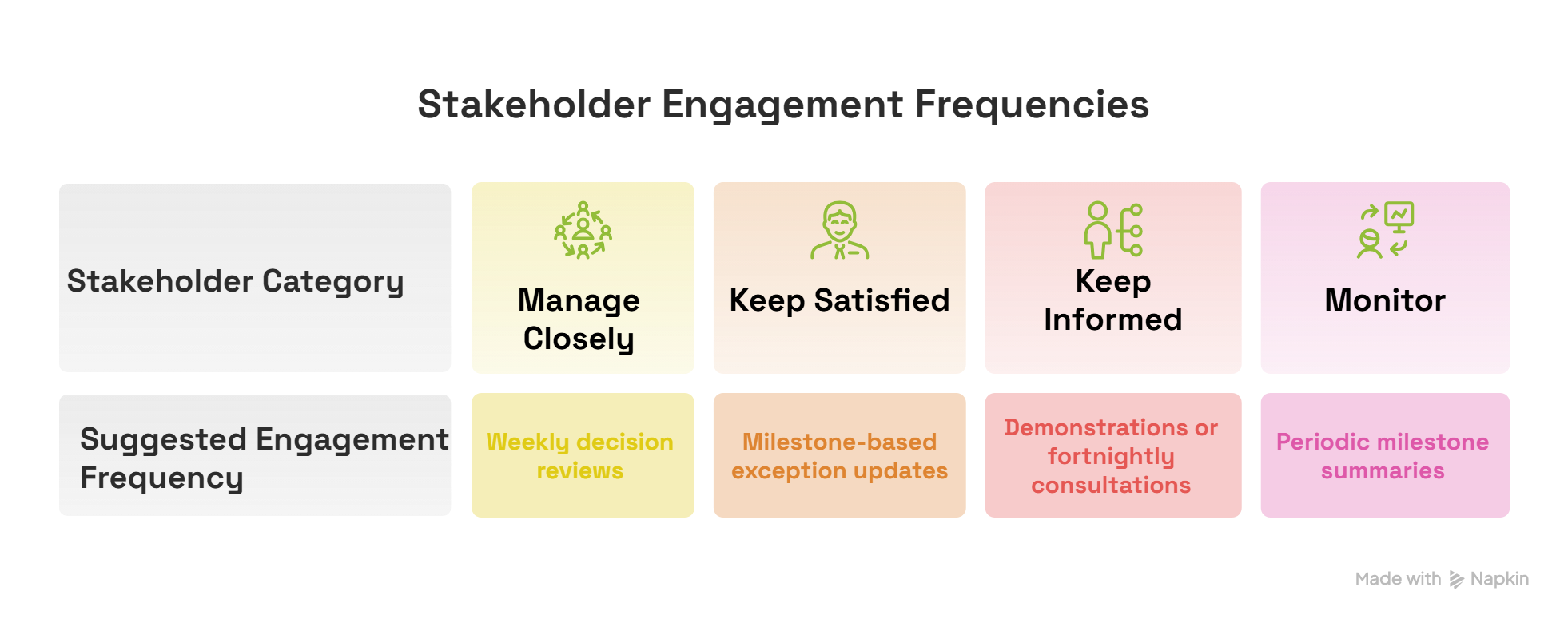
Suggested engagement frequencies include weekly decision reviews for active Manage Closely stakeholders, milestone-based exception updates for Keep Satisfied stakeholders, and demonstrations or fortnightly consultations for Keep Informed stakeholders.
Monitor stakeholders may receive periodic milestone summaries, subject to changing project relevance.
These frequencies are starting assumptions. Regulatory timelines, urgency, stakeholder preferences, and organizational requirements may demand different arrangements.
For a marketing project launch, engagement may intensify near campaign approval. For an international development initiative, consultations may need to align with community access and implementation windows. For a digital transformation program, change-freeze dates may determine when stakeholders must provide decisions.
Measure Whether Engagement Is Working
Useful indicators include the percentage of decisions made by their required dates, unresolved stakeholder objections, approval delays, participation in essential consultations, and verified adoption after implementation.
For example, a project might target 95% of critical approvals completed by their decision deadlines. Another may track whether unresolved operational objections fall between testing and release.
These indicators should be tied to real delivery consequences. A high meeting-attendance rate offers little reassurance when critical approvals remain outstanding.
Use project performance measurement techniques, project management reporting tools, and governance scorecard practices to connect stakeholder activity with outcomes.
5. Five Stakeholder Mapping Mistakes That Cause Delays, Resistance, and Failed Approvals
Mistake 1: Confusing Seniority With Actual Decision Power
A senior executive may have little authority over a particular technical approval, while a specialist with a less prominent title can prevent a release because their sign-off is mandatory.
Inspect decision logs, contracts, delegated authority, and approval workflows before finalizing scores.
This matters especially in IT project management, project governance roles, and cybersecurity-related projects.
Mistake 2: Assuming High Interest Means Strong Support
A stakeholder can be extremely interested because they believe the project threatens their responsibilities, job security, service quality, or professional reputation.
Assess their stance separately, investigate specific objections, and agree on concrete steps toward resolution.
When managing organizational transitions, operational change, or Agile team adoption, this distinction can prevent leadership from interpreting polite meeting attendance as genuine acceptance.
Mistake 3: Ignoring Informal Influence and Stakeholder Coalitions
Formal authority does not capture every source of influence. Experienced employees, community representatives, technical specialists, and trusted advisers may shape decisions without holding approval titles.
Individually low-power stakeholders may also gain influence through collective action, public attention, or coordinated resistance.
Investigate influence pathways and connections between stakeholders. For nonprofit project managers, environmental project leaders, and professionals managing international development initiatives, these relationships can determine whether consultation produces practical cooperation.
Mistake 4: Treating the Map as a One-Time Planning Document
Stakeholder power and interest change during the project lifecycle.
A finance director may become highly interested when costs exceed tolerance. A regulator may become central after a compliance issue. A frontline group may gain influence when a planned rollout creates operational disruption.
Reassess scores after significant funding decisions, scope changes, major incidents, leadership changes, approval failures, and transitions between project phases.
Integrate these reviews with project risk management, delivery governance, and program-level planning.
Mistake 5: Using Low Power to Justify Ignoring Legitimate Concerns
The power/interest grid prioritizes engagement effort, but formal power is an incomplete measure of a stakeholder's rights, vulnerability, and exposure to harm.
A community affected by construction disruption, an employee group exposed to safety risks, or a user population facing accessibility barriers may warrant substantial consultation even when they have little formal influence.
Add an impact and obligations review alongside your map. Document legal requirements, ethical concerns, accessibility issues, and potential harm. Establish escalation routes that remain available regardless of quadrant.
This is particularly important in environmental project management, international development, nonprofit program delivery, and public-facing governance initiatives.
6. FAQs: Stakeholder Map Generator and Power/Interest Grid
-
A stakeholder map classifies people or groups by their influence, interest, and engagement needs. A RACI matrix identifies who is Responsible, Accountable, Consulted, and Informed for specific activities or decisions.
Use the stakeholder map to plan relationships and communication. Use the RACI matrix generator to clarify task-level ownership and decision accountability. Together, they support effective project governance and cross-functional project coordination.
-
Evaluate their demonstrated ability to approve funding, authorize changes, control resources, enforce requirements, stop work, or influence major decision-makers.
A high organizational title may provide useful context, but documented authority and actual dependencies provide stronger evidence. Review the project's approval chain, identify decision owners, and validate assumptions with relevant stakeholders.
Use project management documentation and responsibility assignment methods to support consistent scoring.
-
Yes. Interest describes how much attention or concern a stakeholder has regarding the project. Opposition represents their stance.
A stakeholder who expects serious operational disruption may be highly interested and strongly resistant. Record those dimensions separately, investigate the source of opposition, and involve the stakeholder in relevant decisions.
This distinction is especially important during Agile transformations, organizational restructuring, and stakeholder-led product development.
-
Review the map at major project gates and whenever an event could change influence, interest, or engagement requirements.
Examples include executive turnover, funding revisions, contractual disputes, regulatory changes, operational incidents, and major scope adjustments.
A fortnightly review may suit an active transformation, while a milestone-based review may be sufficient for a stable initiative. Align reassessment with project governance checkpoints and risk monitoring activities.
-
Give both stakeholders the same initial quadrant, then tailor their engagement strategies according to decision authority, project impact, attitude, information needs, and timing.
For example, a technical approver and a business sponsor may both score 5/5. One requires detailed evidence of technical readiness; the other requires business outcomes, cost forecasts, and trade-off recommendations.
Use RACI assignments and governance decision records to distinguish their responsibilities.
-
A program-level map is useful for identifying shared sponsors, strategic decision-makers, regulatory authorities, and cross-project dependencies.
However, individual projects may require additional maps because the same stakeholder's influence and interest can vary by workstream.
Maintain a program-level overview and link it to project-specific engagement records. This approach supports program management governance, global project leadership, and executive portfolio oversight.
