
Project Manager Layoffs: Reddit Stories on Why PMs Get Cut, Which Roles Survive & How to Become Harder to Replace
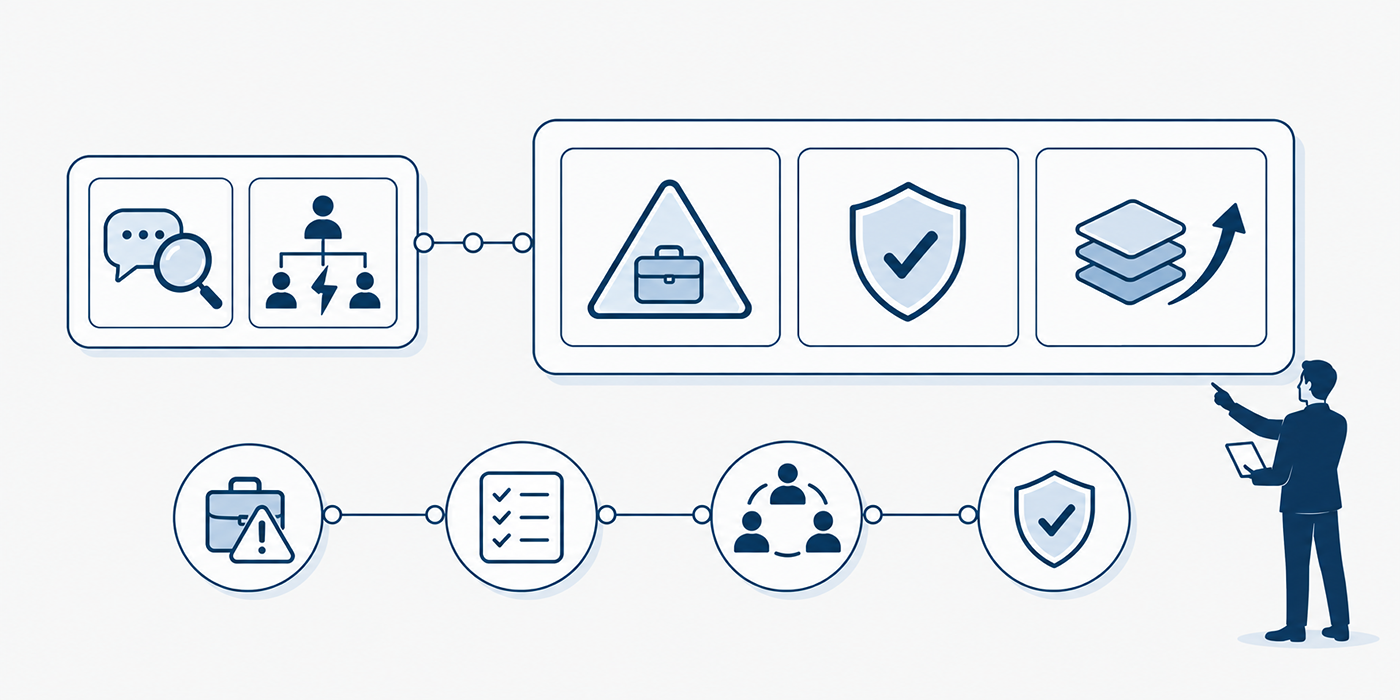
Project managers can be delivering solid work on Monday and lose their role on Friday because a company cuts a PMO, cancels investment, moves delivery offshore, merges teams, or decides fewer people can coordinate the same portfolio. That uncertainty has intensified as hiring slows and AI raises productivity expectations. The useful question is which factors increase exposure. Understanding the 2026 project-management job market, building proof beyond certifications, improving PMP career ROI, and developing harder-to-automate PM skills can materially change how defensible a PM becomes.
1. Why Project Managers Get Laid Off Even When Their Projects Are Going Well
One uncomfortable lesson from recent project-management layoff stories is that individual performance and organizational survival are different variables. In a 2025 Deloitte Reddit thread, a project manager with 12 years at the firm was reportedly laid off even though the wider project was expected to continue well into the future. Another 2025 technology PM described being cut after five years during repeated company layoffs following a private-equity acquisition, with some North American positions reportedly shifting to lower-cost regions. These stories reinforce why strong project performance, professional certification, technical PM experience, and even senior-level responsibility cannot fully eliminate restructuring risk.
The macro environment helps explain why the market can feel harsher even while long-term PM demand remains positive. LinkedIn reported U.S. hiring in July 2026 running 7.6% below July 2025 and 26% below its pre-pandemic pace. Its broader labor-market analysis attributes much of the weakness to economic uncertainty and monetary conditions rather than a sudden wave of AI replacement. That environment naturally makes career changes into project management, entry-level PM searches, project coordinator promotions, and certification-led job searches more competitive.
A project manager becomes especially vulnerable when leadership sees the role primarily as coordination overhead. If executives believe the PM mainly organizes meetings, requests updates, maintains Jira, formats PowerPoint decks, and passes information between specialists, cost-cutting creates an obvious question: can those tasks be absorbed by functional managers, automated, centralized, or distributed across the delivery team? Reddit discussions include organizations eliminating or dramatically reducing project-management structures because leadership believed PMs or PMOs were not producing visible value. That is a serious warning for anyone building a career around PM software administration, remote coordination, PMO reporting, or generic agile facilitation without measurable business ownership.
Budget cuts create another structural risk. When an organization freezes discretionary investment, delays transformation programs, reduces capital expenditure, or cancels product initiatives, project demand can disappear before operational demand does. An operations department still has customers, payroll, compliance obligations, and daily service requirements tomorrow morning. A transformation PM may lose their portfolio when the transformation pauses. This is one reason professionals benefit from combining project delivery with operational knowledge, business-analysis depth, financial control, and project governance capability.
Offshoring and delivery-model redesign can create a similar outcome. A business may retain the project while relocating coordination, analysis, testing, development, or PM support to another geography. The vulnerable candidate is the one whose contribution transfers easily across borders because it depends mainly on process rather than scarce organizational knowledge. Professionals with deep cybersecurity-project-management experience, construction expertise, earned-value capability, or difficult stakeholder-governance responsibility are usually harder to relocate purely on labor-cost grounds because their value depends on context, trust, judgment, or technical knowledge.
There is an important counterweight to the layoff headlines. BLS currently projects employment of U.S. project management specialists to grow 7% between 2025 and 2035, with approximately 76,500 openings annually, while PMI estimates organizations worldwide could face a shortage approaching 30 million project professionals by 2035. The career opportunity remains substantial. The pressure is shifting toward professionals who can demonstrate valuable project outcomes, build future-ready PM skills, progress into program management, and connect delivery directly to strategic leadership.
2. What Reddit Layoff Stories Reveal About Who Gets Cut
Reddit stories repeatedly challenge the assumption that tenure creates immunity. One Deloitte poster described a PM with 12 years at the company being removed while the project itself continued. A technology PM with nine years of overall experience described being laid off after five years at a company that had already conducted repeated rounds of cuts. Another 2026 PM said their company was struggling financially when their first official PM role disappeared. These are useful reminders when planning long-term PM career progression, deciding whether PMP improves career security, building stronger interview evidence, or preparing for senior consulting roles.
A second pattern is the danger of becoming unallocated. A PM who loses their primary project and remains on the bench can quickly appear as an expense without associated revenue or strategic work. Consulting, professional services, agencies, implementation firms, and contractors are particularly sensitive to utilization. Professionals working in those environments should understand portfolio governance, build multiple-domain project evidence, develop business-analysis flexibility, and understand how PMO effectiveness is evaluated so they can remain useful between assignments.
The third pattern is cost-center visibility. PMOs can produce enormous organizational value while presenting themselves poorly. If executives see governance templates, mandatory meetings, reporting deadlines, and red-yellow-green dashboards but cannot connect them to reduced overruns, faster decisions, avoided risk, increased revenue, or better capital allocation, the PMO becomes vulnerable during restructuring. That is why professionals interested in project governance leadership, PM executive careers, program-management progression, and eventual COO responsibility need to speak the language of enterprise economics, rather than only methodology.
Reddit also exposes the domain-experience premium. Laid-off generalists frequently encounter job advertisements requiring project-management capability plus sector-specific knowledge. An experienced PM may suddenly be competing against someone with the same delivery skills plus banking, healthcare, ERP, cybersecurity, construction, manufacturing, or SaaS expertise. This makes IT-to-PM specialization, cybersecurity project work, environmental project management, and marketing project management strategically useful career moats. A 2023 Reddit discussion captured this frustration directly: an experienced PM questioned whether switching industries too often had weakened their fit for a role requiring domain familiarity.
Remote positions add another layer of exposure because geographic competition becomes much larger. LinkedIn's March 2026 data showed remote positions representing only about 9% of paid U.S. postings while attracting 37% of applications. A candidate who insists on remote-only work is competing inside a highly compressed funnel. Building capability in remote project collaboration, understanding enterprise PM tool selection, strengthening project portfolio evidence, and targeting specialized industries becomes even more important when hundreds of candidates can pursue the same opening.
3. Which Project Management Roles Are More Likely to Survive Restructuring
The strongest survival characteristic is proximity to money. PMs tied directly to revenue launches, contractual client delivery, expensive infrastructure, regulated programs, cost reduction, or strategically mandated transformation give executives a clearer economic reason to preserve the role. A professional managing a $20 million customer implementation is easier to defend than someone producing internal progress reports about it. Developing cost-professional expertise, earned-value capability, commercial project evidence, and program-level ownership moves a PM closer to measurable economics.
Technical and domain-heavy project managers also carry stronger defenses. Construction managers understand sequencing, contractors, permits, claims, safety, and site realities. Cybersecurity PMs must understand controls, risk, dependencies, remediation, and regulatory exposure. Healthcare PMs navigate operational and compliance complexity. IT transformation PMs benefit from understanding systems architecture, migrations, integrations, data, and vendor constraints. These paths align with construction-management certification, cybersecurity and PM convergence, IT-to-project-management transitions, and future cybersecurity requirements for PMs.
Program managers and portfolio leaders can also be more defensible when they genuinely allocate resources, manage cross-project dependencies, challenge investments, and connect execution to strategy. Managing ten projects administratively creates less protection than deciding which five deserve funding and how scarce resources should move between them. This is the difference between project-to-program progression, project governance leadership, senior PM consulting, and executive project leadership on one side, and expanded project administration on the other.
PMs who rescue troubled work develop another valuable moat. Organizations frequently discover the value of strong project leadership after deadlines slip, customers escalate, vendors fail, budgets deteriorate, or executives lose confidence. A PM who can diagnose a failing initiative, rebuild its critical path, renegotiate commitments, create credible governance, and recover stakeholder trust is solving an expensive problem. That capability requires business-analysis skill, cost and schedule control, agile transformation judgment, and mature stakeholder governance.
Long-term labor data supports the idea that organizations continue to need sophisticated project talent. BLS forecasts 73,200 additional U.S. project-management-specialist jobs between 2025 and 2035, while PMI estimates global demand could increase by as much as 64% over the decade in its high-growth scenario. Construction alone may need approximately 2.5 million additional project professionals by 2035 according to PMI. Professionals developing construction PM capability, technical PM expertise, program leadership, and strategic governance skills are therefore positioning toward areas where project complexity continues to expand.
4. How AI Changes Layoff Risk for Project Managers
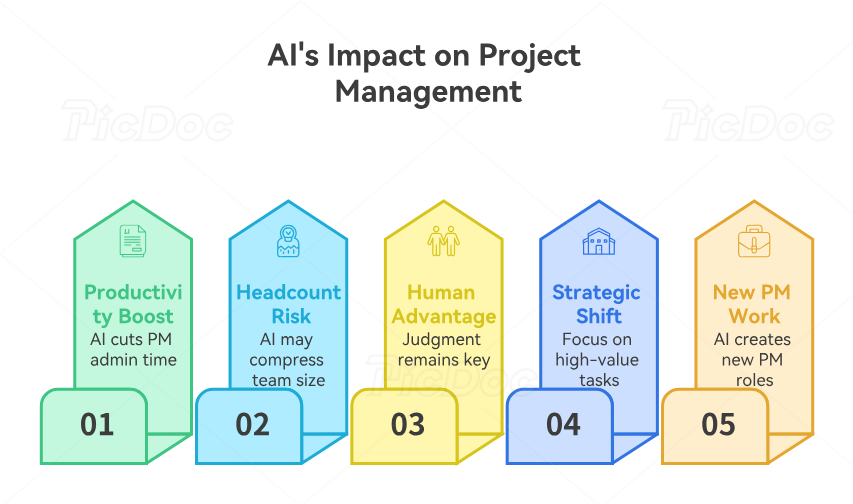
AI matters because it changes the minimum amount of labor required to produce coordination outputs. A PM who previously spent four hours building a weekly status pack may now produce a strong first draft in minutes. Meeting transcripts can produce action items automatically. Risks can be generated from project data. Schedules can be analyzed for slippage. Emails, charters, stakeholder communications, and summaries can be drafted quickly. Professionals familiar with current PM software adoption, enterprise PM tool selection, remote collaboration systems, and future technology-heavy project work should assume this productivity shift will continue.
That creates headcount compression risk even where AI never becomes an autonomous project manager. A department that required six PMs and three coordinators may discover that six AI-enabled professionals can handle similar administrative volume. LinkedIn's 2026 labor-market research says companies are emphasizing productivity and that jobs requiring AI-literacy skills grew 70% year over year in the U.S. The survival strategy is therefore to become the person using automation to expand output while simultaneously taking on higher-value project evidence, program-level responsibility, governance decisions, and strategic executive work.
The strongest human advantage remains judgment under consequence. PMI's 2026 PMP update explicitly emphasizes durable and enduring skills such as judgment as technology changes rapidly. Organizations still need somebody to decide whether a launch should slip, whether a vendor's recovery plan is credible, which stakeholder objection changes scope, whether a budget forecast can be trusted, and what risk senior leadership should accept. These capabilities grow through PMP-level project discipline, earned-value management, business-analysis capability, and project governance experience.
A dangerous response to AI is becoming a faster administrator. Generating twice as many reports, meeting summaries, plans, and templates does not automatically create twice the value. The better response is using AI to recover time and reallocating that time toward commercial analysis, stakeholder negotiation, project recovery, domain learning, risk investigation, and benefits realization. That approach strengthens agile PM progression, technical project-management capability, cybersecurity project specialization, and the path toward senior consulting.
AI implementation also creates new project-management work. Businesses deploying generative AI need data governance, cybersecurity review, vendor evaluation, procurement, adoption planning, employee training, policy design, change management, benefits tracking, executive sponsorship, and risk controls. A PM who develops cybersecurity fluency, enterprise governance skill, agile transformation experience, and program-management capability can move toward the transformation budget being created by AI rather than competing for administrative work AI is reducing.
5. How to Become a Project Manager Who Is Harder to Replace
Begin by calculating your replacement argument. Imagine your CFO asks, “Why do we need this project manager next quarter?” Your answer needs to survive financial scrutiny. “I keep everyone organized” is weak. “I manage $8 million of implementation spend, own three strategic suppliers, lead executive escalation for two customers worth $12 million annually, and recovered $900,000 of forecast overrun last year” is materially stronger. Building that argument requires commercial project evidence, cost-management knowledge, earned-value discipline, and a path toward program-level ownership.
Next, build a domain moat. Choose an industry or business problem where five years of accumulated knowledge changes your ability to make decisions. Cybersecurity, healthcare, ERP implementation, financial services, construction, aerospace, manufacturing, energy, regulatory transformation, and enterprise technology all reward context. A PM with deep domain knowledge can challenge estimates, detect unrealistic dependencies, ask better questions, and earn specialist trust. This is why IT-to-PM transitions, construction-management careers, environmental PM careers, and cybersecurity-project-management specialization can create stronger differentiation than remaining indefinitely industry-neutral.
Then increase your exposure to difficult decisions. Volunteer for troubled initiatives, high-risk migrations, customer escalations, vendor negotiations, budget recovery, executive steering groups, regulatory work, and major change programs. These experiences create stronger resume evidence than another year of routine delivery. They also accelerate movement toward project governance leadership, program manager roles, senior PM consulting, and project-management executive positions.
Your resume should make this value visible in seconds. Replace “managed project timelines and stakeholder communication” with “recovered a 10-week implementation delay by resequencing critical dependencies, renegotiating supplier milestones, and securing executive approval for revised scope, protecting a $6.4 million customer launch.” Replace “managed project budget” with “controlled $4.8 million annual program spend and reduced forecast overrun from 14% to 3% through vendor renegotiation and scope governance.” This is the type of portfolio evidence employers screen for, especially when certifications alone are not producing interviews, PMP ROI depends on experience, and career progression requires proof.
Maintain career portability before you need it. Keep quantified accomplishments, sanitized work samples, references, certification records, measurable outcomes, and a current resume ready while employed. Know which industries could use your skills and which adjacent titles match your background. A technology PM may also fit implementation manager, technical program manager, business transformation manager, delivery manager, or operations-program roles. A BA-heavy PM can explore the business analyst-to-PM pathway, while agile practitioners can deepen scaled-agile capability, Scrum@Scale knowledge, or traditional-to-agile PM expertise.
Finally, watch organizational warning signals before a layoff announcement arrives. Repeated hiring freezes, backfills being denied, projects losing funding, travel restrictions, contractor cuts, executives discussing efficiency, functions being centralized, work shifting offshore, declining utilization, PMs being removed from projects without replacements, delayed bonuses, merger activity, and unexplained requests to document processes all deserve attention. These signals do not guarantee a layoff, but they justify preparing. Professionals who understand the current PM employment market, maintain strong hiring evidence, choose certifications strategically, and develop portable domain expertise can respond before circumstances force the decision.
6. FAQs
-
The broader 2026 hiring market remains weak, which increases competition after any layoff. LinkedIn reported U.S. hiring 7.6% lower year over year in July and 26% below its pre-pandemic pace. Long-term PM demand remains healthier, with BLS projecting 7% employment growth through 2035. Candidates should therefore separate a difficult current PM hiring environment from long-term career demand, while strengthening project evidence, certification strategy, and industry specialization.
-
Companies may eliminate strong PMs because a portfolio is cancelled, funding disappears, duplicated roles are removed after a merger, work moves offshore, utilization falls, or leadership restructures the PMO. Reddit examples include long-tenured professionals losing roles despite active projects and experienced technology PMs being caught in wider cost-cutting. Keeping project outcomes measurable, moving toward program-level responsibility, developing commercial expertise, and building governance influence improves defensibility.
-
PMP can strengthen credibility, hiring filters, methodology knowledge, and career portability. Corporate restructuring can still eliminate certified professionals. The stronger defense combines PMP career value with proven delivery experience, appropriate career-stage certification choices, and increasingly valuable technical or domain expertise. Certification works best when it validates a valuable professional rather than functioning as the main source of value.
-
The strongest profiles usually combine domain expertise, economic responsibility, stakeholder trust, difficult decision-making, and ownership of consequential outcomes. PMs managing major customers, regulated delivery, strategic transformations, high-value infrastructure, cybersecurity programs, multimillion-dollar budgets, or portfolio trade-offs are harder to substitute with generic coordination. Career paths in technical project management, construction management, project governance, and program management naturally create more of these responsibilities.
-
AI increases pressure on work that consists largely of documentation, status aggregation, meeting summaries, schedule administration, and repetitive communication because one professional can produce more output with fewer manual hours. LinkedIn also reports rapidly rising demand for AI literacy. PMs can respond by automating administrative work themselves and redirecting time toward business analysis, cost and schedule judgment, cybersecurity and AI-related delivery, and executive governance.
-
Capture your project history before details fade: budgets, timelines, team sizes, vendors, business outcomes, recovery actions, technologies, certifications, and measurable impact. Request references quickly, update your resume around outcomes, and target adjacent roles instead of searching one title exclusively. Review why PM candidates fail employer screens, strengthen portfolio evidence, examine career-change positioning, and compare certification options before spending months on credentials.
