
Can You Become a Project Manager With No Experience? Reddit Career-Change Stories + a Realistic Entry Roadmap
Breaking into project management can feel like a hiring paradox: employers ask for project experience, yet your first project role is supposed to give you that experience. The route becomes much clearer once you stop treating “Project Manager” as the only acceptable first title. People move into PM from operations, administration, sales, healthcare, IT, construction, events, customer service, and dozens of other fields by translating existing work into project evidence, building missing proof, and targeting the right bridge role.
1. Can You Become a Project Manager With No Experience? What Reddit Career Changers Actually Reveal
Yes, people become project managers without previously holding a formal PM title. The important distinction is between having no Project Manager job title and having no evidence that you can coordinate work, manage dependencies, communicate with stakeholders, solve delivery problems, or own an outcome. Career changers who understand that distinction have a much stronger path than applicants who simply complete a course and begin applying to every PM vacancy they can find.
Reddit provides unusually useful examples because the stories expose how messy these transitions actually are. In one r/projectmanagement discussion, a contributor described moving from QA and content work inside an agency into project management after the company recognized that their existing abilities matched what it needed from a PM. Another contributor in the same discussion moved from supervising in dentistry into a clinical-research Project Manager role. Those transitions illustrate why a career transition into project management, an IT-to-project-management transition, or even a business-analyst-to-project-manager move often succeeds through transferable delivery evidence rather than a perfectly linear résumé.
Another Reddit discussion asked project managers when they entered the profession. One contributor had been a developer through their twenties and early thirties before moving into PM at 36. Their technical background became useful because it helped them understand delivery work and communicate it to stakeholders. That is a powerful lesson for anyone considering moving from technical work into project management, building toward an Agile project manager career, developing Scrum-scale capabilities, or eventually becoming a program manager. Your previous career can become domain leverage rather than baggage.
There is also a harder Reddit story worth studying. One newly hired Project Coordinator entered with no PM experience expecting to work beneath experienced PMs, then found themselves independently managing software implementations without adequate training or mentoring. The title looked like the perfect entry opportunity, yet the operating environment left the person overwhelmed. This exposes a risk that beginner career guides frequently miss: getting hired is only one part of the problem; getting hired into a role where you can learn safely is equally important. A healthy entry role should provide escalation routes, documented processes, realistic authority, usable project management templates, access to experienced delivery people, and enough project governance structure to prevent a beginner from being handed accountability without support.
The job market also punishes overconfidence. A 2025 Reddit poster with a business degree and five years of event-planning experience described applying repeatedly for Project Coordinator and administrative positions, reaching interviews, and then losing to candidates with more direct experience. Their event-planning background already contained scheduling, stakeholder coordination, deadline management, vendor work, and execution pressure. The gap was competitive positioning. Career changers need to understand how employers choose project-management capability, how collaboration systems shape modern teams, and how to convert operational activity into quantified project accomplishments.
Reddit anecdotes should be treated as career evidence rather than labor-market statistics, but the broader occupation remains substantial. The U.S. Bureau of Labor Statistics reported a $102,320 median annual wage for Project Management Specialists in May 2025, projects 7% employment growth from 2025 to 2035, and estimates roughly 76,500 openings annually over that period. Entry salaries will vary enormously by industry, geography, responsibility, and experience, but the profession itself has significant scale.
The practical conclusion is simple: your first objective should be to make employers believe you can handle one bounded piece of project delivery. Once you can prove that, you can move from coordinator work into broader ownership, then toward senior PM consulting, project governance leadership, project-management executive roles, or even the longer-term PM-to-COO pathway.
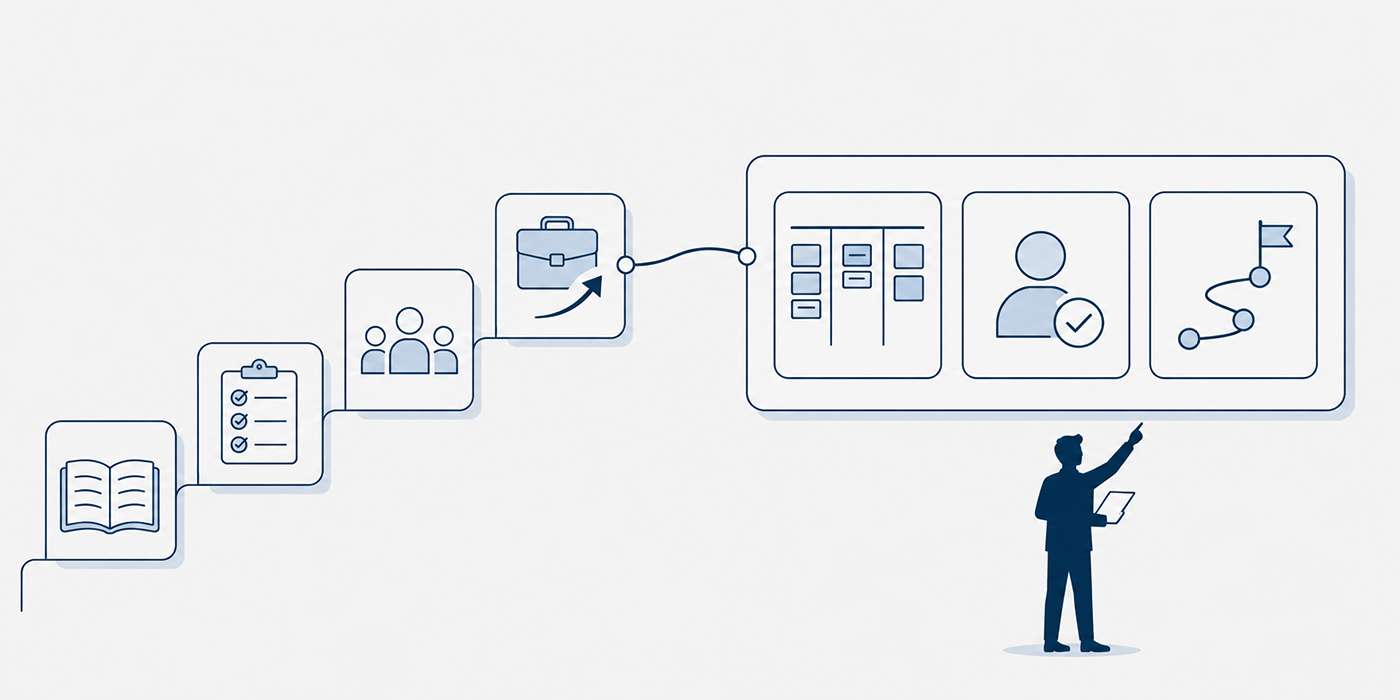
2. The Realistic Entry Roadmap: From Zero PM Title to Hireable Candidate
A weak entry strategy starts with “I want to become a Project Manager” and jumps directly to hundreds of Project Manager applications. A stronger strategy starts with an evidence inventory. Review the last three to five years of your work and identify situations where you coordinated several people, worked toward a fixed deadline, managed a change, solved a delivery problem, controlled requirements, organized vendors, created reports, negotiated priorities, or delivered something temporary with a clear beginning and end. Those examples can later support a business-analyst-to-PM transition, an IT-to-PM career move, a marketing PM career, or a nonprofit project-management pathway.
Next, choose an industry bridge, because employers usually take less risk when one side of your profile is already familiar. A healthcare supervisor may have better odds pursuing healthcare implementations than competing immediately for software-infrastructure PM roles. A developer may move more naturally toward technical delivery, while an event professional can target marketing, conferences, customer implementations, or operational rollouts. This is also why candidates considering environmental project management, Agile project management, cybersecurity project management, or program management should build domain credibility alongside generic PM knowledge.
Your third step is creating two or three proof assets. Build a one-page project charter, stakeholder map, RAID log, milestone schedule, change log, status report, and retrospective for a real project you have participated in. Remove confidential information and turn the project into a portfolio case study. A hiring manager can then see that you understand more than terminology. You can reinforce that portfolio with project-management templates, familiarity with project-management integrations, knowledge of collaboration-software adoption, and practical awareness of how organizations evaluate PM tools.
Then target bridge titles rather than one title. Search for Project Assistant, Project Coordinator, PMO Coordinator, PMO Analyst, Implementation Coordinator, Associate Project Manager, Junior Project Manager, Program Coordinator, Project Administrator, Project Analyst, Project Engineer, Delivery Coordinator, Change Coordinator, Implementation Specialist, and Operations Project Coordinator. A candidate aiming eventually for senior project consulting or project-management executive leadership still benefits from entering through the role where real scope ownership first becomes available.
The final step is converting interviews into evidence conversations. Prepare six stories: a deadline under pressure, a stakeholder disagreement, a scope change, an unexpected risk, competing priorities, and a measurable outcome. For every story, explain the original objective, constraint, decision, communication method, result, and lesson. This interview bank becomes more valuable than memorizing definitions from a certification course because it gives employers concrete evidence that you can function inside project governance, work across Agile delivery environments, and eventually progress toward program management.
3. How to Turn Your Existing Experience Into Project Management Evidence
The phrase “I have no experience” is often damaging because it makes career changers delete the most useful evidence they already possess. Replace the question “Have I ever been called a Project Manager?” with “Have I ever been accountable for moving a defined piece of work from an initial requirement to a completed outcome?” That broader test frequently uncovers relevant experience.
Suppose you worked in customer support and helped redesign an escalation process. Saying “handled escalated customer issues” describes a responsibility. Saying “coordinated support, engineering, and operations to redesign an escalation workflow, defined response ownership, tracked unresolved dependencies, and reduced overdue escalations” communicates project behavior. The second version introduces stakeholder coordination, process change, ownership, and measurable value. That language becomes especially important when moving toward IT project management, project governance roles, Agile project leadership, or senior PM consulting.
The same transformation works for administrative careers. “Scheduled meetings” is weak. “Coordinated a 12-person cross-functional implementation calendar, maintained actions and decision deadlines, escalated overdue dependencies, and prepared weekly executive status summaries” reveals project coordination. “Ordered supplies” can become vendor management when the underlying work actually involved quotes, lead times, delivery risk, approvals, and budget control. Those distinctions matter because PM hiring is ultimately about whether your experience predicts competence in requirements, schedule, risk, stakeholder communication, and change control, the same capabilities that become increasingly important in project-management executive roles and PM-to-COO progression.
Quantification should also become more sophisticated than adding random percentages. Useful project metrics include budget size, number of stakeholders, number of workstreams, delivery duration, number of locations, vendor count, defects resolved, days saved, cycle-time reduction, adoption rate, backlog reduction, revenue protected, costs avoided, and percentage of milestones delivered on schedule. A credible résumé for a candidate pursuing marketing project management, nonprofit PM work, environmental project management, or technical project management shows the scale and consequences of the work.
You should also separate participation from ownership. Attending weekly project calls provides exposure. Maintaining the action log, chasing dependencies, presenting blockers, coordinating approvals, or owning a workstream provides stronger evidence. Being present during a software rollout does not automatically make it your project. Leading user testing for three departments, maintaining defect priorities, coordinating sign-off, and reporting readiness gives you a defensible project story.
PMI's own competency model reinforces this broader view. Its Talent Triangle organizes development around Ways of Working, Power Skills, and Business Acumen, with communication, collaborative leadership, strategic thinking, requirements management, risk management, governance, and industry knowledge among the capabilities that support effective project work. Those are exactly the dimensions you should expose when rewriting experience for an Agile career transition, SAFe-oriented career path, Scrum@Scale progression, or project governance leadership.
4. Which Entry Role Should You Target First?
Your first role should maximize three things: access to real projects, proximity to experienced project professionals, and ownership that can later be quantified. Salary and title matter, but a glamorous title with poor mentorship can leave you less employable a year later than a well-designed coordinator role that exposes you to planning, status reporting, risk, budgets, vendors, and stakeholder management.
Project Coordinator is usually the broadest target. Strong versions of the role involve maintaining schedules, preparing status reports, recording risks and decisions, managing documentation, following up actions, coordinating meetings, supporting change control, and working directly with PMs. That experience creates a foundation for project-manager progression, Agile PM development, program-management advancement, and later senior PM consulting.
PMO Analyst or PMO Coordinator can be even better for people with strong reporting, Excel, finance, governance, administration, or analytical backgrounds. You may gain exposure to portfolio reporting, stage gates, resource planning, governance packs, standards, financial controls, and executive reporting across multiple projects. For someone who ultimately wants project governance leadership, project-management executive responsibility, or a PM-to-COO trajectory, that visibility can be unusually valuable.
Implementation Coordinator or Implementation Specialist is particularly strong for career changers from sales, customer support, SaaS, operations, healthcare, or account management. These jobs often require you to move a customer from contract signature to successful launch, which naturally creates scope, deadline, dependency, configuration, training, stakeholder, and adoption experience. That can later support moves into IT project management, cybersecurity project delivery, project-management integrations, and more complex program management.
Project Analyst suits candidates who are stronger in data, business analysis, reporting, requirements, or process improvement. It can provide a clean bridge from analytical work into ownership, especially when paired with skills from a business-analyst-to-project-manager roadmap, knowledge of project-management tools, strong collaboration-software awareness, and practical project templates.
Assistant Project Manager is common in sectors such as construction, engineering, infrastructure, and property. These roles can provide unusually strong exposure to budgets, schedules, contractors, procurement, change orders, compliance, and commercial constraints. Applicants coming from design, engineering, purchasing, or site operations should often exploit that domain advantage rather than abandoning it to chase generic tech PM vacancies.
A useful filter when evaluating any entry role is to ask: Will I leave this job with stronger evidence? Look for exposure to scope, schedules, requirements, risks, budgets, vendors, executive reporting, stakeholder decisions, and measurable outcomes. Be cautious when a “Project Coordinator” vacancy is primarily calendar management with almost no delivery ownership, and be equally cautious when a “Junior Project Manager” vacancy expects full senior-PM accountability without mentorship.

5. Certifications, Tools, Applications, and a 90-Day Execution Plan
Certification decisions cause career changers to lose months because studying feels productive even when the actual bottleneck is weak experience. The most important distinction is eligibility. PMI currently requires CAPM candidates to have a secondary degree or equivalent plus 23 hours of project-management education. Prior PM work experience is not listed as a CAPM eligibility requirement. That makes CAPM a credible foundational option for genuine beginners, especially when paired with CAPM preparation resources, awareness of common CAPM mistakes, and a deliberate plan for using CAPM for career advancement.
PMP belongs later in the roadmap. PMI's current requirements include professional project-management experience, with the required duration depending on education: for example, three years with a bachelor's degree, four years with certain associate/vocational qualifications, or five years with secondary education, plus required professional training. PMI's 2026 examination documentation also states that qualifying experience must have been accumulated within the preceding ten years. A beginner should therefore avoid treating PMP as a shortcut around experience. When you eventually qualify, resources on PMP exam domains, common PMP exam mistakes, PMP preparation resources, and maintaining PMP certification become much more relevant.
PRINCE2 can be useful where employers explicitly request it, particularly in organizations and markets where the methodology appears frequently in job descriptions. Before paying, sample 30–50 target vacancies and count the certifications employers actually mention. Compare that evidence against PRINCE2 versus PMP, examine the potential PRINCE2 career and salary benefits, understand common PRINCE2 exam pitfalls, and consider the long-term PRINCE2 renewal requirements.
Tools should be learned through workflow, not button memorization. Know how to convert requirements into work, assign ownership, model dependencies, establish milestones, track changes, surface risks, record decisions, communicate status, and close work. Whether a company uses Jira, Asana, Monday.com, ClickUp, Smartsheet, Microsoft Project, Trello, Basecamp, or another platform matters less than whether you understand why the workflow exists. Reviewing how companies choose PM tools, Trello versus Basecamp, project-management APIs and integrations, and remote collaboration adoption helps you think beyond software interfaces.
A realistic 90-day roadmap can look like this:
Days 1–15: Build the target. Choose one or two adjacent industries. Collect 40 relevant vacancies. Record repeated titles, tools, methodologies, domain terms, certification requests, and experience requirements. Compare the patterns with suitable paths such as marketing project management, IT project management, nonprofit project management, or environmental project management.
Days 16–30: Rebuild your evidence. Identify five previous projects or project-like initiatives. Rewrite each using objective, scope, stakeholders, constraints, actions, and quantified results. Build at least one charter, RAID log, schedule, status report, and retrospective using practical PM templates and resources.
Days 31–45: Close the knowledge gaps. Learn scope, schedule, risk, stakeholder management, change control, requirements, Agile versus predictive delivery, project economics, and status reporting. Candidates targeting Agile environments can study an Agile career transition, an Agile-team-member-to-PM pathway, and the SAFe Agilist career route.
Days 46–60: Get one piece of fresh evidence. Volunteer for a bounded initiative, own a workstream at your current employer, coordinate a small nonprofit project, help implement a system, manage an event rollout, or lead a measurable process improvement. The goal is a recent example with stakeholders, deadlines, decisions, and results.
Days 61–75: Build the interview bank. Prepare STAR-style stories for scope change, stakeholder conflict, delivery risk, missed deadlines, ambiguity, prioritization, and lessons learned. Create a 60-second career-transition explanation that connects your previous domain to your target PM role.
Days 76–90: Run a measured application campaign. Apply to closely matched roles, track response rates by title, revise weak positioning every 20–30 applications, contact recruiters, approach PMs in your industry, and ask your existing organization about internal project work. A 1% interview rate signals a résumé or targeting problem. Strong interviews followed by repeated rejection indicate a proof, domain, or interview-communication problem. Treat the search itself like a project.
That final point is critical. Sending 300 applications with the same positioning can create activity without learning. Track applications → recruiter screens → hiring-manager interviews → final rounds → offers. Diagnose the stage where conversion collapses and repair that stage. Project managers are paid to identify constraints, so your own transition should demonstrate the same discipline.
6. FAQs: Becoming a Project Manager With No Experience
-
It can happen, especially through an internal promotion, a small organization, a domain where you already have strong expertise, or a role where your previous responsibilities closely resemble project delivery. Reddit contains examples of people moving from QA, content, healthcare supervision, development, operations, and other backgrounds into PM positions.
Your probability generally improves when you broaden the search to Project Coordinator, Associate PM, PMO Analyst, Implementation Coordinator, and Project Analyst positions. Use your existing domain through an IT-to-PM pathway, business-analyst transition, marketing PM roadmap, or nonprofit PM pathway whenever that reduces the employer's perceived risk.
-
CAPM can be useful when target employers recognize PMI credentials and you need structured foundational knowledge. PMI's current eligibility criteria require a secondary degree or equivalent and 23 hours of PM education rather than previous PM employment.
Its value increases when certification supports evidence rather than replacing it. Combine the credential with CAPM exam resources, awareness of CAPM exam mistakes, a plan to leverage CAPM professionally, and two or three credible project case studies.
-
Apply when you can satisfy most of the actual work requirements and can demonstrate comparable project ownership from another title. Experience requirements are particularly worth testing when the role is coordinator-level, associate-level, or highly adjacent to your current industry.
Avoid treating every experience requirement as meaningless. A role involving seven-figure budgets, major regulatory exposure, complex procurement, or executive-level transformation genuinely may require maturity that a simulated project cannot provide. Build toward those roles through project governance experience, program management, senior PM consulting, and progressively larger delivery ownership.
-
The highest-leverage route is often inside your current organization because your employer already knows your reliability and domain knowledge. Ask to coordinate a rollout, process improvement, vendor implementation, event, migration, onboarding change, compliance initiative, reporting redesign, or cross-functional workstream.
Document the work using a charter, stakeholder map, schedule, RAID log, decision log, change register, status report, and closing retrospective. Practical project-management templates, familiarity with collaboration platforms, understanding of PM integrations, and knowledge of Agile delivery progression can make that experience easier to translate later.
-
The required technical depth depends heavily on the industry. An IT PM benefits from understanding software delivery, infrastructure, security, APIs, environments, dependencies, and change management. A construction PM needs stronger knowledge of drawings, contracts, procurement, scheduling, site sequencing, and commercial controls. A marketing PM needs campaign, creative, channel, approval, and production knowledge.
You do not need to become the team's deepest specialist. You need enough domain literacy to ask intelligent questions, understand risk, challenge assumptions, and communicate trade-offs. That is why studying cybersecurity and project management, the future of cybersecurity PM, project-management integrations, or emerging areas such as AR and VR in project management can strengthen domain-specific positioning.
-
Keep your official job titles accurate and make the bullets expose the project work underneath them. Lead with outcomes, project scope, stakeholder complexity, deadlines, ownership, risks, and measurable impact. Use terms such as coordinated, delivered, implemented, planned, tracked, resolved, facilitated, controlled, launched, improved, reported, negotiated, and standardized only when they accurately describe what you did.
Your résumé should make the career transition feel like a continuation of increasing responsibility. Someone moving through business analysis into PM, IT into project management, Agile delivery into PM, or eventually toward project-management leadership should be able to show a visible progression from supporting work → coordinating work → owning work → leading outcomes.
