
Comprehensive Report: How Companies Choose Project Management Tools (2026)
Companies choosing project management software in 2026 are evaluating an operating system for delivery rather than buying a digital task board. The strongest buyers connect tool selection to project governance, portfolio visibility, resource allocation, team communication, and measurable business outcomes. This report explains how companies identify requirements, score vendors, test integrations, model ownership costs, assess AI and security risks, negotiate contracts, and prevent adoption failure after the software has been purchased.
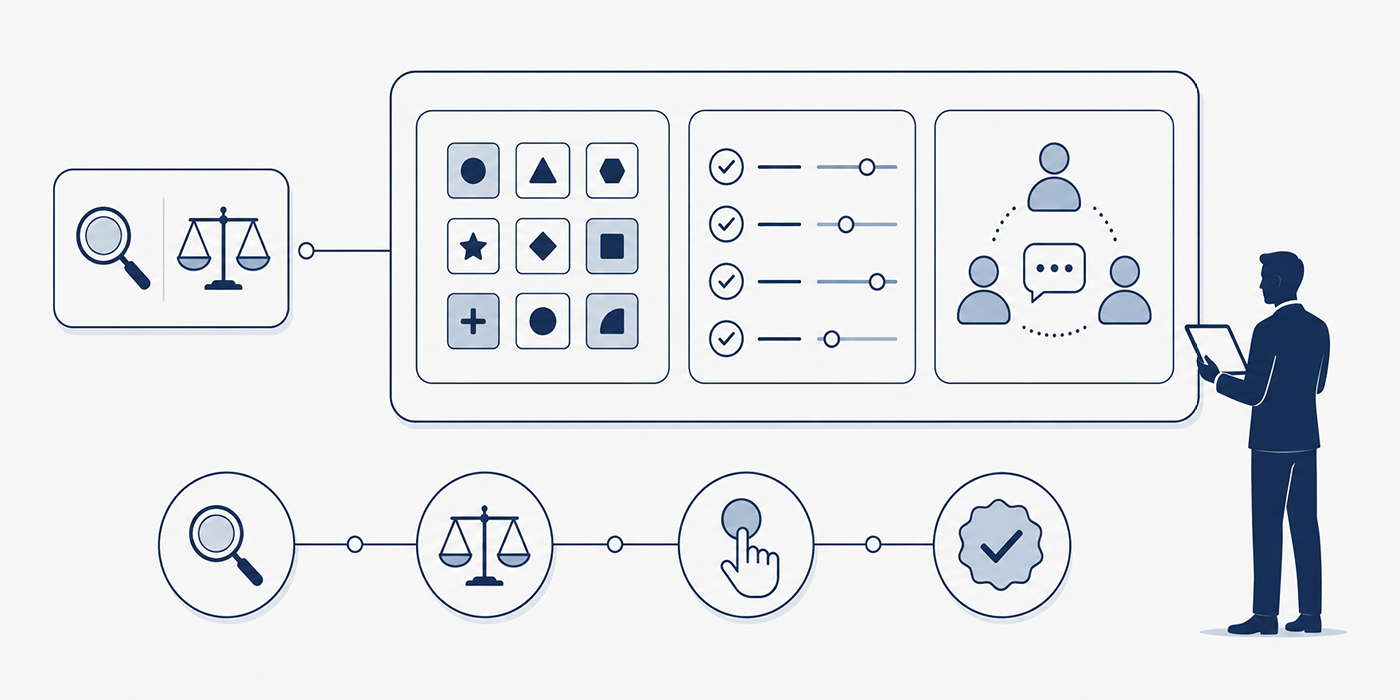
1. What the 2026 Project Management Software Market Reveals
The project management software decision has become more expensive, more strategic, and more difficult to reverse. Gartner forecasts worldwide software spending of approximately $1.43 trillion in 2026, representing 14.7% year-over-year growth. Organizations are therefore increasing technology investment while demanding stronger evidence that each application can consolidate work, improve decisions, and reduce operational friction.
That pressure is accelerating project management software investment, digital PMO transformation, cloud-based software adoption, and demand for dependable project management APIs. Buyers still face a painful contradiction: budgets are growing, but many organizations continue purchasing platforms that employees resist, integrations cannot support, and executives cannot use for reliable reporting.
Capterra’s 2026 Software Buying Trends research, based on 3,385 software decision-makers across 11 countries, found that only 34% qualified as successful adopters. The remaining 66% encountered unexpected disruption, purchase regret, or both. Among buyers who regretted a purchase, 89% first experienced an implementation disruption. Integration failures, data-migration complications, delays, and configuration problems were among the most common sources of damage.
These figures reveal why a company cannot evaluate software only through feature comparisons, polished vendor demonstrations, software rankings, or downloadable project management templates. A purchase can appear technically correct and still fail because the organization selected the wrong implementation model, underestimated workflow redesign, migrated unreliable data, or expected employees to abandon familiar spreadsheets without receiving a better daily experience.
AI Has Become a Buying Trigger, but Buyers Are Demanding Proof
Capterra’s project-management-specific research surveyed 2,545 respondents and found that 55% of buyers were seeking AI capabilities to improve productivity. Security has simultaneously become a decisive filter: 71% rated security as critical, while 39% said security concerns triggered their latest PM software purchase.
The strongest companies therefore examine whether AI improves a real project monitoring process, strengthens project estimation, identifies patterns within a risk register, or automates dependable project reporting. “Includes AI” has little purchasing value unless the vendor can explain the data used, permissions applied, outputs generated, human review required, usage charges incurred, and protections preventing confidential project information from entering unsafe models.
PMI reports that only 1% of organizations consider themselves mature in generative AI, even as it highlights projections that AI could run 80% of project-management tasks by 2030. That maturity gap makes governance, training, data quality, and human validation central purchasing criteria.
Companies Are Moving From Feature Shopping to Risk-Adjusted Selection
A typical buying committee may include the PMO, IT, information security, procurement, finance, operations, legal, department leaders, project managers, administrators, and representative end users. Each group measures value differently. The PMO wants standardization and portfolio reporting. Project managers want faster updates and credible schedule control. Finance wants budget visibility and earned value data. IT wants manageable integrations, access controls, and protection against the cybersecurity risks surrounding PM software.
Employees place greater value on usability because they absorb the daily administrative burden. A platform can satisfy executive requirements while increasing frontline work through duplicate data entry, excessive fields, slow navigation, irrelevant notifications, or cumbersome time reporting. When users obtain less value than management receives, they create shadow systems. The official platform becomes a reporting destination, while actual delivery continues through spreadsheets, chat, email, whiteboards, and private task lists.
Successful adoption begins earlier in the purchase cycle. Capterra found that 62% of successful adopters defined budgets and must-have features early, compared with 48% of disappointed buyers. More than half of successful adopters also created detailed implementation plans covering areas such as integration and training.
That pattern supports a more disciplined sequence:
Business problem → measurable outcome → workflow requirements → data requirements → security gates → integration design → user testing → commercial evaluation → implementation plan → vendor decision
Starting with product names reverses this logic. It encourages internal sponsors to defend preferred tools before the company has documented what the software must accomplish.
| Selection Factor | What “Good” Looks Like | Evidence Buyers Should Demand | Failure Signal | Primary Decision Owner |
|---|---|---|---|---|
| Business alignment | Capabilities are tied to delivery outcomes, governance needs, and strategic priorities. | Approved problem statement, outcome baseline, executive sponsor, and benefit targets. | The business case is primarily a list of attractive features. | Executive sponsor and PMO |
| Workflow fit | The system supports how work should move from intake through execution and closure. | Configured demonstration using the company’s actual project scenario. | The vendor demonstrates only a generic sample workspace. | Process owners |
| Portfolio visibility | Leaders can compare initiatives, dependencies, benefits, risk, capacity, and status. | Live portfolio dashboard built from project-level pilot data. | Executives need manual slides to understand the portfolio. | PMO and portfolio board |
| Resource capacity | Demand, availability, skills, assignments, and overallocations are visible. | Capacity test using real roles, calendars, leave, and shared resources. | Resource views exist but depend on inaccurate manual updates. | PMO and department heads |
| Schedule control | Dependencies, baselines, milestones, calendars, critical paths, and variances remain usable. | Import, update, baseline, recovery, and reporting test. | The scheduling engine cannot represent the company’s real complexity. | Project controls |
| Financial control | Budgets, actuals, forecasts, commitments, rates, and value measures reconcile correctly. | End-to-end test using finance-system data and sample cost changes. | Financial reports require repeated spreadsheet repair. | Finance and project controls |
| Risk management | Risks have causes, impacts, owners, responses, triggers, dates, and escalation rules. | Risk workflow showing alerts, aggregation, reporting, and closure. | The module functions as an isolated list without governance. | Risk owner and PMO |
| Stakeholder access | Internal and external stakeholders receive appropriate views and controlled permissions. | Role-based access test across executives, contributors, clients, and vendors. | External collaboration requires unsafe workarounds or duplicate systems. | PMO, legal, and security |
| Collaboration | Decisions, conversations, files, approvals, and actions remain connected to work. | Pilot covering comments, mentions, notifications, decisions, and handovers. | Discussion happens elsewhere and loses its project context. | Team leads and end users |
| Reporting quality | Reports explain status, variance, forecast, cause, exposure, ownership, and action. | Generate executive and operational reports from the same pilot data. | Dashboards look impressive but cannot answer management questions. | PMO and executives |
| API coverage | Documented APIs support required objects, events, authentication, limits, and error handling. | Technical proof of concept for the highest-risk integration. | The vendor describes integrations broadly without exposing limitations. | Enterprise architecture |
| Native integrations | Critical systems exchange accurate information without fragile custom maintenance. | Field-level integration map and bidirectional synchronization test. | A marketplace logo is treated as proof of complete integration. | IT and system owners |
| Security controls | Encryption, access control, logging, vulnerability management, and incident response meet policy. | Security questionnaire, independent assurance reports, and remediation evidence. | The vendor relies on broad claims such as “enterprise-grade security.” | Information security |
| Compliance | Relevant regulatory, contractual, retention, residency, and audit requirements are supported. | Control mapping, certifications, data locations, and contract commitments. | Compliance badges cannot be mapped to the intended use case. | Legal, risk, and compliance |
| AI usefulness | AI reduces verified effort or improves decision quality within controlled workflows. | Use-case test measuring time saved, accuracy, review effort, and error rates. | The buying case depends on AI-generated summaries with no measurable benefit. | PMO, IT, and end users |
| AI governance | Data usage, model providers, retention, permissions, human review, and opt-outs are clear. | AI data-flow diagram, contractual terms, administrator controls, and audit logs. | The vendor cannot explain where prompts and outputs are processed. | Security, legal, and AI governance |
| Configurability | Workflows can be adapted without creating an unmaintainable custom system. | Administrator builds a representative workflow during the pilot. | Every process change requires paid vendor development. | Platform owner |
| Usability | Users can complete frequent tasks quickly with limited support. | Observed usability testing with new and experienced users. | Evaluation relies on the impressions of trained administrators. | End users and UX reviewers |
| Method flexibility | Teams can use Kanban, Scrum, predictive, hybrid, or stage-gate controls where appropriate. | Multiple project types configured within common governance rules. | One methodology is forced across incompatible work. | PMO and delivery leaders |
| Hybrid delivery | Agile execution and predictive governance can coexist without duplicate reporting. | Hybrid pilot connecting backlogs, milestones, budgets, risks, and approvals. | Teams manually translate agile work into executive project reports. | PMO and product leadership |
| Scalability | Performance, permissions, reporting, administration, and costs remain manageable as use expands. | Growth model covering users, projects, records, entities, and geographies. | The pilot works only because it contains limited data and users. | IT and finance |
| Training burden | Different roles receive focused instruction based on the work they perform. | Training plan, estimated hours, learning assets, and proficiency tests. | The implementation plan contains one generic vendor webinar. | Change lead and HR |
| Administration | Internal administrators can govern templates, users, workflows, integrations, and data quality. | Administrator workload model and operating procedures. | The platform requires continuous emergency support from consultants. | PMO platform owner |
| Auditability | Important changes, approvals, decisions, and access events can be reconstructed. | Audit-log demonstration using a realistic control failure. | Records can be altered without traceable history. | Audit, compliance, and PMO |
| Total cost | Licensing, implementation, integrations, migration, support, training, and administration are modeled. | Three-year total-cost-of-ownership calculation with growth assumptions. | The decision compares only advertised per-user prices. | Finance and procurement |
| Vendor support | Support channels, response targets, escalation, expertise, and premium costs are explicit. | Service-level commitments and reference-customer evidence. | Sales responsiveness is mistaken for post-sale support quality. | Procurement and platform owner |
| Commercial terms | Pricing, renewals, usage limits, overages, reductions, and termination rights are understood. | Negotiated order form, price schedule, and scenario analysis. | Discount urgency prevents review of long-term obligations. | Procurement and legal |
| Implementation risk | Migration, integration, adoption, configuration, and schedule risks have owners and responses. | Implementation risk register and readiness assessment. | The vendor labels implementation “simple” without examining the environment. | Implementation sponsor |
| Data portability | Projects, files, metadata, history, and relationships can be exported in usable formats. | Test export and documented offboarding procedure. | The company can export reports but cannot reconstruct its records elsewhere. | Legal, IT, and records management |
| Outcome measurement | Adoption, cycle time, reporting effort, forecast quality, and delivery performance are measured. | Baseline metrics, target values, data owners, and review dates. | Success is defined as licences activated or training completed. | Executive sponsor and PMO |
2. How Companies Turn Requirements Into a Defensible Shortlist
Strong buyers begin with a requirements architecture rather than an unranked wish list. They distinguish business outcomes, mandatory controls, workflow capabilities, technical requirements, commercial constraints, and user-experience needs. This prevents an attractive Scrum platform, visual Kanban application, advanced waterfall scheduling system, or broad agile project management tool from winning because it performs brilliantly in one area while failing the operating model as a whole.
Start With the Decision the Tool Must Improve
“Improve collaboration” is too vague to evaluate. A useful outcome identifies a process, baseline, target, population, and deadline. Examples include:
Reduce weekly status-report preparation from four hours to one.
Increase the percentage of active projects with approved baselines from 45% to 90%.
Cut project-intake decision time from twenty working days to eight.
Identify cross-project resource conflicts four weeks earlier.
Reduce duplicate project data entry across finance, HR, CRM, and delivery systems.
Give executives a consistent view of forecast completion, budget exposure, and major risks.
Those targets can be traced to project reporting practices, resource-management requirements, project financial controls, and portfolio-management priorities. Without a baseline, buyers can demonstrate that software was deployed, but they cannot prove that the investment solved anything.
Separate Mandatory Gates From Scored Preferences
Certain requirements should function as pass-or-fail gates. A tool that cannot meet a required residency rule, authentication standard, audit requirement, critical integration, data-export obligation, or regulatory control should leave the competition before weighted scoring begins.
Everything else can be weighted. A practical 100-point model might assign:
20 points to workflow and methodology fit
15 points to usability and adoption
15 points to integration and data architecture
15 points to security, compliance, and governance
10 points to reporting and analytics
10 points to portfolio and resource management
10 points to total cost of ownership
5 points to vendor capability and roadmap
The weight should change with the buyer. A regulated organization may increase security and auditability. A professional-services company may prioritize utilization, time capture, rates, and billing. A construction company may need construction project management software, document control, field access, schedule coordination, and vendor-management capability. An educational institution may emphasize accessibility, approval workflows, stakeholder access, and education-focused project tools.
Keep the Serious Shortlist Small
Capterra’s 2026 buying research indicates that successful adopters usually focus on three vendors and reach a decision within approximately three months. A longer search can feel more rigorous while generating comparison fatigue, inconsistent demonstrations, shifting requirements, and political lobbying.
A good longlist may contain eight to twelve credible options. Desktop research and mandatory gates should reduce that group to three serious finalists. Buyers can use tool directories, Kanban software comparisons, Scrum platform reviews, and focused comparisons such as Trello versus Basecamp to discover candidates. The company’s own requirements must determine which candidates advance.
Control the Demonstration
Vendor-led demonstrations tend to emphasize polished functionality, carefully prepared data, and workflows that flatter the platform. A defensible evaluation uses a buyer-controlled demonstration script sent to every finalist.
Each vendor should receive the same scenario:
Accept a proposed project through an intake workflow.
Score and approve the project.
Create a schedule or backlog from the approved request.
Assign shared resources and expose overallocations.
Record a budget, forecast, risk, issue, and change.
Route an approval through the correct authority.
Update progress using different user roles.
Produce an executive portfolio report.
Exchange information with one critical external system.
Export the complete project record.
This script tests project initiation, risk-response workflows, change and requirements control, and project closure as one connected lifecycle. Buyers can see whether the platform supports management continuity or merely provides disconnected feature modules.
Score Evidence, Rather Than Promises
Use separate scores for:
Capability demonstrated live
Capability available through configuration
Capability requiring integration
Capability dependent on customization
Capability shown only on the roadmap
Capability unavailable
Roadmap promises should receive little or no current-value credit. Customization should incur a cost and maintainability penalty. An integration should receive full credit only after its scope, direction, latency, data ownership, permissions, error handling, and commercial terms are understood.
The same scrutiny applies to project management APIs, AI-enabled workflow automation, machine-learning estimates, and blockchain-based project records. Product terminology can imply greater maturity than the tested capability delivers.
3. What Different Buyers Prioritize by Size, Industry, and Operating Model
Company size affects the selection process, but operational complexity matters more than employee count. A 70-person engineering consultancy managing regulated capital projects may require stricter controls than a 2,000-person company using software for internal marketing work. Buyers should classify their environment by project diversity, regulatory exposure, contractual complexity, data sensitivity, external collaboration, financial control, geographic reach, and integration dependence.
Startups and Small Teams: Speed, Simplicity, and Low Administration
Small teams frequently prefer rapid setup, intuitive boards, flexible fields, automation, templates, mobile access, and predictable pricing. The greatest danger is buying an oversized system that requires more administration than the organization can sustain.
A small buyer should test whether a platform provides enough Kanban control, backlog management, team communication, and agile estimation without turning every task into a governance exercise. The winning product should reduce coordination work during the first month, rather than promising enterprise sophistication the company may never use.
Pricing must still be modeled beyond the entry tier. Automation limits, guest access, storage, dashboards, permissions, time tracking, integrations, AI consumption, and administrative features may sit behind higher plans. A cheap first year can become an expensive migration when the team grows beyond the plan’s functional ceiling.
Mid-Market Companies: Standardization Without Suffocation
Mid-market organizations often have several departments running different processes, naming conventions, spreadsheets, and reporting cycles. They need a common data model and governance layer while preserving enough flexibility for marketing, IT, operations, product, HR, finance, and client-delivery teams.
These buyers frequently compare the benefits of a unified workforce-management platform, specialized agile tools, structured waterfall software, and integrated communication platforms. Their core question concerns the minimum standardization required to create reliable enterprise visibility without forcing every department into one unnatural workflow.
The PMO must define a controlled core: project identifiers, sponsors, owners, lifecycle stages, status definitions, health rules, strategic alignment, major milestones, budget fields, risk thresholds, and reporting dates. Teams can then configure their execution layer inside those boundaries.
Enterprises: Governance, Architecture, Security, and Scale
Large companies place more weight on identity management, granular permissions, data residency, audit logs, sandbox environments, administrator roles, API limits, integration architecture, vendor viability, support escalation, and contractual remedies. Procurement can take longer because a tool may affect thousands of users and dozens of systems.
Enterprise evaluations therefore connect PMO governance, project portfolio management, digital transformation, and software cybersecurity. A platform that works well for one department may create enterprise-level fragmentation when each division configures fields, workflows, and reports independently.
Cloud architecture also matters. Gartner projected public-cloud end-user spending of $723.4 billion in 2025 and expected 90% of organizations to adopt hybrid-cloud approaches through 2027. Buyers operating across cloud, on-premises, and regulated environments must examine data synchronization, integration reliability, availability, and identity architecture.
Regulated Buyers: Control Evidence Before Convenience
Healthcare, financial services, government, defense, critical infrastructure, and regulated construction buyers may reject an otherwise excellent tool because it cannot support a legal, contractual, security, accessibility, record-retention, or audit requirement.
These organizations need traceable approval governance, defensible project records, controlled vendor relationships, and clearly defined ISO-related requirements. AI capabilities deserve additional scrutiny because project records may contain personal information, confidential designs, commercial negotiations, security-sensitive infrastructure data, or regulated documentation.
Construction, Professional Services, Education, and Events Need Different Proof
A construction buyer may prioritize drawings, RFIs, submittals, site documentation, contractor collaboration, change control, cost commitments, and schedule integration. Relevant construction software reviews, RFP terminology, supplier-management controls, and construction-management trends help define the use case.
Professional-services companies care about pipeline-to-project conversion, utilization, skills, rates, time, expenses, margin, billing, and revenue forecasting. Educational institutions may prioritize grants, academic calendars, committees, accessibility, approvals, and cross-department projects through education project tools. Event teams need run-of-show planning, suppliers, budgets, deadlines, venues, and rapid collaboration through event project management platforms.
The product category may be the same. The evidence required to approve the purchase should be materially different.
The most expensive selection mistake usually appears after signing, when weak requirements become configuration problems and untested assumptions become operational disruption.
4. Why Good-Looking Tool Purchases Fail During Implementation
Selection teams often treat contract signature as the finish line. It marks the transfer of risk from the vendor’s sales process into the buyer’s operating environment. The platform must now absorb imperfect data, inconsistent processes, competing departmental expectations, integration constraints, limited training time, and employees who already have ways to complete their work.
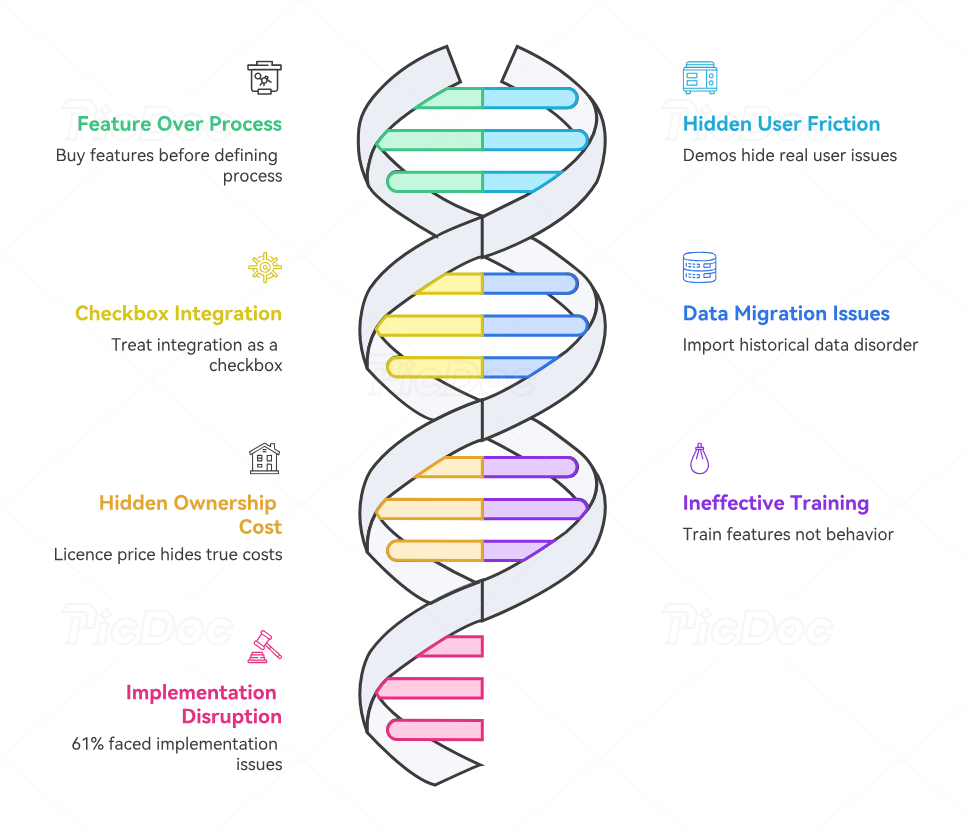
Capterra’s 2026 findings are particularly important here: 61% of buyers experienced implementation disruption during the preceding 18 months, and nearly nine in ten regretful buyers first experienced an unexpected disruption.
Failure 1: The Company Buys Features Before Defining Process
A tool cannot resolve disagreement about intake, prioritization, approval authority, status definitions, risk escalation, or ownership. Configuration merely turns unresolved disagreement into fields, workflows, and permissions.
Companies should define project execution stages, monitoring controls, stakeholder responsibilities, and governance decisions before asking a vendor to configure them. A software consultant can facilitate process design. The company remains accountable for deciding how it wants to operate.
Failure 2: The Demonstration Hides User Friction
A trained salesperson can complete an unfamiliar workflow smoothly because the environment has been rehearsed. Real users encounter bulk updates, missing data, interruptions, exceptions, mobile constraints, repeated approvals, and high project volumes.
Observed testing should cover frequent and painful tasks:
Creating and assigning work
Updating several tasks quickly
Moving between projects
Finding current priorities
Recording time or costs
Escalating risks and issues
Approving requests
Producing status reports
Locating decisions and attachments
Completing work on mobile devices
Usability must be evaluated alongside agile workflow design, sprint-planning practices, team communication, and project reporting. A platform that saves executives ten minutes each month while adding ten minutes to every employee’s day will struggle to retain accurate data.
Failure 3: Integration Is Treated as a Checkbox
“Integrates with Microsoft, Google, Salesforce, Slack, Jira, SAP, or QuickBooks” does not reveal which products, objects, fields, plans, directions, or events are supported.
Every critical integration needs a specification:
System of record
Data objects and fields
Synchronization direction
Frequency or triggering event
Identity-matching rules
Validation requirements
Failure handling
Retry logic
Monitoring ownership
API limits
Security permissions
Historical-data treatment
Support responsibility
Additional licensing cost
This rigor turns API planning, cloud integration, software risk management, and digital PMO transformation into testable architecture. Without it, teams discover after purchase that a “native integration” transfers only basic records or requires an expensive third-party connector.
Failure 4: Data Migration Imports Historical Disorder
Companies frequently underestimate migration because exporting rows appears simple. Real migration must resolve duplicate users, obsolete projects, inconsistent status labels, unsupported custom fields, broken ownership, missing dates, inaccessible files, and conflicting financial records.
The buyer should decide which data to migrate, archive, cleanse, transform, validate, and discard. Active projects may require complete operational migration. Closed projects may need searchable archival access. Financial and regulated records may require reconciliation and retention evidence.
Migration should be governed like project closure, quality management, risk-register control, and requirements traceability. The organization should establish record counts, control totals, exception thresholds, owner sign-off, and rollback procedures before the production cutover.
Failure 5: The Licence Price Hides the Ownership Cost
Three-year cost should include:
Subscription fees + premium modules + AI usage + implementation + configuration + migration + integrations + training + support + internal administration + change management + renewal increases + exit costs
A platform priced at $15 per user may require higher tiers for permissions, portfolio views, time tracking, workload planning, audit logs, SSO, sandboxes, API capacity, or advanced reporting. External collaborators may require paid seats. AI features may carry separate credits or consumption charges. Growth can move the company into a different commercial tier.
A defensible model uses project financial terminology, earned value principles, vendor-management controls, and RFP evaluation methods. Procurement should model low, expected, and high-growth scenarios before comparing offers.
Failure 6: Training Explains Features Without Changing Behavior
Users need role-based instruction built around real work. Executives need portfolio review and decision workflows. Project managers need planning, baselining, reporting, risk, and change control. Contributors need priorities, updates, collaboration, and notifications. Administrators need governance, permissions, configuration, audit, integration, and data-quality procedures.
Training must also explain which previous systems will stop, which records belong where, how compliance will be measured, and where users can obtain help. Otherwise, the new platform becomes another layer in the stack.
Adoption metrics should include active use of required workflows, data completeness, reduction in duplicate systems, reporting time, support demand, update timeliness, and process cycle time. Login rates alone cannot prove successful PMO transformation, workforce adoption, communication improvement, or project-control maturity.
5. A 2026 Procurement Blueprint for Selecting and Rolling Out the Right Tool
Companies can complete a rigorous selection within approximately twelve weeks when decision rights, requirements, and evaluation stages are controlled. Complexity may extend security, procurement, or integration work, but endless searching rarely compensates for weak preparation.
Weeks 1–2: Diagnose the Operating Problem
Interview executives, PMO leaders, project managers, functional managers, contributors, finance, IT, security, and external collaborators. Map how projects enter the organization, receive approval, obtain resources, report progress, manage change, and close.
Collect evidence such as spreadsheet inventories, duplicate-entry points, delayed approvals, reporting hours, missed handovers, inconsistent data, and unresolved integration failures. Connect the diagnosis to project monitoring, stakeholder engagement, resource allocation, and project financial management.
Deliverables should include:
Problem statement
Current-state workflow
Baseline performance measures
Target outcomes
Stakeholder map
Decision authority
Initial risk register
Weeks 3–4: Define Requirements and Market Options
Separate mandatory gates from scored requirements. Set weights before evaluating products. Define three to five end-to-end demonstration scenarios. Document security, integration, migration, reporting, AI, administration, support, and exit requirements.
Create a longlist using agile software reviews, Scrum platform rankings, Kanban directories, waterfall tool comparisons, and industry-specific sources. Eliminate candidates that fail mandatory controls before allowing product enthusiasm to form.
Deliverables should include:
Requirements register
Evaluation weights
Mandatory-gate checklist
Demonstration script
Longlist and exclusion rationale
Preliminary ownership-cost model
Weeks 5–6: Run Controlled Demonstrations
Provide the same script, data, user roles, and time constraints to every vendor. Require vendors to identify which capabilities are standard, configured, integrated, customized, partner-provided, or planned.
Evaluators should score independently before discussing results. This reduces the influence of seniority, vendor charisma, group conformity, and departmental politics. Record unanswered questions and request written clarification.
The demonstration should produce evidence across project execution, schedule management, risk response, project reporting, and portfolio governance. Screenshots and sales statements should never substitute for live completion of the required scenario.
Weeks 7–8: Pilot the Finalists
A strong pilot uses representative data, users, workflows, and integrations. It tests the hardest use case, rather than the easiest department. Each finalist should support a complete project lifecycle or a sufficiently demanding slice of it.
Measure:
Time required to complete key tasks
User error and confusion
Administrator effort
Integration reliability
Reporting quality
Data completeness
Notification burden
Mobile usability
AI output accuracy and review effort
Support responsiveness
User willingness to continue
Use agile metrics, quality-management principles, project risk controls, and monitoring terminology to evaluate the pilot. Satisfaction matters, but observed performance carries greater weight.
Weeks 9–10: Complete Due Diligence and Commercial Evaluation
Security should review architecture, authentication, encryption, logging, vulnerability management, incident response, subcontractors, backups, data residency, disaster recovery, and AI processing. Legal should review data rights, confidentiality, compliance, intellectual property, liability, termination, and export rights.
Procurement should negotiate:
Price protection
Renewal caps
User-growth bands
Licence-reduction rights
Implementation deliverables
Acceptance criteria
Support levels
Availability commitments
Data-breach obligations
AI usage terms
Data-return procedures
Transition assistance
Termination rights
These controls turn vendor management, software cybersecurity, RFP governance, and risk mitigation into enforceable commercial protection.
References should come from customers with similar scale, industry, workflow complexity, and integration requirements. Ask reference customers what required more time than expected, which promised capabilities disappointed them, how support behaved during failure, how pricing changed, and which workarounds remain.
Weeks 11–12: Approve the Decision and Mobilize Implementation
The recommendation should show:
Business outcomes
Evaluation method
Mandatory-gate results
Weighted scores
Pilot findings
Security and legal findings
Three-year ownership cost
Implementation plan
Adoption plan
Risk register
Benefits-measurement plan
Rejected alternatives
Remaining assumptions
Implementation planning should begin before contract signature. Capterra found that 54% of successful adopters created detailed implementation plans, reinforcing the value of treating deployment readiness as a purchasing criterion.
The rollout can then follow controlled waves. Start with a representative group whose processes are important enough to reveal weaknesses but manageable enough to support rapid correction. Stabilize templates, permissions, integrations, training, support, and reporting before expanding.
A final tool-selection decision should answer one hard question:
Can this organization operate more clearly, quickly, securely, and measurably through this platform after accounting for the effort required to adopt and govern it?
That standard connects future PMO responsibilities, software automation, project governance, and portfolio strategy to operational proof
6. Frequently Asked Questions About Choosing Project Management Tools
-
Three serious finalists are usually sufficient after a broader longlist has passed through mandatory requirements. Capterra’s 2026 research indicates that successful adopters tend to focus on three vendors and make a decision within roughly three months.
The longlist can be developed through agile tool reviews, Kanban software rankings, Scrum platform comparisons, and waterfall software assessments. A larger finalist group increases demonstration work and comparison noise without necessarily improving the decision.
-
The answer depends on the operating model, but high-value criteria commonly include workflow fit, usability, integration, security, reporting, resource management, automation, financial visibility, access control, and data portability. AI matters where it improves a measured process under appropriate governance.
Companies should translate generic features into testable workflows involving resource allocation, risk registers, schedule management, and project reporting. A long feature list provides limited protection when the platform cannot support the company’s actual decisions.
-
AI deserves weight when it can reduce verified administrative effort, improve forecast quality, identify risks, support planning, retrieve project knowledge, or automate controlled workflows. Capterra reports that 55% of PM software buyers sought AI capabilities, while PMI highlights both the expected growth of AI-managed project tasks and the low percentage of organizations claiming GenAI maturity.
Buyers should test AI against project estimation, risk analysis, project reporting, and AI-enabled PM trends. Measure accuracy, time saved, review effort, data exposure, and incremental cost.
-
A unified platform can reduce integration, licensing, administration, and reporting fragmentation. Specialized tools may provide stronger functionality for scheduling, software delivery, construction, resource management, financial control, or creative collaboration.
The best architecture may combine a governed portfolio layer with specialized execution systems connected through reliable project management APIs. Companies should compare a consolidated workforce-management platform, focused construction software, specialized Scrum tools, and broader portfolio-management requirements. The architectural cost of fragmentation should be evaluated beside the functional cost of compromise.
-
Begin with measurable baselines such as reporting hours, approval cycle time, duplicate entry, project delays, forecast errors, integration failures, unused licences, tool consolidation opportunities, and administrative effort.
Calculate benefits from:
Labor hours avoided
Retired software and support costs
Faster project decisions
Earlier risk detection
Improved capacity utilization
Reduced rework
Better billing or cost recovery
Lower audit and compliance effort
Improved forecast reliability
Compare those benefits with complete ownership cost using project financial terms, earned value concepts, resource-allocation data, and project performance reporting. Use conservative assumptions and separate verified savings from speculative benefits.
-
Buyers should examine authentication, SSO, multifactor authentication, encryption, data residency, backups, logging, administrator access, vulnerability remediation, incident response, disaster recovery, subcontractors, retention, deletion, export, and regulatory controls.
AI adds questions about model providers, training use, prompt retention, output ownership, tenant isolation, human review, administrator controls, and opt-out mechanisms. These checks should align with cybersecurity risks in PM software, ISO-related controls, AI project-management adoption, and vendor-management governance.
