
A project-management certification can improve credibility, vocabulary, and recruiter discoverability, while interview conversion still depends heavily on evidence that you have handled real delivery problems. That distinction matters for candidates comparing CAPM career leverage, studying PMP exam domains, or making an IT-to-project-management transition. Reddit hiring discussions repeatedly expose the same painful gap: candidates collect credentials, optimize résumés, and still struggle because employers cannot see enough proof of scope control, stakeholder judgment, risk ownership, or measurable delivery.
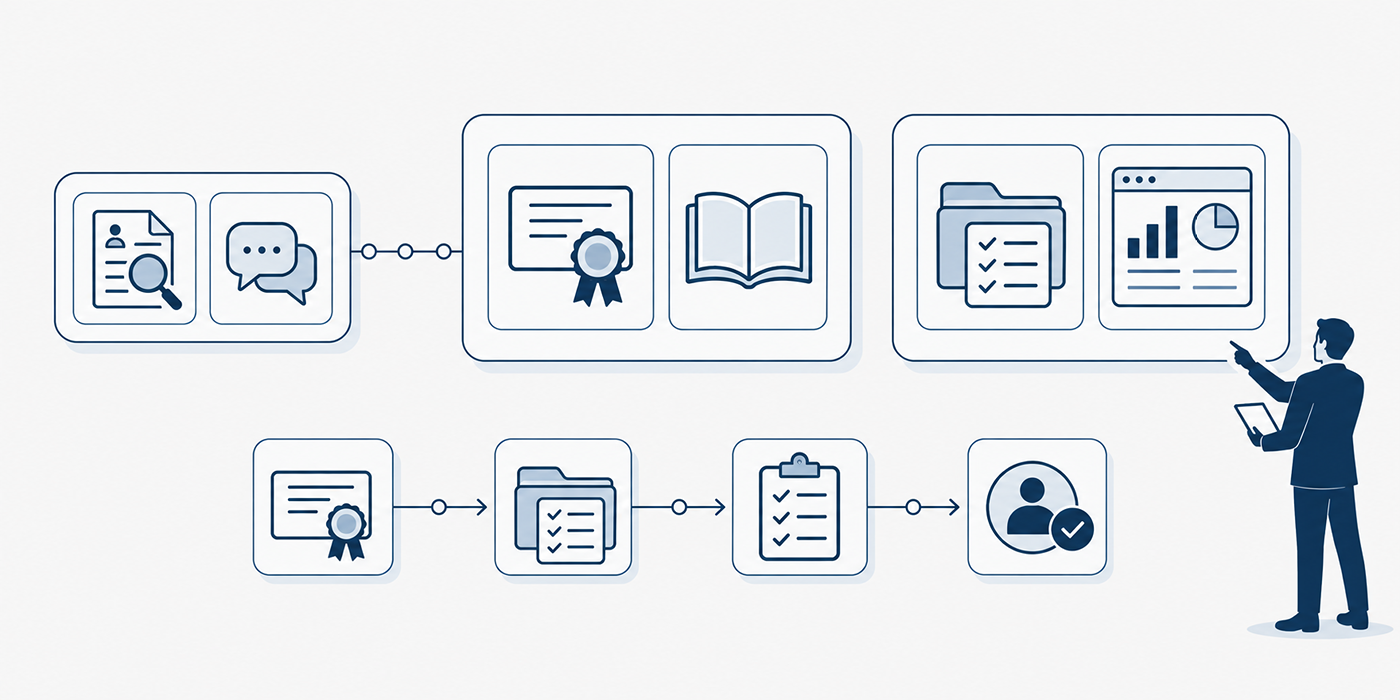
1. Project Management Certification vs Experience: Understand What Each Hiring Signal Actually Proves
The certification-versus-experience debate becomes much clearer when you separate knowledge signals from execution signals.
A certification can show that you understand project terminology, frameworks, planning concepts, governance mechanisms, and structured decision-making. Candidates studying PMP preparation resources, avoiding common PMP exam mistakes, developing CAPM exam knowledge, or learning from PMP success stories are building genuine professional foundations.
Experience answers a different set of hiring questions:
What happened when requirements changed after work had started?
How did you recover a slipping schedule?
Which stakeholder had competing priorities?
What trade-off did you recommend?
Which risk did you escalate?
What documentation did you create?
How did you know the project succeeded?
What would have happened without your intervention?
These are judgment questions. They sit closer to the capabilities required in project governance leadership, senior PM consulting, program management, and eventually project-management executive roles.
There is also an important distinction between CAPM and PMP.
PMI currently allows CAPM applicants to qualify with a secondary degree and at least 23 hours of project-management education, without a professional project-management experience requirement. The exam covers fundamentals, predictive methods, Agile, and business analysis. That makes CAPM particularly relevant for candidates building entry-level PM credibility while developing stronger Agile project-management skills.
PMP operates at a very different level. Under PMI's 2026 eligibility structure, candidates generally need between two and five years of professional project-management experience, depending on educational background. PMI describes qualifying work as taking responsibility for planning, decisions, delivery, and outcomes in a professional setting.
That creates an important hiring nuance. A PMP already implies that an applicant reported qualifying project experience. Employers still need evidence showing the depth, recency, industry relevance, complexity, and results of that experience.
A July 2026 Reddit discussion illustrates the problem. One candidate reported earning PMP after more than 15 years in healthcare operations and business management, yet struggled to secure interviews for corporate PM, program, and operations roles. Responses pointed toward intense competition, candidates with direct corporate PM backgrounds, and the declining ability of a credential alone to differentiate applicants in a crowded market.
Another 2026 discussion involved someone considering CAPM while struggling to secure project-coordinator interviews. Experienced commenters repeatedly emphasized reframing existing work into credible project evidence and targeting industries where the candidate already possessed useful domain knowledge.
That advice matters whether you are moving through a business-analyst-to-PM pathway, transitioning from traditional PM into Agile, developing toward SAFe Agilist roles, or considering Scrum@Scale expertise.
The practical hiring model looks like this:
Certification helps employers believe you understand project management. Experience helps them believe you can survive project management. Portfolio evidence helps them verify the second claim quickly.
2. Reddit Hiring Reality: Why Certifications Frequently Fail to Turn Into Interviews
Reddit's PM communities contain a recurring pain point: people often solve a knowledge problem when their application actually has an evidence problem.
A candidate earns CAPM, completes another course, learns Jira, adds Agile terminology, and expects the résumé to become materially stronger. The hiring manager still sees weak evidence of delivery responsibility. Someone who has already explored CAPM career advancement, studied CAPM preparation tools, avoided CAPM exam mistakes, and learned Agile PM fundamentals may therefore gain little from certificate number four.
A March 2026 Reddit discussion captured that mismatch. The original poster had worked across retail, banking, law, and entertainment, had some coordination exposure, and was considering CAPM after struggling to secure coordinator roles. Commenters emphasized fierce competition from experienced PMs and repeatedly recommended extracting project evidence from existing work rather than expecting additional education to carry the application.
An April 2026 project-coordinator thread showed a similar frustration. A graduate with operations experience and a PM internship had applied to hundreds of roles and was still asking which certification might unlock the market. One highly rated response focused on the difficult hiring environment and the mistaken expectation that completing a course naturally produces a six-figure PM opportunity.
This is where candidates need to distinguish screening signals from selection signals.
A credential such as PMP, CAPM, PRINCE2, or an Agile qualification can help with:
keyword matching,
stated job requirements,
recruiter confidence,
professional vocabulary,
career-change credibility,
structured learning,
internal promotion eligibility.
The final hiring decision usually becomes much richer. Employers begin examining whether you can control work using the same practical disciplines found in project-management templates, use collaboration tools effectively, understand how organizations select PM platforms, and integrate workflows through PM APIs and integrations.
Another 2026 Reddit thread summarized what interviewers often remember: candidates who can explain a failed project, stakeholder conflict, pressure, changing priorities, and recovery decisions create stronger interview memories than candidates who mainly discuss certifications.
That insight should change how you prepare.
Imagine Candidate A says:
“I am PMP certified and experienced with risk management.”
Candidate B explains that a supplier delay threatened a launch, identifies the deadline exposure, describes creating a recovery schedule, explains which features were deferred after stakeholder negotiation, and quantifies the final schedule variance.
Candidate B has supplied observable judgment.
The same principle appears when moving toward marketing project management, environmental project management, nonprofit project leadership, or technical roles involving cybersecurity and project management. Domain context changes. The employer's need for evidence remains.
Candidates should therefore ask a tougher question after every certification:
Which hiring uncertainty does this credential remove, and which hiring uncertainty remains?
For a career changer, CAPM may remove uncertainty about foundational knowledge. A portfolio should then attack uncertainty around execution.
For an experienced PM, PMP may strengthen professional validation. Strong case studies should then communicate project size, stakeholder complexity, budgets, constraints, recovery situations, governance maturity, and measurable outcomes.
For someone targeting program-management careers, evidence must rise above single-project coordination and show dependency management, strategic alignment, benefits, governance, and cross-project trade-offs. For someone targeting the longer PM-to-COO pathway, the evidence must eventually demonstrate operational economics and enterprise decision-making.
3. Build a PM Portfolio That Proves Judgment Instead of Showing Pretty Templates
A project-management portfolio becomes valuable when the reviewer can reconstruct what you were responsible for, what became difficult, which decision you made, and what changed because of it.
A folder containing polished Gantt charts, RAID logs, and Jira screenshots can easily become portfolio theatre. Anyone studying PM templates and resources, evaluating project-management tools, learning collaboration software, or experimenting with PM integrations can manufacture clean artifacts.
The stronger portfolio explains why each artifact existed.
Build three to five case studies. Each should contain seven layers:
1. Business context. Explain the reason the project existed. “Website redesign” is weak. “Checkout abandonment had risen to 71%, and the business needed a redesigned mobile purchase flow before Q4 acquisition campaigns” gives the work economic context.
2. Your ownership boundary. State what you personally controlled. This becomes especially important for candidates moving from business analysis into PM, IT into PM, or Agile team membership into project leadership.
3. Constraint. Every memorable PM story contains friction. Budget ceiling. Missing resource. Vendor dependency. Regulatory deadline. Technical uncertainty. Executive disagreement. Scope conflict. A candidate preparing for senior consulting roles needs particularly strong evidence of navigating constraints rather than merely administering activity.
4. Decision. Describe a choice you influenced. Maybe you re-sequenced work, rejected a change, escalated a risk, split a release, changed meeting cadence, renegotiated a dependency, or recommended stopping low-value work.
5. Artifact. Attach one sanitized proof asset: decision log, schedule snapshot, risk register, requirements map, steering summary, backlog, vendor tracker, change request, dashboard, or closure report. Candidates working toward project governance leadership should emphasize artifacts showing decision rights and accountability.
6. Outcome. Quantify what changed. Schedule variance reduced from six weeks to two. Defect escape rate fell 31%. Approval cycle fell from nine business days to four. Project closed 4.8% under budget. Migration completed with 99.7% record accuracy.
7. Reflection. Explain what you would change next time. Mature project managers understand second-order consequences. That ability becomes increasingly important in executive project-management careers, program management, and eventually COO-level operating roles.
Privacy matters. Replace client names with descriptions such as “regional healthcare provider.” Remove employee names. Normalize commercially sensitive numbers where necessary. Rebuild confidential dashboards using representative values while clearly labelling them as sanitized recreations.
The goal is verifiability without disclosure.
Candidates with limited formal PM history can still build legitimate evidence. Volunteer delivery, internal improvement initiatives, system migrations, events, onboarding redesigns, process automation, compliance projects, product launches, nonprofit work, and cross-functional campaigns can produce useful cases when the candidate genuinely owned part of the outcome.
A 2025 Reddit discussion even included someone who obtained a PM role through an internal promotion after years as a department coordinator and strong cross-department relationships. That pathway deserves more attention than endlessly collecting credentials. Internal projects often provide safer opportunities to own timelines, stakeholders, requirements, and outcomes.
Someone developing toward marketing PM work could coordinate a campaign launch. Someone pursuing environmental PM roles could manage a sustainability initiative. An IT professional using the IT-to-PM career route could lead a migration, rollout, upgrade, or vendor implementation.
Those projects generate the raw material interviewers need.
4. Turn Existing Experience Into Resume Evidence Recruiters Can Actually Screen
Many candidates already possess useful experience and describe it in a way that hides its value.
Consider:
Weak: “Responsible for coordinating stakeholders and project meetings.”
This tells a recruiter what activity occurred.
A stronger version would be:
“Coordinated requirements and weekly decisions across six business and technical stakeholders during a 14-week CRM migration, maintaining the decision log and resolving approval bottlenecks that threatened the launch milestone.”
Now the recruiter can see scale, duration, cross-functional work, artifact ownership, risk, and outcome.
This approach matters for candidates pursuing an IT-to-PM transition, moving from business analyst to project manager, shifting from traditional to Agile PM, or building toward Agile project-management leadership.
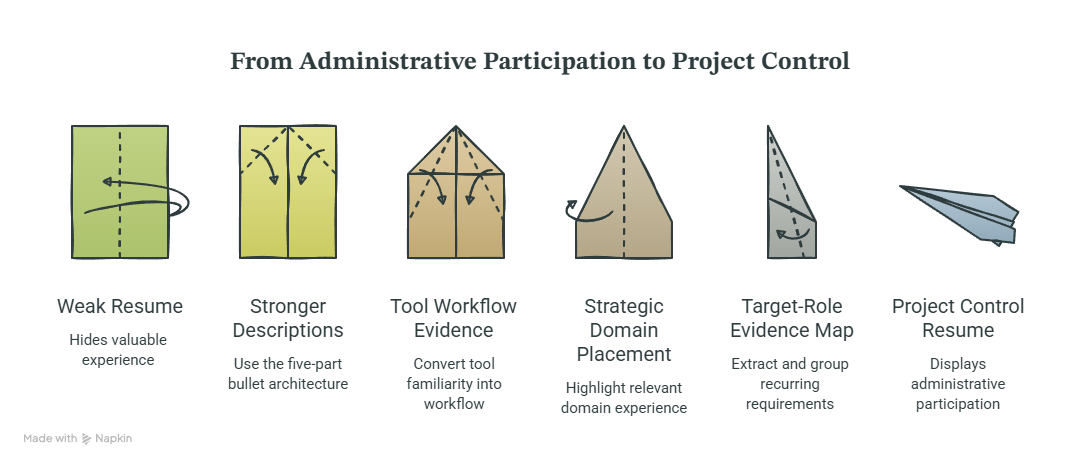
Use a five-part bullet architecture:
Project context + scale + ownership + problem/decision + measurable effect.
For example:
Weak: “Managed project schedules.”
Stronger: “Owned the integrated schedule for a 22-person implementation across product, engineering and operations, identified a vendor dependency threatening the critical path, and re-sequenced testing to recover eight working days.”
Weak: “Worked with vendors.”
Stronger: “Managed two external suppliers against delivery milestones, maintained issue and SLA trackers, and escalated a recurring integration delay that reduced forecast slippage from four weeks to nine days.”
This is the difference between displaying administrative participation and displaying project control.
Tool lists deserve the same scrutiny. A résumé filled with Jira, Trello, Asana, Monday.com, Smartsheet, MS Project, Slack, and Teams rarely proves much by itself. Hiring teams care more about what you accomplished with those tools. Candidates evaluating Trello versus Basecamp, researching how companies choose PM software, learning remote collaboration adoption, or exploring project-management integrations should convert tool familiarity into workflow evidence.
For example:
“Configured Jira” is shallow.
“Redesigned Jira workflow states and blocked-work reporting so product owners could distinguish approval delays from engineering delays, reducing unresolved blocked tickets by 38% over two releases” gives the tool a business purpose.
Domain experience also deserves strategic placement. A healthcare operator applying to healthcare PM roles may possess valuable workflow, compliance, vendor, patient-service, and regulatory knowledge even without years under the exact “Project Manager” title. A technical professional studying cybersecurity-project-management trends or the future cybersecurity responsibilities of PMs can use that knowledge to compete for implementation and transformation projects where a generic PM may require months to understand the domain.
Your résumé therefore needs a target-role evidence map.
Take ten relevant job descriptions. Extract recurring requirements. Group them into capabilities such as stakeholder management, budgeting, risk, Agile delivery, vendor management, governance, requirements, compliance, change control, and executive reporting.
Then mark each capability:
Strong proof
Some proof
Knowledge only
Missing
This produces a rational development plan. Someone whose missing area is Agile delivery can build through Agile PM progression or a SAFe career pathway. Someone whose weak area is governance can study the project-governance career path and deliberately seek steering, escalation, and decision-control responsibilities.
That is considerably more efficient than collecting credentials without knowing which hiring objection they are supposed to solve.
5. Certification, Experience, Portfolio, and Domain Knowledge: Build the Right Combination for Your Career Stage
The strongest combination changes with career stage.
Career changer with almost zero project evidence
Your first objective is controlled exposure to real projects. CAPM can strengthen foundational knowledge because its eligibility structure is accessible to candidates without prior PM employment. Pair it with internal initiatives, volunteer projects, coordinator work, implementation support, and project-adjacent responsibilities.
Use CAPM career leverage, CAPM exam resources, CAPM mistake avoidance, and relevant project-management templates to build competence while collecting genuine artifacts.
Professional with transferable project-adjacent experience
This candidate often has the highest hidden-value opportunity.
Operations managers, analysts, marketers, engineers, event coordinators, teachers, implementation specialists, administrators, and team leads frequently have examples involving schedules, vendors, requirements, launches, process changes, stakeholders, or cross-functional delivery.
Instead of starting from zero, translate the work. The BA-to-PM roadmap, IT-to-PM pathway, marketing PM roadmap, and nonprofit PM pathway show how sector knowledge can become a bridge rather than career baggage.
Experienced project practitioner considering PMP
Here, certification can become a strong formal signal. PMI's current PMP rules require substantial professional project-management experience, with the exact requirement depending on education.
Preparation through PMP exam domains, PMP study resources, common PMP mistakes, and real PMP success experiences can strengthen the credentialing side.
The portfolio should then show why your experience deserves the title.
Mid-career PM targeting senior roles
At this stage, employers expect evidence beyond task coordination.
Show:
portfolio prioritization,
difficult stakeholder trade-offs,
commercial decisions,
governance design,
program dependencies,
executive reporting,
troubled-project recovery,
benefits realization,
resource conflict,
operating-model improvement.
That evidence aligns far better with senior PM consulting, project-governance leadership, program-management careers, and project-management executive progression.
The long-term lesson is simple: build a stack of proof.
Credential → project evidence → domain credibility → quantified results → interview stories → references.
Each component removes a different hiring risk.
The candidate who understands that architecture stops asking, “Which certification gets me hired?” and starts asking, “Which unresolved hiring risk is preventing someone from trusting me with this project?”
That is the question capable of changing the entire job search.
6. FAQs: Project Management Certification, Experience, Portfolios, and Hiring
-
A certification can improve your chances of passing certain screening stages and can demonstrate deliberate career preparation. CAPM is especially accessible because PMI currently requires a secondary degree plus 23 hours of project-management education rather than prior professional PM experience.
Your strongest strategy is to combine that foundation with evidence from internal initiatives, volunteer projects, coordinator responsibilities, implementations, or process improvements. Use CAPM career advancement strategies, PM templates, collaboration tools, and an Agile PM pathway to turn learning into observable delivery evidence.
-
PMP becomes most powerful when it validates substantial experience and the candidate can explain that experience convincingly. PMI itself requires qualifying professional project work for PMP eligibility, so the credential and experience are structurally connected.
For interviews, prepare evidence alongside your PMP exam knowledge, PMP preparation resources, PMP success strategies, and eventually PMP renewal planning.
-
Start with three strong cases rather than twenty superficial artifacts.
A useful first portfolio could include:
one project that finished successfully,
one project that encountered a serious problem,
one project involving difficult stakeholders.
For each, include context, objective, your role, constraints, one or two sanitized artifacts, the major decision, result, and lesson. PM resource templates, project software research, collaboration practices, and project-management integrations can help you build professional artifacts around real work.
-
Focus on responsibilities and outcomes.
Someone following an IT-to-project-management pathway, business-analyst transition, marketing PM pathway, or Agile PM career transition may already have controlled requirements, dependencies, stakeholders, vendors, deadlines, change, or risk.
Describe that work accurately. Quantify its scale. Preserve your true job title. Let the evidence establish project-management relevance.
-
Yes, especially when formal experience is thin. A concise portfolio can supply evidence your job title cannot.
Project-coordinator applicants frequently compete with people who already have project exposure. Reddit discussions from 2026 show candidates reporting hundreds of applications even with operations experience, internships, certificates, or newly acquired PM credentials.
A portfolio built around PM templates, remote-team collaboration, Agile progression, and your own project evidence can give recruiters something concrete to evaluate.
-
Include certifications that strengthen the target role and keep the section subordinate to evidence of delivery.
A candidate with five credentials and vague experience can still create uncertainty. A candidate who pairs relevant certification with strong outcomes, PMP-level project knowledge, Agile project-management capability, governance understanding, and sector-specific experience gives employers several independent reasons to trust the application.
