
Is Project Management Still Worth It in 2026? Reddit Job-Market Reality, Layoffs & Where PM Demand Is Holding Up
Project management remains a high-value career in 2026, although the opportunity has shifted sharply toward professionals who combine delivery skills with industry knowledge, commercial judgment, technology fluency, and measurable execution. The strongest opportunities increasingly sit beyond generic coordination work, especially in infrastructure, healthcare, manufacturing, cybersecurity, transformation, and complex implementations. Professionals considering a transition into project management, business analyst-to-PM move, agile project management career, or eventual program management career therefore need a much more precise strategy than “get certified and apply.”
1. Is Project Management Still Worth It in 2026? The Short Answer
Yes, for candidates who build toward the parts of project management businesses genuinely struggle to replace.
The U.S. Bureau of Labor Statistics now projects employment for project management specialists to grow 7% between 2025 and 2035, compared with 3% across all occupations, with approximately 76,500 openings per year. Median annual pay reached $102,320 in May 2025, while finance and insurance posted a $120,700 median for PM specialists. Those figures support continued career viability even while individual job searches can feel brutal.
The global picture is larger. PMI estimates that the project profession already includes roughly 40 million people and that organizations could require as many as 65 million project professionals by 2035, producing a potential talent gap approaching 30 million people. South Asia, China, Sub-Saharan Africa, and the Middle East/North Africa are projected to experience especially rapid demand growth.
Those long-term numbers coexist with a difficult 2026 hiring environment. That distinction matters enormously.
A company can need more project capability over the next decade while simultaneously freezing recruitment this quarter, eliminating layers of management, asking one senior PM to oversee three workstreams, or giving project coordination duties to operational teams. Candidates building a project governance career, aiming for project management executive roles, developing toward a senior PM consulting career, or planning a longer-term PM-to-COO transition should therefore read cyclical hiring weakness separately from structural demand.
The August 2026 U.S. employment report illustrates the tension. Payrolls grew by 162,000 and unemployment remained at 4.1%, yet the previous 12 months had averaged only 31,000 additional payroll jobs per month. July JOLTS data showed 7.3 million openings, alongside a relatively subdued 5.1 million hires. Professional and business services hiring fell by 188,000 during July. The result is a labor market where vacancies exist while actual employer movement remains cautious.
For PM candidates, “worth it” therefore depends heavily on career positioning. Someone offering meeting scheduling, status updates, task chasing, and dashboard maintenance faces much greater pressure from automation and organizational consolidation. Someone who can govern a multimillion-dollar implementation, negotiate scope, understand procurement, challenge risk assumptions, manage vendors, interpret business impact, and guide executives through trade-offs occupies a substantially stronger position.
That distinction should shape everything from project management certification strategy and PMP preparation to PM tool selection and your understanding of collaboration-software adoption.
2. What Reddit Is Really Saying About the 2026 PM Job Market
Reddit's 2026 project-management conversations deserve attention because they reveal hiring friction that occupational forecasts cannot show. They also require disciplined interpretation. A subreddit naturally attracts people struggling with layoffs, applications, certification decisions, workload, and career transitions, so individual posts cannot establish nationwide employment rates. They can reveal recurring pain points.
One April 2026 r/PMP discussion came from a professional with five years of experience who reported 100-plus applications and only two interviews after earning the PMP. Commenters described the certification as an advantage inside a competitive field rather than an automatic interview generator. A May thread similarly found PMs reporting that PMP often appears under “preferred” qualifications and can effectively become a screening threshold when applicant quality is high.
That distinction should influence how candidates approach PMP exam preparation, avoid common PMP exam mistakes, understand the PMP exam domains, and eventually handle PMP renewal and PDUs. Certification can improve your signal. Employers still need evidence that you can deliver.
A more alarming May 2026 PMCareers thread came from a PMP-certified professional with eight-plus years of experience who described the U.S. PM market as extremely difficult and warned about hundreds of applicants competing for corporate roles. The same discussion identified construction and healthcare as comparatively resilient areas. Another March discussion involved a laid-off healthcare-tech implementation manager struggling to secure responses despite tailoring applications.
These stories explain why a candidate with respectable experience can feel as though project management has collapsed while broader occupational data still points upward. Job supply can remain healthy in aggregate while being badly mismatched by location, seniority, industry, project type, salary expectation, and work arrangement.
Remote work intensifies that mismatch. A fully remote PM vacancy can attract candidates across an enormous geography. A hybrid construction, hospital implementation, manufacturing, or infrastructure position may have a substantially narrower viable pool because candidates need local presence, industry knowledge, travel tolerance, regulatory exposure, or technical familiarity.
This is where specialization changes the mathematics. An IT professional pursuing a transition into project management brings technical credibility. A business analyst can turn requirements and stakeholder experience into a BA-to-PM career transition. An agile practitioner can build toward SAFe Agilist career progression or a Scrum@Scale practitioner pathway while retaining their original domain advantage.
Reddit's 2026 salary discussions also show the other side of the market. The annual r/projectmanagement salary thread includes reported examples such as a U.S. construction senior PM at $250,000 base, an energy/utilities senior PM at $172,000, a systems-integration senior PM at $145,000, and technology, healthcare IT, construction, and program-management professionals reporting six-figure compensation. These are self-reported anecdotes rather than salary benchmarks, yet they demonstrate that strong PM careers continue to exist inside the same market producing job-search horror stories.
The useful Reddit lesson is therefore segmentation. “Project management” contains radically different labor markets. A SaaS PM seeking a $150,000 fully remote role, a healthcare implementation manager, a construction senior PM, an energy capital-project manager, and a government program manager compete under different economics.
Candidates who recognize that difference can make better decisions about project management career specialization, marketing project management, nonprofit project management, and eventual program management.
3. Why PM Layoffs Are Happening and Which Roles Are Most Exposed
The 2026 layoff story is particularly harsh in technology. Challenger, Gray & Christmas recorded 155,126 announced technology-sector cuts through August 2026, 52% above the same period in 2025. Technology accounted for 29% of all announced cuts. Across industries, AI was cited in 116,175 announced cuts, roughly 22% of the year-to-date total. At the same time, overall U.S. announced job cuts through August were 41% lower than during the first eight months of 2025, while announced hiring plans were up 37%.
Those numbers reveal restructuring rather than universal employment destruction.
The most exposed PM work tends to contain a large percentage of activities that organizations can compress: meeting administration, minutes, reminders, simple schedule maintenance, repetitive reporting, ticket chasing, basic documentation, and information routing. Modern collaboration platforms and AI systems can accelerate much of that work. PMs therefore gain resilience by moving toward tasks requiring accountability, contextual judgment, negotiation, escalation, commercial decisions, risk ownership, and cross-functional authority.
That trend makes knowledge of project management APIs and integrations, modern project management templates and resources, evidence on collaboration software adoption, and intelligent project-management tool selection strategically important. The objective is greater delivery leverage per PM.
AI also raises the premium on project judgment. PMI's 2026 guidance explicitly argues that employers increasingly value proven execution, durable capabilities, and judgment as rapidly changing tools make narrower technical skills expire faster.
Consider a status report. AI can summarize meeting transcripts and produce a first draft quickly. A strong PM still decides whether a supplier's two-week delay threatens the critical path, whether a regulatory dependency needs executive escalation, whether contingency funding should be released, whether a milestone should be rebaselined, and which stakeholder owns the recovery plan.
The same pattern applies to cybersecurity project management, preparing for future cybersecurity-PM convergence, managing emerging AR and VR projects, and leading complex event project-management systems. Technology increases the value of people who can govern technology-driven change successfully.
Choose one durable sector and build proof around its workflows, risks, terminology, tools and commercial realities. A PM who understands the industry is considerably harder to replace than a general coordinator.
Reduce dependence on mass applications. Narrow your target roles, quantify delivery outcomes, pursue referrals, search adjacent job titles and include hybrid or local positions where applicant competition may be substantially lower.
Use AI to accelerate reporting, documentation and routine coordination, then strengthen the human capabilities employers still need: judgment, negotiation, governance, commercial decisions, escalation and stakeholder leadership.
Pick an economically durable lane such as healthcare, cybersecurity, infrastructure, energy, manufacturing or enterprise implementation. Learn its risks, regulations, workflows and decision language while pursuing adjacent project exposure.
Analyze 30–50 roles you genuinely want and record recurring requirements. Pursue another certification when it repeatedly closes a real qualification gap rather than simply adding another badge to your resume.
Compare compensation alongside sector stability, specialization, advancement potential and work arrangement. A carefully chosen lateral move can provide the domain experience that produces stronger bargaining power later.
The best 2026 career move starts with identifying the constraint actually weakening your market position.
4. Where Project Management Demand Is Holding Up in 2026
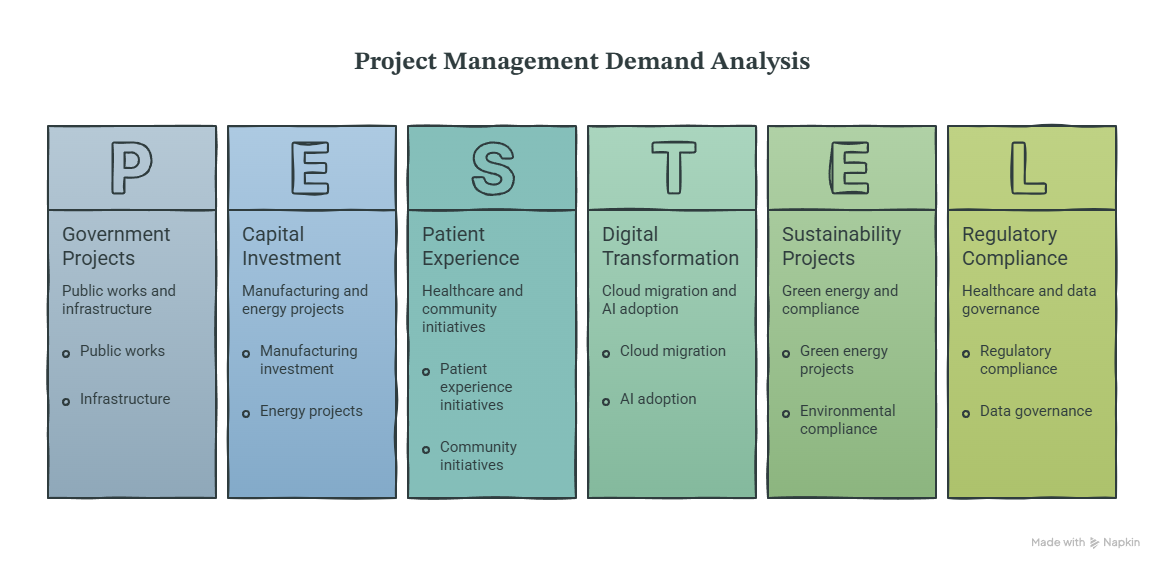
Construction, infrastructure and capital projects
Construction remains one of the clearest long-term PM demand stories. PMI estimates that construction alone could require nearly 2.5 million additional project professionals by 2035, representing approximately 60% growth from 2025 levels.
The opportunity varies by geography and construction segment, so candidates should study local pipelines rather than treating the entire industry as uniformly strong. Yet infrastructure, utilities, data centers, transport, public works, industrial construction, energy projects, and major capital programs create work requiring schedules, contracts, procurement, cost control, safety, permitting, vendors, and physical delivery.
A PM who understands these mechanisms possesses a stronger moat than someone whose entire toolkit consists of Jira and weekly stand-ups. Professionals entering capital-intensive sectors should therefore strengthen project governance capability, senior PM consulting skills, program-management capability, and a longer-term route toward project management executive leadership.
Healthcare and regulated transformation
Healthcare generates projects through EHR modernization, cybersecurity, interoperability, clinical systems, facilities, payer transformation, regulatory compliance, mergers, data programs, patient-experience initiatives, and operational redesign.
The strongest candidates can speak the industry's language. A PM entering healthcare should understand where clinical, technical, regulatory, financial, and operational stakeholders collide. This principle applies equally to environmental project management, nonprofit project management, cybersecurity project delivery, and roles built around future cybersecurity transformation. Specialized context increases trust.
Manufacturing, industrial modernization and supply-chain projects
PMI's global talent analysis identifies manufacturing among the sectors facing significant future project-professional demand. Manufacturing investment creates projects around plant expansion, automation, ERP deployment, robotics, quality systems, product launches, warehouse modernization, procurement, resilience, and supply-chain redesign.
Candidates coming from engineering, operations, quality, logistics, procurement, or business analysis can often create a credible PM transition faster by staying close to their original expertise. The same logic behind an IT-to-project-management transition and business-analyst-to-PM progression applies here: preserve the domain advantage while adding delivery responsibility.
Cybersecurity, data, cloud and enterprise implementations
Technology hiring carries substantial layoff risk in 2026, yet technology projects themselves continue becoming more complex. BLS specifically identifies the growing volume and complexity of IT projects as a contributor to future PM-specialist demand.
Security remediation, cloud migration, ERP implementation, data governance, AI adoption, identity management, infrastructure modernization, and system integration require people who can coordinate business owners, engineers, security teams, vendors, legal teams, finance, and executives.
This creates a valuable distinction between generic technology PM work and deeply contextual technology delivery. Learning project-management integrations and APIs, understanding cybersecurity trends affecting PMs, selecting project-management platforms intelligently, and understanding actual remote collaboration adoption creates far more value than memorizing software menus.
High-growth international markets
PMI projects some of the fastest project-professional demand growth through 2035 in South Asia at 68%-91%, China at 81%-109%, Sub-Saharan Africa at 56%-75%, Asia-Pacific at 38%-50%, and the Middle East/North Africa at 32%-42%. Europe and North America show lower percentage growth, while their absolute talent gaps remain significant.
That makes geographic strategy relevant for internationally mobile professionals. A candidate can compare certification and market considerations in Bangladesh, Nigeria, Kenya, South Africa, Germany, Ireland, New Zealand, and the Netherlands rather than assuming one country's hiring environment represents the profession globally.
5. How to Make Yourself Hireable in a Tough PM Market
The strongest 2026 strategy begins with proof density. Every major line on your resume should answer at least one commercial question: How much money did you manage? How many people or vendors were involved? What deadline did you protect? What risk did you reduce? What revenue did the implementation unlock? What adoption level did you achieve? What cost did you prevent? What operational metric improved?
“Managed multiple cross-functional projects” offers weak evidence.
“Delivered a $4.2 million ERP rollout across seven business units, recovered a six-week schedule variance, reduced open critical defects by 43%, and achieved 96% user migration before cutover” gives a hiring manager something concrete to evaluate.
Candidates building toward project management executive roles, governance leadership, senior consulting positions, or a future COO pathway should begin writing their experience in this outcome-oriented language immediately.
Second, search by business problem and project type, alongside the Project Manager title. Relevant titles can include implementation manager, delivery manager, transformation manager, project controls specialist, PMO analyst, technical program manager, capital projects manager, change manager, deployment manager, operations program manager, project engineer, implementation consultant, and portfolio analyst.
This approach is especially powerful for people making a career transition from traditional PM to agile, progressing from an agile team into project management, pursuing a SAFe Agilist path, or adding Scrum@Scale capability.
Third, treat certification as a market filter. Collect 30-50 genuinely attractive job descriptions. Record every repeated requirement. If PMP appears in 70% of them, the business case for pursuing it becomes clearer. If the roles consistently emphasize construction experience, healthcare systems, cybersecurity, ERP, change management, SQL, procurement, or specific compliance frameworks, another general PM certificate may produce less leverage than domain learning.
Anyone choosing between credentials should understand the practical differences behind PMP and PRINCE2, assess PRINCE2 career benefits, avoid common PRINCE2 exam pitfalls, and consider how CAPM can support early career progression.
PMI's 2025 salary survey also found PMP holders reporting 17% higher median salaries than non-certified professionals across 21 countries. That is an association across surveyed professionals rather than a guaranteed personal salary increase, yet it reinforces the credential's continuing market relevance.
Fourth, build a small evidence portfolio. Confidential company material should stay private. You can still create sanitized examples showing how you think: a sample RAID log, project charter, steering dashboard, dependency map, change-control workflow, project recovery plan, vendor scorecard, benefits tracker, implementation plan, or executive status pack.
Using strong project-management templates, understanding PM APIs and integrations, evaluating software-selection criteria, and studying remote collaboration patterns can help you create evidence that demonstrates systems thinking rather than tool familiarity alone.
Fifth, reduce dependence on high-volume applications. Use former colleagues, vendors, clients, local PMI chapters, professional associations, industry conferences, alumni, implementation partners, recruiters specializing in your vertical, and internal mobility. A referral still needs qualifications, yet it can move your profile out of a pile containing hundreds of near-identical applications.
Finally, evaluate PM careers on a five-factor basis: sector durability, specialization, work arrangement, geographic competition, and proximity to business outcomes. A lower-profile hybrid implementation role in healthcare, utilities, manufacturing, infrastructure, or cybersecurity may produce more long-term leverage than an attractive generic remote PM title receiving enormous applicant volume.
The goal is to become difficult to substitute. Strong project professionals combine the discipline found in PMP preparation, the adaptability behind agile career progression, the strategic perspective required for program management, and the commercial judgment expected in project governance leadership.
6. FAQs: Project Management Careers in 2026
-
Project management continues to show positive structural demand. BLS projects U.S. project-management-specialist employment to grow 7% from 2025 to 2035, while PMI estimates that global demand could create a project-talent shortfall approaching 30 million people by 2035.
The profession is changing quickly. Administrative coordination carries greater automation and consolidation exposure, while delivery involving commercial judgment, technical complexity, risk, governance, stakeholders, vendors, and business transformation remains highly valuable. Understanding future cybersecurity-PM demand, project governance careers, program management progression, and PM executive pathways helps reveal where the profession is moving.
-
Many candidates are competing inside the same narrow part of the market: well-paid corporate roles with broad PM responsibilities and remote or highly flexible working arrangements. Low hiring velocity compounds that problem. July 2026 JOLTS data showed 7.3 million U.S. openings alongside only 5.1 million hires, while professional and business services hiring declined by 188,000 during the month.
Candidates can improve their odds through sector specialization, local or hybrid searches, referrals, quantified achievements, and adjacent job titles. Professionals coming from technology can use an IT-to-PM roadmap, analysts can pursue a BA-to-PM transition, and experienced PMs can build toward senior consulting roles or governance leadership.
-
A PMP remains valuable when target employers request or prefer it. PMI's salary research found PMP holders reporting 17% higher median salaries than non-certified project professionals across the countries surveyed. Reddit discussions in 2026 also show candidates describing PMP as a common preferred qualification that can become an important screening factor in competitive applicant pools.
Its highest value comes when paired with proven delivery experience. Candidates should study PMP exam resources, understand PMP exam domains, avoid predictable PMP exam mistakes, and plan for ongoing PMP renewal.
-
Construction and infrastructure, manufacturing, IT services, healthcare, energy, cybersecurity, large-scale digital transformation, and complex enterprise implementations have strong structural drivers. PMI specifically highlights construction, manufacturing, IT services, and healthcare among sectors facing rising demand for project talent.
Candidates should prioritize the intersection between project skills and scarce domain knowledge. That may mean cybersecurity project management, environmental project management, marketing project management, or eventually program-level leadership.
-
AI will absorb significant quantities of administrative PM work. Meeting summaries, first-draft plans, reporting, document extraction, risk suggestions, task creation, scheduling assistance, and routine communications already lend themselves to automation.
Career resilience comes from moving higher in the decision chain. Learn to evaluate risk, shape scope, govern vendors, resolve conflict, control budgets, advise sponsors, manage regulatory dependencies, and convert data into executive decisions. Knowledge of PM software integrations, collaboration technology adoption, cybersecurity transformation, and emerging AR/VR project applications can help PMs operate effectively in technology-intensive environments.
-
It can be, especially when beginners enter through adjacent experience rather than competing immediately for generic PM titles. Project coordinator, business analyst, implementation analyst, operations specialist, project engineer, PMO analyst, customer implementation, and delivery-support positions can create the first credible evidence of project ownership.
A beginner can combine CAPM career leverage, strong CAPM preparation resources, awareness of common CAPM exam mistakes, and practical exposure to project-management tools. The first objective should be acquiring evidence that you can own deadlines, stakeholders, risks, and deliverables.
