
CAPM Worth It With No Experience? Reddit Career Outcomes, Employer Recognition & Better Ways to Build Proof
CAPM can be a sensible first project-management credential when you have little formal experience, but its value depends heavily on what your résumé already proves. The certification can establish foundational knowledge, introduce credible PM vocabulary, and satisfy employers that prefer an entry-level PMI credential. It cannot manufacture delivery experience. Reddit career stories make that gap painfully visible: some candidates gain interviews and coordinator roles after CAPM, while others remain stuck because certification solved the wrong hiring problem.

1. Is CAPM Worth It With No Experience? Start With What You Are Actually Buying
CAPM is specifically designed for people who have not yet accumulated the experience required for more advanced credentials. PMI currently requires a secondary degree or global equivalent plus 23 hours of project-management education, with no professional project-management experience prerequisite. The exam contains 150 questions over 180 minutes, covering Project Management Fundamentals and Core Concepts at 36%, Predictive methodologies at 17%, Agile at 20%, and Business Analysis at 27%.
That breadth matters. Someone beginning an IT-to-project-management transition, moving through a business-analyst-to-project-manager pathway, developing toward Agile project management, or exploring a future program-management career gets exposure to more than traditional scheduling terminology. Requirements, stakeholder analysis, adaptive delivery, project roles, governance, risk, planning, and business analysis all become part of the candidate's working vocabulary.
The hiring value is narrower than the learning value.
A CAPM can communicate “I have intentionally learned recognized project-management fundamentals.” It cannot independently communicate “I have successfully controlled a difficult project.” That second message normally comes from examples involving deadlines, conflicting stakeholders, changing requirements, budgets, dependencies, vendors, risks, and measurable outcomes. Candidates who eventually want project-governance leadership, senior project-management consulting, project-management executive roles, or the longer PM-to-COO pathway will ultimately be judged much more heavily on that delivery evidence.
This distinction also changes how you should interpret salary claims. PMI's current CAPM page displays an average U.S. salary of $70,000 for CAPM-certified project managers. That figure confirms that CAPM holders participate in meaningful professional roles, but it should not be read as a guaranteed post-certification salary. Existing experience, degree status, industry, geography, technical expertise, responsibility level, and previous earnings can all influence compensation. Someone following a marketing-project-management career, pursuing environmental project management, entering nonprofit project management, or building technical project-management capability can face completely different compensation markets despite holding the same credential.
CAPM therefore has the highest return when it closes a specific credibility gap. Perhaps your résumé already contains operations, implementations, events, software releases, campaigns, process improvement, procurement, or stakeholder coordination, but lacks recognizable PM terminology. Perhaps employers repeatedly list CAPM as preferred. Perhaps you understand your industry deeply but cannot yet demonstrate formal knowledge of Agile project-management practices, project-management tools, remote collaboration workflows, or project-management integrations.
The weaker use case is spending months collecting CAPM, Scrum, Agile, Google, LinkedIn Learning, and other certificates while your résumé still contains no convincing evidence of ownership. Certification stacking can feel like progress because every course produces a completion signal. Hiring managers still need evidence that somebody trusted you with an outcome.
2. Reddit CAPM Career Outcomes: Why Some Candidates Get Jobs and Others Stay Stuck
Reddit's CAPM discussions reveal a pattern that is more useful than either “CAPM is worthless” or “CAPM will get you hired.” Outcomes depend on what the certification is added to.
A June 2026 r/CAPM poster had recently passed the certification while completing a master's degree in finance, then discovered that entry-level Project Coordinator and PMO Analyst opportunities were difficult to find. Another contributor explained that their own route into project coordination had come earlier through an inside-sales coordination role, which later created enough adjacent experience for a Project Coordinator/Analyst position. The contrast is important for anybody using CAPM for career advancement, preparing with CAPM study resources, avoiding CAPM exam mistakes, or planning eventually to understand PMP exam domains. Passing the examination solves the knowledge-validation problem. It does not automatically solve the experience-access problem.
A March 2026 r/PMCareers poster presented an even sharper version of the dilemma. They had worked across retail, banking, law, and entertainment, had some coordination exposure, were repeatedly applying to Project Coordinator jobs, and were considering CAPM because they lacked PMP eligibility. Commenters emphasized reframing existing work around project-related skills and exploiting adjacent routes inside industries where the candidate already possessed useful experience. That advice aligns closely with an IT-to-PM transition, a business-analysis-to-PM move, a marketing PM pathway, or a nonprofit PM career: the easiest bridge often preserves your domain knowledge while changing the type of responsibility you own.
There are positive outcomes too. In a 2025 r/CAPM discussion, one commenter said the credential had helped them obtain a Project Coordinator job three years earlier. An older r/CAPM discussion included a candidate who reported receiving responses for Project Coordinator applications and an expected job offer after earning CAPM. These remain personal anecdotes rather than controlled employment studies, but they demonstrate that the credential can become part of a successful project-management entry strategy, particularly when combined with usable PM resources, familiarity with modern collaboration systems, and credible Agile-delivery knowledge.
The negative stories expose the more expensive mistake: using certification to compensate for an undefined target market. A candidate applying simultaneously to construction, SaaS, banking, marketing, healthcare, government, and infrastructure Project Coordinator positions may technically qualify for junior PM work while looking weaker than candidates who understand the industry's systems, vocabulary, risks, and stakeholders. Developing cybersecurity-project-management knowledge, following an environmental-project-management roadmap, learning an Agile project-management pathway, or understanding SAFe career progression creates a stronger hiring narrative than “I am open to any PM industry.”
Reddit should therefore be used diagnostically. When somebody with CAPM receives no interviews, investigate targeting, degree filters, industry alignment, résumé evidence, geography, compensation expectations, and role seniority before assuming the credential failed. When somebody receives interviews but no offers, examine stakeholder stories, ownership depth, commercial judgment, and interview evidence. If applications repeatedly fail before human contact, acquiring another certificate may simply decorate the same weak application.
3. Do Employers Actually Recognize CAPM? Read Job Descriptions More Carefully
There is clear evidence that employers recognize the credential, although recognition is uneven and frequently appears as preferred rather than required.
LinkedIn's current U.S. CAPM search page shows more than 1,000 listings associated with CAPM, including Project Coordinator, Junior Project Manager, Assistant Project Manager, PMO Analyst, IT Project Coordinator, and other delivery roles. The number is a live search result rather than a stable labor statistic, so it will change, but it demonstrates active employer usage of the credential. Candidates comparing CAPM career leverage, PMP preparation pathways, PRINCE2 versus PMP, and longer-term program-management careers should therefore distinguish “recognized” from “powerful enough to override every other requirement.”
Current job postings show that distinction clearly. A Pakistan Project Coordinator advertisement from ibex listed CAPM among additional desired qualifications, while still requesting two to three years of relevant experience, stakeholder exposure, process-improvement experience, and familiarity with tools such as Monday.com and Jira. Another current Project Coordinator posting lists PMP, CAPM, or Agile certification as an ideal qualification while requiring at least two years of coordination, operations, or administrative-support experience plus hands-on PM tools and Excel/Google Sheets. Someone building project-tool competence, learning PM APIs and integrations, using project templates, and understanding remote-team collaboration is therefore strengthening precisely the evidence that employers place beside certification.
An entry-level Islamabad Project Coordinator vacancy currently describes CAPM as a strong plus, while emphasizing granular tracking, technical aptitude, communication, and coordination with engineers, developers, field technicians, and vendors. A Government of Pakistan National IT Board posting for a Project Coordinator and Management Professional states that PMP, PRINCE2, or CAPM certification will be preferred, alongside project documentation, decision logs, vendor coordination, stakeholder communications, and public-sector experience. Those examples demonstrate where CAPM can reinforce a candidate pursuing technical PM work, project governance, cybersecurity project management, or eventual senior PM consulting.
The wording matters. Required means the absence of the credential may eliminate you. Preferred means it can differentiate comparable candidates. Plus means it helps but usually sits below experience. PMP/CAPM/PRINCE2 preferred often indicates that the employer values formal project-management knowledge without insisting on one methodology. A candidate who tracks those phrases across 30–50 vacancies can make a far more rational certification decision than somebody relying on generic online advice.
The strongest question therefore becomes: How often does CAPM appear in the exact jobs you intend to pursue? Build a spreadsheet containing target title, employer, industry, experience requirement, degree requirement, CAPM status, PMP status, tool requirements, Agile requirements, domain requirements, salary, and location. Candidates already studying CAPM career advancement, comparing PMP and PRINCE2, developing SAFe expertise, or exploring Scrum@Scale development should let actual vacancies determine which credential receives their money and study time.
4. Better Ways to Build Proof After CAPM
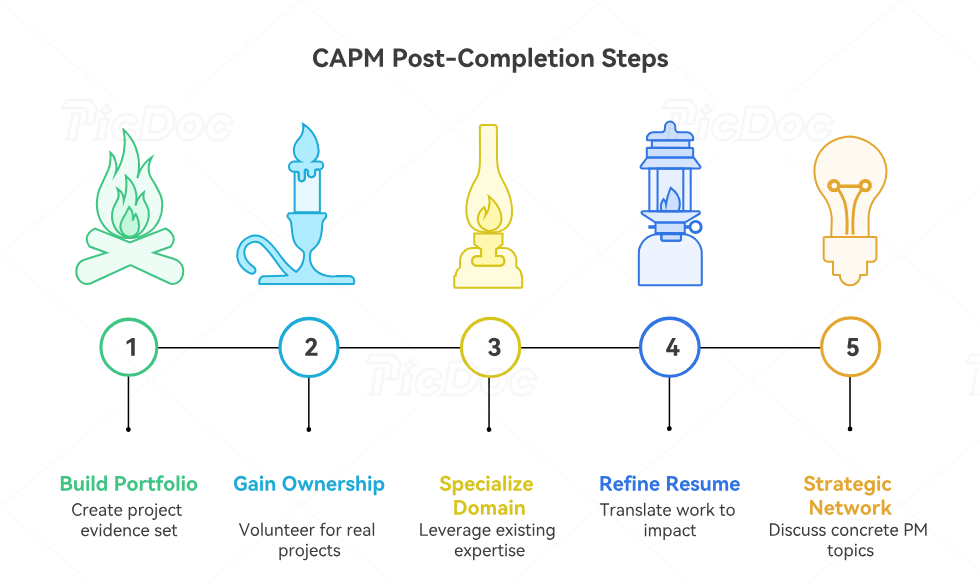
Once CAPM is complete, the most valuable activity is usually turning knowledge into observable work. Employers cannot inspect your memory of project terminology. They can evaluate a project charter you created, a difficult stakeholder situation you resolved, a delivery schedule you maintained, or a measurable process change you led.
Start by building a project evidence portfolio. Choose one real project you are legally allowed to discuss, anonymize confidential details, then produce a concise charter, milestone schedule, stakeholder map, RAID log, decision register, change log, weekly status report, and retrospective. Templates from a practical project-management resource library, exposure to project-management tools, familiarity with collaboration software, and understanding of PM APIs and integrations can help the portfolio resemble actual workplace delivery rather than an academic exercise.
Then acquire fresh ownership. Your current employer may provide the fastest route because you already possess organizational trust. Volunteer to coordinate an onboarding redesign, system rollout, vendor transition, internal event, process improvement, compliance initiative, reporting automation, software implementation, office move, customer migration, or cross-functional campaign. Someone aiming for Agile project management, Scrum@Scale expertise, SAFe career development, or traditional-to-Agile transition should specifically seek work where planning, prioritization, dependencies, iteration, stakeholder feedback, and outcomes are visible.
Make the project small enough to finish. A six-week onboarding redesign with four stakeholders and three measurable outcomes can create stronger interview evidence than “assisted with a transformation program” for a year. Strong project evidence contains boundaries: objective, starting condition, stakeholders, constraints, decisions, actions, problems, result.
Domain specialization is another underrated proof multiplier. If you already understand healthcare, construction, software, finance, logistics, marketing, government, education, or nonprofit operations, protect that advantage. A healthcare candidate with CAPM and clinical-process experience may offer more immediate value than a generic beginner. The same logic supports an environmental PM specialization, a marketing PM career, a nonprofit PM pathway, or a cybersecurity PM specialization.
Your résumé then needs to translate this proof properly. “Responsible for weekly project meetings” communicates administration. “Coordinated weekly delivery reviews across product, engineering, and operations, maintained 35+ actions and dependencies, escalated blocked decisions, and supported an on-time implementation” communicates project work. Candidates preparing for project governance, moving toward program management, building toward senior PM consulting, or eventually pursuing executive project leadership should learn this discipline early: hiring signals become stronger when responsibility, scale, complexity, and impact are visible simultaneously.
Networking becomes more useful once you have something concrete to discuss. Instead of messaging a stranger with “How do I become a PM?”, ask how their company separates Project Coordinator and PM responsibilities, which entry role owns RAID logs, whether implementations sit under operations or PMO, or which capability new hires most frequently lack. Those questions produce market intelligence. They can also reveal whether your target organization values Agile project-management skills, project-tool fluency, cybersecurity awareness, or deeper business-analysis-to-PM capability.
CAPM becomes significantly more persuasive once somebody can say: “I understand the framework, and here is how I applied it.”
5. A Better CAPM Decision Framework and 90-Day Career Plan
Before enrolling, calculate the opportunity cost. Estimate the examination fee, preparation course, study materials, practice questions, and 60–100 hours you might spend learning and revising. Then ask what else those same hours could produce: a portfolio, an internal project, stronger domain knowledge, fifty targeted applications, networking conversations, or competence with a tool repeatedly requested in your market.
This is where studying CAPM preparation resources, avoiding common CAPM exam mistakes, understanding how to leverage CAPM professionally, and comparing future PMP preparation requirements becomes useful. The certification should fit into a career system rather than consume the entire system.
Use this four-question test:
1. Do target employers mention CAPM? Review at least 30 vacancies in your intended geography and sector. Record whether CAPM is required, preferred, optional, or absent.
2. Do you already possess transferable project evidence? If you have managed implementations, campaigns, vendors, deadlines, process changes, events, releases, or cross-functional initiatives, CAPM may help formalize an existing capability.
3. What is currently preventing interviews? If your problem is weak PM vocabulary, CAPM may help. If your problem is a missing degree, no domain expertise, unrealistic salary expectations, or applying to senior roles, CAPM may leave the bottleneck untouched.
4. Can you build proof while studying? The highest-return approach combines theory with execution. Use project-management templates, practice through modern PM tools, understand collaboration workflows, and learn how integrations shape project systems while building one demonstrable project.
A practical 90-day CAPM-to-employment plan should therefore run on two tracks.
During Days 1–30, complete the foundational study while analyzing 30–50 vacancies. Separate Project Coordinator, PMO Analyst, Implementation Coordinator, Project Analyst, Project Administrator, Associate PM, and Junior PM requirements. Candidates considering an IT project-management transition, marketing PM path, nonprofit PM pathway, or Agile PM transition should build separate requirement maps rather than mixing incompatible industries.
During Days 31–60, complete one real project or build an anonymized evidence case from legitimate previous work. Create a charter, schedule, stakeholder analysis, RAID log, status report, decision log, and closeout review. Rewrite five résumé bullets using project scope, scale, decisions, stakeholders, and outcomes. Prepare examples that demonstrate capabilities relevant to project governance, Agile project delivery, future program management, and eventually senior project consulting.
During Days 61–90, run the job search as a measurable funnel. Track applications, recruiter screens, hiring-manager interviews, final interviews, and offers. Break performance down by role title and industry. If 40 well-matched applications generate zero screens, investigate your résumé, eligibility, market positioning, and evidence. If recruiter screens convert poorly into hiring-manager interviews, strengthen your transition narrative. If you repeatedly reach final rounds without offers, work on deeper examples of conflict, risk, trade-offs, leadership, and results.
That feedback loop protects you from the most expensive beginner mistake: assuming every rejection means you need another certificate.
CAPM also carries an ongoing maintenance commitment. PMI currently requires holders to earn 15 PDUs during each three-year cycle, including at least nine Education PDUs, with up to six available through Giving Back activities. If you later qualify for PMP, you can then evaluate PMP exam preparation, avoid common PMP mistakes, understand PMP certification maintenance, and compare PMP against PRINCE2 from a much stronger evidence base.
6. FAQs: Is CAPM Worth It With No Experience?
-
CAPM can improve your candidacy for some entry-level roles because it demonstrates foundational knowledge and appears as a preferred or desirable qualification in real Project Coordinator postings. Current examples include employers explicitly listing CAPM as a strong plus or preferred credential.
Your strongest strategy combines CAPM with an entry-level PM career plan, practical project-management templates, familiarity with project-management tools, and evidence from at least one real project. Employers can then evaluate knowledge and execution together.
-
Start with Project Coordinator, Project Assistant, Project Administrator, Project Analyst, PMO Analyst, PMO Coordinator, Implementation Coordinator, Implementation Specialist, Associate Project Manager, Junior Project Manager, Change Coordinator, and Program Coordinator. PMI itself currently identifies Assistant Project Manager, Project Administrator, Project Analyst, Project Coordinator, Project Manager, and Technical Project Manager among possible CAPM career paths.
Choose titles that preserve your existing domain advantage. Someone with technology experience can follow an IT-to-PM pathway, while an analyst can use a business-analyst-to-PM roadmap, a marketer can pursue marketing project management, and nonprofit experience can support a nonprofit PM career.
-
They solve somewhat different problems. CAPM is a PMI professional certification with an examination and ongoing renewal requirements. A course completion certificate can provide useful structured education and project-management exposure, but employer recognition varies considerably.
Compare the actual requirements in your target vacancies before investing. If employers repeatedly request CAPM, CAPM career leverage, targeted CAPM exam preparation, practical PM templates, and relevant collaboration-software skills form a stronger package than accumulating certificates without checking employer demand.
-
Evaluate PMP first. CAPM is designed around foundational and associate-level knowledge, while PMP is intended to validate more advanced project leadership experience. PMI itself positions CAPM as a foundation and PMP as the credential for professionals with established project-management experience.
Candidates who already qualify can compare PMP exam domains, study PMP preparation resources, examine PMP versus PRINCE2, and understand PMP maintenance requirements before spending time on a more foundational credential.
-
Build a compact portfolio containing a project charter, stakeholder map, milestone schedule, RAID log, decision register, change log, weekly status report, and lessons-learned summary. One strong case study showing why decisions were made is more valuable than a folder containing twenty generic templates.
Use project-management templates to create the structure, learn how organizations select project-management software, understand collaboration-software adoption, and develop basic knowledge of PM integrations and APIs. Your portfolio should reveal how you think when requirements change, stakeholders disagree, or dependencies threaten delivery.
-
Track conversion rather than feelings. Compare your application performance before and after adding CAPM while holding role quality roughly constant. Measure applications → recruiter screens → hiring-manager interviews → final rounds → offers.
If certification increases recruiter screens, it improved your initial signal. If screens remain unchanged, investigate résumé positioning, industry alignment, degree requirements, and experience. If interviews increase but offers do not, improve your examples of Agile project leadership, project governance, technical project delivery, and business-analysis-to-PM ownership.
