
The Ultimate Guide to Getting Your Project Management Certification in Bangladesh: All You Need to Know in 2026–2027
Bangladesh’s project economy rewards professionals who can control budgets, protect schedules, manage vendors, document decisions, and communicate across technical and executive teams. A project management certification can strengthen your credibility, yet employers still expect proof that you can apply frameworks under real delivery pressure. This guide explains which credential fits your experience, how to prepare efficiently, what capabilities Bangladeshi employers value, and how to convert certification into stronger roles across technology, construction, manufacturing, development, finance, telecom, and public-sector projects.
1. Why Project Management Certification Has Greater Career Value in Bangladesh in 2026–2027
Bangladesh has entered a more demanding phase of project delivery. Employers increasingly need professionals who can move beyond maintaining task lists and actively control scope, procurement, risk, quality, reporting, and stakeholder expectations. Candidates who understand project initiation terminology, can build a credible project schedule, identify the critical path, and apply disciplined project reporting practices are easier to trust with valuable work.
The value becomes especially clear when projects involve contractors, donor requirements, regulatory documentation, imported equipment, cross-functional teams, or fixed delivery dates. A certified candidate should understand procurement terminology, distinguish an RFP, RFQ, and RFI, control supplier performance, and recognize the contractual consequences of approving work without proper evidence. These capabilities protect organizations from rework, disputes, uncontrolled variations, and delayed approvals.
Public-sector and government-linked work creates an additional competency requirement. Bangladesh’s Public Procurement Rules 2025 took effect on September 28, 2025. The framework introduced mandatory e-GP use for public procurement, procurement-strategy requirements, beneficial-ownership disclosure, sustainable procurement provisions, and other governance changes. Project professionals pursuing government, infrastructure, consulting, or development-sector work should therefore build practical knowledge of procurement planning, audit trails, tender documentation, evaluation governance, and contract administration.
Certification is most useful when it closes a specific credibility gap. An experienced engineer may need proof of formal risk-management knowledge. A software team lead may need stronger command of Agile project tools, Scrum responsibilities, and Kanban workflow systems. A development professional may need better governance, stakeholder mapping, benefits tracking, and donor-reporting discipline.
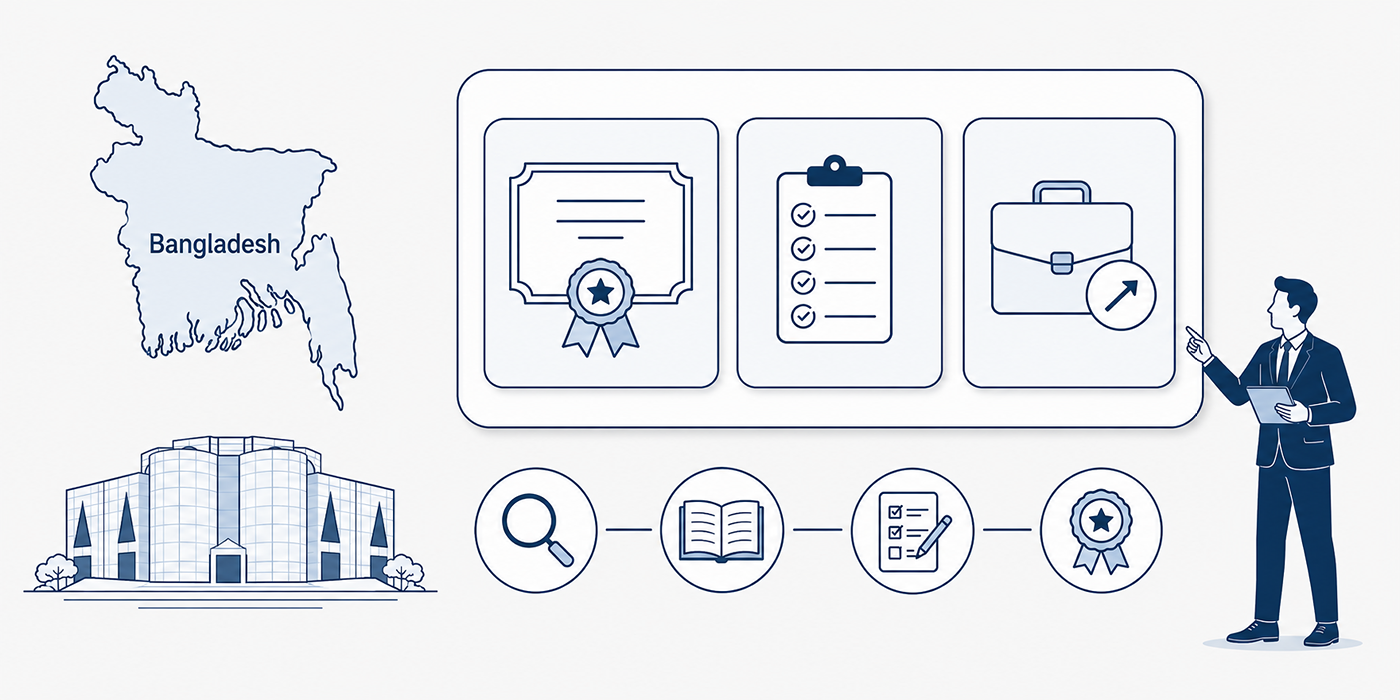
The hiring advantage comes from combining three forms of evidence:
Credential evidence: A recognized certification confirms that you understand established project-management concepts.
Delivery evidence: Your portfolio shows schedules, registers, reports, decisions, and measurable outcomes.
Context evidence: Your examples demonstrate that you understand the industry, organization, regulations, and commercial environment surrounding the project.
Candidates who rely only on an exam certificate often struggle during interviews. Hiring panels frequently test whether the person can explain a delayed milestone, defend a forecast, challenge an unrealistic deadline, handle a vendor dispute, or recover a project with weak requirements. Studying schedule-compression techniques, conflict-resolution terminology, stakeholder engagement, and budget-management concepts prepares you for those conversations.
Bangladesh Project Management Capability Matrix: 28 Skills Hiring Panels Actually Reward
| Capability | What “Good” Looks Like | Business Impact | Proof Asset to Build | Roles That Value It |
|---|---|---|---|---|
| Requirements control | Maintains a signed baseline, traceability, acceptance criteria, and controlled requirement changes. | Reduces rework, disputes, and silent scope growth. | Requirements traceability matrix and change log. | IT PM, business analyst, implementation manager. |
| Scope definition | Separates deliverables, exclusions, assumptions, constraints, dependencies, and acceptance boundaries. | Prevents teams from committing to undefined work. | Scope statement and work breakdown structure. | Project coordinator, PM, consulting analyst. |
| Schedule development | Builds logic-driven activities with dependencies, milestones, resources, and realistic durations. | Creates an achievable delivery forecast. | Gantt chart with baseline comparison. | Construction PM, planning engineer, PMO analyst. |
| Critical-path control | Identifies zero-float work, near-critical paths, schedule sensitivity, and recovery options. | Directs management attention toward genuine deadline threats. | Critical-path report and recovery scenario. | Planner, scheduler, program controls specialist. |
| Cost estimating | Documents estimate basis, quantities, rates, contingency, assumptions, and confidence levels. | Improves funding decisions and cost accountability. | Cost estimate with basis-of-estimate document. | Project controller, estimator, commercial PM. |
| Budget control | Tracks commitments, actuals, forecasts, accruals, contingency use, and variance causes. | Identifies overspending before cash is exhausted. | Monthly cost report and forecast-at-completion. | Finance PM, project controller, PMO analyst. |
| Risk management | Assigns owners, triggers, response actions, deadlines, and residual exposure. | Converts uncertainty into managed decisions. | Risk register with heat map. | PM, risk analyst, donor-project manager. |
| Issue resolution | Records impact, owner, target date, escalation route, decision, and closure evidence. | Stops unresolved problems from becoming chronic delays. | Issue log with aging analysis. | PMO coordinator, service-delivery manager. |
| Change control | Assesses schedule, cost, resource, quality, risk, benefit, and contract impact before approval. | Protects the baseline and management reserve. | Change request with impact assessment. | PM, change manager, contract administrator. |
| Procurement planning | Defines procurement route, package strategy, evaluation method, lead time, approvals, and risks. | Reduces tender delays and poor sourcing decisions. | Procurement plan and sourcing calendar. | Government PM, procurement specialist, consultant. |
| e-GP awareness | Understands digital tender workflows, approval records, evaluation governance, and auditability. | Supports compliant public procurement. | Sample procurement process map. | Public-sector PM, infrastructure consultant. |
| Tender documentation | Creates clear specifications, deliverables, qualifications, scoring criteria, and commercial conditions. | Produces stronger bids and fewer clarifications. | Draft RFP package and evaluation matrix. | Procurement PM, bid manager, technical consultant. |
| Vendor evaluation | Uses weighted criteria, due diligence, reference checks, risk review, and documented moderation. | Improves supplier selection defensibility. | Technical and commercial scorecard. | Procurement manager, PM, sourcing analyst. |
| Contract administration | Tracks obligations, notices, securities, insurance, variations, payments, claims, and closeout. | Protects commercial and legal positions. | Contract obligations register. | Contract manager, construction PM, commercial lead. |
| Stakeholder mapping | Maps influence, interest, impact, expectations, resistance, communication needs, and ownership. | Reduces approval delays and political friction. | Power-interest map and engagement plan. | Development PM, transformation lead, PMO. |
| Executive reporting | Explains status, decisions, forecast, exposure, and support required without drowning leaders in activity. | Enables faster and better governance decisions. | One-page steering-committee report. | Senior PM, program manager, PMO lead. |
| Meeting governance | Uses decision-focused agendas, pre-reads, action ownership, deadlines, and decision logs. | Reduces repetitive meetings and unclear accountability. | Governance calendar and decision register. | PMO analyst, project coordinator, PM. |
| Team communication | Defines channels, response expectations, escalation rules, document locations, and reporting rhythm. | Reduces information loss and duplicated effort. | Communication-management plan. | Every project-delivery role. |
| Resource planning | Matches skill, availability, effort, sequencing, productivity assumptions, and backup coverage. | Prevents hidden capacity shortages. | Resource plan and capacity heat map. | PM, resource manager, delivery lead. |
| Team leadership | Clarifies outcomes, delegates authority, coaches performance, resolves friction, and protects focus. | Improves accountability and execution speed. | Responsibility matrix and team charter. | PM, Scrum Master, operations manager. |
| Quality planning | Defines standards, review methods, acceptance thresholds, defect treatment, and approval responsibilities. | Reduces late-stage rejection and warranty exposure. | Quality-management plan. | Engineering PM, QA lead, implementation manager. |
| Agile delivery | Manages product goals, prioritized backlogs, short feedback cycles, reviews, retrospectives, and flow. | Improves responsiveness when requirements evolve. | Product backlog, sprint report, and release plan. | Technology PM, Scrum Master, product operations. |
| Hybrid delivery | Combines governance milestones with iterative development where each approach provides greater control. | Balances predictability with adaptability. | Hybrid lifecycle map and governance model. | Digital-transformation PM, enterprise PMO. |
| Benefits management | Connects outputs to adoption, operational improvement, savings, revenue, service quality, or public value. | Prevents delivery teams from declaring success after producing unused outputs. | Benefits register and measurement plan. | Program manager, transformation lead, donor PM. |
| Data-driven control | Uses trends, forecast accuracy, aging, throughput, variance, and leading indicators to guide action. | Replaces optimistic status reporting with evidence. | Project dashboard. | PMO analyst, project controller, portfolio analyst. |
| Document control | Applies naming, versioning, approval status, access control, retention, and distribution rules. | Prevents teams from acting on obsolete information. | Document register and approval workflow. | Construction PM, compliance PM, PMO coordinator. |
| Audit readiness | Maintains approvals, decisions, procurement evidence, financial records, acceptance documents, and closure files. | Reduces compliance exposure and delayed reimbursements. | Project audit checklist and evidence index. | Government PM, NGO PM, finance-project lead. |
| Project closeout | Completes acceptance, handover, contract closure, final accounts, lessons, archiving, and benefit ownership. | Prevents unresolved liabilities from following the organization. | Closeout report and handover checklist. | PM, contract administrator, implementation lead. |
2. Which Project Management Certification Should You Choose?
Your best certification depends on the evidence you already possess and the roles you plan to pursue. Selecting the most famous credential without checking eligibility, industry fit, and career timing can waste months of study. Compare the options through the lens of job requirements, then review a detailed PMP versus PRINCE2 comparison, explore CAPM career applications, and examine the certification expectations in nearby markets such as Malaysia and China.
PMP for experienced project leaders
PMP is the strongest general-purpose choice for professionals who already lead projects and want access to project manager, senior project manager, PMO, consulting, implementation, and delivery-lead opportunities. The current PMP pathway recognizes predictive, hybrid, and Agile delivery. PMI launched its updated examination on July 9, 2026, with greater attention to business environment, modern leadership, AI, sustainability, value delivery, and realistic project scenarios.
As of July 2026, PMI lists four experience routes. Applicants with a secondary qualification need five years of project leadership experience, vocational or associate-degree holders need four years, bachelor’s-degree holders need three years, and graduates of eligible PMI-accredited programs may qualify with two years. Applicants also need 35 hours of project-professional training or an active CAPM credential. Experience must fall within the preceding ten years, and overlapping projects cannot be double-counted.
Prepare by mastering the PMP examination domains, studying through credible PMP preparation resources, reviewing successful candidate strategies, and eliminating the most common PMP mistakes. Scenario judgment deserves more study time than memorizing isolated definitions.
CAPM for graduates, coordinators, and career changers
CAPM suits candidates who understand that project work is their target but have not yet accumulated enough leadership experience for PMP. PMI currently requires a secondary qualification and at least 23 hours of project-management education. The CAPM examination contains 150 questions, allows 180 minutes, and covers fundamentals, predictive methods, Agile approaches, and business analysis.
A CAPM candidate should build practical evidence alongside the credential. Create a charter, stakeholder register, work breakdown structure, schedule, risk register, status report, and change request for a realistic case project. Use CAPM preparation resources, learn from CAPM exam mistakes, follow disciplined exam-day techniques, and understand CAPM renewal requirements.
PRINCE2 for governance-heavy environments
PRINCE2 is useful for professionals targeting organizations that value defined roles, controlled stages, business justification, formal governance, and management by exception. It can fit consulting, donor-funded programs, government-linked work, service transformation, and organizations influenced by UK or international delivery practices. PeopleCert currently treats PRINCE2 Version 7 credentials as renewable certifications, so candidates should include renewal requirements in their long-term cost and development plan.
Before committing, study common PRINCE2 examination pitfalls, compare reputable PRINCE2 training providers, understand its salary and career applications, and plan for PRINCE2 renewal. Foundation establishes method knowledge, while Practitioner tests your ability to apply and tailor it.
Agile and Scrum credentials for technology careers
Scrum or Agile credentials can support technology, product, software, fintech, telecom, and digital-transformation careers. Their value rises when you can facilitate refinement, remove delivery blockers, interpret flow data, protect the sprint goal, and help product owners make prioritization decisions. Build familiarity with Scrum project-management platforms, Kanban software, team communication platforms, and project-management integrations.
A short Agile certificate rarely compensates for weak delivery knowledge. Hiring managers may ask how you handled unfinished work, conflicting stakeholder priorities, repeated carryover, technical debt, poor estimates, or a product owner who changed priorities during execution. Your answers should demonstrate facilitation, evidence-based forecasting, servant leadership, and commercial awareness.
3. Eligibility, Costs, and a Realistic Certification Plan
Start by auditing your experience before buying a course. Create a spreadsheet listing every project from the relevant eligibility period, with dates, objective, organization, role, team size, budget responsibility, delivery approach, and outcomes. Then identify where you personally led planning, decisions, stakeholders, risks, delivery, and results. This exercise improves the certification application and gives you reusable interview evidence. Strengthen your language through the top project-management terms, human-resource management concepts, team-building terminology, and stakeholder terminology.
Your total budget should include the examination fee, training, mock examinations, study materials, membership where useful, internet reliability, travel to a test centre where applicable, currency-conversion charges, taxes, and a contingency for a second attempt. Official prices and exchange rates can change, so confirm the checkout amount directly with the certification body before paying. Avoid selecting a provider solely because its fee is low. Verify instructor experience, course recognition, lesson access period, mock quality, refund terms, and whether the promised training hours meet the certification body’s rules.
PMP candidates require additional caution in late 2026. PMI has announced that live training completed after its future implementation date will qualify only when delivered by an Authorized Training Partner, an eligible accredited academic program, or another specified authorized route. PMI states that self-paced courses can continue to come from any organization, while training completed before the change date remains eligible under the existing rules. Confirm the final implementation date before enrolling in a live class.
A strong 12-week study plan can follow this sequence:
Weeks 1–2: Read the examination content outline, map your knowledge gaps, and complete a diagnostic test.
Weeks 3–5: Learn scope, schedule, cost, quality, resources, communication, procurement, risk, and stakeholder management.
Weeks 6–7: Study Agile, hybrid delivery, value realization, business analysis, and organizational change.
Weeks 8–9: Solve scenario questions in timed sets and document why every incorrect option is weaker.
Weeks 10–11: Complete full mock examinations, analyze performance by domain, and repair recurring judgment errors.
Week 12: Reduce new content, review decision principles, test your examination system, and protect sleep.
Support the plan with a personal knowledge system. Store notes under lifecycle phases, maintain an error log, and create one-page summaries for cost-management terminology, quality-management concepts, Six Sigma terminology, and resource-allocation tools. Review mistakes by decision pattern rather than question wording.
Many candidates fail because they study passively. Reading a guide creates familiarity, while the examination requires selection among several plausible actions. After every mock question, ask what happened, what stage the project is in, which information is missing, who owns the decision, and what the project manager should do first. This approach develops situational judgment and exposes gaps hidden by repeated reading.
What Is Your Biggest Barrier to Building a Project Management Career in Bangladesh?
4. How to Turn Certification Into a Project Management Job Offer
Your certification should become the foundation of a proof portfolio. Recruiters need visible evidence that you can structure delivery, communicate risk, and control decisions. Build a sanitized project pack containing a charter, stakeholder map, requirements matrix, work breakdown structure, Gantt schedule, budget tracker, RAID log, change request, status report, dashboard, lessons register, and closeout report. Useful starting points include project-management templates, reporting and analytics software, issue-tracking platforms, and dashboard tools.
Each portfolio item should answer five questions: What decision did it support? Who used it? Which data fed it? What changed because of it? How did you keep it current? A beautiful risk register with no ownership, triggers, or response deadlines reveals weak practice. A simple register that drives weekly decisions demonstrates control. The same principle applies to workforce-management software, resource-allocation systems, procurement-management tools, and contract-lifecycle platforms.
Rewrite your CV around project outcomes instead of administrative duties. Replace “responsible for project coordination” with a statement that identifies project scale, your intervention, and the measurable result. For example: “Rebuilt the implementation schedule for a multi-site rollout, identified three critical dependencies, and enabled leadership to resequence vendor activities before procurement delay affected deployment.” Strong bullets use the language of delivery, including baseline, forecast, variance, acceptance, dependency, exposure, decision, recovery, and benefit.
For every target role, mirror the vacancy’s genuine requirements in the first half of your CV. A construction role may prioritize planning, contractor control, safety interfaces, claims, and construction project-management software. A technology role may emphasize Agile delivery, integrations, release planning, and Scrum platforms. A procurement-heavy position may focus on sourcing, tendering, evaluation, contracts, and supplier-management terminology.
Your interview stories should follow a decision structure:
Context → delivery risk → evidence reviewed → options considered → decision made → stakeholder response → measurable result → lesson applied.
This format demonstrates judgment. It also prevents vague answers about teamwork and communication. Prepare at least eight stories covering a late dependency, stakeholder disagreement, uncontrolled scope request, vendor underperformance, quality failure, budget pressure, team-capacity problem, and project recovery. Review conflict-resolution concepts, stakeholder engagement terms, communication techniques, and risk-assessment terminology while preparing.
Candidates without a project-manager title can still develop valid examples. A teacher introducing a new assessment process, an engineer coordinating installation, an NGO officer delivering a field initiative, an analyst automating a report, or an operations employee moving a service to a new location may all have project experience. The critical evidence is temporary work performed to create a defined outcome, with planning, stakeholders, constraints, risks, and delivery responsibilities.

5. Project Management Career Paths and Salary Negotiation in Bangladesh
Certification can support several career routes in Bangladesh, including project coordinator, assistant project manager, PMO analyst, implementation specialist, Scrum Master, project controls analyst, planning engineer, procurement-project officer, development-project officer, project manager, program manager, and transformation lead. Your strongest route will depend on domain knowledge. Employers usually gain more confidence from a certified project professional who understands their operating environment than from a candidate who speaks only in generic methodology language.
Technology candidates should understand backlog prioritization, release risk, APIs, testing, data migration, cybersecurity dependencies, and adoption. They can strengthen tool knowledge through Agile software reviews, Kanban platform comparisons, communication-platform reviews, and project API guidance.
Construction and infrastructure candidates need stronger control over quantities, schedules, subcontractors, inspections, drawings, variations, payment certification, claims, and handover. Knowledge of Waterfall software, critical-path terminology, schedule compression, and contract-management language provides useful interview depth.
Development-sector and NGO candidates should emphasize logical frameworks, stakeholder inclusion, procurement compliance, safeguarding interfaces, budget utilization, monitoring, donor reporting, sustainability, and benefits realization. Public-sector candidates should also develop familiarity with Bangladesh’s current procurement environment, particularly e-GP, procurement strategy, transparent evaluation, audit evidence, and sustainable procurement requirements.
When discussing salary, research the complete role rather than anchoring only to the job title. Evaluate project size, decision authority, reporting level, team size, contractual responsibility, travel, working hours, benefits, bonuses, insurance, training support, certification reimbursement, and renewal costs. A “project manager” role that combines procurement, commercial control, operations, and client management deserves a different discussion from a coordination role with limited authority.
Build your negotiation case around marketable evidence:
Size and complexity of projects delivered
Budget, vendor, or contract responsibility
Industries and regulatory environments understood
Schedule or cost improvements achieved
Revenue, savings, adoption, quality, or service outcomes
Certifications and specialist tools mastered
Leadership scope and senior-stakeholder exposure
Avoid presenting certification as the sole reason for a salary increase. Use it as evidence that strengthens a wider business case. Your argument becomes stronger when you can show improved forecast accuracy, earlier risk detection, faster approvals, fewer defects, better vendor accountability, or more reliable reporting. Continue learning through PMP renewal guidance, project-reporting practices, budgeting concepts, and quality-management terminology.
Regional awareness can also support professionals seeking multinational, remote, consulting, or cross-border work. Compare certification expectations and employer contexts across Vietnam, Thailand, South Korea, Japan, and Turkey. The certification may remain the same, while employer expectations, industry concentration, governance maturity, and communication culture can differ significantly.
6. Frequently Asked Questions About Project Management Certification in Bangladesh
-
PMP generally provides the strongest option for professionals with enough project-leadership experience. CAPM serves graduates, coordinators, and career changers who need foundational credibility. PRINCE2 suits structured governance environments, while Scrum and Agile credentials fit many product and technology roles. Compare your eligibility, target vacancies, and preferred industries through the PMP and PRINCE2 comparison, CAPM career guide, Scrum tools directory, and Agile tools guide.
-
A fresh graduate will rarely meet PMP’s project-leadership experience requirement. CAPM provides a more practical starting point because it currently requires a secondary qualification and 23 hours of project-management education. A graduate can also build experience through project coordination, implementation support, business analysis, operations improvement, event delivery, volunteering, or internal transformation work. Study CAPM preparation resources, avoid CAPM exam errors, and develop a portfolio with project templates.
-
Experience should involve leading projects in a professional setting through responsibility for planning, decisions, delivery, and outcomes. PMI currently asks candidates to count qualifying experience within the previous ten years and to avoid double-counting overlapping project periods. Your job title does not have to be “project manager,” provided your responsibilities genuinely demonstrate project leadership. Build a detailed project inventory using initiation terminology, risk concepts, stakeholder terminology, and reporting practices.
-
Most working professionals benefit from a structured 8-to-16-week plan, depending on their existing knowledge, examination choice, weekly availability, and mock-test performance. Progress should be measured through timed scenario accuracy and error-pattern reduction. Use PMP preparation resources, PMP domain guidance, exam-success lessons, and exam mistake analysis.
-
Online training can be accepted when it meets the certification body’s current education requirements and provides valid completion evidence. PMP candidates should distinguish self-paced education from live instructor-led education because PMI plans to tighten eligibility for live training in late Q4 2026. PMI states that the specific effective date will be announced and that earlier completed training will remain eligible under the current rules. Verify the provider before payment and retain certificates, course outlines, dates, and training-hour records.
-
Certification can strengthen your profile for remote PMO, implementation, operations, software-delivery, consulting, and project-coordination work. Remote employers also assess written communication, asynchronous decision-making, tool fluency, timezone reliability, stakeholder management, and portfolio evidence. Develop experience with team communication platforms, project integrations, reporting software, and dashboard tools.
