
The Ultimate Guide to Getting Your Project Management Certification in Philippines: All You Need to Know in 2026-2027
The Philippines needs project professionals who can turn ambitious plans into controlled delivery. Digital transformation, infrastructure, banking, IT-BPM, telecommunications, healthcare, logistics, and government modernization all create demand for people who understand project initiation, risk management, stakeholder engagement, project reporting, and vendor management.
The opportunity is real, although certification alone cannot carry a weak professional profile. Philippine candidates need the right credential, documented project evidence, sector-specific language, and an application strategy that converts experience into hiring confidence.
1. Why Project Management Certification in the Philippines Carries More Weight in 2026-2027
The Philippine digital economy generated ₱2.74 trillion in gross value added during 2025, represented 9.8% of national GDP, and employed approximately 10.39 million people. Its major components include digital infrastructure, ICT services, digital content, e-commerce, and government digital services. Each component creates projects involving systems, vendors, data migration, cybersecurity, compliance, workforce training, infrastructure, and organizational change.
That environment favors candidates who can demonstrate Agile delivery knowledge, Scrum role clarity, Kanban workflow control, project integration awareness, and team communication discipline. Employers need people who can coordinate technical specialists while protecting timelines, approvals, budgets, quality, and business outcomes.
Government transformation also strengthens the case for structured project capability. The Philippine Development Plan 2023-2028 frames national priorities around economic and social transformation, job creation, innovation, competitiveness, and stronger workforce skills. The government’s eGovernment Masterplan seeks to unify public-sector ICT initiatives and accelerate the digital transformation of services.
For candidates, this means greater relevance for governance terminology, stakeholder mapping, project communication techniques, dashboard reporting, and quality management. Public-sector and regulated projects frequently involve formal approvals, cross-agency coordination, documentation standards, procurement controls, and politically sensitive timelines.
The pain point for many Filipino professionals is hidden experience. A business analyst may already control requirements and testing. An engineer may already manage contractors, schedules, and risks. An operations supervisor may already lead system rollouts. An IT specialist may coordinate users, developers, vendors, and acceptance testing. Their resumes often reduce that work to “assisted,” “supported,” and “coordinated.”
Certification helps candidates translate that experience through critical path terminology, schedule compression methods, budgeting concepts, conflict-resolution language, and procurement terminology. The certificate gives hiring panels a recognizable framework for understanding what the candidate has already done.
Location also affects positioning. Metro Manila offers dense opportunities across finance, technology, shared services, telecommunications, consulting, healthcare, and government. Cebu has strong technology, BPO, tourism, construction, and service-sector demand. Davao, Clark, Iloilo, and other regional centers continue developing business, logistics, digital, real-estate, and infrastructure ecosystems. Candidates targeting these markets should connect their credentials to resource planning, workforce management, issue tracking, contract management, and project scheduling.
2. Which Project Management Certification Should You Choose in the Philippines?
The right credential depends on your current experience, target role, sector, and hiring gap. Begin by collecting 15 relevant job advertisements. Record which credentials appear, which responsibilities repeat, and where your experience falls short. This approach prevents candidates from spending months on a credential that hiring managers rarely request for their chosen pathway.
PMP for experienced project professionals
PMP is suited to candidates who already lead and manage projects. PMI currently provides three eligibility routes. Candidates with a secondary diploma generally need 60 months of project leadership experience within the previous eight years and 35 hours of project management education. Candidates with a bachelor’s degree generally need 36 months of experience and 35 education hours. Graduates of qualifying GAC-accredited programs may use a 24-month experience route.
Filipino candidates pursuing senior project manager, implementation manager, transformation manager, construction PM, PMO lead, program coordinator, or client-delivery positions can build their route through PMP exam resources, PMP domain guidance, common PMP mistakes, PMP success strategies, and PMP renewal planning.
Exam timing deserves special attention in 2026. PMI states that candidates taking the current version must sit for it before July 8, 2026. The updated PMP examination follows with revised resources, while changes to eligibility for certain live training hours are planned for late Q4 2026. Candidates should confirm the exam version before purchasing courses, building a study calendar, or relying on older mock questions.
CAPM for beginners and career changers
CAPM suits fresh graduates, junior coordinators, project administrators, PMO analysts, operations professionals, business analysts, and technical employees entering formal project work. PMI currently requires a secondary degree or global equivalent and at least 23 hours of project management education completed before the exam. Prior project leadership experience is not required.
The best CAPM strategy combines CAPM preparation resources, CAPM mistake prevention, exam-day planning, CAPM career positioning, and CAPM renewal awareness. Candidates should also build a portfolio because entry-level recruiters still need evidence of organization, ownership, communication, and disciplined follow-through.
PRINCE2 for governance-driven environments
PRINCE2 works well for candidates targeting PMO, consulting, government, financial services, enterprise transformation, infrastructure, and organizations using formal stage controls. PeopleCert describes PRINCE2 Project Management Practitioner Version 7 as a credential focused on applying and tailoring the method, leading project teams, and supporting successful delivery. Practitioner prerequisites apply.
Prepare by comparing PRINCE2 and PMP, reviewing PRINCE2 exam pitfalls, evaluating PRINCE2 training providers, understanding PRINCE2 career benefits, and planning PRINCE2 recertification.
Agile, Scrum, and hybrid credentials for digital delivery
Agile-oriented training is valuable for software, fintech, e-commerce, telecommunications, product development, customer-experience, data, AI, and government digital-service projects. Candidates should understand that employers still expect planning, governance, risks, budgets, and stakeholder decisions around iterative delivery.
Build hybrid capability using Agile project tools, Scrum responsibilities, Kanban platforms, waterfall software, and project integrations. A candidate who can combine iterative execution with executive governance becomes useful across complex Philippine organizations.
3. How to Build a Philippines-Ready Project Management Profile
Certification should produce visible changes in your professional evidence. Start with a proof portfolio containing a project charter, milestone plan, stakeholder matrix, RAID register, change log, budget snapshot, communication plan, weekly status report, vendor tracker, and lessons-learned document. Use project management templates, reporting practices, risk-identification terms, stakeholder terminology, and dashboard resources to make each artifact credible.
Anonymize proprietary information. Replace company names, customer data, prices, system credentials, and confidential technical details. Preserve the project logic: objectives, responsibilities, constraints, decisions, risks, changes, and outcomes. Recruiters need to see your reasoning without receiving sensitive employer material.
Your resume should show ownership. “Coordinated weekly meetings” gives little evidence. “Maintained a 35-item action register, escalated seven overdue decisions, and reduced average approval time from nine days to four” exposes the management value. “Assisted vendor implementation” can become “Tracked 18 vendor milestones against contract acceptance criteria and escalated two critical-path delays before payment approval.”
Stronger bullets draw from vendor-management language, contract terminology, cost-management concepts, schedule terminology, and issue-management practices. Every bullet should answer at least two questions: what did you control, and what changed because of your work?
Sector translation also strengthens applications. IT-BPM candidates should emphasize service transitions, workforce readiness, client communication, data controls, productivity, and distributed teams. Technology candidates should emphasize requirements, testing, releases, integrations, cybersecurity dependencies, and adoption. Construction candidates should emphasize sequencing, procurement, contractors, quality, site risks, change orders, and handover. Banking and healthcare candidates should emphasize governance, compliance, documentation, access controls, approvals, and operational continuity.
Prepare these narratives through team-building terminology, human-resource management terms, quality-management definitions, procurement-management tools, and contract lifecycle software.
4. An Eight-Week Certification and Career Plan for Filipino Candidates
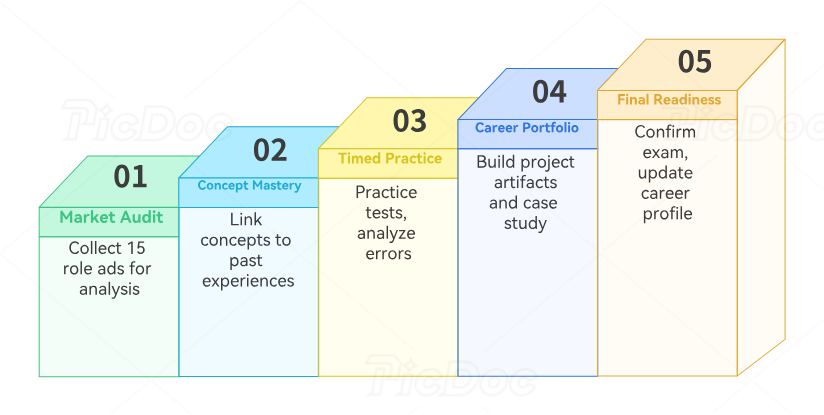
Week 1: Audit the market and select the credential
Collect 15 advertisements for your desired role. Create columns for credential, experience, sector knowledge, tools, delivery method, reporting, vendors, budgets, and leadership. Count repeated requirements. Then compare the evidence with PMP exam domains, CAPM career pathways, PRINCE2 and PMP differences, Agile tool requirements, and Scrum accountabilities.
Weeks 2-3: Build conceptual control
Study scope, schedule, cost, quality, risk, resources, procurement, communication, stakeholders, governance, and delivery methods. Connect every concept to a situation you have experienced. Explain the trigger, decision, owner, action, result, and lesson. Use project scheduling terms, risk-management terminology, budgeting definitions, communication techniques, and quality terminology.
Candidates frequently waste this stage by memorizing definitions without developing decision judgment. Scenario exams and hiring interviews expose that weakness quickly. You should be able to explain when a risk becomes an issue, when a request becomes a change, when schedule compression creates unacceptable exposure, and when a stakeholder concern requires escalation.
Weeks 4-5: Begin timed practice and error analysis
Complete timed practice sets. For every error, document the concept tested, your reasoning, the stronger reasoning, and the warning sign you missed. PMP candidates should practice situational questions. CAPM candidates should balance fundamentals, predictive methods, Agile concepts, and business analysis. PRINCE2 candidates should master principles, practices, processes, roles, tolerances, and tailoring.
Support this phase with PMP mistake analysis, PMP study resources, CAPM preparation tools, CAPM exam-day guidance, and PRINCE2 exam pitfalls.
Weeks 6-7: Produce career evidence
Create your portfolio while your knowledge is fresh. Build a charter, milestone plan, RACI, RAID log, stakeholder map, budget snapshot, vendor tracker, and status dashboard. Create a one-page case study describing a project challenge, the management decision, the outcome, and the lesson.
Use project templates, Gantt chart concepts, vendor-management definitions, reporting software, and dashboard tools. Each artifact should resemble something a working project manager would confidently place before a sponsor.
Week 8: Finalize exam and employment readiness
Confirm your application, training evidence, identification, exam version, appointment, testing requirements, and renewal obligations. Complete full-length practice under realistic conditions. At the same time, rewrite your resume, update your LinkedIn headline, prepare six interview stories, and build a list of 30 target employers.
Your application should connect the credential to resource-allocation capability, reporting discipline, conflict-resolution skill, procurement understanding, and contract control. The resulting profile should communicate immediate workplace usefulness.
5. How to Turn Certification Into Better Roles and Higher Pay
Certification creates leverage when employers can connect it to reduced delivery risk. A credential name has limited negotiating power without evidence. A candidate who can show faster approvals, cleaner reporting, stronger vendor control, lower rework, improved schedule visibility, and fewer unresolved risks presents a stronger commercial case.
For interviews, prepare six stories:
A scope change that required formal analysis and approval.
A critical delay that required recovery options.
A difficult stakeholder whose resistance threatened delivery.
A vendor problem involving milestones, quality, or acceptance.
A budget pressure requiring prioritization.
A quality failure caught before operational handover.
Each answer should identify the baseline, pressure, decision authority, options, action, outcome, and learning. Develop the vocabulary through schedule-compression concepts, stakeholder-engagement terms, vendor-management guidance, contract-management terminology, and conflict-resolution methods.
For construction and infrastructure roles, emphasize sequencing, contractors, procurement lead times, permits, safety dependencies, change control, quality inspections, and handover. Strengthen your profile with construction project management software, critical path terminology, procurement definitions, cost-management concepts, and quality-management language.
For IT-BPM, fintech, telecom, and digital transformation, emphasize requirements, integrations, testing, service transition, data migration, adoption, distributed teams, release readiness, and operational continuity. Build this positioning through Agile tools, Scrum responsibilities, Kanban platforms, communication software, and project integrations.
For PMO and enterprise roles, emphasize portfolio reporting, governance cadence, methodology, resource visibility, stage gates, assurance, and decision support. Use reporting terminology, dashboard platforms, resource-allocation software, project templates, and workforce-management tools.
Regional awareness can also support international applications. Compare how project careers are positioned in Malaysia, Vietnam, Thailand, Japan, and South Korea. This comparison helps candidates identify portable skills across ASEAN and Asia-Pacific markets.
6. FAQs
-
PMP is generally the strongest option for professionals with established project leadership experience. CAPM serves beginners, fresh graduates, project coordinators, analysts, and career changers. PRINCE2 fits governance-heavy, PMO, consulting, government, and enterprise environments. Agile and Scrum credentials support software, fintech, e-commerce, product, data, and digital-transformation careers.
Compare your target roles using PMP domain guidance, CAPM preparation resources, PRINCE2 versus PMP, Agile project tools, and Scrum responsibilities.
-
PMP can strengthen applications for experienced candidates because it provides a recognized framework for project leadership, people management, delivery processes, priorities, and business outcomes. PMI describes PMP as a credential for professionals with multiple years of project leadership experience.
Its career value rises when the candidate can demonstrate risk ownership, stakeholder control, schedule management, vendor oversight, and executive reporting.
-
Yes. PMI currently requires a secondary degree or global equivalent and 23 hours of project management education. Project leadership experience is not part of the current CAPM eligibility requirement.
Fresh graduates should combine CAPM exam resources, project initiation knowledge, Gantt chart fluency, risk-identification terminology, and project templates with internship, university, volunteer, or freelance project evidence.
-
A practical preparation window is six to ten focused weeks. Candidates with extensive project experience may progress faster because they can connect scenarios to real delivery. Beginners often need extra time for terminology, delivery methods, practice questions, and portfolio development.
Use PMP study resources, CAPM preparation tools, PRINCE2 provider comparisons, project scheduling concepts, and risk-management terminology to structure the schedule.
-
Prioritize scope control, scheduling, stakeholder engagement, risk management, vendor coordination, procurement, budgeting, quality assurance, change control, executive reporting, resource planning, and delivery-method fluency. Each skill should appear through evidence rather than a keyword list.
Strengthen the wording with critical path terminology, budgeting concepts, procurement terminology, communication techniques, and quality-management definitions.
-
Yes. IT-BPM professionals frequently work on client transitions, process migrations, staffing, technology implementation, service improvement, compliance, reporting, and operational change. These responsibilities can provide strong project evidence when documented carefully.
Build the connection through workforce-management tools, HR management platforms, team communication software, issue-tracking tools, and project reporting platforms.
