
Ultimate Guide to Scrum Product Owner Certification (CSPO)
The Certified Scrum Product Owner credential gives professionals a structured foundation for converting customer needs, commercial goals, and stakeholder pressure into valuable product decisions. It is especially relevant for project managers, business analysts, product managers, and delivery professionals moving toward agile ownership. Understanding the Scrum terminology, product backlog, stakeholder engagement, and agile estimation responsibilities behind the credential helps you judge its career value before paying for training.
1. What the CSPO Certification Actually Prepares You to Do
The Certified Scrum Product Owner, or CSPO, is a foundational product ownership certification issued by Scrum Alliance. It teaches how a product owner establishes direction, orders work, collaborates with customers, handles competing stakeholder demands, and helps a Scrum Team concentrate on the most valuable outcomes. The certification fits naturally alongside knowledge of the complete agile project management glossary, sprint planning concepts, agile performance metrics, and project execution terminology.
A product owner operates at the intersection of customer value, business viability, technical feasibility, and delivery sequencing. The role involves defining a product vision, managing the Product Backlog, making scope and ordering decisions, resolving trade-offs, and maintaining customer focus. Scrum Alliance also describes the product owner as the bridge between stakeholders and the developers creating the product.
That accountability becomes painful when authority remains unclear. Many professionals carry the product owner title while executives continue inserting urgent requests, sales teams promise unvalidated features, and developers receive contradictory priorities. A capable product owner creates a visible decision system through project governance practices, stakeholder alignment, clear project reporting, and leadership communication.
The CSPO course therefore concentrates on decision quality rather than administrative backlog maintenance. Writing user stories represents one small part of the role. Strong product ownership also requires discovering valuable problems, defining measurable outcomes, rejecting weak requests, understanding delivery constraints, and revising priorities when evidence changes. These responsibilities connect directly with risk-response planning, resource allocation, project financial management, and monitoring and control.
Who benefits most from CSPO training?
CSPO training is particularly useful for:
Product managers entering Scrum environments
Business analysts moving toward product ownership
Project managers transitioning from delivery coordination to value ownership
Founders who need a disciplined product decision process
Scrum team members who regularly clarify requirements
Marketing, operations, or strategy professionals responsible for digital products
Delivery leads working in hybrid project environments
Professionals evaluating agile certification options
Junior product professionals building credibility before pursuing advanced roles
Scrum Alliance identifies product managers, business analysts, project managers, data analysts, and Scrum team members among the professionals who can benefit from the CSPO course. The credential has no mandatory prior-experience requirement, so recent graduates and career changers can also enroll.
Certification alone rarely solves an experience gap. Employers still look for evidence that a candidate can prioritize under pressure, convert discovery into decisions, manage disagreement, and explain why one item deserves investment before another. Candidates gain a stronger position by combining CSPO training with practical examples involving backlog refinement, conflict resolution, agile metrics, and team communication platforms.
| Capability | What Strong Performance Looks Like | Business Impact | Evidence to Build | APMIC Resource |
|---|---|---|---|---|
| Product vision | Connects a defined customer problem with a measurable business direction. | Prevents teams from delivering disconnected features. | Vision statement, outcome map, strategic narrative | Leadership approaches |
| Product goal | Creates a meaningful medium-term target that guides backlog decisions. | Improves focus across multiple Sprints. | Product Goal with measurable success conditions | Scrum terminology |
| Customer discovery | Validates needs through interviews, observations, data, and experiments. | Reduces investment in low-value functionality. | Interview notes, problem statements, insight repository | Business analysis skills |
| Stakeholder mapping | Identifies decision-makers, influencers, users, blockers, and information needs. | Reduces late objections and political surprises. | Influence-interest map, engagement plan | Stakeholder engagement |
| Backlog ownership | Maintains a transparent, ordered, outcome-linked Product Backlog. | Gives developers a reliable source of direction. | Ordered backlog with rationale and dependencies | Backlog concepts |
| Prioritization | Compares value, risk, urgency, learning, effort, and strategic fit. | Moves scarce capacity toward stronger opportunities. | Scoring model, decision log, prioritization workshop | Resource allocation |
| Value definition | Defines value using customer, financial, operational, and strategic outcomes. | Stops output volume from becoming the primary success measure. | Value hypothesis, benefit measures, outcome tree | Financial terminology |
| User stories | Uses stories to create conversations around user needs and outcomes. | Improves shared understanding before development. | Story map, examples, acceptance criteria | Requirements engineering |
| Acceptance criteria | States testable conditions that clarify expected behavior and boundaries. | Reduces rework and avoidable interpretation gaps. | Scenario-based criteria, examples, test conditions | Quality terminology |
| Backlog refinement | Brings the right items to the right level of understanding at the right time. | Improves readiness without creating excessive specification. | Refinement agenda, split items, clarified dependencies | Product Backlog guide |
| Sprint collaboration | Supports Sprint planning while respecting developer ownership of the plan. | Creates realistic commitment around a coherent Sprint Goal. | Sprint Goal options, ordered candidate work | Sprint planning terms |
| Estimation literacy | Uses estimates for forecasting and trade-offs without treating them as promises. | Improves planning conversations and expectation management. | Relative estimates, ranges, assumptions log | Agile estimation |
| Release forecasting | Communicates possible delivery ranges using evidence and explicit assumptions. | Supports commercial planning with less false certainty. | Forecast scenarios, burn-up chart, confidence range | Scheduling concepts |
| Outcome metrics | Measures behavior change, adoption, revenue, retention, quality, or efficiency. | Reveals whether released work created meaningful value. | Metric tree, baseline, target, review cadence | Agile metrics |
| Experiment design | Tests risky assumptions with the smallest credible learning investment. | Reduces expensive certainty based on opinion. | Hypothesis, experiment card, learning report | Emerging methodologies |
| Risk ordering | Raises high-uncertainty and high-impact work early enough to learn. | Prevents critical risks from remaining hidden until release. | Risk-adjusted backlog, assumption register | Risk registers |
| Scope negotiation | Protects the outcome while adjusting features, sequencing, or delivery options. | Preserves value under time and budget pressure. | Trade-off log, minimum outcome definition | Schedule compression |
| Decision authority | Clarifies who recommends, contributes, approves, and decides. | Reduces stalled work and recurring escalations. | Decision rights map, escalation path | Project governance |
| Conflict navigation | Surfaces competing interests and redirects discussion toward evidence and outcomes. | Converts political tension into explicit trade-offs. | Facilitation plan, option analysis, decision record | Conflict resolution |
| Developer collaboration | Shares context, constraints, and goals while encouraging technical input. | Produces stronger solutions than requirement handoffs. | Joint discovery notes, refinement outcomes | Leadership communication |
| Technical-debt awareness | Considers maintainability, reliability, architecture, and delivery sustainability. | Protects future product speed and operational stability. | Debt themes, impact analysis, capacity agreement | Software evolution |
| Roadmapping | Communicates goals, problems, and likely sequencing without false precision. | Aligns stakeholders while preserving adaptability. | Outcome roadmap, assumptions, review triggers | Portfolio management |
| Reporting | Reports decisions, outcomes, risks, learning, and forecast changes. | Builds trust through useful transparency. | Product review, metric dashboard, decision summary | Reporting practices |
| Vendor coordination | Aligns external suppliers with product outcomes, quality, and feedback cycles. | Prevents contracts from driving low-value delivery behavior. | Outcome-based SOW, review cadence, acceptance model | Vendor management |
| Tool discipline | Uses tools to support transparency and flow without replacing conversation. | Improves visibility while limiting administrative waste. | Workflow policy, dashboard, backlog hygiene rules | Scrum tools |
| Continuous learning | Reviews feedback, metrics, failures, and changing market conditions regularly. | Improves product decisions as evidence accumulates. | Learning backlog, review notes, revised hypotheses | Future-ready skills |
| AI-assisted ownership | Uses AI for synthesis and analysis while retaining accountable human judgment. | Accelerates preparation and discovery without outsourcing decisions. | Prompt workflow, validation checklist, decision audit | AI in project management |
| Ethical product judgment | Considers accessibility, privacy, safety, sustainability, and unintended consequences. | Reduces reputational, regulatory, and customer harm. | Ethical-risk review, impact questions, guardrails | Sustainability and ESG |
2. CSPO Requirements, Course Format, Cost, and Certification Process
The CSPO pathway is unusually straightforward. Candidates select an approved course delivered by a Certified Scrum Trainer, attend the complete 16-hour class, and receive the credential after successful course completion. Courses may be delivered live online or in person. Scrum Alliance currently requires no CSPO examination and lists no formal prerequisite certification or prior Scrum experience.
This structure benefits professionals who learn through discussion, exercises, and instructor feedback. It also creates a responsibility for careful provider selection. A candidate can complete the attendance requirement while gaining limited practical depth when the course relies heavily on slides and definitions. Before enrolling, examine the trainer’s product experience, workshop design, case-study quality, class size, learner reviews, and coverage of Scrum concepts, backlog management, agile estimation, and stakeholder communication.
The CSPO process step by step
Step 1: Confirm that product ownership matches your career direction. Review real job descriptions and separate product owner responsibilities from those of project managers, Scrum Masters, product managers, and business analysts. Compare the role with PMP exam domains, PMI-PBA preparation, advanced Scrum Master certification, and leading agile certifications.
Step 2: Search for an authorized CSPO course. Compare delivery dates, time zones, trainer credentials, included materials, refund conditions, accessibility arrangements, and post-course support. Pricing is established by independent training providers, so Scrum Alliance does not publish one universal CSPO fee. The official course listing provides provider-specific pricing and registration details.
Step 3: Prepare before the class. Read the Scrum Guide, learn the basic agile terminology, review Sprint planning language, study agile metrics, and bring a genuine product challenge. This foundation allows you to spend class time testing decisions rather than decoding vocabulary.
Step 4: Attend and participate fully. Expect discussions, simulations, prioritization exercises, vision work, customer-focused activities, and Product Backlog practice. Ask how each technique behaves when executives override priorities, teams face dependencies, customers disagree, and deadlines remain fixed. These questions connect training with project governance, risk mitigation, resource constraints, and conflict resolution.
Step 5: Accept the license and access your credential. After course completion, Scrum Alliance creates or updates your account so you can access the certification and member resources. Course registration includes the 16-hour course, certification access, learning materials supplied by the trainer, and a complimentary two-year Scrum Alliance membership.
How much does CSPO certification cost?
The initial cost varies by provider, geography, delivery format, trainer reputation, and added support. Evaluate the full economic cost rather than the advertised fee alone. Include time away from work, currency conversion, taxes, rescheduling restrictions, and the value of post-course coaching. Compare the investment with certification career trends, future project-management skills, automation-driven career changes, and your local hiring market.
The cheapest course can become expensive when it produces no usable portfolio evidence. A stronger course gives you reusable decision frameworks, realistic practice, trainer feedback, peer insight, and examples you can adapt into interviews. Assess expected return through improved responsibilities, internal mobility, interview access, and stronger performance—not through the badge alone.
Does CSPO have an exam?
Scrum Alliance currently awards CSPO through successful attendance of the approved 16-hour course, with no certification test.
This removes test anxiety while increasing the importance of active learning. Create your own competence check by explaining the Product Backlog, designing a stakeholder engagement plan, selecting agile metrics, and defending a prioritization decision using evidence. Your ability to perform these tasks carries more hiring value than attendance alone.
3. What You Learn During CSPO Training and How to Apply It
Scrum Alliance’s CSPO learning scope covers Scrum principles, values, product ownership, stakeholder needs, product vision, customer understanding, Product Backlog management, and selecting the next valuable increment. The practical quality of your learning depends on how well you translate each topic into a repeatable operating method.
Product vision and direction
A useful product vision identifies the customer, meaningful problem, intended change, strategic relevance, and boundaries. It becomes a filter for investment decisions. When every stakeholder request receives equal treatment, the team effectively operates without strategy. Product owners can strengthen vision work through business-analysis preparation, requirements engineering, project leadership, and portfolio-management thinking.
Convert the vision into a Product Goal that gives the Scrum Team a coherent target. Then link each major backlog theme to an expected customer or business outcome. This exposes orphan work: items consuming capacity without contributing meaningfully to the product’s direction.
Customer understanding
A weak product owner collects requests. A strong product owner investigates the underlying need, context, frequency, consequence, and current workaround. Customer statements provide evidence inputs rather than automatic specifications. Use interviews, observation, support tickets, product analytics, sales patterns, and operational data to understand the problem before proposing a solution.
This discipline protects the backlog from becoming a storage facility for every suggestion. It also complements monitoring and control, project reporting, quality-management concepts, and risk-register techniques.
Backlog ordering and prioritization
Product Backlog ordering requires decisions across value, urgency, learning, risk, dependency, cost, and strategic fit. A simple numerical framework can support discussion, though formulas should never conceal weak evidence. Record why major items moved, which assumptions influenced the decision, and what evidence could change the order.
For example, a revenue feature may appear urgent while a compliance defect threatens the product’s ability to operate. A technical enabler may produce no immediate customer-facing output while unlocking several strategic capabilities. Product owners need enough financial-management fluency, risk-response knowledge, resource-allocation understanding, and project-governance awareness to handle those trade-offs credibly.
User stories and acceptance criteria
User stories help frame conversations around a user and desired outcome. Acceptance criteria define boundaries, examples, and conditions that support shared understanding. Their quality depends on the conversation they generate. Excessive detail can lock teams into premature solutions, while vague statements transfer uncertainty into development.
Build examples that cover normal behavior, edge cases, permissions, failure states, data needs, and quality expectations. Align the result with requirements-control practices, quality terminology, project execution, and monitoring standards.
Forecasting and stakeholder communication
Product owners frequently face requests for exact dates before uncertainty has been reduced. Responsible forecasting communicates ranges, assumptions, dependencies, confidence, and review points. It also distinguishes a forecast from a commitment.
Use evidence from historical throughput, remaining scope, changing priorities, technical risk, and external dependencies. Support the conversation with agile estimation methods, schedule terminology, schedule-compression concepts, and clear reporting practices.
Measuring outcomes
Velocity, story points, and completed items describe delivery activity. Product success usually requires measures such as adoption, task completion, retention, conversion, revenue, quality, reduced handling time, customer satisfaction, or risk reduction. Select metrics before development so the team knows how value will be evaluated.
A product owner should identify the baseline, desired movement, measurement method, observation period, and decision threshold. This makes agile metrics, earned-value concepts, financial management, and project reporting part of one coherent value system.
Select the obstacle consuming the most career momentum. Your result will identify the highest-leverage next action.
4. How to Prepare for CSPO Training and Extract Maximum Value
Because CSPO currently has no exam, preparation should target application depth. Arriving with basic Scrum knowledge gives you more capacity to examine difficult product decisions, test frameworks, and challenge assumptions.
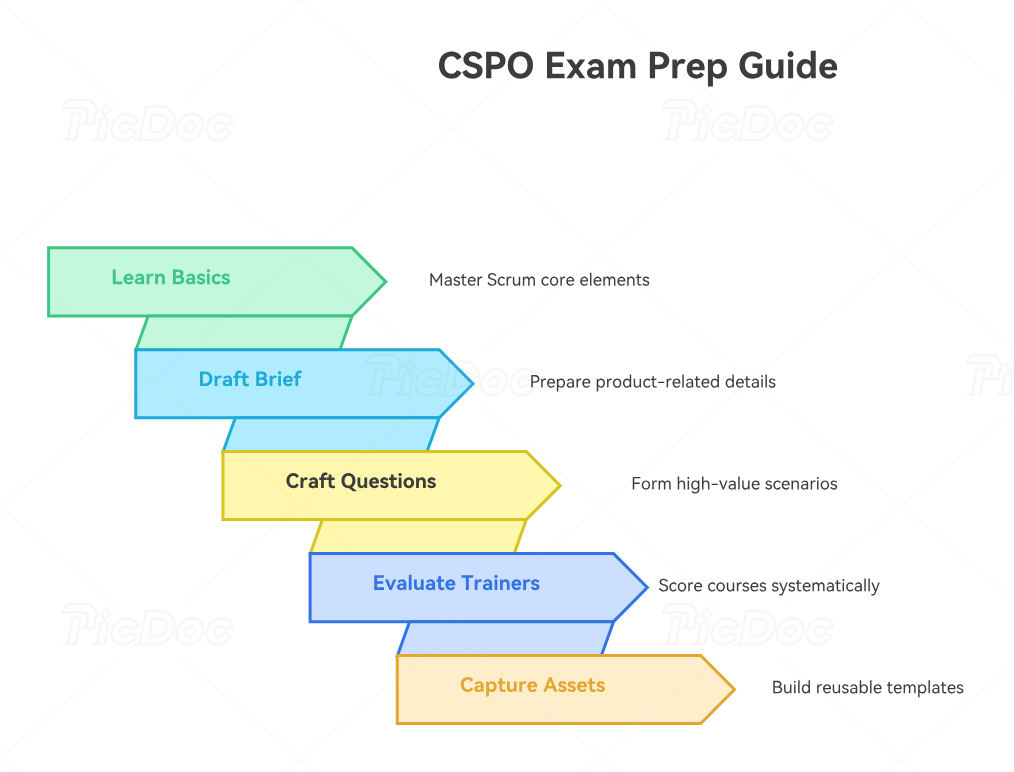
Start by learning the purpose of the Scrum accountabilities, events, and artifacts through the Scrum glossary, agile terminology guide, Sprint planning reference, and Product Backlog definitions. Focus on how the elements interact instead of memorizing isolated definitions.
Complete a pre-course product brief
Choose a real, hypothetical, or volunteer product and document:
The target customer
The painful problem or unmet need
Current customer alternatives
The intended business outcome
The proposed Product Goal
Five major assumptions
Three significant risks
A first-pass Product Backlog
Expected outcome metrics
Stakeholders who can support or block progress
This brief gives you concrete material for class exercises. It also exposes where you need stronger requirements knowledge, risk-register skills, stakeholder planning, and financial fluency.
Prepare high-value trainer questions
Generic questions produce generic answers. Bring situations with genuine tension:
How should a product owner respond when the chief executive bypasses backlog ordering?
How can one Product Backlog serve several stakeholder groups with conflicting goals?
When should technical risk move ahead of a visible customer feature?
How should a product owner communicate a forecast after scope or assumptions change?
What evidence makes a Product Goal strong enough to guide difficult decisions?
How should product ownership operate within procurement, regulatory, or fixed-contract environments?
How can one product owner support several teams without becoming a bottleneck?
How should AI-generated product insights be validated before influencing priorities?
These questions connect CSPO theory with vendor management, RFP and contract terminology, hybrid project management, and AI-enabled project work.
Evaluate trainers with a decision scorecard
Score each course from one to five across trainer experience, interactive practice, realistic cases, learner support, schedule suitability, class size, product-discovery coverage, backlog practice, stakeholder simulation, included resources, and total cost. Weight the factors according to your career gap.
A first-time product owner may prioritize foundational clarity and post-course support. An experienced business analyst may gain more from advanced discovery and prioritization exercises. A project manager moving into product work may need explicit guidance on the shift from schedule control toward outcome ownership. Review the distinction using project execution terminology, monitoring and control concepts, agile metrics, and future PM competencies.
Capture reusable assets during training
Finish the course with more than notes. Build templates for a product vision, Product Goal, stakeholder map, story map, prioritization model, experiment card, outcome dashboard, decision log, and product review. Adapt resources from project-management templates, Scrum tools, agile platforms, and project-management integrations.
For every framework introduced, record four things: the problem it solves, the conditions where it works, its failure risks, and one situation where you will apply it. This converts course content into operating capability.
5. Turning CSPO Certification Into Product Ownership Experience and Career Results
The credential can strengthen your profile, yet the largest career return appears when you quickly convert learning into visible evidence. Recruiters regularly encounter applicants who list CSPO while providing no proof of discovery, prioritization, backlog decisions, stakeholder management, or measurable product outcomes.
Build a product ownership portfolio
Create two or three concise case studies. Each case should show:
Product or service context
Customer group and problem
Research or evidence used
Product vision and Product Goal
Important assumptions and risks
Stakeholder conflicts
Prioritization method
Example backlog items
Release or experiment decision
Metrics selected
Results, learning, or next decision
Use sanitized workplace projects, volunteer assignments, personal products, or realistic simulations. A strong case study makes your judgment visible. It should demonstrate requirements analysis, stakeholder engagement, risk planning, and agile measurement.
Translate prior experience into product language
Many candidates already possess relevant evidence under different job titles. A business analyst who clarified requirements may have led problem discovery. A project manager who negotiated scope may have practiced value-based trade-offs. An operations specialist who redesigned a workflow may have owned an internal product outcome.
Rewrite experience around decisions and impact:
“Maintained Jira tickets” becomes “Ordered backlog items using customer impact, operational risk, and delivery dependencies.”
“Held stakeholder meetings” becomes “Resolved competing stakeholder priorities through evidence-based option analysis.”
“Collected requirements” becomes “Validated user problems and converted findings into testable product hypotheses.”
“Reported project status” becomes “Communicated product outcomes, forecast changes, risks, and decisions to sponsors.”
Support these claims with vocabulary from project reporting, leadership communication, conflict resolution, and project execution.
Create a 30-60-90-day post-certification plan
Days 1–30: Build foundations. Complete one portfolio case, improve your LinkedIn profile, rewrite your resume, observe a Scrum Team, and practice Product Backlog ordering. Review Scrum software, agile estimation, backlog terminology, and Sprint planning.
Days 31–60: Generate practical evidence. Facilitate a prioritization session, interview potential users, build a simple outcome roadmap, and define metrics for one product challenge. Ask for feedback from an experienced product manager, product owner, or agile coach.
Days 61–90: Test the market. Apply selectively, conduct mock interviews, refine your case studies, and target internal product opportunities. Compare roles through agile certification pathways, CAPM career guidance, PMP career resources, and future certification trends.
Prepare for product owner interviews
Interviewers often test how you think under ambiguity. Prepare stories covering:
A stakeholder demand you challenged
A priority you changed after receiving evidence
A feature you reduced, delayed, or rejected
A disagreement with developers
A failed assumption and subsequent learning
A forecast you revised
A customer insight that changed the solution
A metric that revealed weak product performance
Structure each response around context, evidence, options, decision, communication, outcome, and learning. This format demonstrates reasoning while drawing naturally on risk management, resource allocation, conflict resolution, and leadership communication.
Plan the longer certification pathway
CSPO can lead into Advanced Certified Scrum Product Owner and Certified Scrum Professional–Product Owner. Scrum Alliance currently requires A-CSPO candidates to hold a CSPO, complete approved advanced education, and validate at least 12 months of product-owner experience within the previous five years. CSP-PO later requires A-CSPO, approved education, and 24 months of relevant experience within the previous five years.
The experience requirements make early practice valuable. Track your product-owner work, dates, responsibilities, outcomes, and learning. Continue developing through advanced agile certifications, future PM skills, AI-driven project trends, and product-portfolio management.
6. Frequently Asked Questions About CSPO Certification
-
Yes. Scrum Alliance lists no formal prerequisites for the CSPO course, and prior Scrum, agile, software-development, or product-owner experience is not mandatory.
Beginners gain more when they study Scrum terminology, agile fundamentals, Product Backlog concepts, and Sprint planning beforehand. This preparation frees class time for application, discussion, and decision practice.
-
The required CSPO course contains 16 hours of instruction and may be delivered live online or in person. Providers frequently distribute those hours across two full days or several shorter sessions. Certification access follows successful course completion and completion of the required account steps.
Allow additional time for pre-course reading, trainer comparison, portfolio development, and post-course application. Learning agile estimation, stakeholder engagement, project reporting, and agile metrics deepens the practical value of the course.
-
CSPO operates on a two-year renewal cycle. Foundational Scrum Alliance certifications currently require 20 Scrum Education Units and a $100 renewal fee. One hour of qualifying learning generally equals one SEU. Eligible activities can include education, events, relevant reading, webinars, and volunteering.
You can develop renewal learning around future project-management competencies, AI in project management, hybrid delivery, and agile tool developments.
Scrum Alliance also allows certifications to be renewed by completing another Scrum Alliance certification course. Higher-level certifications can renew lower credentials within the applicable pathway.
-
CSPO offers strong value when the course supports a defined career or workplace objective. Suitable objectives include transitioning into product ownership, improving backlog decisions, gaining product vocabulary, strengthening stakeholder management, or preparing for the advanced Scrum Alliance product-owner track.
The value falls sharply when the candidate collects the badge without building experience. Evaluate expected return through role access, internal promotion potential, improved decision quality, and practical skill development. Compare CSPO with PMI-PBA certification, PMP certification resources, CAPM career use, and agile certification alternatives.
-
CSPO centers on product value, customer needs, Product Goals, stakeholder decisions, roadmaps, and Product Backlog ordering. CSM centers on Scrum facilitation, team effectiveness, coaching, impediment removal, and helping the Scrum Team apply Scrum effectively. Scrum Alliance describes CSPO as the product-focused route and CSM as the team-coaching route.
Choose according to the work you want to perform. Professionals drawn toward customer problems, investment decisions, and prioritization usually align with CSPO. Professionals drawn toward facilitation, team development, and Scrum effectiveness usually align with CSM. Review Scrum terminology, advanced Scrum Master certification, Scrum tools, and agile certification comparisons.
-
CSPO is issued by Scrum Alliance and currently requires an approved 16-hour trainer-led course with no examination. PSPO is issued by Scrum.org and uses an assessment-based certification model. Scrum.org’s PSPO I assessment requires an 85% passing score, while official training remains optional for candidates purchasing the assessment independently.
CSPO suits professionals seeking interactive instruction, exercises, peer discussion, and trainer guidance. PSPO suits professionals comfortable with independent study and formal assessment. Compare both against your learning style, employer preferences, experience level, and long-term pathway. Use the agile certification comparison, Scrum glossary, backlog guide, and agile metrics reference during evaluation.
