
Project manager interviews test your judgment when deadlines collapse, stakeholders disagree, budgets tighten, and teams lose direction. Strong candidates demonstrate how they identify problems, evaluate trade-offs, influence decisions, and deliver measurable outcomes. This guide covers 75 behavioral and scenario-based interview questions, practical answer frameworks, evidence hiring managers expect, and mistakes that weaken otherwise qualified applicants. Whether you're targeting your first PM position or advancing into senior project leadership, these questions will help you convert experience into credible interview answers supported by project governance and delivery performance.
1. What Are the Most Important Behavioral Project Manager Interview Questions? (Questions 1–15)
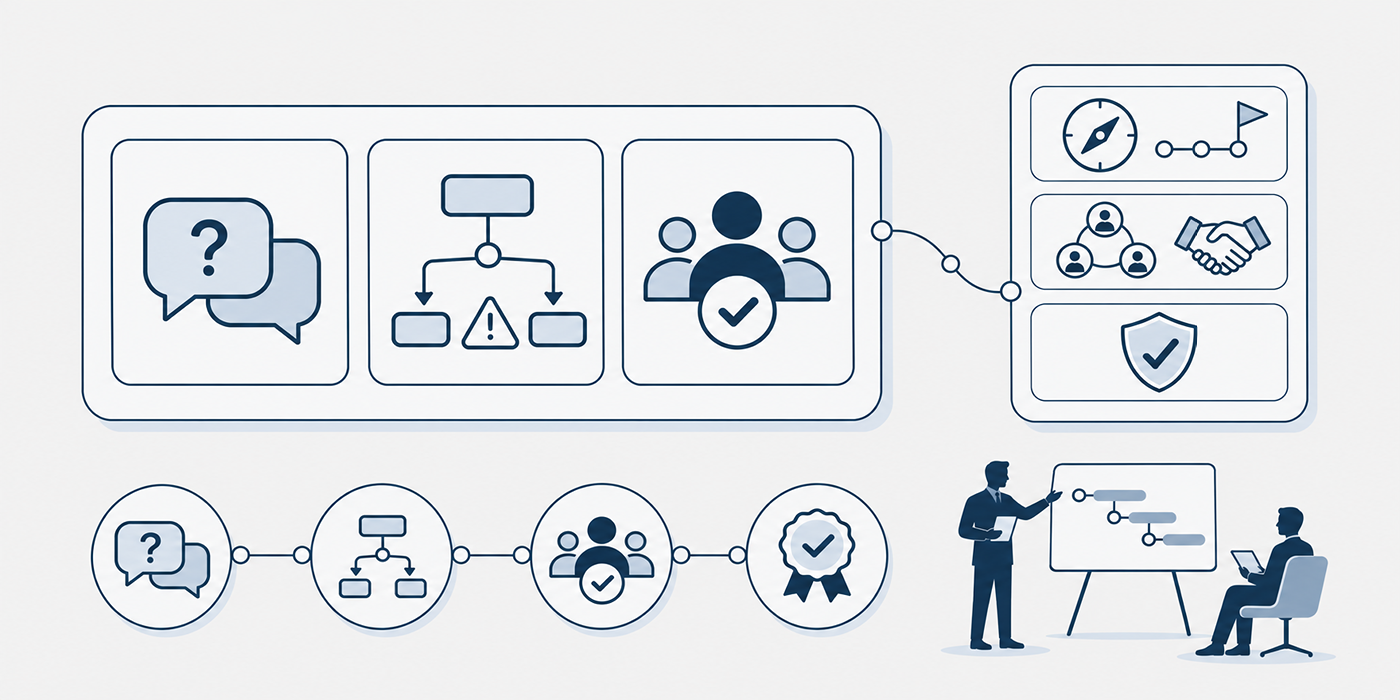
Behavioral questions require evidence from situations you have experienced. Interviewers want to understand what happened, what you personally did, what changed, and whether your decision-making would transfer to their organization.
The STAR framework provides a useful structure: Situation, Task, Action, and Result. A stronger project management answer adds a fifth element: the evidence supporting your result.
For example, saying you improved team communication provides little information. Explaining that you introduced a weekly decision review, reduced unresolved dependencies from 18 to 5, and improved milestone reliability demonstrates an observable management contribution.
Prepare stories that show stakeholder coordination, delivery accountability, performance measurement, and cross-functional leadership.
The answers below are adaptable frameworks. Replace illustrative details with achievements you can genuinely substantiate.
Leadership, Communication, and Team Management
1. Tell me about yourself and your project management experience.
Build a 60–90-second professional introduction around your delivery environment, scope of responsibility, and strongest measurable result. For example: "My background is in coordinating cross-functional technology initiatives, managing dependencies, and improving delivery visibility. My strongest contribution has been turning ambiguous priorities into accountable execution plans."
Connect your experience to the advertised role. Candidates transitioning from technical work can emphasize IT-to-project-management skills, while career changers can translate transferable project evidence.
2. Describe a project you managed from initiation to completion.
Choose one project with a clear objective, baseline, major constraint, and verifiable outcome. Explain how you clarified scope, established milestones, assigned responsibilities, controlled changes, and obtained final acceptance.
A compelling answer distinguishes personal decisions from team achievements. Mention the responsibility framework you used and how cost or schedule performance was measured.
3. Tell me about a time you led without formal authority.
Explain how you secured cooperation through shared objectives, credible evidence, and clear commitments.
For example, describe obtaining support from a functional manager who controlled resources but did not report to you. Show how you negotiated priorities and agreed on delivery responsibilities through cross-functional accountability and appropriate governance escalation.
4. Describe a conflict between two stakeholders. How did you resolve it?
Use a conflict involving competing requirements rather than personality differences. Establish each stakeholder's underlying concern, the decision criteria, and the authority responsible for resolving the disagreement.
An effective example might involve balancing regulatory controls against launch speed. Explain how you structured the decision using project governance principles and clarified decision ownership.
5. Tell me about a time you delivered difficult feedback.
Describe a specific performance concern and the evidence used to address it. Explain how you discussed expectations privately, agreed on corrective actions, and monitored improvement.
Hiring managers value respectful accountability. A strong answer shows how you addressed the problem without creating unnecessary project team burnout or losing clarity about task ownership.
6. How have you handled an underperforming team member?
Begin by diagnosing the cause: unclear expectations, missing skills, insufficient capacity, conflicting priorities, or disengagement.
Explain how you established measurable improvements, provided support, and escalated persistent performance problems through the appropriate manager. Connect your response to resource accountability and sustainable project workload management.
7. Describe a time your team was demotivated.
Explain the underlying conditions and your specific intervention. Perhaps the team faced repeated scope changes, unrealistic commitments, or unclear success criteria.
Show how you restored achievable priorities, improved decision-making, and protected focused work. Highlight improvements in Agile team collaboration or reduced the firefighting patterns damaging morale.
8. Tell me about managing a remote or geographically distributed team.
Discuss time-zone overlap, decision documentation, asynchronous updates, and escalation coverage.
Strong examples show how you prevented delays caused by unavailable decision-makers. Demonstrate methods relevant to remote project management careers and the expectations of legitimate remote PM positions.
9. Describe a situation where new evidence changed your original decision.
Choose an instance involving an estimate, requirement, technical assumption, or supplier commitment.
Explain your original rationale, the evidence that invalidated it, and how you corrected the plan. Interviewers are looking for disciplined adaptation supported by predictive project analysis and documented governance decisions.
10. Tell me about a professional mistake you made.
Choose a genuine mistake with consequences you can explain. Identify the decision or omission you personally controlled.
For instance, you might describe accepting an unverified dependency date, then introducing formal evidence checks afterward. Demonstrate changes to your project planning methods and governance controls.
11. Describe a time your project missed a deadline.
Explain whether the deadline was an approved baseline, an internal target, or a supplier commitment. Identify the causes and quantify the variance.
Describe how you updated the forecast, communicated consequences, and recovered deliverables where possible. Use schedule performance indicators and forecasting techniques to substantiate your answer.
12. Tell me about working with people from different professional or cultural backgrounds.
Choose an example where communication conventions, decision processes, or working practices created a genuine challenge.
Explain how you adjusted documentation, meeting design, and approval expectations. This demonstrates skills relevant to global project management leadership and international development projects.
13. Describe a time you escalated a problem that others preferred to ignore.
Identify the business consequence, evidence, and latest safe decision date.
Explain how you proposed alternatives while avoiding unnecessary blame. Hiring panels value the ability to challenge optimistic reporting using transparent project governance and reliable performance data.
14. Tell me about competing priorities and how you managed them.
Describe the competing demands, available resources, critical deadlines, and business-value consequences.
Show how you obtained an explicit prioritization decision instead of promising everything. This demonstrates the judgment needed for program-level coordination and executive project leadership.
15. What is the most valuable lesson you learned from a completed project?
Select a lesson that changed a repeatable process. Describe the original problem, supporting evidence, revised control, and later results.
Examples include stronger acceptance criteria, earlier supplier validation, or clearer escalation thresholds. Connect the improvement to standardized project templates and better governance practices.
| Interview Competency | What a Strong Answer Demonstrates | Evidence to Prepare | Weak Answer Warning |
|---|---|---|---|
| 1. Project ownership | Clear responsibility across initiation, execution and closure. | Approved charter, baseline, acceptance record. | Describes team activity without personal decisions. |
| 2. Scope control | Requirements traceability and controlled change decisions. | Change request and impact assessment. | Agrees to changes before assessing consequences. |
| 3. Schedule recovery | Critical-path analysis and realistic recovery choices. | Updated schedule and revised forecast. | Promises overtime without evaluating feasibility. |
| 4. Budget management | Explains cost variance and remaining funding needs. | CPI, EAC or variance record. | Quotes spend without comparing against earned progress. |
| 5. Risk management | Early identification, response ownership and triggers. | Risk register and mitigation evidence. | Only reacts after risks become issues. |
| 6. Issue resolution | Recovery actions with independent closure verification. | Issue log, test result and acceptance. | Calls the issue closed when a fix is merely proposed. |
| 7. Dependency control | Clear handoffs, receiving owners and due dates. | Dependency tracker and agreed commitments. | Assumes another team will deliver automatically. |
| 8. Stakeholder conflict | Uses decision criteria and appropriate authority. | Decision log and agreed resolution. | Claims everyone became happy without trade-offs. |
| 9. Executive reporting | Presents exceptions, impacts and decisions concisely. | Steering committee briefing. | Overloads leaders with routine task detail. |
| 10. Influencing skills | Secures commitments without relying on hierarchy. | Cross-functional agreement and outcome. | Equates influence with issuing instructions. |
| 11. Team development | Diagnoses capability gaps and improves performance. | Coaching plan and measurable improvement. | Blames individuals without examining constraints. |
| 12. Resource planning | Balances capacity, priority and delivery commitments. | Capacity plan and allocation decisions. | Assumes resources are available at full capacity. |
| 13. Procurement | Manages supplier obligations and contract boundaries. | Statement of work and supplier scorecard. | Changes supplier scope informally. |
| 14. Quality assurance | Uses acceptance criteria and verified test outcomes. | Defect report and signed acceptance. | Confuses testing completion with product acceptance. |
| 15. Business analysis | Turns ambiguous needs into testable requirements. | Requirements traceability or mapping document. | Starts development before resolving contradictions. |
| 16. Change adoption | Plans communications, training and operational readiness. | Readiness checklist and adoption measures. | Assumes technical deployment equals business adoption. |
| 17. Governance | Applies decision rights, gates and audit trails. | Approval history and exception register. | Bypasses controls to make a deadline. |
| 18. Compliance | Identifies mandatory obligations and escalation paths. | Compliance evidence and control validation. | Treats regulatory failures as ordinary scheduling trade-offs. |
| 19. Security awareness | Understands data protection and access risks. | Security review and remediation acceptance. | Shares confidential information through unapproved tools. |
| 20. Agile planning | Uses feedback, prioritization and empirical forecasts. | Backlog, velocity history and review decisions. | Promises fixed output from uncertain velocity. |
| 21. Hybrid delivery | Aligns iterative work with contractual or regulatory gates. | Integrated plan and acceptance milestones. | Uses one delivery method mechanically everywhere. |
| 22. Remote leadership | Maintains visibility across locations and time zones. | Decision cadence and response-time controls. | Relies on meetings without documented ownership. |
| 23. Data literacy | Interprets metrics and recognizes misleading signals. | Trend analysis and corrective decision. | Reports numbers without explaining consequences. |
| 24. AI judgment | Uses automation with verification and security boundaries. | Reviewed AI-assisted workflow. | Trusts generated summaries without checking sources. |
| 25. Vendor negotiation | Balances commercial terms and delivery exposure. | Negotiated recovery plan or contract variation. | Makes commitments outside delegated authority. |
| 26. Crisis leadership | Stabilizes operations, assigns decisions and protects customers. | Incident timeline and recovery evidence. | Prioritizes presentation quality over recovery actions. |
| 27. Benefits realization | Connects deliverables with measurable business outcomes. | Benefits baseline and post-launch indicators. | Declares success solely because deployment occurred. |
| 28. Ethical judgment | Maintains truthful reporting under pressure. | Documented escalation and approved decision. | Manipulates estimates or conceals exceptions. |
| 29. Career transferability | Shows authentic PM-equivalent responsibilities. | Cross-functional project artifacts and outcomes. | Relies entirely on job titles or certifications. |
| 30. Strategic alignment | Prioritizes investment against organizational value. | Business case and benefits assessment. | Optimizes project tasks while ignoring strategic priorities. |
2. How Should You Answer Project Delivery, Budget, Scope, and Scheduling Scenarios? (Questions 16–30)
Scenario questions test your approach to unfamiliar problems. Interviewers expect a clear decision sequence, an understanding of trade-offs, and recognition of when authorization is required.
A strong structure is assess → quantify → propose options → obtain decisions → implement → verify.
For delivery-related scenarios, demonstrate familiarity with earned value calculations, project templates, governance controls, and predictive scheduling.
Scope, Deadlines, and Resources
16. A sponsor requests additional features halfway through the project. What do you do?
Clarify the business benefit and assess effects on scope, schedule, cost, risk, and quality. Present options such as replacing lower-priority features, increasing approved capacity, or moving delivery dates.
Route the decision through the appropriate change-control process and update requirements traceability after authorization.
17. Your sponsor insists on an unrealistic deadline. How would you respond?
Estimate the work, identify critical dependencies, and explain what is achievable with available capacity.
Offer viable alternatives: reduced scope, phased delivery, additional resources where effective, or a revised deadline. Document assumptions and obtain an explicit decision. Support your recommendation with schedule forecasts and governance authority.
18. A critical-path activity is running two weeks late. What is your recovery plan?
Recalculate the network and verify whether the activity remains critical. Identify the actual cause, resource constraints, successor impacts, and available float elsewhere.
Evaluate fast-tracking, crashing, or re-sequencing with their cost and risk implications. Rebaseline only when properly authorized. Reference performance forecasting and project cost implications.
19. A project has CPI = 0.80 and SPI = 0.90. What would you tell management?
The project is experiencing cost inefficiency and has earned less budgeted work than planned.
Explain that CPI indicates approximately $0.80 of earned value per dollar spent, while SPI of 0.90 indicates schedule underperformance in earned-value terms. Investigate drivers and prepare an estimate at completion for the next governance review.
20. Your critical vendor announces a delivery delay. What happens next?
Confirm the revised delivery date, contractual obligations, downstream dependencies, and available alternatives.
Request a supplier recovery plan with measurable checkpoints. Assess whether substitute outputs or parallel activities can protect the schedule. Escalate material impacts through supplier governance and update the integrated delivery forecast.
21. Project requirements are unclear, but development has already started. What do you do?
Identify which decisions are genuinely ambiguous and which work can safely continue.
Bring business owners and delivery leads together to resolve acceptance criteria, document assumptions, and assess rework exposure. Update the backlog or baseline as applicable. Explain how business analysis practices and responsibility clarity prevent recurring ambiguity.
22. A customer changes acceptance criteria during user acceptance testing. How do you handle it?
Compare the requested criteria against approved requirements and the agreed acceptance baseline.
Determine whether the change corrects a genuine defect, clarifies an existing requirement, or adds new scope. Assess rework and approval requirements. Protect formal acceptance governance while maintaining requirements traceability.
23. Two projects need the same specialist during the same week. What do you do?
Quantify the effect of each allocation option on delivery commitments, business value, and critical milestones.
Ask the authorized portfolio or resource decision-maker to prioritize. Consider sequencing, approved substitutes, or partial allocation only when practical. Demonstrate program-level resource management and formal accountability assignments.
24. You inherit a project with no reliable schedule or budget baseline. What is your first move?
Establish the current factual position: approved objectives, completed deliverables, outstanding commitments, actual expenditure, and contractual deadlines.
Validate a realistic forecast, identify urgent exposures, and propose controlled re-planning. Avoid presenting invented progress percentages. Use project planning templates and financial performance methods to rebuild visibility.
25. A critical defect appears the day before go-live. What do you do?
Assess severity, customer exposure, reproducibility, containment options, and rollback readiness.
Determine whether the defect breaches mandatory release criteria. Present a go/no-go recommendation supported by test evidence and clearly identified residual risks. Follow security and quality governance and established approval authority.
26. You are assigned a project without an approved charter. How would you begin?
Clarify the sponsor, business problem, intended outcomes, boundaries, major constraints, and decision rights.
Prepare a charter or equivalent initiation agreement before making substantial commitments. Align the work with project governance and use appropriate project documentation templates to obtain authorization.
27. What factors determine your final go/no-go recommendation?
Evaluate readiness against predefined acceptance criteria: critical defects, operational support, security, data integrity, regulatory approval, contingency capability, and stakeholder authorization.
Distinguish manageable residual risks from unmet mandatory conditions. Prepare a decision pack supported by delivery governance and technical risk controls.
28. A contractor demands extra payment for work you believe is included in scope. What do you do?
Review the statement of work, acceptance criteria, assumptions, change history, and contractual dispute process.
Separate genuine additional scope from disputed interpretation. Document the facts and involve the authorized procurement or legal function. Maintain contract governance and clear scope requirements.
29. Several dependencies are approaching their due dates without confirmation. How do you manage them?
Identify supplying teams, receiving teams, committed dates, latest acceptable dates, and acceptance criteria.
Escalate forecast slippage before successor activities lose float. Link the dependency tracker to responsibility assignments and schedule risk analysis.
30. What would you do during your first 30 days managing an unfamiliar project?
Meet the sponsor, team leads, customers, and key suppliers. Validate objectives, delivery commitments, open risks, decision rights, financial status, and stakeholder expectations.
Then establish a concise execution cadence with accountable owners and priority actions. Use standard project controls and practical stakeholder governance.
3. What Risk, Stakeholder, and Governance Scenarios Do Hiring Managers Ask? (Questions 31–45)
Senior interview panels often distinguish candidates who can manage tasks from those who can protect business outcomes.
They look for early-warning judgment, responsible escalation, ethical conduct, and an understanding of who can authorize consequential decisions.
These scenarios connect particularly strongly with project governance leadership, risk forecasting, cybersecurity project management, and executive-level project responsibility.
Risk Decisions, Transparency, and Executive Accountability
31. How would you explain the difference between a risk and an issue?
A risk concerns an uncertain future event; an issue concerns a condition that has already occurred.
Use a clear example: possible supplier failure is a risk; a confirmed missed delivery is an issue. Explain the differing responses using project risk governance and forward-looking forecasts.
32. A cybersecurity risk is unlikely but could cause severe damage. How do you prioritize it?
Assess probability, potential consequences, contractual exposure, regulatory obligations, and mandatory control requirements.
A low probability score may still require immediate mitigation or escalation when consequences are unacceptable. Demonstrate awareness of project cybersecurity risks and developing security governance requirements.
33. What information belongs in a steering committee report?
Include milestone forecasts, material budget variance, critical risks, unresolved decisions, major changes, and the specific approvals required.
Use trend information to distinguish improving conditions from worsening exposure. Leaders need actionable exceptions rather than task inventories. Support reports with earned value measures and established executive governance processes.
34. Your sponsor ignores an urgent escalation. How do you proceed?
Confirm that the sponsor received a concise explanation of the impact, available options, and deadline for action.
Follow the documented escalation path when the response window expires. Preserve the decision history and protect immediate operational responsibilities. Demonstrate respect for governance authority and executive accountability.
35. Two senior stakeholders demand incompatible project outcomes. What would you do?
Translate both requests into measurable requirements and assess feasibility, budget, deadlines, and strategic value.
Present the trade-offs to the authorized decision-maker. Confirm the outcome in writing and update affected commitments. This demonstrates stakeholder accountability and mature project governance.
36. You discover potential regulatory noncompliance halfway through delivery. What happens next?
Contain further exposure where appropriate and involve the designated compliance, legal, or security authority.
Assess affected deliverables, reporting obligations, corrective measures, and approval requirements. Preserve evidence and update the plan. Demonstrate competence in risk-controlled delivery and formal project governance.
37. A project delivered every requirement but failed to produce expected business benefits. Was it successful?
Explain the difference between project output and business outcome.
Confirm what the project was authorized to deliver, then evaluate adoption, operational readiness, and measurable benefits against the business case. Identify the benefits owner and corrective opportunities. This distinction becomes especially important in program management and executive project leadership.
38. A critical project assumption turns out to be false. What should you do?
Document the new evidence, identify affected estimates and commitments, and quantify the consequences.
Determine whether the invalid assumption has already caused an issue or creates additional risks. Obtain authorization for material plan changes through project governance and revise the delivery forecast.
39. You inherit a risk register containing 50 outdated entries. How do you improve it?
Validate critical items against the current project objectives, identify duplicate or expired concerns, and assign owners to unresolved material risks.
Introduce consistent scoring, review dates, mitigation triggers, and closure evidence. Improve the register using standardized project resources and risk analytics.
40. How do you communicate bad news to senior leadership?
Lead with the verified problem, business consequence, and decision deadline.
Explain what is known, what remains uncertain, and which options are available. Assign the next action clearly. This demonstrates the reporting discipline required for senior project governance and executive stakeholder management.
41. A manager asks you to manipulate progress reporting to make the project appear on schedule. What do you do?
Maintain accurate reporting, explain the professional and organizational consequences, and document the actual position.
Offer a realistic recovery forecast and escalate inappropriate pressure through authorized channels. Demonstrate that performance reporting and project governance integrity remain reliable under pressure.
42. A possible customer-data exposure occurs during testing. What are your immediate priorities?
Activate the applicable incident process, limit further exposure, preserve evidence, and involve the designated security and privacy specialists.
Coordinate project impacts without conducting unauthorized investigations or making premature assurances. Apply cybersecurity project controls and appropriate security escalation procedures.
43. Executives suddenly change strategic priorities. How do you respond?
Reassess project value, dependencies, contractual commitments, resource allocation, and opportunities to stop or defer work responsibly.
Present the financial and operational consequences of each option before changing approved baselines. Connect the response to portfolio-level coordination and executive strategic leadership.
44. A vendor rejects responsibility for a major delivery defect. What would you do?
Establish the technical facts, relevant acceptance criteria, contract obligations, and defect history.
Maintain a joint resolution process while preserving contractual rights and documented evidence. Escalate unresolved commercial disputes appropriately. Use requirements traceability and supplier governance.
45. Two projects in the same portfolio are competing for funding. How should the decision be made?
Compare expected benefits, strategic alignment, urgency, regulatory obligations, delivery risks, and the consequences of deferral.
Present comparable assumptions and decision criteria rather than advocating solely for your own project. This illustrates the judgment expected in program management and portfolio-oriented executive leadership.
4. What Agile, Hybrid, Remote, and AI Project Management Scenarios Should You Prepare? (Questions 46–60)
Modern PM interviews increasingly examine how candidates choose delivery methods, coordinate distributed teams, and evaluate technology.
The essential skill is selecting an approach appropriate to uncertainty, contractual obligations, team capacity, and business objectives.
A strong candidate understands Agile delivery, scaled Agile practices, software integrations, and the limitations of AI-assisted project workflows.
Agile Delivery and Technology Judgment
46. When would you choose Agile over predictive project management?
Evaluate requirement stability, stakeholder availability, technical uncertainty, delivery frequency, and external constraints.
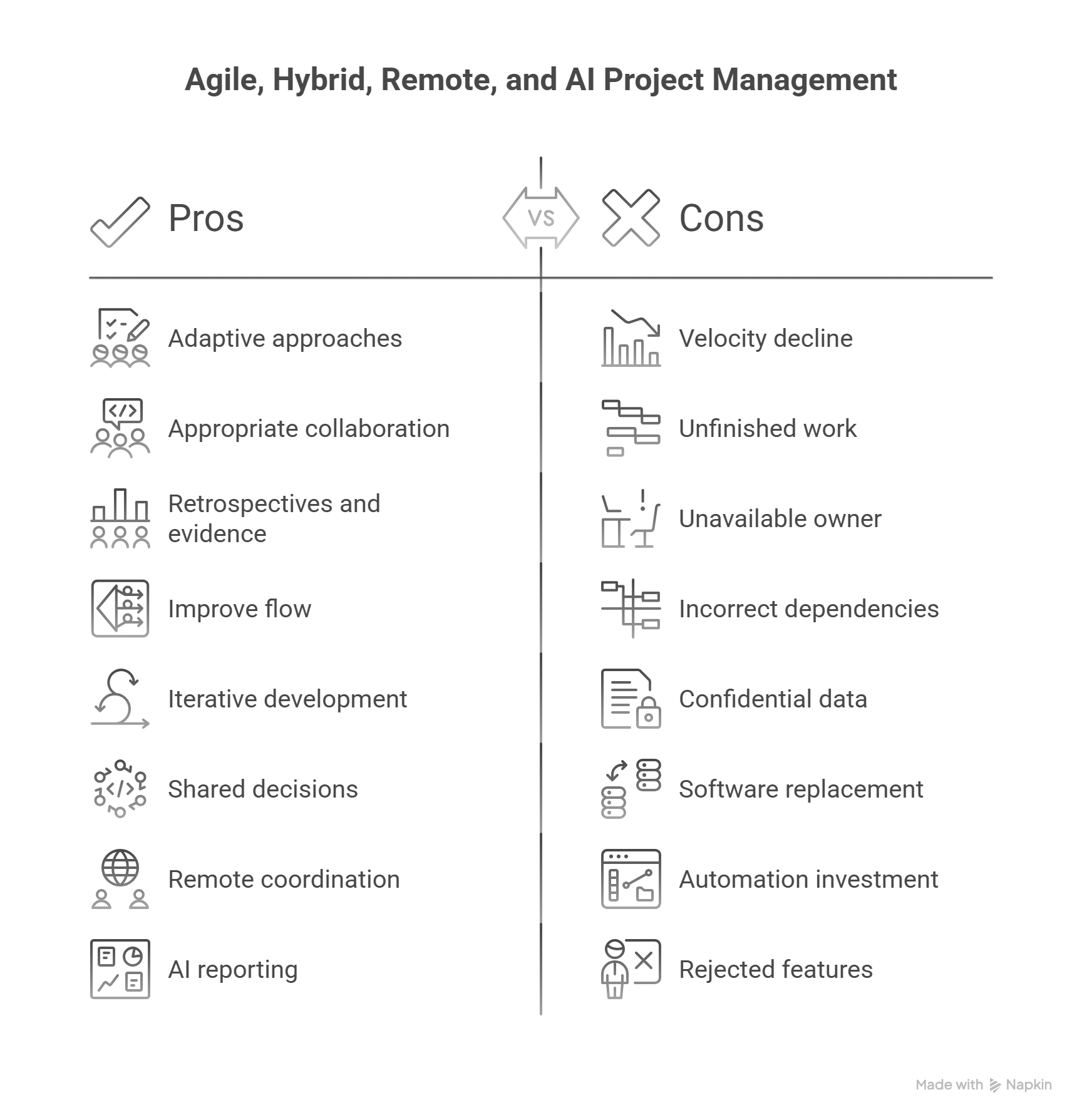
Adaptive approaches suit work that benefits from frequent learning and reprioritization. Predictive planning is useful when requirements and dependencies can be established reliably. Show how you select a method using Agile transition principles and project governance requirements.
47. A product owner wants urgent new work added halfway through a sprint. What do you do?
Clarify urgency and business impact, then involve the team in assessing current sprint goals and capacity.
For Scrum, changes should preserve the Sprint Goal and be handled through appropriate collaboration and backlog decisions. Demonstrate Agile team coordination and scaled prioritization practices.
48. Your Agile team's velocity has dropped for three consecutive sprints. What do you investigate?
Examine changing team capacity, story slicing, technical debt, blocked work, defect load, and shifting estimation practices.
Avoid using velocity as an individual performance target. Look for causes through retrospectives and delivery evidence. Use Agile management methods and predictive delivery analytics.
49. A Kanban team keeps starting work but rarely finishes items. How would you improve the process?
Measure work in progress, cycle time, throughput, blockers, and waiting time.
Introduce appropriate WIP limits and improve flow through bottlenecks. Evaluate results using completed work rather than activity volume. Connect the approach with Agile workflow practices and operational performance leadership.
50. How would you manage a hybrid project with fixed compliance gates and Agile development?
Establish fixed contractual or regulatory milestones while allowing iterative development within authorized boundaries.
Connect backlog outcomes to formal acceptance, security, integration, and deployment gates. Manage dependencies through an integrated plan. Demonstrate hybrid delivery judgment and regulated project governance.
51. The product owner is frequently unavailable. What problems does this create, and how would you respond?
Identify delayed decisions, unclear priorities, weak acceptance criteria, and accumulated rework.
Agree on decision availability, delegated authority where appropriate, and prioritized backlog refinement. Escalate chronic gaps through established channels. Reference Agile stakeholder responsibilities and decision accountability.
52. How would you manage teams across three time zones?
Create predictable overlap windows for consequential decisions and use asynchronous documentation for routine coordination.
Set response expectations, maintain a shared decision register, and define escalation coverage. Demonstrate experience relevant to global project management and remote delivery roles.
53. How would you use AI to improve project status reporting?
Use approved tools to consolidate source updates, identify overdue actions, draft exception summaries, and highlight inconsistencies.
Validate generated claims against authoritative project records before publishing. Maintain human accountability for interpretations and decisions. Explain practical AI reporting workflows alongside project management integration controls.
54. An AI-generated project plan contains incorrect dependencies. What would you do?
Verify the activity network against approved requirements, actual handoffs, constraints, and resource availability.
Correct the plan before using it for commitments. Introduce validation checks for future generated outputs. This demonstrates awareness of AI automation limitations and the importance of schedule forecasting accuracy.
55. A team member uploads confidential project data to an unapproved AI tool. How do you respond?
Follow the organization's security incident process, involve the designated specialists, and establish the exposure details through authorized channels.
Contain further sharing, preserve appropriate evidence, and implement corrective controls. Reference cybersecurity risk management and emerging AI-related security considerations.
56. Your organization wants to replace its project management software. What would your evaluation include?
Define workflow requirements, integration needs, security standards, migration effort, reporting capabilities, training requirements, and total cost.
Pilot representative use cases before committing. Use lessons from project management API integration and applicable software evaluation practices.
57. How would you decide whether automating project administration is worth the investment?
Estimate recurring time saved, implementation costs, error reduction, maintenance needs, security risks, and expected adoption.
Compare credible alternatives using a measurable business case. Include review costs and exceptions requiring human judgment. Draw on AI project management workflows and automation opportunities.
58. Stakeholders repeatedly reject features during demonstrations. How do you improve delivery?
Investigate whether the problem is unclear requirements, missing stakeholder participation, weak acceptance criteria, or poor product discovery.
Use earlier feedback checkpoints, concrete examples, and shared definitions of acceptance. Strengthen business analysis practices and Agile stakeholder collaboration.
59. Two Agile teams have very different velocities. Which team is performing better?
Explain that story points are locally calibrated and velocity does not reliably compare performance across unrelated teams.
Evaluate outcomes such as quality, predictability, value delivered, throughput under comparable conditions, and customer impact. Apply scaled Agile coordination and appropriate performance analytics.
60. How would you coordinate Agile development with a fixed enterprise release date?
Work backward from deployment gates, integration testing, compliance approvals, and operational readiness.
Forecast delivery using actual capacity and establish dates when scope decisions must occur. Protect mandatory acceptance criteria while enabling iterative feature delivery. Connect Agile execution with formal governance milestones.
5. What Senior-Level, Failure-Recovery, and Career-Transition Questions Should You Expect? (Questions 61–75)
Final-round interviews often test commercial judgment, professional maturity, and readiness for the organization's actual environment.
Candidates moving from coordinator to project manager, project manager to program manager, or specialist to delivery leader face different expectations. Their answers should show a credible progression of responsibility.
Use evidence appropriate to your background and target role. Helpful preparation includes entry-level PM career comparisons, career progression to program leadership, executive career development, and project management salary research.
Senior Judgment and Career Readiness
61. What is the strongest measurable result you have achieved as a project manager?
Choose an outcome with a credible baseline and your identifiable contribution.
Examples include reducing delivery cycle time, recovering a critical milestone, controlling budget exposure, or improving adoption. Explain how the result was verified through project performance indicators or operational outcome measures.
62. Describe a project that was failing and how you helped recover it.
Explain the early-warning signs, root causes, immediate stabilization actions, decision process, and final outcome.
Include the cost of recovery and any remaining compromises. Avoid claiming a perfect result when significant consequences remained. Demonstrate credible recovery forecasting and senior governance judgment.
63. Your project budget is reduced by 20%. How would you respond?
Reassess contractual obligations, committed expenditure, remaining work, expected benefits, and minimum viable outcomes.
Present reprioritization options with cost and schedule consequences. Obtain approval for material changes. Show how budget forecasting and program-level prioritization support the recommendation.
64. A colleague publicly blames you for a problem outside your control. How do you handle it?
Address the project impact first and clarify the facts using the decision history, ownership records, and evidence.
Resolve the interpersonal disagreement privately where practical. Maintain professional accountability without accepting inaccurate responsibility. Demonstrate RACI-based ownership and effective stakeholder leadership.
65. A sponsor asks you to exclude an important risk from the executive report. What do you do?
Clarify the reason for the request and explain the potential consequences of incomplete reporting.
Preserve accurate risk information and follow applicable reporting and escalation rules. Offer concise, contextualized disclosure with mitigation options. Show professional integrity through risk governance and executive accountability.
66. You have 60 seconds to brief the CEO on a troubled project. What would you say?
Use four elements: current position, business impact, recommended response, and required decision.
For example: "The launch is forecast two weeks late because supplier integration failed. Customer onboarding will be affected. We recommend phased deployment with additional validation. Approval is required today to preserve the alternative release window."
Connect the briefing to forecast evidence and executive project governance.
67. How do you decide when to challenge a senior leader's decision?
Challenge decisions when credible evidence shows material business, contractual, safety, security, or delivery consequences.
Present the facts respectfully, explain alternatives, and identify the responsible authority. Record decisions appropriately. This demonstrates the professional maturity expected of senior project management consultants and project governance leaders.
68. Why should we hire you when you have never held the title "Project Manager"?
Map your actual experience against the role's responsibilities: planning deliverables, coordinating stakeholders, controlling deadlines, resolving risks, and securing acceptance.
Provide two concise examples with verifiable outcomes. Candidates can use transferable project experience and junior PM role comparisons to present a credible case.
69. How does your previous career prepare you for project management?
Identify strengths directly applicable to delivery. Business analysts may emphasize requirements, stakeholder decisions, and change impact; engineers may emphasize technical dependencies, quality, and integration.
Explain the additional management capabilities you have developed. Use relevant business analyst transition guidance or IT-to-PM career planning.
70. Do you need a PMP certification to become an effective project manager?
Explain how experience, demonstrated judgment, and relevant professional development contribute to competence.
Describe certifications accurately as evidence of structured learning and assessment rather than guarantees of delivery performance. Discuss their relevance through PMP exam domains and PMP versus PRINCE2 comparisons.
71. Why do you want to manage projects in our industry?
Identify the industry's genuine delivery constraints: regulatory approvals, technical complexity, customer expectations, supplier structures, or operational risks.
Connect those challenges to your demonstrated strengths. A technology applicant might discuss cybersecurity delivery risks, while a construction-oriented candidate might evaluate industry-specific PM differences.
72. What would your 30-60-90-day plan look like?
During the first 30 days, validate objectives, constraints, stakeholders, current performance, and major risks.
By day 60, strengthen delivery controls and resolve the most consequential ownership or forecasting gaps. By day 90, demonstrate measurable improvement and a credible forward plan.
Adapt the approach using project governance methods and delivery performance measures.
73. What is your biggest professional weakness as a project manager?
Choose a genuine limitation you have actively addressed.
For example, you may have previously provided overly detailed status reports, then adopted concise exception-based reporting with clearer decision requests. Explain the improvement and supporting evidence.
Keep the answer grounded in real development, drawing on project reporting practices and mature stakeholder communication.
74. What salary are you expecting for this project manager role?
Research compensation for comparable responsibilities, location, industry, organizational scale, and experience requirements.
Provide a defensible range when appropriate and explain your expectations through the role's scope and total compensation structure. Account for differences between industry pay patterns and remote project management roles.
75. What questions would you ask the interview panel?
Ask questions that reveal the position's real operating conditions:
Which project outcomes define success in the first six months?
What currently causes the greatest delivery uncertainty?
Which decisions can this project manager make independently?
How are scope changes and unresolved dependencies escalated?
How does leadership evaluate delivery performance beyond milestone completion?
These questions help assess governance maturity and identify potential high-stress PM environments.
The Final Interview Preparation Test
Before the interview, challenge your strongest stories with five follow-up questions:
What exactly were you responsible for?
Which evidence showed that action was necessary?
What alternatives did you reject, and why?
What did your decision cost or save?
How would the outcome have changed without your intervention?
Strong answers survive these questions because they demonstrate genuine responsibility.
Build a realistic portfolio of delivery evidence using project management templates, financial performance measures, responsibility matrices, and credible career-transition documentation.
6. Frequently Asked Questions About Project Manager Interviews
-
Common behavioral questions involve stakeholder conflict, difficult deadlines, missed commitments, resource shortages, leadership without authority, project recovery, and professional mistakes.
Employers ask these questions to evaluate how candidates make decisions when plans encounter resistance.
Prepare several reusable stories showing different competencies. Each should include the situation, your responsibility, actions, measurable outcome, and lessons that improved future delivery.
Candidates transitioning from other professions should emphasize transferable project achievements, while experienced managers should demonstrate governance decisions and financial accountability.
-
For a typical behavioral question, aim for approximately 60–120 seconds unless the interviewer requests greater detail.
Allocate most of the time to your actions, decisions, and results. Provide enough initial context to make the problem understandable.
An effective structure is brief situation and responsibility, specific actions, measurable outcome, and one relevant lesson.
Practice concise communication because the same skill supports executive reporting and effective stakeholder governance.
-
State the assumptions you would validate, identify the likely business impact, and describe a sensible decision sequence.
For example, when asked about a delayed supplier, explain how you would assess contractual commitments, downstream dependencies, recovery options, and escalation requirements.
Distinguish hypothetical judgment from achievements you have personally delivered.
Candidates can improve scenario reasoning through project planning resources, requirements analysis, and project governance techniques.
-
Metrics that connect delivery performance with business decisions are especially valuable.
Examples include schedule variance, cost performance index, estimate at completion, defect reduction, lead time, throughput, customer adoption, and benefits realization.
Explain the baseline, measurement method, actions taken, and verified result. Avoid quoting numbers without context.
Use earned value management, predictive project analytics, and Agile delivery practices to select metrics appropriate to your project environment.
-
Many employers evaluate candidates through experience, job-specific competency, industry knowledge, and the strength of their delivery examples. Certification requirements vary by role and organization.
A candidate without PMP should demonstrate an understanding of planning, scope, risk, stakeholder coordination, and accountability.
Candidates pursuing formal qualifications can explore PMP preparation, CAPM preparation, and PMP versus PRINCE2 while building evidence of practical responsibilities.
-
Junior PM interviews typically focus on coordination, documentation, communication, organization, and awareness of project controls.
Mid-level interviews demand evidence of managing delivery trade-offs, risks, budgets, teams, and stakeholders independently.
Senior interviews emphasize strategic alignment, major financial exposure, executive influence, portfolio dependencies, and decisions under uncertainty.
Candidates can map their preparation to entry-level PM roles, program management progression, and executive project leadership.
