
The Ultimate Guide to Getting Your Project Management Certification in Canada: All You Need to Know in 2027-2028
Canada’s project management market rewards professionals who can convert strategy into controlled delivery, document decisions, manage stakeholders, and protect budgets. A certification can strengthen your position, provided you select one that matches your experience, industry, and target role. This guide explains how to choose between PMP, CAPM, PMI-ACP, and PRINCE2, document your eligibility, prepare efficiently, control costs, and turn the credential into interview-ready evidence for Canadian employers.

1. Choose the Right Project Management Certification for Your Career in Canada
The strongest certification is the one that closes the exact credibility gap standing between you and your target role. Before paying for training, study 20 to 30 Canadian job advertisements and record the certifications, delivery methods, software, industry knowledge, and years of experience employers repeatedly request.
Someone targeting a project coordinator position may gain more immediate value from CAPM and a portfolio built with project initiation terminology, project scheduling concepts, stakeholder engagement language, and project reporting practices. An experienced delivery leader should usually evaluate PMP, while a professional working in software, digital transformation, or product delivery may need PMI-ACP or Scrum capability beside a broader credential.
PMP: Best for experienced project leaders
The Project Management Professional credential suits professionals who already lead projects, own outcomes, manage cross-functional teams, and make delivery decisions. Its value comes from validating experience across predictive, agile, and hybrid environments rather than tying the candidate to one industry.
For Canadian roles involving transformation, infrastructure, financial services, telecommunications, healthcare, consulting, or government delivery, PMP preparation can strengthen your command of project risk terminology, budget management concepts, critical-path analysis, resource-allocation tools, and stakeholder management terms.
PMI currently lists several PMP eligibility routes based on education. Candidates need professional project leadership experience plus 35 hours of project management training. The required experience varies according to the applicant’s education, and overlapping project periods cannot be counted twice. The exam contains 180 questions and provides 240 minutes.
A common application mistake is describing operational duties instead of project leadership. “Attended status meetings” carries little weight. “Led requirements validation, controlled scope changes, coordinated vendor dependencies, escalated schedule threats, and obtained sponsor acceptance” demonstrates ownership. Study PMP exam domains, review common PMP mistakes, use credible PMP preparation resources, and examine successful candidate strategies before submitting the application.
Candidates testing in 2026 must align their study materials with their scheduled exam date. PMI launched its revised PMP examination on July 9, 2026, with greater emphasis on AI, sustainability, value delivery, and other future-focused topics. PMI has also announced planned changes to eligible live training providers for late Q4 2026, while self-paced training remains available through broader provider routes.
CAPM: Best for early-career professionals and career changers
CAPM is a practical route for graduates, coordinators, administrators, analysts, military leavers, newcomers to Canada, and professionals moving from operations into formal project work. It creates a structured vocabulary for scope, schedule, risk, cost, quality, business analysis, and agile delivery.
PMI requires a secondary degree or global equivalent and at least 23 hours of project management education. The current examination contains 150 questions and allows 180 minutes. Its content includes project fundamentals, predictive delivery, agile methodologies, and business analysis.
CAPM becomes more valuable when your resume also shows evidence. Build a small project charter using project management templates, create a schedule using Gantt chart terminology, prepare a risk register with risk-identification techniques, and produce a weekly dashboard using reporting and analytics tools.
CAPM candidates should use CAPM study resources, avoid common CAPM preparation errors, practise a structured CAPM exam-day routine, and understand how to use CAPM for career advancement.
PMI-ACP: Best for experienced agile practitioners
PMI-ACP works well for professionals who already participate in agile delivery and want broader validation than a single-framework credential. It covers agile principles and practices across approaches rather than focusing solely on Scrum ceremonies.
Current PMI eligibility routes include two years of agile experience within the previous five years, a qualifying accredited degree plus one year of agile experience, a third-party agile certification plus one year of agile experience, or an active PMP. Candidates also need 21 hours of formal agile training.
Prepare by understanding Scrum roles and responsibilities, comparing Scrum project management platforms, evaluating Kanban software, and studying the broader agile project management tool landscape.
PRINCE2: Best for structured governance environments
PRINCE2 suits professionals working in governance-heavy organizations where projects require formal stages, defined roles, business-case control, management by exception, and documented approvals. Foundation develops method knowledge, while Practitioner tests application and tailoring.
PRINCE2 Project Management Version 7 includes people management, sustainability, data, communication, principles, practices, and processes. Its Foundation examination is closed book, lasts 60 minutes, and currently requires a 60% passing score. Practitioner carries prerequisites and focuses on applying and tailoring the method.
Before choosing it, compare PRINCE2 and PMP, assess PRINCE2 career benefits, review PRINCE2 training providers, and understand common PRINCE2 exam pitfalls.
2. Confirm Your Eligibility and Build an Audit-Ready Application
Create an eligibility file before registering for a course. Include your education records, training certificates, project history, supervisor contacts, dates, responsibilities, and supporting project documents. This folder reduces application errors and protects you if the certifying body requests verification.
For every PMP project, record the objective, your leadership role, delivery approach, team composition, budget or scope level, major risks, decisions, and outcome. Use vocabulary from the top project management terms, while keeping each description specific to your actual work. Strengthen weak descriptions by reviewing scope and initiation concepts, project communication techniques, and stakeholder engagement terminology.
Use outcomes instead of duty lists
A weak entry says, “Managed project schedule and stakeholders.”
A stronger entry says, “Led a cross-functional implementation, established the approved baseline, resolved resource conflicts, governed vendor milestones, reported schedule variance to the sponsor, and secured operational acceptance.”
That wording demonstrates leadership across schedule management, vendor governance, conflict resolution, and project reporting.
Handle overlapping projects carefully
Applicants frequently overstate experience by adding the full duration of simultaneous projects. Build a monthly timeline showing which projects overlapped and calculate distinct calendar periods according to the certifier’s current rules. Keep a second sheet recording project-specific details, contacts, and evidence.
Your evidence may include approved charters, sanitized schedules, decision logs, risk registers, status reports, procurement records, closure documents, and performance summaries. Remove confidential information while preserving enough context to demonstrate the work. Templates from a project management resource library, risk-management glossary, budgeting guide, and quality-management guide can help you identify missing evidence.
Treat industry qualifications separately
Certification validates project management capability. Canadian employers may still expect sector-specific education, licences, technical knowledge, security clearance, language ability, or local regulatory experience.
Construction roles may prioritize construction technology, engineering exposure, site leadership, contracting, and safety knowledge beside project credentials. Canada’s Job Bank indicates that construction management roles commonly require relevant post-secondary education or extensive industry experience.
An IT project manager may need systems implementation experience, cybersecurity awareness, cloud knowledge, data governance, or business analysis. A healthcare project manager may need privacy, clinical workflow, procurement, change adoption, and patient-safety knowledge. Build domain credibility through construction PM software knowledge, project API and integration skills, dashboard literacy, and reporting analytics capability.
3. Prepare for the Exam With a High-Performance Study System
A productive study plan begins with the official exam content outline. Convert every domain and task into a tracker with four statuses: unfamiliar, understood, applicable, and exam-ready. “Understood” means you recognize the concept. “Applicable” means you can use it in a scenario. “Exam-ready” means you can choose the strongest response under time pressure.
Build your study cycle around five activities
1. Learn the framework. Study the official syllabus, terminology, processes, principles, and role expectations. Use PMP domain guidance, project scheduling terminology, procurement definitions, and stakeholder terminology to close language gaps.
2. Apply each concept. Convert theory into a decision. Ask what the project manager should assess first, which stakeholder owns the decision, what evidence is missing, which response protects value, and what action follows governance. Practise through risk-assessment concepts, contract-management terminology, team-building terminology, and conflict-resolution approaches.
3. Complete timed question sets. Start with short sets by domain, then use mixed sets, half-length simulations, and full mock examinations. Track errors by cause: knowledge gap, missed keyword, premature answer selection, framework confusion, time pressure, or poor elimination.
4. Maintain an error log. For each error, write the tested principle, your reasoning, the stronger reasoning, and the trigger you missed. This converts mistakes into reusable decision rules. Combine the log with PMP mistake prevention, CAPM mistake prevention, PRINCE2 pitfall analysis, and exam-day preparation.
5. Rehearse the exam environment. Use the same time of day, desk setup, breaks, calculator habits, and reading process planned for the real examination. Online candidates should test equipment, identification, room conditions, internet stability, and proctoring requirements early.
Use scenario logic instead of memorized slogans
Most difficult questions contain several reasonable actions. Select the response that fits the project’s current stage, authority structure, delivery method, urgency, and available evidence.
When a stakeholder raises a concern, determine whether the issue requires clarification, analysis, engagement, escalation, formal change control, or immediate protective action. When a supplier misses a milestone, review the agreement and evidence before choosing a remedy. When an agile team faces changing priorities, protect transparency and product-value decisions through the correct role.
Develop this judgement through RFP, RFQ, and RFI distinctions, vendor-management principles, Scrum responsibility guidance, and agile-tool comparisons.
Fix the highest-risk blocker first, then build the evidence, study system, and career assets around it.
4. Turn Your Certification Into Interviews With Canadian Employers
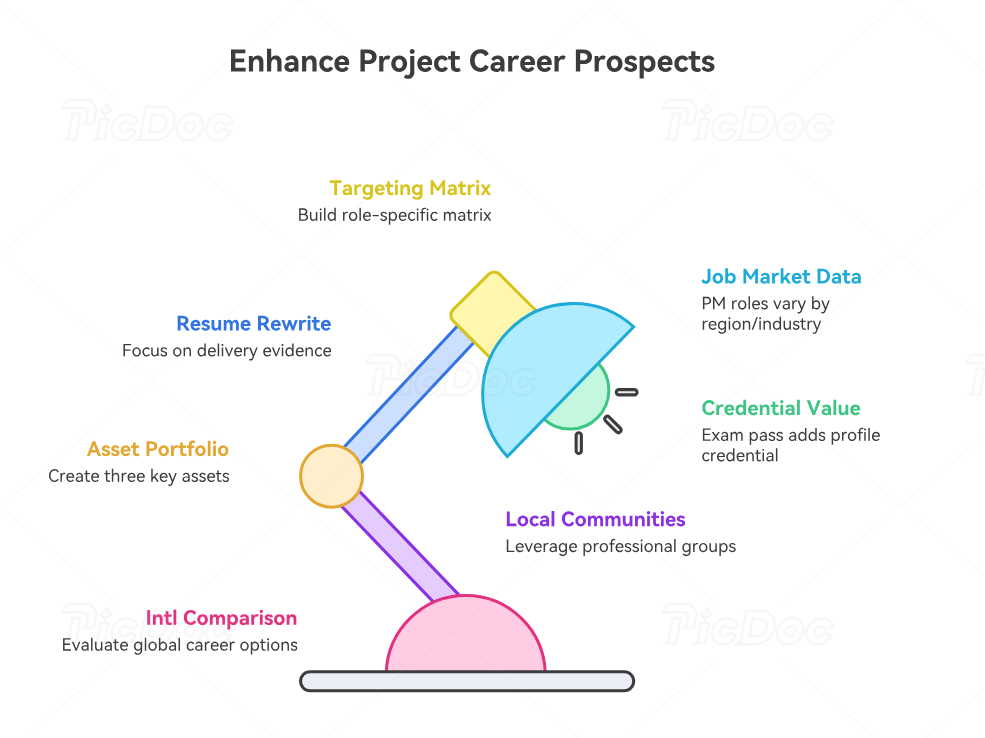
Passing the exam adds a credential to your profile. Career movement comes from translating that credential into evidence that employers can evaluate quickly.
Canada’s Job Bank shows that project-management-related requirements differ across occupational groups and provinces. For example, current IT project manager prospects range from moderate in several provinces to good in others, while some non-technical project roles explicitly state that employers may require project management certification.
Build a Canadian job-targeting matrix
Create one row for every target role and capture:
Province and city
Industry
Required certification
Required delivery method
Technical or regulatory requirements
Software mentioned
Years of experience
Leadership expectations
Salary range when disclosed
Work arrangement
Language requirements
Security or clearance requirements
A Toronto financial-services transformation role may prioritize governance, third-party risk, executive reporting, and hybrid delivery. A Calgary energy project may emphasize cost control, contractors, field dependencies, and safety. A Vancouver technology role may prioritize agile delivery, cloud migration, stakeholder facilitation, and product collaboration. A public-sector role may demand procurement fluency, documentation, accessibility, privacy, auditability, and formal approvals.
Prepare for those differences through procurement-management tools, contract lifecycle platforms, team communication platforms, and workforce-management software.
Rewrite your resume around delivery evidence
Each accomplishment should identify the problem, scale, intervention, and result.
Replace “Responsible for stakeholder management” with:
“Established a stakeholder segmentation and escalation model for a multi-department implementation, reducing unresolved approvals and protecting the launch milestone.”
Replace “Managed project budget” with:
“Reforecast labour and vendor expenditure, identified an emerging variance, and supported corrective decisions before the contingency threshold was exceeded.”
Replace “Used Jira and Microsoft Project” with:
“Integrated sprint-level delivery data with milestone reporting to give sponsors a consolidated view of dependencies, blockers, and forecast risk.”
Support these claims with knowledge of Gantt-chart terminology, dashboard tools, issue-tracking software, and project reporting systems.
Build a three-asset portfolio
Asset one: a project case study. Show the business problem, scope, constraints, stakeholders, approach, major decisions, risks, results, and lessons. Sanitized information protects confidentiality.
Asset two: an executive dashboard. Include schedule health, financial position, top risks, major issues, decisions required, milestones, benefits, and forecast confidence. Use principles from reporting best practices, data-visualization tools, resource-allocation software, and issue-management platforms.
Asset three: a governance pack. Include a charter, responsibility matrix, risk register, change log, decision log, communication plan, and closure checklist. This proves that you understand controlled delivery beyond exam questions.
Use local professional communities strategically
PMI maintains Canadian chapters across provinces and regions, offering access to events, professional communities, volunteering, and local development opportunities.
Attend events with a defined goal. Ask professionals which delivery problems are receiving investment, which credentials appear in internal promotion criteria, which tools are standard, and where organizations struggle to hire. Volunteer for work that produces credible evidence, such as event planning, reporting, stakeholder coordination, schedule management, or risk tracking.
Compare career conditions across Ireland, New Zealand, Germany, and France when evaluating international mobility or multinational employers.
5. Control the Cost, Timeline, Renewal, and Career Return
Budget for the complete certification lifecycle. Include exam fees, membership, training, books, simulations, travel, equipment, taxes, retakes, renewal charges, and the value of your study time. Fees can change, exchange rates affect Canadian-dollar costs, and training packages vary significantly, so confirm current prices with the certification body before paying.
Use a stage-gated investment plan
Gate one: role validation. Review job advertisements and speak with professionals before selecting a credential.
Gate two: eligibility validation. Confirm experience, education, prerequisites, and training requirements.
Gate three: provider validation. Check course recognition, instructor quality, current syllabus alignment, practice-question quality, refund terms, and access duration.
Gate four: readiness validation. Book the examination after your mock performance and error patterns become stable.
Gate five: career activation. Update your resume, LinkedIn profile, portfolio, networking plan, and interview examples before results-day momentum fades.
Reduce waste by comparing PMP preparation resources, PRINCE2 training providers, CAPM study tools, and project management templates.
Plan renewal before taking the exam
PMI credentials use continuing-certification requirements. CAPM holders currently need 15 PDUs during each three-year cycle. PMI-ACP holders need 30 PDUs, while PMP holders need 60 PDUs during each three-year cycle. Education and eligible contribution activities can support renewal, subject to category rules.
Create a three-year development plan connected to your career target. A technology PM might combine agile learning, data literacy, cybersecurity awareness, product strategy, and AI governance. A construction PM might focus on contract management, scheduling, cost forecasting, safety, claims, and sustainable delivery. A public-sector PM might develop procurement, accessibility, privacy, benefits realization, and policy implementation capability.
Use the PMP renewal guide, CAPM renewal requirements, and PRINCE2 recertification guidance to avoid a rushed renewal cycle.
Measure return through capability and opportunity
Track certification return using six measures:
Interview invitations for target roles
Recruiter responses
Access to higher-responsibility assignments
Promotion eligibility
Compensation growth
Delivery improvements produced by the new knowledge
A credential deserves part of the credit when it helps you pass a hiring filter. Your evidence, domain knowledge, interview performance, and leadership record determine how far that access carries you. Strengthen the complete package with team-building capability, communication techniques, quality-management knowledge, and cost-management fluency.
6. Frequently Asked Questions About Project Management Certification in Canada
-
PMP generally offers the broadest fit for experienced project leaders because it validates leadership across predictive, agile, and hybrid delivery. CAPM is better aligned with entry-level candidates. PMI-ACP supports experienced agile practitioners, while PRINCE2 suits structured governance environments.
Choose through job-posting evidence rather than popularity. Compare PMP and PRINCE2, examine CAPM career leverage, study Scrum responsibilities, and review agile project tools.
-
Yes. Eligibility depends on qualifying project leadership experience and the certifier’s current requirements. Titles such as business analyst, implementation lead, engineer, consultant, operations lead, product lead, coordinator, and team lead may include relevant project responsibilities.
Document decisions, planning, delivery ownership, stakeholder leadership, risk management, and outcomes. Use project initiation language, risk terminology, stakeholder concepts, and reporting terminology accurately.
-
CAPM can help demonstrate structured knowledge, especially when your experience is limited or difficult for employers to interpret. Its impact grows when paired with quantified coordination experience and portfolio assets.
Show that you can maintain schedules, track actions, prepare reports, coordinate meetings, manage documentation, and escalate risks. Practise through Gantt chart concepts, project templates, issue-tracking tools, and communication platforms.
-
Preference depends on the employer, industry, and governance model. PMP often appears across private-sector, consulting, technology, construction, healthcare, and transformation roles. PRINCE2 can be valuable where formal governance, stage control, business-case ownership, and structured documentation are central.
Review target vacancies, compare PRINCE2 career benefits, understand PMP exam domains, assess PRINCE2 exam risks, and evaluate project reporting practices.
-
Most internationally administered project management credentials can be pursued outside Canada, subject to eligibility, identity, payment, examination, and delivery requirements. Confirm current rules directly with the certification provider.
Use the period before arrival to build Canadian-style accomplishment statements, study provincial markets, prepare portfolio evidence, and strengthen domain knowledge. Country comparisons such as Ireland’s certification pathway, Germany’s PM pathway, New Zealand’s PM pathway, and France’s certification pathway can also help with international career planning.
-
Study duration depends on experience, exam complexity, weekly availability, reading speed, and practice-question performance. Build your schedule from required learning outcomes rather than an arbitrary number of weeks.
Set readiness gates: syllabus coverage, domain-level question performance, full-mock stamina, stable time management, and a shrinking error log. Use PMP preparation resources, PMP success strategies, CAPM preparation resources, and CAPM exam-day guidance.
